52 Weeks – Week 28: Characters

This week’s 52 Ancestors Challenge theme is “Characters”. While that actually provides a wide scope, the inclination might be to write about an ancestor who had a big personality or was quite the extrovert. I’ve decided to write about an ancestor who most likely needed quite a bit of character to have endured what life sent her way.

One of my Gx3 grandmothers was Charlotte Elizabeth Liggett. Charlotte was born on October 2 or 6, 1837, to Conrad Liggett and Louisa Thomas. According to some sources, Charlotte was born born in Dover Township, Union County, Ohio, although most other accounts say it was Ostrander, Delaware, Ohio. While in different counties, these communities are about five kilometers apart.
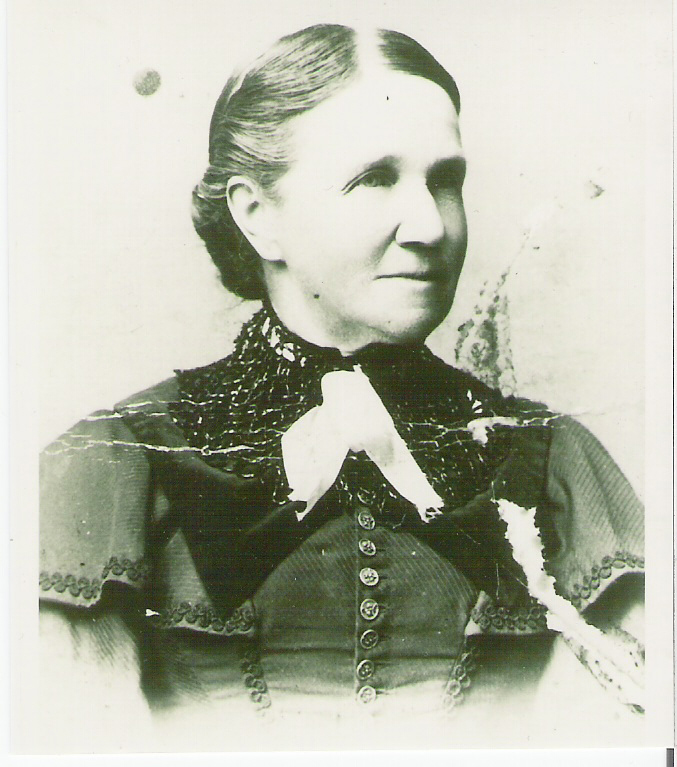
Charlotte Elizabeth Liggett

Conrad and Louisa married on February 28, 1837. Unfortunately, Conrad died shortly after Charlotte was born. I have been unable to find definitive sources as to when and where he actually died, although it is likely that it occurred in April 1838. Several sources suggest he died at Nauvoo, Illinois sometime before 1839. However, the Latter Day Saints (Mormons), of which he was likely a member, did not really begin to settle in Nauvoo until after they were expelled from Missouri in late 1838. It may be that Conrad himself never left Ohio. According to Find a Grave, Conrad is buried in Ohio, although there is always the possibility that his remains were transported to Ohio after his death.

Louisa remarried in 1841, to Aaron Cook. This marriage may have occurred in Nauvoo. With the Mormons being driven out of Nauvoo starting in 1846, Louisa, Aaron, and Charlotte set out in the westward migration to what is now Utah. The migration, undertaken in haste and without time for proper preparations, was arduous. On the way to Winter Quarters in Nebraska, in November 1846, Louisa died. Charlotte had just turned nine.

After time spent at Winter Quarters, Aaron continued to Utah with Charlotte. According to one family history I’ve read, upon reaching Utah Aaron, he “married Charlotte off” to a Mormon elder. That was likely a reference to Charlotte’s first husband, my Gx3 grandfather, William Burgess. The marriage occurred on June 3, 1852, when William was 30 and Charlotte was only 14. Even worse, this was a polygamous marriage, as William was still married to his first wife of 12 years, Maria Pulsipher.

The marriage did not last long. Fortunately for me, it lasted long enough to produce one child, my Gx2 grandfather, Horace Burgess. Apparently Charlotte did not get along with Maria. Charlotte left William sometime in 1857, when she was 19. Many secondary sources suggest that William and Charlotte divorced. However, being a polygamous marriage, there may have been no formal civil registration of the marriage and, therefore, no formal divorce. While at the time of their marriage William and Charlotte had been “sealed” (a Mormon ritual meant to bind familial relationships for eternity), Charlotte had the sealing annulled in 1890.

Shortly after leaving her first husband, Charlotte entered into her second marriage, with William Whitehead Taylor, on September 7, 1857. This was also a polygamous marriage, and at age 28, William was almost 10 years older than Charlotte.

While Charlotte’s early life may have been difficult, it may have been much less onerous after she joined with William. It appears that they remained together for 50 years, until William passed away in 1907. Charlotte and William were never sealed during their lifetimes, as a bishop had told Charlotte that she could not be sealed again. Apparently they were sealed after Charlotte’s death, as it was her “dying wish”.
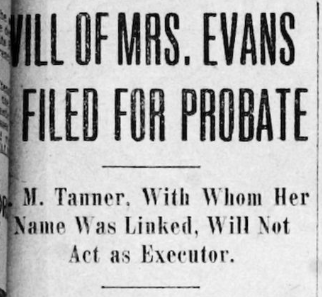
The Salt Lake Tribune, April 25, 1908, Page 11

Charlotte and William had four children. It appears their second child, Louisa, may have died in infancy or childhood. Their eldest, Sarah, died at age 49, when Charlotte was 70. There was a small amount of notoriety in the press when Sarah died. She was married twice. The first marriage was to Prime Evans. The second marriage was with a J. M. Tanner. However, this was not a legal marriage. According to newspaper reports at the time of Sarah’s death, this was a secret polygamous marriage, solemnized within the church after polygamy was outlawed. Tanner had been named executor of Sarah’s will and guardian of children Sarah had adopted (young relatives of hers). However, he ultimately declined to act in either role, likely because of the scandalous nature of his relationship with Sarah.

Charlotte died at home in Lehi, Utah on February 20, 1909 due to apoplexy, a term formerly describing a cerebral hemorrhage or stroke. Charlotte is interred at Lehi City Cemetery, with her second husband.
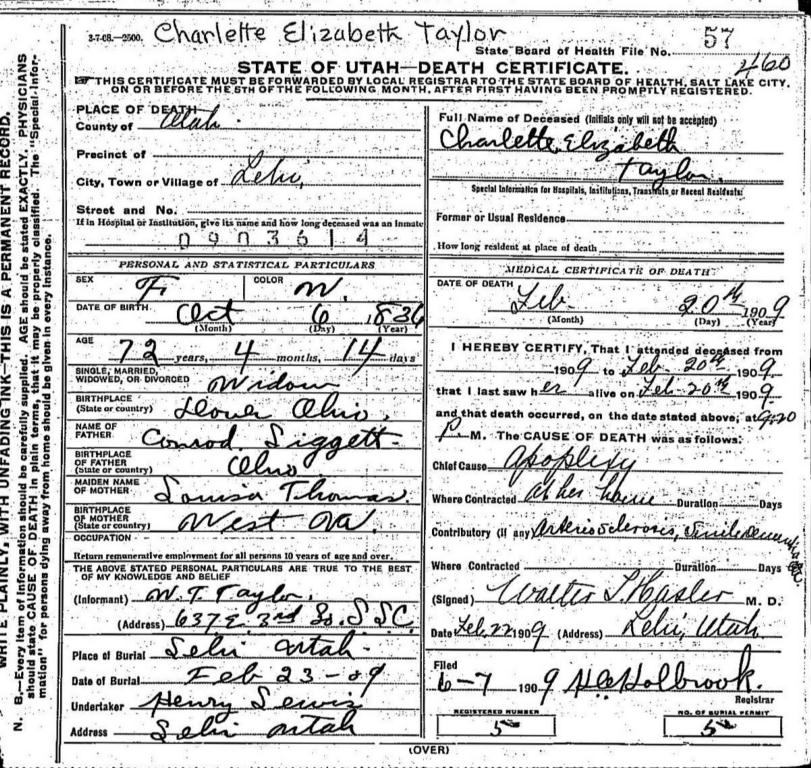
Charlotte’s Death Certificate

52 Weeks – Week Thirteen: Sisters

My mother has told me, several times, that before I was born my father had hoped to have five daughters. As the first born, I quickly put paid to that. It was probably in my father’s best interest. Back in my teens when my father had hair, I liked to tell him that all the grey ones were entirely due to his daughters and none of his sons.

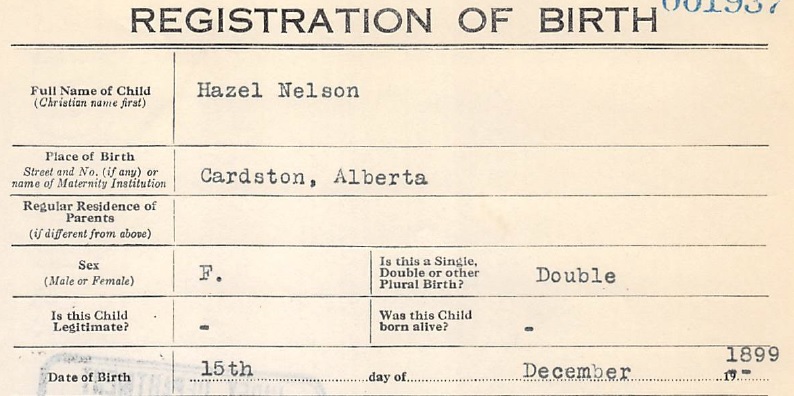
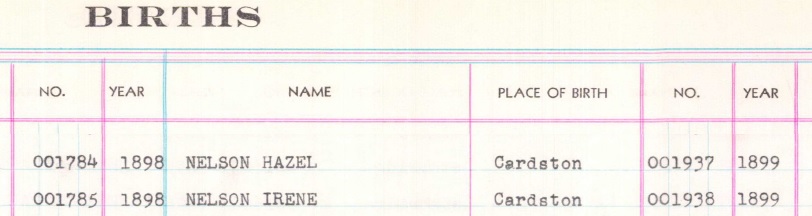
Hazel and Irene Nelson in the Alberta Birth Index

When I saw the topic for this week’s  52 Ancestors Challenge, the first sisters who immediately came to mind were my great grandmother and her sister. They are amongst the very few twins I actually have in my family tree. Unfortunately, they were sisters who never had the opportunity to know each other or to share a childhood together.

Hazel and Irene Nelson were born to John Alexander Nelson and Ella Elizabeth Thomas on December 15, 1899. The girls were the tenth and eleventh of twelve children. Given that Hazel was registered first, I take it that she was born first.

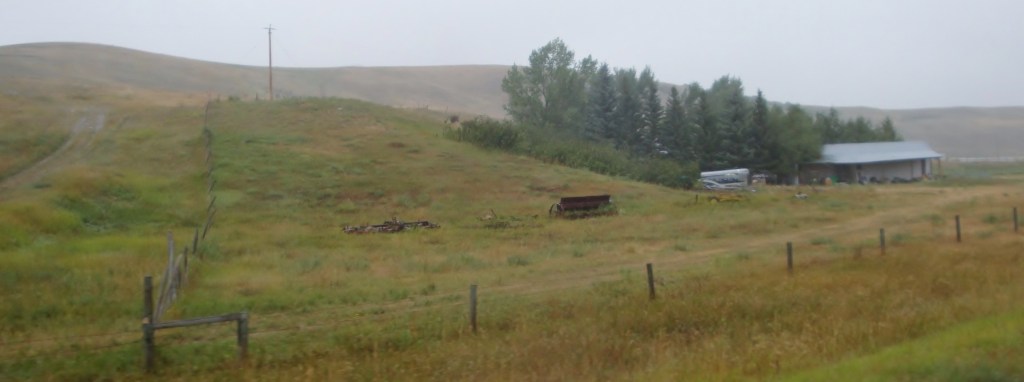
John and Ella were amongst the earliest settlers of Cardston, Alberta, which was founded in 1887 by members of the Latter Day Saints (Mormons). The Nelsons arrived in 1890 and began farming nearby.

This is where my great great grandparents, John and Ella Nelson, first farmed when they settled in Cardston, Alberta

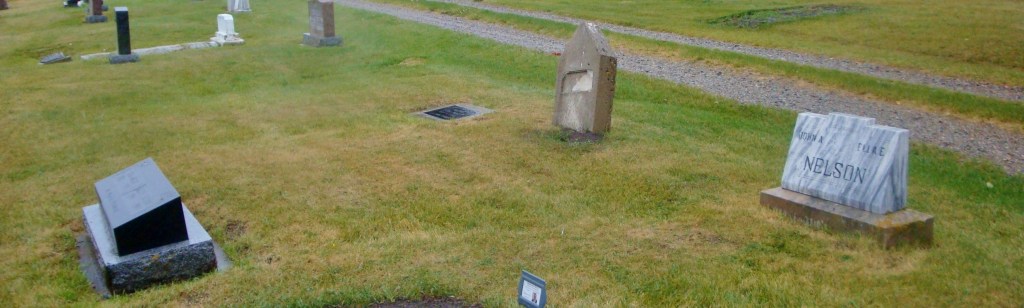
Hazel and Irene Nelson were the first twins born in Cardston. Sadly, Irene passed away five weeks later. I’ve been to the cemetery where she is buried. Unfortunately for me, I only discovered where she is interred after my trip. While I did not realize it at the time, Irene is buried next to her parents. The grave marker is damaged. Information for the Cardston Cemetery on the Town of Cardston website confirms that Irene’s grave is the one beside her parents. Irene’s brother is interred in the plot below hers.

Irene Nelson is buried beside her parents John and Ella, whose grave marker is the white one in the foreground. Irene’s grave is the one with the damaged headstone. The black marker on the left is Irene’s brother Seth Henry Nelson and his wife Mabel.
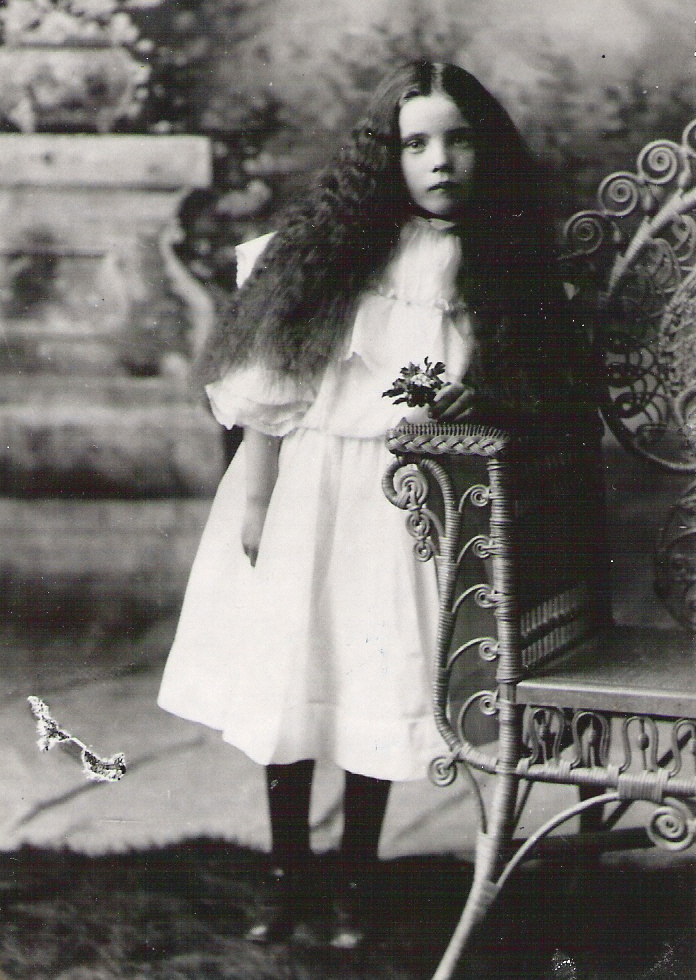
Hazel Nelson, about 1904

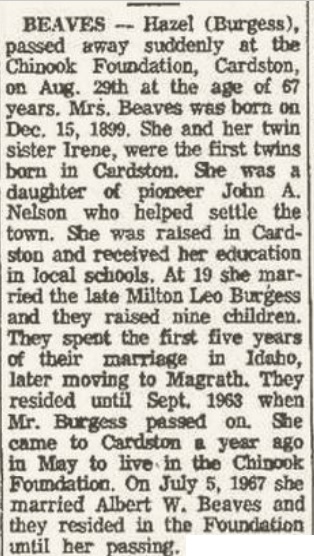
Hazel, on the other hand, lived to be 67. She and her husband, Milton Leo Burgess, had nine children, the oldest of whom was my grandfather, Leo. Milton died in 1964. Eight weeks before she died, Hazel married a widower, Walter Beaves. They met in the seniors’ home where they both lived, which Hazel called “the old fools’ home”.

Hazel passed away three days before I was born. My mother pretty much went from her grandmother’s funeral to the hospital for my arrival.

Hazel’s obituary in The Lethbridge Herald

More Than a Full Deck

Here’s the deal…

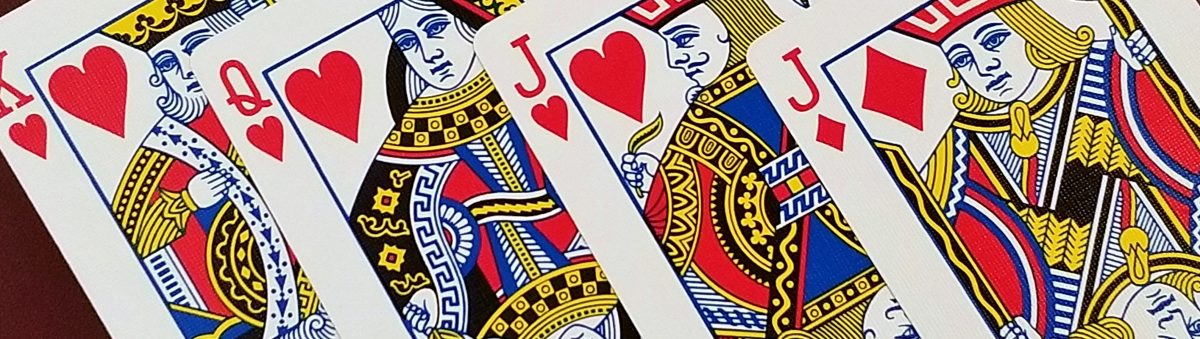
Three years in a row, I signed up for Amy Johnson Crow’s “52 Ancestors in 52 Weeks“. The first two times, that was as far as I got. Hopefully, third time’s the charm. Hence this blog, only a quarter century behind the times. As someone who enjoys games as much as genealogy, I naturally associated the number of weeks of the challenge with the number of cards in a deck.

I’d love to figure out how to centre this image – and justify this caption. [Edit: I figured it out!]

Despite the association with a deck of cards, I’ve identified more than 52 ancestors. In fact, I’ve managed to identify 55 out of my 64 great great great grandparents. So it seems I am playing with more than a full deck.

My interest in genealogy began when I was about eight years old. It was prompted along the way by questions I had as a child that, to me, had odd answers. When I was in elementary school, I asked my mom why my school principal always asked if I was Belgian. She said, “because you have a Dutch last name”. At the time, I thought Belgium was an entirely French-speaking country, so that answer made no sense. In grade eight, I switched from taking French to German. One day while visiting my great grandmother, my mother said, “Grandma, Sean is taking German in school.” I was bewildered why a woman who I thought was of English origin would care. I was even more surprised when she started speaking to me in fluent German.

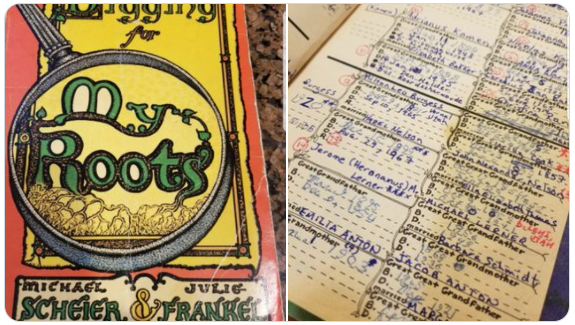
Literally my first genealogy book, which I bought when I was 8 or 9.

My father’s side of the family is Dutch, going back generations, mostly from the part of the Netherlands that is now the provinces of North Holland and South Holland. However, several weeks ago I discovered connections to the Achterhoek, the easternmost part of the province of Gelderland that pokes into Germany. I have also recently been investigating a branch of the family that originates in Zeeland and what is now Oost-Vlaanderen (East Flanders). Sometime in the early 19th century, one of those Zeelanders ended up in the northernmost part of North Holland. His daughter, my third great grandmother, married into a family that has deep roots on the island of Texel.

My mother’s side is much more of a mix. Her mother’s side of the family are what is known as Germans from Russia. One branch came to Canada by way of Texas, the other branch came directly to Canada. My mother’s paternal side has roots in the United States, several branches of which go back to colonial times, including the Mayflower and Salem. My maternal grandfather’s direct paternal line goes back to a Hessian mercenary who initially fought for the British in the American Revolution, but later switched sides. That branch of the family were also some of the original members of the Latter Day Saints (the Mormons). They joined the church in its infancy, moving from New York to Ohio to Illinois. They were also part of the migration along the Mormon Trail to Salt Lake City.

I’ve also done a lot of work on my wife’s side of the family. At present, my intention with this blog is to focus on my side of the family. However, I will probably delve into my wife’s side from time to time because there are some fairly interesting stories there. Our eldest child, who shares my love of genealogy, is fascinated with a branch of his mother’s family that has deep roots on the island of Jersey. To be honest, I find it fascinating as well.