My grandfather, Leo Burgess (1920 – 1995), worked for the Canadian Pacific Railway for 32 years. I’ve written about various aspects of his time with the railway, such as the fact he was a proud member of his union and his brushes with Hollywood, including meeting his movie idol Glenn Ford.
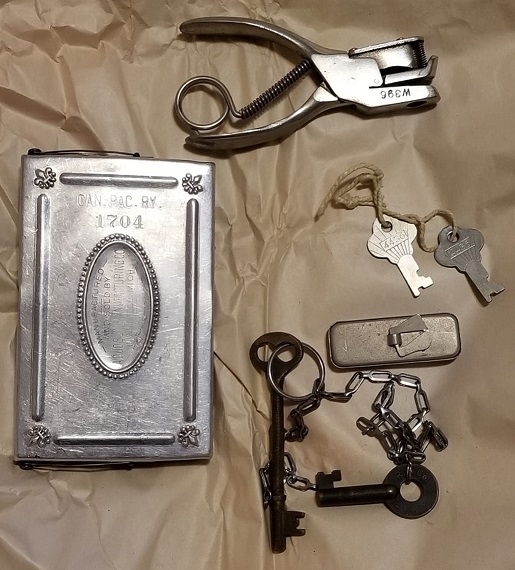
Some of the items my grandfather used as a conductor, which are now in my possession
Leo was based out of Lethbridge, Alberta. He started as a brakeman and worked through the ranks, later becoming a yard manager. Early on, because of winter layoffs, he chose to work for the CPR in Cranbrook because there was more work there during the winter to provide a steady income. In 1972 he became a conductor, performing that role until his retirement in 1982.
One of my earliest memories was travelling on the train from Medicine Hat to Lethbridge. I’m sure my mother would correct me if I’m wrong, but in that memory I am sure my grandfather was travelling with us.
My grandfather often brought me to the train station in Lethbridge when I was little. Of course, the highlight was always getting to go on to the caboose. Of course, I’m showing my age in being able to recall a caboose as an everyday working part of a train and not just as a museum piece.
One of my favourite photos, showing me with my grandfather. If there’s any doubt, he’s the one on the left.
The station building still exists and has been designated with heritage status. In the 1980s, the railyard was relocated a few kilometers west of the city and the tracks were removed from central Lethbridge. In 1987, the station building was converted into the Lethbridge Community Health Centre and it still serves in that capacity.
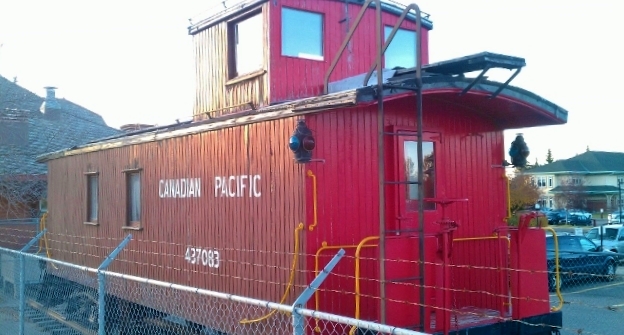
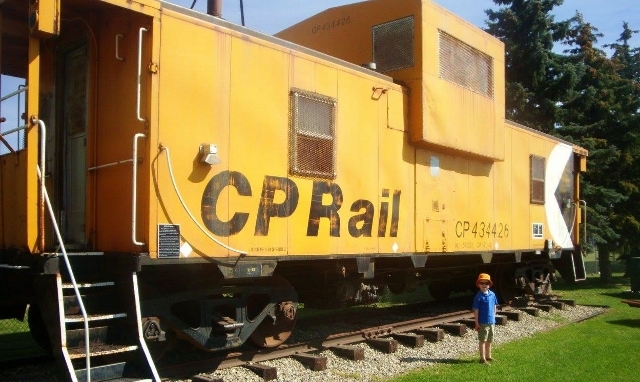
The former train station in Lethbridge is now the Community Health Centre. This caboose remains preserved beside the former station building. I wonder if my grandfather ever worked on this specific railcar. Heck, I wonder if this is one of the cabooses that he took me on!
Of course, I would be remiss if I did not repeat the fact that working on the train crew for Superman: The Movie was one of the highlights of his time with the CPR. During the eulogy at my grandfather’s memorial service, one of his friends told an anecdote that suggests my grandfather felt that he had gotten familiar with the cast and crew. The scene took six days to shoot. Apparently during a break in filming, Ford was talking to a group of railway workers when my grandfather sauntering up, put his arm around the actor, and said, “How’s it going, Glenn?”
My grandfather was working in the engine during the filming of this scene. My parents live about a 30 minute drive from where this was filmed. The tracks are gone, but the memories live on.
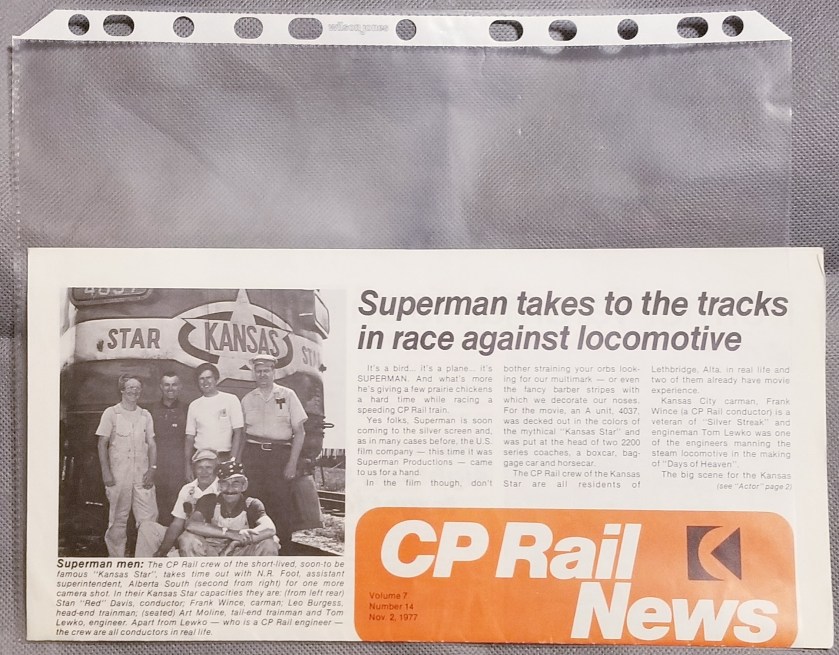
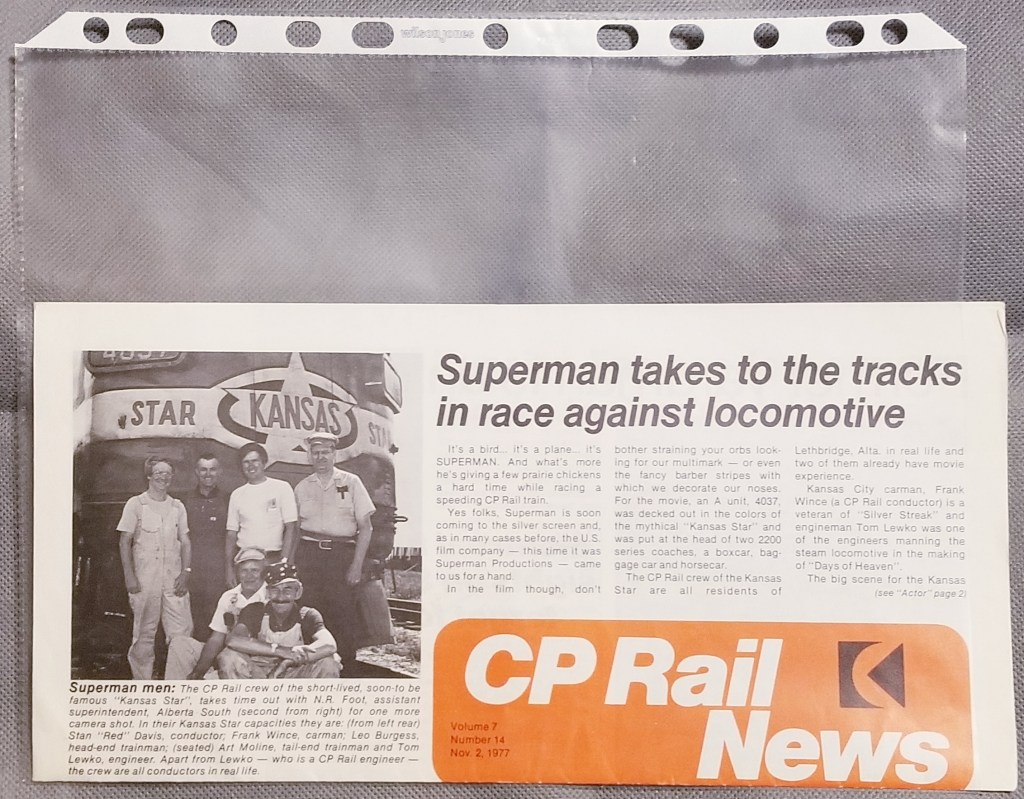
My grandfather is the man wearing a cap standing on the right side of the photo.
Every week, participants in Amy Johnson Crow’s 52 Ancestors in 52 Weeks are invited to post on the hebdomadal theme at her Facebook group, Generations Cafe. In my post there for last week, I noted that it’s been quite the struggle participating in the challenge this year. For every week’s theme this year, it felt like I had already written about the current topic – sometimes more than once. It’s getting hard – challenging even! – to think of something new that fit, which I also found interesting enough to me to write about.
This week, I’m not going to fight it, I’m just going to go along with it. So you’re not experiencing deja vu when reading about my grandfather, Leo Burgess, and his brush with Hollywood.
My grandfather worked for the Canadian Pacific Railway for over 30 years, first as a brakeman and later as a conductor. During his time with the CPR, he worked on the train crews for movies like Silver Streakand Superman: The Movie.
My grandfather, Leo Burgess, is the man wearing a cap standing on the right side of the photo.
Working on Superman was one of the highlights of my grandfather’s life. He was always proud to talk about meeting one of his favourite actors during filming, Glenn Ford.
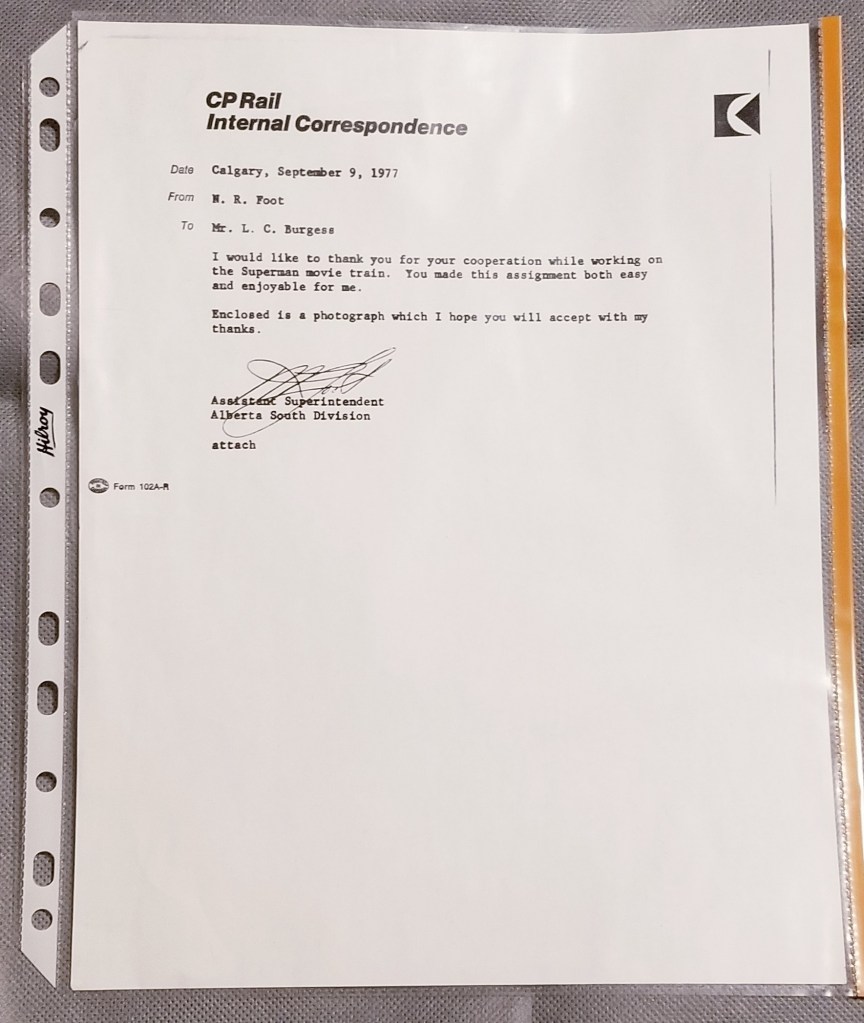
I assume photo referred to in the letter is the same photo that appeared in the CP Rail News, above.
During the eulogy at my grandfather’s memorial service, one of his friends told an anecdote that suggests my grandfather felt that he had gotten familiar with the cast and crew. The scene took six days to shoot. Apparently during a break in filming, Ford was talking to a group of railway workers when my grandfather sauntering up, put his arm around the actor, and said, “How’s it going, Glenn?”
My grandfather was working in the engine during the filming of this scene.
Today my parents live about a 30 minute drive from where this was filmed. The tracks are gone, but the memories live on.
Wow, hard to believe that with this post, there are only ten weeks left of this year’s 52 Ancestors Challenge!
This week’s theme is “Organized”. I can be organized, but I hate doing it and it bores me as a topic. The irony is, given some unexpected events, I find myself having to be organized so that I can create this post. If not tonight, then it won’t be done at all!
I decided to do another take on the word. Organized labour came to mind. My maternal grandfather, Leo Burgess, was a strong union man. I thought I had a photo of his union card, which would have been a centerpiece of this post. Turns out I have almost everything but!
Many years ago, the CPR station in Lethbridge was converted into a public health center and the railyard was removed. However, this caboose remains preserved at the site of the former station. I wonder if my grandfather ever worked on this specific railcar. Heck, I wonder if this is one of the cabooses that he took me on!
My grandfather worked for the Canadian Pacific Railway for 32 years. He started as a brakeman and worked through the ranks, later becoming a yard manager. Early on, because of winter layoffs, he chose to work for the CPR in Cranbrook because there was more work there during the winter to provide a steady income. In 1972 he became a conductor, performing that role until his retirement in 1982.
Some of the items my grandfather used for his work as a conductor, which are now in my possession.
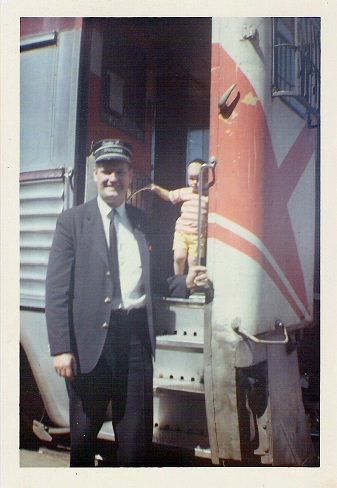
A trip to the train station with my grandfather. I would have been about two or three years old at the time.
My grandfather often brought me to the train station when I was little. Of course, the highlight was always getting to go on to the caboose. When I was older, he’d often take us kids to his favourite haunts, which included the former Labour Club of Lethbridge. We’d always get a treat, like a pop and french fries, but what we loved best were the “pull tabs”. This was many years before lottery scratch tickets, but the idea was similar. They were about the size of a scratch ticket and had semi-perforated tabs that you’d pull off. Underneath were the kinds of images you’d see on a slot machine. Grandpa would buy a bunch and let each of us kids open one up.
My grandmother’s politics were never a secret and she was more than happy to share her opinion about it. However, I don’t remember my grandfather ever talking about politics. I didn’t want to assume what his politics might be, even though he was a staunch union supporter. A few years ago I asked my mom about it. She told me that she rarely heard him talk about politics and he never said what parties he might have supported. My mom had her theories, but had little to base them upon.
I previously wrote about my grandfather’s role as part of the crew operating the train that was used during the filming of Superman: The Movie.
I’ll be at my folks’ later this week. I’ll have to dig through what of my grandfather’s belongings that my mother still has and see what more I can find.
The CPR caboose on display at the Claresholm & District Museum in Claresholm, Alberta, which is located in a former CPR station. I highly recommend this museum – it is an amazing place for a town of Claresholm’s size.
In the “Better Late Than Never Department”, it’s Week 17 of the 52 Ancestors Challenge. It was a busy week, so I am a bit late with what I am referring to as “this week’s theme”, Document. While an excellent album by R.E.M., the topic here actually relates to genealogical records and documenting genealogical events.
You spin me right round baby, right round, like a record baby, right round, round round.
Many many years ago, I read Ayn Rand’s The Fountainhead. As political philosophy, it’s nonsense, but I read it as literature. In that regard, there was one turn of phrase she used that I found to be an excellent descriptor of what one might otherwise call a “mixed bag” or “hodge podge”: “a mottled collection of cracked coffee cups“. I think that describes the somewhat random curation of documents I have chosen to highlight.
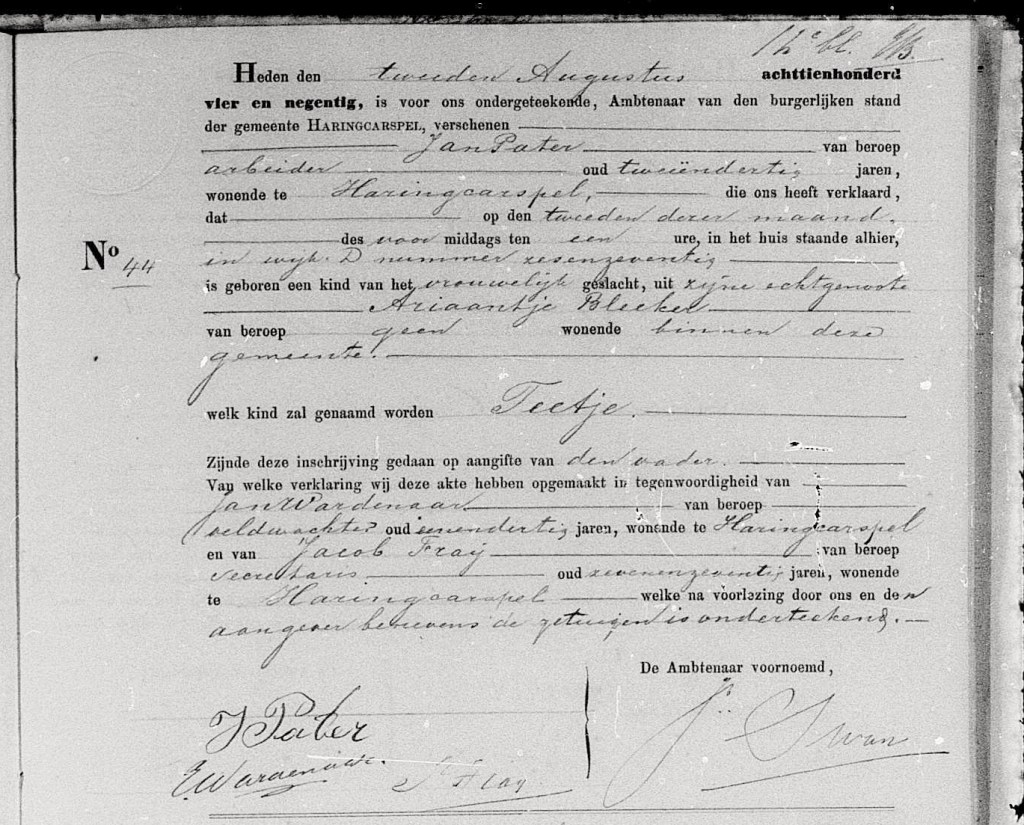
My original intention was to find the very first physical copy of document I sent away for as part of my genealogical research. I started my family tree when I was eight, but did not start gathering records until my 20s. That was back when you had to write letters and send away for documents. I’m pretty sure the first record I obtained that way included the birth registration for my father’s paternal grandmother, Teetje Pater.
Birth registration for Teetje Pater, born August 2, 1894 in Waarland, Harenkarspel, Noord Holland, Netherlands.
However, I never got around to finding the physical document, although it turns out I had scanned it a long time ago. I got sidetracked in my quest, because I had forgotten how many physical records I had gathered back in the day. I was impressed with myself, seeing the care I had taken to properly sort and store them. Not only documents, but artifacts. Hopefully my Aunt Diana would be proud. It turned into a fun trip down memory lane. What I’ve ended up doing is choosing a few random items that caught my fancy in the moment.
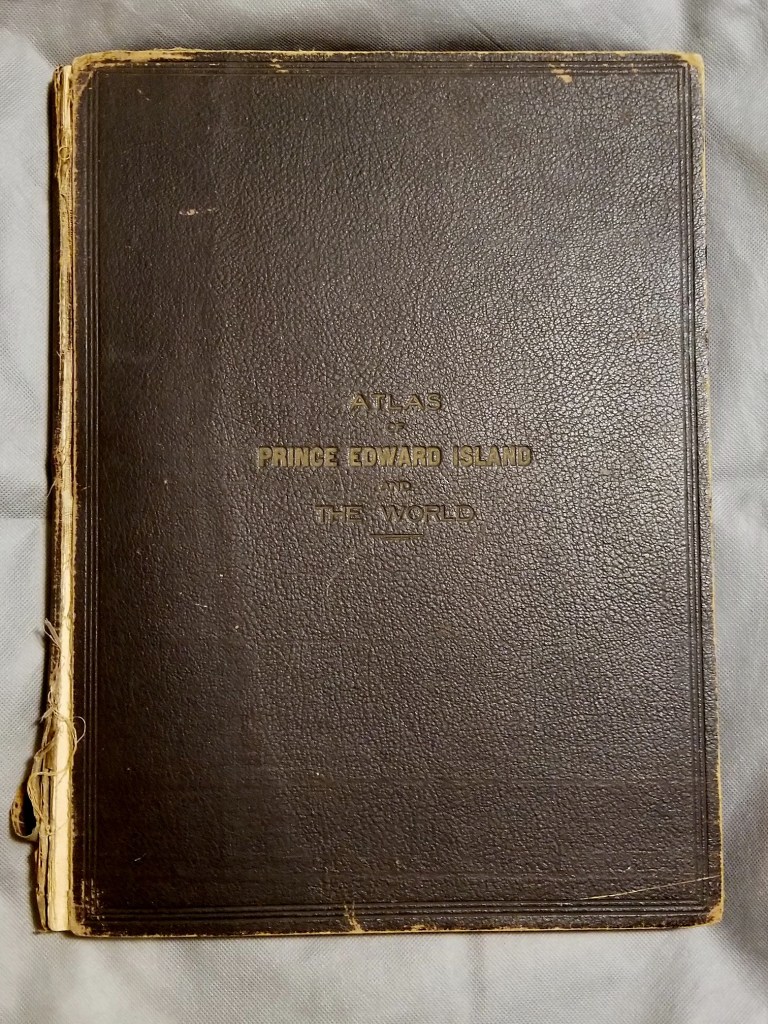
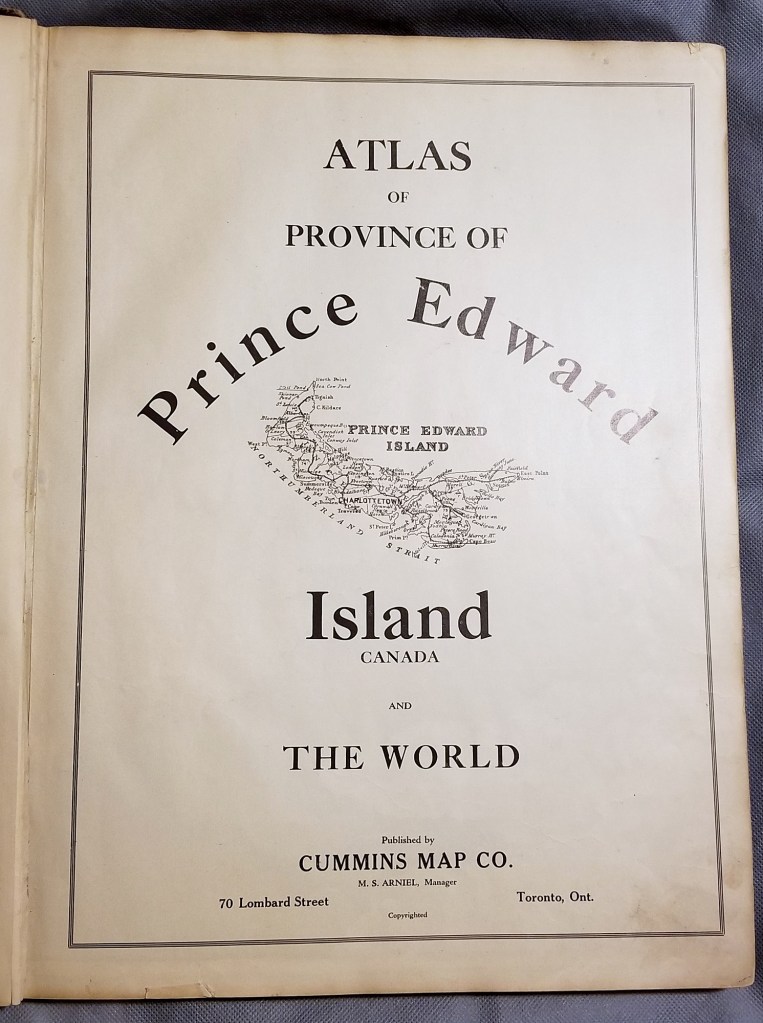
The first item I cast my eye upon was not so much a document qua document, but a book that I store with my documents, the Atlas of Prince Edward Island, Canada, and the World, published by the Cummins Map Co. in 1928. It belonged to my wife’s great grandfather and was given to me by my father-in-law, who has deep Island roots. Not only is it an amazing resource for research, it’s a beautiful work of art. You can see this atlas online.
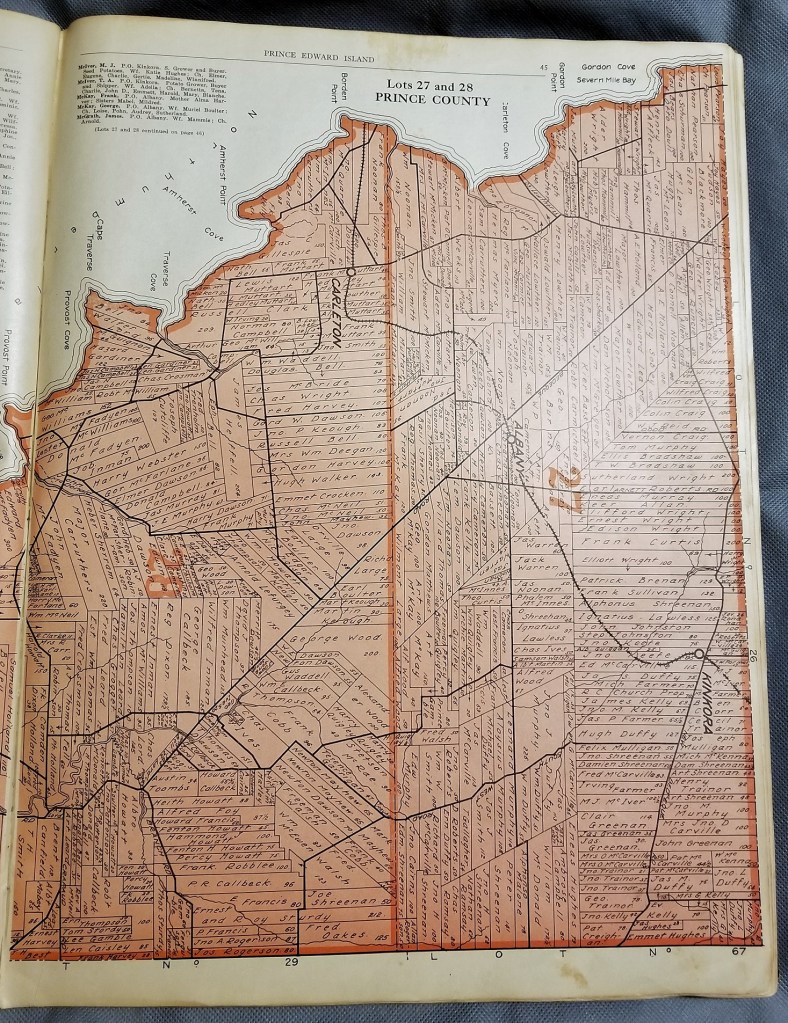
Lots 27 and 28, showing where my wife’s great great grandfather farmed.Atlas of Prince Edward Island, Canada, and the World. I suppose it might have been helpful if I had remembered this book during Week Six, Maps.
The CBC recently reported about a similar earlier atlas of P.E.I, the Illustrated Historical Atlas of the Province of Prince Edward Island, published by the J. H. Meacham Company in 1880. The Meacham Atlas is available to view online through the University of PEI.
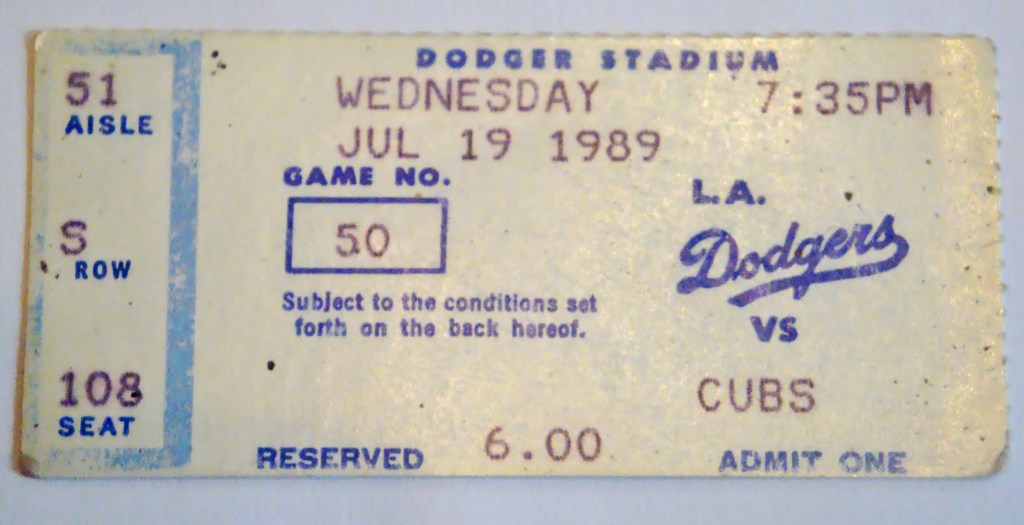
I also have many original records of my maternal grandfather, Leo Burgess. These not only included things like letters he wrote to his grandparents while he was in basic training during World War II, LDS church records, tax and property records, vital stat records, SIN card, drivers licence, but also fun things like a ticket stub when he saw his beloved LA Dodgers with his brother.
Unfortunately for my grandfather, the Dodgers lost. The final score was 4 – 0 for the Cubs.
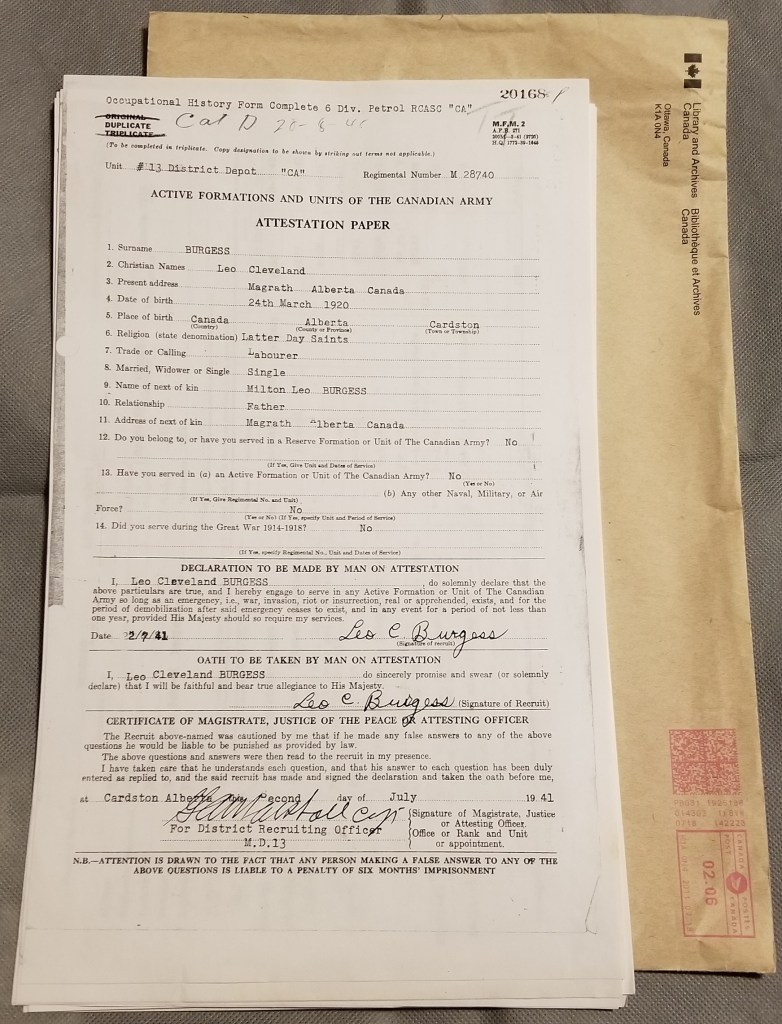
Among other things, I also have the records of his appeal for his military pension. My grandfather enlisted with the army twice during World War II – long story – but was discharged due to an injury he sustained during basic training the first time he enlisted. It wasn’t the training itself that caused his injury, it was a prank his bunkmates pulled on him that resulted in a permanent back injury. The documents read a lot like a workers’ compensation claim, as they use a lot of the same language that you see in workers’ compensation law. I also have my grandfather’s military records, which I obtained from Library and Archives Canada. I only had to wait a year for them, which unfortunately nowadays would be considered a pretty speedy response.
My grandfather’s attestation paper and other military records from the short time he spent in the army during World War II.
I have mentioned before that my grandfather worked for the Canadian Pacific Railway for over 30 years, first as a brakeman and later as a conductor. During his time with the CPR, he worked on the train crews for movies like Silver Streakand Superman: The Movie.
Working on Superman was one of the highlights of his working life. My grandfather was always proud to talk about meeting one of his favourite actors during filming, Glenn Ford. The scene took six days to shoot. During his memorial service, one of my grandfather’s friends told an anecdote that suggests my grandfather felt that he had gotten familiar with the cast and crew. Apparently during a break in filming, Ford was talking to a group of the railway workers when my grandfather sauntering up, put his arm around the actor, and said, “How’s it going, Glenn?”
My grandfather was working in the engine during the filming of this scene.
I don’t have the photo that this letter refers to, but I assume it’s the same photo that appeared in a few railway publications I have seen.
My grandfather, Leo Burgess, is the man wearing a cap standing on the right side of the photo. I assume this is the photo referred to in the photo above.
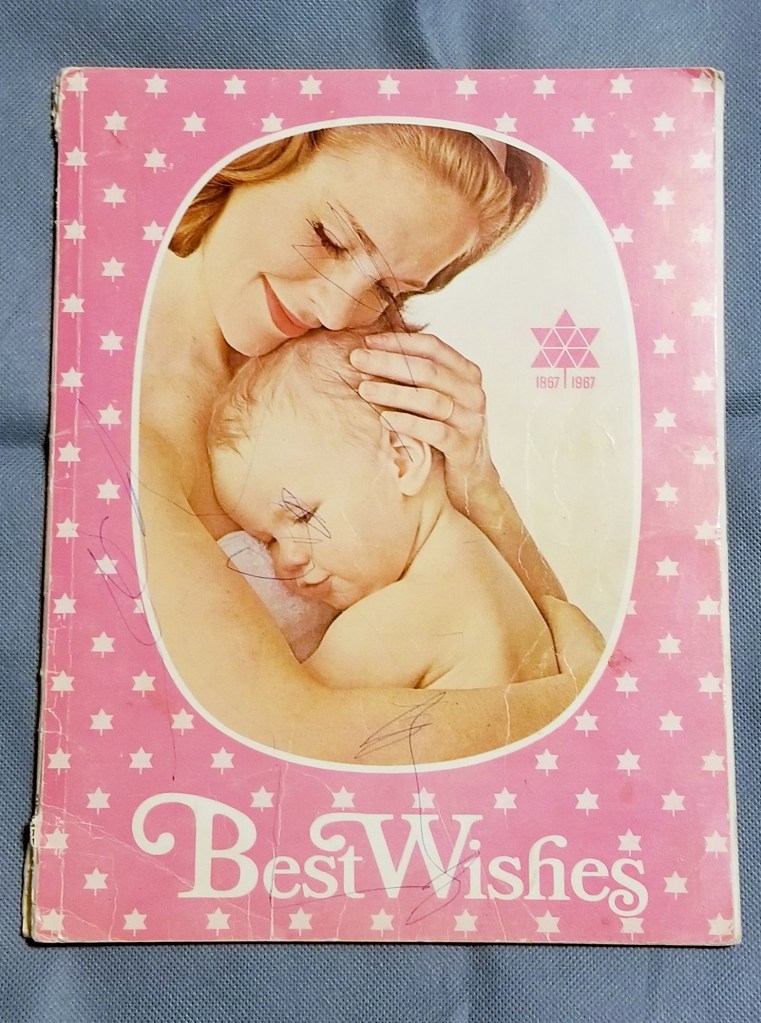
I was also surprised to see the records I have for myself, including an envelope containing a lock of my hair from my first haircut. What I was happiest to find was my baby book. I came across all my siblings’ baby books while visiting my folks over Christmas, but not mine. I forgot my mother had given me mine a long time ago.
On the first day of Grade Five, our teacher began class with, “Welcome centennial babies!”
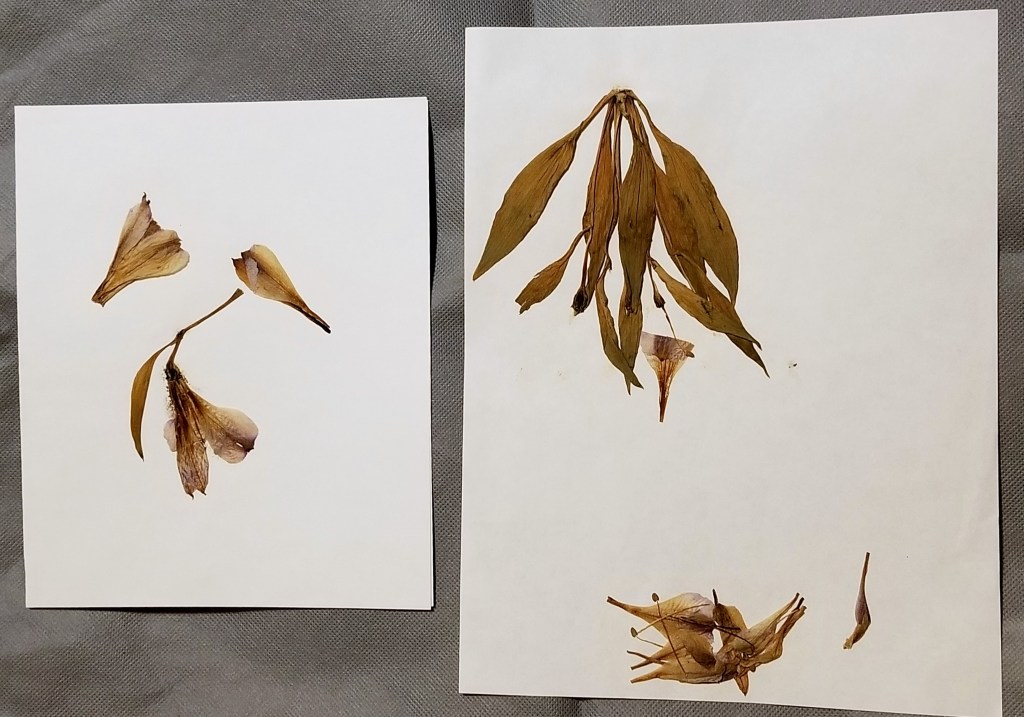
More of an artifact turned into a document, I pressed some of the flowers that relatives in the Netherlands sent for the funeral of my paternal grandmother, Christina Komen. She passed away in Lethbridge, Alberta on Christmas Eve in 2000, only a few hours after I arrived there for the Christmas holidays. I was always sorry I was unable to get there a few days earlier.
If I had been smarter, I would have made a note of what kind of flowers these were. I also wish I had remembered these during Week Eleven, Flowers.
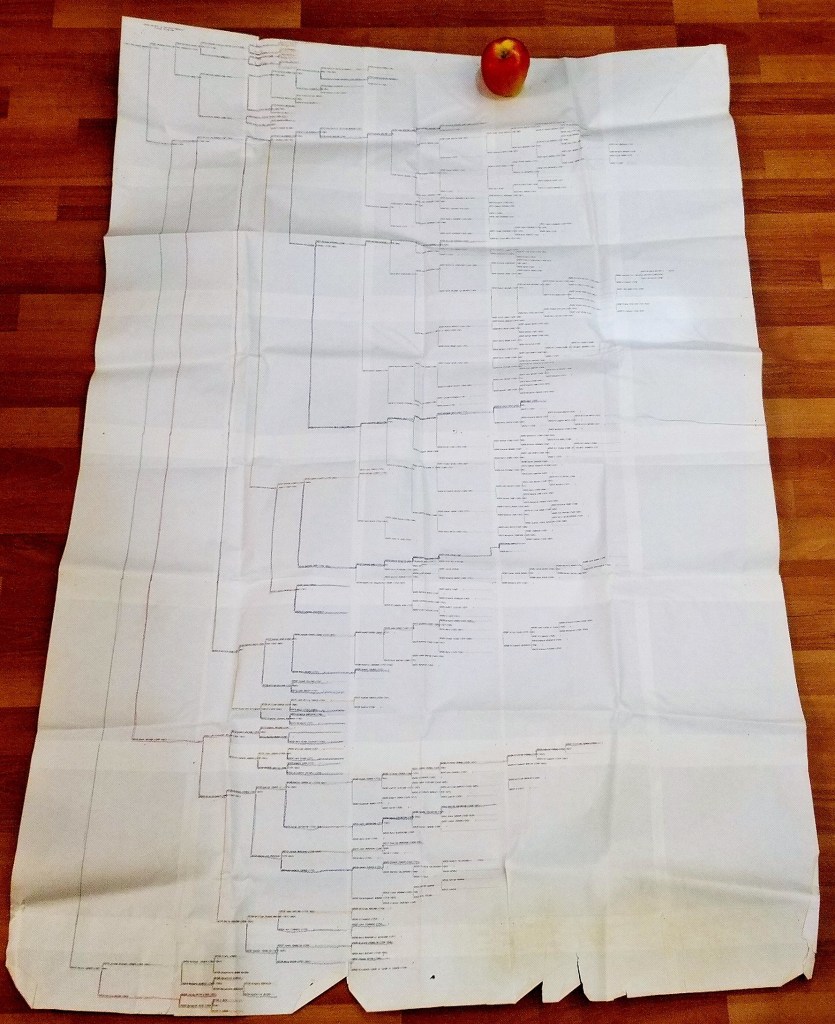
I’d like to end with one document I forgot I had saved. This is one of two wall-sizes pedigree charts I had hanging in the flat where I lived in the 1990s. I created it with the old DOS version of Cumberland Family Tree, probably using a dot matrix printer. It hung on a wall I had dedicated to family history photos.
In the decades since I created this, a couple of branches of this pedigree have now been pruned, while others have been greatly expanded. I placed an apple on the document to provide a sense of scale.
Now time to play catch up and start on Week 18: Social!
 A Deck of Ancestors