52W Mark V – Week 8: Daniel Thomas

Daniel Thomas (1776-1830)

No wonder I am weeks behind in the 52 Ancestors Challenge. In order to provide some background into their childhood and family before marriage, I look for what I have on each individual’s parents and siblings. It’s a good practice to examine your ancestors’ FAN club (“Friends, Associates, and Neighbours”), but I end up getting sucked into deeper research for the grandparents and great grandparents of the person I am writing about.

In this case, I’m supposed to be writing about my Great x4 Grandfather Daniel Thomas. Instead, I’ve spent the last few weeks researching his parents, Rev. Daniel Thomas (1739-1810) and Sarah Covington (1750-1828). In fact, while writing this paragraph, I ended up falling back into the research wormhole and spent two more hours on it before returning to this post.

Daniel and Sarah were both born in Maryland and had deep family roots in that state, back to the early 18th century when it was still a British colony.

Daniel Thomas Sr. was a Baptist minister and well-to-do plantation owner , which, of course, meant that he was a slave owner. Daniel Senior was the first minister of Dockery Meeting House in Rockingham, Richmond County, North Carolina, which was chartered in 1774. It was later renamed Cartledge Creek Baptist Church. While every source I have about his marriage to Sarah Covington says they married in 1770 in Rockingham, I suspect they might have married in Maryland because it seems Daniel moved to Rockingham to take up his ministerial role there.

Daniel and Sarah had eleven children in Richmond County. Daniel the younger was their third child and second son. All of Daniel’s children are named in his will, although it does not appear that he provided anything for his eldest child, Priscilla, even though she was one of the witnesses to the will. However, it may be that Priscilla was not actually Daniel’s daughter, but his niece or daughter-in-law. I could dive back into the research wormhole to find out, but I really want to make some progress here.

Daniel Senior did not divide his estate equally. Daniel junior only received ten shillings, as did two of his brothers. Sarah received Daniel’s plantation with a life estate, which passed to their eldest son, William, on her death. One son received $25, on received $100, and another received $400. Two daughters received a cows, with one receiving furniture as well, while a third daughter only received a bed and furniture.
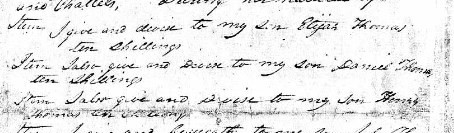
Portion of the will of Daniel Thomas, Sr., showing bequests of 10 shillings to his sons Elijah, Daniel, and Henry.
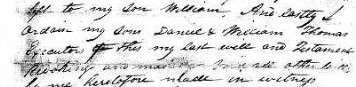
Portion of the will of Daniel Thomas, Sr., naming his sons William and Daniel as executors of his estate.

While Daniel might not have inherited his father’s plantation, he did well enough for himself. According to his grandson, also named Daniel, Daniel Jr. could be described as “wealthy”, owning a “well equipped plantation with many negro slaves.” Another writer described Daniel as “an affluent slaveholder”.

Sometime in his early adulthood Daniel bought a 3000 acre plantation with a river running through it, which included some islands. The land cost $2.24 per acre, plus the cost of surveying and the deeds. The plantation was on the east bank of the Yadkin River about 8 miles northwest of Rockingham. Daniel built an 8-room wood frame house on the land, which had an orchard and garden. Daniel kept sheep and also had a carpenter shop, blacksmith shop, a cotton gin, and a shad fishery.

Daniel also owned about 30 slaves. It’s hard enough wrapping one’s mind around the concept of one human “owning” another, even harder to think a man of God could justify it.

On December 3, 1795, Daniel married Nancy Ann Morehead. I don’t know if this was before or after he bought his plantation, but it’s likely the two events were not far apart in time. Or not. As I noted in my earlier post about Nancy, despite all the (mostly secondary) sources indicating that they married in 1795, there was a 16-year gap between their marriage and the birth of their first child in 1811.

Together Daniel and Nancy had four children, all born in Rockingham, likely on the plantation. All four were born about a year apart from each other. The fact Nancy had four children in rapid succession after a 16-year period also causes me to question the chronology set out in the information I have. Alternatively, Daniel and Nancy might have had other children I don’t know about before 1811, but that seems unlikely.

Daniel died on November 7, 1830 in Rockingham. According to Find A Grave, Daniel might be buried at the Cartledge Creek Baptist Church Cemetery, like his father. However, if he is buried there, the site of his grave is unknown.

On Daniel’s death, his family sold his property for $3,000 and relocated to Tennessee and later to Mississippi. Of course, they kept the slaves. Heaven forbid. As contemptuous as I am, one can’t choose their ancestors. You have to take the crunchy with the smooth when you do genealogy.
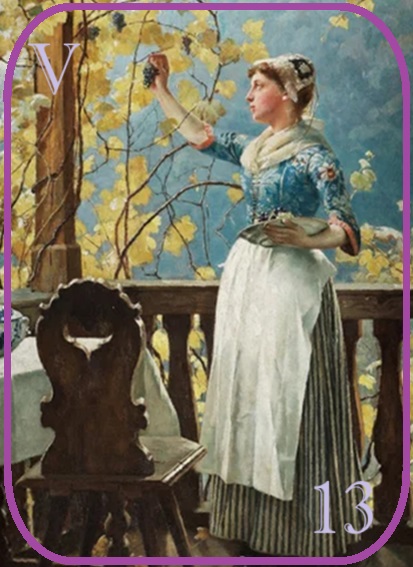
52W Mark IV – Week 13: Card V13 Trijntje Jans(en)

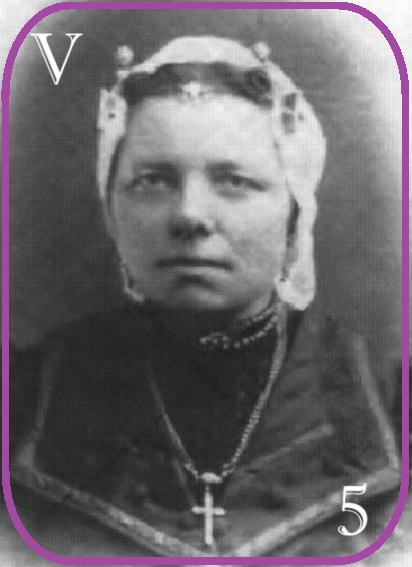
Trijntje Jans (1830-1915)

With Week 13, we have reached the last card of the first suit of this year’s deck of ancestors! I am really enjoying the different approach I have taken with the 52 Ancestors Challenge this year. I thought it might be less work, but as I worked through each card, I realized that my research hadn’t been as thorough or complete as I thought it had been. So I’ve spent much more time researching than writing as part of this year’s challenge. In essence, it has turned into Yvette Hoitink‘s Level-Up Challenge!

My Gx3 Grandmother, Trijntje Jans, is featured in this final card. For decades, I’ve had her entered in my database as “Trijntje Jansen”, with “Jans” as an alternate surname. However, quite recently, I’ve reversed things, and now have “Jans” as Trijntje’s surname with “Jansen” as an alternative.

As anyone who has done genealogy for enough time knows, a fixed consistent spelling of names is a relatively recent thing, so the fluidity of Trijntje’s surname is not surprising.

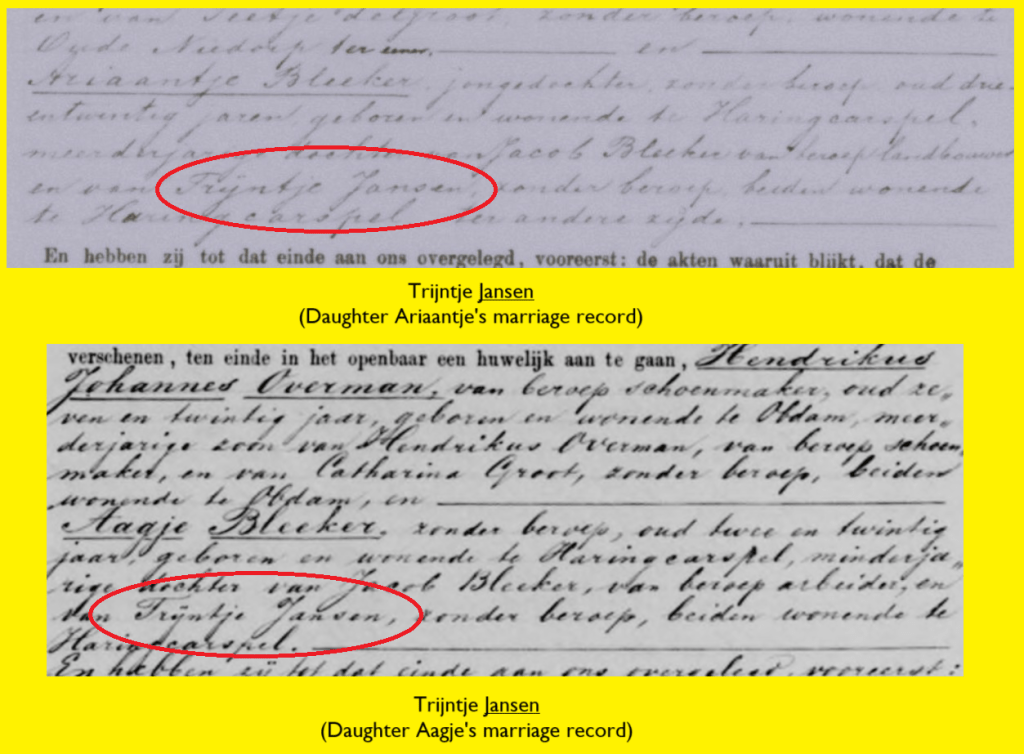
I first used “Jansen” because it was how I first encountered Trijntje. In the marriage registration for Ariaantje Bleeker, my Gx2 Grandmother and Trijntje’s daughter, Trijntje’s surname was recorded as “Jansen”. It was also entered as “Jansen” in the marriage registration of Ariaantje’s younger sister, Aagje Bleeker.

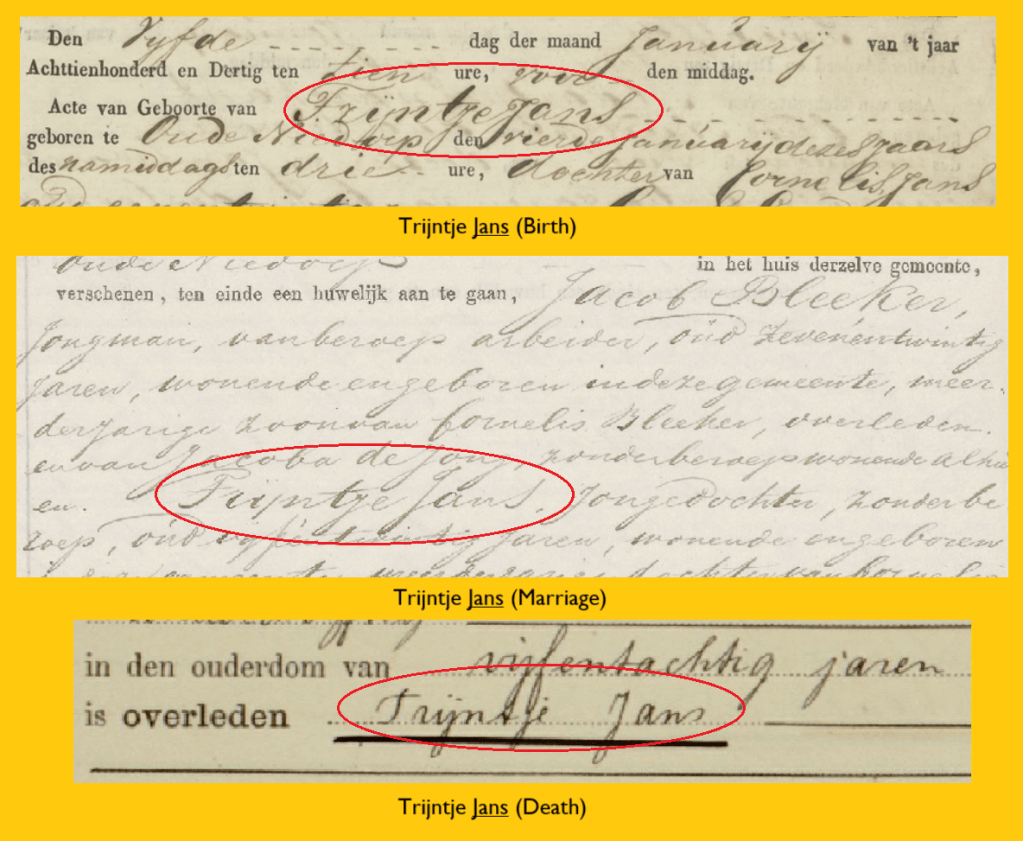
However, in records specifically about Trijntje herself, her surname was recorded as “Jans”. Most significantly, the name entered in the registration of her birth was “Jans”. Trijntje’s marriage and death registrations also named her as “Jans”. To me, that’s a compelling reason to use “Jans” as her “actual” surname and “Jansen” as the alternate.

So what do all these records tell us?

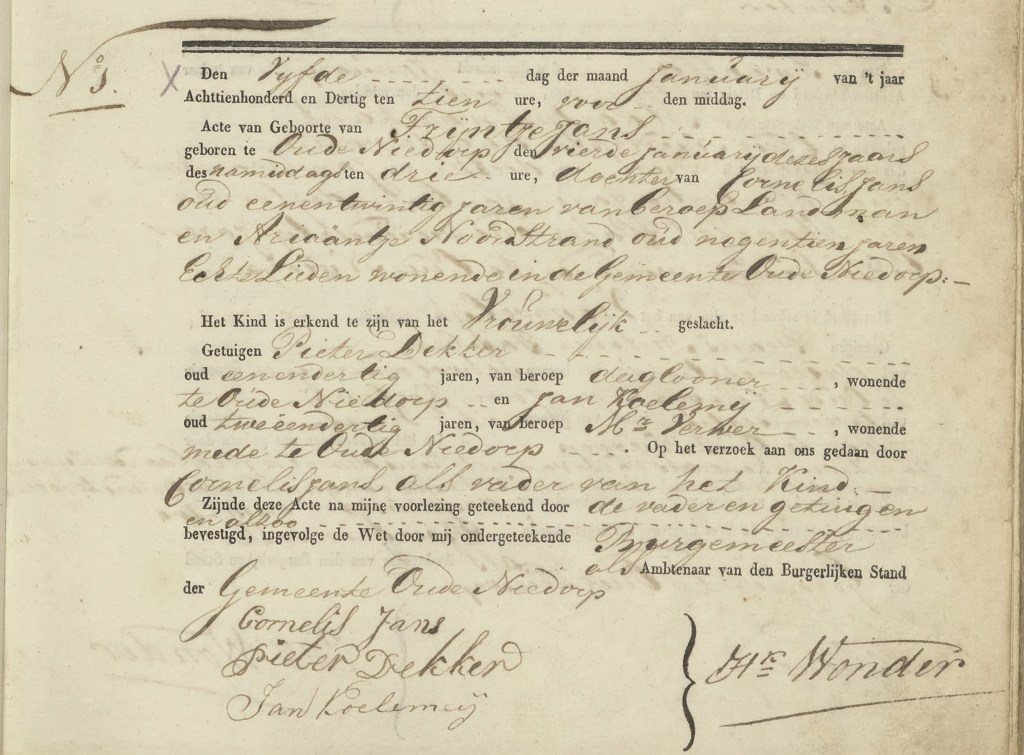
Trijntje was born on January 4, 1830 in Oude Niedorp, Noord Holland. She was the first of 13 children born to Cornelis Janz Jans(en) and Ariaantje Noordstrand. Fewer than half the children survived infancy or childhood.

Trijntje’s full birth registration

Oddly enough, the youngest of the 13 children was also named Trijntje. The elder Trijntje was 19 years old when her younger namesake was born and was likely still living at home. There are many reasons why parents would give two or more of their children the same name, but I cannot think of any that would have applied in this case.

Trijntje married Jacob Bleeker on May 12, 1855 in Oude Niedorp. Together they had four children. Sometime between the birth of their second and third children (1859 to 1865), Trijntje and Jacob moved to Harenkarspel, Noord Holland. Harenkarspel is about 10 kilometers west of Oude Niedorp. That strikes me as a huge move, given that even today that seems to be a long distance for some of my relatives who live in Noord Holland. I don’t know why they moved. It’s possible there was significant event in their lives, which might go to the five and a half year age gap between their second child, Cornelis, and third child, Adriana (my Gx2 Grandmother).

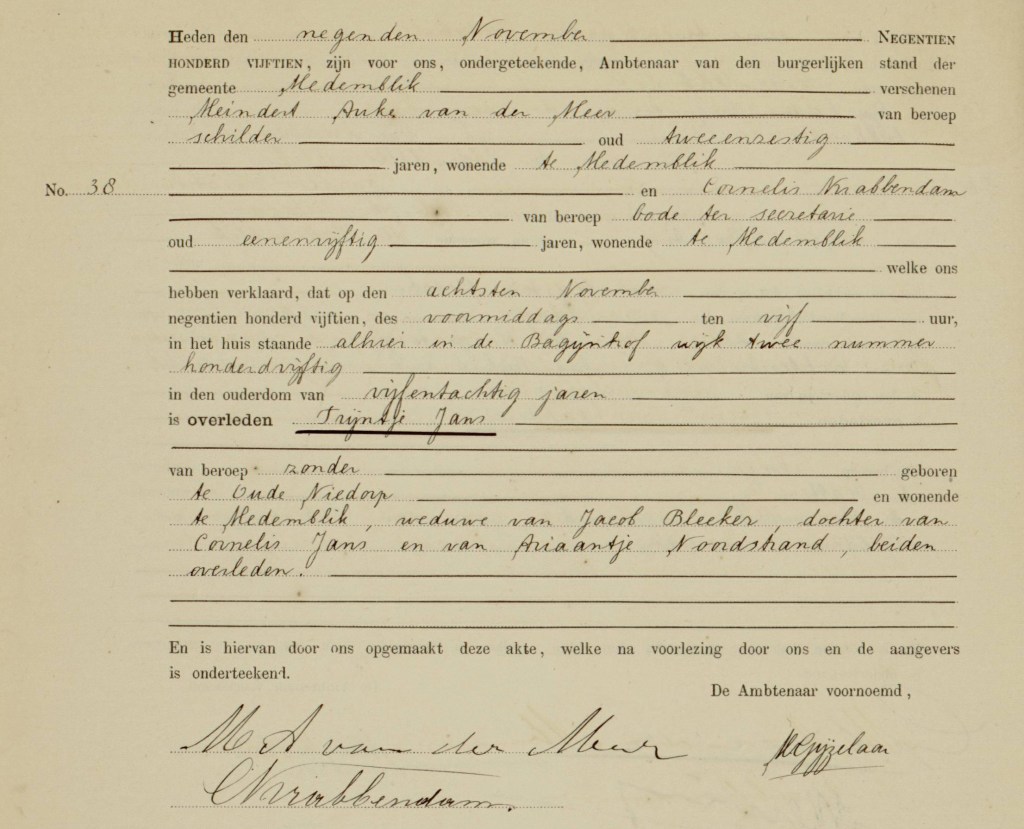
Jacob died in 1890, when Trijntje was 60 years old. However, she did not remain in Harenkarspel after he died. According to her death registration, Trijntje died in Medemblik, Noord Holland, on November 8, 1915. I do not know when or why she moved to Medemblik, which is on the coast of the Zuiderzee (“South Sea”), a saltwater bay. With the completion of the Afsluitdijk in 1932, the Zuiderzee became a freshwater lake, the IJsselmeer.

This was also a significant move, because Medemblik is almost 30 kilometers east of Harenkarspel and 10 kilometers east of Oude Niedorp. I don’t know of any contemporaneous family who lived in Medemblik at the time that might explain why Trijntje moved there. I will have to check the bevolkingsregisters (population registers) and Trijntje’s FAN club (“Friends, Associates, and Neighbours”) to see if I can solve this mystery.

Trijntje’s death registration.

52W Mark IV – Week 5: Card V5 Ariaantje Jacobs (Adriana or Jaantje) Bleeker

Ariaantje Jacobs (“Adriana” or “Jaantje”) Bleeker
(1865-1929)

When I first started tracing my Dutch line further back further than my great grandparents, I started coming upon some very clearly Germanic and feminine sounding names but did not sound cute in any way. Then again, what should I expect from a language where the word for “cute” is “schattig” – definitely not a cute sounding word to an Anglo ear, especially with that Dutch “g”!

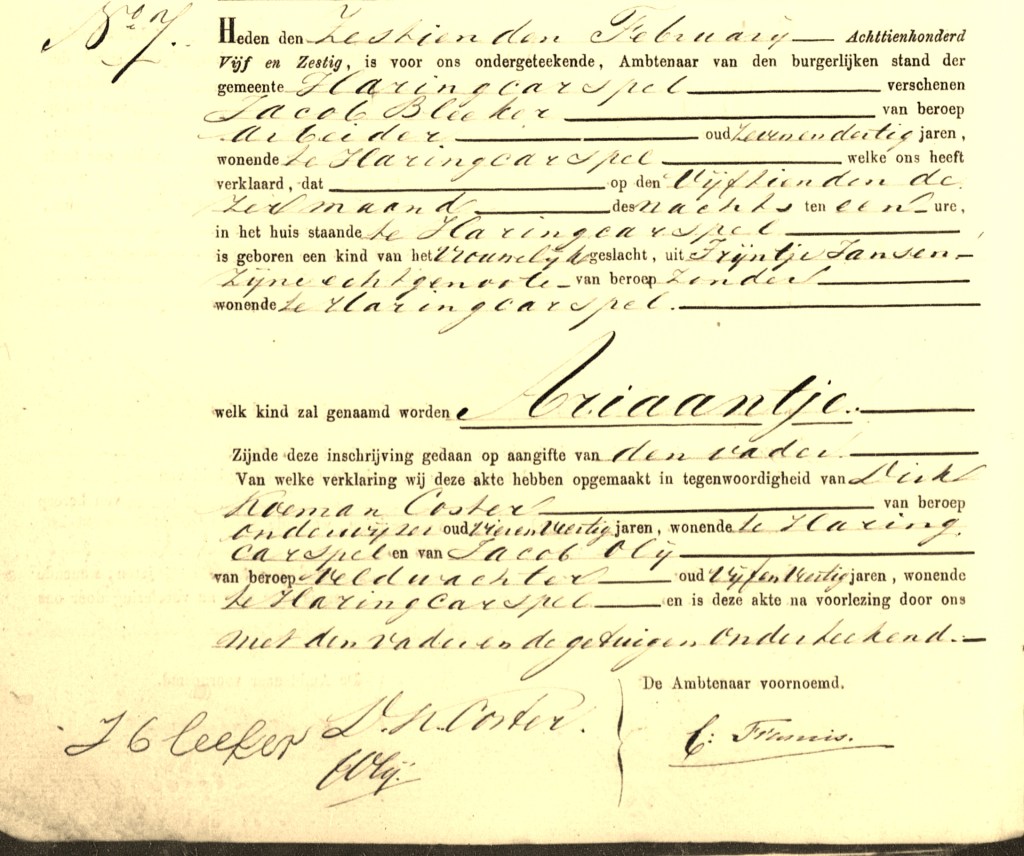
One of the standouts of these was my second great grandmother, Ariaantje Jacobs Bleeker. Ariaantje did not easily roll off the tongue when I first encountered it, but it came to me quickly. Like most people in the Netherlands, she did not go by Ariaantje on a daily basis. She is often referred to as “Adriana” or “Jaantje” in the records.

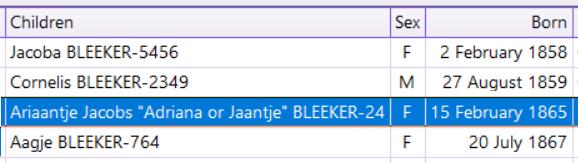
Adriana was born on February 15, 1865 (160 years ago this month!) in Harenkarspel, Noord Holland. For the longest time, I have had Adriana as the third of three children born to Jacob Bleeker and Trijntje Jansen. However, given the age gap between Adriana and her older brother, Cornelis, I suspected there might have been some other children in between.

Mind the gap!

I’ve done some digging to fill the gap. One strategy I’ve employed is looking at Adriana’s FAN club: her “Friends, Associates, and Neighbours”. So far I haven’t found any missing siblings. It’s still on my research to-do list, although it has not been a priority.

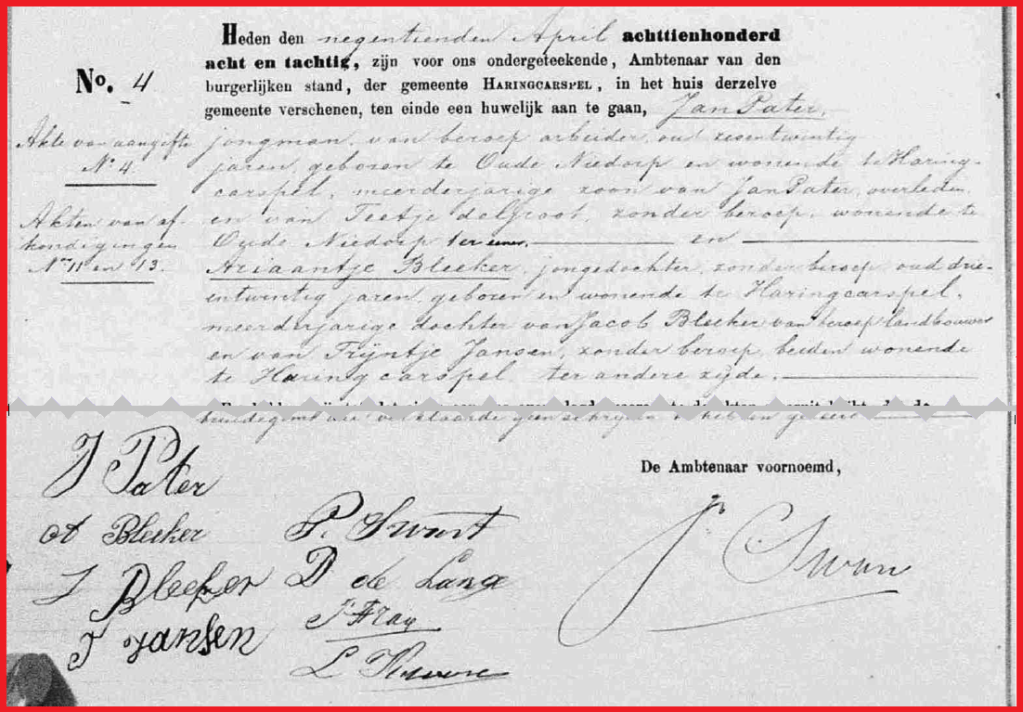
Marriage Registration for Jan Pater and Ariaantje Bleeker (top and bottom)

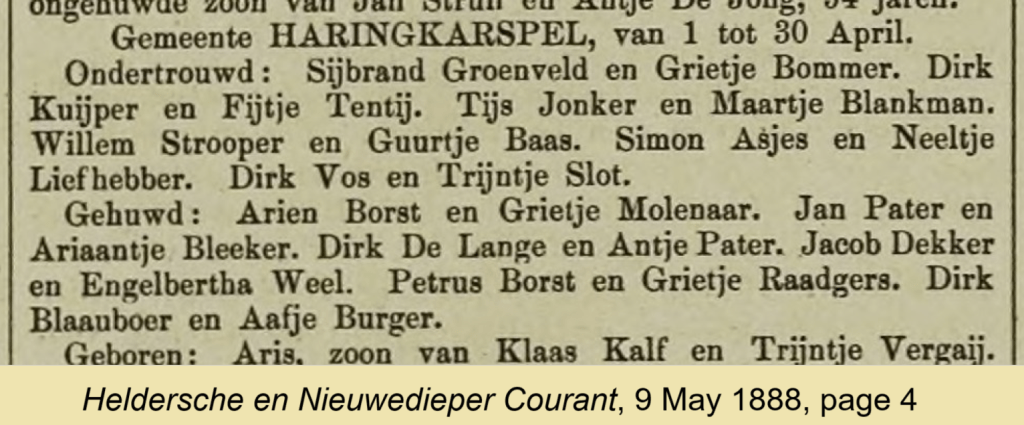
It appears that Adriana lived with her parents in Harenkarspel until she married Jan Pater on April 19, 1888. The Bevolkingsregister (population register) for Harenkarspel shows that she relocated to Heerhugowaard on April 20, 1888. Jan and Adriana had four children: Johannes (who only lived two weeks), Jacob, Teetje (my great grandmother), and Jan. Only Jacob and Teetje married. Jan worked on his parents’ farm for many years after reaching adulthood.

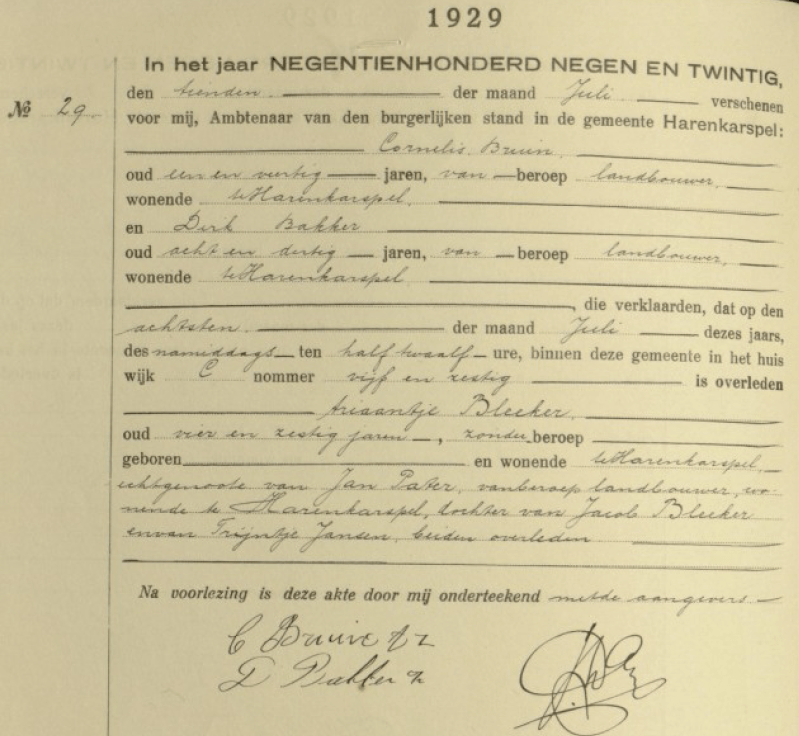
Adriana died on July 8, 1929, at home in Slootgaard, a village in gemeente Harenkarspel.

Death registration for Adriana.

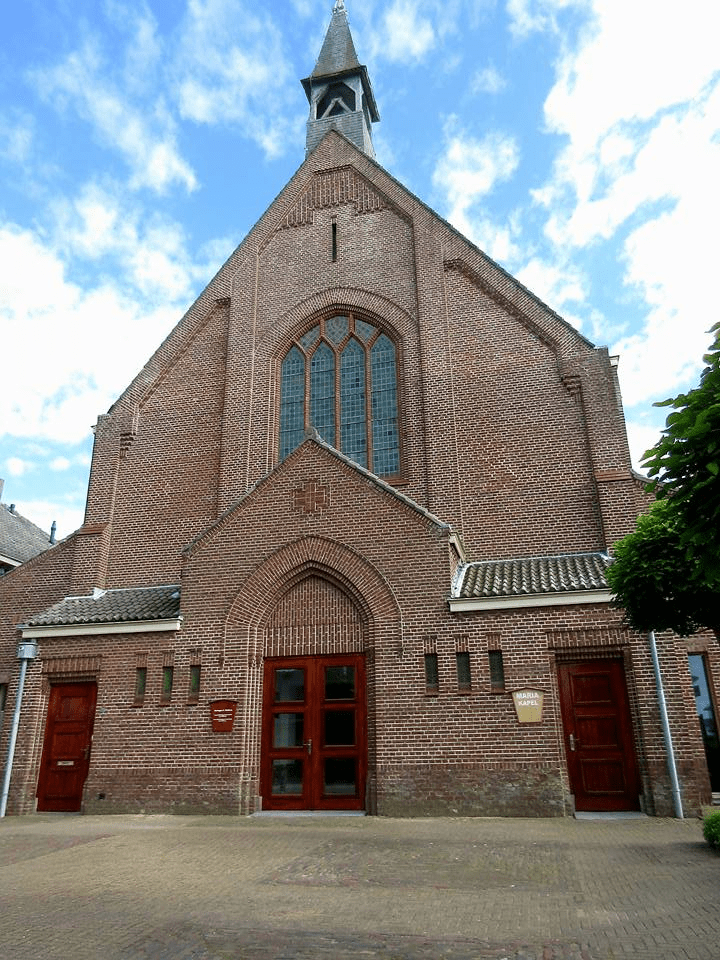
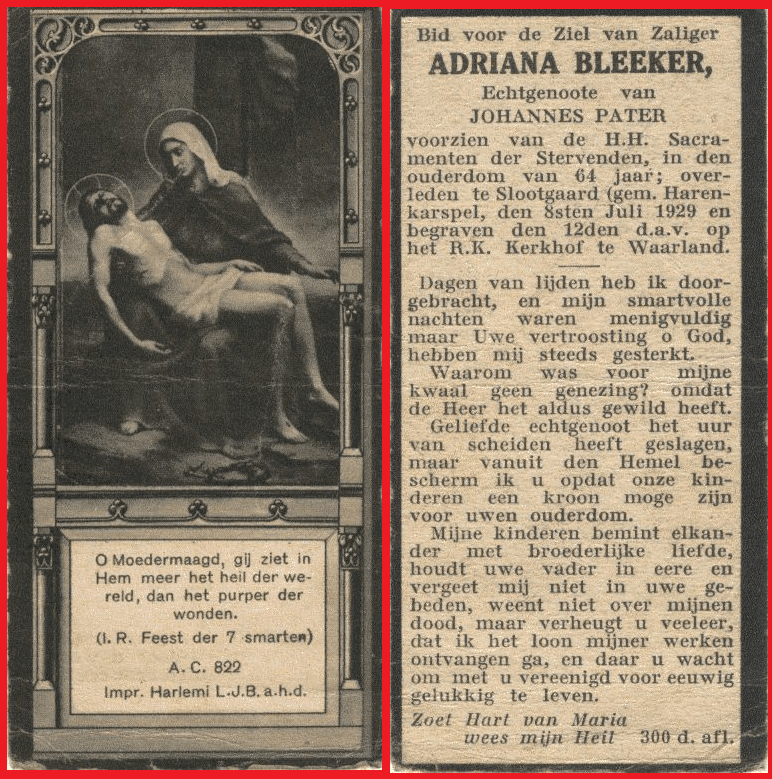
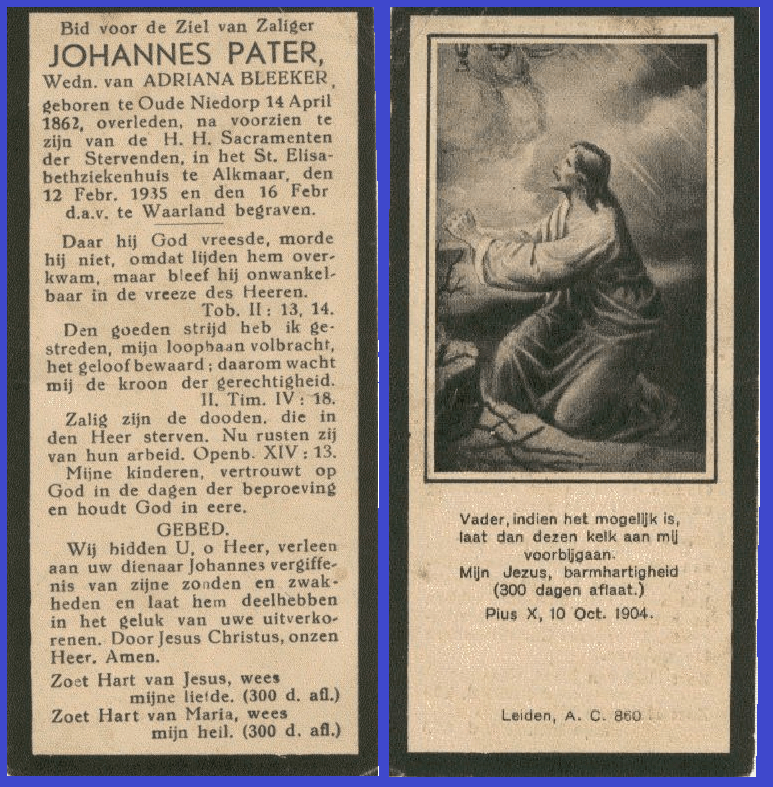
The bidprentje (prayer card or in memoriam card) for Adriana’s funeral states that she was buried at the church cemetery in Waarland, which at the time was part of gemeente Heerhugowaard. This would be St. Wulfram’s Church (left), which I drove past the last time I was in the Netherlands. However, there would have been no point in stopping to look for her grave, because graves in the Netherlands are usually cleared within thirty years. A quick check of Online Begraafplaatsen (a database of Dutch cemeteries) shows no entries for Adriana at the St. Wulfram cemetery, which is consistent with her grave having been cleared.

Adriana’s bidprentje, front and back.

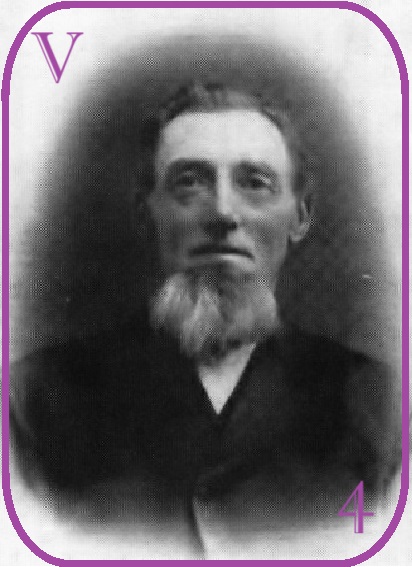
52W Mark IV – Week 4: Card V4 Johannes Jansz (Jan) Pater

Johannes Jansz (“Jan”) Pater (1862-1935)

I’ve always found it amazing when talking to my grandparents’ generation about their grandparents. I remember when my great aunt Addie casually mentioned in passing about how she’d usually go to her grandmother’s house every day after school. It immediately popped into my head that she was talking about someone who was born in the mid-19th century. It felt like a bridge through time.

Likewise for my Gx2 grandfather, Johannes Jansz (“Jan”) Pater. I found an article in a Dutch magazine, Toendertoid: Stichting Waarland van Toen (“Then and There: Foundation of Waarland“) containing an interview of my great uncle Jan van der Fluit (“Ome Jan” 1918-2011), where he shared childhood recollections of his grandfather Jan Pater. I met Ome Jan on my first trip to Waarland. He was still living in the house where he was born and spent his childhood. Reading Ome Jan’s story made me feel like there was no barrier in time and space between me and my Gx2 grandfather.

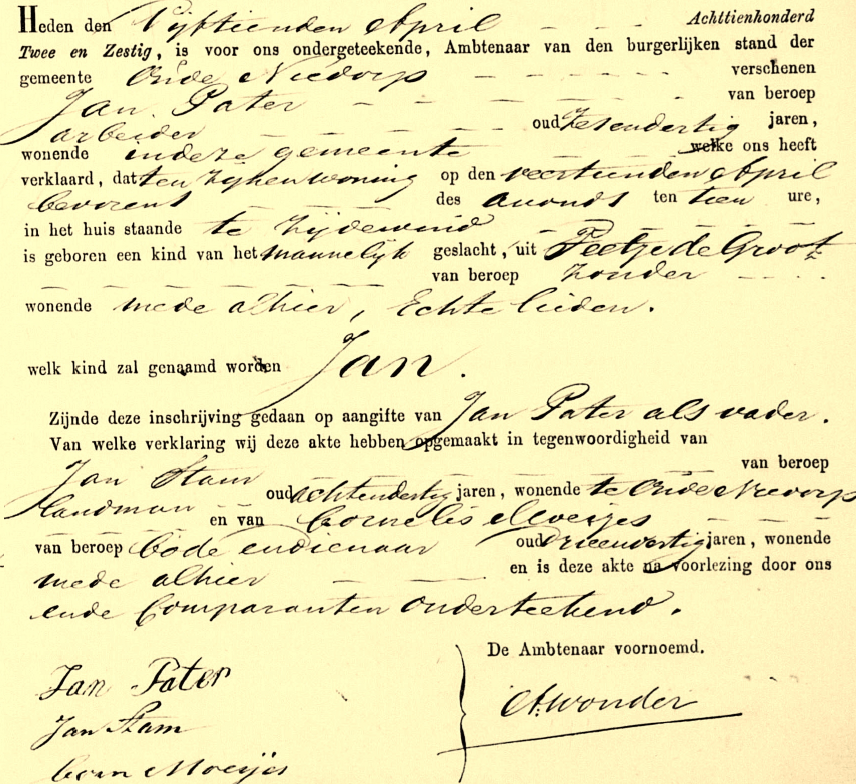
Jan’s birth registration

Jan Pater was born on April 14, 1862 in Oude Niedorp, Noord Holland. By 1882, Jan was working in Oude Niedorp as a farm labourer, as noted in a militia register. Military service was compulsory. Jan’s military service was as a conscript under the national service (the militia), somewhat equivalent to reserve or national guard duty. Adrianus was assigned to the “torpedo corps”. The militia register shows that Adrianus was 172 cm (5′ 7 1/2″) tall with a flat face, low forehead, gray eyes, a “just” nose, and blond hair.

Jan remained in Oude Niedorp at least until 1888, working as a farm labourer. On April 19, 1888, he married Ariaantje Jacobs (“Adriana” or “Jaantje”) Bleeker in gemeente Harenkarspel, Noord Holland. At the start of their marriage, they briefly lived with Adriana’s parents, but by the time their first child was born they had moved out on their own. Together Jan and Adriana had four children, three boys and one girl (my great grandmother, Teetje Pater). The eldest only lived a few weeks; the others lived to adulthood.

After he and Adriana were married, Jan continued to work as a labourer. Sometime around 1917 he began farming in Slootgaard, a village within Harenkarspel. It is now part of gemeente Schagen.

According to Ome Jan’s account, Jan Pater had over three acres of land where he carried out mixed farming. Jan’s youngest son – and Ome Jan’s uncle – was also named Jan, who helped on his father’s farm. The elder Jan had four cows and a horse, while the younger Jan had 100 brown and white chickens.

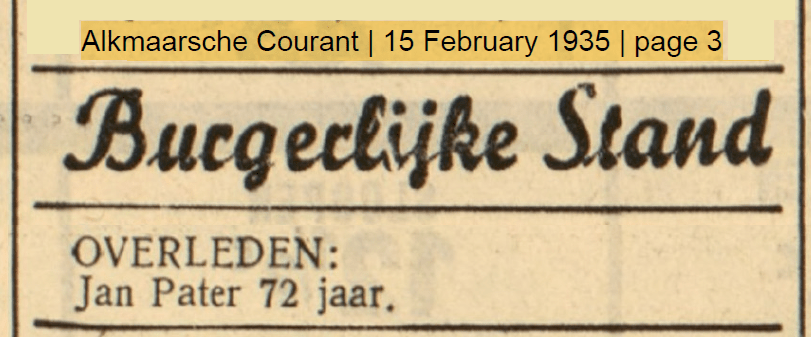
My records indicate Jan continued farming in Slootgaard at least until 1930, when he was in his late 60s. However, the registration of his death in 1935 indicates that he was still farming at that time. Jan’s death was due to an unfortunate accident with a horse at a railway crossing.

Addendum March 2, 2025: Always pay attention to the FAN club: “Friends, Associates, and Neighbours”! When an ancestor has a lot of siblings, it can be tedious to do all the research on them, too. Often I’ll do a quick-and-dirty entry into my database and then leave it languish for years.

Tonight I was flushing out my research on Jan’s siblings. For the four oldest, it was mostly entering information from death records, as the first two died very shortly after birth and the next two died shortly before their 17th birthdays. It wasn’t until the fifth child, Antje, two years older than Jan, that any child of Jan Pater and Teetje de Groot survived to adulthood.

Going through Antje’s marriage registration, I saw that one of the witnesses was her younger brother Jan. Then I expanded the image on the screen and noticed the signatures on the proceeding page were the same. What? Zooming in, I realized it was Jan and Adriana’s marriage registration! A double wedding. Siblings Antje and Jan got married the same day!

Signatures of the parties and witnesses of the double wedding of siblings Jan Pater (left) and Antje Pater (right)