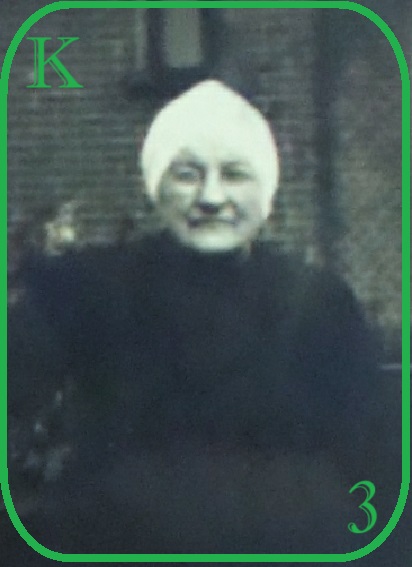
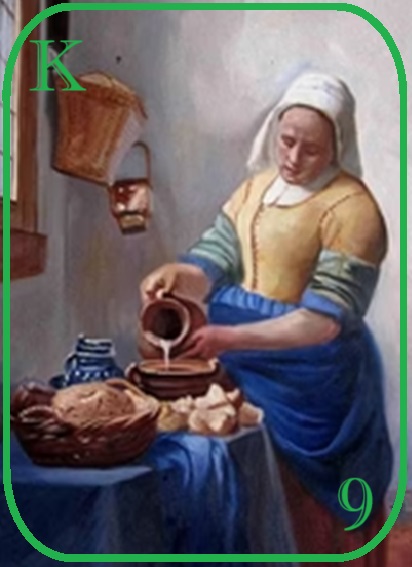
52W Mark IV – Week 22: Card K9 Neeltje Smit

Neeltje Smit (1816-1906)

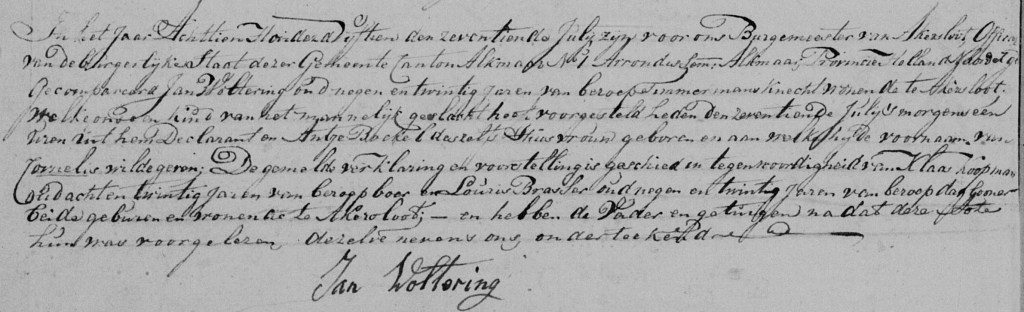
Neeltje Smit, my Gx3 Grandmother born on June 10, 1816, is one of my longest-lived ancestors. Her life spanned nearly ninety years, from the end of the Napoleonic era into the 20th century. Her life began in Heerhugowaard, Noord Holland, where she was born. She was the third of nine children born to Jan Smit and Leentje van Dam.
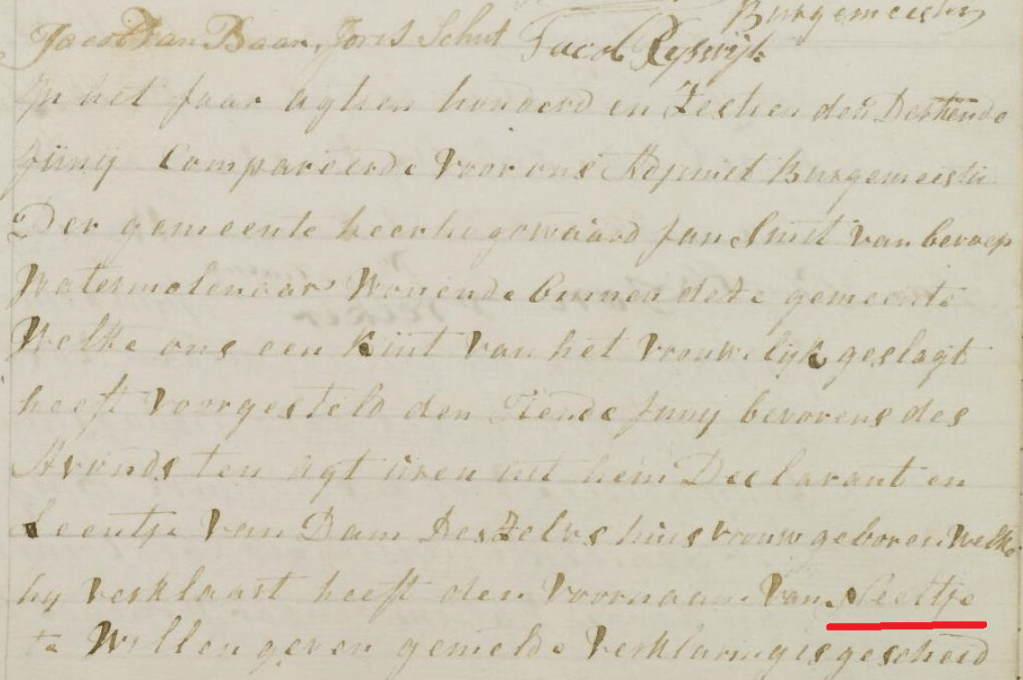
Portion of Neeltje’s birth registration.

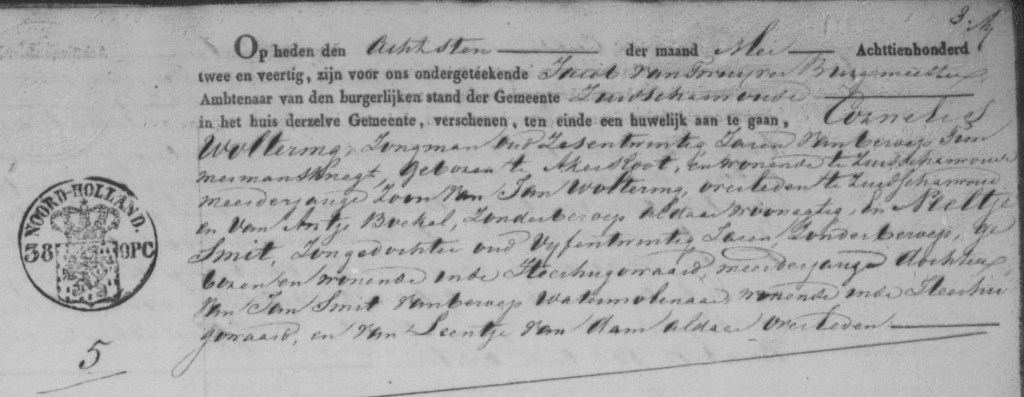
I have little information about Neeltje’s childhood or early adulthood. She was still living in Heerhugowaard at age 26, when she married her first husband, Cornelis Woltering, on May 8, 1842. Cornelis, born in Akersloot in 1815, was then a carpenter’s apprentice, just starting his trade. After they were married, Neeltje and Cornelis settled in Zuid-Scharwoude, Noord Holland. Neeltje would spend almost the rest of her life living there.
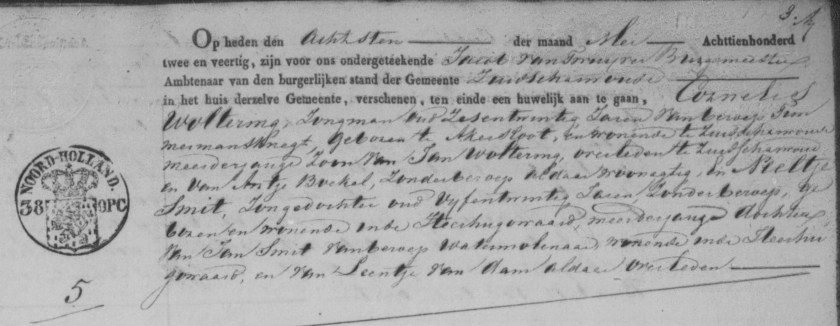
Cornelis and Neeltje’s marriage registration.

The couple had six children. Their first child, Leentje, was born in 1843 and would marry and move to Den Helder, and then later to Nijmegen. Their second child, Jan, born in 1846, died in infancy. Another son, also named Jan, was born in 1848 and lived to age 71, working as a tailor. He never married. Willem (1850–1851) and Teetje (1855–1860) also died young. Their daughter Antje – my Gx2 Grandmother – was born in 1853 and would later marry Nicolaas Komen in 1878.

Cornelis Woltering passed away in Zuid-Scharwoude in December 1862, leaving Neeltje a widow at just 46 years old. Her youngest child, Antje, was only nine years old. In the population register for the year Neeltje was widowed, she was quaintly described as a “landsraamster”; literally, a “country widow”.
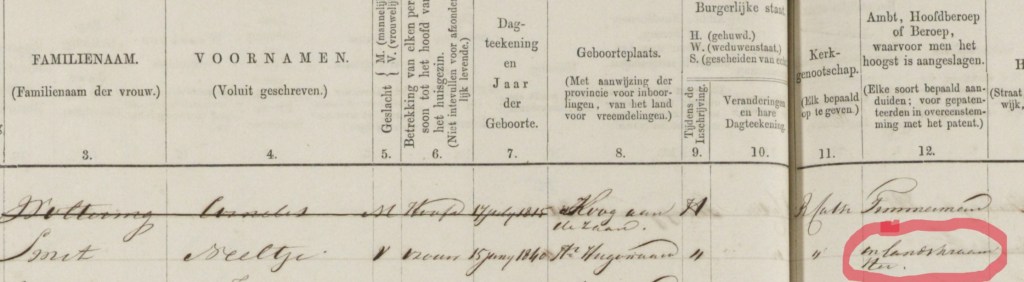
Bevolkingsregister (Population Register) for Zuid-Scharwoude 1860-1870 showing Neeltje as a “landsraamster”

Two years after Cornelis died, on January 29, 1865, Neeltje remarried. Her second husband was Cornelis Oudhuis, a labourer born around 1817 in Zuid-Scharwoude. He himself was a widower. Cornelis had lived in Warmenhuizen prior to his marriage to Neeltje. The two spent over three decades together before Cornelis died in 1897 at age 80.
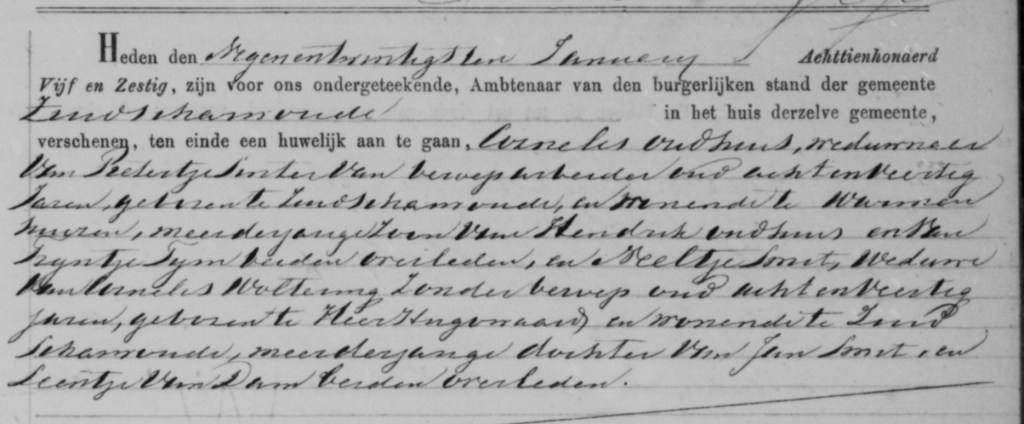
Neeltje and Cornelis Oudhuis’s marriage registration.

After her second husband’s death, Neeltje continued to live in Zuid-Scharwoude for several more years, remaining in the village where she had spent much of her life. In April 1903, in her late 80s, Neeltje moved a short distance to Noord-Scharwoude, another of the component parts of Langedijk. There she lived with her daughter Antje and son-in-law Klaas Komen.

Neeltje Smit died in Noord-Scharwoude on January 22, 1906, at the age of 89. She had outlived two husbands and several of her children, living the entirety of her long life within a few kilometers of where she had been born.
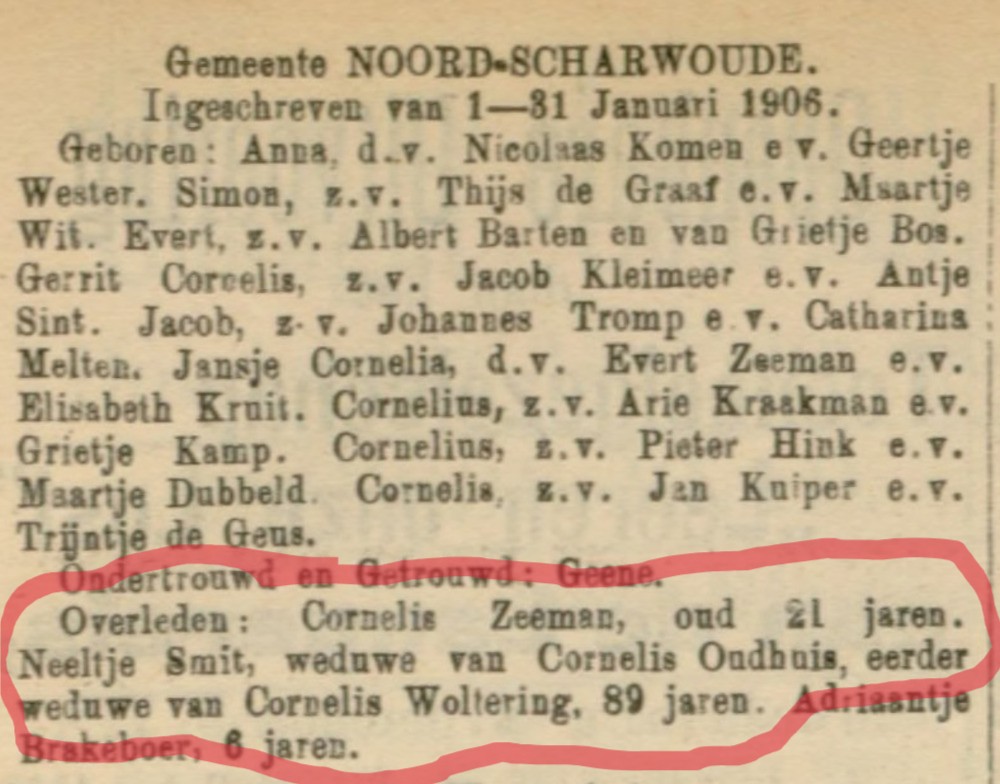
Schager Courant, February 15, 1906, page 3
“Neeltje Smit, widow of Cornelis Oudhuis, previously widow of Cornelis Woltering, age 89.”
52W Mark IV – Week 21: Card K8 Cornelis Woltering

Cornelis Woltering (1815-1862)

Cornelis Woltering was born on July 17, 1815, in the village of Akersloot, Noord Holland. He was born less than two months after the official establishment of the United Kingdom of the Netherlands and one month after the Battle of Waterloo.

Cornelis was the eldest of three children born to Jan Woltering and Antje Boekel. What I find surprising is that Jan was born in what is now Vreden, North Rhine-Westphalia, Germany, about three kilometers from the Dutch border. Sometime before he married Antje in 1814, Jan literally moved across the Netherlands to Noord-Holland. I have no idea what motivated the move, particularly given the significant distance.

Unlike the majority of my Dutch ancestors who were labourers or farmers, Cornelis was a tradesperson, working as a carpenter. It was the same occupation as his father and it was Cornelis’s profession his entire life.

Cornelis was serving his apprenticeship when he married Neeltje Smit on May 8, 1842 in Zuid-Scharwoude. For the entirety of their marriage, the couple lived in Zuid-Scharwoude, where Cornelis carried out his work.

Cornelis and Neeltje’s marriage registration.

Cornelis and Neeltje had six children. The first born, Leentje, married and later ended up living in the province of Gelderland, most likely in Nijmegen. Another daughter, Anjte, my Great x2 Grandmother, married and spent the rest of her life in Noord-Scharwoude. A son, Jan, who never married, was a tailor. The three other children never survived childhood.

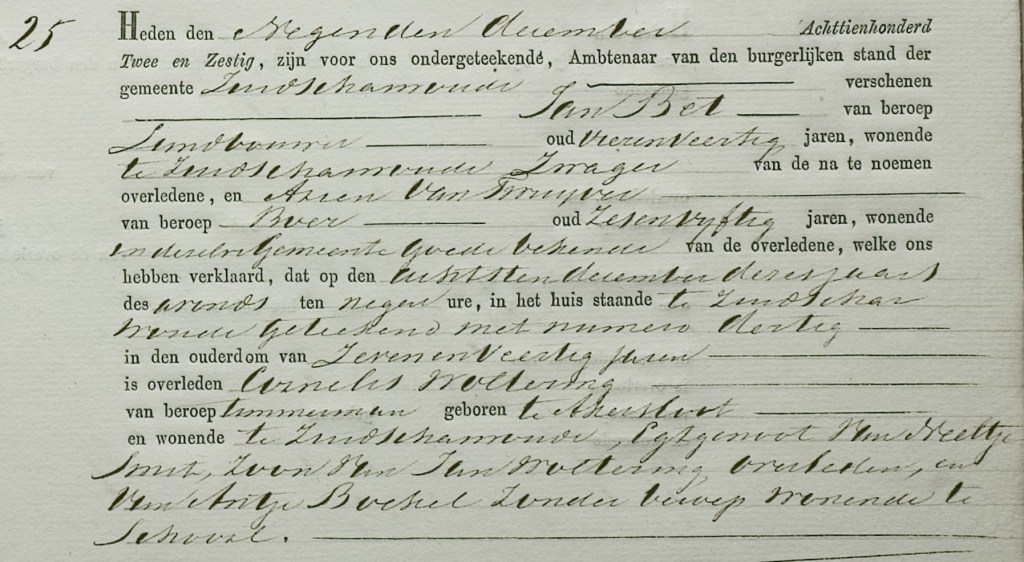
Cornelis died relatively young, at age 47, on December 8, 1862 in Zuid-Scharwoude. Leentje was nineteen; Antje was nine. Neeltje lived another 44 years after her husband’s death.

Cornelis’s death registration.

52W Mark IV – Week 16: Card K3 Antje “Anna” Woltering

Anna Woltering (1853 – 1935)

Antje “Anna” Woltering, my Gx2 grandmother, was born in Zuid-Scharwoude, Noord Holland on February 25, 1853. She was the youngest of four children born to Cornelis Woltering and Neeltje Smit. [Update: I have since learned that Anna was the fifth of six children. An older brother died before Anna was born, and a younger sister died at age five.]

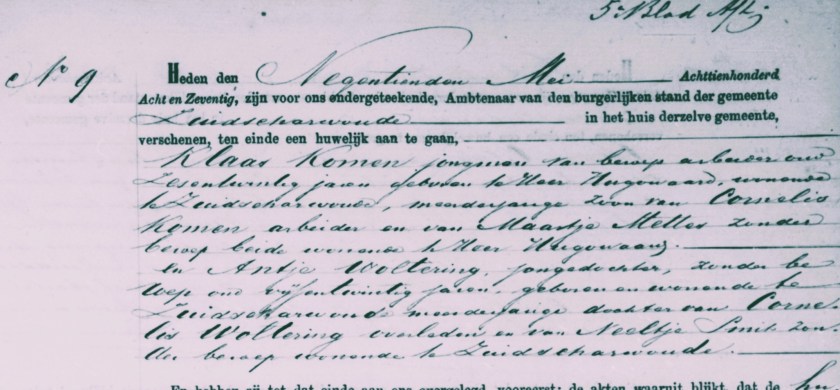
Anna lived over half her life in Zuid-Scharwoude. There she married Nicolaas “Klaas” Komen on May 19, 1878.

Opening paragraph of Anna and Klaas’s marriage registration, from the civil register of Zuid-Scharwoude.

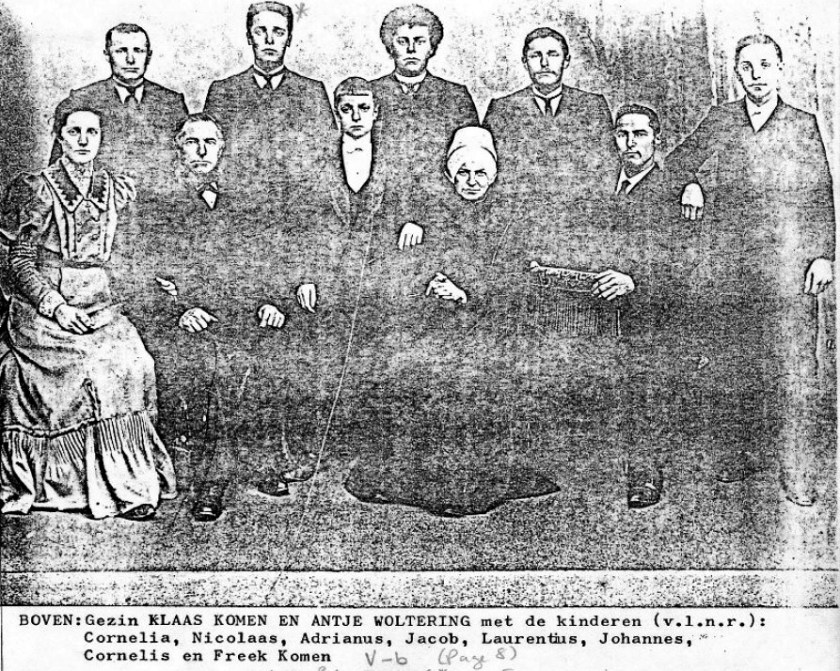
Together Anna and Klaas had ten children, all of whom were born in Zuid-Scharwoude, although two did not survive infancy. Seven of their children married and had families of their own. Their youngest son, Jacob, took up a religious life as a “kloosterbroeder” with the Franciscan Fathers in the province of Limburg – almost as far as one could get from Zuid-Scharwoude and still be in the Netherlands.

The caption in English:  “ABOVE: Family KLAAS KOMEN and ANTJE WOLTERING with the children (from left to right: Cornelia, Nicolaas, Adrianus, Jacob, Laurentus, Johannes, Corenlis, and Freek [a diminutive of Frederik].”

On March 20, 1900, after two decades of marriage and a few years after Jacob was born, the family moved to Noord-Scharwoude. It was not a far move, since Zuid- and Noord-Scharwoude are adjacent to each other and were part of the then gemeente of Langedijk (now part of Dijk en Waard). Anna and Klaas lived together in Noord-Scharwoude for over 30 years and Anna remained there after Klaas died on February 28, 1929. The photo of Anna in the playing card was taken in front of her house.

Less than a year before she passed away, Anna went to live with her son Arie and daughter-in-law Elizabeth at Pikstraat (now Werfstraat) 8 in Noord Holland. Elizabeth lived at that house until her death in 1976. My father remembers visiting that house as a child, and I walked down that street with him during a visit in 2017.

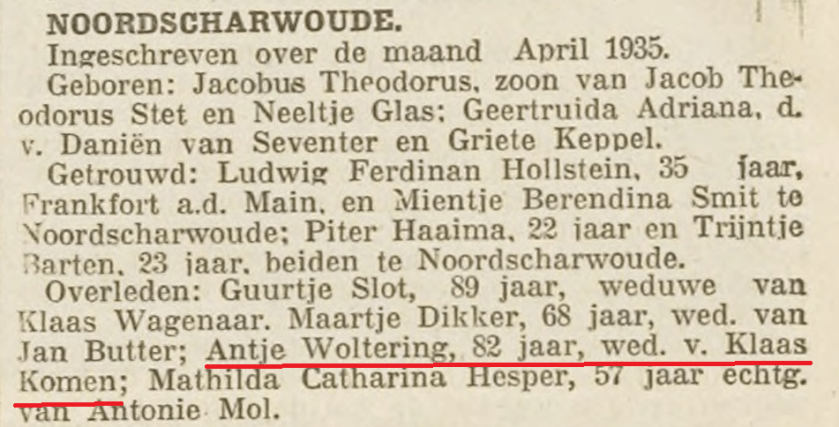
Six years after Klaas passed away, Anna died on April 21, 1935 at the age of 82. She was laid to rest on April 25, 1935, likely at St. Jan de Doper (St. John the Baptist) church in Noord-Scharwoude. However, her remains are no longer there, as graves in the Netherlands are usually leased, not purchased. They are routinely cleared after a few decades.

Anna’s death noted in the Schager Courant, May 6, 1935, page 6: “Antje Woltering, age 82, widow of Klaas Komen”

52 Weeks Mark III – Week 6: Earning a Living

While most of my Dutch ancestors were farmers and labourers, it should come as no surprise that a few worked in windmills. On my father’s maternal side of the family, three of my Gx4 grandfathers were watermolenaaren (singular, watermolenaar – “water mill worker”). These were the windmills used for pumping water.

On my father’s paternal line, the surname “van der Fluit” may have originated with a windmill (“Fluijtermolen” – “Whistler Mill”) or the polder (“Fluitpolder”) on which it stood in Veur, Zuid-Holland (now part of Leidschendam). Alternatively, the windmill and polder might have been named after my ancestor, Johannes Dircks (“Jan”) (van der Fluit or Goeman) who owned or constructed them.

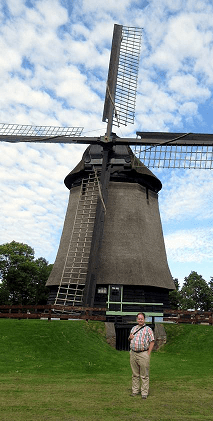
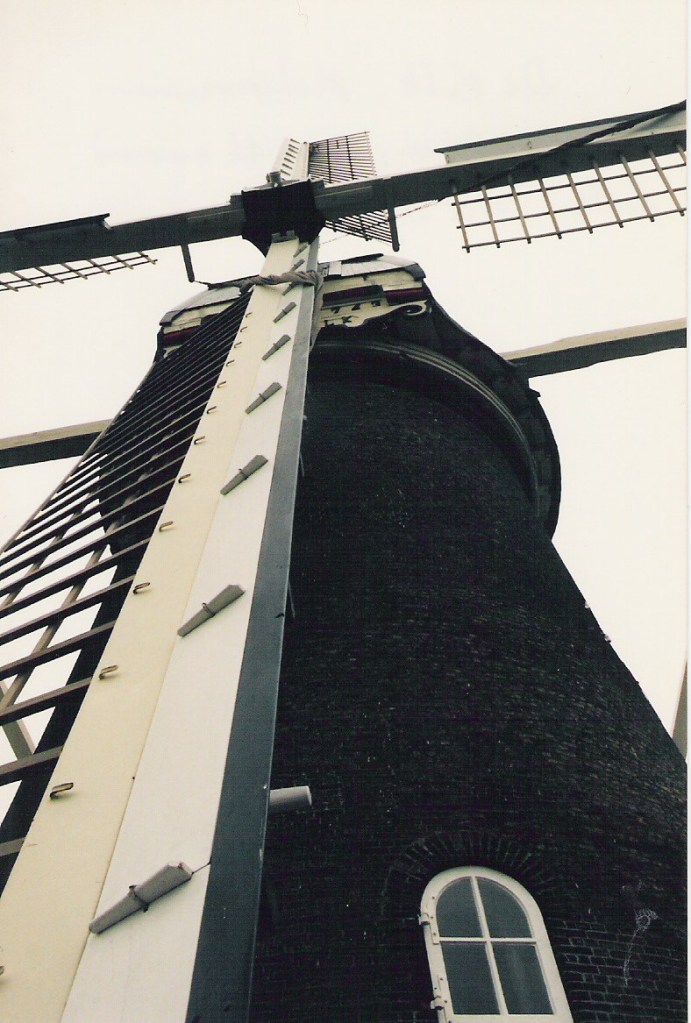
Me standing in front of the windmill in Waarland, Noord Holland, at more than a metre below sea level, about a kilometer from where my father was born and 200 metres from where he was baptized.

My paternal grandmother’s father was Adrianus Komen (1888-1948). Three of his four great grandfathers were all water mill workers. There is a strong possibility all three worked in the same windmill at the same time. I know that two of them, Nicolaas Cornelisz “Klaas” Komen (1786-1864) and Jan Smit (1786-1852) worked at the windmill located in Heerhugowaard, Noord Holland. However, the records I have consulted do not indicate when they worked in the windmill. At most, it is quite likely that Jan was working at the windmill until at least 1852.

I have no idea where and when the third, Johannes “Jan” Woltering (abt 1788-1834) worked in a windmill. I know that it was sometime before 1814, by which time he was working as a carpenter, as documented in the registration of his marriage. Unfortunately, the source from which I obtained the fact he had been a watermolenaar was simply an index and no longer exists. I have not found this item in other sources and records I’ve consulted. The population registers I have seen do not include his occupation. A notarial record I’ve found is dated 1817, which shows Jan working as a carpenter.

Despite this, I have reason to believe that Jan may have worked in the windmill in Heerhugowaard. Jan was born in 1788 in what is now Vreden, North Rhine-Westphalia, Germany. Vreden is about three kilometers from the Dutch border. What he did between his birth and marriage I don’t know, but by 1814 he was living in Akersloot, Noord Holland, which is about 14 kilometers south of Heerhugowaard. After he married he lived and worked in Langedijk, Noord Holland, which is immediately adjacent to Heerhugowaard.

“De Valk” (The Falcon), a windmill in Leiden, Zuid Holland, about 10 kilometers from where Fluijtermolen once stood.

There is one fact in particular that makes me suspect Jan may have worked in the windmill in Heerhugowaard is that Jan Woltering’s son Cornelis married Jan Smit’s daughter Neeltje. Thus, it is possible that the families knew each other because Jan and Jan worked together in the same windmill. Then again, Heerhugowaard was not a large place in 1814 and it is quite possible they knew each other the way everyone in a small town tends to know each other.

Turning to Jan Dircks, the website for the municipality of Leidschendam-Voorburg used to have this information, which I have translated from Dutch:

The square and adjacent street between Prinsensingel, Noordsingel, de Amstelweg, and de Graaf Willem de Rijkelaan is called Fluitpolderplein. This was decided in 1970. But where does the “fluit” in “Fluit Polder” come from anyway? According to a historian of Veur, Hendrik Brouwer Schut, it may have something to do with the whistle of the grinding mills, or possibly the “fluitenkruid” (“cow parsley” or “Queen Anne’s lace” in English). [The Dutch name of the plant refers to the fact a flute or whistle can be made from the stem.] However, there may be a better explanation. In 1648 a large part of the territory of the polder already belonged to a certain Jan Dirckxz, who also went by the name “Fluijt”.

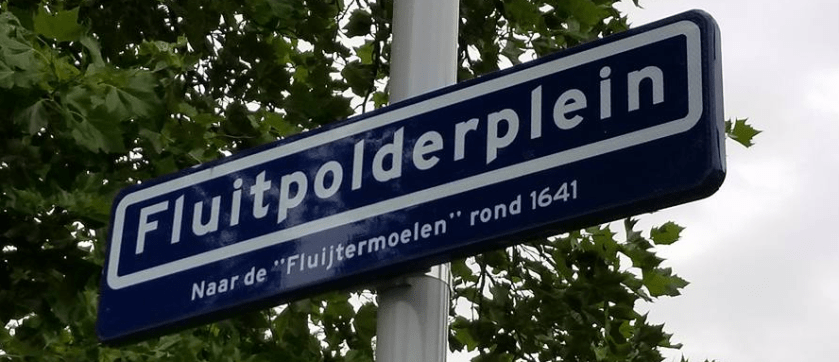
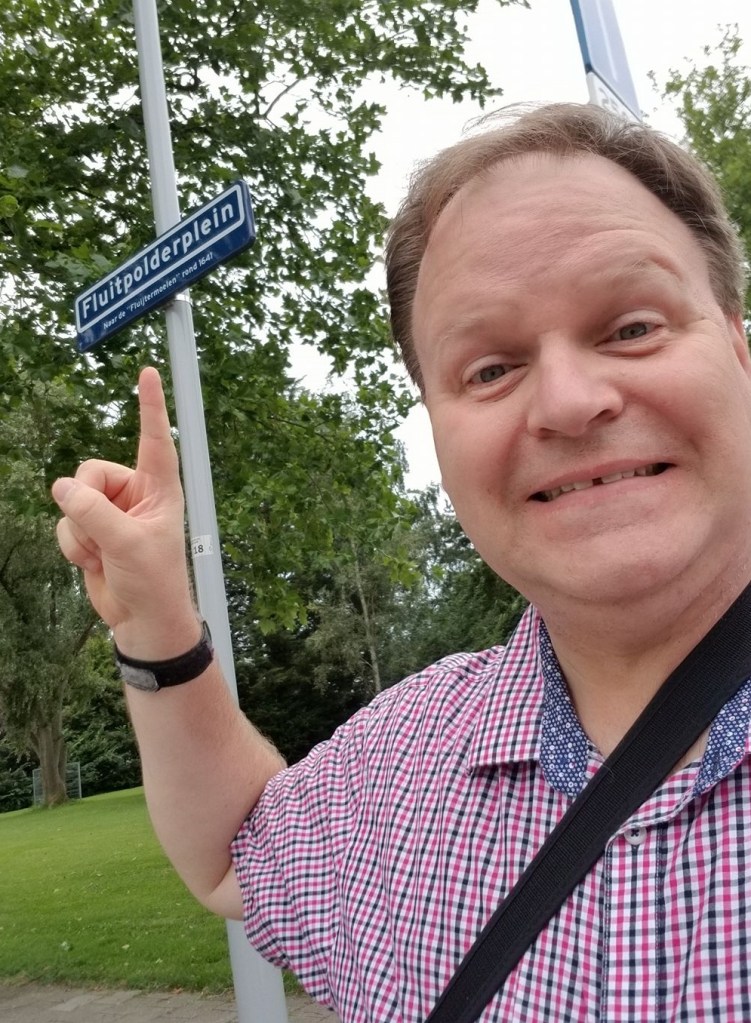
According to the street sign for Fluitpolderplein, the polder was located alongside the “Fluijtermolen” (Fluit Windmill), which was built around 1641. 

Am I named after the polder or is the polder named after me?