
52W Mark IV – Week 26: Card K13 Elisabeth de Waard

Elisabeth “Lisabeth” de Waard (1824-1887)

Halfway through the 2025 52 Ancestors Challenge brings us to the last card on my paternal line. Last but not least, meet Lisabeth de Waard, my Gx3 grandmother.

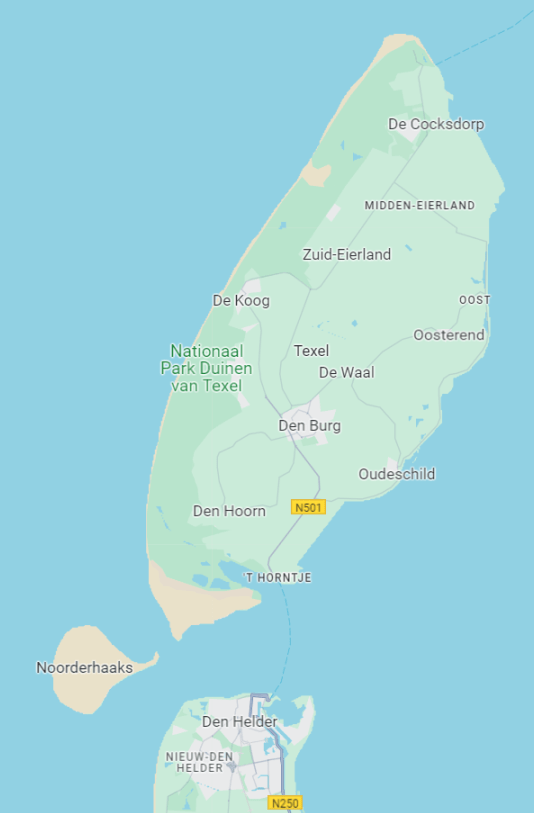
Elisabeth de Waard was born on February 18, 1824 in Oudeschild, a village on the island of Texel, the largest of the Wadden Sea Islands off the north shore of the Netherlands. It is the only settlement on the island located on the coast. While there is now a ferry dock on the southernmost point of the island, Oudeschild was the only port on Texel in Elisabeth’s time.

Thus, it should come as no surprise that her paternal grandfather, husband, and at least three of her brothers were sailors. Despite the seafaring lives of many of her relatives, Elisabeth’s father, Jan Teunisz de Waard, was a labourer at the time she was born. Jan became a shopkeeper shortly afterwards and remained in that profession until he died in 1863 at age 76.
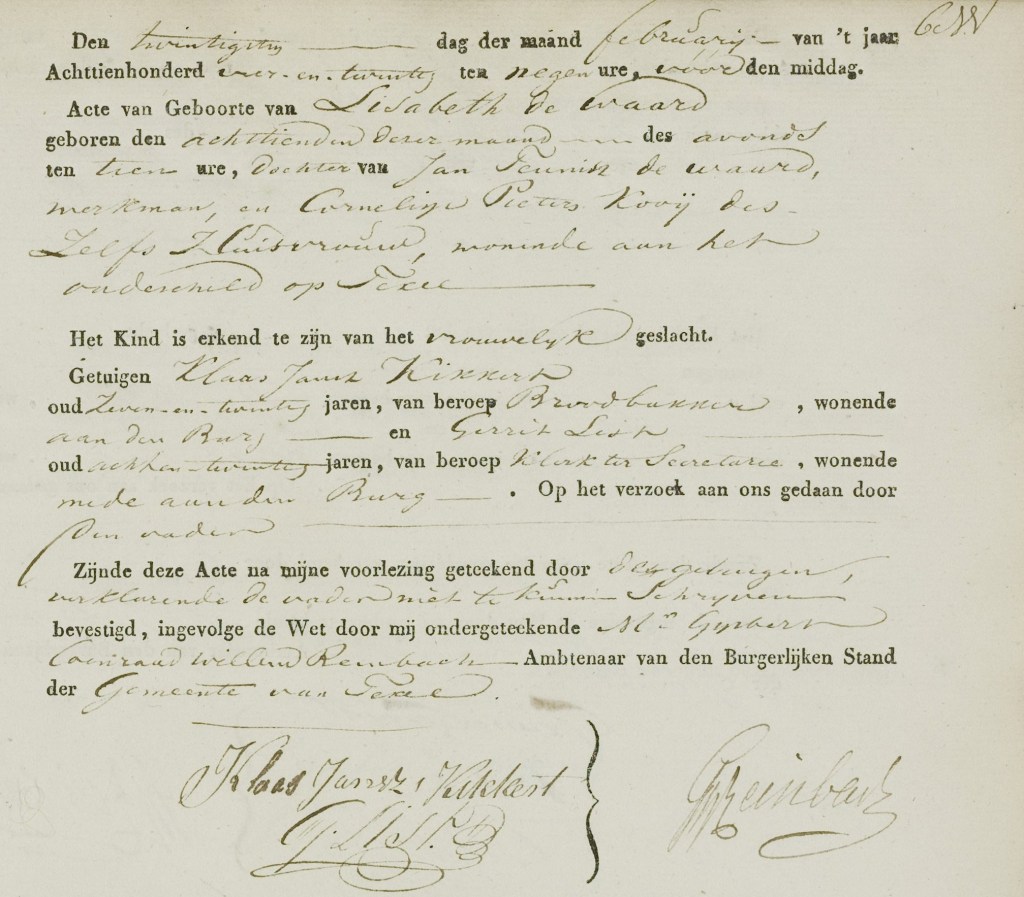
Registration of Lisabeth’s birth.

Elisabeth’s mother was Cornelia Pieters Kooij. Jan and Cornelia’s marriage intrigues me, because Jan was Protestant and Cornelia was Roman Catholic. Jan was the first direct ancestor I found on my paternal line who was not Catholic. They married at the Catholic church on Texel.

Up until the mid to late 20th Century, Protestants and Catholics in the Netherlands kept well apart. Each had their own schools, newspapers, sports clubs, political parties, and social organizations. Intermarriage between the two groups was not common or as widely accepted as it is now. The 1830 census shows that their eldest child, Teunis, was a Protestant like his father, but the rest of their eight children, were Catholic like their mother.

One might think that my great grandmother’s name was Elisabeth and Lisabeth was her nickname. However, as can be seen above, her father named her as “Lisabeth” when he registered her birth. The only place I have found her name recorded as Elisabeth was in the Bevolkingsregisters (population registers). Moreover, the 1840 census listed her as Betje, another common Dutch nickname for Elisabeth.

One of the many population registers showing my great grandmother as “Elisabeth”. Cornelis and Elisabeth’s names are crossed out because they moved to a different house. In fact, they moved around Den Helder a lot!

The census records also show that Lisabeth lived in Oudeschild at least into her late teens. In fact, the registration of her marriage to Cornelis Ran shows that she was still resident on Texel when they married on February 6, 1851 in Den Helder, where Cornelis was an apprentice harbour pilot. While it appears that Cornelis had lived on the mainland for many years by the time they married, he had deep roots in Oudeschild. It is likely that Jan and Lisabeth came together through familial connections.

Lisabeth and Cornelis settled into life in Den Helder, where they had seven children – five girls and two boys. The boys, who were the youngest, were also drawn to naval life, although as members of the navy.

The couple spent the rest of their lives in the port city. Lisabeth passed away in Den Helder on July 18, 1887, at the age of 63. She was buried in Huisduinen, a village outside of Den Helder, four days later. Cornelis lived another ten years.
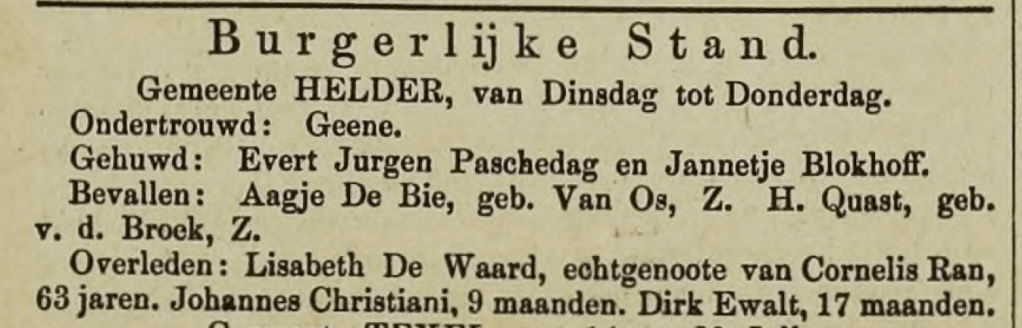
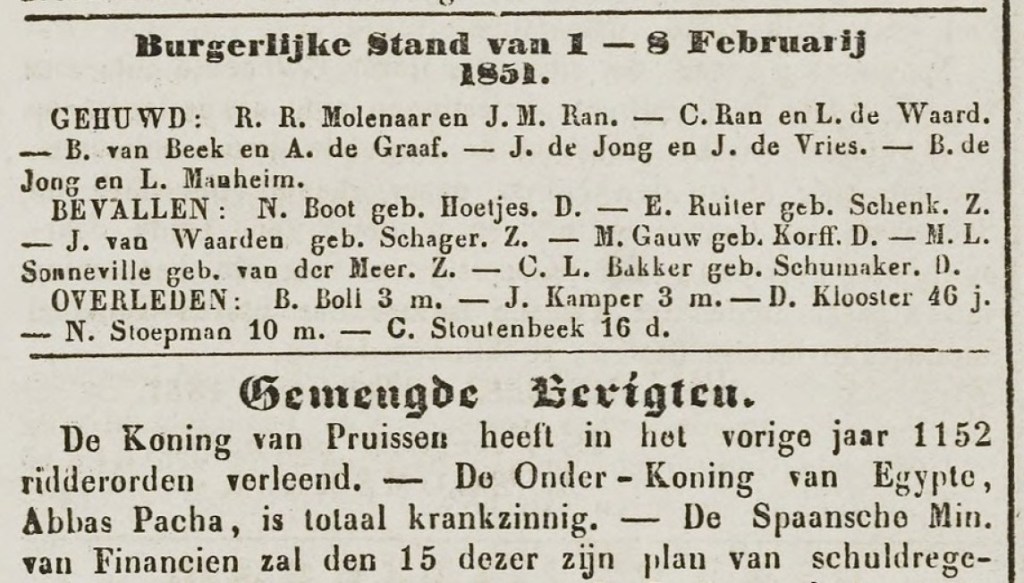
Weekblad van Den Helder en het Nieuwediep, 10 February 1851, page 3
Civil Register. Deceased: Lisabeth de Waard, wife of Cornelis Ran, age 63.

Two suits down, two to go!
52W Mark IV – Week 25: Card K12 Cornelis Ran

Cornelis Ran (1824-1897)

Continuing with the foray into my direct Dutch ancestors who were not farmers or labourers, meet Cornelis Ran, my Gx3 Grandfather. In his occupation, Cornelis was following in the footsteps of his father, Reijer Jansz Ran, at least as much as you can follow on the confines of a boat or ship. Cornelis’s maternal grandfather and great grandfather were also sailors, although their forebears were innkeepers, bricklayers, and bakers.

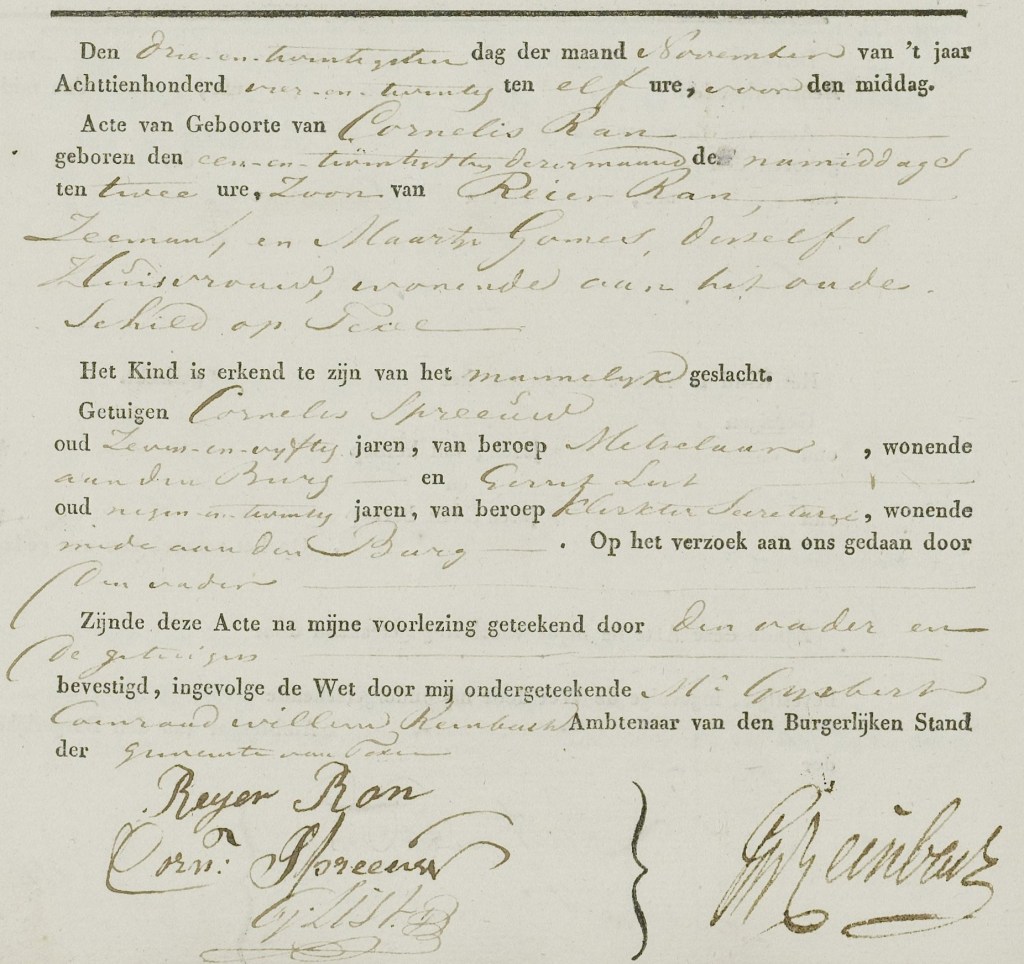
Cornelis’s birth registration

Reijer and his wife Maartje Klaas Gomes had eleven children, all born on Texel. Remarkably for the time, all but two survived to adulthood. Cornelis, born on November 21, 1824, was the sixth of these eleven children. He was born in Oudeschild, a coastal village on the east coast of the island of Texel, which lies only a couple of kilometers across the Marsdiep from the mainland city of Den Helder, a major Dutch port and naval city. Several generations of Cornelis’s ancestors spent their lives in Oudeschild.

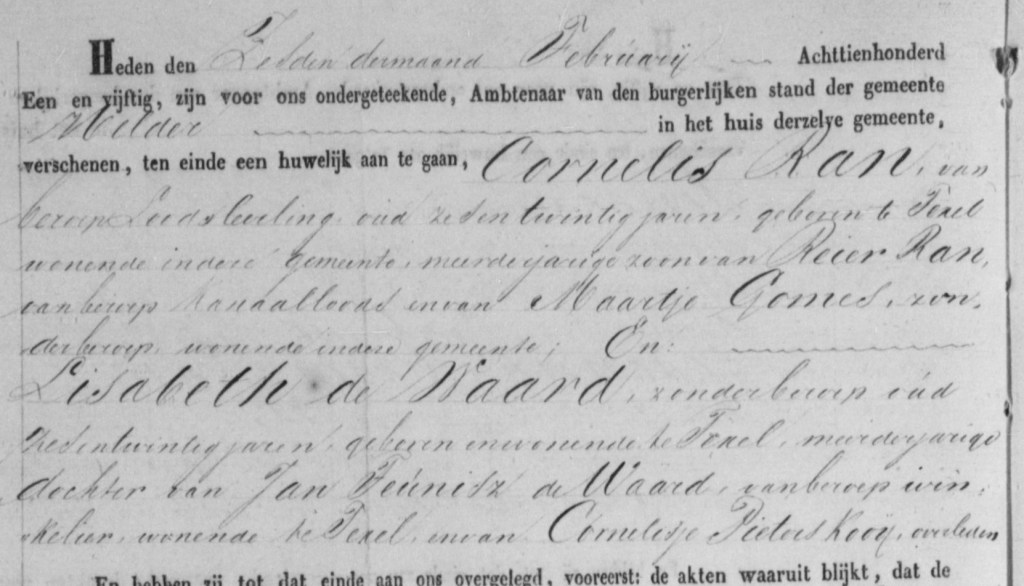
Top portion of Cornelis and Elisabeth’s marriage registration

Cornelis’s life on the water was spent as a harbour pilot and sailor. He was serving his apprenticeship as a harbour pilot in Den Helder when he married Elisabeth “Lisbeth” de Waard there on February 6, 1851. Lisbeth, who also went by Betje, was born on Texel in 1824. Delightfully, Cornelis and his sister Johanna Maria were both married on the same day and at the same place, possibly in a joint family celebration in Den Helder.

From the Weekblad van Den Helder en het Nieuwediep, 10 February 1851, page 3. It shows the double-marriage of Johanna Maria Ran (to Reijer Molenaar) and Cornelis Ran (to Lisbeth de Waard).
The item below the civil registration notice are odd little bits of news: “The King of Prussia appointed 1,152 knights in the previous year.” “The Governor of Egypt, Abbas Pacha, is totally insane.”

Elisabeth and Cornelis remained in Den Helder for the rest of their lives, where they raised seven children. Again, remarkably for their time, all seven of their children lived well into adulthood. All seven also went on to marry.

Over those years, Cornelis continued in his profession, working as a harbour pilot and as a sailor until about 1886, when he was 62. Records show that Cornelis had no occupation from 1886 to 1890. This suggests he might have retired. However, he was working again as a sailor in 1890, so it is not clear if he had briefly retired, had been unable to work, or had been unable to find work.

Elisabeth passed away in 1887 at the age of 63 and was buried in Huisduinen, a village near Den Helder. Cornelis lived another ten years, dying in Den Helder on June 26, 1897, at the age of 72. He was also buried in Huisduinen, on June 29, 1897.

52W Mark IV – Week 23: Card K10 Jan Cornelis Bakker

Jan Cornelis Bakker (1819-1859)

I recently noted that most of my direct Dutch ancestors were farmers and labourers. Jan Cornelis Bakker is another exception to that generalization. For most of his short life, he worked as a sailor in Den Helder, Noord Holland. In fact, he was the descendant of sailors on both sides of his family.

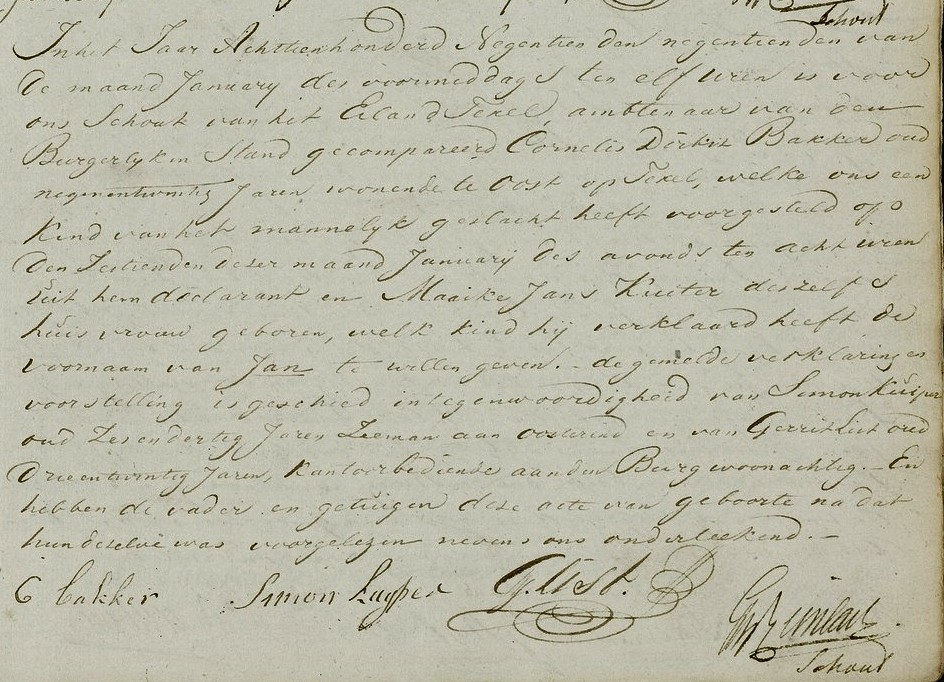
Jan was born on January 16, 1819, in the village of Oost, located on the island of Texel in the province of Noord Holland, Netherlands. He was the second child of Cornelis Dirksz Bakker and Marijke Jans Kuiter, who had married a few years earlier in Texel, on April 25, 1815. Jan’s older sister, Naantje, had been born in July 1815, just months after their parents’ wedding.

Jan’s birth registration

Both sides of Jan’s family have deep roots on Texel. I have traced both his lines back at least three generations. Jan’s mother, Marijke, was born on Texel around 1787. Her father, Jan Kuiter, was a sailor. Marijke passed away relatively young, on January 4, 1824, in Oost, when Jan was only five years old.

Jan’s father was a sailor on Texel. His father remarried in 1826 and moved the family from Texel to Den Helder sometime before 1833. Den Helder is a major Dutch port at the northwestern tip of the country and has been a major naval base since the 1700s. It seems that Cornelis gave up life at sea for life on the shore after moving to Den Helder. His recorded occupation was porter, most likely working on the docks.

When the family moved to the mainland, Jan Cornelis would have been in no more than his early teens. By 1847, Jan had followed in his father’s footsteps and was working there as a sailor. That year, he registered for compulsory military service but was not called to serve. Jan carried on in his profession as a sailor, which was how he spent the rest of his working life.

On June 3, 1847, Jan married Johanna Adriana Puinbroek in Den Helder. Johanna was born in 1822, in Heinkenszand, Zeeland, far to the south. Her parents were Johannes Puinbroek and Maria Theresia Letens. What brought Johanna’s family north to Den Helder is unclear, but her marriage to Jan firmly rooted her there. Together, Jan and Johanna had one child, my Gx2 Grandfather, Cornelis Jan Bakker, born on April 26, 1855, in Den Helder.

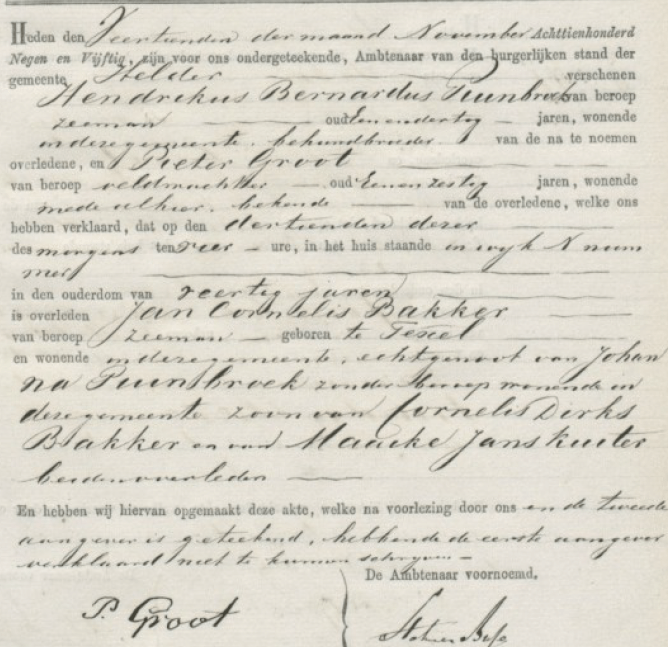
Sadly, Jan’s life was cut short. He died on November 13, 1859, at the age of 40, in Den Helder. His widow, Johanna, lived on for more than two decades after his death, passing away in 1881, at age 58. I have no idea as to how he died, but I’ve wondered whether it occurred as a result of his work as a sailor given how young he was at the time. However, I’ve found nothing in any of the sources I’ve consulted, including the online newspaper collections at Delpher and various Dutch archives.

Jan’s death registration

52 Weeks Mark III – Week 4: Witness to History

Two weeks ago, I wrote about my roots in the Dutch island of Texel. While the focus was primarily on my paternal grandmother’s ancestors, my paternal grandfather’s side of the family also has a strong connection to Texel. This includes several van der Fluit cousins of varying degrees, many of whom are descendants of my 4x Great Grandfather, Petrus Pieterszoon “Pieter” van der Fluit. I’ve written about at least one of those cousins, Pieter Jansz van der Fluit.

Both sides of my father’s family had a presence on Texel during the French occupation of the Netherlands during the Napoleonic Wars. Many of my ancestors were living on the island during one of the most unusual military confrontations in history, involving a confrontation between cavalry and naval forces.

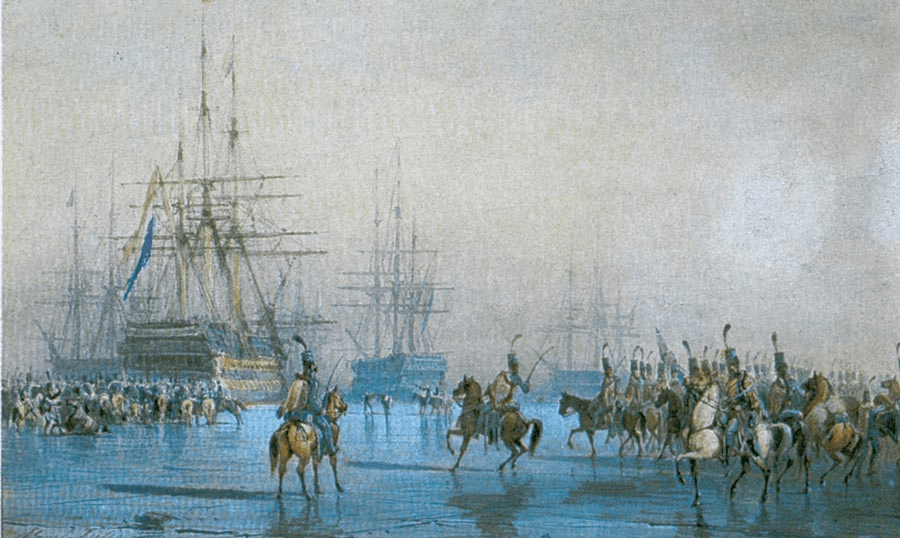
A depiction of the capture of the Dutch fleet at Texel by French naval painter Antoine Léon Morel-Fatio (1810–1871)

The French invaded the Dutch Republic over the period from 1793 to 1795. There was a great deal of support for the French in the Dutch provinces. The Patriotten (“Patriots”) shared the ideals of the French Revolution. During the French incursion, a French-supported uprising led by the Patriots overthrew the previous regime.

By January 19 , 1795, the Patriots had succeeded and established the Batavian Republic (later the Batavian Commonwealth). While nominally independent, the Batavian Republic was essentially a French vassal state. However, Napoleon was dissatisfied by the rate of change in the new state and was not impressed by its degree of opposition to the English. In 1806 he replaced the Batavian Republic with the Kingdom of Holland, with his brother Louis (Lodewijk in Dutch) installed as its King. When Lodewijk proved to be too sympathetic to his subjects, Napoleon removed him from office and incorporated the Netherlands into France itself.

After the success of the Batavian revolution, the provisional government ordered loyalist Dutch forces to stand down. Despite the support for the French in the Netherlands, the Navy remained loyal to the previous regime. It had formidable forces centred at Den Helder, a major naval port.

The winter of 1794-95 was particularly cold. A storm threatened the Dutch fleet at Den Helder, so it sought shelter on the leeward side of Texel. Nevertheless, the fleet found itself frozen in the ice offshore. Wishing to take advantage of the loyalists’ plight, the French ordered the appropriately-named Admiral Jan Willem de Winter to Den Helder to secure the fleet for the Franco-Dutch forces. De Winter led forces comprised of cavalry and artillery. They arrived on January 22, 1795.

The senior officer of the fleet prepared to scuttle his ships, while de Winter prepared for an attack. However, once news confirmed that the revolutionaries had succeeded and taken over the government, the two sides negotiated a surrender.

There were other reasons why a battle might not have occurred, even if the rebels had not succeeded in overthrowing the government. If the battle had occurred, it would have been a very rare occasion of a land force attacking and (possibly) overtaking a naval force.

Texel was of significant military value during the French occupation. It was a lynchpin of defence against an English naval attack on the Dutch coast. So much so, Napoleon himself visited the island in 1811. One of the key locations he visited were two fortresses at De Schans, a kilometer or so outside of Oudeschild, where many of my ancestors lived. I would love to know what my ancestors might have seen and experienced at that time!

A cousin of mine has a story about one of our van der Fluit ancestors that took place on Texel during the French occupation. He didn’t say who it was specifically, other than a van der Fluit. Whether or not the story is true, or has a kernel of truth, I really cannot say. Nevertheless, whether fact or fantasy, it’s a fascinating legend.

In the course of the wars, Napoleon instituted conscription in many of the French territories, including the Netherlands. Orders were sent to round up all able-bodied men of fighting age and press them into service. One of our Texelaar van der Fluit ancestors sought to evade conscription by hiding in a hay rick while soldiers were rounding up men. The soldiers suspected that people might try to hide in the hay ricks, so they went from rick to rick and pierced them with their bayonets. Legend has it that this particular van der Fluit was praying the rosary while hiding. While doing so, a bayonet passed between his chest and upper arm. He went unscathed and undetected, so he evaded conscription.