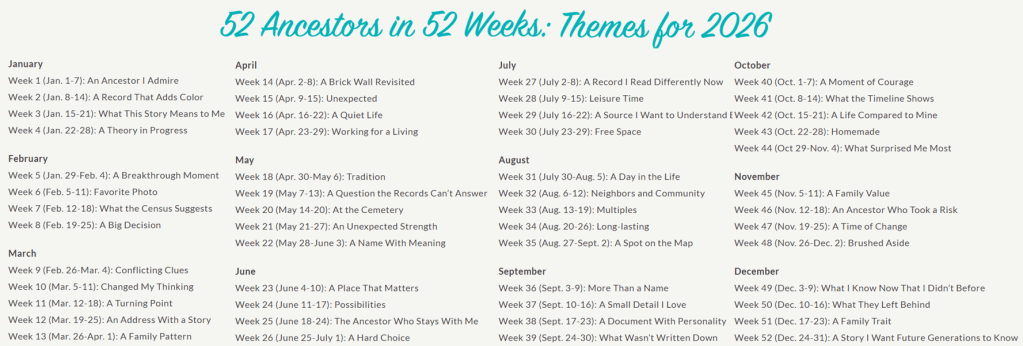
For the fifth year in a row, I’m going to participate in Amy Johnson Crow’s 52 Ancestors Challenge. For the first three years, I followed Amy’s prompts. However, for the 2024 iteration of the Challenge, I struck my own path and set my own prompts, as I explained this time last year. In Week 52 of last year’s Challenge, I indicated that I would likely return to following Amy’s prompts.
However, after seeing the list of this year’s prompts, I decided they were not for me. While I appreciate that there are many new ideas this year, most of them do not speak to me. As well, for many of the prompts, I feel hard pressed to come up with something I haven’t covered before. So I’ve decided to once again strike out on my own and create my own set of prompts.
For me, what I came up with last year really worked for me. Not only did it help my achieve my primary goal of writing up my research, it unexpectedly helped me identify the many unexpected gaps in my research. As a result, I inadvertently participated in Yvette Hoitink‘s Level-Up Challenge! It also helped that I was able to divide my fourth through sixth generations of grandparents into four suits and 52 cards, keeping with my blog’s theme of 52 Ancestors.
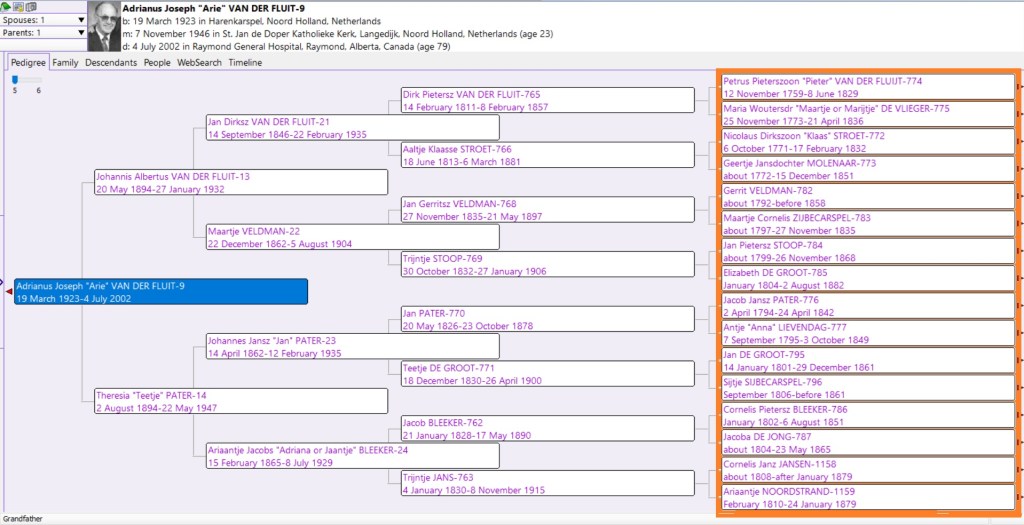
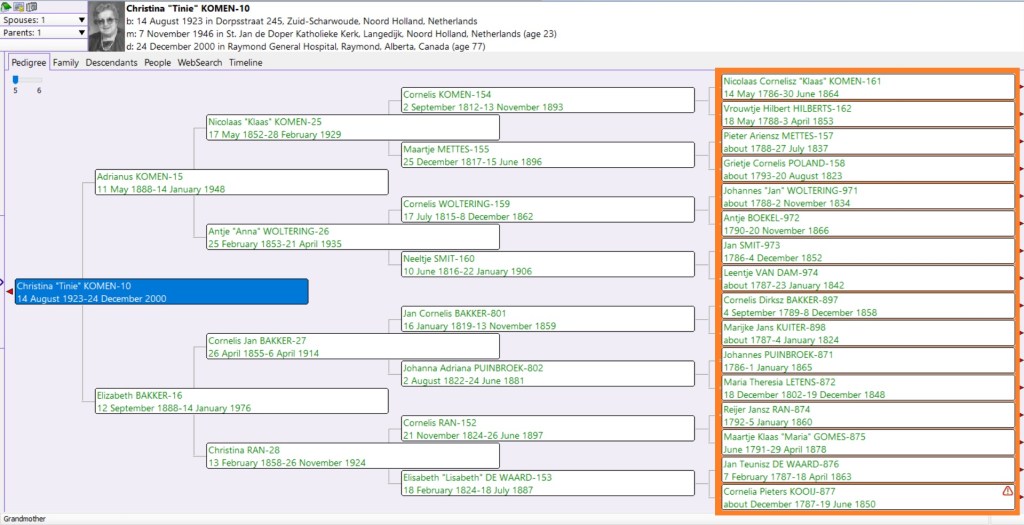
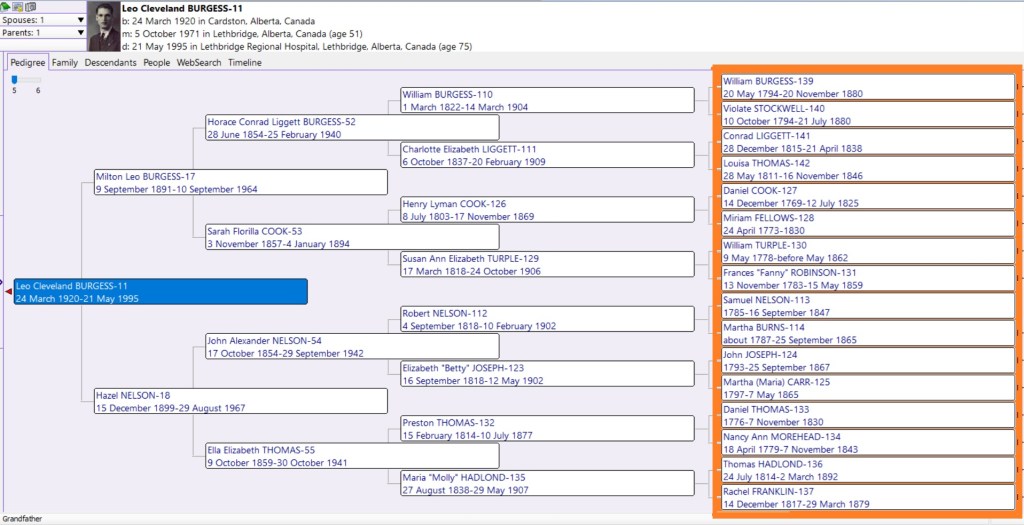
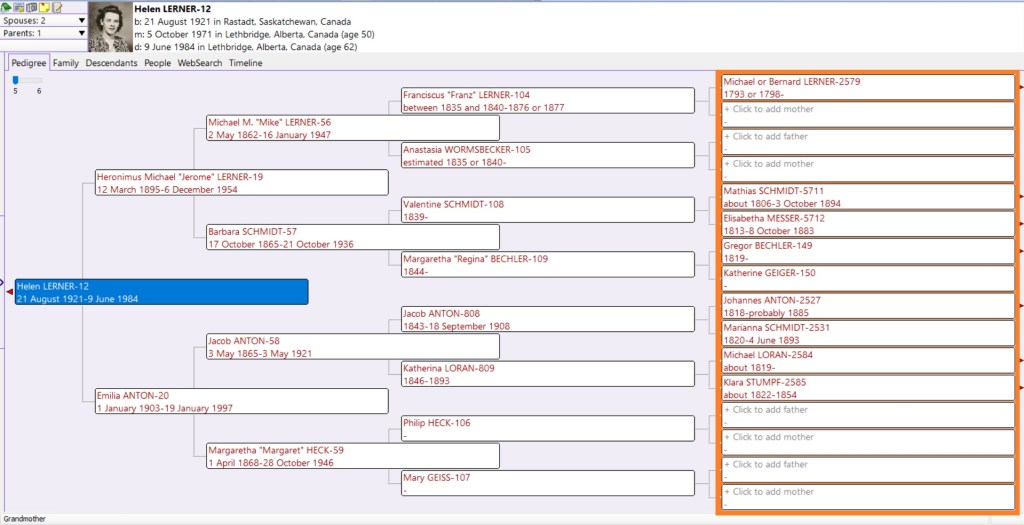
I decided that I would write about the next generation of my ancestors. It would once again tie the whole year together and provide me with some focus. However, the seventh generation consists of 64 individuals, which precludes writing about one per week. This problem is partly resolved by the unfortunate fact I have yet to identify seven of my Gx4 Grandparents, but that still leaves me with 57 people to fit into 52 weeks.
Despite that problem, I’m going to forge ahead with the plan to write about my seventh generation of ancestors this year – my Great Great Great Great Grandparents. I’ll figure out how to fit 57 people into 52 weeks as I go.
Continuing with last year’s theme, this results in four “suits” based upon each of my four grandparents. The individuals I will write about are in the orange boxes.
Good luck to everyone participating in the 52 Ancestors Challenge this year!
Franciscus “Franz” Lerner (betw. 1835~1840 – 1876~1877)
I’m now entering the set of cards in this suit of my Gx3 Grandparents on my mother’s maternal line, of whom I know the least. We are in some pretty hazy territory, so I expect the next eight posts to be much shorter than the rest. My Gx3 Grandfather, Franciscus “Franz” Lerner is a prime example of this. I don’t even have a solid idea of when he was born and died.
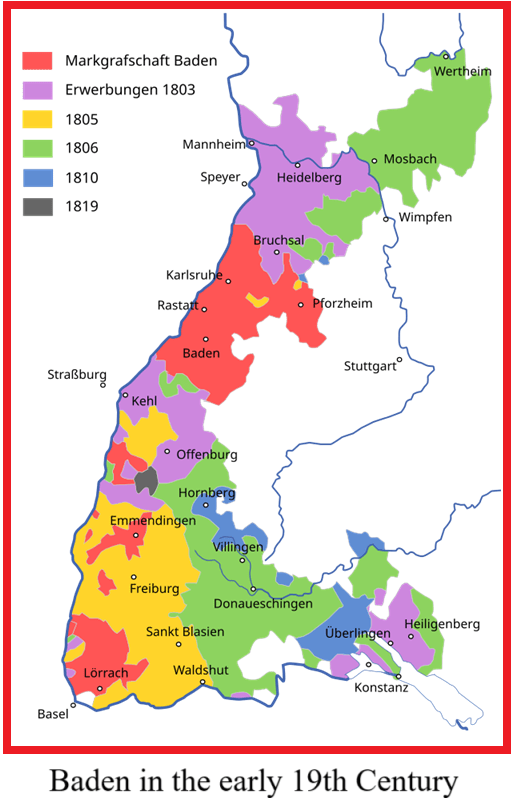
As far as I know, with not a lot of evidence, is that Franz was born sometime between 1835 and 1840 in the German colony of Rastadt in the Beresan District of Ukraine, which was part of the Russian Empire at the time. What I know with a bit more certainty is that Franz’s paternal line hailed from the Karlsruhe area of Baden in what is now Germany. At least four generations of his direct male line likely may have lived in Baden.
The hiccup in this lineage is the identity of Franz’s father. While I know nothing of Franz’s mother, not even her name, I have two possible candidates who might be his father. Franz may be the son of one of two brothers, Michael Lerner or Bernard Lerner. They are the sons of Franz Ignaz Lerner (1759-aft. 1816) and Maria Eva Geiger (1756-aft. 1816), both from Malsch, Karlsruhe, Baden. They left Baden for the Beresan in 1809 and settled in Rastadt.
Michael Lerner was born on July 11, 1793 in Malsch, Karlsruhe, Baden. He was married to Maria Eva Eberle, born June 3, 1793 in Pleisweiler, Bergzabern, Pfalz, although the evidence of this marriage is not verified.
Bernard Lerner born February 27, 1798 in Malsch, Karlsruhe, Baden. Bernard was married to Barbara Heil, who was born about 1799 in Niederlustadt, Germersheim, Pfalz.
Franz married Anastasia Wormsbecker (there are many spelling variations) in Rastadt, Beresan sometime around 1860. They had five children. The youngest four all emigrated to North America. Two went directly to Saskatchewan, Canada. Two sons went to Texas, one of whom was my Great Great Grandfather, Michael (“Mike”) Lerner. Mike ultimately moved to Saskatchewan with his family; his brother, Jerome, remained in Texas. Only their eldest child, Elisabeth, remained in the Beresan.
As I was looking at the list of Franz’s children, my mind began to speculate. A custom in the Netherlands for naming children was that the first son was named after the child’s paternal grandfather. The second son was named after the maternal grandfather. The first-born daughter was named after her maternal grandmother; the second daughter was named after her paternal grandmother.
If there was anything similar in German culture, particularly those parts of Germany closer to the Netherlands, that carried into the Beresan, it might provide a clue as to whether Michael or Bernard is Franz’s father. Mike was Franz and Anastasia’s first-born son. The name would be in keeping with a paternal grandfather with the same name. Mike and Anastasia did not name any of their other two sons Bernard. Of course, I can’t place much, if any, weight on this, but it does make some walking around sense.
For me, Franz’s life ended as mysteriously as it began. At most, all I know is that the possibility is that Franz died in 1876 or 1877 in the Beresan.
You can find more specific information about the dates and places of Franz’s birth, marriage, and death on various online trees, but they are largely unsourced or provide unverifiable and vague citations. Without something more, they deserve to be given no weight.
My Great Great Grandmother, Barbara Schmidt, was born to Valentine Schmidt and Margaretha Boechler on October 25, 1865 in Karlsruhe, Beresan, Ukraine, Russian Empire. Karlsruhe was one of the colonies established by German settlers who responded to the manifestos issued by Catherine the Great and, later, her grandson Czar Alexander I. Since Karlsruhe was founded in 1809, it is most likely that its founders were responding to a manifesto issued by Alexander I in 1804.
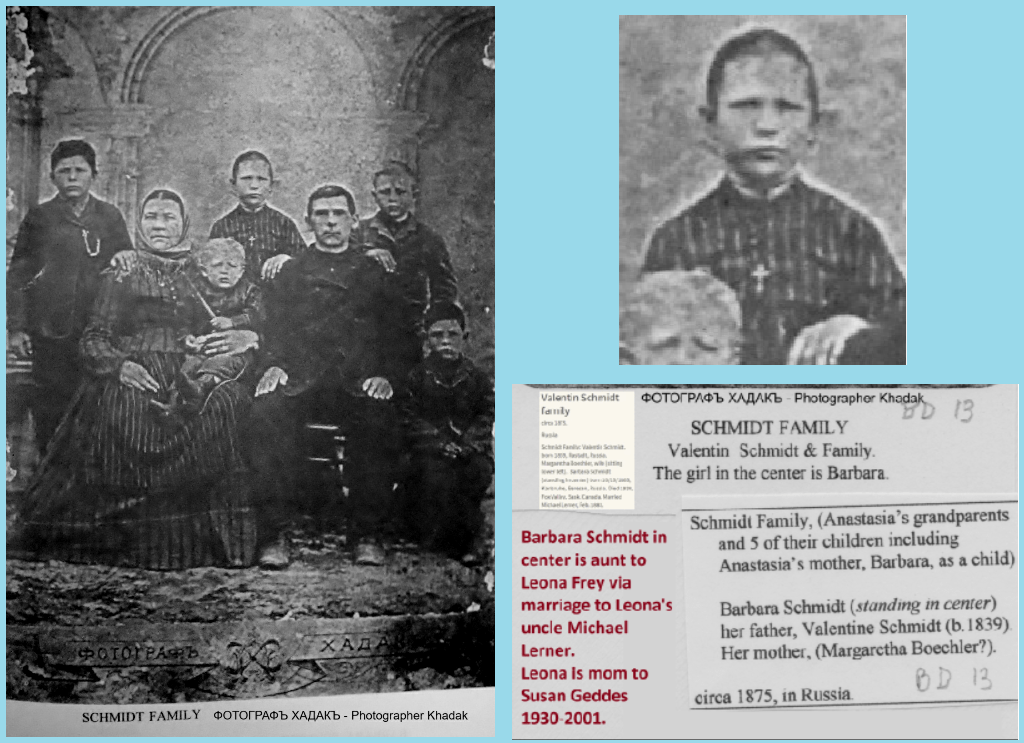
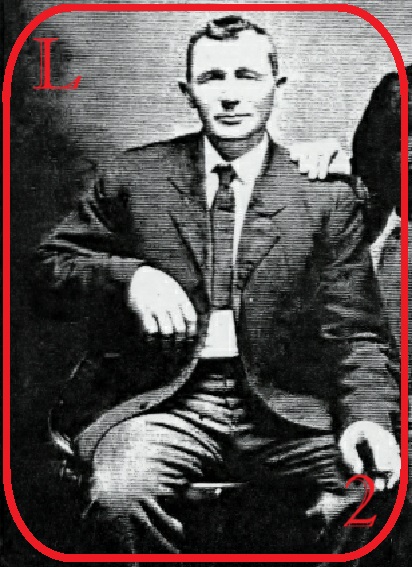
I know almost nothing about Barbara before she married Michael Lerner, said to have been in February 1883. There’s only one clue about her childhood, which is from a photo I first saw in a book in 1997. I’ve since seen it other places. I can’t even recall when or how I came across it. I think I was probably still using Windows 95 and Netscape. One of the later iterations I have of it came with additional information, which is in the bottom left of this graphic:
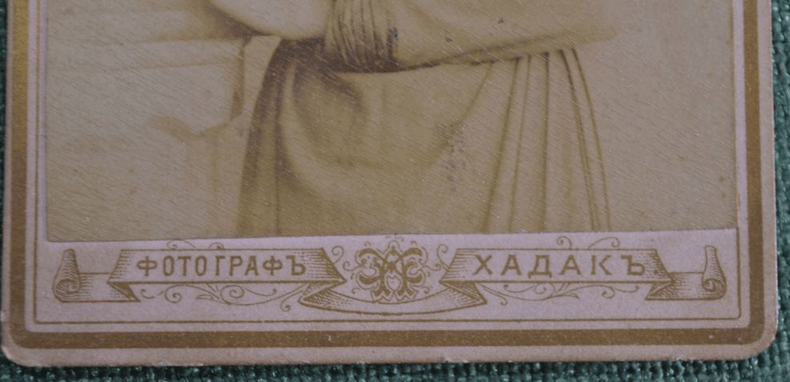
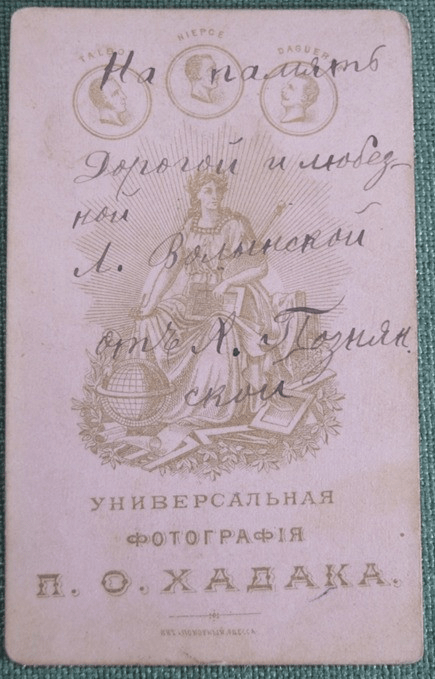
The one alteration I made to each image was to add “ФОТОГРАФЪ ХАДАКЪ Photographer Khadak” (or “Hadak”). It is what you can see in the bottom of the photo. I googled the phrase using the Cyrillic, without the translation/transliteration. The results included a photograph that was listed for sale on a Russian website that sells collectibles, which had the same caption at the bottom.
The photos of the item included this:
My Google results also included a Russian-language Wikipedia article, Хадак, Павел Иосифович (Khadak, Pavel Iosifovich). If the person in the article is the person who took the photograph, I have a real timeline problem.
The article says that Pavel Khadak was born in 1863 – two years before Barbara. So if the photo was taken when Barbara was 10, in 1875, Pavel would have been 12 years old. The Wiki article also says that Pavel took up photography sometime after 1881, and only later attended photography school. This means that Pavel likely couldn’t have taken the photo until the early to mid-1880s.
I also considered whether Barbara could have been born much later than 1865. If so, if she was 10 in a photo taken around 1885, she’d have been born in 1875. The problem is she’d have been eight years old when she married and had her first child.
Update: So often I find what I’m looking for after I click “publish”. Sigh. Better late than never! I’ve since come across transcriptions/translations of church records, which include baptismal registrations for Karlsruhe. Amongst these is an entry showing that Barbara was born on October 17, 1864, not October 25 as I found in many other secondary sources. Barbara was baptized on October 18, 1864. Interestingly, her godparents were Franz Böhm and…Barbara Schmidt! My guess is that Godmother Barbara might be an aunt.Of course, this supports the original estimate that the family photo was taken in 1875 – which weighs against it having been taken by Pavel Khadak of the Wikipedia article.
I have no idea how Barbara and Michael came to be together, as Michael was from Rastadt, Beresan, which was about 50 kilometers from Karlsruhe. After the marriage, the couple lived in Rastadt, where Michael was a farmer. The couple had six children in Rastadt.
In 1893, Michael and Barbara moved the family family from the Beresan and relocated to the United States. Their youngest child was only five months old at the time, with three three others being aged 5 and under. Poor Barbara – I’m pretty sure the childcare would have all fallen upon her.
The Lerners landed at Ellis Island on May 12, 1893 and quickly settled in Clay County, Texas, where Michael started a farm outside of Henrietta, the county seat. Meanwhile, Barbara gave birth to eight more children. The first of their child born in the United States was my Great Grandfather, Heronimus (“Jerome” or “Jerry”) Lerner. According to the 1910 US Census, Barbara only spoke German. However, according to Canadian census records, Barbara was able to speak English by 1921.
The family remained in Texas for 25 years, until 1918. By that time, several of Barbara’s older children, including Jerry, had relocated to Saskatchewan, near Fox Valley. Michael moved Barbara and most of their other children to Rastadt, Saskatchewan, not far from Fox Valley. Only one of their daughters remained in Texas. Once in Rastadt, Michael again took up farming. Barbara became a nationalized Canadian (although technically a British subject – Canadian citizenship separate from British nationality did not occur until 1947).
In 2000 or 2001, I was doing a series of job interviews. I included genealogy as one of my interests in my resume. One of my interviews was at a firm where I didn’t have much of an expectation of succeeding (there were good reasons), but I went to it anyway. Can’t score if you don’t take the shot!
One of the interviewers took great interest in my hobby, and I ended up talking about a trip to a small town in Saskatchewan that I had done a few years ago, meaning my trip to Fox Valley and Rastadt in 1997. The panelist asked me to name the towns anyway, and he said that he had heard of them. It instantly clicked as to why – his last name was Schmidt! After comparing notes, we figured out that we were third or fourth cousins of some degree.
As expected, I didn’t get the job – although I was successful elsewhere. But I found a cousin!
Barbara died on October 21, 1936, four days shy of her 71st birthday. Her death occurred in Liebenthal, Saskatchewan, a village about 25 kilometers north of Fox Valley and Rastadt. Other than the proximity, I haven’t found Barbara’s connection to Liebenthal. Her husband, who survived her, was still farming in Rastadt. Barbara might have had family in Liebenthal, but her children had largely moved to larger places like Regina, Saskatchewan and Medicine Hat, Alberta.
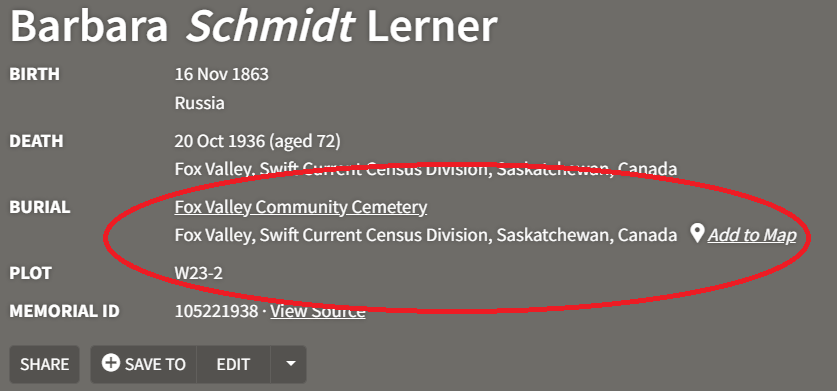
The larger mystery for some time was where Barbara was buried. When I first started investigating this in the late 1990s, the sources available to me had her interred at either the Fox Valley Cemetery or the Rastadt Cemetery. After further investigation, and a trip to Fox Valley and Rastadt in 1997, I determined that she must be buried at the Fox Valley Cemetery.
While there is no marker for her at Fox Valley, the cemetery records show that she is buried in plot as W23-2, which is right beside where her husband, Michael, is buried (plot W23-3). As well, other close Lerner family members are buried in Fox Valley Cemetery, including their son Jerome Lerner (plot W13-1).
On the contrary, there are no other Lerners buried in the Rastadt cemetery. As well, there appears to be inconsistency in the plot in which she is supposedly interred in Rastadt. An older listing from 1997 indicated plot 61; in 2004, it was said to be plot 70. This inconsistency casts doubt on the possibility Barbara is interred at Rastadt. In any event, the Fox Valley Cemetery records far outweigh the secondary sources for Rastadt Cemetery.
My Michael (“Mike”) Lerner, my Great Great Grandfather, his wife Barbara Schmidt, and their family were the first of my Germans from Russia ancestors to leave the German colonies in the Russian Empire for North America. He spent about a third of his life in Russia, a third in Texas, and a third in Canada, and was a citizen of all three.
Mike was born on May 2, 1862 in Rastadt, a German colony in the Beresan district of what is now Ukraine, which at the time was part of the Russian Empire. Mike’s paternal line originated in the Karlsruhe area of Baden. In fact, the capital of Baden at the time the Lerners left for Russia was Rastadt.
I don’t know much about Mike’s life in Russia, particularly his childhood. He married Barbara Schmidt in February 1883. Nine months later, they had their first of 14 children. Until the family emigrated in 1893, Mike was a farmer in Rastadt. He may have actually owned his land, as a map of Rastadt in Joseph Height’s book Paradise on the Steppe shows several pieces of land which belonged to individuals with the surname Lerner.
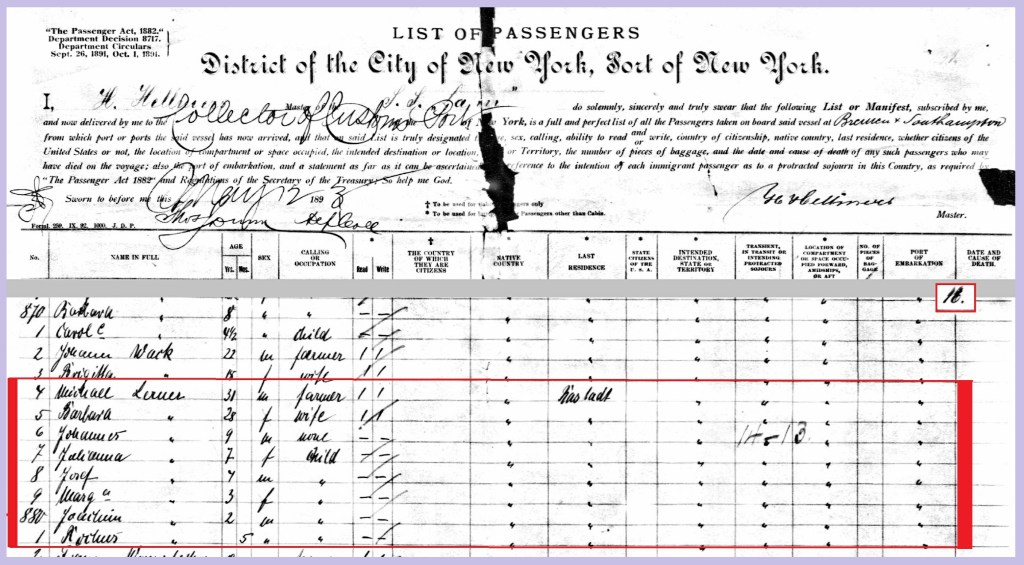
The family departed Bremen aboard the S.S. Lahn in the spring of 1893. By that time, they had six children. Four of those children were aged five and under (the listed age for Joseph is likely incorrect), with the youngest, Rochus, being about five months old at the time. The ship landed at Ellis Island on May 12, 1893. From there, the family made their way to Clay County, Texas, arriving there by June 1893.
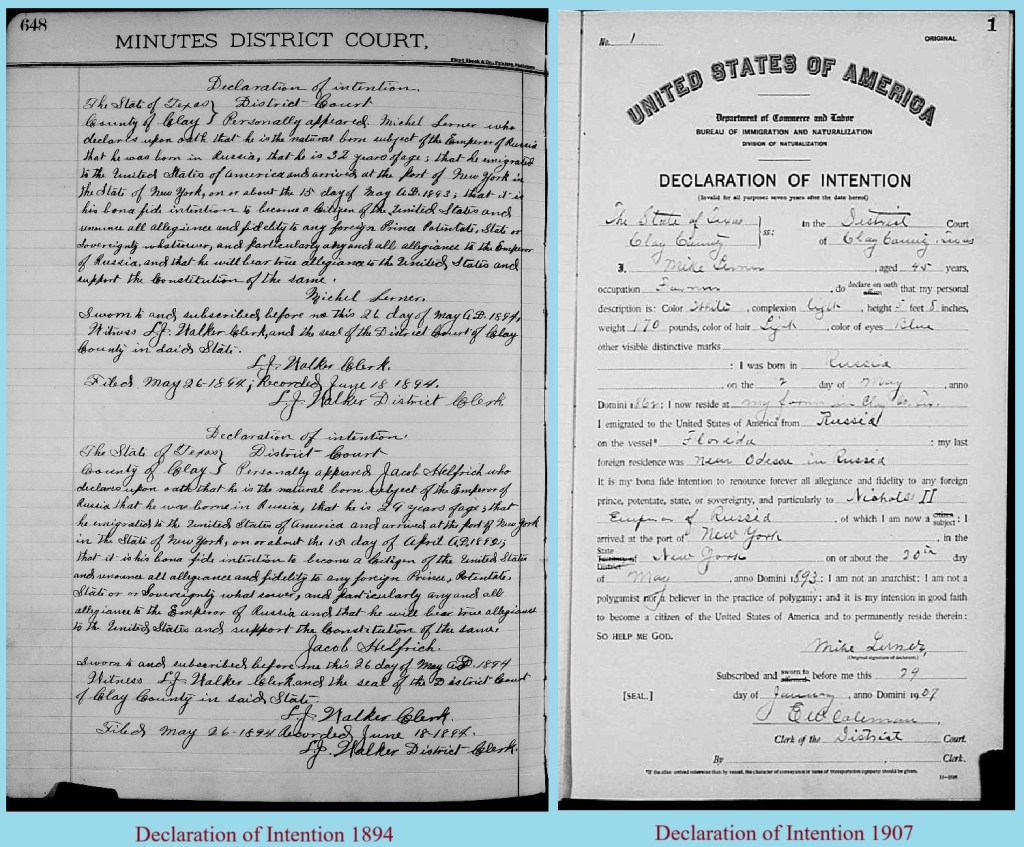
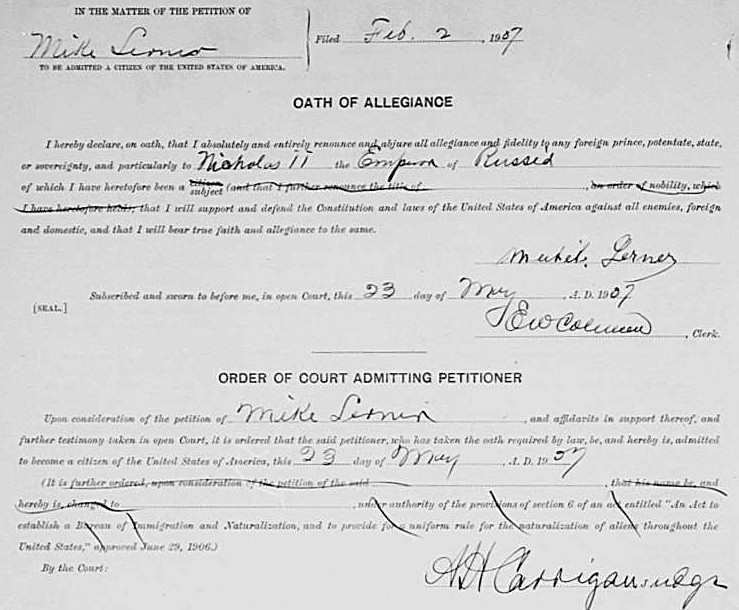
A year later, on June 18, 1894, at the Clay County District Court, Mike made a Declaration of Intention to become an American citizen. However, it seems that he was in no hurry to follow through. Mike did not take any further steps towards citizenship until January 29, 1907, when he filed a new Declaration of Intention. Soon after, on May 23, 1907, Mike took an Oath of Allegiance and became an American citizen.
Also shortly after arriving in Clay county, and no later than 1894, Mike had established himself as a farmer. By 1910, Michael owned his farm, free of any mortgage, on Jacksonboro Road. In that time, he and Barbara had eight more children.
In 1912, Mike’s son Joseph had migrated to Maple Creek, Saskatchewan. Sons Rochus and Jerome (my Great Grandfather) followed suit, in 1913 and 1917, respectively. In 1918, Mike made the move to Canada and began farming outside Fox Valley, Saskatchewan. He continued farming there well into his 60s. When Mike became a Canadian citizen on December 5, 1929 when he was 67, he was still farming.
In fact, Mike was still farming into his 80s. After his son Jerome (my Great Grandfather) separated from his wife Emelia (my Great Grandmother), he moved in with Mike. Sometime around 1944, Jerome’s daughter, Adeline Lerner, came to live with Mike and her grandfather. Mike was a widower by then, as Barbara passed away in 1936. According to Adeline, her grandfather was still running the farm at the time. Adeline told me that her grandfather generally spoke German, but could speak English as well.
Mike died in Fox Valley on January 16, 1947. He is buried at the Fox Valley Cemetery, next to Barbara.
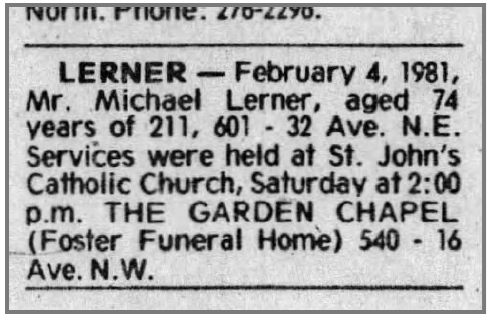
Calgary Herald, February 9, 1981, page 45
“Baden in the early 19th Century” image attribution: Creative Commons Attribution 2.5 Generic license via Wikimedia Commons. Author: ziegelbrenner.


 A Deck of Ancestors