Today we’ll be driving through Fort Macleod, Alberta. Every time we do that trip, I always remind our kids that’s where the father of one of my dearest friends was born, followed by saying that’s where Joni Mitchell was born.
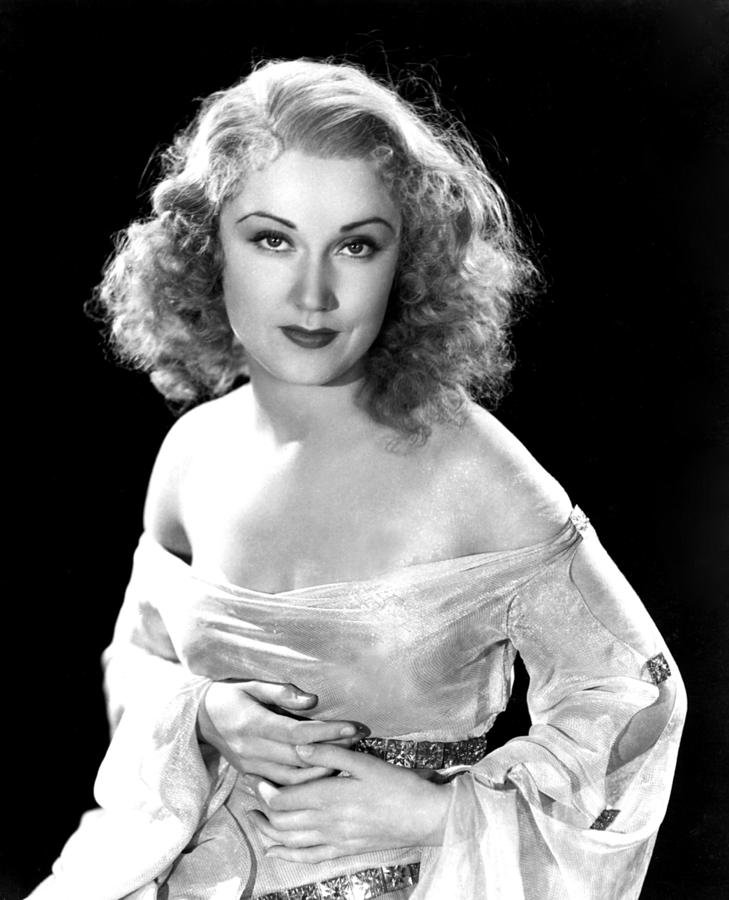
This time, I said it while at my mother’s house. She then started to wrack her mind for the name of another celebrity that she thought was born there. After a few minutes of her describing who she was trying to remember, I realized that she was thinking of Fay Wray.
Vina Fay Wray (1907-2004)
Once I identified who my mother was thinking of, she realized that it was someone born in Cardston, not Fort Macleod.
Years ago Fay Wray was trending on social media because it was her birthday. My mother’s father, Leo Burgess, was born in Cardston and his grandparents were amongst the original settlers there. So I decided to look her up.
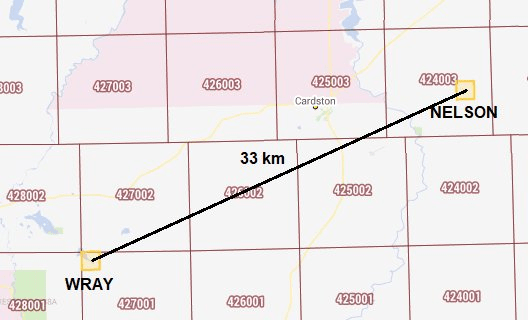
Born Vina Fay Wray, she was born near Cardston, Alberta in 1907. My great grandmother lived near Cardston with her family at that time. I wondered if the families might have known each other. They were all Mormons in the same stake (like a parish), so they could have known each other through church. Fay was born after the 1906 census, but I found her parents there. Using the census data, I mapped out where both families lived. It turns out the Wrays lived almost exactly midway between Cardston and Waterton, while my great great grandparents and their children lived east of Cardston, less than 10 km from town.
Heronimus Michael “Jerome” Lerner (1895-1954) Emelia Anton (1903-1997)
Welcome to the last suit of the deck of ancestors I’ve been writing about for the 2025 edition of the 52 Ancestors Challenge – with the unique spin I’ve given the challenge this year. This final suit relates to my mother’s maternal grandparents, Heronimus Michael “Jerome” Lerner (1895-1954) and Emelia Anton (1903-1997). Both were Germans from Russia. I never met my great grandfather – neither did my mother – but I knew my great grandmother very well, who passed away shortly before I turned 30.
Very long story short, just after Catherine the Great, Empress of Russia, came to power in 1762, she issued a manifesto inviting foreign settlement in lands controlled by Russia. A significant number of those who responded to the offer were German peoples (as there was no “Germany” at the time). Even a summary of the reasons behind Catherine’s invitation and why so many Germans responded would significantly detract from the topic at hand.
There are some similarities between what Catherine promised in her manifesto (and subsequent manifestos by future Czars) and what later was promised to homesteaders by the United States and Canada. Catherine’s incentives included free transportation to Russia, free land, freedom from taxes for 10 to 30 years, interest-free loans to buy equipment, freedom of religion, exemption from military service, retaining their language, and local self-government. However, circumstances changed, so in the late 19th and early 20th centuries the descendants of those original colonists left to homestead in the United States and Canada.
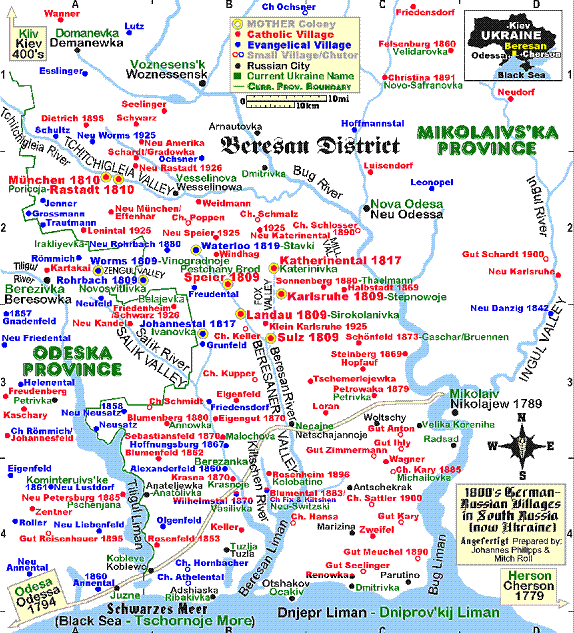
Both Jerome and Emelia’s ancestors originally hailed from what is now western Germany, particularly the Rhineland-Palatinate and Baden-Württemberg. Those ancestors all settled in colonies located in what is now the Ukraine (“Odessa” or “Black Sea” Germans), particularly what was known as the Beresan District, north-east of Odessa. Most of the colonies took the names of the German cities and towns from which the settlers came. Many of my German-Russian ancestors were located in Rastadt and Karlsruhe.
The Beresan in the 1800s (source: http://www.rollroots.com/beresanmap.htm). Essentially all colonies were based upon the religion of the settlers. Rastadt is in the upper right corner; Karlsruhe is close to the centre. Both were Roman Catholic colonies.
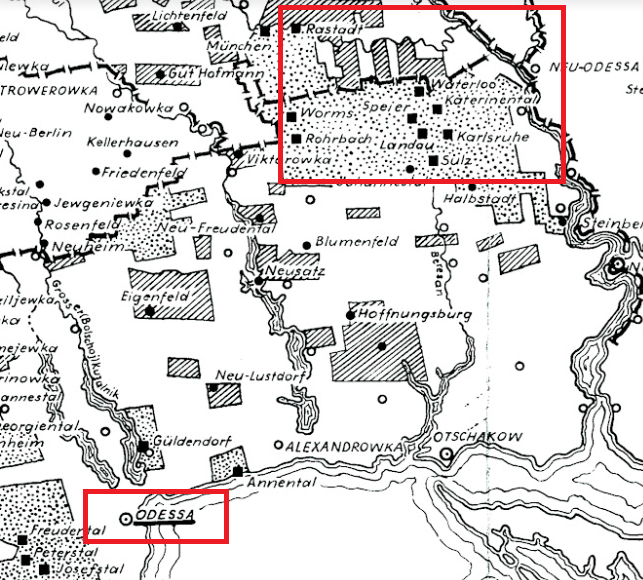
The Beresan District in relation to Odessa, in what is now Ukraine.
Neither Jerome nor Emelia were born in the Beresan, where each of their parents were born. Jerome was born in Henrietta, Texas on March 12, 1895, less than two years after his parents emigrated from the Beresan. Emelia was born in Selo Suchoi, Veronesch, Russia on January 1, 1903. I assume that date is under the Julian calendar. Emelia’s parents had left the Beresan sometime around 1899 and remained in Russia until 1912, when they left for Canada.
Emelia’s family first settled near Maple Creek, Saskatchewan. By 1920, they were living in Rastadt. Just as the German place names followed the colonists to Russia, they followed them to the new world as well. In the meantime, Jerome’s older brother had moved to the area, starting a gradual migration of the Lerner’s to and from Saskatchewan. Jerome came to Canada in 1917 and settled near Fox Valley, not far from Rastadt, taking up farming like he had in Texas. Jerome never obtained Canadian citizenship; I don’t know if Emelia ever did.
Jerome and Emelia married in Rastadt on August 3, 1920. Jerome continued to farm land south of Rastadt throughout the marriage. They had six children together over their 17 year marriage.
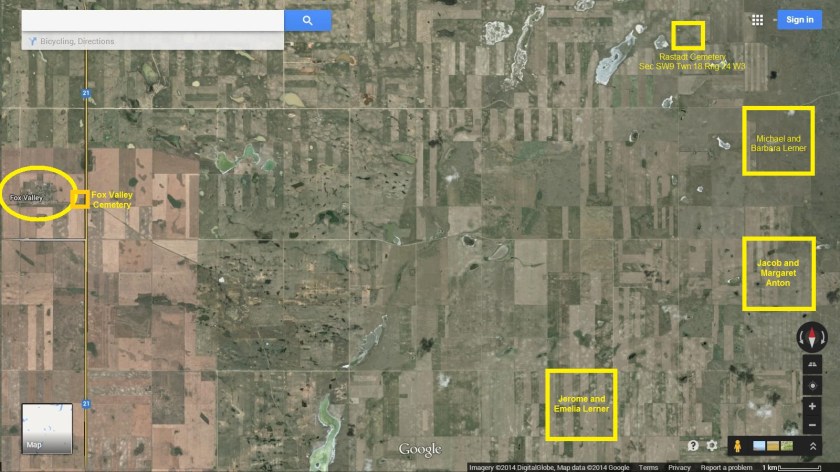
This map shows where Jerome and Emelia lived while they were together. Fox Valley is in the circle on the left. Michael and Barbara Lerner (née Schmidt) were Jerome’s parents; Jacob and Margaret Anton (née Heck) were Emelia’s parents.
Unfortunately, Jerome developed a mental health condition*, which contributed to the breakdown of his marriage with Emelia. Their daughter, my Aunt Adeline (“Addie”), told me that she believed her father had schizophrenia, although I doubt there was ever any formal diagnosis.
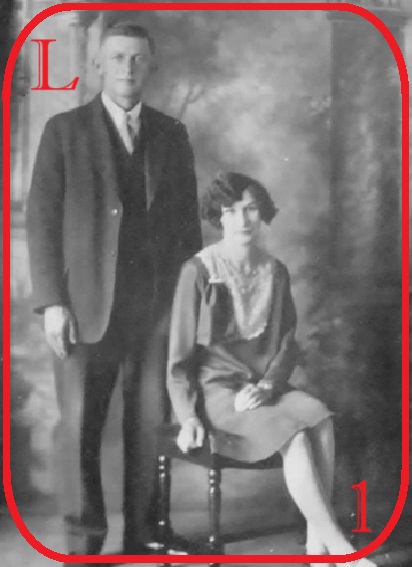
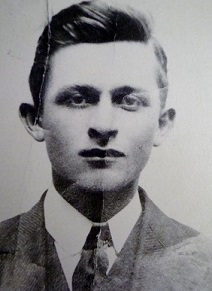
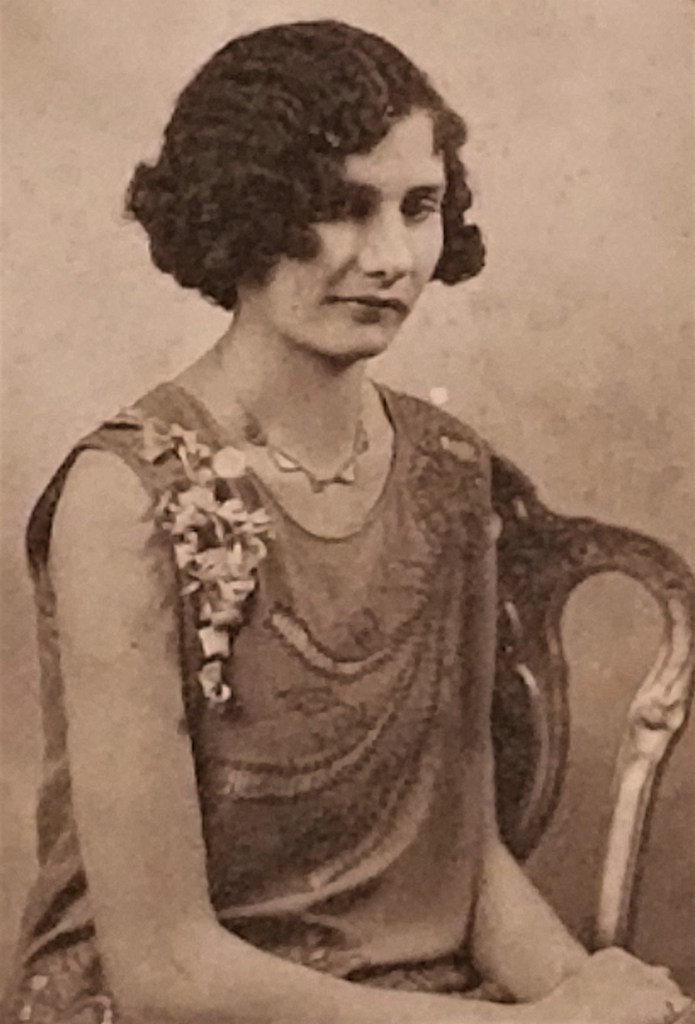
Jerome Lerner and Emelia Anton. The photo of Jerome is from his application for an American passport in 1917, when he was 22. My guess is that the photo of Emelia was taken when she was in her mid-teens.
My great grandparents separated sometime between 1937, when their youngest son Herb was born. My guess is that when the 1931 census is released in 2033, it will show them as having been separated. Jerome and Emilia most likely did not file for divorce. They do not come up on the Library and Archives Canada divorce database. Being Catholic, they might have simply separated without divorcing. However, my Aunt Addie told me it had nothing to do with being Catholic, it was because it was so difficult to get a divorce at the time they separated. (It was not until 1968 that the divorce laws in Canada were liberalized to make it easier to obtain a divorce.)
My mother once told me that a rift developed between the Lerners and my great grandmother over her separation from Jerome. It seems there was some sort of expectation that my great grandmother should have remained with Jerome despite his troubles.
After they separated, Jerome continued farming in the Rastadt area. Aunt Addie told me that after her parents separated, her father lived with his father, Michael Lerner. Michael had become a widower not long before Jerome and Emelia separated. Aunt Addie told me that her father was still able to care for himself, such as dressing himself and cooking, but he needed some guidance.
When her parents separated, Aunt Addie went with her mother, but when she was about 13 years old (around 1944), she moved in with her father and grandfather for about a year. Aunt Addie described her father as quiet and intelligent, and was able to reason through things quite well. He did not talk much, but would “explain stuff” to Addie from time to time. Addie remembers that he read the newspaper a lot. Aunt Addie added that he could become upset very quickly, which she attributed to his mental condition. Addie said that her Grandfather took care not to upset Jerome or “push his buttons.”
When I asked Aunt Addie whether her father was still working at the time, she told me that he didn’t really work and that work would upset him. He would help with the harvest, but he would “moan and groan all night.” Aunt Addie believed he wasn’t used to that kind of regular work and it really wore out his muscles. To whatever degree Jerome was still able to work, I note that the registration of his death stated that he was a farmer at the time.
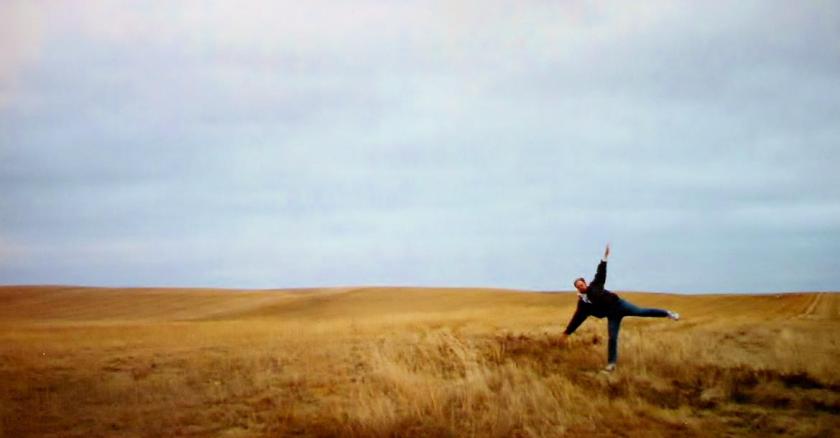
This is me on the land my Great Grandfather Jerome farmed. This was taken in April 1997, only a few months after my Great Grandmother Emelia passed away. The house they lived in – where my grandma Helen Lerner was born – stood around here. At the time, the house still existed, but had been moved elsewhere.
Aunt Addie said that her father spoke both English and German. Her grandfather mostly spoke German, but could understand English. So both languages were used at home. Aunt Addie said that her Addie said that this meant she grew up speaking both languages, although she had lost her ability to speak German later in life. mother mostly spoke to her in German, because it was better than her English. She added that her mother also spoke some Russian, which my mother had told me as well. As my mother described it, when her grandmother was still living in Russia, she’d speak German with her family and Russian with people working the farm.
When I told Aunt Addie that I was 13 before I learned her mother could speak German (which caught me quite by surprise!), she commented on how her mother spoke with an accent that wasn’t quite German and not quite Russian. She concluded it was its own thing. I concurred, because I could never tell what kind of accent my great grandmother had before I learned she was multilingual. In fact, I don’t recall thinking she had an accent; I think I thought she sounded the way she did because of her age.
According to Aunt Adeline, it sounds like her mother remained at the home she had shared with Jerome after their separation. Addie said that her mother leased out the farm land. How long my great grandmother remained there, I do not know. However, Emelia was still there when Aunt Addie moved in with her father in 1944. Sometime afterwards, Emelia moved to Alberta, likely first to Medicine Hat, and then on to Lethbridge.
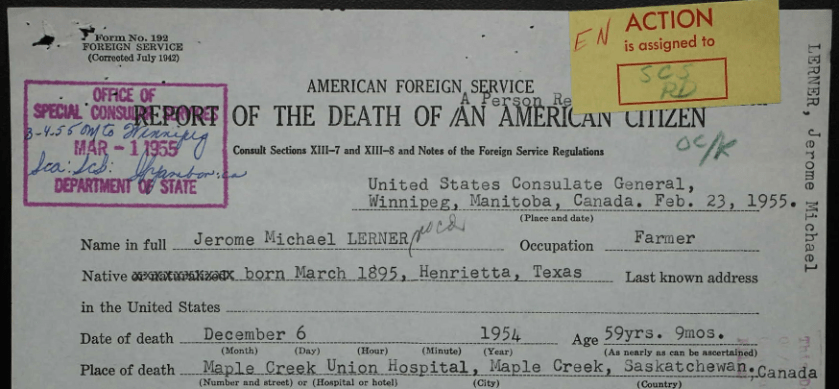
Jerome passed away in hospital in Maple Creek on December 6, 1854, due to kidney disease. He was buried at the Fox Valley Community Cemetery. Meanwhile, by the mid-1950s Emelia was working as a chambermaid at the Alexander Hotel in Lethbridge. By 1958 Emelia had largely retired. She was collecting a pension and was living off an inheritance she had received from her father. She bought a house on 19th Street in Lethbridge.
Sometime in 1958 or 1959, Emelia married Walter Henry Wright. He died on December 4, 1978. While I saw him every time we visited my great grandmother, I don’t really know much about him. Most of what I learned about him is from his obituary, from when he died in December 1978. Other than the fact Walter served in World War II, I have no idea about his life before marrying my great grandmother or what he did for a living.
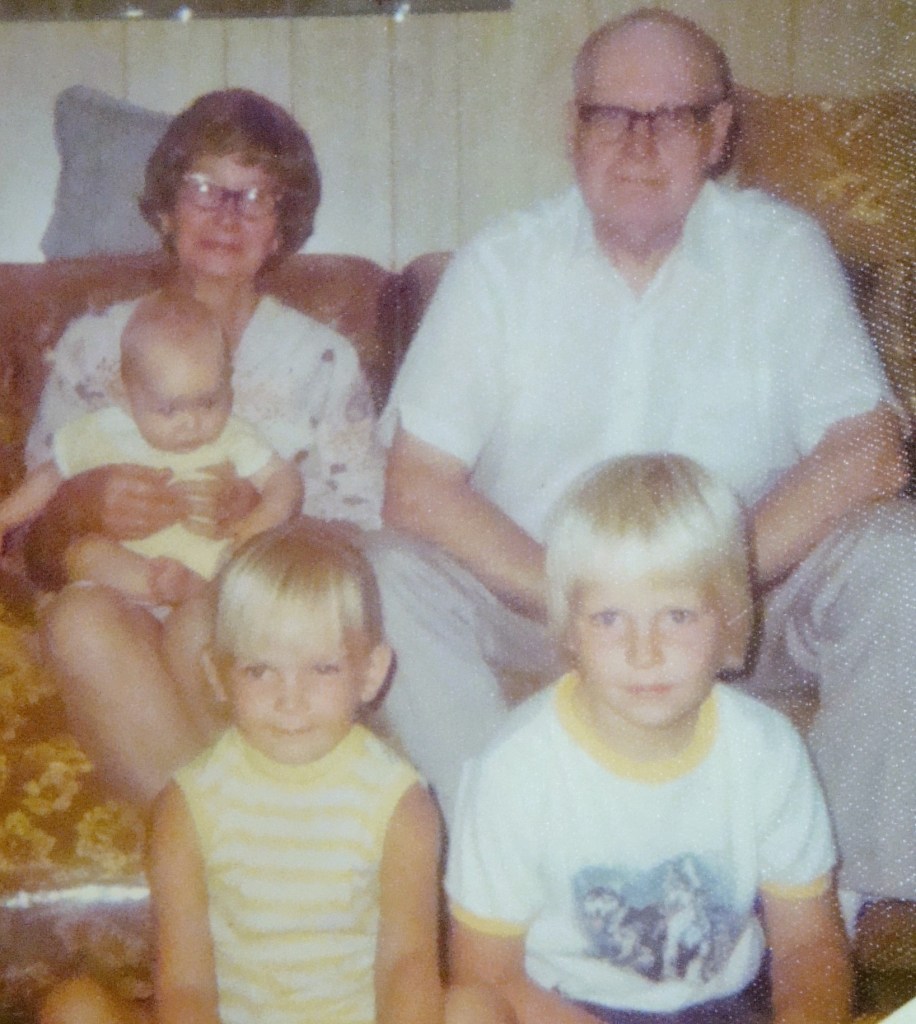
Me and two of my siblings with Emelia and Walter.
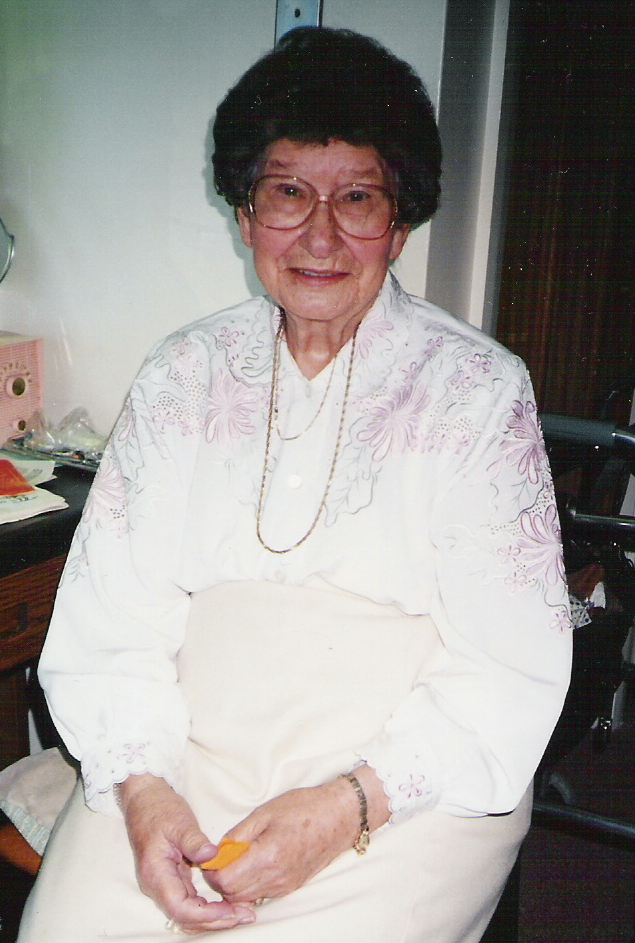
Emelia survived Jerome by fifty years and Walter by twenty years. She even outlived my grandmother, Helen Lerner, by more than ten years. Emelia continued to live on her own at home for many years after Walter’s death, but ultimately moved into a nursing home. I honestly cannot remember when she moved. She was there at least by her late 80s – I know she was there before she turned 90. I messaged my mother to ask if she could recall when, but couldn’t. I thought one of my sisters had a reason to remember, but she couldn’t recall it either.
In the last years of her life, Emelia’s activities included bridge and bingo. She was proud of her mental acuity and ability to play the game, but was always unhappy that her peers did not. My grandfather, Leo Burgess, often took Emelia to bingo. I remember my grandfather “complaining” that he was in his mid-70s and still had mother-in-law problems.
Emelia died on January 19, 1997 in Lethbridge. The memorial mass was held at St. Basil’s Catholic Church in Lethbridge and my mother gave the eulogy. Emelia was cremated and buried at Mountain View Cemetery, alongside her son Jim, who died in 1983.
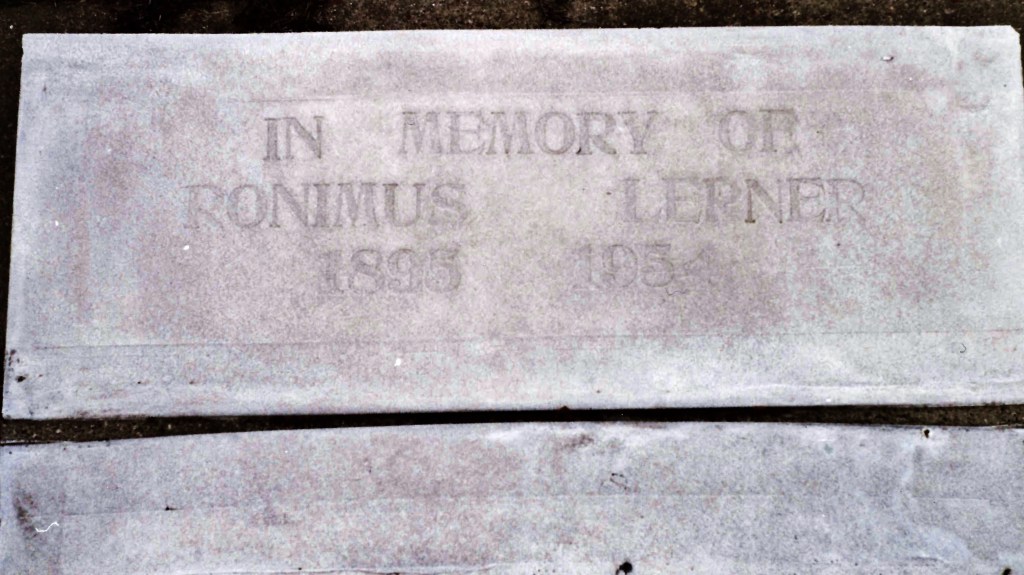
Jerome’s grave at the Fox Valley Community Cemetery
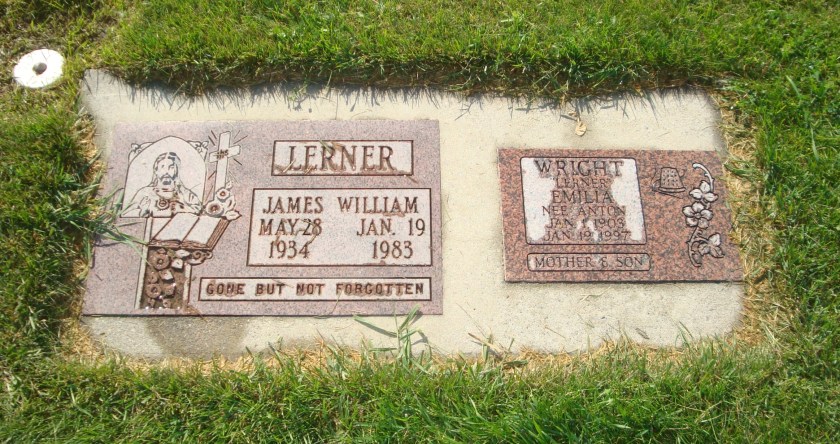
Emelia’s grave at the Mountain View Cemetery in Lethbridge, alongside her son Jim.
* There are resources available if you need help with your mental health. In British Columbia, where I live, this includes:
→ Calling 2-1-1 will connect you with community and social services.
We’ve reached the last card in the deck for my mother’s paternal line and the last of my Mormon ancestors who I’ll be looking at for this year’s 52 Ancestors Challenge.
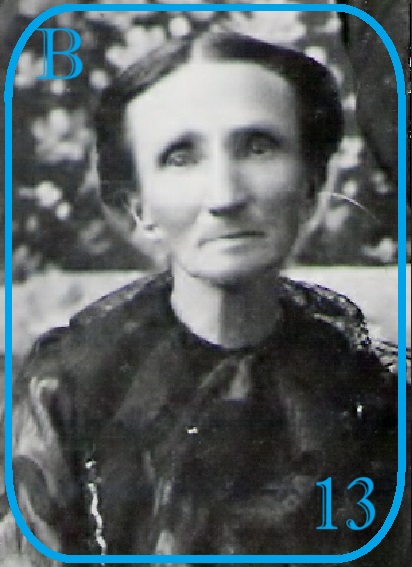
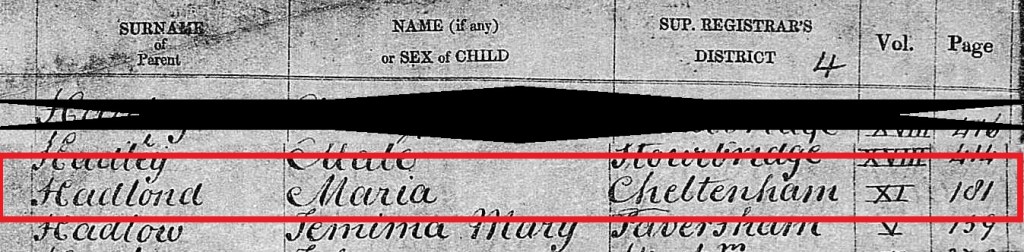
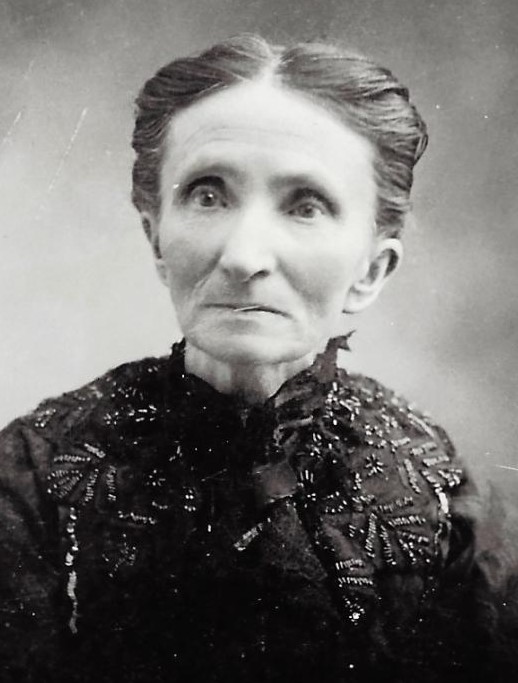
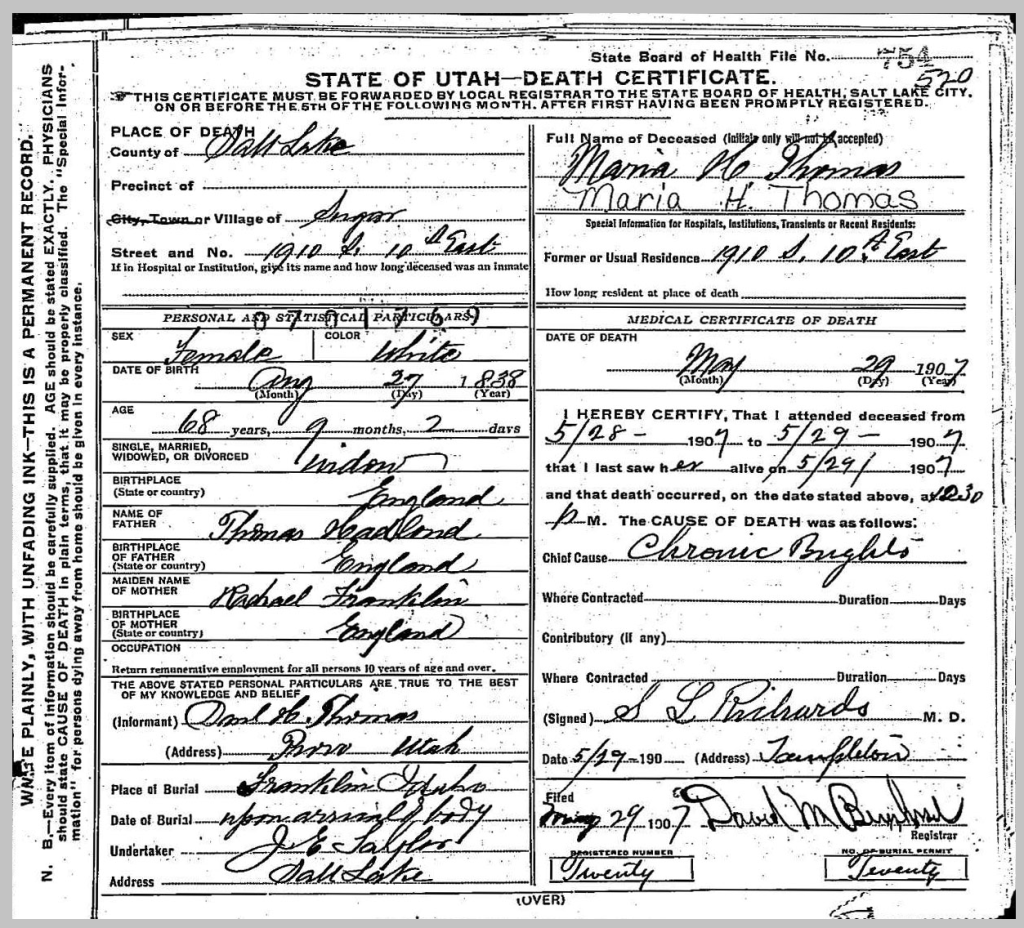
Maria Hadlond, my Gx3 Grandmother, is my most recent ancestor from England. I have to go back another five generations on some of my other maternal lines before I can come upon anyone else from Old Blighty. Maria was born in Cheltenham, Gloucester, England on August 27, 1838, to Thomas Hadlond (1814-1892) and Rachel Franklin (1817-1879).
Thomas and Rachel were originally from West Oxfordshire, but were living in Cheltenham, on the edge of the Cotswolds, in the years before they emigrated. At the time, Thomas was working as a domestic servant.
Sometime in the late 1840s, the Hadlonds heard the preaching of some Mormon missionaries. On November 23, 1846, Rachel was baptized into the church. Several of their older children were baptized in the next two years, including Maria who was baptized on December 21, 1848, when she was 10 years old. I have the impression that while Rachel was a fervent convert, Thomas wasn’t too taken with the new religion and never actually joined it in his lifetime. He wasn’t baptized until 1893, a year after his death.
Whatever Thomas’s beliefs, the family left England for America to join the migration of Mormon converts who hoped to join the settlement in Utah. It is most likely the family left England sometime after September 1850, when their daughter Alice was born, and before June 1853, when their son Franklin was born. In fact, while their destination was ultimately the United States, it seems that the family entered North America through Canada, as Franklin was born in the Province of Canada (likely Canada West, which is modern-day Ontario).
By no later than 1856, the Hadlonds were in St. Louis, Missouri. It seems that the family’s circumstances were such that they did not plan to move to Utah anytime soon. However, I have not been able to determine whether this was because of finances (many Mormon migrants took years moving west while saving up for the trip) or because Thomas was not an adherent or all that serious about the church.
When Maria was 16, her mother met a Mormon missionary by the name of Preston Thomas who was passing through St. Louis on his way to Texas. When Rachel learned that Preston planned to arrange for a company of Texan converts to migrate to Utah, she “begged” him to take her three oldest children with him. This included Maria. Thomas did as requested and took the three Hadlond children to Utah. Ultimately, Maria’s two siblings returned to St. Louis and lived out the rest of their lives there. Maria remained in Utah.
Two years later, on October 8, 1856, Maria married Preston in Brigham Young’s office in Salt Lake City, with Young himself officiating. Preston was 42 years old at the time; Maria was 18. Moreover, this was a plural (polygamous) marriage, as Preston had two other wives. Preston’s first wife, Sarah Jane Morehead, was born the same year as Maria’s mother and they had a daughter only a few months younger than Maria. Preston’s second wife, Maria Foscue, was 16 years older than Maria. In order to avoid confusion between the two wives, Maria went by “Molly”. Molly and Preston had nine children together. This was in addition to the nine Preston fathered with Sarah Jane and four he fathered with Maria.
For the first four years after Molly married Preston, the entire family lived in Lehi, Utah, where Molly gave birth to her first two children. This included Ella Thomas, my Gx2 Grandmother.
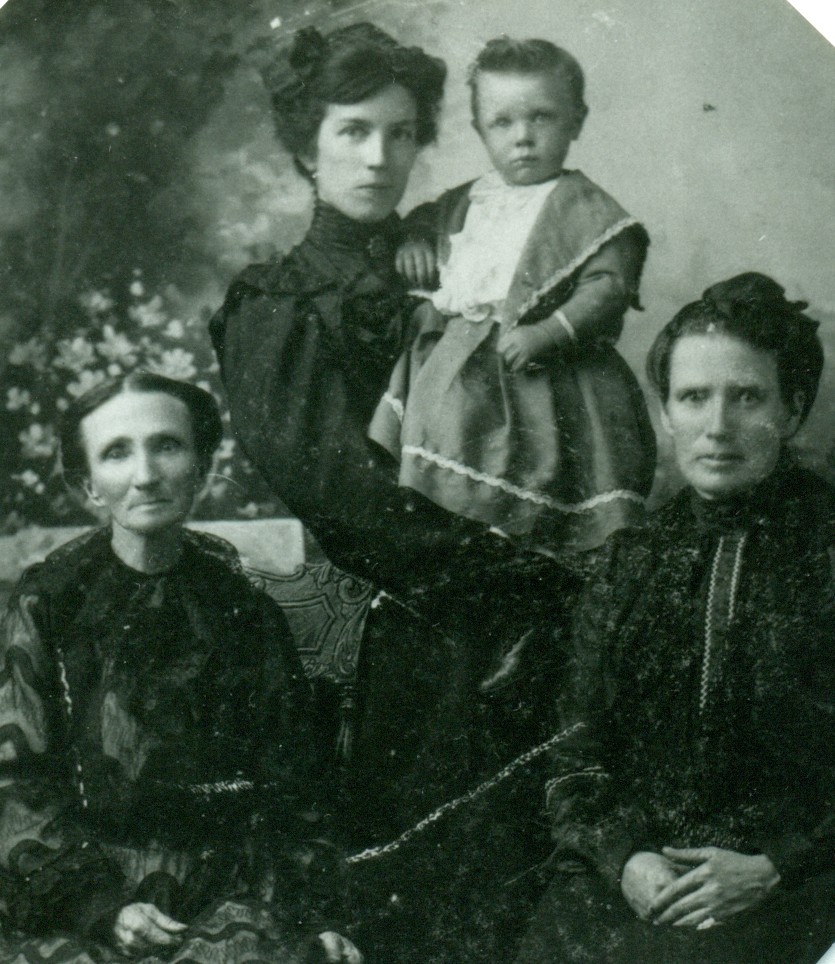
Four generations: Maria with her granddaughter Maria (“Mimie”) Lamb (née Thomas) holding great granddaughter Rulon Lamb, and Ella Nelson (née Thomas), my Gx3 Grandmother.
In 1860, Brigham Young had Preston join a team exploring an area in northern Utah, where Young intended to form a new settlement that is now Franklin, Idaho. However, at the time, and for many years afterwards, the inhabitants thought they were in Utah. They only discovered later that the town was a mile north of the Utah-Idaho border.
Young directed Preston to return to Lehi to collect his family and join the first settlers. In addition, Young appointed Preston as the first Bishop of Franklin. Preston did as he was asked (today we might say “voluntold”), but it appears that Maria Foscue might have refused and remained in Lehi with her children.
In 1863, Brigham Young formed a team of 12 to 15 men to explore the Bear Lake Valley in Idaho, not far from Franklin. This group included Preston. By September 1863 a settlement had been erected in Bear Lake Valley where Paris, Idaho now stands. Preston moved the family there in the spring of 1864. A few years later, Preston moved the family to Fish Haven, about 20 kilometers south of Paris.
During the family’s time in Idaho, Preston carried out at least one more major mission to the South. This was in addition to Preston’s other endeavors, which included a term as a judge of the Utah Probate Court (when it was still believed that Franklin was in Utah) and a run for office for the Idaho territorial legislature (after the discovery Franklin was in Utah). This obviously left Sarah Jane and Molly without his support while they raised a significantly large household of children.
Preston’s absences from home were compounded when he left this world following an accident that occurred in 1877 while he was building a house on his property. Molly’s youngest child was seven months old at the time.
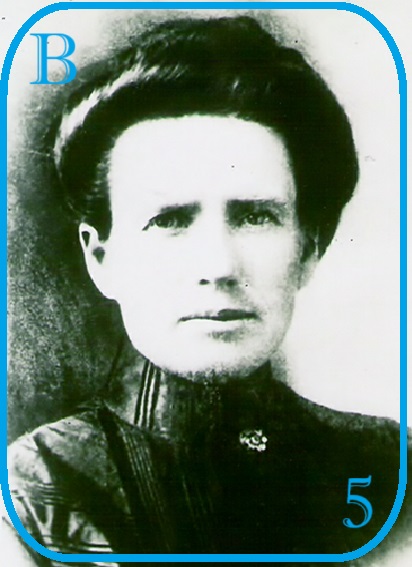
Maria with her three youngest children: Daniel, Letitia, and Rosabell (seated).
I have not yet tracked where Molly lived in the years immediately following Preston’s death, so I don’t know if she remained in Idaho or moved back to Utah. However, over the years several of her children joined the Mormons who were settling in Canada, in what is now the southern part of the province of Alberta. For example, her daughter Ella had moved there with her husband John Nelson. So in 1896, Molly and four of her children – all of whom were now adults – moved to Cardston, Alberta. Census records show that in 1901 Molly (who was going by Maria again) was a neighbour of one of her sons.
In 1902, Maria moved back to the United States and settled in the “Sugar House” neighbourhood of Salt Lake City, one of the oldest neighbourhoods in the city. Maria remained at the same house for the rest of her life. She passed away at home on May 29, 1907. She is interred in Franklin at the Franklin Cemetery.
Next week we start the last suit, covering my mother’s maternal line, who are Germans from Russia.
My Gx2 Grandmother, Ella Elizabeth Thomas, is a rarity amongst my direct female ancestors, as she was one of the few with an occupation outside of the home. Ella was a midwife and nurse for about 40 years, serving the town of Cardston, Alberta and the surrounding community.
Ella was born in Lehi, Utah on October 9, 1859. Her father, Preston Thomas, was originally from North Carolina. Her mother, Maria Hadlond, was from England and emigrated to the States with her family when she was a teen.
When Ella was about 18 months old, her family moved nearly 200 kilometers north to Franklin, Idaho, which is located right on the Utah border. It was the first non-Indigenous settlement in Idaho. In fact, when the town was founded, the original settlers thought they were within the boundary of Utah. Another fun fact about Franklin is that its county, also named Franklin, is the only county by that name in the United States that is not named after Benjamin Franklin. Rather, it was named after Franklin Richards, a Mormon leader.
Somehow, by 1879, when she was 19, Ella was living in Salt Lake City. It is not clear what events in her life led her to be there. Salt Lake City is a fair distance south of Franklin. Her father died in 1877, so it may have been that her mother relocated to the city after becoming a widow. That’s a matter for further research.
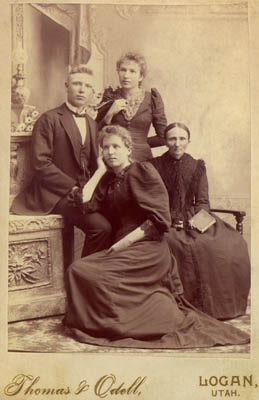
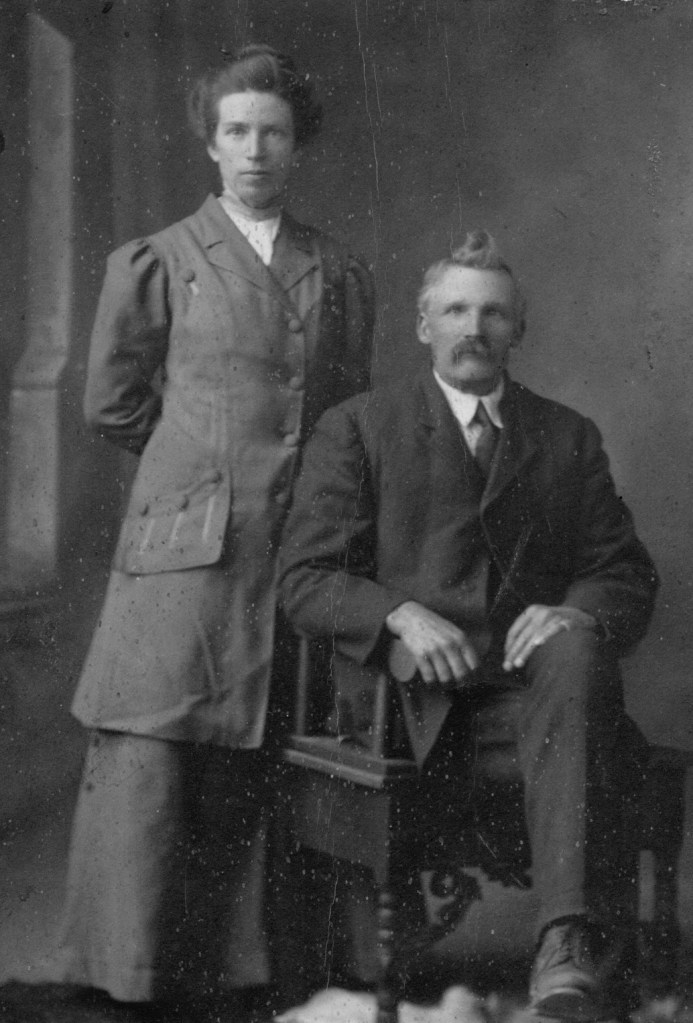
Ella and John. One source I’ve seen says this is their wedding photo, but I have a hard time seeing a 19-year-old and a 24-year-old. Of course, the stern expressions, style of dress, and fact it’s black and white all serve to age them.
In Salt Lake City, Ella married John Alexander Nelson on January 9, 1879. After marrying, the couple relocated to Smithfield, Utah, which is relatively close to Franklin. They remained there for about ten years, where Ella gave birth to the first six of their twelve children. In September 1890, the family moved to Canada. They were part of the earliest wave of Mormons to settle Cardston, Alberta after it was founded in 1887.
While John was kept busy by a multitude of endeavors, Ella was soon called to a profession of her own after the family settled in Canada. As a new community, Cardston did not have any physicians or other kind of healthcare providers. The closest doctor would have been in Lethbridge, 80 kilometers away. Today that’s under an hour’s drive; in 1890, it was a long and difficult journey by horse or wagon.
The accounts of Ella’s training as a midwife differ. They all agree that Ella was called to study nursing and obstetrics in her early 30s and was sent to Salt Lake City for training. Several sources say that Cardston’s founder and stake president, Charles Ora Card, issued the direction himself. However, the various sources are inconsistent as to when Ella received her training.
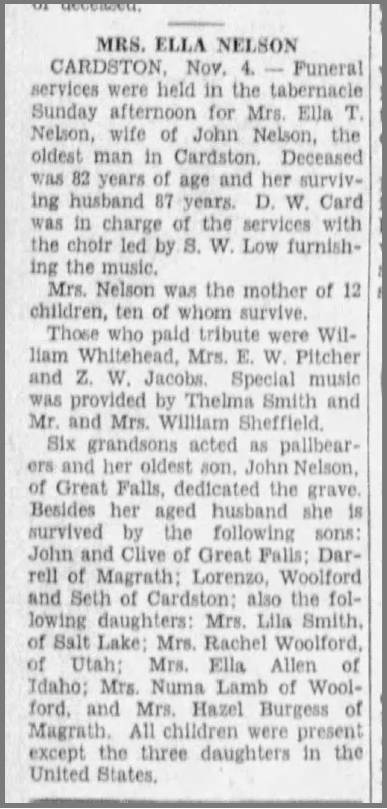
An article about Ella in the Lethbridge Herald following her death said that she left her five eldest children at home, taking with her “a six months old baby”. Given there were five older children left at home, that baby would have been Seth Henry Nelson, who was born October 1891. Another article in an annual family newsletter, Nelson Talk, stated that the baby Ella brought with her was her son Cleveland, who was born in March 1893. Chief Mountain Country: A History of Cardston suggests that Ella “left behind seven small children for John to care for and run the home, only to find she was expecting another child.”
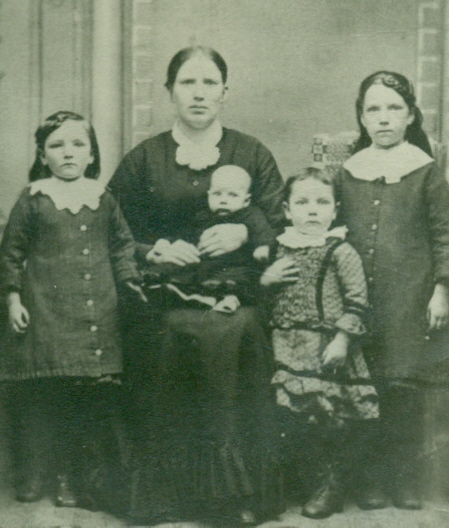
Ella with her four eldest children, Ella, Rachel, Lileth, and Maria. This photo would have been taken in Utah shortly before the family moved to Canada.
Together, these accounts are most consistent with Ella having attended her studies in Utah in 1892. Seth would have been about six months old at the time, and the child Ella learned she was expecting was most likely Cleveland. Of course, Nelson Talk most likely nailed it when it said that John and Ella’s eldest child, Maria, who was about 12 at the time, primarily took care of the other children in the family during their mother’s absence.
In Salt Lake City, Ella trained under a Dr. Shipp for about six months. When Ella returned, she was the only medical help that Cardston and area had for many years. The Herald article says that Ella “answered every call from 1892 to the time when the district was supplied with medical men, and after that time when there was more work than one doctor could do”.
Chief Mountain Country indicated that Ella often received no payment for her services, or would sometimes be paid in goods, such as produce. In a short biography of his mother’s life, Seth wrote that Ella’s regular fee for the delivery was $5 and $1 per day for nursing services after the delivery. However, she would often not receive anything for nursing.
Nevertheless, it seems that Ella did not forego payment easily. Seth said that her sons were often sent to collect on outstanding accounts, which sometimes required repeated trips. An account from another of Ella’s sons was that one woman deducted fifty cents on her own volition because she was paying in cash. Ella promptly sent her son back to get the full $5, who told the woman, “mother is not a storekeeper and does not give discounts!”
All the while, Ella had five more children after becoming a midwife. I have no idea who, if anyone, attended to her for those births. However, Seth wrote that at the time Ella began her service there were “a partially trained midwife or two” in Cardston.
Ella assisted in the delivery of hundreds of babies in her 40 years of service. According to Seth, his mother lost track after 400. Seth proudly said that Ella never lost a mother and rarely lost a baby.
When physicians first set up shop in Cardston, Ella would sometimes act as their nurse. Ella also helped those suffering from diphtheria, typhoid, and childhood diseases. Seth wrote that Ella continued to provide midwife services after physicians had established themselves in Cardston. However, Seth stated that after the Alberta “Medical Professional Act” came into effect, Ella was not permitted to charge a fee for her services.
This was most likely a reference to the Alberta Health Insurance Act enacted in 1935, when Ella was 76. She had already largely retired from working as a midwife and healthcare provider a few years earlier, when she was 73. By that time, Ella was not only a grandmother, but a great grandmother.
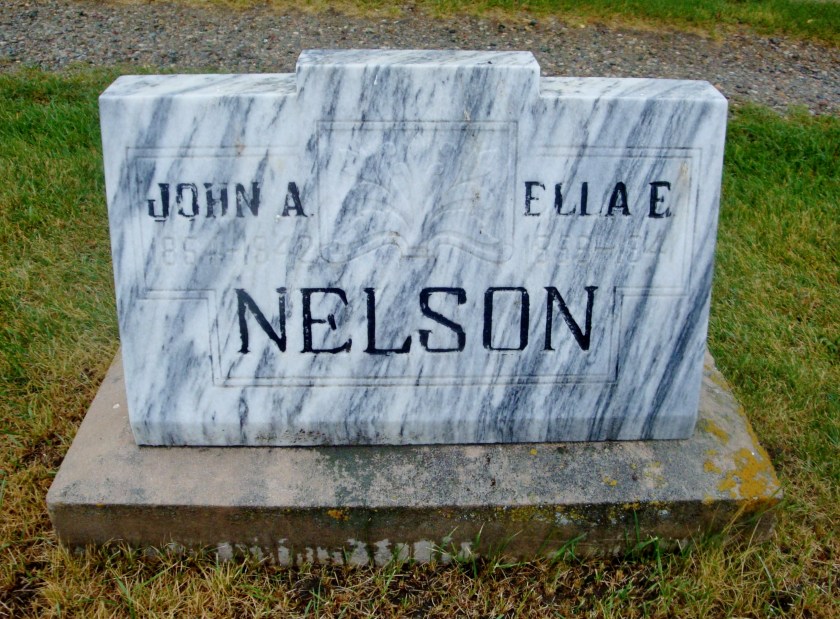
Ella passed away on October 30, 1941, almost a month after her 82nd birthday. The funeral service was held at the Latter Day Saints tabernacle in Cardston and Ella was interred at the Cardston Cemetery. Ella’s pallbearers were all grandsons: Leo Burgess (my grandfather), Grant Lamb, Rulon Lamb, Grover James, and Wilbur Nelson. Her granddaughters Ella Burgess, Julia Burgess, Fontella Burgess, Jean Nelson, Dorothy Nelson, Kathleen Nelson, and Jane Nelson all served as flower girls.
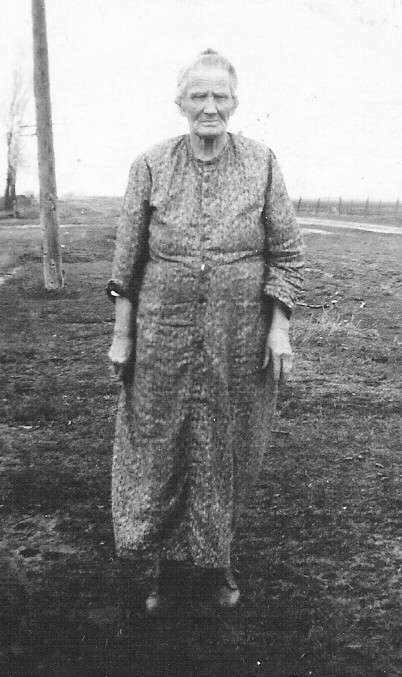
Ella in about 1940
Ella is one of those ancestors for whom I have a lot of respect. When people query which of your ancestors you’d like to meet, Ella certainly comes to mind. It is somewhat strange and special to think of my personal connection with my grandfather, born over 100 years ago, who had a personal connection with someone born in the middle of the 19th Century. While musing over this, I also remembered that just as my grandfather was a pallbearer for his grandmother, I was one of his.
 A Deck of Ancestors