
52W Mark V – Week 13: Frances “Fanny” Robinson

Frances “Fanny” Robinson (1783-1859)

Having managed to catch up on this year’s 52 Ancestors Challenge, I’m once again weeks behind. At least it was for a good reason, as I’ve spent much of the last three weeks learning about my Great x4 Grandmother, Frances “Fanny” Robinson. While I did not find much more in the way of sources, I have managed to form a somewhat better understanding about what little I know about her.

A large part of that time was spent trying to learn more about when and where she was born and died. Nothing major!

Fanny was born sometime around 1783. Many of the secondary sources I have say she was born in Fewston, Yorkshire, England. Few of those sources provide much supporting information, if any, and what they relied upon is tenuous. A newspaper record regarding her marriage indicated that her father was “J. Robinson” of Cornwallis, Nova Scotia. Some of the researchers relied on a baptism registration for a Frances Robinson for August 19, 1783, naming Jonathan Robinson as her father. Other records show Jonathan Robinson was married to a woman named Susannah Snell.

The baptism registration of a Frances Robinson – hopefully the Frances Robinson

I have found some poll and census records of a John Robinson and a Jonathan Robinson from Cornwallis from around the relevant time, but they don’t show a connection to Fanny. They also don’t show a clear connection to Fewston. Moreover, the Jonathan Robinson shown in the baptism record appears to have spent his whole life in Fewston, without ever having emigrated.

Even if Fanny was born in England, I cannot find any indication as to when she left that country. The one thing I do know is that Fanny and her husband are on the only branch of my family tree that goes into the Maritimes.
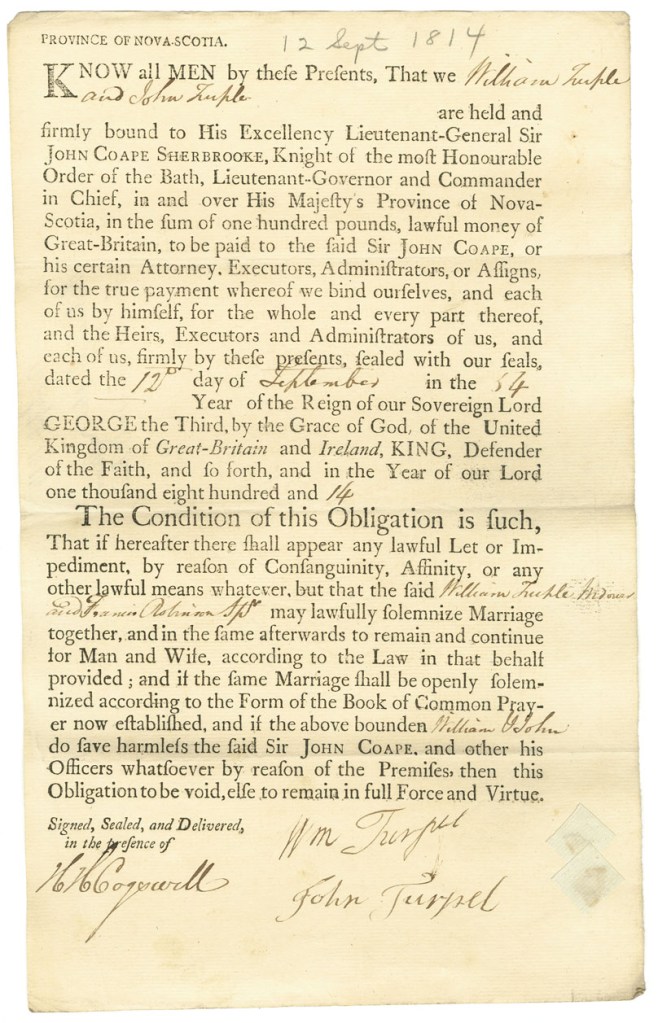
Marriage bond for William Turple and Frances Robinson.

The first reliable records I can find for Fanny are the records of her marriage to William Turple, which took place on September 12, 1814 in Halifax, Nova Scotia in St. Paul’s Church.
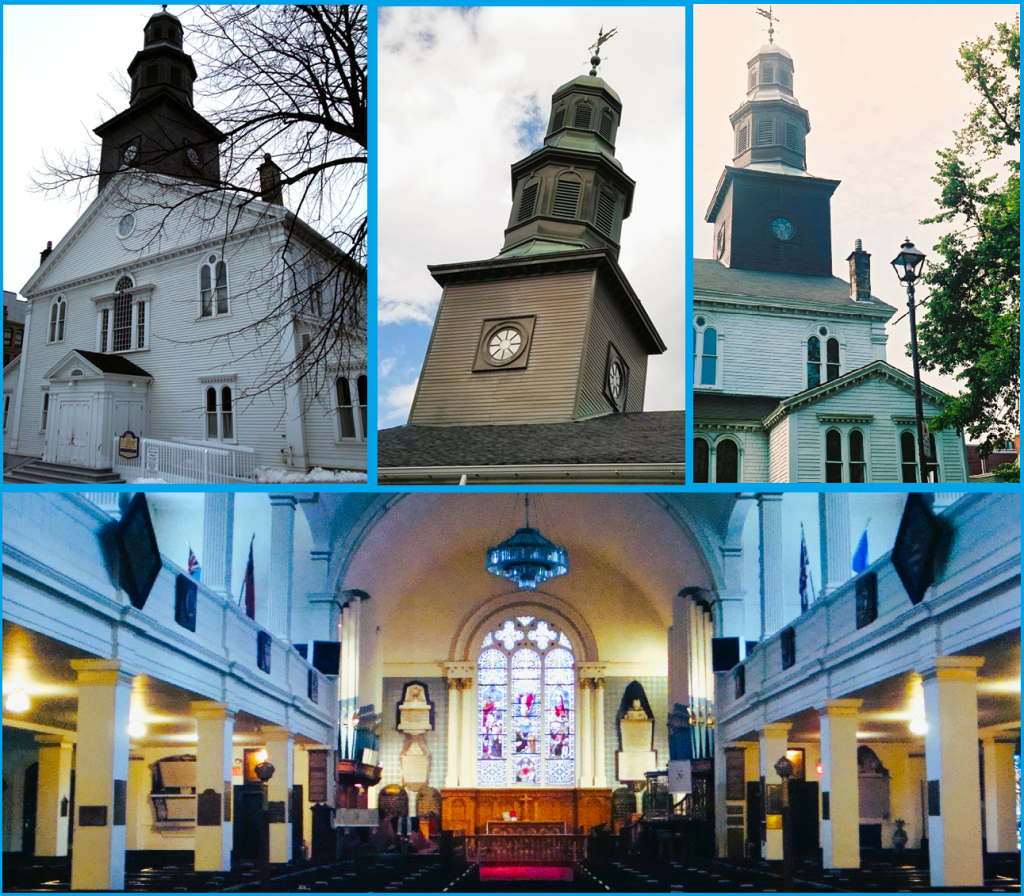
Photos of St. Paul’s that I’ve taken on various trips to Halifax.

Completed on September 2, 1750, St. Paul’s Church is a Halifax landmark. It’s the oldest building in the city and the oldest surviving Protestant church in Canada. My wife has much deeper and more recent Haligonian roots and many of her family have connections to St. Paul’s. Her grandmother, aunts, and uncles were all baptized at St. Paul’s. Her great grandparents, Edmund MacDonald and Beatrice Dimock, were also married at St. Paul’s.
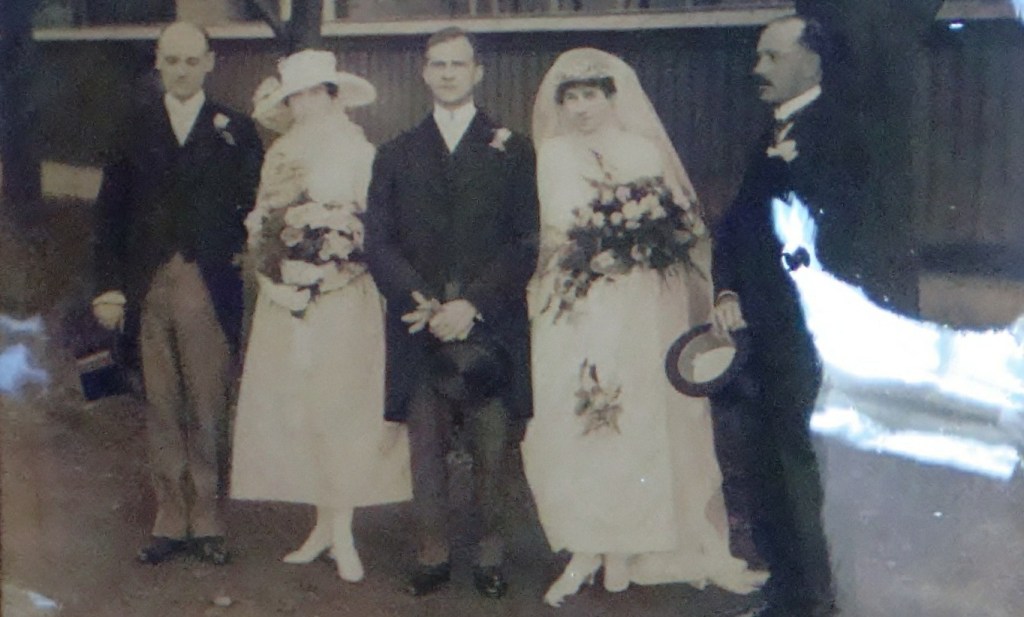
Edmund MacDonald and Beatrice Dimock, who married at St. Paul’s Church in Halifax on September 25, 1918. Beatrice is wearing the veil worn by her grandmother, Ellen Venning, who married George Dimock in 1866. My wife wore that same veil when we got married.

St. Paul’s also bears some interesting scars from the Halifax Explosion of December 6, 1917. It was the largest man-made explosion at the time, resulting from the collision of two ships in Halifax harbour during World War I. One is a piece of wood blown from another building into the interior of St. Paul’s, where it wedged into the wall and has remained there ever since. The other is the Explosion Window. A shattered window on the side of the building bears an eerie human-shaped silhouette. The legend is that it’s the outline of a Deacon who was standing beside the window at the time of the explosion. Of course, that makes no sense, since the force of the explosion came from the outside and the Deacon was standing on the inside.
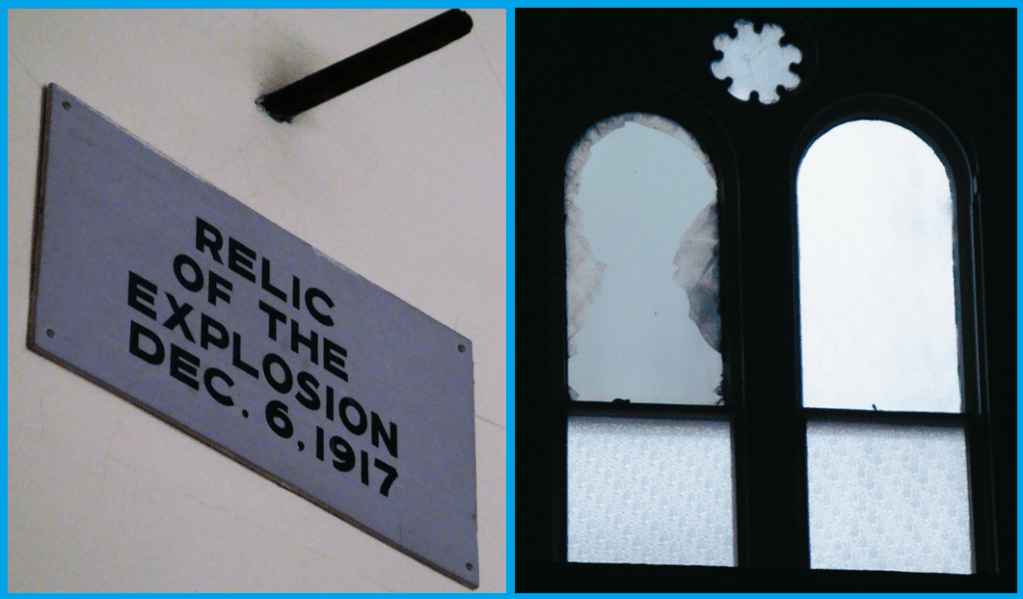
The “relic” of the explosion and the explosion window.

But I digress. Very much.

Returning to Fanny, she and William had at least seven children, although some of my secondary sources list eight. The wrinkle likely involves a William. Fanny and William’s third child and first son was named William, who lived to be 80. Fanny’s fifth pregnancy may have been twins – boys named Stephen and William. It is this William that isn’t included in some lists I’ve seen. The second William is also not mentioned in his father’s will, although it is as likely that he predeceased his father as much as he never existed. Then there’s the next born, who was named Edmund William. Fanny must have really liked the name William.

In 1838, Mormon missionaries appeared in Halifax. By 1843, the Latter Day Saints had established a church there. Fanny and some of her children all joined. Fanny was baptized on November 16, 1844. This was only five months after church founder Joseph Smith died, which had resulted in a succession crisis with several claimants to the leadership of the church.

Fanny and her children found themselves aligned with James Strang, who himself had only joined the Mormon church four months before Smith’s death. However, like many Halifax Mormons, it appears this largely occurred by default rather than any actual theological position or political choice. Strang had risen quickly through the church’s ranks and claimed that a week before his death Smith had given him a letter naming him as his successor. The “Strangites” were one of the smallest factions and Strang’s claim failed quickly.

Brigham Young, who was the successful claimant to Smith’s mantle, sent a delegation to Halifax in 1851 to establish his control of the church in the city. Upon arrival, the delegation excommunicated Strang’s followers, including Fanny and her children. Over time, many of those followers were re-admitted into the church and re-baptized. It seems that Fanny and her children recanted and rejoined the church, but eventually they all left the church other than Fanny’s daughter Susan, my 3x Great Grandmother.

Susan had been married to a man named Charles Brady, who she left sometime after giving birth to a daughter, Amelia. Susan moved in with her parents, who helped raise Amelia. Late in life after moving to Utah with her mother, Amelia wrote about Fanny:

“My dear gramar that raised me (her) name was Fanny Turpel. My grandfather’s name was William Turpel…I love to sit and think of her.”

Just as mysterious as Fanny’s birth was her death. I have not been able to find any record or mention of her death. At most, I assume she died before her husband, because there is no mention of her in William’s will, which was written in 1861 and proved in 1862.
52W Mark V – Week 6: Thomas Hadlond

Thomas Hadlond (1814-1892)

My Great x4 Grandfather, Thomas Hadlond, was most likely born in July 1814, in Churchill, Oxfordshire, England, on the fringe of the Cotswolds. Thomas was born only a couple of months after Napoleon abdicated and was exiled to Elba.

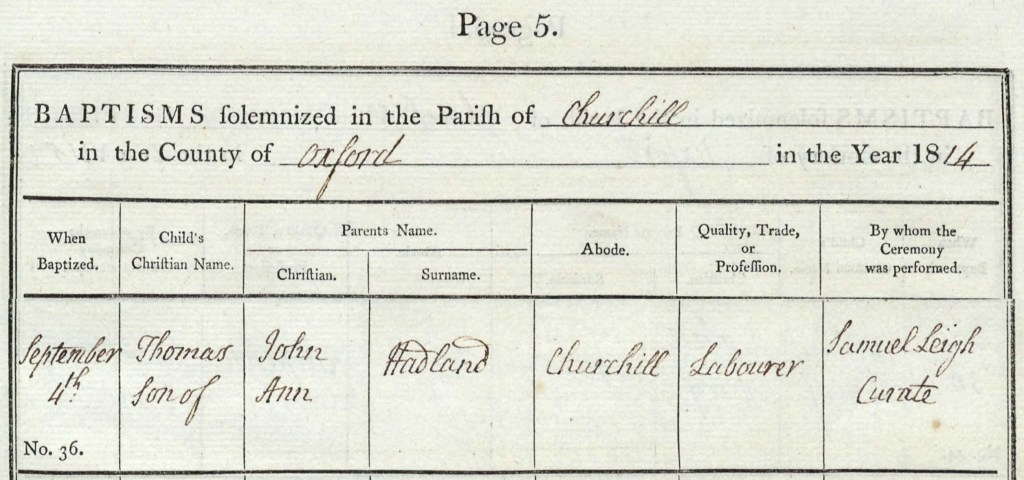
If July is the month in which Thomas was born, there was an seemingly long time before he was baptized, which occurred on September 4, 1814. The English records, including Thomas’s baptism registration, show that the family name was primarily spelled “Hadland”.

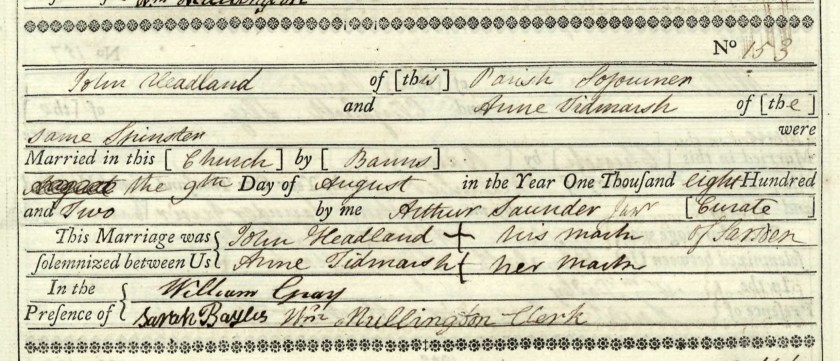
It was not until Thomas came to the new world that the spelling was recorded as “Hadlond”. Other variations in England included “Haddlond” and “Headland”. An example of the differences can even be seen in records of the same event, such as the registration of the marriage of Thomas’s parents, John Hadland and Ann Tidmarsh. In one record, it’s “Hadland”; in another it’s “Headland”.

John “Hadland” and Ann Tidmarsh, married August 9, 1802
John “Headland” and Ann Tidmarsh, married August 9, 1802

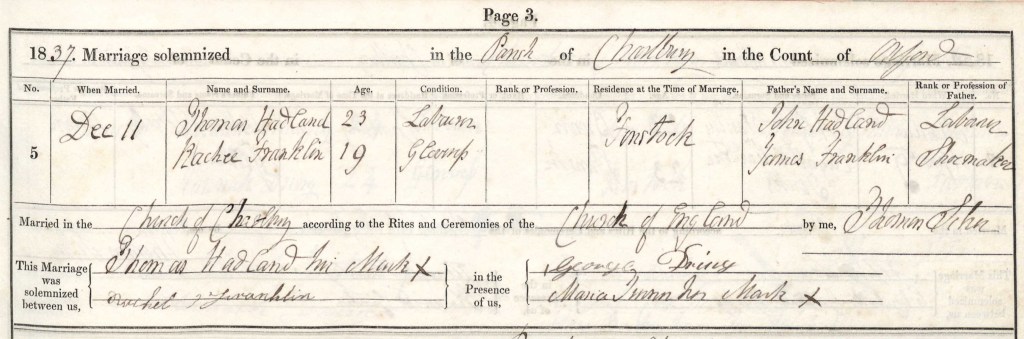
Thomas was the youngest of four children. It appears that during his adulthood, up until he married, Thomas lived in Finstock, Oxfordshire, where he worked as a labourer. On December 11, 1837, Thomas married Rachel Franklin in nearby Charlbury. After the marriage the couple likely settled in Finstock, as their first child, Charlotte, was born there.

Thomas and Rachel’s marriage registration. What I find interesting about this is that it appears that Thomas could not write, as he signed with his mark (“X”), while Rachel signed her full name. Speaking of Rachel, I’d love to decipher what was entered for her “Condition”, which to me looks like “gloump”.

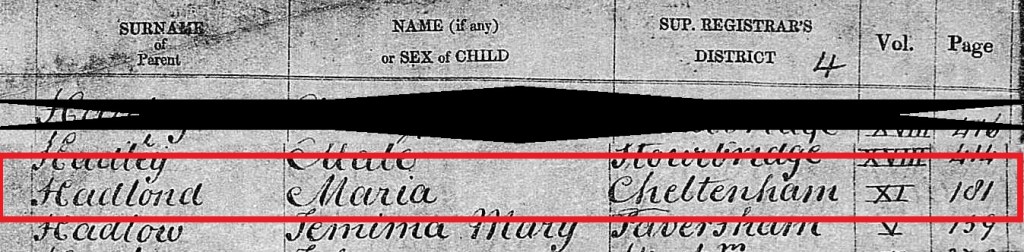
By August 1838, the family had moved west to Cheltenham, Gloucester, on the other side of the Cotswolds. There Thomas worked as a domestic servant. Thomas and Rachel had six children in Cheltenham, starting with my Great x3 Grandmother, Maria Hadlond.

In 1846, Rachel joined the Mormon church, but it appears that Thomas never did. This is evidenced by the fact Thomas was not baptized into the Mormon church until June 13, 1893, a year after he passed away.

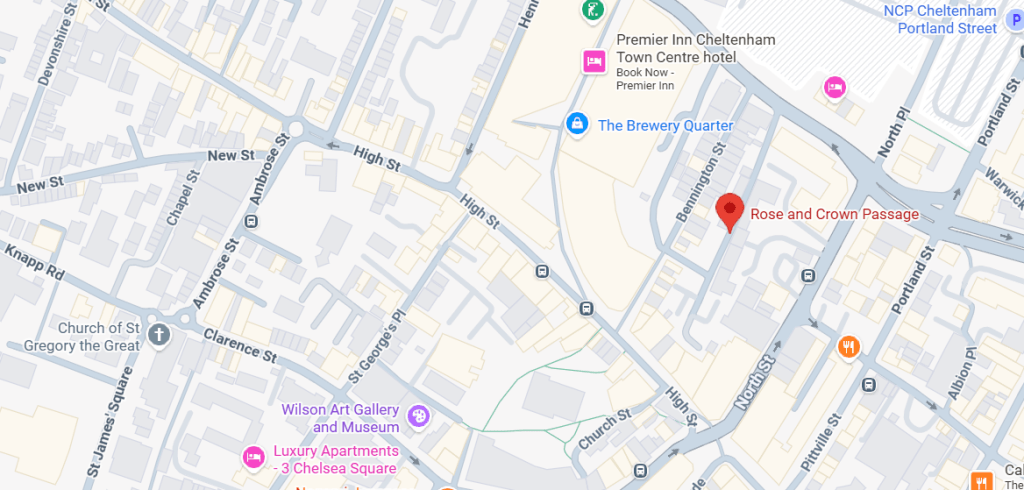
Sometime after 1851, Thomas and family left England for North America. They were still in Cheltenham when their daughter, Alice, was born on September 1, 1850. As well, the 1851 census shows that the family was still living in Cheltenham, at No. 38 Rose & Crown Passage.

Rose and Crown Passage in Cheltenham as shown on Google Maps as of March 2026.

The family left England sometime before June 1853, because Rachel gave birth to a son, Franklin, somewhere in Canada. While the family ultimately settled in the United States, this indicates that they most likely landed somewhere in British North America (the former British colonies that came together to form Canada).

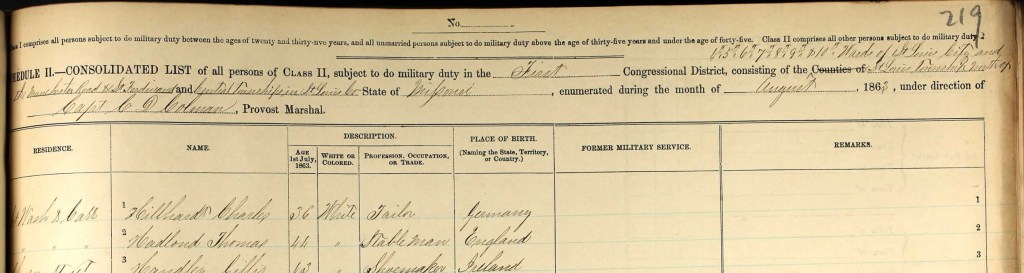
By 1856, Thomas and his family were living in St. Louis, Missouri. At the time of the 1860 census, Thomas was working in St. Louis as a hostler (a person who took care of horses, usually at an inn). During this time, the US Civil War erupted and the United States initiated a military draft in 1863. All men ages 20 to 45 were required to register. Thomas was 44 at the time. Thomas registered as Class II, which applied to married men ages 36 to 44.

Thomas’s registration for the draft during the US Civil War.

As of 1870, the family had moved across the Mississippi River to East St. Louis, Illinois, where Thomas was employed as a labourer. In East St. Louis, Thomas and Rachel had two more children, twins named Ella and Alphius, born on August 21, 1858.

Rachel passed away in March 1879. Shortly afterward, Thomas moved in with his daughter, Eunice, and her husband, Richard Cottam, at 2317 Exchange St. in St. Louis. They moved several times within the city. In 1885, they were at 3962 Cook Ave.; in 1889 they were at 4364 Vista Ave. in St. Louis.

Sometime shortly afterwards, Thomas moved to Nebraska City, Nebraska, to live with his daughter, Mary Louisa and her husband John Wischmeyer. He was not there for long, as Thomas passed away there on November 2, 1892. Thomas is interred at Wyuka Cemetery in Nebraska City.

52W Mark V – Week 5: Rachel Franklin

Rachel Franklin (1817-1879)

Unless I go back to the 1600s on my maternal grandfather’s paternal line, I do not have much English ancestry. My most recent ancestors who emigrated from England are my Great x4 Grandparents, Rachel Franklin and Thomas Hadlond. They had seven children at the time they came over sometime around 1852, give or take a year, including my Great x3 Grandmother, Maria Hadlond.

Rachel was the fourth of ten (possibly eleven) children born to James Franklin, a shoemaker, and Mary Luker Eaton. I have found several iterations of Mary’s surname. She was baptized “Mary, Daugr of Eliz Luker”. The register entry does not name a father or husband, implying that Mary was illegitimate. A few pages later there is an entry for the 1792 marriage of Thomas and Elizabeth shows: “May 20, Thos Eaton to Eliz Looker by license.” Earlier on the same page of the register for the marriage is an entry for the baptism of “Charlotte, daur of Thos and Eliz Eaton.” It would be reasonable to believe that it is the same Elizabeth Luker/Looker in both entries, but not without some doubt.

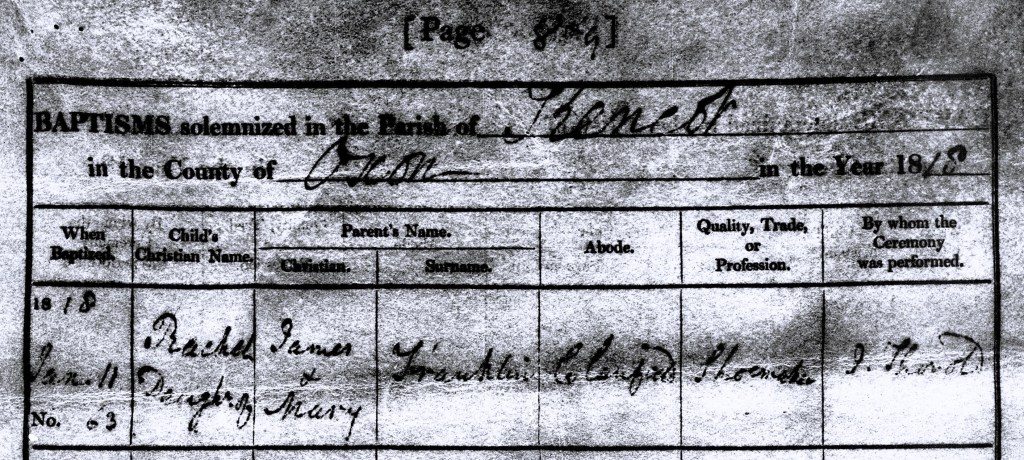
Rachel was born on December 14, 1817, in Clanfield, Oxfordshire, which is located in the Cotswolds. All of Rachel’s siblings were born in Clanfield or the nearby village of Hailey.

Rachel’s baptism registration.

Rachel married Thomas Hadlond three days shy of her 20th birthday, on December 11, 1837, in Charlbury, another village in the Cotswolds, just north of Hailey. Shortly after marrying, Rachel and Thomas were living in Finstock, a stone’s throw from Blenheim castle, the home of the Spencer-Churchill family. There they had their first child, Charlotte. The family was not in Finstock long, as my Gx3 Grandmother Maria was born in Cheltenham, Gloucester, in August 1838. Rachel bore five more children in Cheltenham. Rachel’s last child born there was Alice, in September 1850.

On November 23, 1846, Rachel was baptized into the Mormon church. I know little about the circumstances of her joining the church, but I’ve not yet found any evidence her husband Thomas did. This is evidenced by the fact that Thomas was not baptized into the church until a year after his death.

According to the 1851 English census, Rachel and her family were still resident in Cheltenham. However, sometime before 1853, the family moved to North America. It appears they entered by way of Canada, because Rachel gave birth to a son there in June 1853. By 1856, Rachel and her family were living in St. Louis, Missouri. In August 1858, Rachel gave birth to twins, Ella and Alphius, in East St. Louis, which is a suburb on the Illinois side of the Mississippi River.

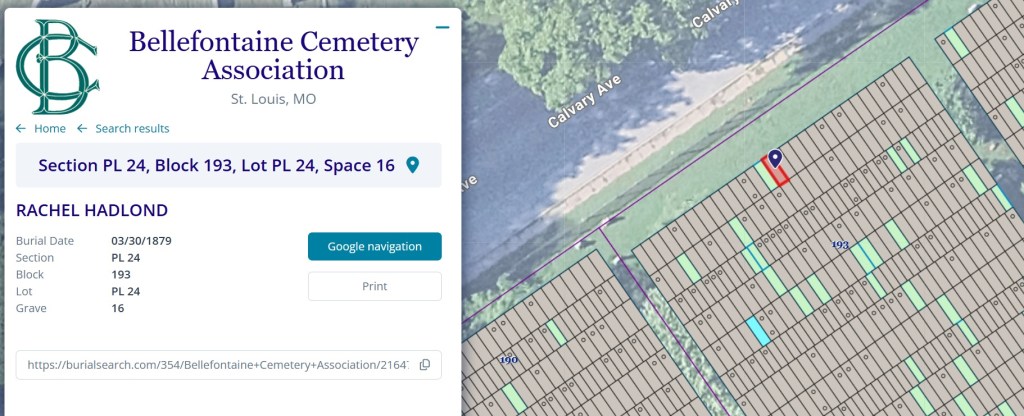
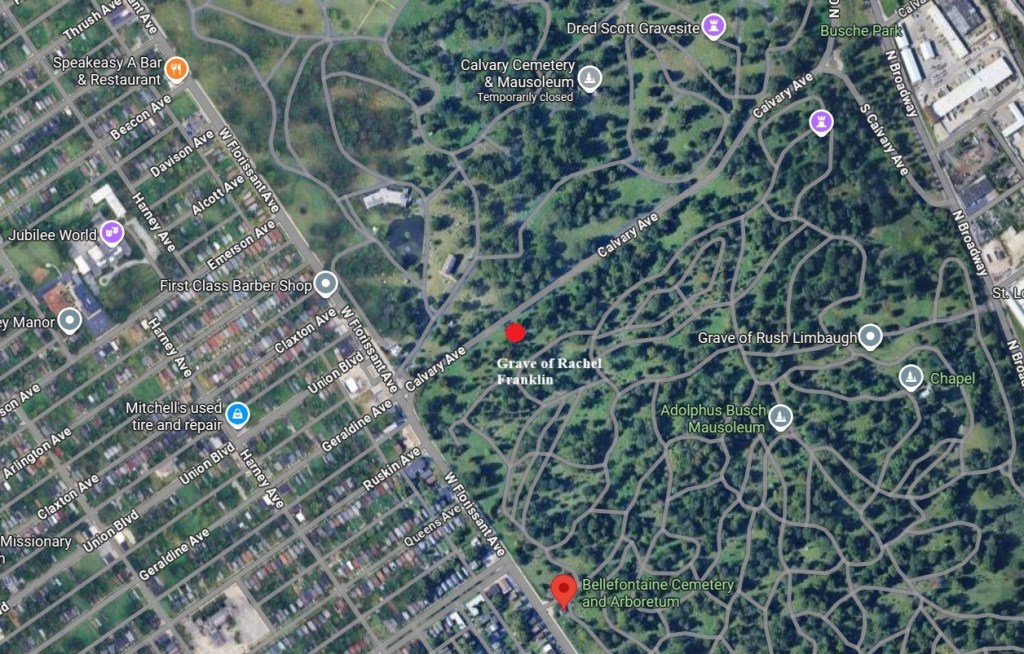
Rachel died in St. Louis on March 29, 1879. She is interred at the Bellefontaine Cemetery in St. Louis. She is buried only a few hundred meters from Dred Scott. She’s also not far from Adolphus Busch, although I think it’s lame that my ancestor is buried near the guy who made crappy Budweiser, while my wife’s ancestors are interred near Alexander Keith, who made excellent beer. Lame for me, anyway. Sadly, Rachel is also not far from Rush Limbaugh. Well, there went the neighbourhood.

Rachel’s burial location.
Rachel and her neighbours. Dred Scott is north east, while Adolphus Busch is to the east.

52W Mark IV – Week 39: Card B13 Maria Hadlond

Maria Hadlond (1838-1907)

We’ve reached the last card in the deck for my mother’s paternal line and the last of my Mormon ancestors who I’ll be looking at for this year’s 52 Ancestors Challenge.

Maria Hadlond, my Gx3 Grandmother, is my most recent ancestor from England. I have to go back another five generations on some of my other maternal lines before I can come upon anyone else from Old Blighty. Maria was born in Cheltenham, Gloucester, England on August 27, 1838, to Thomas Hadlond (1814-1892) and Rachel Franklin (1817-1879).

Thomas and Rachel were originally from West Oxfordshire, but were living in Cheltenham, on the edge of the Cotswolds, in the years before they emigrated. At the time, Thomas was working as a domestic servant.

Sometime in the late 1840s, the Hadlonds heard the preaching of some Mormon missionaries. On November 23, 1846, Rachel was baptized into the church. Several of their older children were baptized in the next two years, including Maria who was baptized on December 21, 1848, when she was 10 years old. I have the impression that while Rachel was a fervent convert, Thomas wasn’t too taken with the new religion and never actually joined it in his lifetime. He wasn’t baptized until 1893, a year after his death.

Whatever Thomas’s beliefs, the family left England for America to join the migration of Mormon converts who hoped to join the settlement in Utah. It is most likely the family left England sometime after September 1850, when their daughter Alice was born, and before June 1853, when their son Franklin was born. In fact, while their destination was ultimately the United States, it seems that the family entered North America through Canada, as Franklin was born in the Province of Canada (likely Canada West, which is modern-day Ontario).

By no later than 1856, the Hadlonds were in St. Louis, Missouri. It seems that the family’s circumstances were such that they did not plan to move to Utah anytime soon. However, I have not been able to determine whether this was because of finances (many Mormon migrants took years moving west while saving up for the trip) or because Thomas was not an adherent or all that serious about the church.

When Maria was 16, her mother met a Mormon missionary by the name of Preston Thomas who was passing through St. Louis on his way to Texas. When Rachel learned that Preston planned to arrange for a company of Texan converts to migrate to Utah, she “begged” him to take her three oldest children with him. This included Maria. Thomas did as requested and took the three Hadlond children to Utah. Ultimately, Maria’s two siblings returned to St. Louis and lived out the rest of their lives there. Maria remained in Utah.

Two years later, on October 8, 1856, Maria married Preston in Brigham Young’s office in Salt Lake City, with Young himself officiating. Preston was 42 years old at the time; Maria was 18. Moreover, this was a plural (polygamous) marriage, as Preston had two other wives. Preston’s first wife, Sarah Jane Morehead, was born the same year as Maria’s mother and they had a daughter only a few months younger than Maria. Preston’s second wife, Maria Foscue, was 16 years older than Maria. In order to avoid confusion between the two wives, Maria went by “Molly”. Molly and Preston had nine children together. This was in addition to the nine Preston fathered with Sarah Jane and four he fathered with Maria.

For the first four years after Molly married Preston, the entire family lived in Lehi, Utah, where Molly gave birth to her first two children. This included Ella Thomas, my Gx2 Grandmother.

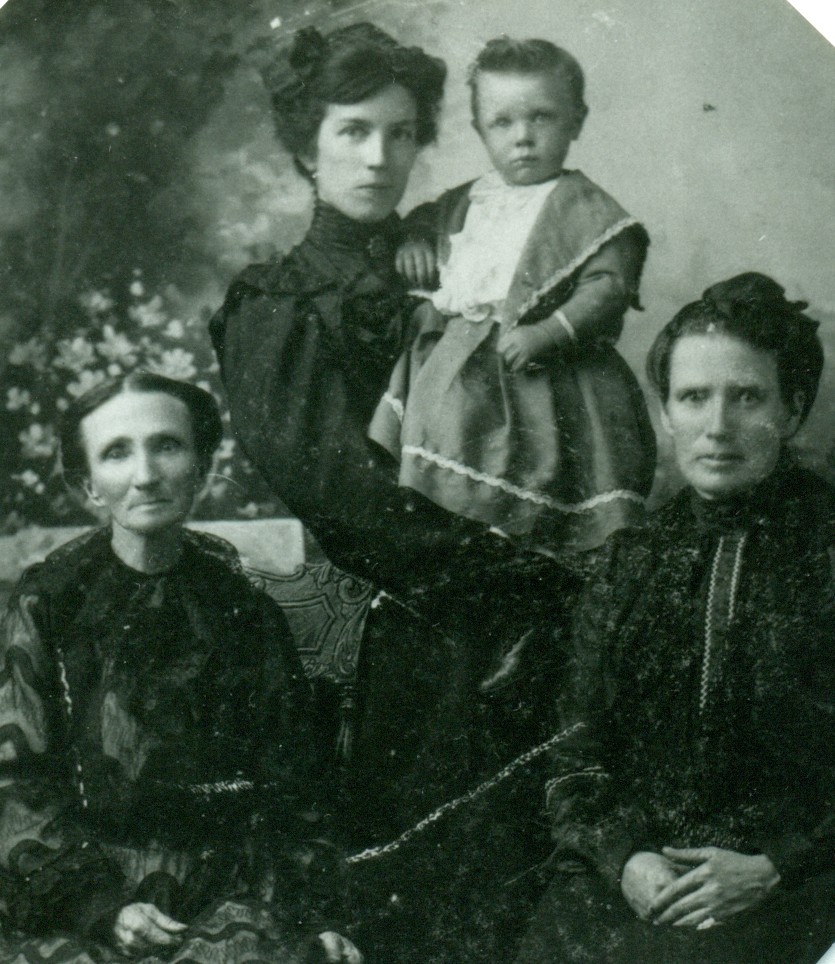
Four generations: Maria with her granddaughter Maria (“Mimie”) Lamb (née Thomas) holding great granddaughter Rulon Lamb, and Ella Nelson (née Thomas), my Gx3 Grandmother.

In 1860, Brigham Young had Preston join a team exploring an area in northern Utah, where Young intended to form a new settlement that is now Franklin, Idaho. However, at the time, and for many years afterwards, the inhabitants thought they were in Utah. They only discovered later that the town was a mile north of the Utah-Idaho border.

Young directed Preston to return to Lehi to collect his family and join the first settlers. In addition, Young appointed Preston as the first Bishop of Franklin. Preston did as he was asked (today we might say “voluntold”), but it appears that Maria Foscue might have refused and remained in Lehi with her children.

In 1863, Brigham Young formed a team of 12 to 15 men to explore the Bear Lake Valley in Idaho, not far from Franklin. This group included Preston. By September 1863 a settlement had been erected in Bear Lake Valley where Paris, Idaho now stands. Preston moved the family there in the spring of 1864. A few years later, Preston moved the family to Fish Haven, about 20 kilometers south of Paris.

During the family’s time in Idaho, Preston carried out at least one more major mission to the South. This was in addition to Preston’s other endeavors, which included a term as a judge of the Utah Probate Court (when it was still believed that Franklin was in Utah) and a run for office for the Idaho territorial legislature (after the discovery Franklin was in Utah). This obviously left Sarah Jane and Molly without his support while they raised a significantly large household of children.

Preston’s absences from home were compounded when he left this world following an accident that occurred in 1877 while he was building a house on his property. Molly’s youngest child was seven months old at the time.

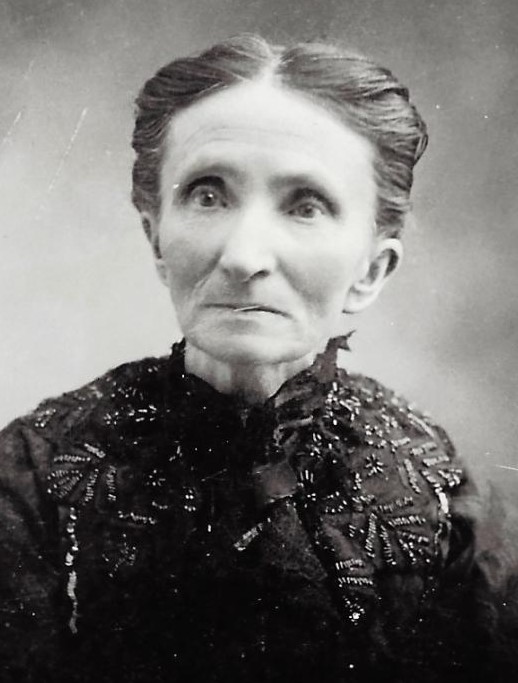
Maria with her three youngest children: Daniel, Letitia, and Rosabell (seated).

I have not yet tracked where Molly lived in the years immediately following Preston’s death, so I don’t know if she remained in Idaho or moved back to Utah. However, over the years several of her children joined the Mormons who were settling in Canada, in what is now the southern part of the province of Alberta. For example, her daughter Ella had moved there with her husband John Nelson. So in 1896, Molly and four of her children – all of whom were now adults – moved to Cardston, Alberta. Census records show that in 1901 Molly (who was going by Maria again) was a neighbour of one of her sons.

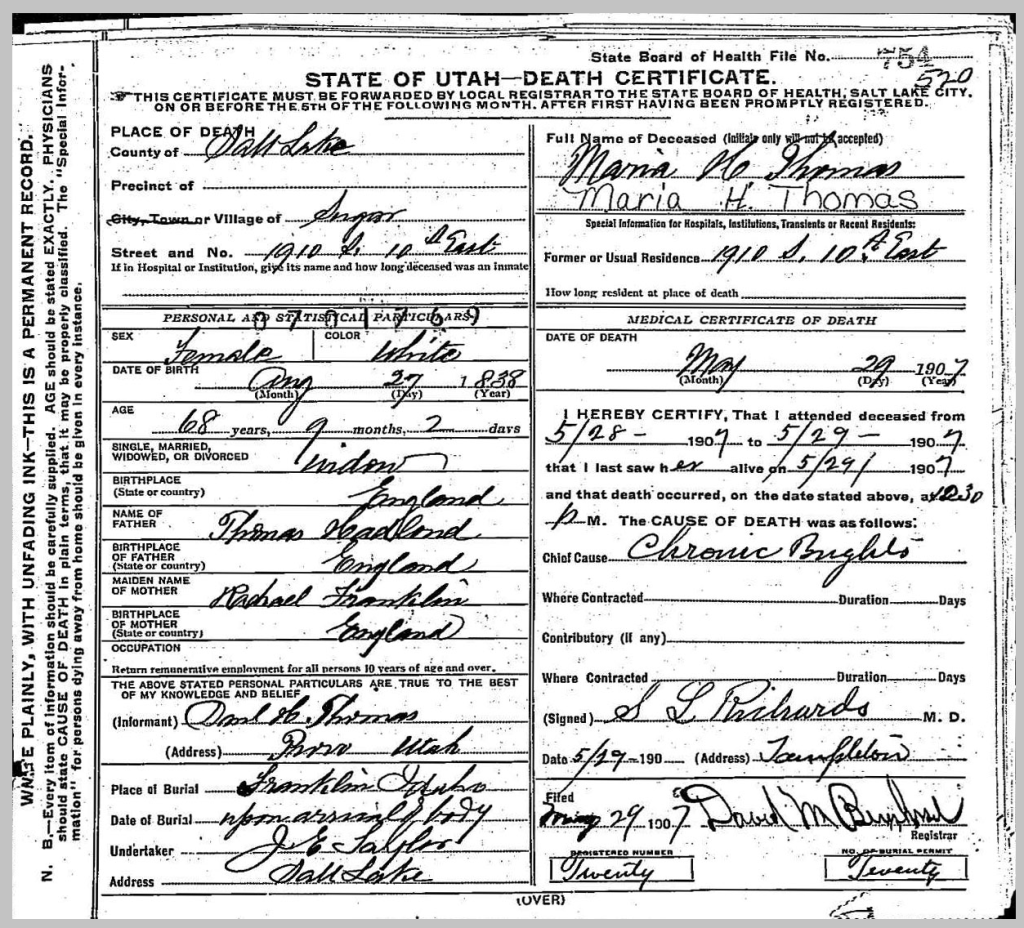
In 1902, Maria moved back to the United States and settled in the “Sugar House” neighbourhood of Salt Lake City, one of the oldest neighbourhoods in the city. Maria remained at the same house for the rest of her life. She passed away at home on May 29, 1907. She is interred in Franklin at the Franklin Cemetery.

Next week we start the last suit, covering my mother’s maternal line, who are Germans from Russia.