

52W Mark V – Week 17: Louisa Thomas

Louisa Thomas (1811-1846)

My 4xG Grandmother, Louisa Thomas, had a short and difficult life. While she passed away when she was 35, she had married three times and had partaken in one of the great westward treks of American history, the Mormon Migration.

While by every account Louisa was possibly born on May 28, 1811, I have had a great amount of difficulty in determining where her birth occurred. I have not found any primary records on the matter. The few sources I have are secondary or tertiary in nature.

When I first learned about Louisa in the mid-1990s, what little I found indicated that she was born in “Berks” or “Berks County” Virginia. However, there is no such place.

There’s a Berks County in Pennsylvania, not Virginia. There is a Burkeley County in West Virginia, in the panhandle bordering Maryland, which would have been part of Virginia when Louisa was born. There was also a Berkley, Norfolk County, Virginia, but the town was annexed by the City of Norfolk and the Norfolk County no longer exists. There is also Burke, Virginia, an unincorporated community in Fairfax County, about 20 kilometers southwest of Washington, D.C. The death certificate for Charlotte Liggett, Louisa’s daughter, says Louisa was born in West Virginia. The entry for Louisa’s death in the Winter Quarters Sexton’s Records says she was born in Maryland.

Considering all this information together, it seems that Louisa was most likely born in Burkeley County, then part of Virginia, close to the border with Maryland.

Louisa’s parents are also largely a matter of speculation and were said to be James Thomas and Elizabeth Stevens. The one source I had that named Louisa and her parents was a family history of Louisa’s second husband, the Liggetts, which I first consulted in 2013. The current version of that document no longer mentions Louisa or her parents. However, after writing this paragraph, I came across a history of Scioto Township in Delaware County, Ohio, which includes mention of James and Elizabeth. Unfortunately, the book does not indicate the source of this information.

FamilySearch had a James Thomas named as Louisa’s father, but named a Catherine Simmons as her mother. There were no sources for this connection, so I edited Louisa’s entry on FamilySearch by disconnecting her from those individuals. As it stands, I have no actual knowledge of who Louisa’s parents might have been.

The fog of history continues with Louisa’s first marriage. She is said to have married Lazarus Absolom Beakley in 1835, when Louisa was 24. However, I cannot find any record of this marriage or of Lazarus himself, who is said to have been born in 1811 and died before 1837. One secondary source even suggested that his name was only Absalem, with no Lazarus as a first name. Lazarus and Louisa supposedly had a son. Not only can I not find a record of this child, I can’t even find anything indicating what his first name might have been. Most of what I have about this marriage comes from a memoire by George Burgess, who was born 50 years after Louisa died, so I do not consider it particularly reliable.

At most, the registration of Louisa’s marriage to her second husband, Conrad Liggett (my Great x4 Grandfather) names her as “Louisa Beakley”. For the longest time, I had assumed this indicated a previous marriage to a man with the surname “Beakley.” However, that was based upon the belief that Louisa’s surname at birth was Thomas. The record of her marriage to Conrad does not indicate she was a widow.
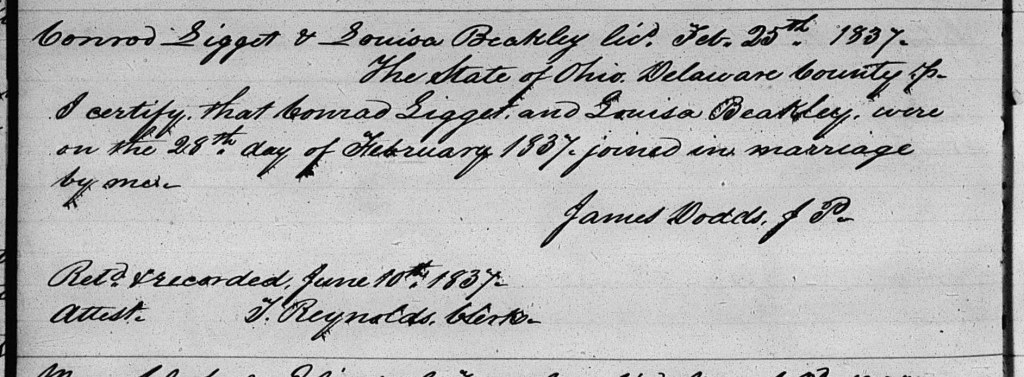
The registration of marriage for Conrad Liggett and Louisa Beakley. There is no indication that Louisa was previously married or whether Beakley was her surname at birth or that of a previous husband.

What if there was no Lazarus Absolom Beakley (given that I can find no record of him) and Louisa’s surname at birth was Beakley? I’ve been unable to find any record or mention of a Louisa Beakley, so that thought remains largely theoretical.

The real paper trail for Louisa begins with her marriage to her second husband, Conrad, as reproduced above. It’s the first tangible record indicating that Louisa even existed. Louisa and Conrad married on February 28, 1837 in Delaware County, Ohio. They had one child together, my Great x3 grandmother, Charlotte Liggett. It was a short marriage, as Conrad died on April 21, 1838, when Charlotte was only five months old.

With Conrad’s death, Louisa had to find work to support her family. As a result, Conrad’s parents, James Liggett and Susana Carr, took Charlotte in, possibly along with her half brother through her mother’s marriage to Lazarus Beakley. It is not clear if Charlotte’s grandparents had full-time custody and care of her or whether they only looked after her during Louisa’s working hours. Based upon the second-hand descriptions of their custody I’ve read, it appears that James and Susana had full-time care of Charlotte.

Three years and one week after Conrad died, Louisa married for a third (second?) time, to Aaron W. Cook. Aaron’s birth information I take with a grain of salt, because it’s exactly the same as what I have for Lazarus, and with an equally flimsy evidentiary basis. What is definitely far more certain is that Louisa married Aaron on April 28, 1841 in Delaware County, since there is a registration for their union in the Delaware County records.
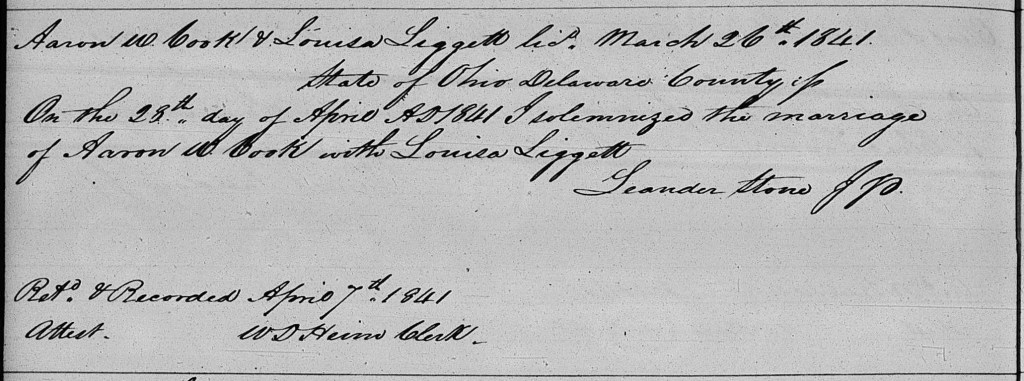
The registration of Louisa and Aaron’s marriage.

Here is where the story becomes (allegedly) more dramatic. According to George Burgess’s memoire, Louisa and Aaron married in secret. Around the same time, the couple joined the relatively new Mormon church.

Shortly after the marriage, Louisa asked James and Susanna if she could take Charlotte home with her for a week or a weekend. However, Louisa never returned Charlotte to her paternal grandparents. In George’s words, they “ran off” with Charlotte and joined the Mormons in their westward migration. However, it seems to me that Louisa was well within her rights to keep her daughter with her, since her in-laws never had any form of legal custody of Charlotte.

George said that Louisa had three daughters with Aaron when they were living in Nauvoo, plus another child about 12 miles out of Nauvoo after the Mormons were driven out of there. I have no records of these children, so I have not included them in my database. Louisa and her youngest child died during childbirth. Allegedly – again! – because I cannot find any mention of a child in the record of Louisa’s death or that Louisa had died in childbirth.

After leaving Ohio, Louisa and Aaron apparently settled in Nauvoo, Illinois, where the Mormons had established a settlement and built a temple. However, in 1846, a few years after the death of church founder Joseph Smith, the Mormons were driven out of Nauvoo. This motivated the Mormons to migrate to what is now Utah, which was then still part of Mexico.

Because of the rushed departure from Nauvoo late in the year, the Mormons set up camp known as Winter Quarters, near present day Omaha, Nebraska. Conditions were rough and many of the trekkers died there. Depending on the source, anywhere from 350 to 2,000 Latter Day Saints perished at Winter Quarters. Louisa was one of those who died there.

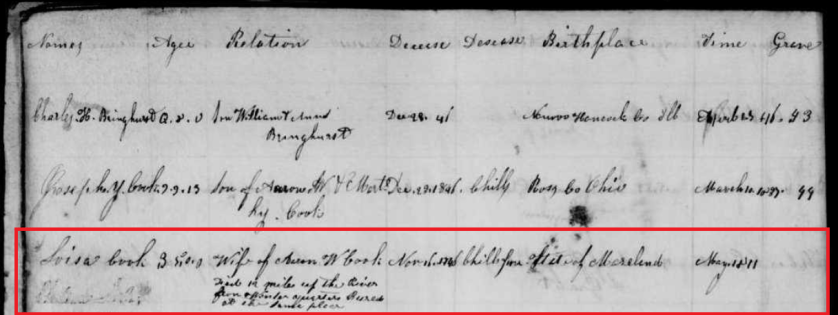
An entry in the Winter Quarters Sexton’s Records shows that Louisa died on on November 16, 1846, about 19 miles up the river from Winters Quarters. Charlotte was only nine at the time.
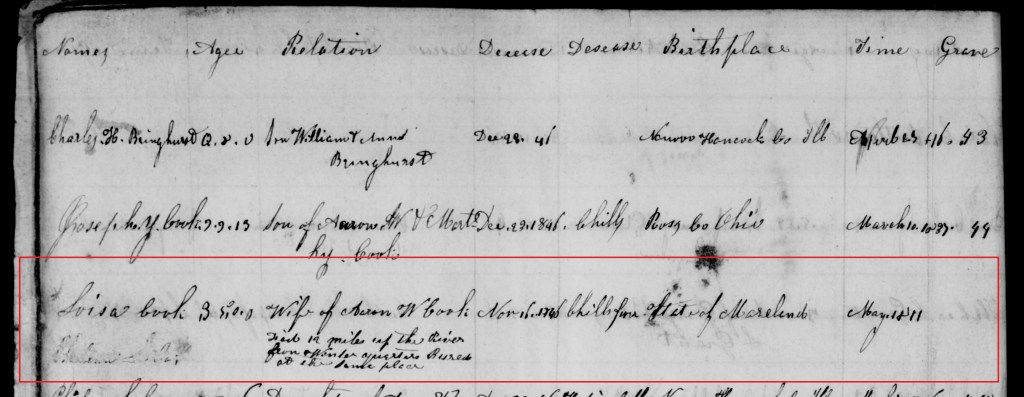
“Loisa Cook. 36 years, 0 months, 0 days. Wife of Aaron W. Cook [her third husband]. Died 19 miles up the River from Winter quarters Bur[i]ed at the same place. [Died] Nov 16 1846. [Disease] chills fever. [Born] State of Mareland May 1811.”

While Louisa only lived for 35 years, I only have documentation I have for her only coves the last ten years of her lifen. What little there is shows short marriages, family strife, religious persecution, and an early death. Despite what I have found, Louisa remains a solid brick wall ancestor.

Hello Louisa!

52W Mark V – Week 6: Thomas Hadlond

Thomas Hadlond (1814-1892)

My Great x4 Grandfather, Thomas Hadlond, was most likely born in July 1814, in Churchill, Oxfordshire, England, on the fringe of the Cotswolds. Thomas was born only a couple of months after Napoleon abdicated and was exiled to Elba.

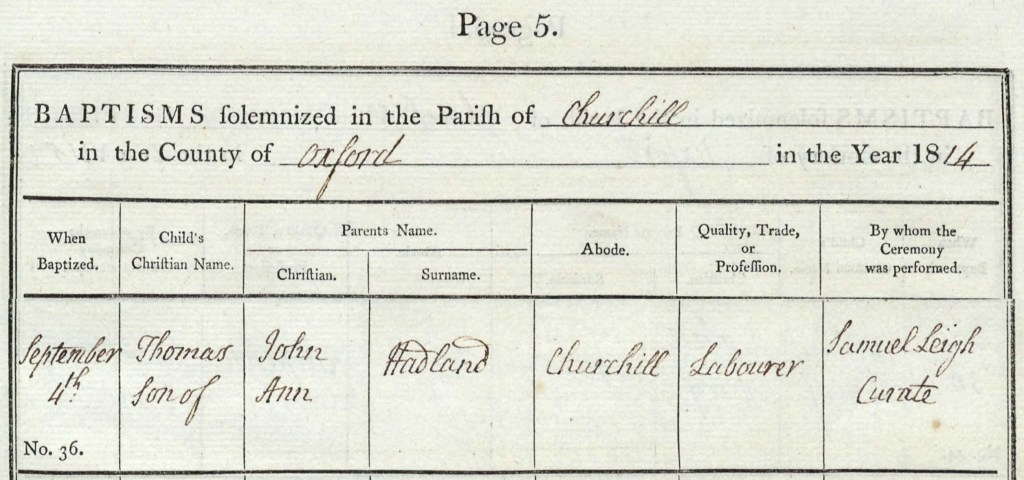
If July is the month in which Thomas was born, there was an seemingly long time before he was baptized, which occurred on September 4, 1814. The English records, including Thomas’s baptism registration, show that the family name was primarily spelled “Hadland”.

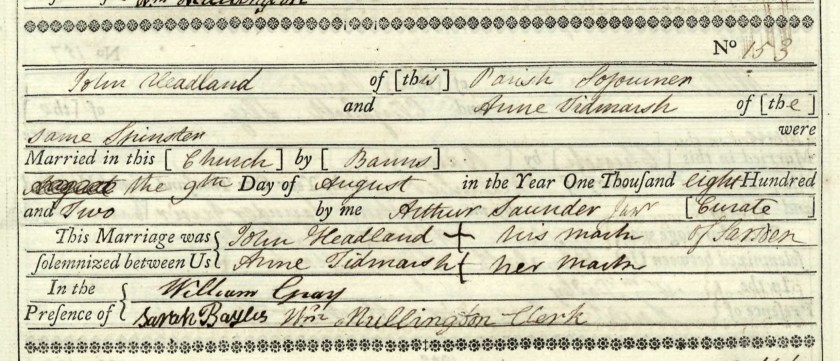
It was not until Thomas came to the new world that the spelling was recorded as “Hadlond”. Other variations in England included “Haddlond” and “Headland”. An example of the differences can even be seen in records of the same event, such as the registration of the marriage of Thomas’s parents, John Hadland and Ann Tidmarsh. In one record, it’s “Hadland”; in another it’s “Headland”.

John “Hadland” and Ann Tidmarsh, married August 9, 1802
John “Headland” and Ann Tidmarsh, married August 9, 1802

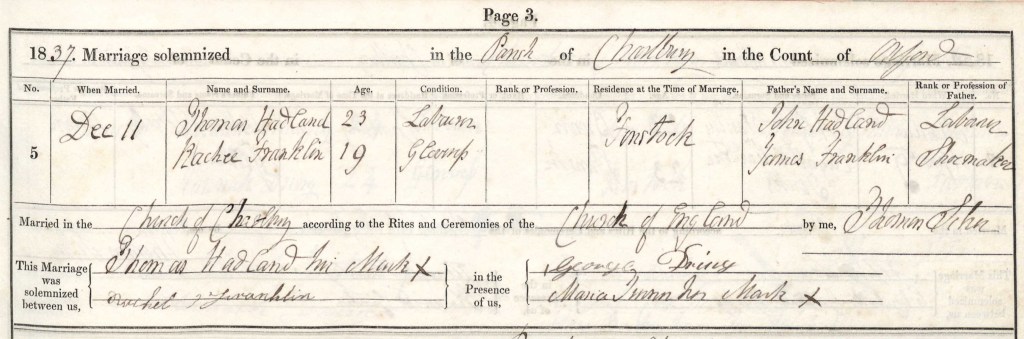
Thomas was the youngest of four children. It appears that during his adulthood, up until he married, Thomas lived in Finstock, Oxfordshire, where he worked as a labourer. On December 11, 1837, Thomas married Rachel Franklin in nearby Charlbury. After the marriage the couple likely settled in Finstock, as their first child, Charlotte, was born there.

Thomas and Rachel’s marriage registration. What I find interesting about this is that it appears that Thomas could not write, as he signed with his mark (“X”), while Rachel signed her full name. Speaking of Rachel, I’d love to decipher what was entered for her “Condition”, which to me looks like “gloump”.

By August 1838, the family had moved west to Cheltenham, Gloucester, on the other side of the Cotswolds. There Thomas worked as a domestic servant. Thomas and Rachel had six children in Cheltenham, starting with my Great x3 Grandmother, Maria Hadlond.

In 1846, Rachel joined the Mormon church, but it appears that Thomas never did. This is evidenced by the fact Thomas was not baptized into the Mormon church until June 13, 1893, a year after he passed away.

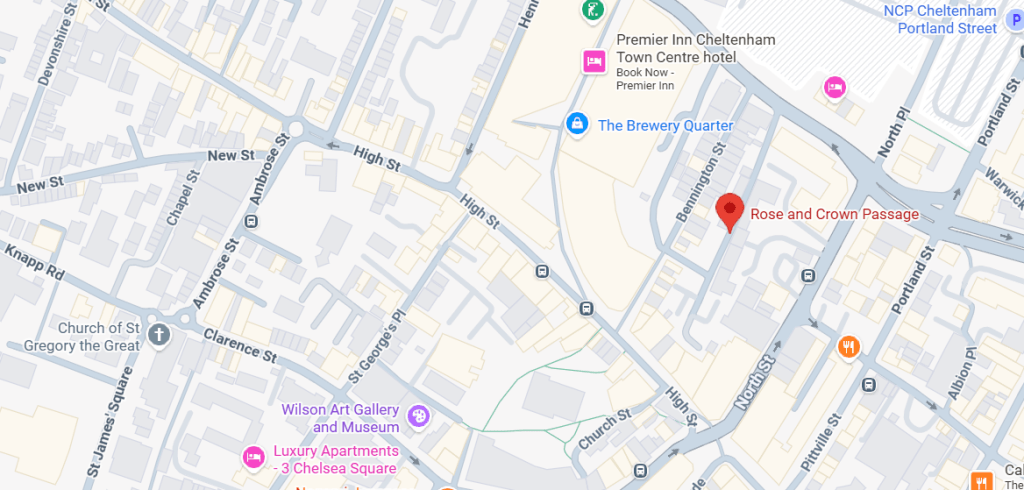
Sometime after 1851, Thomas and family left England for North America. They were still in Cheltenham when their daughter, Alice, was born on September 1, 1850. As well, the 1851 census shows that the family was still living in Cheltenham, at No. 38 Rose & Crown Passage.

Rose and Crown Passage in Cheltenham as shown on Google Maps as of March 2026.

The family left England sometime before June 1853, because Rachel gave birth to a son, Franklin, somewhere in Canada. While the family ultimately settled in the United States, this indicates that they most likely landed somewhere in British North America (the former British colonies that came together to form Canada).

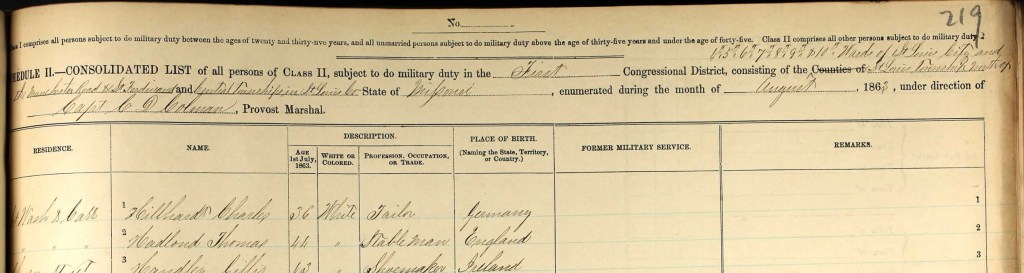
By 1856, Thomas and his family were living in St. Louis, Missouri. At the time of the 1860 census, Thomas was working in St. Louis as a hostler (a person who took care of horses, usually at an inn). During this time, the US Civil War erupted and the United States initiated a military draft in 1863. All men ages 20 to 45 were required to register. Thomas was 44 at the time. Thomas registered as Class II, which applied to married men ages 36 to 44.

Thomas’s registration for the draft during the US Civil War.

As of 1870, the family had moved across the Mississippi River to East St. Louis, Illinois, where Thomas was employed as a labourer. In East St. Louis, Thomas and Rachel had two more children, twins named Ella and Alphius, born on August 21, 1858.

Rachel passed away in March 1879. Shortly afterward, Thomas moved in with his daughter, Eunice, and her husband, Richard Cottam, at 2317 Exchange St. in St. Louis. They moved several times within the city. In 1885, they were at 3962 Cook Ave.; in 1889 they were at 4364 Vista Ave. in St. Louis.

Sometime shortly afterwards, Thomas moved to Nebraska City, Nebraska, to live with his daughter, Mary Louisa and her husband John Wischmeyer. He was not there for long, as Thomas passed away there on November 2, 1892. Thomas is interred at Wyuka Cemetery in Nebraska City.

52W Mark II – Week 33: Strength

I am not a member of the Latter Day Saints (“Mormons”), but my maternal grandfather, Leo Burgess, was. In fact, his direct paternal line were Mormons almost since the beginning. The early members of the church were required to draw on their strength as they faced persecution, exile, and hardship.

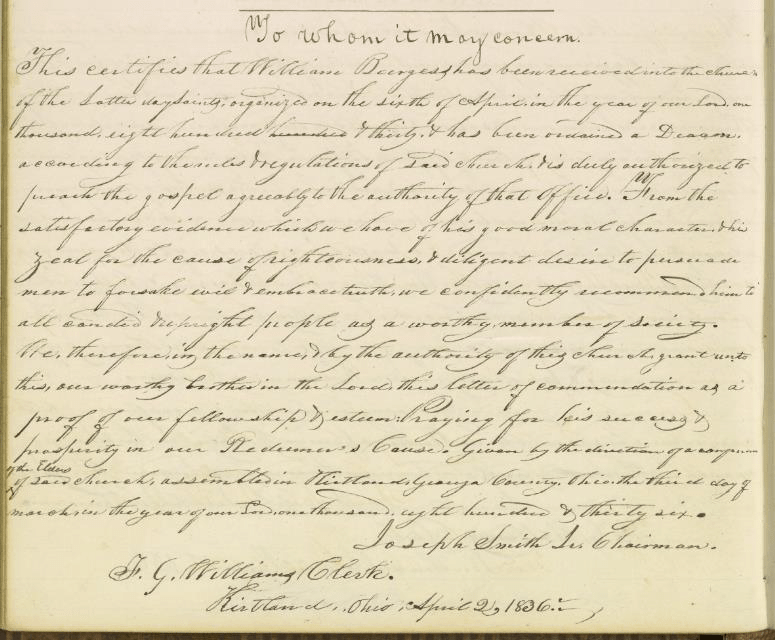
Most sources state that my Gx4 Grandfather, William Burgess (1794-1880) was baptised into the church in 1832, two years after it had been founded by Joseph Smith. However, the Kirtland Elders’ Certificates from the Joseph Smith Papers state that William joined the church and was ordained a deacon on April 6, 1830. All eight of my grandfather’s great grandparents had joined the church in the 1830s and 1840s.

“This certifies that William Burgess has been received into the church of the Latter-Day Saints, organized on the sixth of April, in the year of our Lord, one thousand, eight hundred hundred & thirty, & has been ordained a Deacon…

Joseph Smith Jr. Chairman.
F[rederick] G. Williams Clerk.
Kirtland, Ohio, April 2, 1836.”

Kirtland Elders’ Certificates, p. 84, The Joseph Smith Papers

While I am quite skeptical about much of the church’s dogma, I absolutely respect the strength of its early adherents, including many of my direct ancestors who were early members of the church. Many of them experienced and survived unnecessary suffering due to religious persecution. Several others endured an arduous – and for some,  deadly – journey from Illinois to Utah over the winter of 1846-1847.

Joseph Smith sought to create a “New Jerusalem”. He and his followers moved to Ohio and soon began building a settlement in Missouri. In 1833, church members were run out of Missouri and a failed banking venture crippled the Ohio settlement. The Mormons attempted a settlement elsewhere in Missouri, but were driven out upon an executive order of the governor, calling for them to be exterminated or expelled from the state. In 1939, the church regrouped in a new community, Nauvoo, Illinois, and began to build their Zion there.

Two years after Joseph Smith’s death in 1844, tensions with non-Mormons increased, such that the Mormons were driven out of their settlement once again. They upped stakes and began the migration to Utah. During the westward migration, over the winter of 1846-1847, about 2,500 church members encamped at Winter Quarters, which was just north of where Omaha, Nebraska came to be. The first settlers arrived in what is now Salt Lake City in July 1847, in what was still Mexican territory.

Many of the trekkers did not survive. There are varying accounts of the death toll at Winter Quarters. This is due, in part, to the lack of sufficiently complete and reliable records. It is also due to what was included in each account: some measure death only due to disease, others include deaths of all causes. The periods of time also vary: from a few months over the winter of 1846-1847, to longer periods of time, e.g.,1846 to 1848. Louisa Thomas, my 4x great grandmother, was one of those who perished at Winter Quarters. She died on November 16, 1846. An entry in the Winter Quarters sexton’s records shows that she died 19 miles up the river from Winters Quarters. Louisa’s daughter Charlotte, my Gx3 grandmother, was only nine at the time.

The entry for Louisa Thomas in the Winter Quarters sexton’s records, 1846-1848: “Loisa Cook. 36 years, 0 months, 0 days. Wife of Aaron W. Cook [her third husband]. Died 19 miles up the River from Winter quarters Bur[i]ed at the same place. [Died] Nov 16 1846. [Disease] chills fever. [Born] State of Mareland May 1811.”

To have survived long journeys to settle in new lands, religious persecution, and perilous migration took incredible strength – mental, physical, social, and spiritual. Their conviction and belief carried them through difficult times and experiences. For that I am grateful, because without their strength I would not have been.