Jan Pater was born on May 20, 1826 in Sint Maarten, Noord Holland, the eldest of five children born to Jacob Janz Pater and Antje “Anna” Lievendag. Sometime between the time Jan was three and seven, the family moved a few kilometers south to the adjacent gemeente (municipality) of Harenkarspel. According to his registration of marriage, Jan lived in Harenkarspel and was working there as a labourer until shortly before he got married.
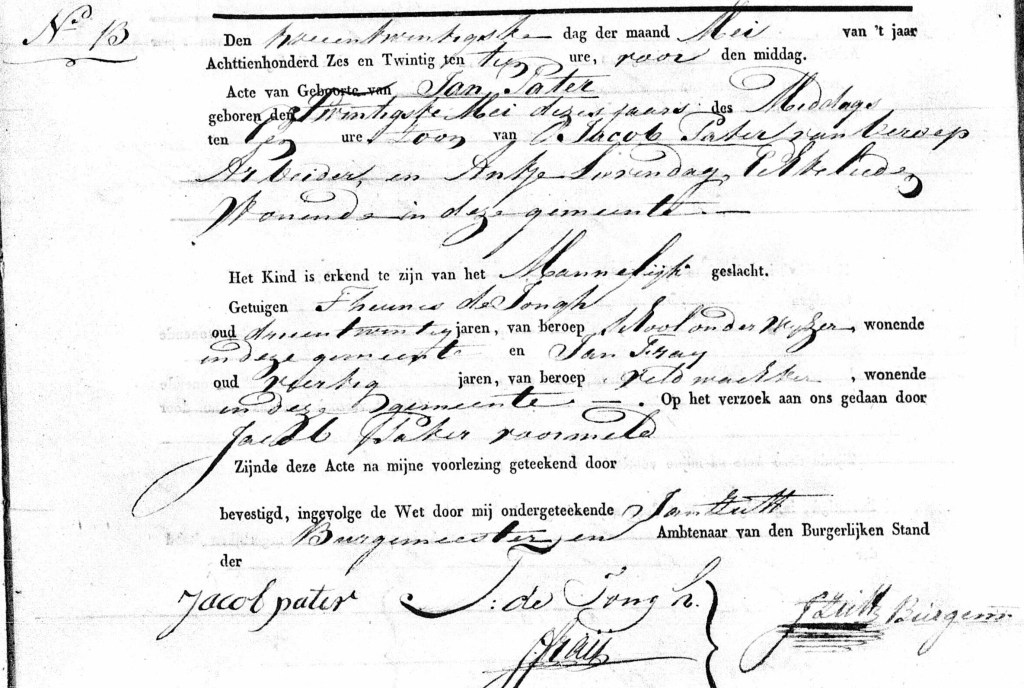
Jan’s birth registration.
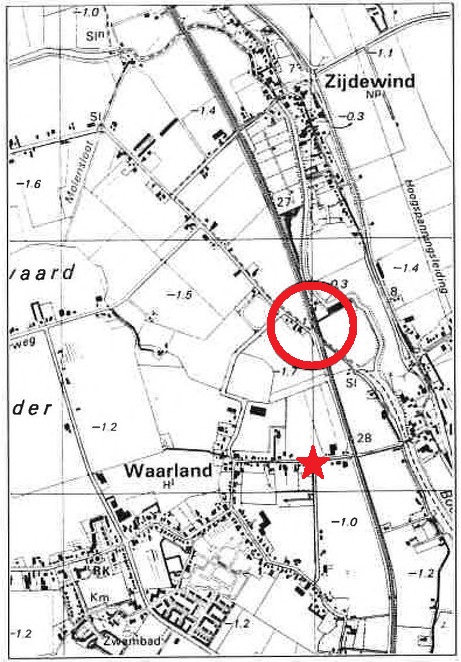
The circle shows where Jan lived with his wife and inlaws. The star is where my father was born.
Jan was 26 when he married Teetje de Groot on June 11, 1852 in Oude Niedorp. After they married, Jan and Teetje moved in with Teetje’s parents, Jan de Groot and Sijtje Sijbecarspel. They lived in Zijdewind, which at the time was part of gemeente Oude Niedorp.
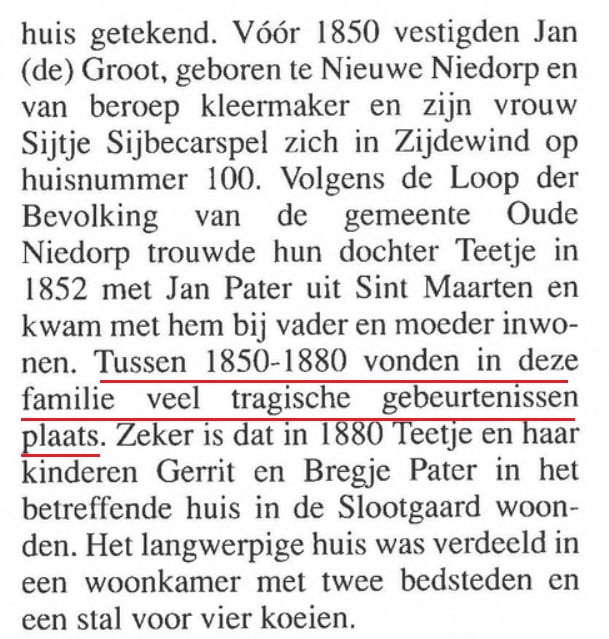
According to an article in Toendertoid: Stichting Waarland van Toen, “Many tragic events took place in this family between 1850 and 1880.” It then went on to describe the house they lived in, without providing any details about what happened.
Toendertoid, May 1994, page 12 WHAT HAPPENED?!?
Jan was a labourer almost his entire life, except for a brief period in 1872 when he was a “veldwachter”; literally, “field guard,” a kind of rural police or constabulary. The veldwachters originated as the “garde champêtre” during the Napoleonic era. They were very poorly paid, if at all, and largely relied upon other sources of income. There were few prerequisites to become a veldwachter and at Jan’s time it was much less than a professional police officer. What authority they had was limited to the municipality in which they served.
Jan was 46 when he was a veldwachter and he did not serve very long. It is not clear what qualification Jan had for the role. He was still described as a labourer when his daughter Maartje was born in March 1871. It was only the April 1872 death registration of his son, Jacob, that showed Jan as a veldwachter. Maartje died later that same year, in December, and her death registration recorded that Jan was a labourer at the time. Jan was still a labourer when he died in Zijdewind at age 52.
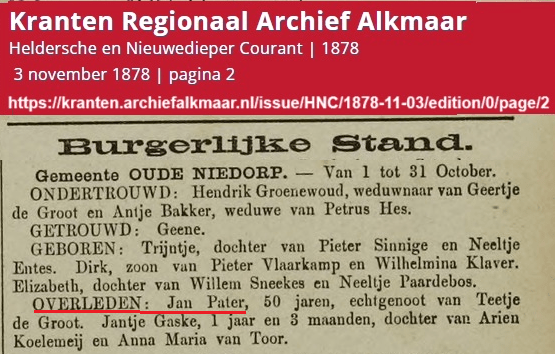
Burgerlijke Stand = Civil Register Died: Jan Pater, age 50, husband of Teetje de Groot.
I generally think of my Dutch ancestors – particularly the paternal side of my father’s family – as labourers, farmers, domestic workers, or similar. I suspect that the maternal side of my father’s family might have been better off, although by how much I cannot say. With a couple exceptions, I have to go five or six generations back to find something other than farmer or labourer, such as a cordwainer and a cobbler, a harbour pilot, or a sailor. Of those who worked the land, I doubt few of them actually owned their farms.
One exception is my Gx3 Grandfather, Jan Gerritsz Veldman. During the 52 Ancestors Challenge in 2023 , I described him and his wife Trijntje Stoop as “prosperous“. However, at one point in time he may have been even better off than I had previously thought.
Jan was born on November 27, 1835 in Nieuwe Niedorp, Noord Holland. He was the eighth of twelve children born to Gerrit Veldman and Maartje Cornelis Zijbecarspel. In 1855, when he was 20, he was drafted for the militia, as the Netherlands had mandatory military service until the 1990s. Many conscripts never actually served; rather, they were largely on-call, like a reserve. However, according to his marriage registration, Jan had “bought” himself a replacement.
According to my late friend Nol van den Hurk, this was a common practice “if you had money.” I asked if this meant Jan was well off, Nol responded:
Whether Jan was well to do or not I can’t tell you. The archives hold papers you had to show when you wanted to marry. One of the papers is an official document that showed that you had fulfilled your duty in the Army. In Jan’s case I saw a document, signed by the Queens commissioner’s clerk in the Province North Holland (who was responsible for those things in those days) that said that Jan had his military duties done by a replacement. This was not uncommon in those days, but it never stated who paid for it. It might have been the bride’s father, the groom’s father, the groom himself…. When he was the only son of a farmer, he did not have to join the army. If so, it was stated so in the document.
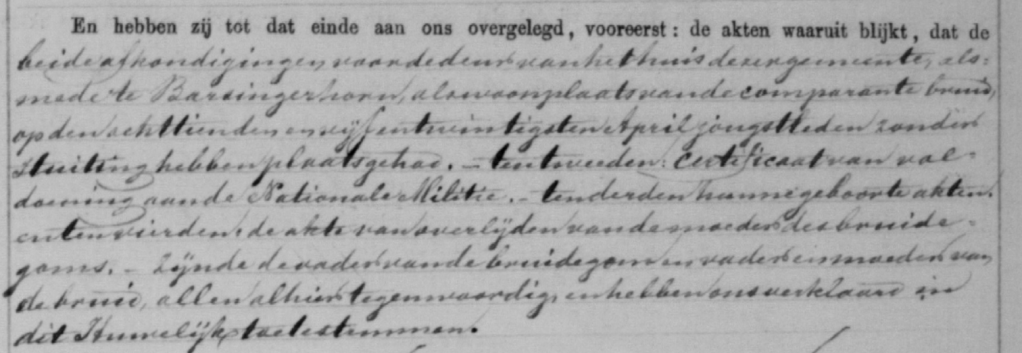
The passage from Jan and Trijntje’s marriage registration that speaks of Jan having discharged his obligation for military service.
Jan and Trijntje married on May 1, 1858 in Nieuwe Niedorp. I have a copy of their marriage registration, but unfortunately I have not yet found a copy of their huwelijksbijlagen (marriage supplements) online. The marriage supplements are a set of documents the couple had to provide before they could marry, such as birth extracts and other vital records. As well, it used to include a record confirming that the groom had satisfied his mandatory military service. It would be nice if I could visit the Dutch archives in person, but I doubt I’ll be in the Netherlands in the foreseeable future.
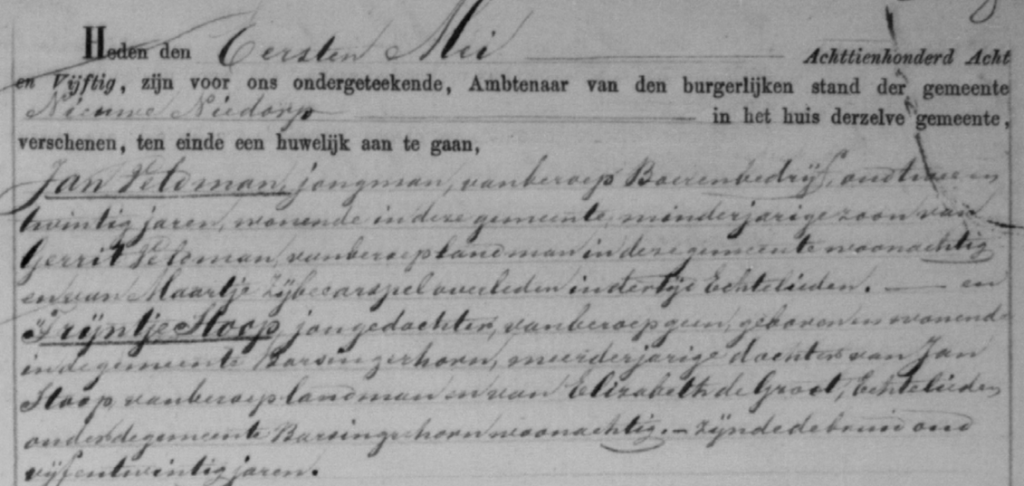
The opening portion of Jan and Trijntje’s marriage registration, showing their names, ages, occupations, places of birth, residence, and parents, among other things.
At the time he married Trijntje, Jan was working as a farmer in Nieuwe Niedorp; however, their eldest child, Gerrit, was born in Harenkarspel in 1859. It is likely that Jan actually lived and worked in ‘t Veld, a village within gemeente (municipality) Nieuwe Niedorp, as reflected in the bevolkingsregister (“population register”) of Nieuwe Niedorp for 1860-1870. There was a subsequent bevolkingsregister for ‘t Veld for 1870–1880, which also listed Jan and his family. As for ‘t Veld, it later became part of gemeente Oude Niedorp. It is now within gemeente Hollands Kroon.
It appears that Jan and Trijnte did very well for themselves while living in ‘t Veld. I recently discovered that they were prosperous enough to have domestic servants in the late 1860s. The first, Jansje, worked for Jan and Trijntje until January 1868, but I do not yet know how long she had been there before leaving. The second, Brigitta, worked from February to December 1868.
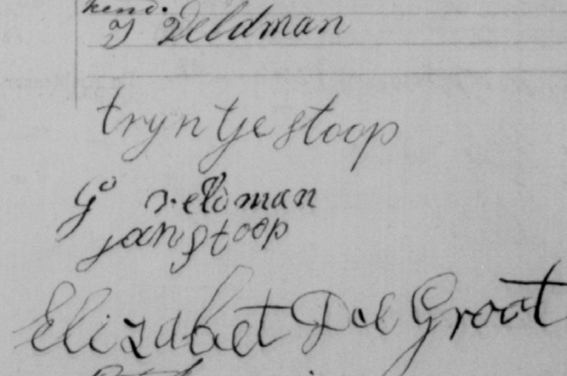
I love seeing the signatures of my ancestors from so long ago. Here are my Gx3 Grandparents, along with the bride’s parents, my Gx4 Grandparents, 167 years ago.
Jan and Trijntje had eight more children who were born in Nieuwe Niedorp. It appears that all but two children survived infancy and childhood. In May 1872, Jan, Trijntje, and their children moved to Barsingerhorn, which is about five kilometers north of ‘t Veld. There they had the last of their ten children, Aantje, born in 1873.
Upon relocating to Barsingerhorn, Jan and Trijntje began to acquire several pieces of farm properties, which together formed two separate properties. One property consisted of two lots in Oude Niedorp of about 0.157 hectares (about 0.4 acres), on which there was a house. The other property was a farm consisting of 20 lots in Barsingerhorn, totalling about 11.9 hectares (just under 3o acres). The farm property included a farmhouse, pastures, farmland, and a boat.
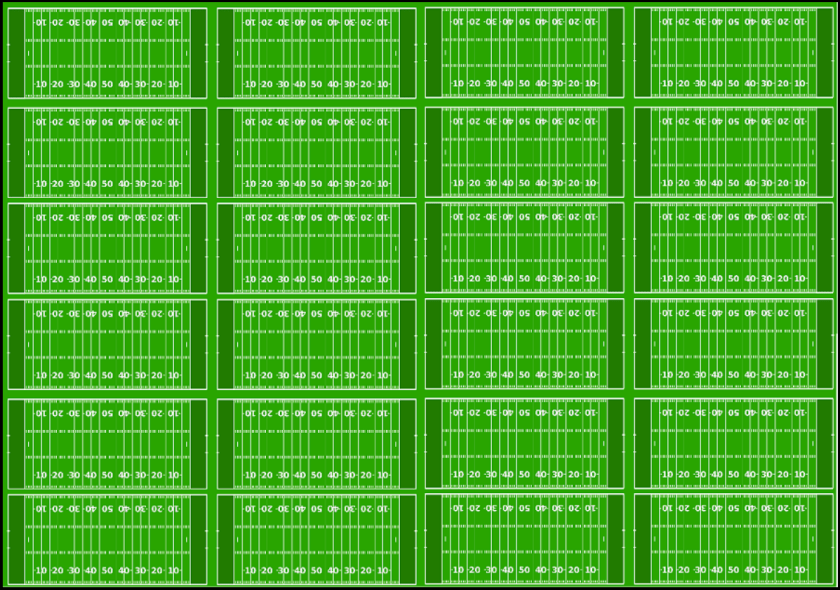
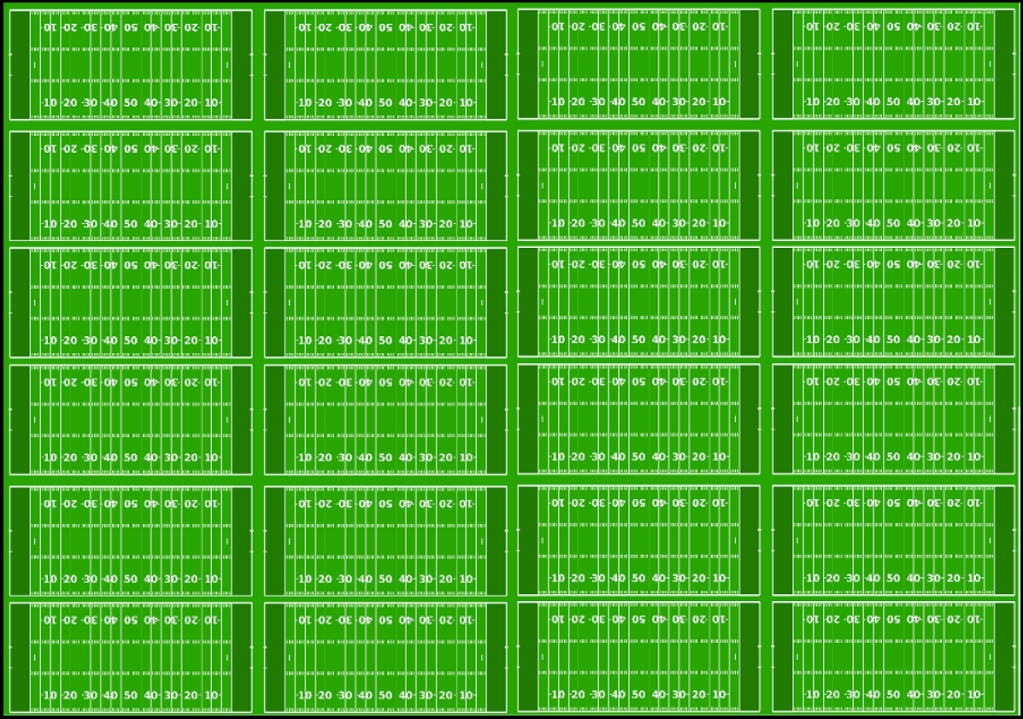
Approximate size of the total amount of land Jan and Trijntje owned: 24 American football fields (FYI, Canadian football fields are longer.)
When Jan died on May 21, 1897, these pieces of property passed to Trijntje. Within a year after she died, on January 27, 1906, these properties were put up for auction. The auction noticed valued the first property at ƒ835, while the second property was valued at ƒ17,152.66. Together, they amounted to about CDN$427,958.27 in 2025 dollars.
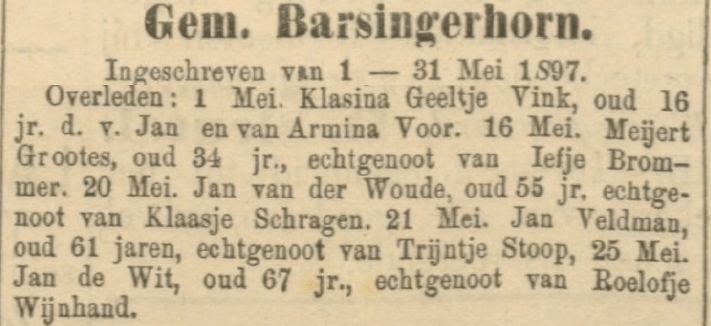
Schager Courant, June 20, 1897, page 3: “Overleden” (Deceased), 21 May, Jan Veldman, age 61, husband of Trijntje Stoop
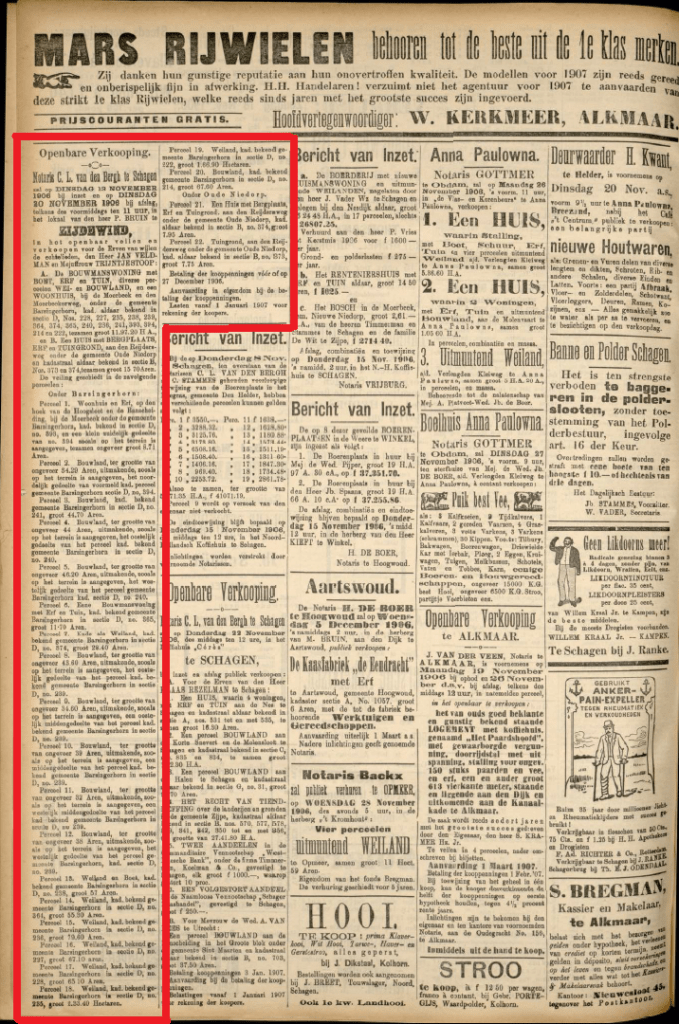
Schager Courant, Schagen, Noord Holland, Netherlands, November 11, 1906, page 4. “Openbare Verkooping” (“Public Sale”). This is an itemized list of Jan and Trijntje’s two properties that went up for public auction after Trijntje died.
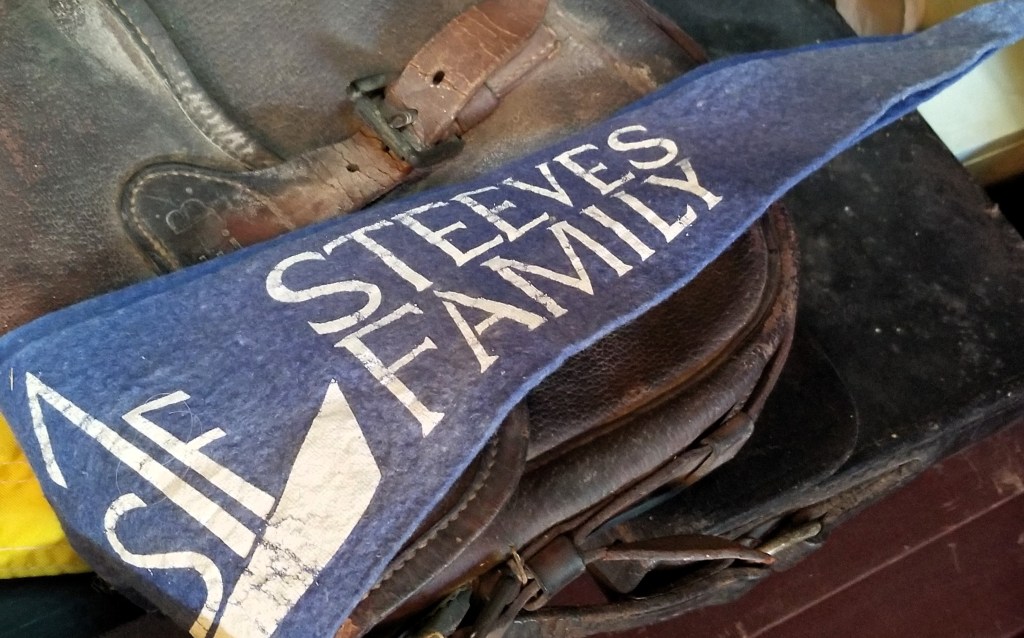
If you’re a “Steeves” in North America, odds are you’re a direct descendant of Heinrich Stief and Regina Stahleker. In 1749, they emigrated from Münsingen in the Duchy of Württemberg (now southwest Germany) and settled in Pennsylvania. There they had seven sons. 250 years ago, in 1766, under land grants arranged by Benjamin Franklin and others, they moved to what is now New Brunswick and were amongst the original settlers of Moncton. The family later settled in Hillsborough, New Brunswick and there they started multiplying.
Apparently there are over 200,000 direct descendants of Heinrich and Regina. Our kids are two of them! At a family reunion in New Brunswick in 2016, there was an attempt to set a Guinness World Record for largest gathering of individuals with the same last name. Unfortunately, the attempt fell short.
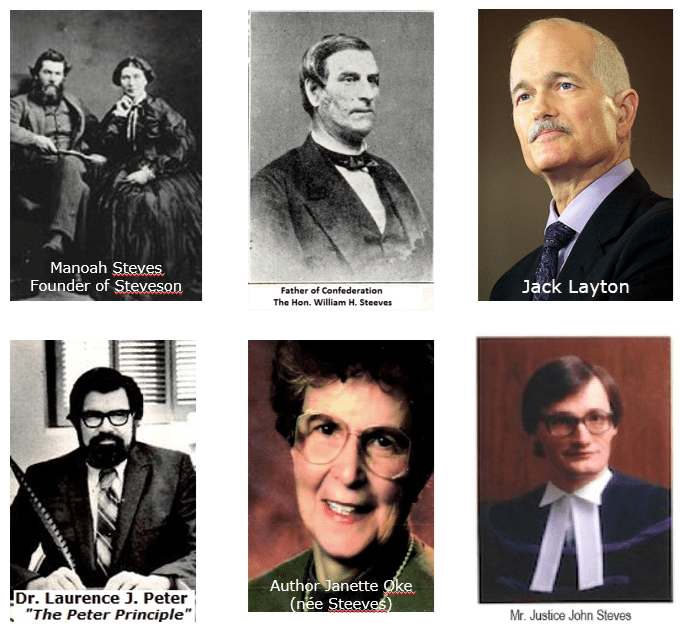
Notable Steeves descendants include the Hon. William H. Steeves (one of the “Fathers of Confederation” of Canada), Jack Layton (late Leader of the Opposition in Canada’s parliament), Laurence J. Peter (author of The Peter Principle), and Janette Oke (author). A few years ago, I gave a presentation on “Law and Genealogy”, using my sons’ Steeves connection as a research example. Through sheer serendipity, the presenter who spoke before me was also a Steeves descendant, John Steeves, a now-retired Justice of the B.C. Supreme Court. Right before the program started, I leaned over and quietly asked him if it was okay to incorporate him into my presentation.
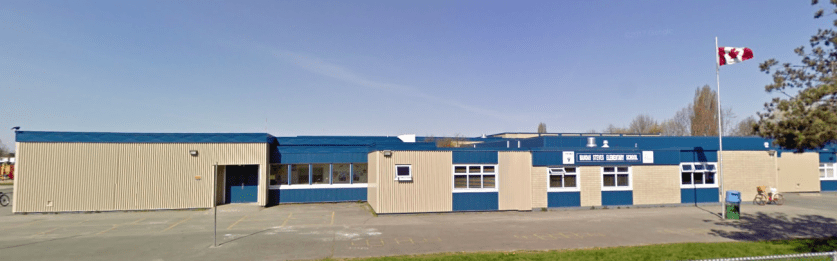
Coincidentally enough, our Steeves connection does not end there. Several years ago we moved to Steveston, a fishing village that is now part of Richmond, B.C. The village was founded by Manoah Steeves, who left New Brunswick with his wife Martha Taylor, dropped an “e” from his surname, bought land in the southwestern corner of Lulu Island in 1877, and established a dairy farm.
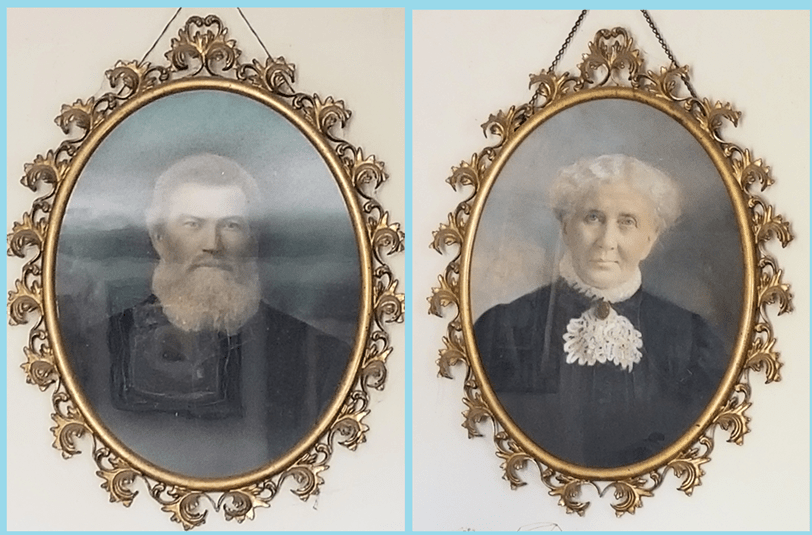
Manoah and Martha Steves
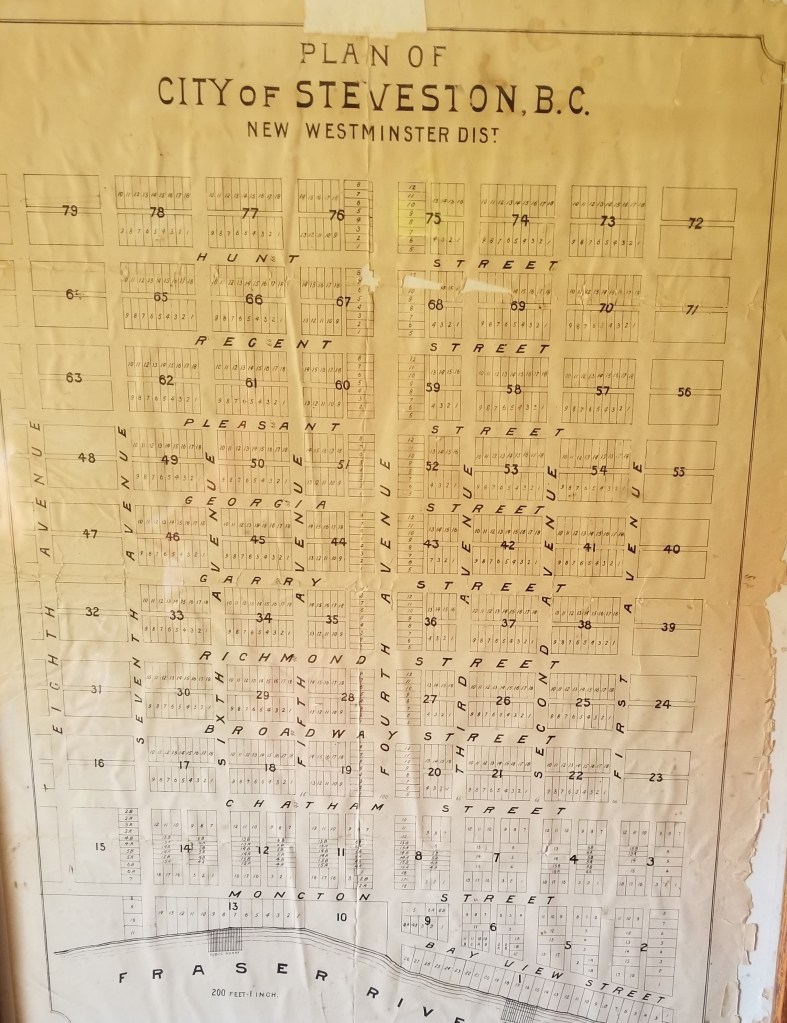
Nearly all of Lulu Island is now part of Richmond. In 1880, Manoah’s son William Herbert obtained a crown grant of the land that became the townsite of Steveston.
The streets in our neighbourhood share the names of Steeves relatives and places in New Brunswick. Manoah’s descendants still operate a farm on the land he originally purchased.
Harold has turned part of the house into a private museum. In addition to artifacts reflecting all aspects of his and the Steves family history of farming, politics, and conservation activism, Harold has turned part of the home into a recreation of the Hong Wo Store, a general store that had been established in 1895. Beside the Hong Wo store, Harold has recreated the canteen his parents operated during World War II, serving the soldiers stationed at a base beside the farm.
Harold opened up his museum to the general public earlier this year as part of “Doors Open Richmond”, a city-wide festival of culture and community operated by the Richmond Museum. Needless to say, we couldn’t pass up the opportunity. I could have spent days in there. His bookshelves alone could keep me occupied for weeks. Plus it was a chance for the boys to meet their fourth cousin three times removed! 😉
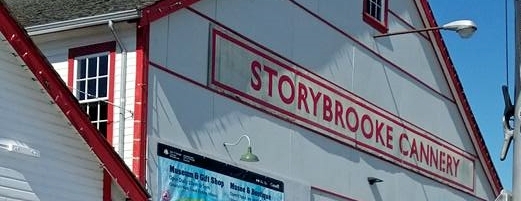
Steveston, B.C., or as you might recognize it from television, Storybrooke, Maine.
This week’s theme for the 52 Ancestors Challenge is “Prosperity”. While for the most part my ancestors over the centuries were largely working class and labourers, I have some that might have been described as “comfortable”. Thinking about it, the only ancestors who I might describe as “prosperous” are largely on the maternal branch of my family tree.
Despite this, the couple that come to mind for this week’s challenge are my Gx3 Grandparents on my father’s side of the family, Jan Gerritsz Veldman and Trijntje Stoop. I think of them primarily because of the amount of time I spent translating a pair of newspaper items describing their estate. Not only was it somewhat difficult because the items were written in an older form of Dutch, but because there was more to interpret than just the foreign language. In particular, the values were reported in guilders, the Dutch currency prior to the introduction of the euro; as well, the land was measured in terms that were not immediately familiar.
Schager Courant, Schagen, Noord Holland, Netherlands, November 11, 1906, page 4. “Openbare Verkooping” (“Public Sale”). This is an itemized list of the two pieces of property, consisting of 20 and 2 lots respectively, that went up for public auction after Trijntje died.
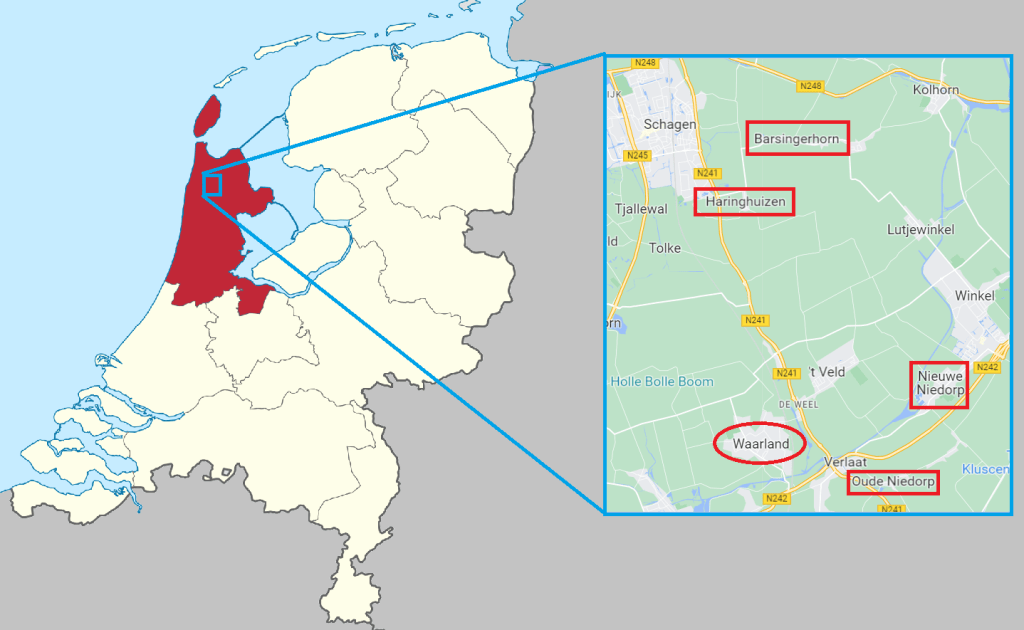
Trijntje was born October 30, 1832 in Haringhuizen, Noord Holland, Netherlands. Jan was born November 27, 1835 in Nieuwe Niedorp, Noord Holland, Netherlands. The two villages are about five kilometers apart. They married in Nieuwe Niedorp on May 1, 1858. They were living in Nieuwe Niedorp as late as 1866, when their fifth child was born. However, by 1873, they were living in Barsingerhorn, Noord Holland, Netherlands, where their tenth and last child was born. Barsingerhorn and Haringhuizen are relatively close to each other, situated about a kilometer and a half apart.
Jan died on May 21, 1897 while Trijntje passed away on January 27, 1906. The couple owned two pieces of property which Trijntje still possessed at the time of her death. One was a house comprised of two lots in Oude Niedorp, Noord Holland, Netherlands, together measuring 15.7 ares (just under 0.4 acres). [“Are” = 100 square meters. 100 Ares = 1 hectare. 1 hectare is just under 2.5 acres.] The other was a farm consisting of 2o lots in Barsingerhorn, which included a farmhouse, pastures, farmland, and a boat, totalling 11.9 hectares (just under 3o acres).
Map of the Netherlands with the province of Noord-Holland in red. The inset shows where Jan and Trijntje lived and owned property. I’ve circled Waarland because that is where my father was born. He did not live far from where his great great grandparents lived.
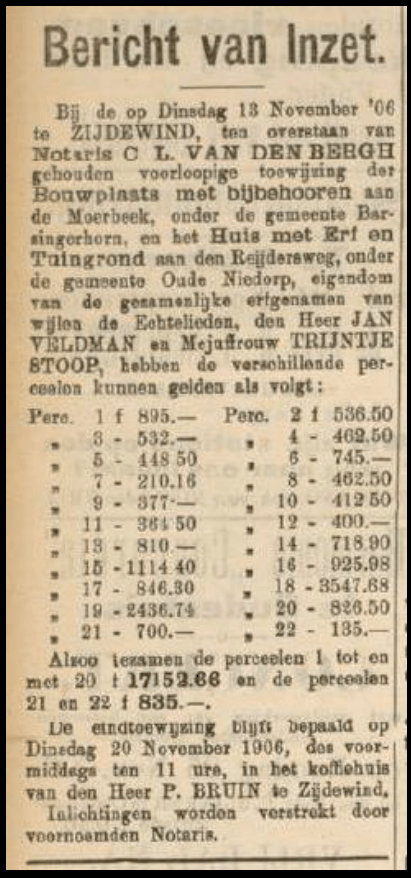
Schager Courant, Schagen, Noord Holland, Netherlands, November 18, 1906, page 4. “Bericht van Inzet” (“Notice of Commitment”).
According to both articles, the auction was scheduled to begin on November 13, 1906, although the second indicated that it was to have remained open until November 20, 1906. The second article set out the proposed value of each lot. Lots 1 to 20, the Barsingerhorn farm, had a total proposed value of ƒ17,152.66. Lots 21 and 22, the house in Oude Niedorp, were ƒ835.
By my calculations, these currently amount to €269,971.80 and €13,142.87 respectively, for a total of €283,114.67. (CDN$389,369.30 and CDN$18,955.42. Total: $408,324.72.) That might seem like a lot, but that’s barely enough to get a 500 square foot (0.01 acre) one bedroom condo apartment in Vancouver.
Approximate size of total land on offer: 24 American football fields (FYI, Canadian football fields are longer.)
 A Deck of Ancestors