I shouldn’t have to tell you that this isn’t really a picture of Trijntje Stoop (1832-1906)
I feel like this post could be a bit of a disservice or letdown to my Great x3 Grandmother, Trijntje Stoop. In many ways, I’ve exhausted a lot of what I could say about her through previous posts, such as Week 37 of the 2023 52 Ancestors Challenge (“Prosperity”) and last week’s post about her husband, Jan Gerritsz Veldman. What else can I say that I haven’t said already?
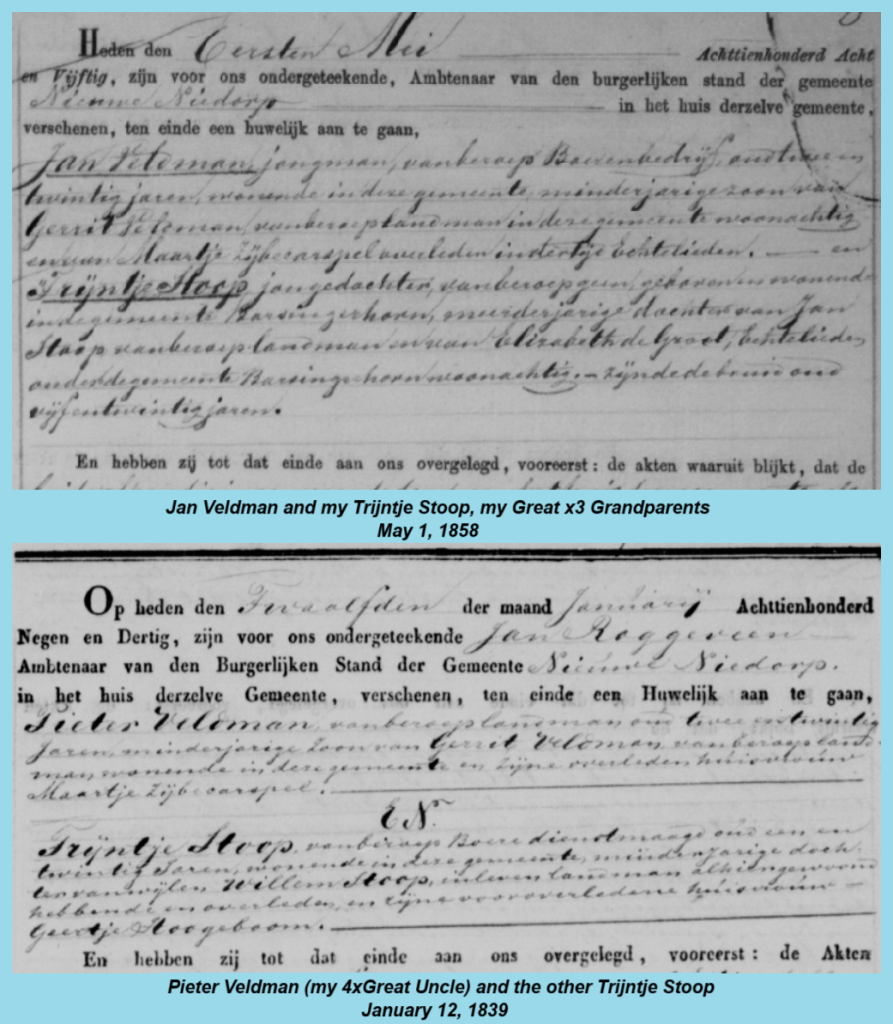
To that end, I have a fun fact about Trijntje. Her sister-in-law was also named Trijntje Stoop! The other Trijntje was married to Jan’s oldest brother, Pieter Veldman. There was an almost 20-year between Pieter and Jan; likewise, there was a 15-year age gap between the two Trijntjes. I’ve done a bit of digging to see if and how the Trijntjes might be connected, but nothing definite yet. In fact, you might think Trijntje Stoop might not be a common name. On the contrary, I’ve found quite a few!
Taking a step back to the beginning, Trijntje was born on October 30, 1832, in Barsingerhorn, Noord Holland. She was the first daughter and second of seven children born to Jan Pietersz Stoop and Elizabeth de Groot.
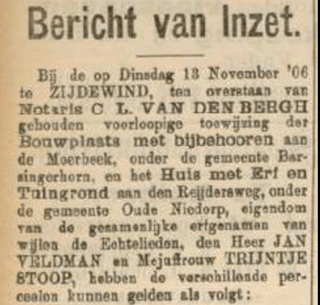
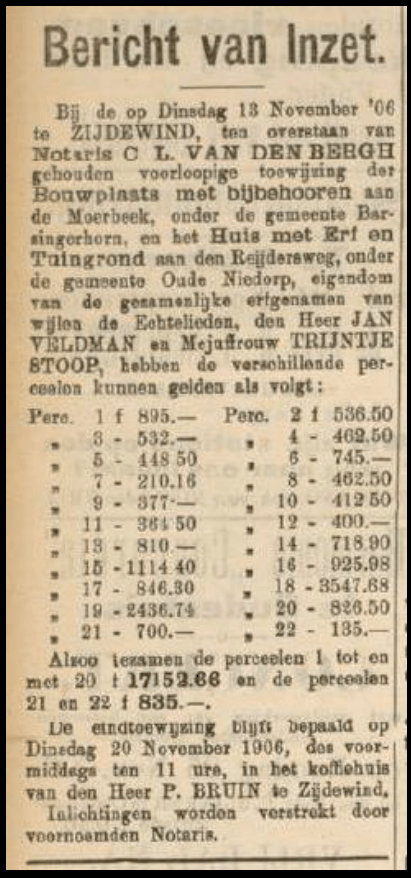
Schager Courant, November 18, 1906, page 4. “Bericht van Inzet” (“Notice of Commitment”), regarding the sale of Jan and Trijntje’s property after she died.
I have not yet found any records regarding Trijntje from the time of her birth to the time she married Jan Gerritsz Veldman on May 1, 1858. Their marriage registration says that Trijntje did not have an occupation at the time of their marriage. Given that she did not marry until she was 25 years old it is quite possible that Trijntje had worked in some form or another, such as a farm worker or a house servant.
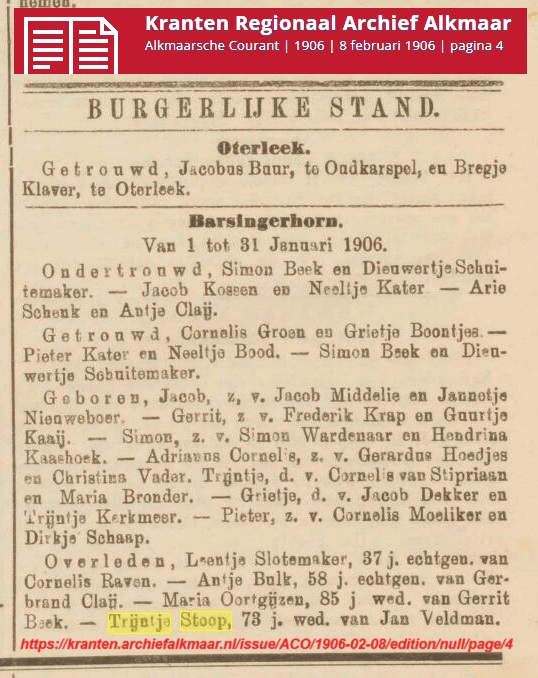
While much of Trijntje’s life story is intertwined with her husband’s, after Jan died in 1897, she spent the next ten years of her life as the owner and operator of their farm. Trijntje died on January 27, 1906 in Barsingerhoorn.
“Burgerlijke Stand” – Civil Register. Notices of births, engagements, marriages, and deaths for Oterleek and Barsingerhorn, with Trijnte’s death noted at the bottom. Alkmaarsche Courant, February 8, 1906, page 4.
Old newspapers are a great resource for genealogists. However, I do more than read just the item I’m looking for. I enjoy seeing what else was in the news on the same day as an ancestor’s birth, marriage, death, or other newsworthy action. Not only because it provides context for the familial event, but also because there are some really fun or interesting items to be found. There are all sorts of things you wouldn’t believe.
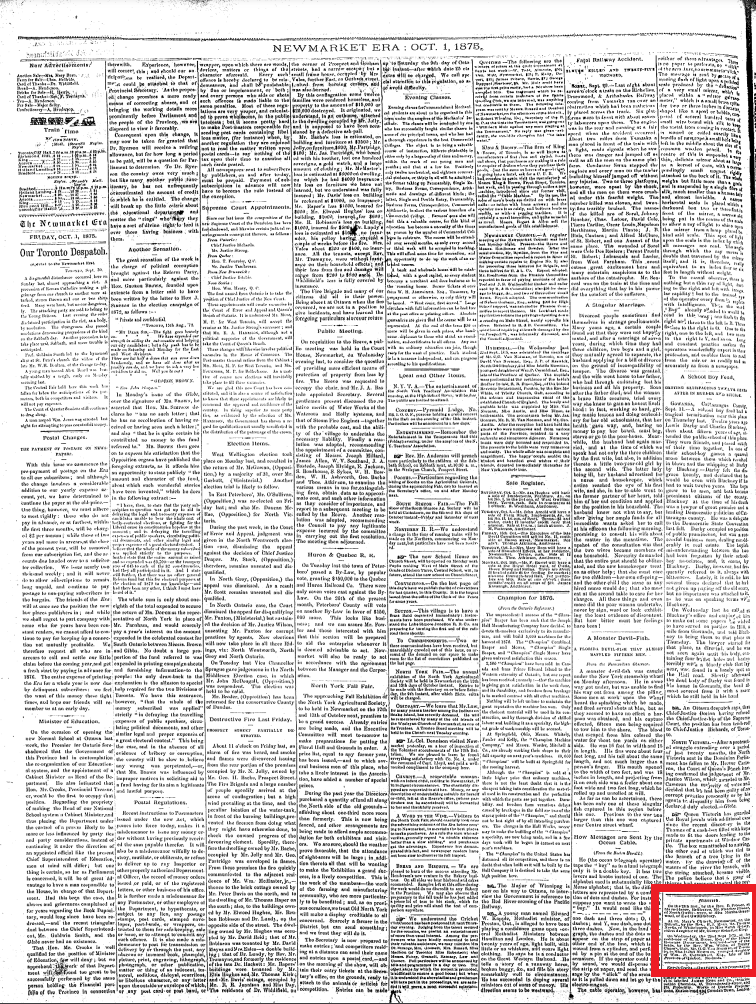
This is page two of the Newmarket Era (Newmarket, Ontario) for October 1, 1875.
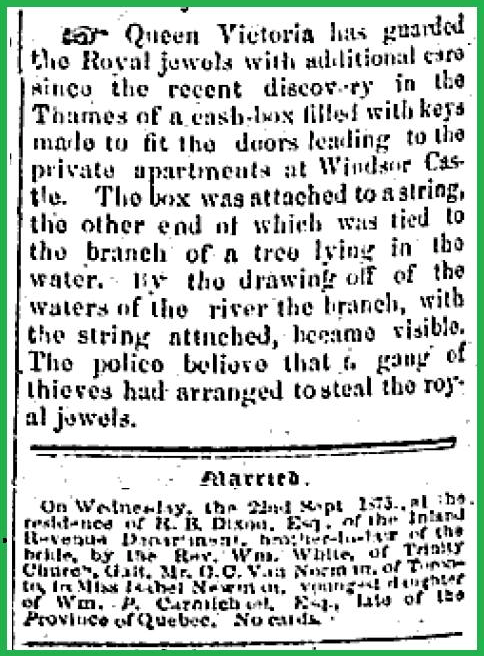
The item I was interested in is found in the bottom right-hand corner, marked in red. It announces the marriage of our sons’ great great great grandparents, Charles Crittenden Van Norman and Isabella Newman Carmichael.
However, there are lots of fun, interesting, and odd bits on the rest of the page. The first thing I noticed is immediately above the marriage notice: a great bit about what appears to have been a foiled plot to rob Windsor Castle, when Queen Victoria was on the throne.
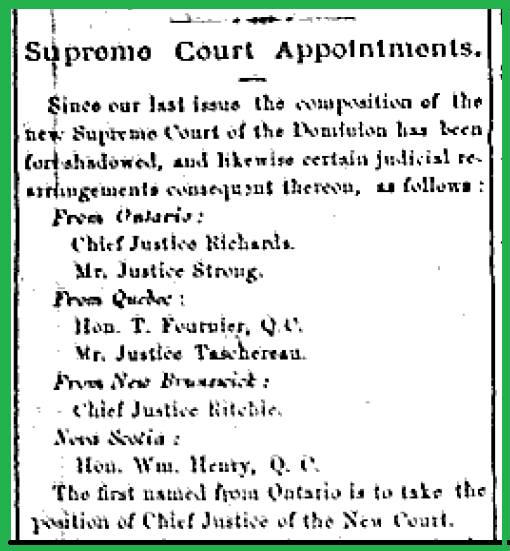
Buried elsewhere on the middle of the page was an item about the first appointees to the newly created Supreme Court of Canada. Note that there were no appointees from west of Ontario, although the only western provinces at the time were Manitoba and British Columbia.
That’s right, you wouldn’t believe it, the Supreme Court of Canada did not come into existence until seven years after Confederation. It wasn’t even front page news. The placement of the item in the middle of the page, in the third column, below a piece on new regulations for local postmasters, indicates the relevant unimportance of the court at that time. It wasn’t even the highest court for the country. That role was held by the Judicial Committee of the Privy Council in the UK until 1949 – 82 years after Confederation. Elsewhere on the page is an item noting that the first choice for Chief Justice of the new court turned down then offer – he preferred to remain in his position as the head of one of the provincial appeal courts.
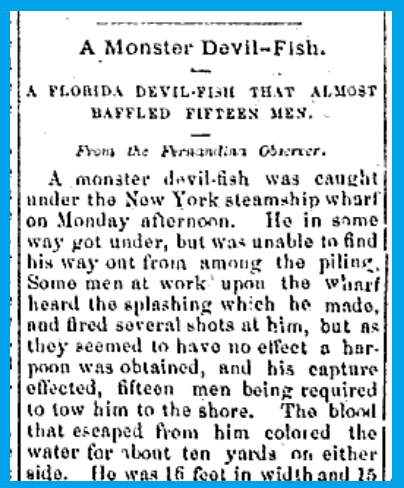
A few columns over is an item that you wouldn’t believe – “A Monster Devil Fish”. An incredible story about “A Florida Devil-Fish That Almost Baffled Fifteen Men”! The item ends by noting that “only only of these singular fish” had been captured before, “previous to the war.” Obviously, readers at the time would have known what war the story was referring to. Today, given that the item came from an American wire service, it’s most likely the reference was to the American Civil War.
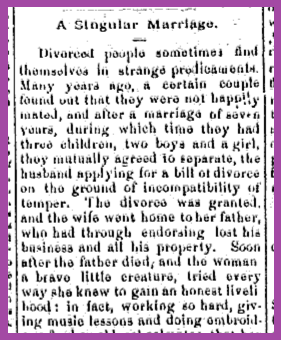
Above the Devil-Fish item is another story that not only you wouldn’t believe, you probably would not want to believe. “A Singular Marriage” tells the story of a divorced single mother of three (a “brave little creature”). She ended up in such a state of poverty that she was left with the prospect of begging, starving or going to the poor-house, unless she took a job as the housekeeper and nanny for her ex-husband, his new wife, and their two-year old daughter. “All these things and even more did the poor woman undertake, never by sign, word or look exhibiting the least evidence of discontent. But bitter her feelings must have been!”
This week’s theme for the 52 Ancestors Challenge is “Prosperity”. While for the most part my ancestors over the centuries were largely working class and labourers, I have some that might have been described as “comfortable”. Thinking about it, the only ancestors who I might describe as “prosperous” are largely on the maternal branch of my family tree.
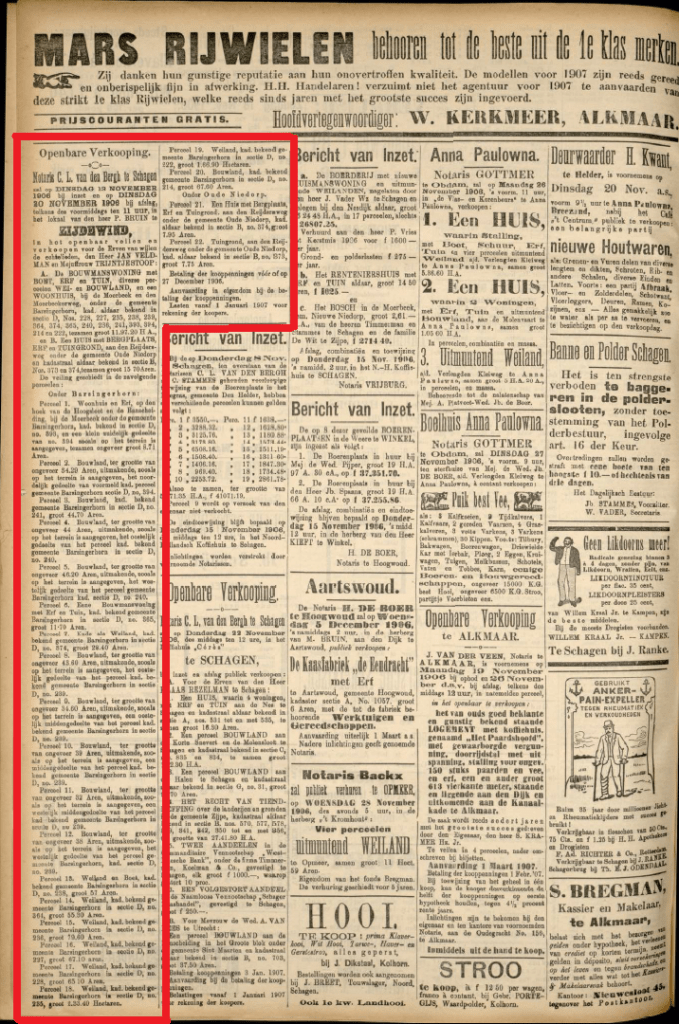
Despite this, the couple that come to mind for this week’s challenge are my Gx3 Grandparents on my father’s side of the family, Jan Gerritsz Veldman and Trijntje Stoop. I think of them primarily because of the amount of time I spent translating a pair of newspaper items describing their estate. Not only was it somewhat difficult because the items were written in an older form of Dutch, but because there was more to interpret than just the foreign language. In particular, the values were reported in guilders, the Dutch currency prior to the introduction of the euro; as well, the land was measured in terms that were not immediately familiar.
Schager Courant, Schagen, Noord Holland, Netherlands, November 11, 1906, page 4. “Openbare Verkooping” (“Public Sale”). This is an itemized list of the two pieces of property, consisting of 20 and 2 lots respectively, that went up for public auction after Trijntje died.
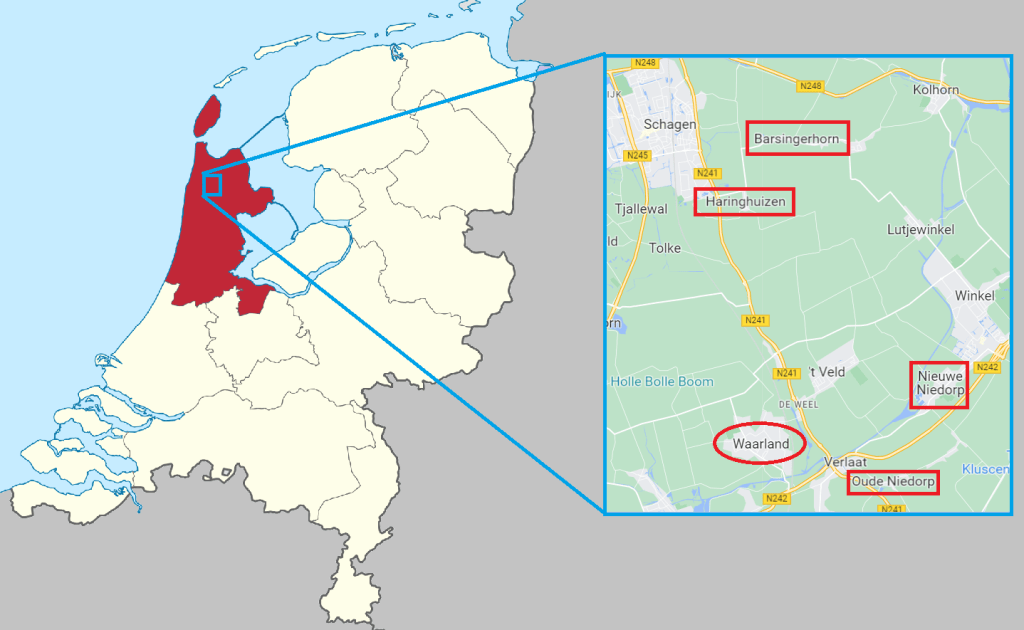
Trijntje was born October 30, 1832 in Haringhuizen, Noord Holland, Netherlands. Jan was born November 27, 1835 in Nieuwe Niedorp, Noord Holland, Netherlands. The two villages are about five kilometers apart. They married in Nieuwe Niedorp on May 1, 1858. They were living in Nieuwe Niedorp as late as 1866, when their fifth child was born. However, by 1873, they were living in Barsingerhorn, Noord Holland, Netherlands, where their tenth and last child was born. Barsingerhorn and Haringhuizen are relatively close to each other, situated about a kilometer and a half apart.
Jan died on May 21, 1897 while Trijntje passed away on January 27, 1906. The couple owned two pieces of property which Trijntje still possessed at the time of her death. One was a house comprised of two lots in Oude Niedorp, Noord Holland, Netherlands, together measuring 15.7 ares (just under 0.4 acres). [“Are” = 100 square meters. 100 Ares = 1 hectare. 1 hectare is just under 2.5 acres.] The other was a farm consisting of 2o lots in Barsingerhorn, which included a farmhouse, pastures, farmland, and a boat, totalling 11.9 hectares (just under 3o acres).
Map of the Netherlands with the province of Noord-Holland in red. The inset shows where Jan and Trijntje lived and owned property. I’ve circled Waarland because that is where my father was born. He did not live far from where his great great grandparents lived.
Schager Courant, Schagen, Noord Holland, Netherlands, November 18, 1906, page 4. “Bericht van Inzet” (“Notice of Commitment”).
According to both articles, the auction was scheduled to begin on November 13, 1906, although the second indicated that it was to have remained open until November 20, 1906. The second article set out the proposed value of each lot. Lots 1 to 20, the Barsingerhorn farm, had a total proposed value of ƒ17,152.66. Lots 21 and 22, the house in Oude Niedorp, were ƒ835.
By my calculations, these currently amount to €269,971.80 and €13,142.87 respectively, for a total of €283,114.67. (CDN$389,369.30 and CDN$18,955.42. Total: $408,324.72.) That might seem like a lot, but that’s barely enough to get a 500 square foot (0.01 acre) one bedroom condo apartment in Vancouver.
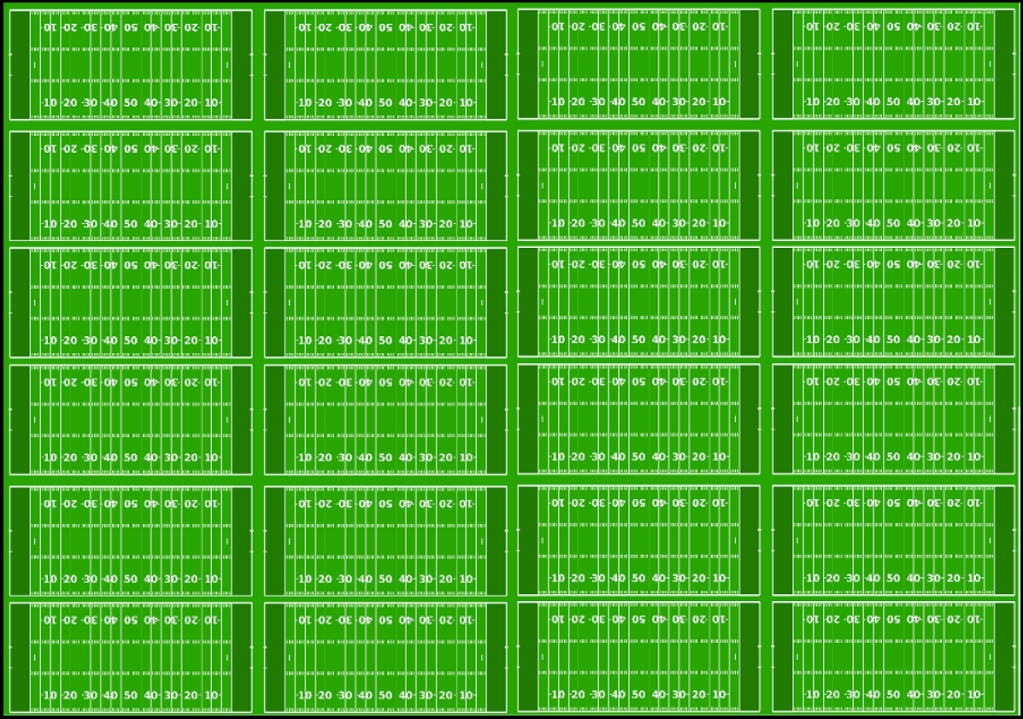
Approximate size of total land on offer: 24 American football fields (FYI, Canadian football fields are longer.)

 A Deck of Ancestors