
52W Mark V – Week 20: William Burgess

William Burgess, Sr.
(1794-1880)

With William Burgess, Sr., we reach the last of my maternal Great x4 Grandparents. William was born in Putnam, Washington County, New York on May 20, 1794, the fourth of eight children born to Chris John Burgess and Hannah Newland.

Chris John was born Johann Christian Borges, who was born in Fischbach, Hesse Nassau. Johann was a Hessian mercenary who initially fought for the British in the American Revolution, but later switched sides.

Johann was a member of the Second Hessian Division, under the command of Lt. General von Knyphausen, which mustered near Bremen in June 1776. His regiment then sailed for England. In July they set sail for the colonies. In August 1778, he and two others deserted, with Johann ending up in Rhode Island. After doing so, Johann set himself up as a weaver, an occupation he may have had in Hesse. As well, the legend is that Johann changed his name during this time in order to fit in with the colonials.

On March 19, 1782, Johann enlisted with the Rhode Island Regiment and served for nine months. Johann served with a fellow named Jabez Newland, whose sister was Hannah Newland. Johann and Hannah married in Providence, Rhode Island in 1786.

Hannah had deep roots in colonial Massachusetts, with both sides of her family having arrived there in the early to mid 17th century. In fact, Hannah is most likely a direct descendant of Francis Eaton, one of the passengers on the Mayflower, although there is one link in her lineage that I haven’t quite confirmed.

Five years before marrying Johann, Hannah had been engaged to a man named John Watterman, who was also a Hessian mercenary who deserted to serve with the rebels. In February 1777, Hannah and John declared their intention to marry, but the Selectmen of Norton, Massachusetts denied them permission to do so. One account is that John had a “questionable” German background. That is somewhat ironic, given that Hannah ultimately ended up marrying another former Hessian mercenary.

The more likely reason is that Hannah and John had conceived a child out of wedlock. Hannah was fined five shillings for “fornication and having had a bastard child born of her body”, as well as paying the cost of the prosecution. John was in attendance at the court proceeding and acknowledged paternity. The court ordered John to pay for the maintenance of the child. It appears from the court record that the order was less for social welfare purposes and more to prevent the town from bearing the cost of supporting an unwed mother.

After Johann and Hannah married, they moved to New York and settled at Fort William on the shore of Lake George. From there the family moved to Putnam, where they had their first five children. The family moved to Bolton, New York sometime around 1797, where Hannah gave birth to three more children.

While the family had moved to Bolton, William appears to have ended up back in Putnam later in life, because that is where he married Violate Stockwell on May 1, 1813. Over the next ten years, William and Violate had six children, with five more after a move to adjacent Warren County.

Then William’s world changed.

Joseph Smith published the Book of Mormon in March 1830. Two years later, in July 1832, William’s eldest child, Harrison, heard a Mormon missionary by the name of Simeon Carter. Harrison joined the fledgling church and was baptised in October 1832. Harrison then convinced his parents and two of his siblings to join. William, Violate, and their children Horace and Rosina were all baptized into the new church, which at the time was called the “Church of Christ”. They were all baptized on December 2, 1832 by another recent convert, William Snow, who himself had only joined the Mormon church earlier in 1832.

This makes William a ground-floor member of the church. He became an active and prominent member. William was well-known to Joseph Smith. William testified on behalf of the defence at one of Joseph Smith’s trials. As well, William’s son William Jr. lived in Joseph Smith’s residence during the time the Latter Day Saints were in Kirtland, Ohio.

In fact, the Kirtland Elders’ Certificates from the Joseph Smith Papers purport that William was ordained a deacon on April 6 1830 – the date the church was formally established. Clearly there was some backdating of his membership.
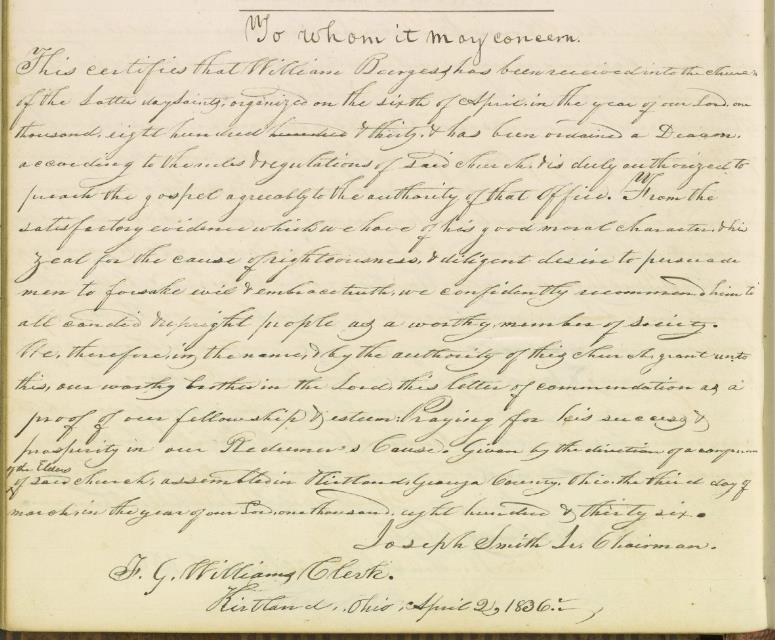
“This certifies that William Burgess has been received into the church of the Latter-Day Saints, organized on the sixth of April, in the year of our Lord, one thousand, eight hundred hundred & thirty, & has been ordained a Deacon…

Joseph Smith Jr. Chairman.
F[rederick] G. Williams Clerk.
Kirtland, Ohio, April 2, 1836.”

Despite the official church record, created years after the event, William and Violate’s baptism is documented in William Snow’s journal, written at the time of the event. So I place no weight on the Kirtland certificate. A copy of the diary is reproduced in last week’s post about Violate.

William and family joined the Mormon migration and their search for Zion, a New Jerusalem and holy city in the Americas that the church desired to build its community of the righteous. This was originally Kirtland, Ohio, where William and Violate’s youngest child was born in 1837.

In Kirtland, William purchased a half acre tract of land in 1834 for $50 from a John Reed. The legal description of the property was Lot No. 44, Tract 1. William was one of the chief carpenters who helped construct the church’s temple at Kirtland. Among other things, William laid out the roofing timbers. When William left Kirtland, he sold his land for $180. Not a bad return for a few years’ investment.

In 1840, William and family moved with the Saints to Nauvoo, where William’s primary occupation was farming. William was also involved in the construction of the temple in Nauvoo. The family remained in Nauvoo until the Mormons were driven out in 1846. The Burgesses were amongst the first companies to leave Nauvoo, destined for what is now Utah, but which at the time was still part of Mexico.
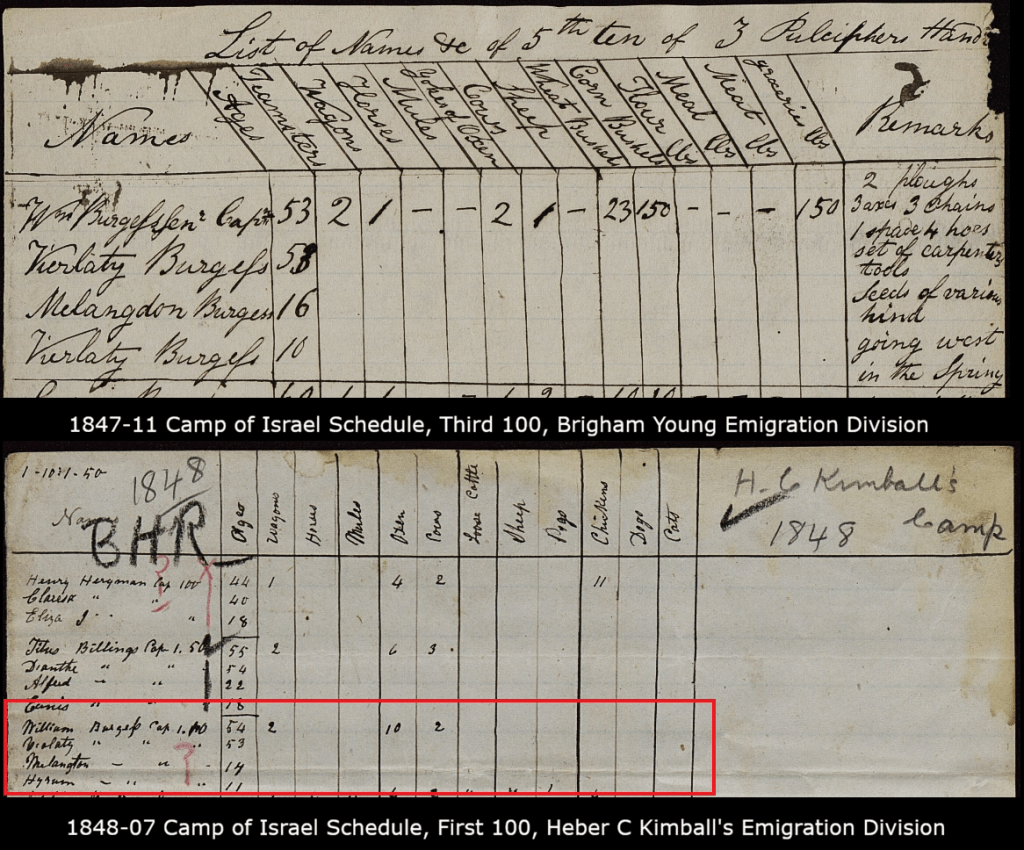
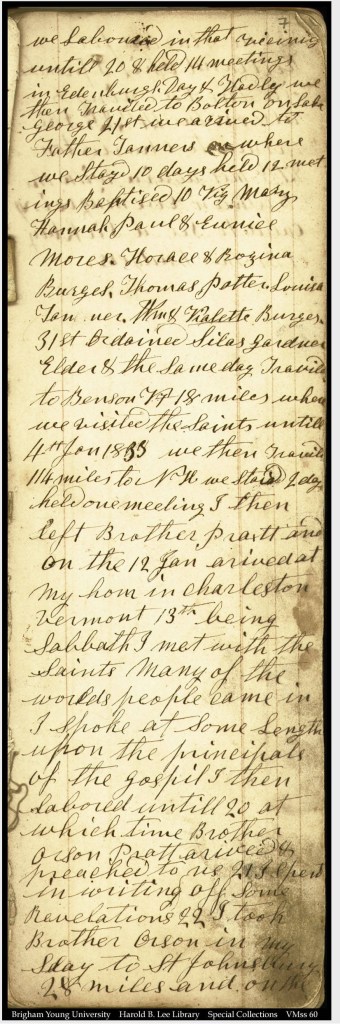
“Camp of Israel” was a name used to describe Winter Quarters. These are entries from William’s time there, one from 1847 and the other from 1848, when William and family left for Utah.

Due to the late and rushed start of the migration, the Mormons were forced to set up camp in Nebraska at a site known as Winter Quarters, near where Omaha came to be. William and family were at Winter Quarters for most of its existence, from 1846 to 1848. When they departed, it was with a company of 662 and arrived in Salt Lake City in September 1848.
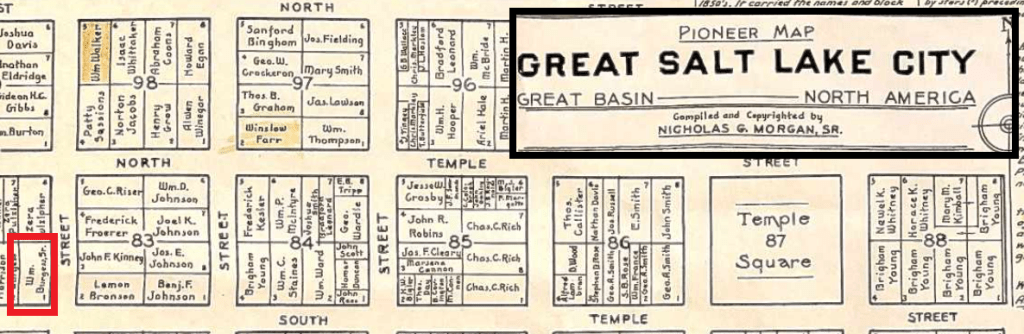
Location of William’s home in Salt Lake City. Today that is some prime real estate.

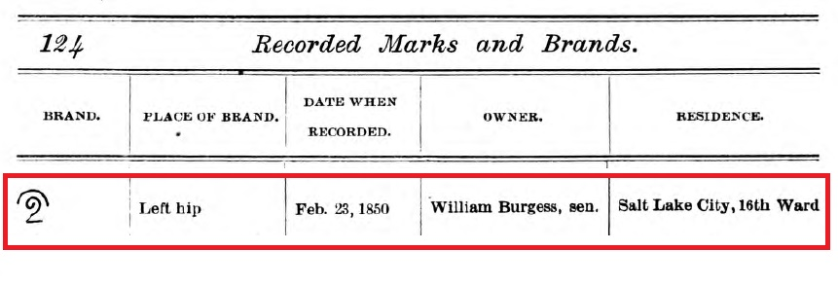
William lived in the 16th Ward of Salt Lake City for 12 years, where he was a farmer. He also raised cattle, and had a brand recorded on February 23, 1850. The mark was a stylized number “2” (having a curled flourish at the top) with an arch above, placed on the left hip.
On December 17, 1854, William entered into a polygamous marriage with Dorcas Keeling, who was 43 years old at the time. They married in the President’s Office in Salt Lake City. Dorcas was a recently divorced mother of three. She had been married to George Dykes, who left the church after serving a mission to Great Britain and Denmark in 1852. Dorcas and her children lived in William’s household until Dorcas’s children married and moved out. In fact, two of William’s grandsons, through his son Horace, married two of Dorcas’s daughters. So the sisters were also sisters-in-law, and the brothers were brothers-in-law.

In 1861, the church directed William to move to Pine Valley, which had been established two years earlier as a logging settlement. William was instructed to establish a saw mill there. Lumber produced at William’s mill was used throughout Utah, including the temple at Salt Lake as well as its pipe organ. Lumber from the mill was also used to build the Pine Valley Chapel, the oldest Mormon chapel in continuous use. As well, William built a separate home for Dorcas, a block from where he and Violate lived. By 1870, William had real property worth $500 and personal property worth $200.

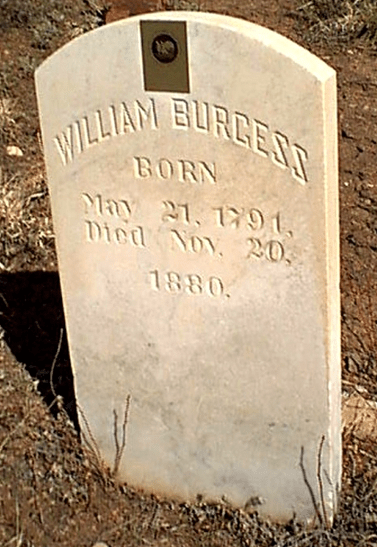
William died on November 20, 1880 in Pine Valley, only four months after his wife Violate. Dorcas survived him by a year. William is buried at the Pine Valley Cemetery.

52W Mark V – Week 19: Violate Stockwell

Violate Stockwell (1794-1880)

I’m amazed – it feels like it’s been months since I last posted, but I see it’s only been three weeks. Yay me.

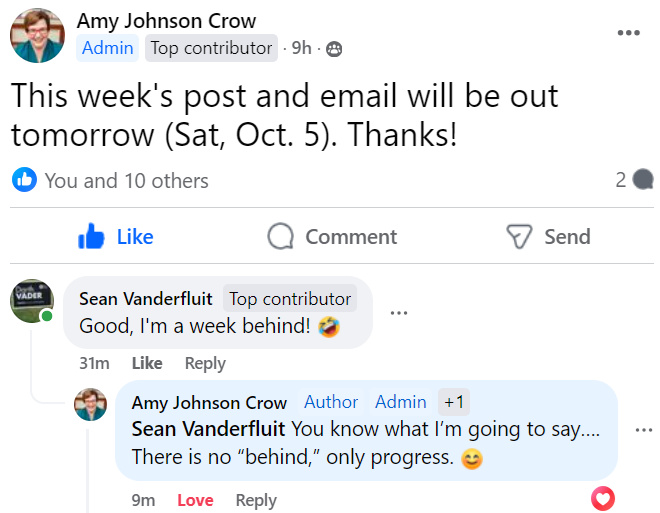
I am, however, eight weeks behind in the  52 Ancestors Challenge. When I commented on that fact a week ago on Amy Johnson Crow’s Facebook group, Generations Cafe, her only response was “You know what I’m going to say.” Of course I did! I even have the receipt to prove it.

October 2024. Not the first time I received that reminder.

So let’s get a move on and talk about my Great x4 Grandmother, Violate Stockwell. She was born on October 10, 1794 in Windham, Vermont, to Abraham Stockwell and Vilate (Violette? Vierlaty?) Gale, who were both originally from Massachusetts. They were third cousins. Even outside their common ancestor, Abraham and Vilate both had deep roots in colonial New England going back to the 1600s.

If I have fancy-pants ancestors or famous cousins, many of them are through Violate. Violate’s Great x4 Grandmother was Rebecca Towne Nurse, one of the accused who was convicted and executed by hanging during the Salem Witch Trials. Violate is also a descendant of the Putnam family, whose members included some of the accusers at Salem. As well, since it’s the Fourth of July (otherwise known as “Saturday” here) while I am writing this, I might as well point out that Violate is a direct descendant of Richard Singletary, who is my Gx 10 Grandfather. Richard is Barack Obama’s Gx9 Grandfather. So the former President and I are 1oth cousins once removed. As far as I know, he’s the only US President I connect to.

While Violate’s parents were from Massachusetts, they married in New Hampshire. I don’t know if they met there or in Massachusetts. Their first two of seven children were born was the third of seven children. Violate, Abraham and Vilate’s third child, was born in Vermont, as were the next three children. The youngest child was born in Hartford, Washington, New York. There was a 27-year difference between the eldest and youngest child. Violate was 23 and had been married for five years when her youngest brother was born. This may have foreshadowed the age span of Violate’s own offspring, for there was a 22-year difference between her eldest and youngest child.

Violate married William Burgess, Sr., on May 1, 1813, in Putnam, New York. While Hartford and Putnam are both in Washington County, they are over 40 kilometers apart, so I have no idea how Violate met her husband.

Violate and William had 12 children together. In fact, Violate appears to be the one who has had the most children of all the women in my family tree. Violate was 18 when she married and gave birth to her first child, Harrison, a year later. The next five children, including my Gx3 Grandfather William Burgess, Jr. were all born in Putnam, while the next five were born in nearby Warren County, New York. The youngest, Vierlaty (or Vilate!), was born in 1837, in Kirtland, Ohio, after Violate and William joined the fledgling Mormon church. Violate was 42 years old when she had her last child.

Extract from William Snow’s Journal, in which he writes about baptizing Violate and William, and two of their children.

Violate and William, along with their second and third oldest children (aged 14 and 18 at the time), were baptized into the church on December 2, 1832. This makes them amongst the earliest converts to the church, as Joseph Smith had only published the Book of Mormon in 1830. In fact, the church founded by Smith was known merely as the “Church of Christ” until 1834 when it was renamed as the Church of Jesus Christ and Latter Day Saints. They were all baptized by William Snow, who himself had only joined the church earlier in 1832.

Violate’s conversion, along with her husband and two children, came through her son Harrison’s involvement with the early Mormon church. According to Harrison’s diary, he first heard a Mormon missionary by the name of Simeon Carter in July 1832. Harrison converted and was baptized by Elder John S. Carter on Oct. 10, 1832 and confirmed as a member of the church by Elder Orson Pratt. Harrison described Violate as “a very gifted and talented mother and of a very religious nature.”

Violate and family joined the migration of Mormon adherents to Kirtland, settling there around September 1833. They remained there until about 1840, when they moved with the Latter Day Saints to Nauvoo, Illinois, which was to be a new Zion for the church.

However, tensions grew between the Mormons in Nauvoo and their neighbours elsewhere in the county, as well as the state. Matters culminated with the state revoking the city’s charter in 1845, followed by the expulsion of the Mormons in 1846. Brigham Young, by then the head of the church, called on church members to migrate west, beyond the western frontier of the United States into Utah, which was then still part of Mexico. Violate and family were part of that migration.

Due to the rushed departure from Nauvoo and the lateness of the season, in September 1846 the Mormons established a camp and waystation near what is now Omaha, Nebraska, known as Winter Quarters. While it essentially began as a refugee camp, it quickly evolved into a small organized town. Despite that, conditions were rough and there were waves of disease that took their toll. The Latter Day Saints vacated Winter Quarters by December 1848.

Violate and family were in Winter Quarters for most of its existence. Two of her children died during their time there. The family set out from Winter Quarters in 1848 destined for Utah, in a party of 662 individuals led by Heber C. Kimball, who was essentially Brigham Young’s right hand man. Violate and family arrived in Salt Lake City in September 1848 and settled in the 16th ward. Violate was 53 years old by that time.

Compared to the tumultuous events that marked Violate’s life from her conversion in 1832 to her arrival in Salt Lake City in 1848, the next 32 years of her life were relatively quiet. So much so that I have little indication of her activities, which presumably were centered around the home and domestic life.

Perhaps the most significant events during that time was Violate’s husband entering into a polygamous marriage in 1854 and the family’s move to Pine Valley, Utah in 1861 at the direction of the church. Coincidentally enough, the first bishop of Pine Valley was William Snow, the man who had baptized Violate into the church.

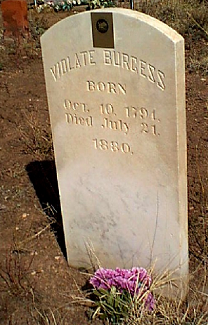
Violate died in Pine Valley on July 21, 1880, aged 85, having outlived nearly half of her children, and predeceasing her husband by only four months. Violate is buried at the Pine Valley Cemetery.
52W Mark V – Week 17: Louisa Thomas

Louisa Thomas (1811-1846)

My 4xG Grandmother, Louisa Thomas, had a short and difficult life. While she passed away when she was 35, she had married three times and had partaken in one of the great westward treks of American history, the Mormon Migration.

While by every account Louisa was possibly born on May 28, 1811, I have had a great amount of difficulty in determining where her birth occurred. I have not found any primary records on the matter. The few sources I have are secondary or tertiary in nature.

When I first learned about Louisa in the mid-1990s, what little I found indicated that she was born in “Berks” or “Berks County” Virginia. However, there is no such place.

There’s a Berks County in Pennsylvania, not Virginia. There is a Burkeley County in West Virginia, in the panhandle bordering Maryland, which would have been part of Virginia when Louisa was born. There was also a Berkley, Norfolk County, Virginia, but the town was annexed by the City of Norfolk and the Norfolk County no longer exists. There is also Burke, Virginia, an unincorporated community in Fairfax County, about 20 kilometers southwest of Washington, D.C. The death certificate for Charlotte Liggett, Louisa’s daughter, says Louisa was born in West Virginia. The entry for Louisa’s death in the Winter Quarters Sexton’s Records says she was born in Maryland.

Considering all this information together, it seems that Louisa was most likely born in Burkeley County, then part of Virginia, close to the border with Maryland.

Louisa’s parents are also largely a matter of speculation and were said to be James Thomas and Elizabeth Stevens. The one source I had that named Louisa and her parents was a family history of Louisa’s second husband, the Liggetts, which I first consulted in 2013. The current version of that document no longer mentions Louisa or her parents. However, after writing this paragraph, I came across a history of Scioto Township in Delaware County, Ohio, which includes mention of James and Elizabeth. Unfortunately, the book does not indicate the source of this information.

FamilySearch had a James Thomas named as Louisa’s father, but named a Catherine Simmons as her mother. There were no sources for this connection, so I edited Louisa’s entry on FamilySearch by disconnecting her from those individuals. As it stands, I have no actual knowledge of who Louisa’s parents might have been.

The fog of history continues with Louisa’s first marriage. She is said to have married Lazarus Absolom Beakley in 1835, when Louisa was 24. However, I cannot find any record of this marriage or of Lazarus himself, who is said to have been born in 1811 and died before 1837. One secondary source even suggested that his name was only Absalem, with no Lazarus as a first name. Lazarus and Louisa supposedly had a son. Not only can I not find a record of this child, I can’t even find anything indicating what his first name might have been. Most of what I have about this marriage comes from a memoire by George Burgess, who was born 50 years after Louisa died, so I do not consider it particularly reliable.

At most, the registration of Louisa’s marriage to her second husband, Conrad Liggett (my Great x4 Grandfather) names her as “Louisa Beakley”. For the longest time, I had assumed this indicated a previous marriage to a man with the surname “Beakley.” However, that was based upon the belief that Louisa’s surname at birth was Thomas. The record of her marriage to Conrad does not indicate she was a widow.

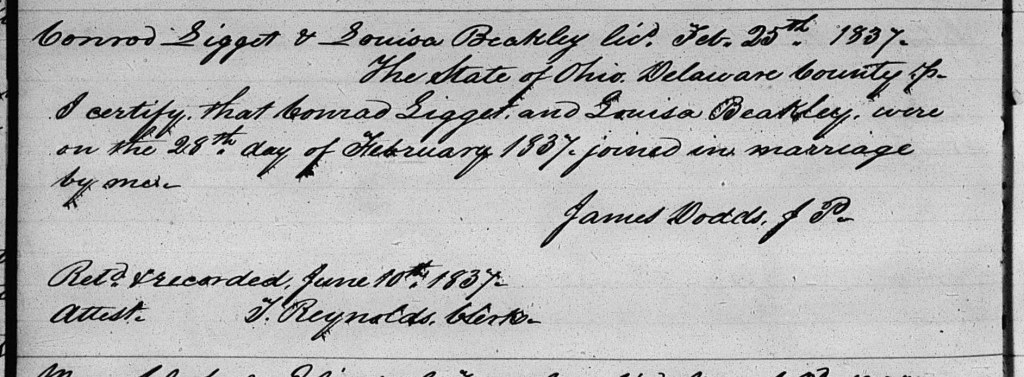
The registration of marriage for Conrad Liggett and Louisa Beakley. There is no indication that Louisa was previously married or whether Beakley was her surname at birth or that of a previous husband.

What if there was no Lazarus Absolom Beakley (given that I can find no record of him) and Louisa’s surname at birth was Beakley? I’ve been unable to find any record or mention of a Louisa Beakley, so that thought remains largely theoretical.

The real paper trail for Louisa begins with her marriage to her second husband, Conrad, as reproduced above. It’s the first tangible record indicating that Louisa even existed. Louisa and Conrad married on February 28, 1837 in Delaware County, Ohio. They had one child together, my Great x3 grandmother, Charlotte Liggett. It was a short marriage, as Conrad died on April 21, 1838, when Charlotte was only five months old.

With Conrad’s death, Louisa had to find work to support her family. As a result, Conrad’s parents, James Liggett and Susana Carr, took Charlotte in, possibly along with her half brother through her mother’s marriage to Lazarus Beakley. It is not clear if Charlotte’s grandparents had full-time custody and care of her or whether they only looked after her during Louisa’s working hours. Based upon the second-hand descriptions of their custody I’ve read, it appears that James and Susana had full-time care of Charlotte.

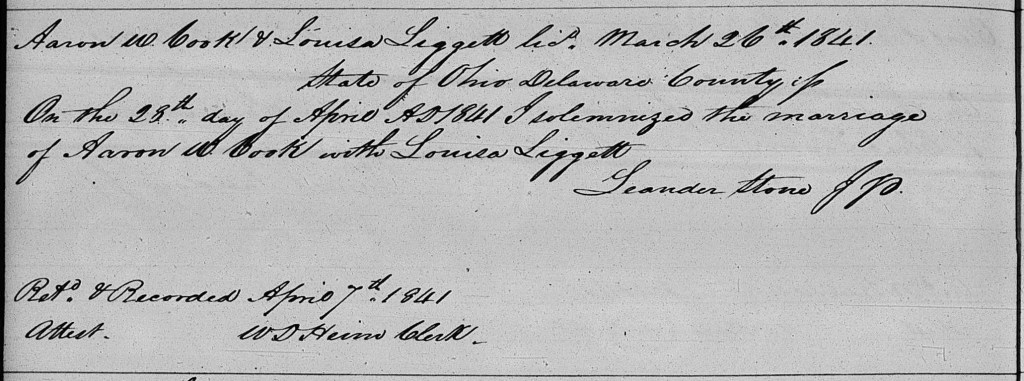
Three years and one week after Conrad died, Louisa married for a third (second?) time, to Aaron W. Cook. Aaron’s birth information I take with a grain of salt, because it’s exactly the same as what I have for Lazarus, and with an equally flimsy evidentiary basis. What is definitely far more certain is that Louisa married Aaron on April 28, 1841 in Delaware County, since there is a registration for their union in the Delaware County records.

The registration of Louisa and Aaron’s marriage.

Here is where the story becomes (allegedly) more dramatic. According to George Burgess’s memoire, Louisa and Aaron married in secret. Around the same time, the couple joined the relatively new Mormon church.

Shortly after the marriage, Louisa asked James and Susanna if she could take Charlotte home with her for a week or a weekend. However, Louisa never returned Charlotte to her paternal grandparents. In George’s words, they “ran off” with Charlotte and joined the Mormons in their westward migration. However, it seems to me that Louisa was well within her rights to keep her daughter with her, since her in-laws never had any form of legal custody of Charlotte.

George said that Louisa had three daughters with Aaron when they were living in Nauvoo, plus another child about 12 miles out of Nauvoo after the Mormons were driven out of there. I have no records of these children, so I have not included them in my database. Louisa and her youngest child died during childbirth. Allegedly – again! – because I cannot find any mention of a child in the record of Louisa’s death or that Louisa had died in childbirth.

After leaving Ohio, Louisa and Aaron apparently settled in Nauvoo, Illinois, where the Mormons had established a settlement and built a temple. However, in 1846, a few years after the death of church founder Joseph Smith, the Mormons were driven out of Nauvoo. This motivated the Mormons to migrate to what is now Utah, which was then still part of Mexico.

Because of the rushed departure from Nauvoo late in the year, the Mormons set up camp known as Winter Quarters, near present day Omaha, Nebraska. Conditions were rough and many of the trekkers died there. Depending on the source, anywhere from 350 to 2,000 Latter Day Saints perished at Winter Quarters. Louisa was one of those who died there.

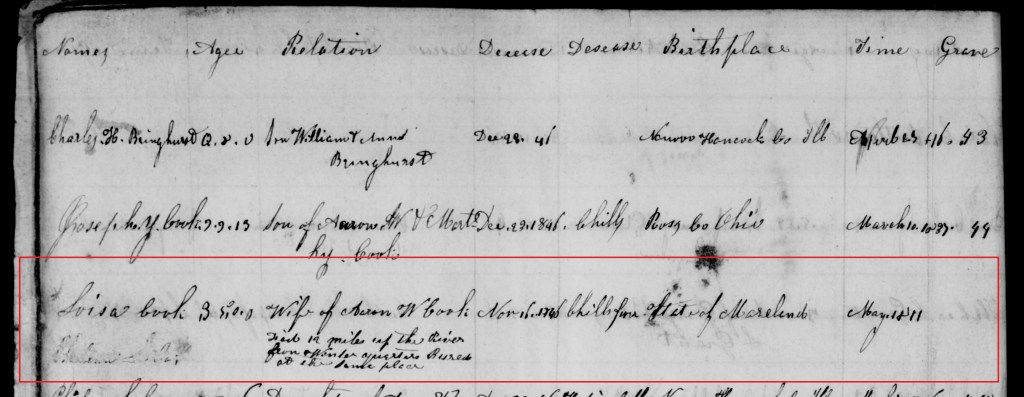
An entry in the Winter Quarters Sexton’s Records shows that Louisa died on on November 16, 1846, about 19 miles up the river from Winters Quarters. Charlotte was only nine at the time.

“Loisa Cook. 36 years, 0 months, 0 days. Wife of Aaron W. Cook [her third husband]. Died 19 miles up the River from Winter quarters Bur[i]ed at the same place. [Died] Nov 16 1846. [Disease] chills fever. [Born] State of Mareland May 1811.”

While Louisa only lived for 35 years, I only have documentation I have for her only coves the last ten years of her lifen. What little there is shows short marriages, family strife, religious persecution, and an early death. Despite what I have found, Louisa remains a solid brick wall ancestor.

Hello Louisa!

52W Mark IV – Week 38: Card B12 Thomas Preston

Preston Thomas (1814-1877)

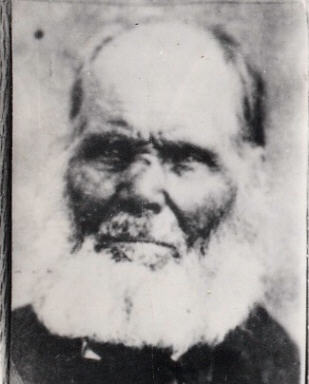
TL;DR: My Gx3 Grandfather Preston Thomas was first a slave owner and later a polygamist. I don’t like him.

Of course, that comes with the bias of my point in time. The longer story is that in his time Preston was well-respected by his community, his church, and his family. He was acting on the norms of his time and his community. In addition to many different occupational pursuits during his life, Preston a leader, a teacher, a politician, and a judge.

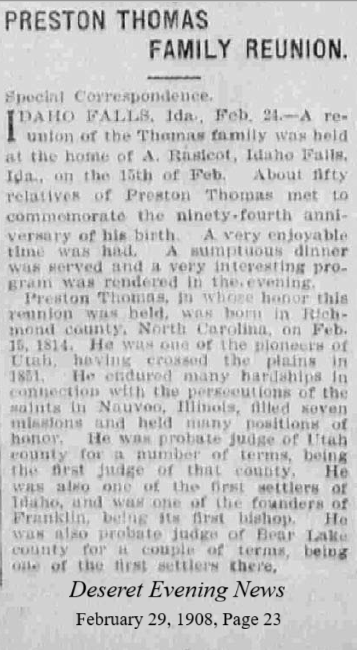
Preston’s story begins in Rockingham, North Carolina, where he was born on February 15, 1814 to Daniel Thomas and Nancy Ann Morehead. Daniel was the son of a Baptist minister and was an affluent slaveowner with a 3000 acre plantation with a carpenter shop, blacksmith shop, a cotton gin, and a shad fishery. Daniel owned about 30 slaves, many of whom were passed onto his sons.

Needless to say, with the stature of his father, Preston was well-educated. Apparently he spent some time in New Jersey as part of his schooling, although I do not know what kind of school he attended or when. Preston was 16 when his father passed away on November 7, 1830. By the time he was 21, Preston’s endeavours included operating a sawmill he owned in Covington, North Carolina.

Sometime after Daniel died, Preston, his mother Nancy, and his older brother Joseph, and younger sister Elizabeth (“Betsy”) all relocated to Tipton, Tennessee. Joseph was married at the time; Preston and Betsy were not. Needless to say, the family brought their slaves with them. It seems Joseph bought some land that he farmed. Preston’s pursuits included the study of law, but I don’t know if he actually practiced. By 1838, Preston also owned a mill in Tipton.

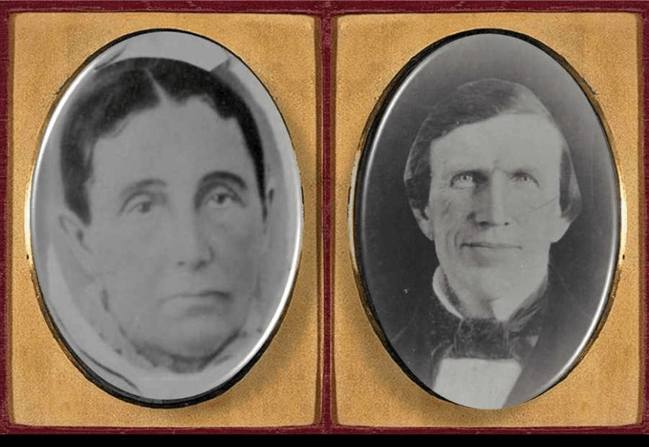
In Tipton, Preston married Sarah Ann Jane Morehead on May 10, 1838. Sarah – who went by Jane – was a cousin of Preston’s to some degree, but I haven’t researched their exact relationship. From 1839 to 1860, over four states, Preston and Jane had nine children.

Sarah Ann Jane Morehead and Preston Thomas

Sometime in mid-1835, Preston’s brother Joseph had relocated to Somerville, Mississippi. Years later, Joseph returned to Tennessee and persuaded his mother and siblings Betsy and Daniel to join him in Mississippi. Preston remained in Tipton. However, after Preston’s mother died on November 7, 1843, he moved to Somerville. Part of the move was to help settle his mother’s estate. Preston build a mill upon moving to Somerville; presumably a sawmill as he had done in North Carolina.

It was in Mississippi that Preston and his family first encountered some Mormon missionaries. Eventually, Preston and all his siblings joined the church; in fact, years later on a mission to Texas, Preston converted his brother Daniel. Preston was baptised into the church January 13, 1844 and became one of its most ardent evangelists. He served on six major missions, primarily to Texas. Preston travelled the Mississippi river nearly thirty times as part of his missionary work. Thomas sold his slaves to his uncle, Benjamin Thomas, and moved his family to Nauvoo, Illinois, settling there by 1845.

When the Mormons were driven out of Nauvoo in 1846, Preston initially moved his family to Memphis, Tennessee. In part, it was because they still had family in Tennessee; as well, Preston was serving another mission. They remained there for at least a year. By 1848, Preston and family had joined the Mormon migration in Winter Quarters in Nebraska, which the Saints had set up as a temporary community on their way to Utah.

However, before proceeding to Utah, Preston was called to another mission to Texas. As well, in 1850, the family briefly lived in Freemont, Iowa, where Preston carried out farming. While residing there, Preston and Sarah Jane took in two of Preston’s nephews, whose parents had passed away. By 1851, Preston and his family had settled in Lehi, Utah, where they remained for the next nine years.

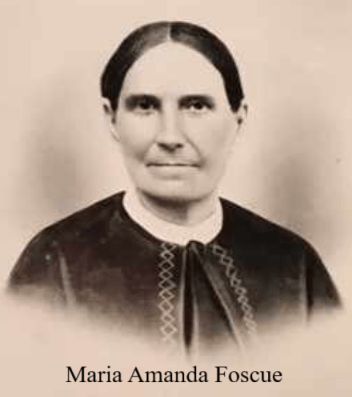
Sometime in 1949, during one of his missions to Texas, Preston met John Smith and Maria Amanda Foscue (1822-1885), a couple with seven children. John was originally from Alabama, Maria was from Florida. During this mission, Preston converted the couple, who undertook the trek to Utah. John did not survive. Maria ultimately ended up in Salt Lake City and came back into contact with Preston, who she married on November 17, 1851. Bear in mind that Preston was still married to Sarah Jane at the time, and he remained so until he died. With Maria, Preston had four children, all of whom were born in Lehi.

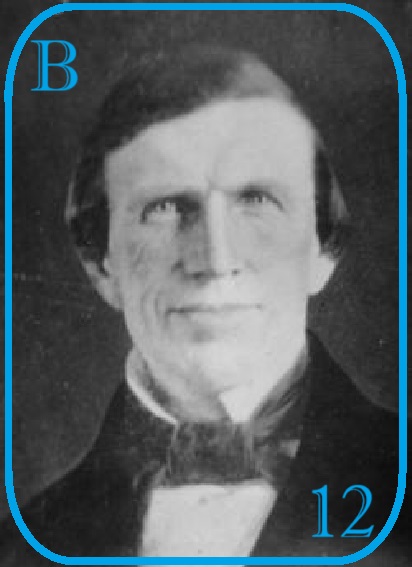
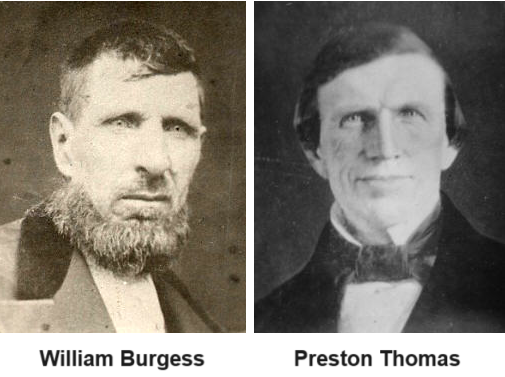
Besides providing for his large and growing family, Preston was a busy man in Lehi. The town established a school in 1851. Preston and his sister Betsy were its first teachers. Preston taught the boys on one side of the school room; Betsy taught the girls on the other side. A school board was established on February 20, 1854. Preston was one of three men elected as the first trustees. Another was William Burgess. My grandfather, Leo Burgess, is a direct descendant of William and Preston – William on his father’s side and Preston on his mother’s. A month after becoming a member of the school board, Preston was elected as an alderman of Lehi.

Two of Lehi’s first school board trustees, and great grandfathers of Leo Burgess, my maternal grandfather

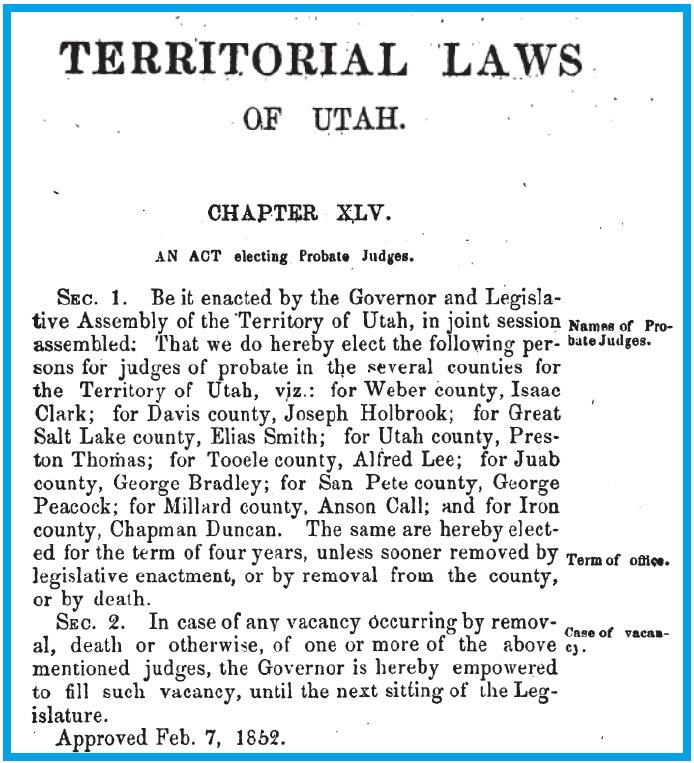
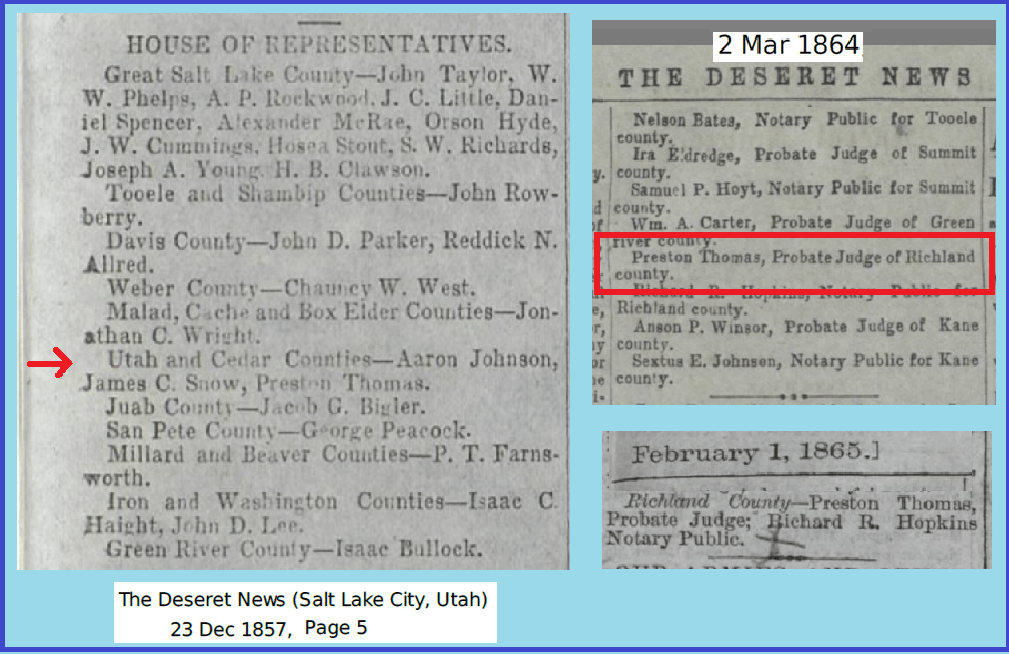
On top of all that, Preston was one of the first Probate Judges in Utah. He was appointed when the court was created and was the first judge for Utah County (Salt Lake City). Preston’s appointment was approved by an Act of the territorial legislature on February 7, 1852 (Laws of the Territory of Utah, Chapter XLV).

At the time of its creation, the Probate Court in Utah had a much broader jurisdiction than simply the estates of the deceased and those under guardianship. In addition, the territorial legislature granted the court jurisdiction over civil, criminal, chancery, and divorce matters. As well, the Probate Court heard appeals from the county Justice of the Peace courts. In 1874, the federal government revoked the Probate Court’s jurisdiction over all matters except for divorce and probate matters and in 1877, it revoked the court’s authority in divorce matters. When Utah became a state in 1896, the Probate Court was abolished.

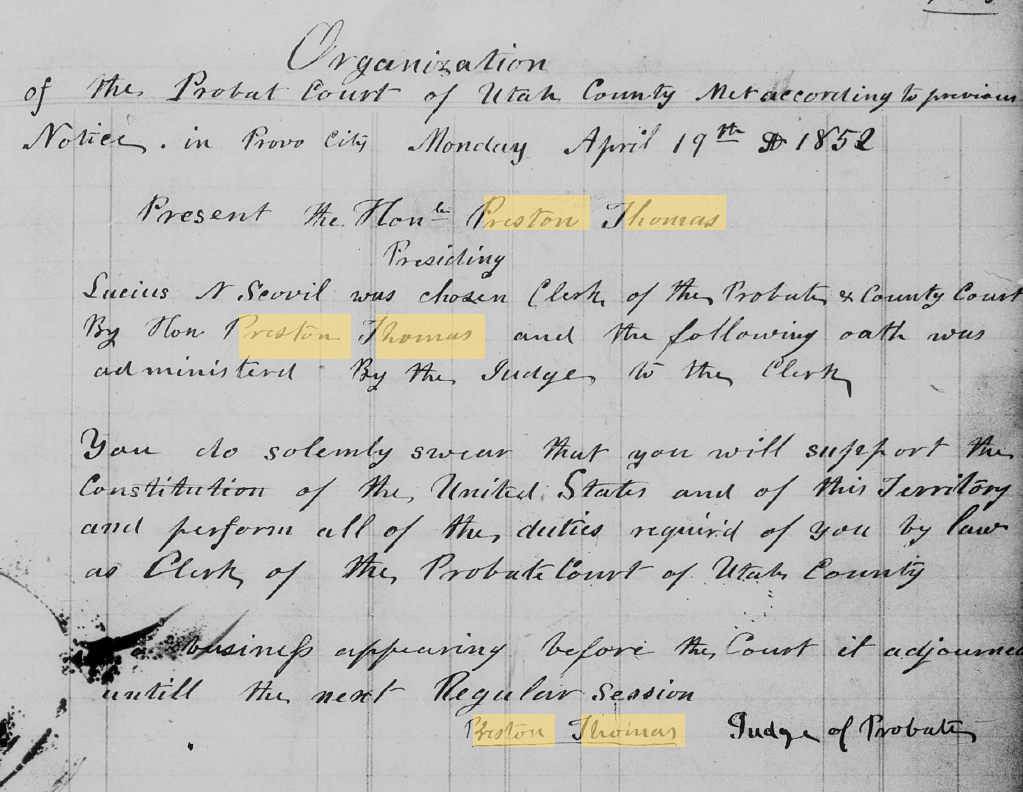
Docket and Journal of the Probate Court, 1852, showing Judge Preston Thomas swearing in the Clerk of the Court.

It appears that Preston’s tenure was a short one, as he was succeeded by Isaac Higbee on December 27, 1852. Not surprising, since Preston was called to serve yet another mission in Texas, from August 1852 to November 1853. Preston served yet another mission in Texas from September 1854 to September 1856.

During that latter mission, Preston made his way to Texas through St. Louis, Missouri. There he met Rachel Hadlond (née Franklin), an English immigrant who had joined the Mormon church. When Rachel learned Preston was arranging for a company of Texan converts to migrate to Utah, Rachel “begged” him to take her three oldest children, Charlotte, Maria (“Molly”), and Edward with him. The children were ages 18, 16, and 14 at the time. While Molly remained in Utah, Charlotte and Edward ultimately returned to St. Louis.

Two years later, on October 8, 1856, Preston married Molly. Apparently Brigham Young himself was the officiant, and conducted the ceremony in his office in Salt Lake City. Preston was 42, Molly was 18. Preston fathered 9 children with Molly. All together, Preston fathered 22 children with his three wives. Preston and Molly’s first child was a daughter, who they named Sarah Ann Jane, after Preston’s first – and still – wife.

During his final years in Lehi, Preston was elected to the Utah Territorial House of Representatives, serving for three sessions from 1857 to 1859. Preston was first elected as one of three representatives of Utah and Cedar Counties, along with Aaron Johnson and James C. Snow. During his first term, he served on two Select Standing Committees: Elections, as well as Agriculture, Trade, and Manufacture. The first session took place in Fillmore, which was originally the territorial capital. The next two took place in Salt Lake City.

Some of Preston’s legislative and judicial positions

In June 1860, Preston accompanied Brigham Young as part of a team exploring a site in northern Utah. Young planned for a settlement at the site. During the trip, Young told Preston that he wanted him to be the Bishop of the new settlement and directed Preston to go home and get his family. It was a two-week trip to make the move. Maria and her children remained behind in Lehi, as she was about to give birth to her youngest child.

By September, a settlement was established at the location, which became Franklin, Idaho. When it was established, the founders believed the site was in Utah. Long afterwards they discovered that it was inside Idaho, about a mile north of the border. In the meantime, Franklin was administered as if it was in Utah. Preston served as bishop in Franklin for three years. In 1863, Preston was reappointed to the Probate Court of Utah, where he served until 1865.

In 1863, Brigham Young directed a team of 12 to 15 men to explore the Bear Lake Valley in Idaho, not too far from Franklin. This group included Preston. The team completed its survey and by September 1863 a settlement had been erected where Paris, Idaho now stands. Preston built a log cabin at the time and then returned to Franklin for the winter. He then moved to Bear Valley with his family the following spring.

After living in Paris for a while, Preston moved the family about 20 kilometers south, to Fish Haven. During the time he lived in Bear Valley, Preston was called to serve another mission in 1869 and 1870, which included Alabama and Tennessee.

In 1873, Preston moved his family back to Franklin. Upon his return, Preston oversaw the construction of a canal, which was nicknamed Thomas Ditch. The name was probably an apt one as it seems calling it a canal might have overstated its stature. Regardless, it remained in use for 60 years and was subsequently expanded. Preston settled on a homestead of 160 acres, alongside the canal.

In 1876, Preston once again stood for election to a territorial legislature. However, by that time, it had been discovered that Franklin was inside Idaho, so Preston was nominated to run for the Territorial Council of Idaho for Franklin County. It does not appear that he was successful.

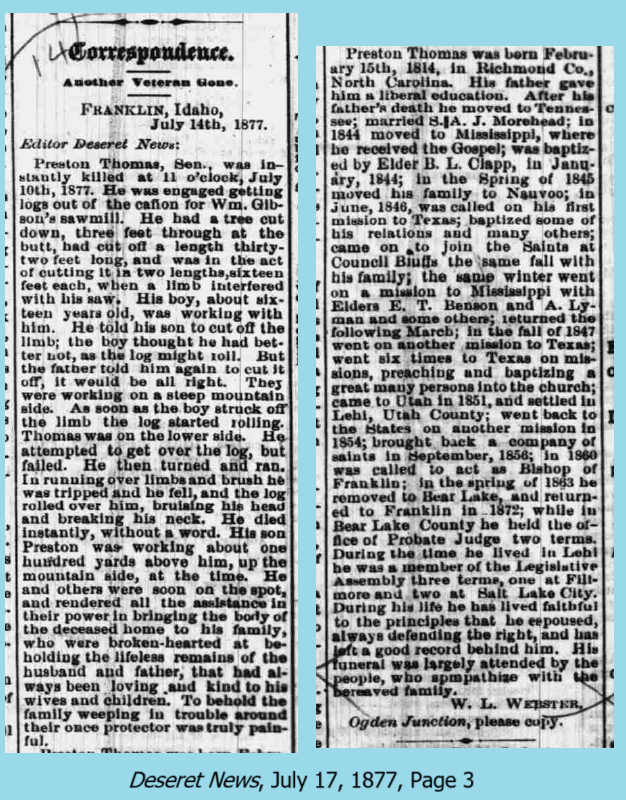
A year later, on July 10, 1877 Preston was killed as a result of an accident while working with his son Preston Pinkney, who was 16 at the time. Preston had felled a pine tree that he intended to mill into lumber for a house he was building on his property. Preston was cutting the tree into lengths when it began to roll downhill. While trying to move out of the way, Preston’s feet became entangled in the brush, and he fell. While he was rolling down the hill, the tree rolled over him and killed him instantly. Preston was interred at the Franklin Cemetery.

I acknowledge that my dislike for Preston might smack of presentism, which involves applying modern values and perspectives to historical analysis. As someone who majored in history, I am well-aware of the viewpoints for and against presentism. It is also a question debated by genealogists in writing about our ancestors.

However, we are also allowed our feelings about past norms that are now seen as historic wrongs. Moreover, while it is important remember our ancestors in the context of their time and what might have been considered right or wrong, I am not convinced that absolves the slaveholders and bigamists of my past. Avoiding presentism does not mean avoiding the application of a critical mind.

While it might not be appropriate to judge Preston, especially by modern standards, it does not mean I have to like him.

One thing that researching Preston has instilled in me is understanding the responsibility I have in doing something positive with the knowledge that Preston was a slaveowner. For example, researching slaveowners can help the descendants of the enslaved learn more about their ancestors. That’s an area of genealogical research I haven’t done much of and involves a steep learning curve. Time, distance, access to records, and resources are also hurdles. Nevertheless, I have started investigating what tools and techniques I can employ in that research.