

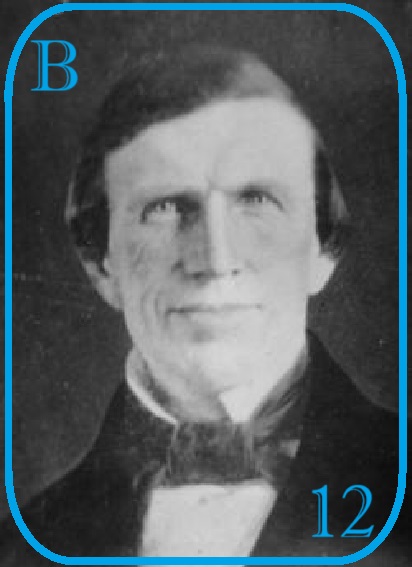
TL;DR: My Gx3 Grandfather Preston Thomas was first a slave owner and later a polygamist. I don’t like him.
Of course, that comes with the bias of my point in time. The longer story is that in his time Preston was well-respected by his community, his church, and his family. He was acting on the norms of his time and his community. In addition to many different occupational pursuits during his life, Preston a leader, a teacher, a politician, and a judge.
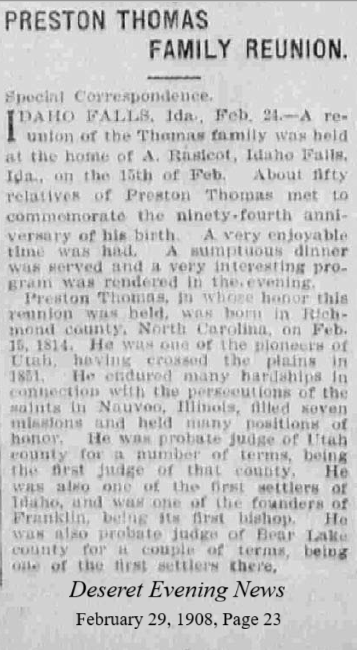
Preston’s story begins in Rockingham, North Carolina, where he was born on February 15, 1814 to Daniel Thomas and Nancy Ann Morehead. Daniel was the son of a Baptist minister and was an affluent slaveowner with a 3000 acre plantation with a carpenter shop, blacksmith shop, a cotton gin, and a shad fishery. Daniel owned about 30 slaves, many of whom were passed onto his sons.
Needless to say, with the stature of his father, Preston was well-educated. Apparently he spent some time in New Jersey as part of his schooling, although I do not know what kind of school he attended or when. Preston was 16 when his father passed away on November 7, 1830. By the time he was 21, Preston’s endeavours included operating a sawmill he owned in Covington, North Carolina.
Sometime after Daniel died, Preston, his mother Nancy, and his older brother Joseph, and younger sister Elizabeth (“Betsy”) all relocated to Tipton, Tennessee. Joseph was married at the time; Preston and Betsy were not. Needless to say, the family brought their slaves with them. It seems Joseph bought some land that he farmed. Preston’s pursuits included the study of law, but I don’t know if he actually practiced. By 1838, Preston also owned a mill in Tipton.
In Tipton, Preston married Sarah Ann Jane Morehead on May 10, 1838. Sarah – who went by Jane – was a cousin of Preston’s to some degree, but I haven’t researched their exact relationship. From 1839 to 1860, over four states, Preston and Jane had nine children.
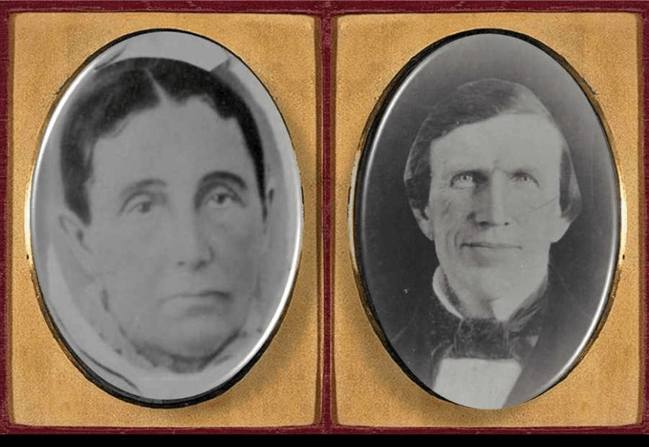
Sarah Ann Jane Morehead and Preston Thomas
Sometime in mid-1835, Preston’s brother Joseph had relocated to Somerville, Mississippi. Years later, Joseph returned to Tennessee and persuaded his mother and siblings Betsy and Daniel to join him in Mississippi. Preston remained in Tipton. However, after Preston’s mother died on November 7, 1843, he moved to Somerville. Part of the move was to help settle his mother’s estate. Preston build a mill upon moving to Somerville; presumably a sawmill as he had done in North Carolina.
It was in Mississippi that Preston and his family first encountered some Mormon missionaries. Eventually, Preston and all his siblings joined the church; in fact, years later on a mission to Texas, Preston converted his brother Daniel. Preston was baptised into the church January 13, 1844 and became one of its most ardent evangelists. He served on six major missions, primarily to Texas. Preston travelled the Mississippi river nearly thirty times as part of his missionary work. Thomas sold his slaves to his uncle, Benjamin Thomas, and moved his family to Nauvoo, Illinois, settling there by 1845.
When the Mormons were driven out of Nauvoo in 1846, Preston initially moved his family to Memphis, Tennessee. In part, it was because they still had family in Tennessee; as well, Preston was serving another mission. They remained there for at least a year. By 1848, Preston and family had joined the Mormon migration in Winter Quarters in Nebraska, which the Saints had set up as a temporary community on their way to Utah.
However, before proceeding to Utah, Preston was called to another mission to Texas. As well, in 1850, the family briefly lived in Freemont, Iowa, where Preston carried out farming. While residing there, Preston and Sarah Jane took in two of Preston’s nephews, whose parents had passed away. By 1851, Preston and his family had settled in Lehi, Utah, where they remained for the next nine years.
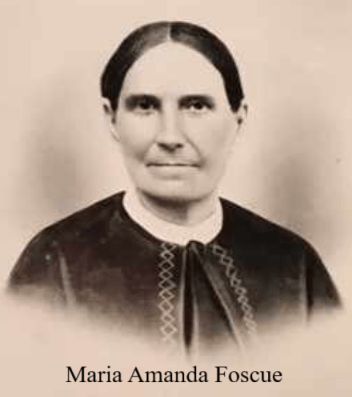
Sometime in 1949, during one of his missions to Texas, Preston met John Smith and Maria Amanda Foscue (1822-1885), a couple with seven children. John was originally from Alabama, Maria was from Florida. During this mission, Preston converted the couple, who undertook the trek to Utah. John did not survive. Maria ultimately ended up in Salt Lake City and came back into contact with Preston, who she married on November 17, 1851. Bear in mind that Preston was still married to Sarah Jane at the time, and he remained so until he died. With Maria, Preston had four children, all of whom were born in Lehi.
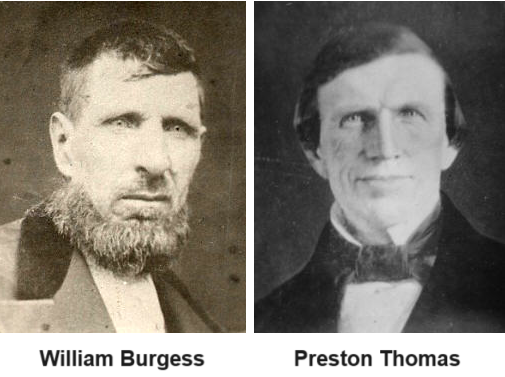
Besides providing for his large and growing family, Preston was a busy man in Lehi. The town established a school in 1851. Preston and his sister Betsy were its first teachers. Preston taught the boys on one side of the school room; Betsy taught the girls on the other side. A school board was established on February 20, 1854. Preston was one of three men elected as the first trustees. Another was William Burgess. My grandfather, Leo Burgess, is a direct descendant of William and Preston – William on his father’s side and Preston on his mother’s. A month after becoming a member of the school board, Preston was elected as an alderman of Lehi.
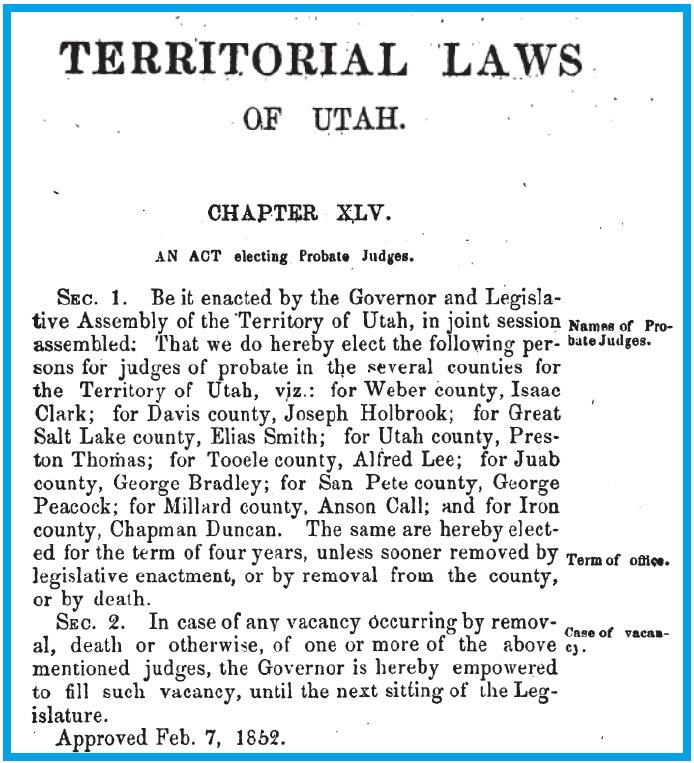
On top of all that, Preston was one of the first Probate Judges in Utah. He was appointed when the court was created and was the first judge for Utah County (Salt Lake City). Preston’s appointment was approved by an Act of the territorial legislature on February 7, 1852 (Laws of the Territory of Utah, Chapter XLV).
At the time of its creation, the Probate Court in Utah had a much broader jurisdiction than simply the estates of the deceased and those under guardianship. In addition, the territorial legislature granted the court jurisdiction over civil, criminal, chancery, and divorce matters. As well, the Probate Court heard appeals from the county Justice of the Peace courts. In 1874, the federal government revoked the Probate Court’s jurisdiction over all matters except for divorce and probate matters and in 1877, it revoked the court’s authority in divorce matters. When Utah became a state in 1896, the Probate Court was abolished.
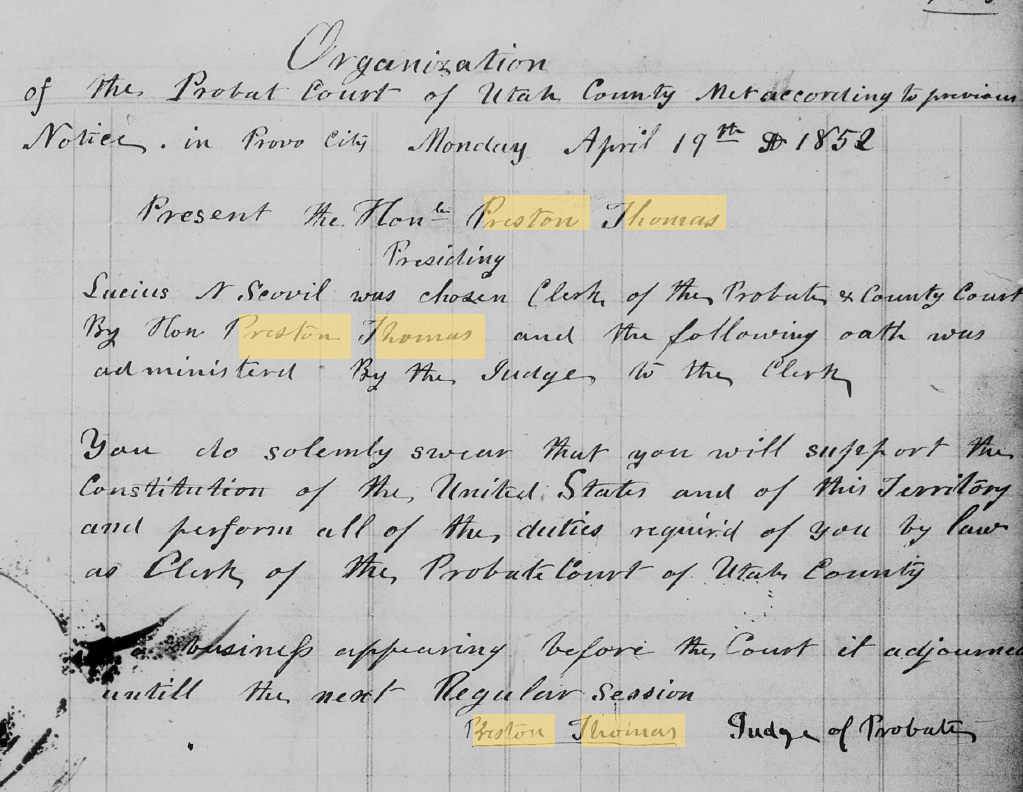
It appears that Preston’s tenure was a short one, as he was succeeded by Isaac Higbee on December 27, 1852. Not surprising, since Preston was called to serve yet another mission in Texas, from August 1852 to November 1853. Preston served yet another mission in Texas from September 1854 to September 1856.
During that latter mission, Preston made his way to Texas through St. Louis, Missouri. There he met Rachel Hadlond (née Franklin), an English immigrant who had joined the Mormon church. When Rachel learned Preston was arranging for a company of Texan converts to migrate to Utah, Rachel “begged” him to take her three oldest children, Charlotte, Maria (“Molly”), and Edward with him. The children were ages 18, 16, and 14 at the time. While Molly remained in Utah, Charlotte and Edward ultimately returned to St. Louis.
Two years later, on October 8, 1856, Preston married Molly. Apparently Brigham Young himself was the officiant, and conducted the ceremony in his office in Salt Lake City. Preston was 42, Molly was 18. Preston fathered 9 children with Molly. All together, Preston fathered 22 children with his three wives. Preston and Molly’s first child was a daughter, who they named Sarah Ann Jane, after Preston’s first – and still – wife.
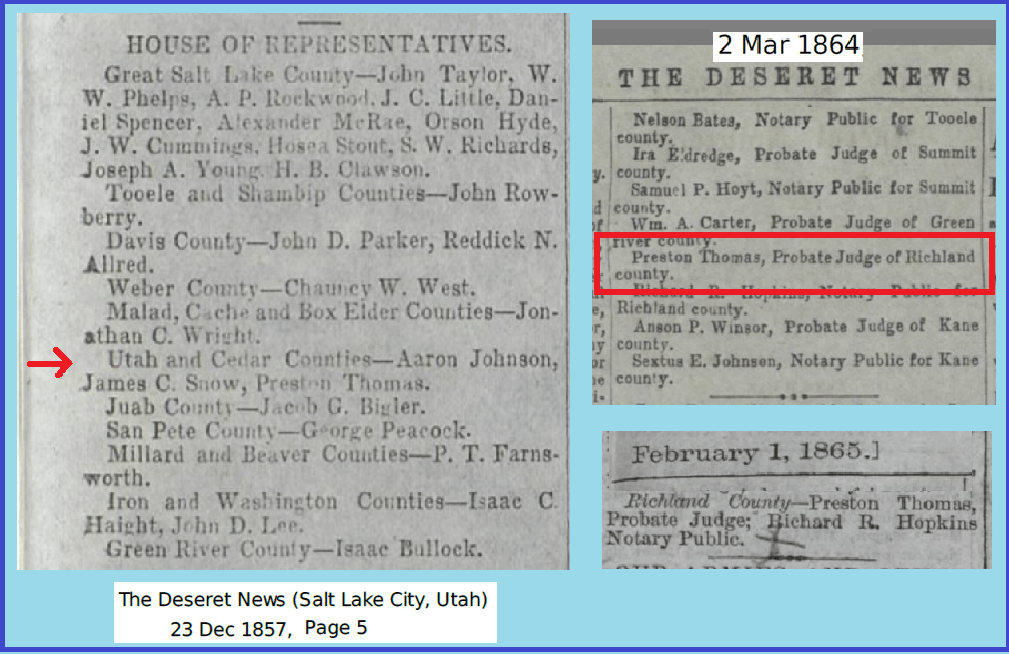
During his final years in Lehi, Preston was elected to the Utah Territorial House of Representatives, serving for three sessions from 1857 to 1859. Preston was first elected as one of three representatives of Utah and Cedar Counties, along with Aaron Johnson and James C. Snow. During his first term, he served on two Select Standing Committees: Elections, as well as Agriculture, Trade, and Manufacture. The first session took place in Fillmore, which was originally the territorial capital. The next two took place in Salt Lake City.
In June 1860, Preston accompanied Brigham Young as part of a team exploring a site in northern Utah. Young planned for a settlement at the site. During the trip, Young told Preston that he wanted him to be the Bishop of the new settlement and directed Preston to go home and get his family. It was a two-week trip to make the move. Maria and her children remained behind in Lehi, as she was about to give birth to her youngest child.
By September, a settlement was established at the location, which became Franklin, Idaho. When it was established, the founders believed the site was in Utah. Long afterwards they discovered that it was inside Idaho, about a mile north of the border. In the meantime, Franklin was administered as if it was in Utah. Preston served as bishop in Franklin for three years. In 1863, Preston was reappointed to the Probate Court of Utah, where he served until 1865.
In 1863, Brigham Young directed a team of 12 to 15 men to explore the Bear Lake Valley in Idaho, not too far from Franklin. This group included Preston. The team completed its survey and by September 1863 a settlement had been erected where Paris, Idaho now stands. Preston built a log cabin at the time and then returned to Franklin for the winter. He then moved to Bear Valley with his family the following spring.
After living in Paris for a while, Preston moved the family about 20 kilometers south, to Fish Haven. During the time he lived in Bear Valley, Preston was called to serve another mission in 1869 and 1870, which included Alabama and Tennessee.
In 1873, Preston moved his family back to Franklin. Upon his return, Preston oversaw the construction of a canal, which was nicknamed Thomas Ditch. The name was probably an apt one as it seems calling it a canal might have overstated its stature. Regardless, it remained in use for 60 years and was subsequently expanded. Preston settled on a homestead of 160 acres, alongside the canal.
In 1876, Preston once again stood for election to a territorial legislature. However, by that time, it had been discovered that Franklin was inside Idaho, so Preston was nominated to run for the Territorial Council of Idaho for Franklin County. It does not appear that he was successful.
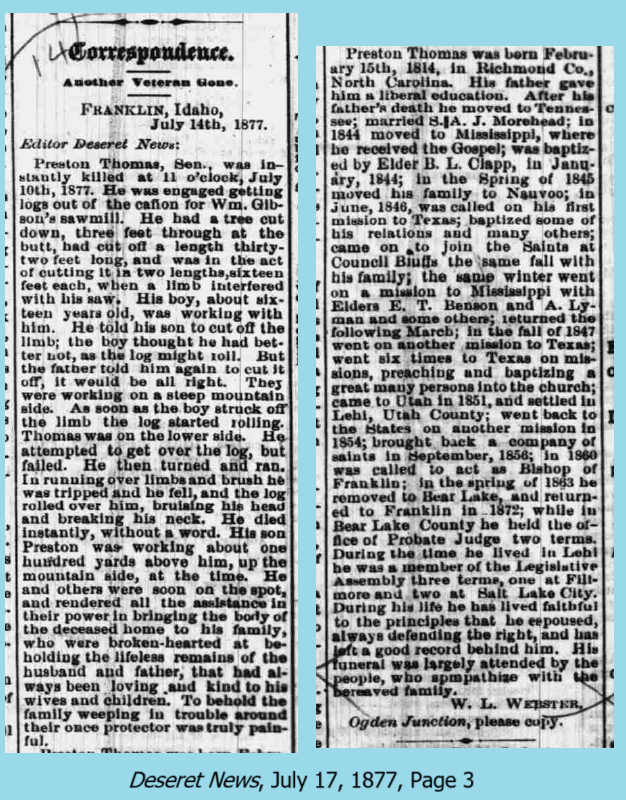
A year later, on July 10, 1877 Preston was killed as a result of an accident while working with his son Preston Pinkney, who was 16 at the time. Preston had felled a pine tree that he intended to mill into lumber for a house he was building on his property. Preston was cutting the tree into lengths when it began to roll downhill. While trying to move out of the way, Preston’s feet became entangled in the brush, and he fell. While he was rolling down the hill, the tree rolled over him and killed him instantly. Preston was interred at the Franklin Cemetery.
I acknowledge that my dislike for Preston might smack of presentism, which involves applying modern values and perspectives to historical analysis. As someone who majored in history, I am well-aware of the viewpoints for and against presentism. It is also a question debated by genealogists in writing about our ancestors.
However, we are also allowed our feelings about past norms that are now seen as historic wrongs. Moreover, while it is important remember our ancestors in the context of their time and what might have been considered right or wrong, I am not convinced that absolves the slaveholders and bigamists of my past. Avoiding presentism does not mean avoiding the application of a critical mind.
While it might not be appropriate to judge Preston, especially by modern standards, it does not mean I have to like him.
One thing that researching Preston has instilled in me is understanding the responsibility I have in doing something positive with the knowledge that Preston was a slaveowner. For example, researching slaveowners can help the descendants of the enslaved learn more about their ancestors. That’s an area of genealogical research I haven’t done much of and involves a steep learning curve. Time, distance, access to records, and resources are also hurdles. Nevertheless, I have started investigating what tools and techniques I can employ in that research.
 A Deck of Ancestors
One thought on “52W Mark IV – Week 38: Card B12 Thomas Preston”