Continuing in my adventures in brick walls, this week I look at my Great x4 Grandmother, Martha Burns.
Several decades ago, while visiting my Aunt Diana, she told me that she understood that through our Nelson line we had Scottish ancestry and that Robbie Burns was one of our ancestors. I was thrilled, because Burns was one of my favourite poets. So when I learned that I had an ancestor surnamed Burns I was excited, because it meant what my aunt had told me was plausible.
Unfortunately, like many family legends, the story does not hold up to scrutiny.
First of all, none of the Bard of Ayrshire’s children – legitimate and illegitimate – were named Martha. Furthermore, the Nelsons weren’t Scottish. They’re Irish. Martha was born in 1787 in Muff, Donegal, Ireland. As far as I know, Martha never left Ireland, where she may have died in 1865. Martha’s son Robert and his wife Elizabeth left Ireland for Scotland in their mid twenties and remained there for five or six years before emigrating to America. It’s possible that Robert brought his mother to Scotland, but I don’t know why he’d leave her there when he left for the States.
Like my other seventhgeneration Irish ancestors, I have precious little information about Martha Burns. So like the others, anything I can say about her does not have a great foundation. It is hardly definitive.
For decades, I have seen trees naming a Mary Slaak or Slaught as Martha’s mother. While this person has been persistently named and connected with Martha in many trees I’ve seen over the decades, I’ve never seen any evidence to support it. I’ve seen various fathers attached to Martha, but I don’t recall seeing one that has been consistently named or been attached for very long.
Martha married Samuel Nelson sometime around 1810. The only child that I know of was their son Robert (my Great x3 Grandfather). I have seen the names of other children come and go, but there’s never been much if any evidence to support the connection. Heck, I don’t think I’ve seen much compelling evidence to indicate that Martha was Robert’s mother. Most of the information I have is as far from the Genealogical Proof Standard as you can get.
Martha died on September 25, 1865. Again, I have little reason to believe that’s correct, but it’s the date I’ve seen most consistently set out over the years. Of course, consistency could only mean that the same mistake has been repeated ad nauseum. Is Martha my ancestor? Did she even exist?
All in all, I’d like one less brick in the wall. 🎶
I know I’ve said it before, but I’ll say it again: my Gx3 Grandmother, Elizabeth Joseph, was not Jewish. I cannot find a shred of evidence to support the suggestion, which definitely falls short of the Genealogical Proof Standard. Elizabeth also wasn’t Scottish, which I’ve also addressed before.
Elizabeth was born on September 16, 1818 in Muff, Donegal, Ireland. It is very likely that she was baptized on November 1, 1818. While the document is not available online, my great aunt Fon Hogg (née Burgess) apparently had or saw a copy of a church record showing Elizabeth’s baptism, which is definitely contrary to her being Jewish.
While there has been a nominal Jewish presence in Ireland for centuries, it was miniscule and largely confined to Dublin or the south coast. However, exclusionary laws resulted in the decline of the tiny Jewish population up until the early 19th century. By the time of the Great Famine, there were only about 25 Jewish families in Dublin. The Jewish population in all of Ireland in 1871 was only 258. Muff is about 8 km north of Londonderry, where the Jewish community was not established until 1893. In 1894, there were only 43 Jews in Londonderry. As of 2016, there were only 25 Jews in Donegal. I also have not seen any DNA test results of Elizabeth’s descendants suggesting that have even a trace of Jewish ancestry. So it is extremely unlikely that Elizabeth was Jewish.
I know nothing of Elizabeth’s life between her birth and marriage to Robert Nelson on December 12, 1842 in Muff. One thing I find interesting about Elizabeth and Robert is that they had remarkably similar lifespans. Robert was two weeks older than Elizabeth and died three months before she did.
The other interesting thing is that Elizabeth and Robert left Ireland for Scotland by 1844 – a year before the Great Famine. However, their departure was not unusual. Ireland was poor, many Irish worked in Scotland as seasonal migrants, and emigration was already on the rise before the Famine.
Elizabeth and Robert had three children in Scotland. While there, the couple joined the fledgling Mormon church and were baptized in 1848. In 1850, Elizabeth and Robert joined the exodus of converts travelling from the UK to Utah. The family travelled from Liverpool to New Orleans in September 1850.
However, upon arriving in the United States, Elizabeth and family did not immediately make their way to Utah. Rather, they spent a year or two in Missouri. In May 1852 in St. Louis, Elizabeth had another child, her first daughter, Mary. Within months of Mary’s birth, the family were in Utah, settling in Farmington. Elizabeth had four more children in Farmington.
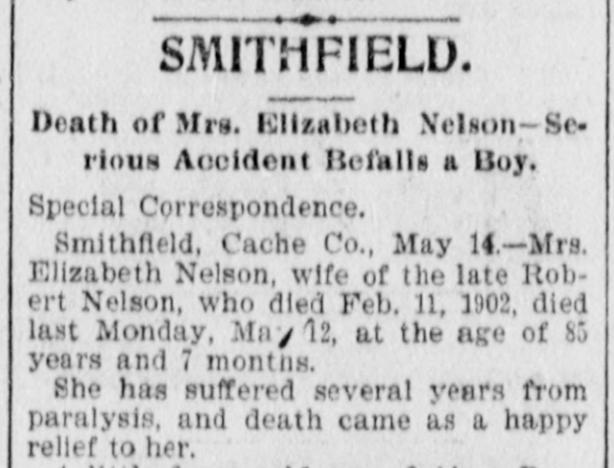
In 1860, Elizabeth and Robert moved for the last time, to Smithfield, Utah. There, Elizabeth gave birth to her last child, a daughter named Jane, in September 1862. Elizabeth spent the next forty years in Smithfield, where she died on September 12, 1902.
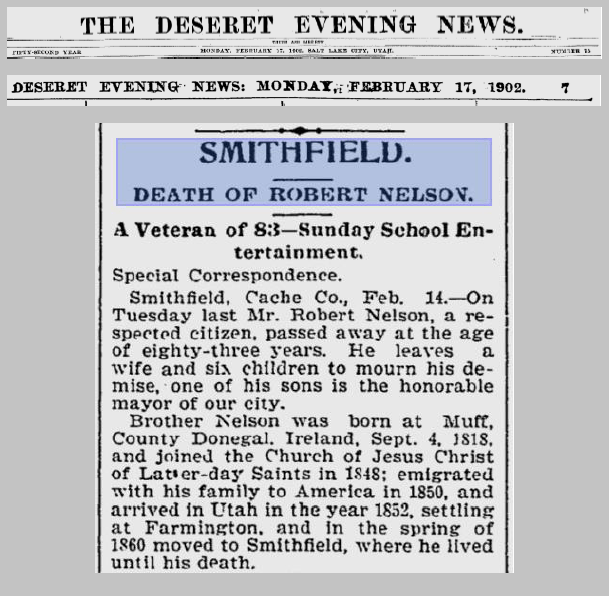
Deseret Evening News, May 16, 1902 (Last Edition), Page 7
Anyone who has done genealogy long enough knows all about the family trees you can find online that are wildly incorrect, have blatant errors, or don’t have a scintilla of evidence to back them up, which are then replicated and used by others, perpetuating and spreading the error. Nowhere in my tree is there a better example of this than my Gx3 Grandparents, Robert Nelson and Elizabeth Joseph. There are a lot of myths, legends, and erroneous information posted about them online that simply are not true.
This sort of thing pre-dates the rise of genealogy on the internet, usually in the form of family lore that was (and still is) passed around. One such story I heard from a relative was that Robert Nelson was a descendant of famed Scottish poet Robbie Burns. While I knew enough not to accept the suggestion as truth, I was thrilled by the possibility because he is one of my favourites. In the meantime, I was excited by the idea that I might have Scottish roots.
It did not take long to dispel the myth that Robert was a descendant of Scotland’s bard. Robert Nelson’s mother was a woman named Martha Burns. Martha was born in 1787. So while her surname was Burns and she was born at a time Robbie Burns was busy fathering numerous children, that is where the correlation ends. None of Burns’ children – legitimate and illegitimate – were named Martha. Besides, Robert Nelson and his mother weren’t even Scottish, they were Irish, although Robert spent about eight years living in Scotland before emigrating for the United States.
Robert was born on September 4, 1818 in Muff, Donegal, to Samuel Nelson and Martha Burns, both of whom were also born in Donegal. I know very little about Robert’s life in Ireland. Beyond his birth, the earliest thing I know is that he married Elizabeth Joseph in Muff on December 12, 1842.
There are many unsubstantiated legends around their marriage. One story, with many iterations, is that Joseph and Elizabeth became stranded overnight by a storm during a picnic. To ameliorate the disgrace of spending the night together, Joseph did the honourable thing and married Elizabeth. Another myth, without a shred of evidence, is that Elizabeth was Jewish and was disowned by her parents when she married a Christian. Rubbish.
Within two years of marrying, Robert and Elizabeth were living in Linwood, Scotland, about 15 kilometers west of Glasgow. Robert was a labourer there. While in Linwood, the couple had their first child, a son named Samuel, born in 1844.
By 1847, the family was living in Greenock, Scotland, a port town west of Glasgow. There Robert worked for Brown’s Sugar House on Roxburgh Street as a sugar baker. Sugar bakers refined muscovado sugar, an unrefined brown sugar imported from Barbados. While in Greenock, Robert and Elizabeth had two more children.
Meanwhile, the first Mormon missionaries arrived in Scotland in the early 1840s. Within ten years, there were two to three thousand adherents to the new religion, with about 70 branches. Many of these people began to emigrate to the United States to join the Mormons who had settled in Utah which, perhaps ironically, resulted in a decline in the church in Scotland.
Robert and Elizabeth joined the Mormon church and were baptized in December 1848. They joined the exodus of people from Scotland who were heading to the New World.
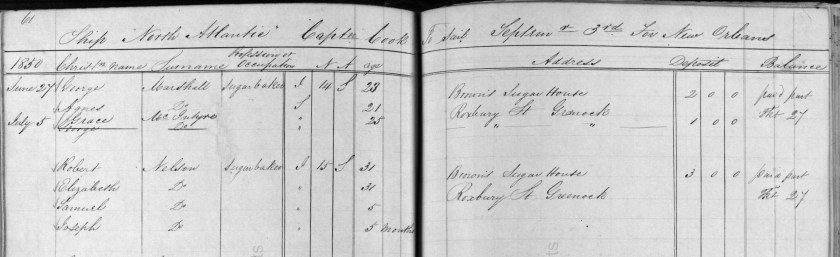
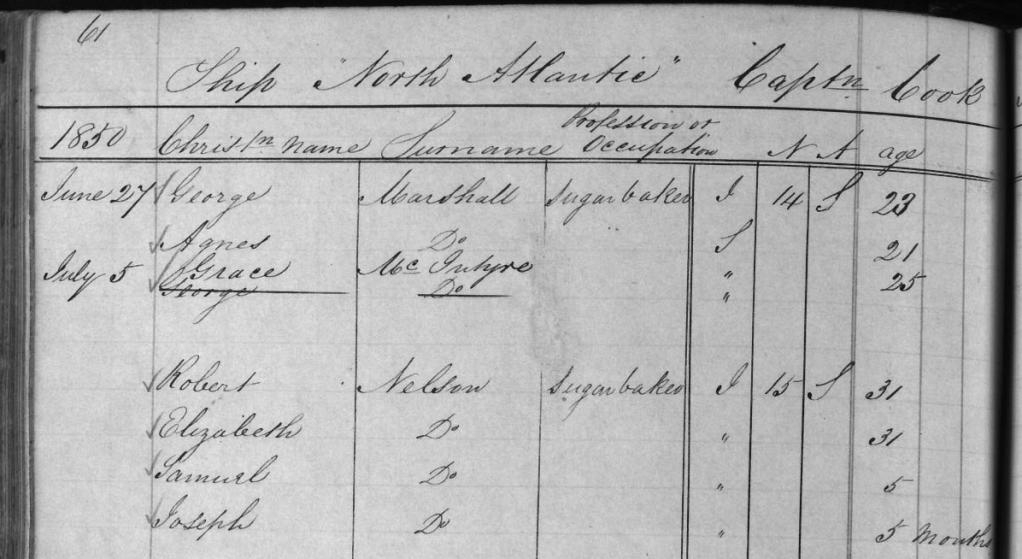
Robert and his family departed Liverpool on September 3, 1850 aboard the ship North Atlantic. All they brought with them was two boxes of clothing. For years I thought “north Atlantic” was a description of their route, until seeing the ship’s manifest. Robert and Elizabeth were part of a group of Mormon converts travelling aboard this ship, which showed at least one other passenger who had been a sugar baker at Brown’s.
Passenger list for the ship “North Atlantic”, which left Liverpool on September 3, 1850, showing the Nelson family travelling from Liverpool to New Orleans.
The North Atlantic landed at New Orleans. Robert and family spent about the next two years in Missouri, where they had a daughter, Mary, in 1852. Within months of Mary’s birth, the family arrived in Utah. They settled in Farmington, just north of Salt Lake City. In 1858, while still living in Farmington, Robert became an American citizen. Robert and Elizabeth had another four children while living in Farmington, including my Gx2 Grandfather, John Alexander Nelson.
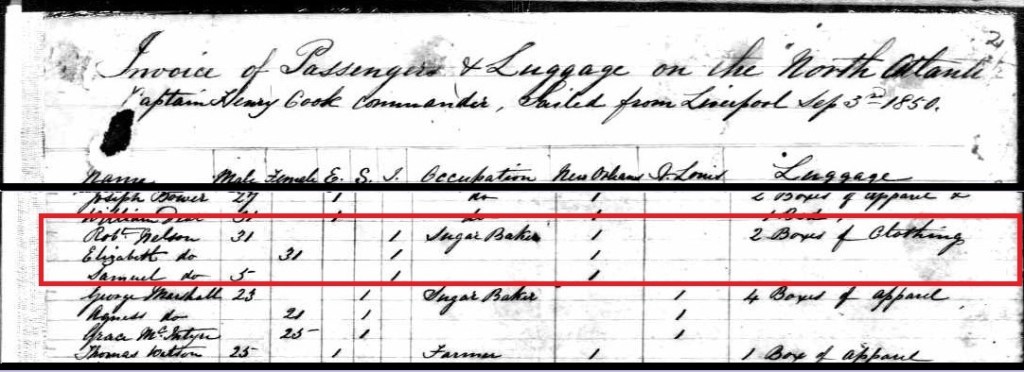
Excerpt of the Invoice of Passengers for the ship “North Atlantic“
Sometime around late 1859, Robert and family moved to Smithfield, Utah, not far from the Idaho border. Robert and Elizabeth’s youngest child, a daughter named Jane Margaret, was born there in 1862. There Robert was a farmer in Smithfield. According to the 1870 census, Robert owned $400 in real property and $300 in personal property. In 1880, Robert was elected to at least one term as a school trustee in Smithfield.
It seems that typical of all my Mormon Gx3 Grandfathers, Robert may have also been a practitioner of polygamy. According to my Aunt Fon, who was a member of the Church of Jesus Christ and Latter Day Saints, Robert was “sealed” to two women on the same day, November 15, 1855. This is an ordinance (rite) in the Mormon church by which individuals are sealed together for eternity. Robert was 66 at the time. Beyond the fact the rite occurred, I know nothing about either woman beyond their names, Mary Ann Burns and Elizabeth Dixon.
Robert, who was only two weeks older than Elizabeth Joseph, died in Smithfield on February 10, 1902, three months before Elizabeth died. Robert is buried at the Smithfield City Cemetery.
My great x3 grandparents, Robert Nelson and Elizabeth Joseph, were originally from Ireland. Shortly after they married in 1842, they moved to Scotland and lived in Renfrew. Their first three children were born there. In December 1848 Robert and Elizabeth joined the Mormon church. They emigrated in 1850, with the intention of travelling to Utah.
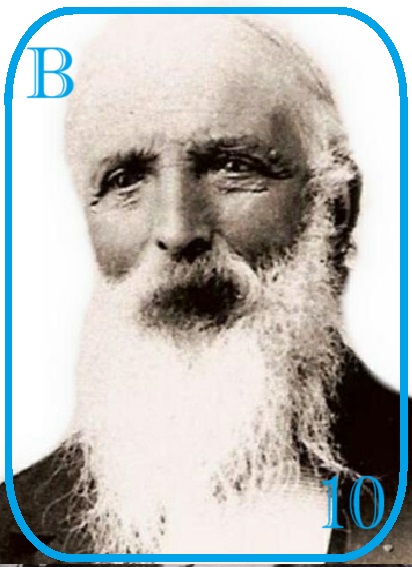
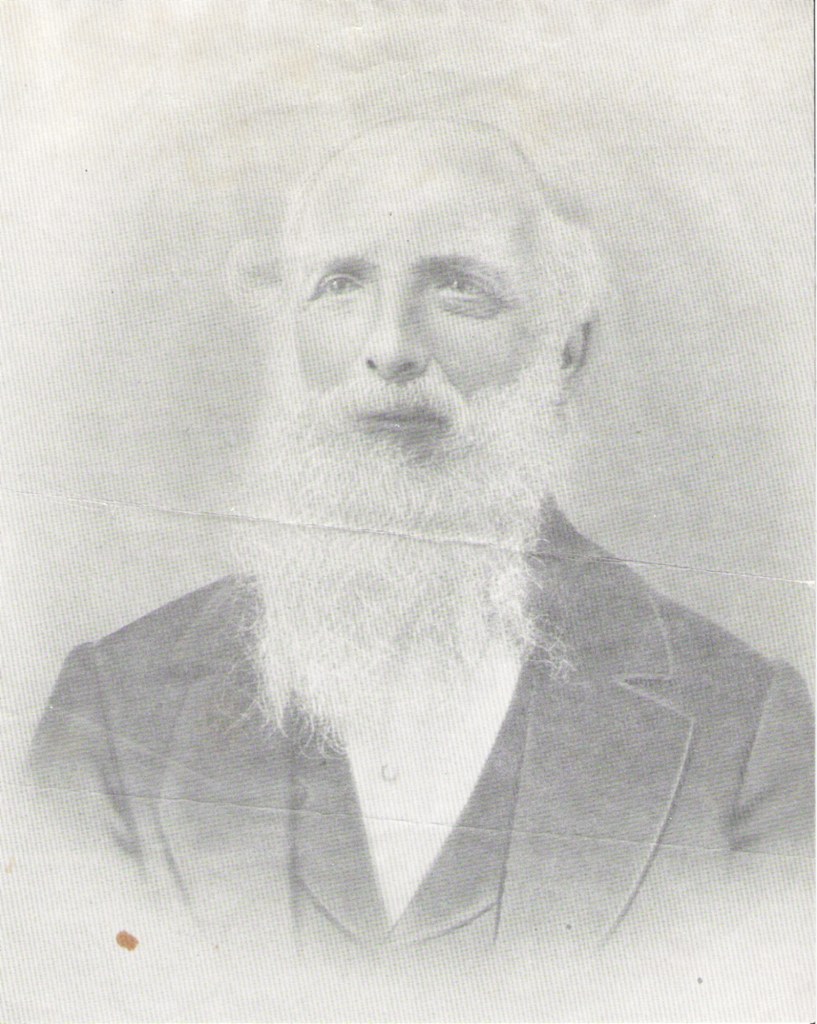
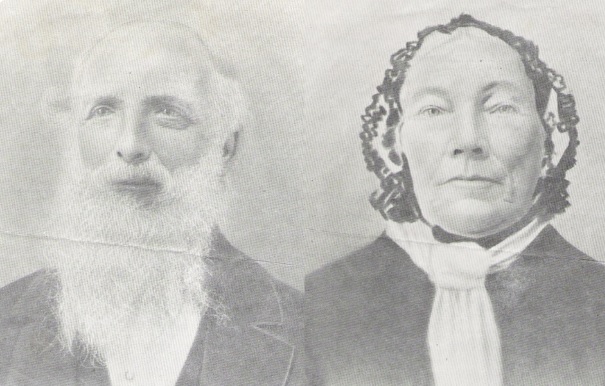
Robert Nelson (1818 – 1902) and Elizabeth Joseph (1818 – 1902)
For years, the only information I could find was that they had travelled the North Atlantic. It was a few years before I learned that “North Atlantic” wasn’t their route – it was the name of the ship on which they travelled! The North Atlantic sailed from Liverpool to New Orleans.
Excerpt of the “Invoice of Passengers” for the ship North Atlantic, which left Liverpool on September 3, 1850
At first I was surprised to learn that the family had landed at New Orleans. Without giving it much thought, I had expected that they would have sailed to the Atlantic seaboard – someplace like Boston, New York, or Philadelphia. Sailing around Florida would have added thousands of miles to the trip. However, I quickly realized that New Orleans was closer to their ultimate destination and saved them hundreds of miles of overland travel.
After arriving in Louisiana, the family travelled up the Mississippi to St. Louis, Missouri, where they lived for a year or two. Robert and Elizabeth’s first daughter, Mary Elizabeth Nelson, was born in 1852 during the sojourn in St. Louis. Shortly afterwards, the family finally relocated to Utah. My great great grandfather, John Alexander Nelson, was Robert and Elizabeth’s first child born in Utah. Later in life, John found his place in Cardston, Alberta.
 A Deck of Ancestors