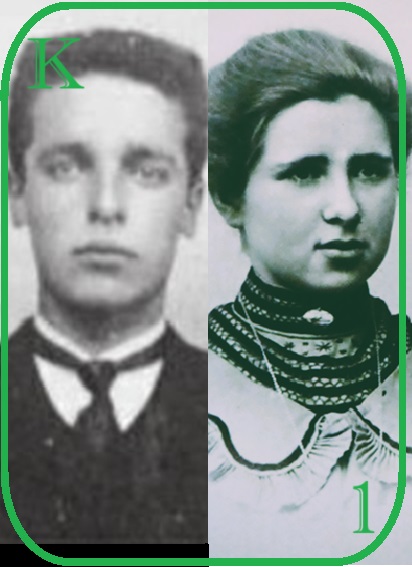
52W Mark IV – Week 14: Card K1 Adrianus Komen and Elizabeth Bakker

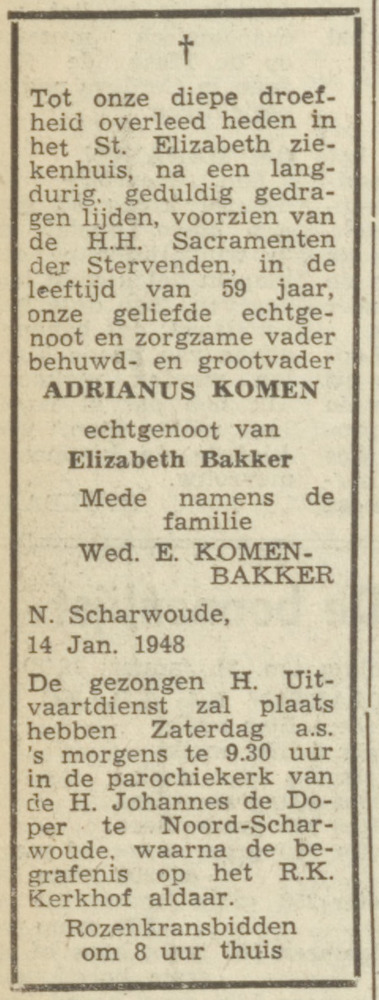
Adrianus Komen (1888 – 1948)
Elizabeth Bakker (1888 – 1976)

It’s the second fiscal quarter of 2025 and time to start the second suit of my Deck of Ancestors. This suit involves my father’s maternal line, starting with his grandparents, Adrianus (“Arie”) Komen (1888 – 1948) and Elizabeth Bakker (1888 – 1976). They were born only a few months apart; Arie was born on May 11 and Elizabeth was born on September 12. They were both 32 when they married and spent 27 wedded years together, but Elizabeth spent more years than that as a widow.

Arie was born in Zuid-Scharwoude, Noord Holland, while Elizabeth was born in Den Helder. I have no idea how they met, as their home towns are 30 kilometers apart – a significant distance at the time. (Heck, it still is for a lot of my Dutch relatives!) Arie spent almost his entire life in Zuid- and Noord-Scharwoude (both part of what was then gemeente Langedijk). In her 20s, Elizabeth worked as a domestic servant. She spent some time in that job in Amsterdam, but from 1918 to when she married in 1921, Elizabeth worked in Den Helder.
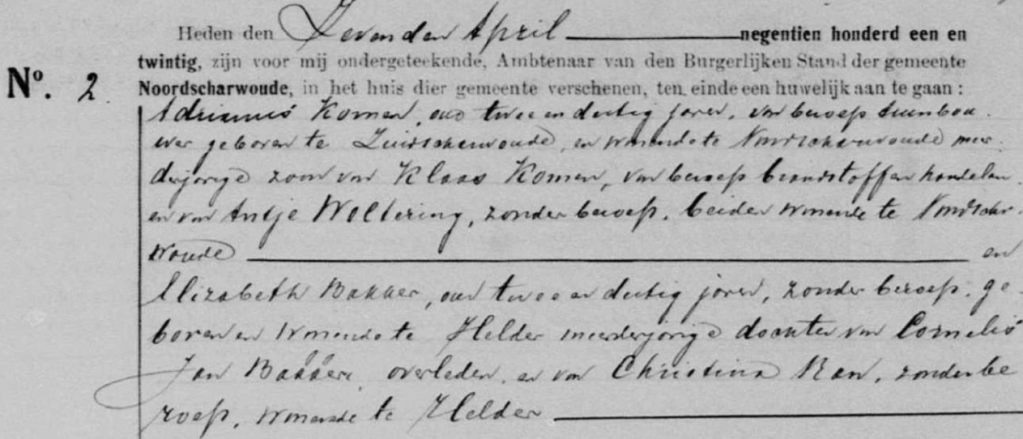
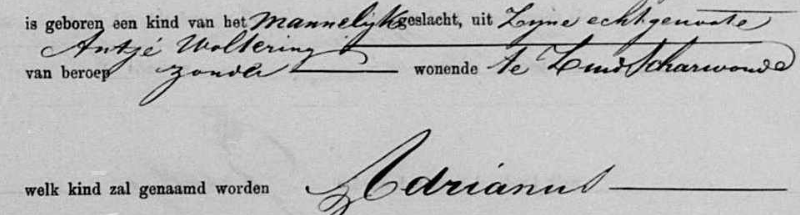
First part of the registration of Arie and Elizabeth’s marriage.

It might be that they met during Arie’s military service. The Netherlands used to have mandatory military service. In practice, most conscripts never really served in active duty; rather, it was more like a reserve militia or national guard. In fact, Arie spent his whole life as an agricultural worker.

Arie initially sought an exemption from service due to poor eyesight. On December 24, 1907, the military deemed him fit for service. Arie was assigned to the 4e Regiment Vesting-Artillerie (4th Regiment Fortress Artillery) based out of Den Helder. Like many conscripts, Arie was never in active service, but likely had to report in or attend training from time to time. Perhaps he met Elizabeth during one of those times.
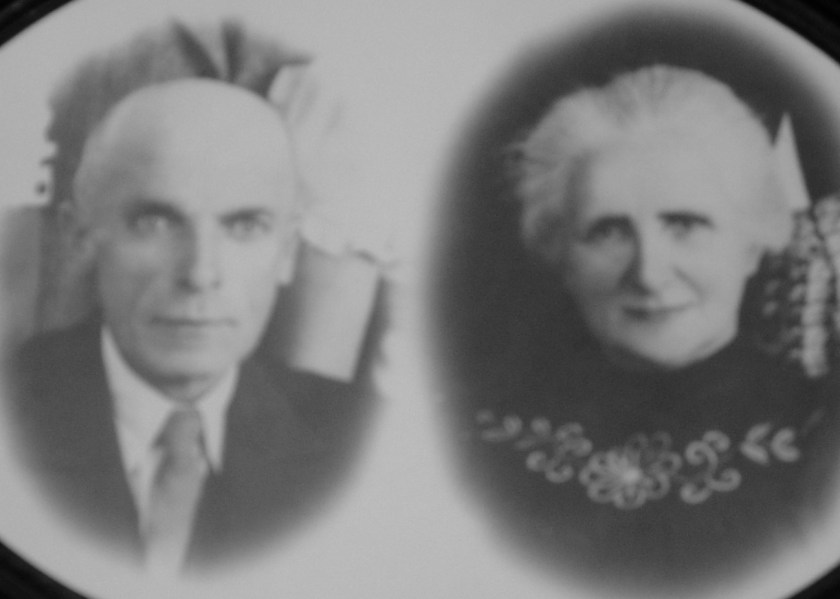
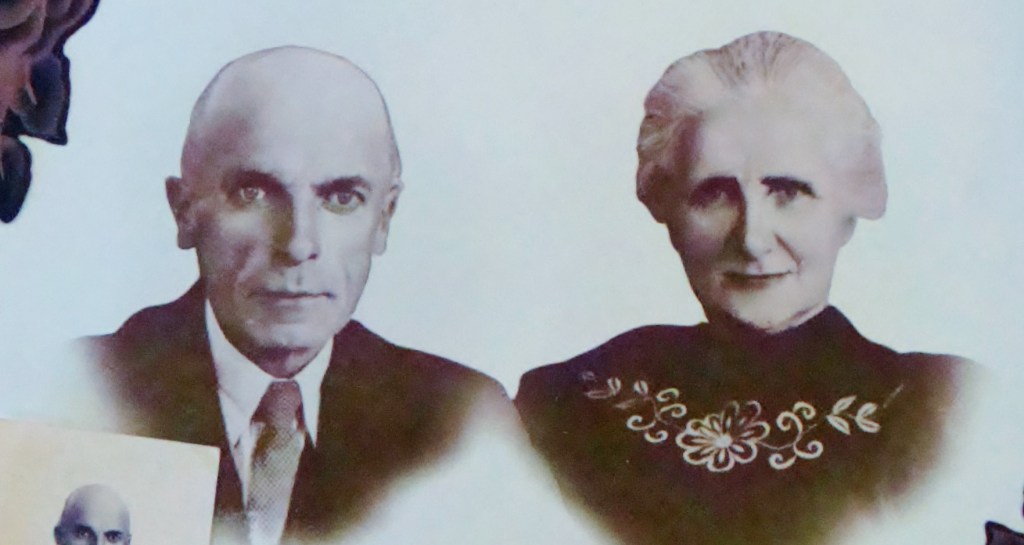
Arie Komen and Elizabeth Komen

Arie and Elizabeth married on April 7, 1921 in Noord-Scharwoude. (This coming Monday will be their 104th wedding anniversary!) They had seven children together, with my grandmother being the eldest – or so I thought. I was surprised to discover through WieWasWie that Arie and Elizabeth had a daughter one year after they were married, who did not live the day. I doubt my grandmother even knew.

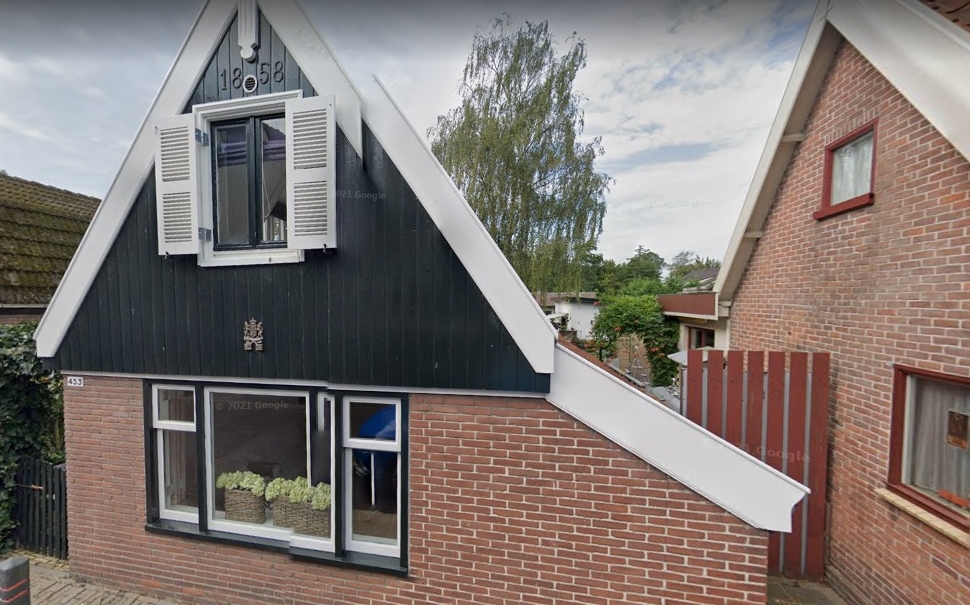
For the first seven years of their marriage, Arie and Elizabeth lived on Dorpstraat in Zuid-Scharwoude. The history of their house is documented in a October 2004 article in Van Otterplaat tot Groenveldsweid (now Otterplaat) magazine:

…the newly married couple Adrianus (Arie) Komen and Elisabeth Bakker moved there, on June 10, 1921 to be precise. Three of their children were born here. The house passed into the hands of Maarten Verweel Voorn in 1928, who lived in the neighboring house (now number 451).
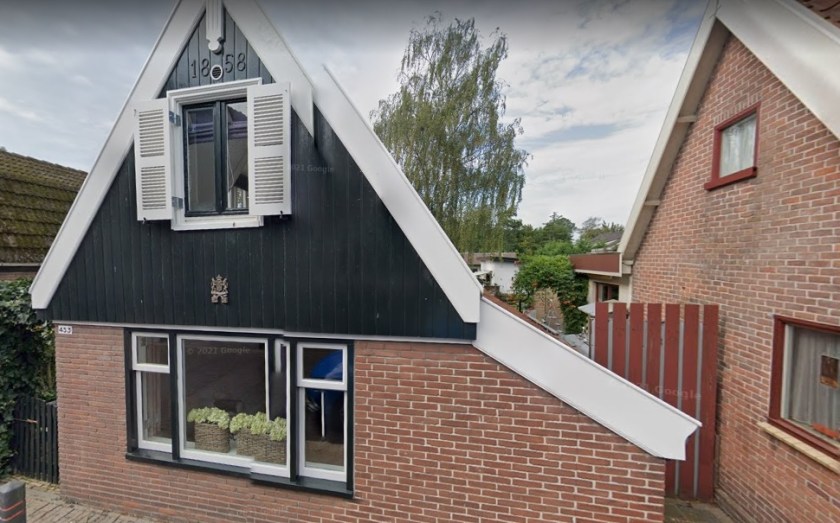
The house on Dorpstraat where Arie and Elizabeth lived, and where my paternal grandmother Christina Komen was born. I saw this house during my first visit to the Netherlands.

They then moved to Pikstraat (now Werfstraat), where they lived together for the next 20 years. Arie died on January 14, 1948. Arie was only 59 years old when he passed away. My father was only a few months old at the time, so he has no recollection of his grandfather. I don’t recall my grandmother ever speaking about her father, but she rarely spoke about the past. To be fair, I never asked her about him, either.

Arie was buried in the parish churchyard of St. Jan de Doper Katholieke Kerk (St. John the Baptist Catholic Church) in Noord-Scharwoude. I’ve been to that cemetery, but his grave is no longer there. Graves in the Netherlands are usually leased, not purchased, and are routinely cleared after a few decades.

Elizabeth remained at the house on Pikstraat and she lived there the rest of her life. She died exactly 28 years after Arie, on January 14, 1976. Her remains were cremated. I don’t know if they were ever interred.

Unlike his grandfather, my father knew his grandmother well. In August 2017, my father and I walked to where his grandmother lived on Werfstraat. My dad told me that when he was a child, the street was a path alongside a canal. It is now a fully-paved street, which might be the reason for the name change from Pikstraat to Werfstraat.
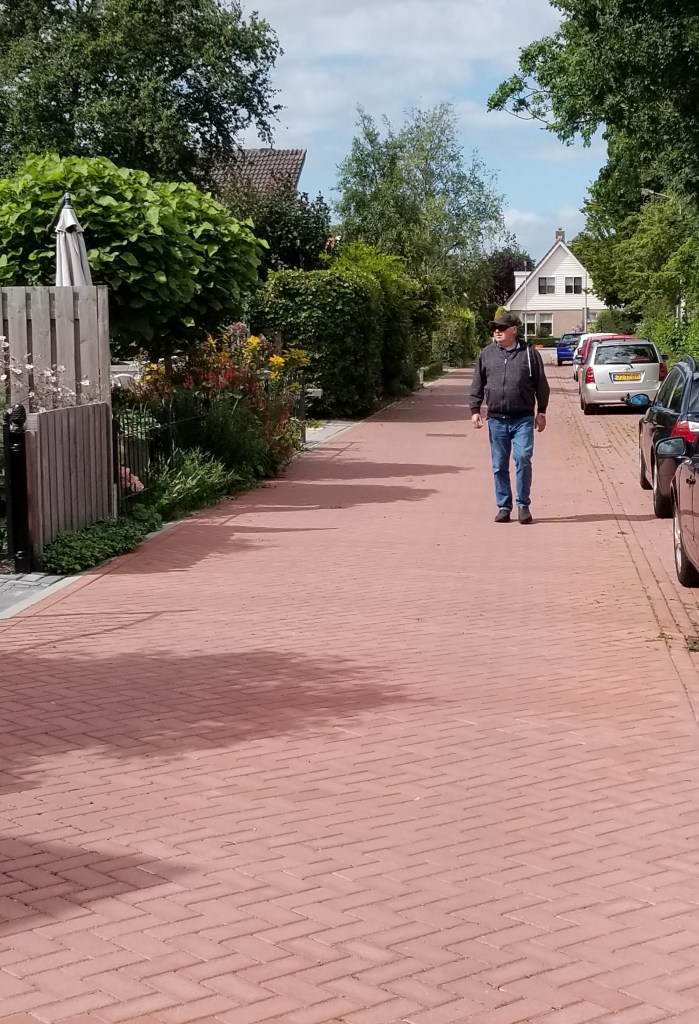
My father walking in front of his grandparent’s house on Werfstraat in Noord-Scharwoude.

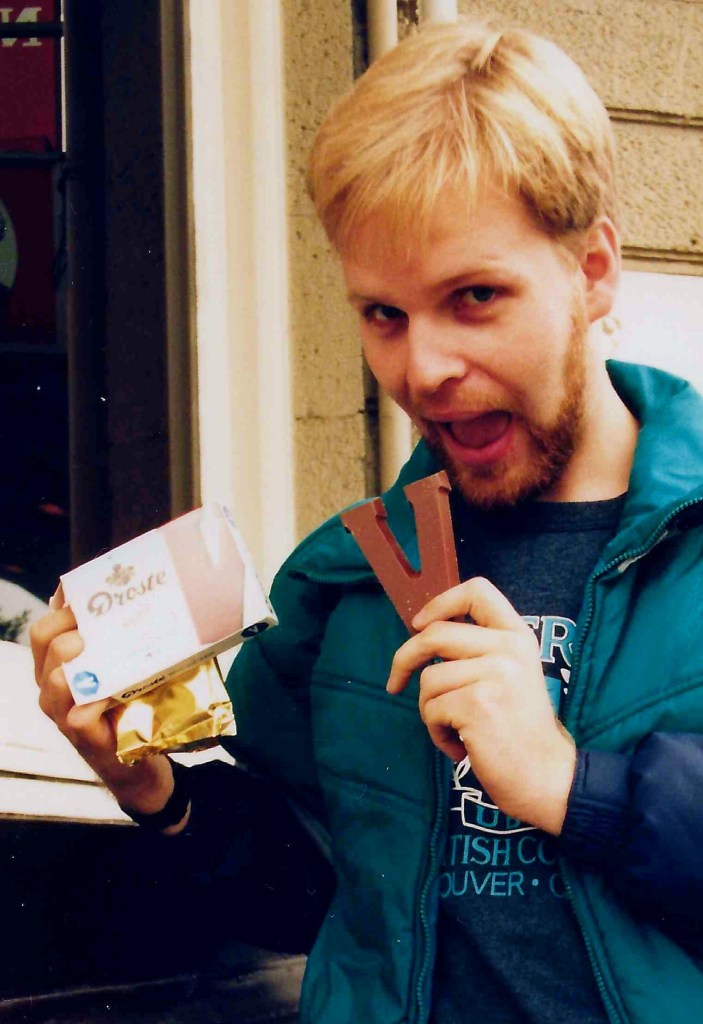
Elizabeth died when I was in elementary school. While I never met her, Oma Komen was well known to me. She regularly sent us letters, postcards, and – most significantly to us as children – boxes of goodies in time for Sinterklaas. However, at the time, I really didn’t know anything about Sinterklaas. I just thought they were really early Christmas treats.


Speculaas, stroopwafels, and chocoladeletters – just some of the treats that Oma Komen would send to us for Sinterklaas!

Supplemental (April 6, 2025): Isn’t this always the case – within a day of hitting publish (late, as usual!), I found interesting new information.

I discovered that Arie spent some or most of 1918 in Heerlen, Limburg. It is almost as far as you can get from Langedijk (Noordscharwoude and Zuidscharwoude) and still remain in the Netherlands. They are pretty much opposite corners of the country.

The dates during which Arie was in Heerlen are unclear from the Bevolkingsregister (population register). It has has him returning from Heerlen (May 10, 1918) before he departs for Heerlen (August 29, 1918). The record of his return was entered on the register on December 10, 1918. It would make more sense that this was also the date he returned from Heerlen.

It is not clear why Arie went to Heelen. His younger brother, Jacob, spent his later years in Limburg and died in Heerlen in 1938. However, it appears that during the time Arie was in Heerlen, Jacob was in Wijchen, Gelderland, which is significantly further north than Heerlen. However, it may be that by 1918 Jacob was in Limburg. Unfortunately, the relevant population registers aren’t available online. As much as I’d love a trip to the Netherlands, that is not happening anytime soon!
52W Mark III – Week 17: War

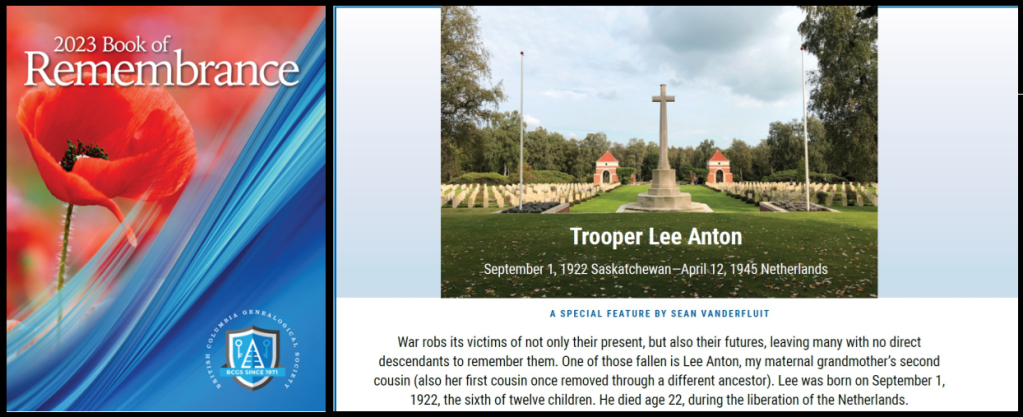
In Week 45 of the 2022 52 Ancestors Challenge, I wrote about my maternal grandmother’s cousin Lee Anton. I also wrote about Lee as one of the Featured Articles for the 2023 Book of Remembrance published by the British Columbia Genealogical Society. With this week’s writing prompt, I’d like to share what I’ve learned since writing these two pieces.

              The cover of the book.                                        Feature about Lee on page 98.

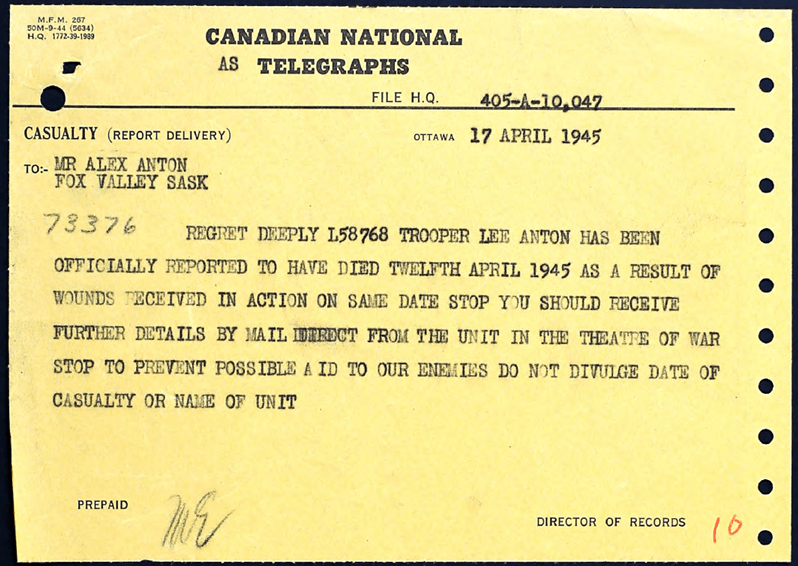
First, to recap, Lee was a Trooper of the 8th Reconnaissance Regiment (14th Canadian Hussars, also known as the 8th Recce) R.C.A.C. Lee was killed in action on April 12, 1945, age 22, less than a month before V-E Day, in the northern part of the Dutch province of Drenthe, the day before the start of the Battle of Groningen. Along with many of Canada’s other fallen soldiers, Lee is memorialized in two very special ways.

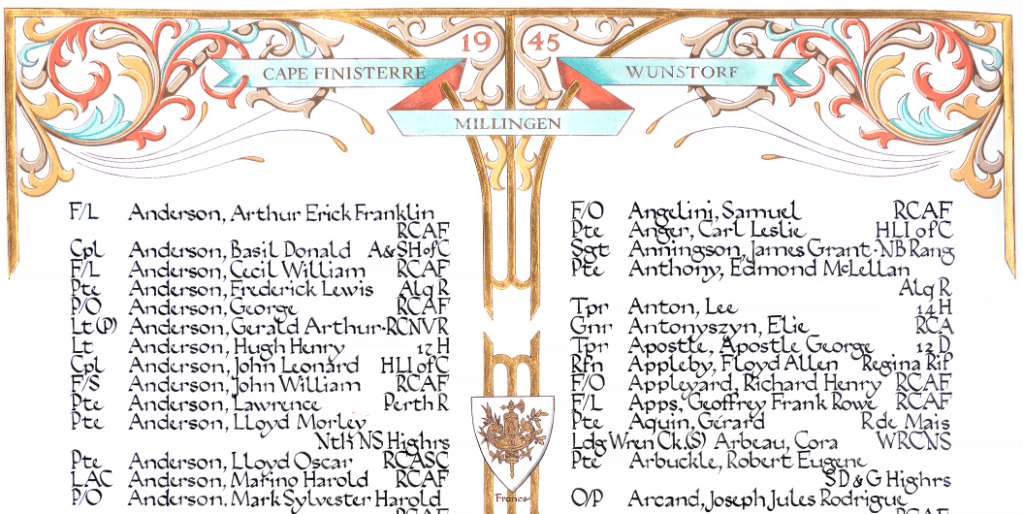
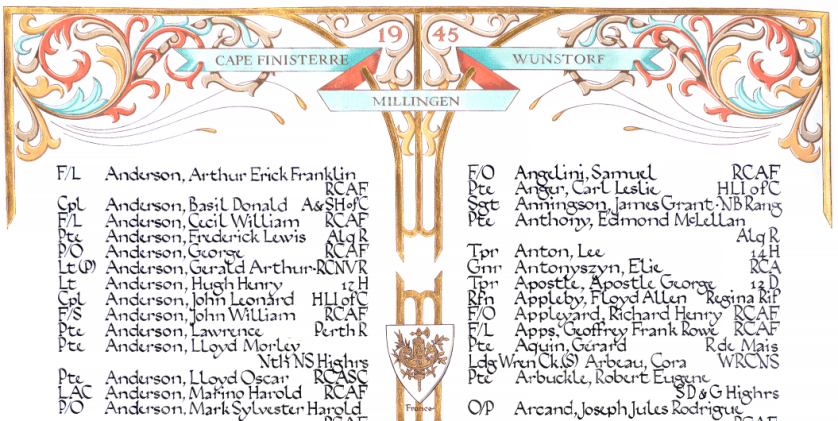
One is through the Second World War Book of Remembrance for the Second World War. Lee is commemorated on page 491.

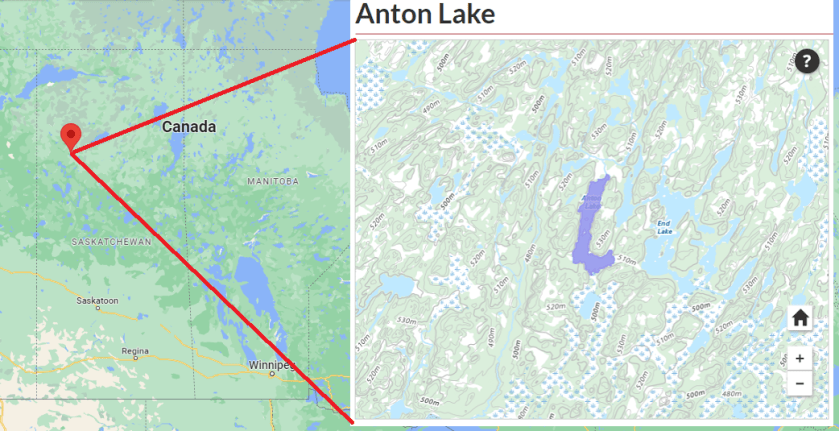
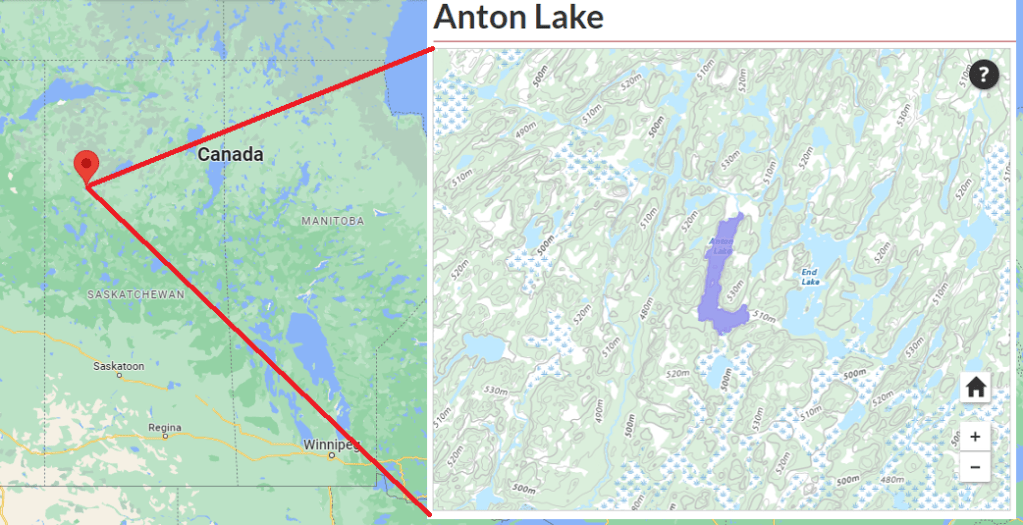
Lee was also memorialized through Saskatchewan’s “Geo-Memorial” program. You can see Anton Lake, which was named after Lee, on Google Maps. This project is documented in the book, Their Names Live on: Remembering Saskatchewan’s Fallen in World War II.

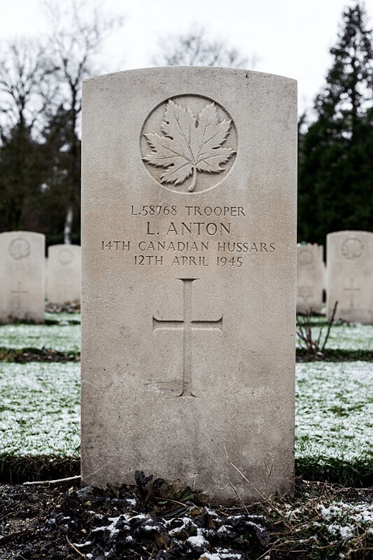
Lee is interred at the Holten Canadian War Cemetery, located just outside of Holten, Overijssel, Netherlands. It is not far from where Lee was killed.

It was only a few weeks ago that the significance of the date on which Lee had been killed dawned on me. April 12, 1945 is the day that Canadian troops liberated Camp Westerbork. It was the transit point where the Nazis gathered Dutch Jews before sending them to the death camps. It was the first place they interred Anne Frank after she and her family were betrayed.

Going through the regimental diaries for Lee’s regiment, I discovered that it was the 8th Recce that liberated the camp, which the Germans had abandoned hours beforehand.

Entry from the War Diary of the 8th Reconnaissance Regiment for April 12, 1945 documenting the liberation of Camp Westerbork.

Based upon the chronology set out in the diaries and other war records, advancing on the camp was the first thing Lee’s regiment did that day. It means that the fighting in which Lee was killed occurred after the camp was liberated. While the entire regiment was not involved, there were at least 100 members of the regiment present at the camp, so there is a good chance that Lee was present for the liberation of Westerbork.

Lee’s grave as seen on Find a Grave

52 Weeks – Week 45: Ghost Story

While this week’s 52 Ancestors Challenge theme is “Ghosts”, I don’t really have any ghost stories. So this week’s post might be a bit of a stretch.

This week, on November 11, it is Remembrance Day in Canada and many other countries. In the US, it’s Veterans Day. We think of all those who gave their lives for their country. The fallen are much more than ghosts. They are the lost, who were robbed of their futures, many with no descendants to remember them. One of those fallen was Lee Anton, my maternal grandmother’s second cousin (also her first cousin once removed through a different ancestor).

Lee was a farm boy from a practically non-existent village in south-west Saskatchewan. That village, Rastadt, is no longer even a ghost town. All that remains of it is the cemetery and a one-room schoolhouse. Lee would have turned 100 this year. Instead, he died at 22, in the liberation of the Netherlands.

Lee was a Trooper of the 8th Reconnaissance Regiment (14th Canadian Hussars) R.C.A.C. Lee was killed in action on April 12, 1945, less than a month before V-E Day, in the northern part of the Dutch province of Drenthe, the day before the start of the Battle of Groningen. Along with many of Canada’s other fallen soldiers, Lee is memorialized in two very special ways.

One is through the Book of Remembrance for the Second World War. This is one of seven books that are normally housed in the Memorial Chamber at the top of the Peace Tower of the Centre Block at Parliament Hill in Ottawa. However, they are being temporarily displayed elsewhere while the Parliament Buildings undergo renovations. The books record the names of over 120,000 Canadians who lost their lives in various conflicts Canada has been a part of. Every morning, a page of each book is turned, so throughout the year every name can be seen. The books can be searched online. The result will include a link to an image of the page the person appears upon, as well as a link to a virtual memorial hosted by Veterans Affairs Canada.

Lee is commemorated on page 491 of the Second World War Book of Remembrance.

Lee’s memory is also commemorated by a lake in northern Saskatchewan that is named after him, Anton Lake, which you can see on Google Maps. From 1947 to 1965, the province operated a “Geo-Memorial” program by which it named lakes and other geographic features after people from Saskatchewan who died in WWII. This project, as well as the stories of some of the veterans who were commemorated this way, is documented in the book, Their Names Live on: Remembering Saskatchewan’s Fallen in World War II.

Lee is interred at the Holten Canadian War Cemetery, located just outside of Holten, Overijssel, Netherlands.

52 Weeks – Week 26: Identity

How little did I realize that when I decided what to write about on the topic of “Identity” for this week’s 52 Ancestors Challenge it would actually turn out to involve a case of mistaken identity!

A suggestion for this week’s topic was to write about an ancestor beyond just their name. I decided to write about my great grandfather, Adrianus (“Arie”) Komen. He was my father’s maternal grandfather. I chose Arie because of all my great grandparents, he seems to be the one who I consider least often when I write or research. Arie passed away not too long after my father was born, which further served to make him more remote in a way.

Arie was born on May 11, 1888 in Zuid-Scharwoude, Noord Holland, Netherlands to Nicolaas Komen and Antje Woltering. As far as any record I have indicates, Arie spent his whole life as an agricultural labourer.

The civil register for Zuid-Scharwoude with the record of Arie’s birth
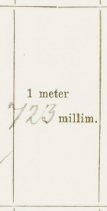
A strange way to state height…

The Netherlands had compulsory military service until the 1990s. When Arie’s name came up in the conscription draw, he sought an exemption from service due to poor eyesight. On December 24, 1907, the military deemed him fit for service. Arie was conscripted into the militia on March 3, 1908. Service was somewhat equivalent to reserve or national guard duty. Adrianus was assigned to the 4e Regiment Vesting-Artillerie (4th Regiment Fortress Artillery) based out of Den Helder. I found the way the military listed his height to be rather odd. Instead of stating that he was 172 cm tall (about 5′ 6 1/2″), it was listed as “1 meter 723 millimeter”.

Arie married Elizabeth Bakker on April 7, 1921 in Noord-Scharwoude, Noord Holland, Netherlands. Elizabeth, or “Oma Komen” as we referred to her when I was a child, lived until I was ten years old. I never met her, but she regularly sent us letters, postcards, and – most significantly to us as children – boxes of goodies in time for Sinterklaas.

Arie and Elizabeth, from a family history album compiled by my aunt.

Shortly after they were married, Arie and Elizabeth moved into a house on Dorpstraat in Zuid-Scharwoude. I know this street well, as I have relatives who live on this street. In fact, during my last visit to the Netherlands, I stayed with a relative who lives at the north end of this street.

I was fortunate to discover an article in a local history society’s annual magazine that included an article documenting the history of the house that Arie and Elizabeth had moved into. The house itself was built in 1858 and my great grandparents lived there from 1921 to 1928. The article noted that their first three children were born in this house. As the eldest child, this would have included my grandmother, Christina Komen.

The house where my great grandparents lived for the first seven years after they were married. I just realized that during my first visit to the Netherlands, one of my cousins took me by this house and told me this is where my grandmother was born.
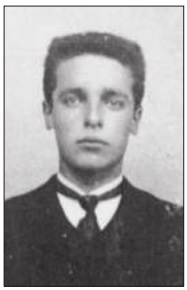
Not so fast, caption writer! This is actually Arie’s older brother, Laurentius (“Louw”) Komen.

Until I found this magazine article, the only photos I had seen of Arie and Elizabeth were taken late in their life. The article had a photo of Elizabeth that I was very familiar with; however, the photo of Arie showed him when he was a younger man of about 32.

Or so I thought.

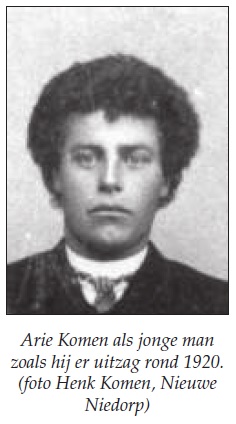
The article appeared in the historical society’s 2004 edition. The 2005 edition included mention of correspondence from my great aunt, Riet Komen, correcting a few errors in the previous year’s publication. One was to note that the photo they had published of Arie was not her father at all, but her uncle, Arie’s older brother Louw. Unfortunately, at the time Tante Riet wrote the magazine, she was unable to provide a photograph of her father. It was another year before the magazine was able to correct the error, two years after the fact.

THIS is Arie Komen!

When I made my original discovery, I emailed my mother the photo of Arie (which was actually Louw) so that she could show my dad. Apparently his response was to say, “what a good looking guy!” When I found the later edition of the magazine with the correction, I sent the actual photo of Arie to my mother for my dad to see. My mom’s response was to say how much they looked alike. I responded by saying that’s probably how the error occurred in the first place.

In December 1928, the family moved to “Pikstraat” in Noord-Scharwoude. I have never been able to find Pikstraat on the map, until today. By happenstance, I found a history of a family unrelated to mine (as far as I know!) in which one of the person’s ancestors lived on Pikstraat. The author of the history noted that the street is now called Werfstraat.

My father walking in front of his grandparent’s house on Werfstraat in Noord-Scharwoude.

I looked it up on Google maps – and discovered I had been there! Werfstraat is just off Dorpstraat at the north end of the municipality, near where I was staying with my family member. My parents were also visiting Noord-Scharwoude at the time, which had partially prompted my trip at the time. One day my father and I were walking around the neighbourhood and he showed me things he remembered from his childhood. One place we went was to where his grandmother, Oma Komen, had lived. I never realized that after Arie passed away in 1948, Oma Komen remained in the same house until she passed away in 1976.

Arie was only 59 years old when he passed away in January 1948. He was buried in the parish churchyard of St. Jan de Doper Katholieke Kerk (St. John the Baptist Catholic Church) in Noord-Scharwoude. I’ve been to that cemetery, but his grave is no longer there. Graves in the Netherlands are usually leased, not purchased, and are routinely cleared after a few decades.

While I’d say I know more about my great grandfather Arie than simply his name, despite all I’ve written about him I still do not feel like I know him. My grandmother never spoke of her father and, to be fair, I never asked her about him. I was very close to one of my grandmother’s sisters, Anny Komen, ever since I was twelve. However, despite the close relationship we had, language was a significant barrier as she never spoke English and my Dutch was very rudimentary for most of the time I knew her (we had our ways of communicating), so asking about her father was not realistic. My grandmother’s youngest sister passed away only last year, but we were not as close. I last visited her in 2017, and it was not really the time for questioning her about her family history. As well, her health in the last many years made correspondence difficult for her. Thus, what I have to rely upon are what records are available. Nevertheless, I am pleased to discover that I know him better than I realized.