How little did I realize that when I decided what to write about on the topic of “Identity” for this week’s 52 Ancestors Challenge it would actually turn out to involve a case of mistaken identity!
A suggestion for this week’s topic was to write about an ancestor beyond just their name. I decided to write about my great grandfather, Adrianus (“Arie”) Komen. He was my father’s maternal grandfather. I chose Arie because of all my great grandparents, he seems to be the one who I consider least often when I write or research. Arie passed away not too long after my father was born, which further served to make him more remote in a way.
Arie was born on May 11, 1888 in Zuid-Scharwoude, Noord Holland, Netherlands to Nicolaas Komen and Antje Woltering. As far as any record I have indicates, Arie spent his whole life as an agricultural labourer.
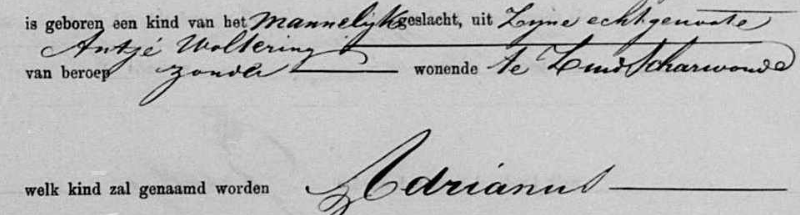
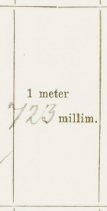
The Netherlands had compulsory military service until the 1990s. When Arie’s name came up in the conscription draw, he sought an exemption from service due to poor eyesight. On December 24, 1907, the military deemed him fit for service. Arie was conscripted into the militia on March 3, 1908. Service was somewhat equivalent to reserve or national guard duty. Adrianus was assigned to the 4e Regiment Vesting-Artillerie (4th Regiment Fortress Artillery) based out of Den Helder. I found the way the military listed his height to be rather odd. Instead of stating that he was 172 cm tall (about 5′ 6 1/2″), it was listed as “1 meter 723 millimeter”.
Arie married Elizabeth Bakker on April 7, 1921 in Noord-Scharwoude, Noord Holland, Netherlands. Elizabeth, or “Oma Komen” as we referred to her when I was a child, lived until I was ten years old. I never met her, but she regularly sent us letters, postcards, and – most significantly to us as children – boxes of goodies in time for Sinterklaas.
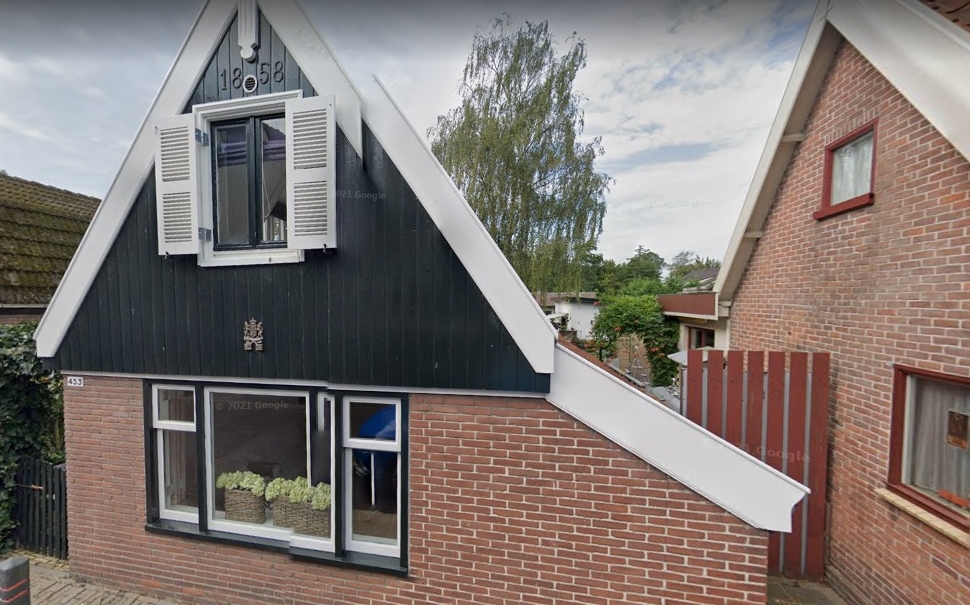
Shortly after they were married, Arie and Elizabeth moved into a house on Dorpstraat in Zuid-Scharwoude. I know this street well, as I have relatives who live on this street. In fact, during my last visit to the Netherlands, I stayed with a relative who lives at the north end of this street.
I was fortunate to discover an article in a local history society’s annual magazine that included an article documenting the history of the house that Arie and Elizabeth had moved into. The house itself was built in 1858 and my great grandparents lived there from 1921 to 1928. The article noted that their first three children were born in this house. As the eldest child, this would have included my grandmother, Christina Komen.
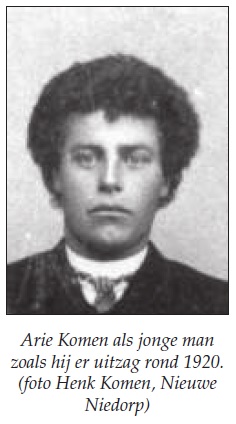
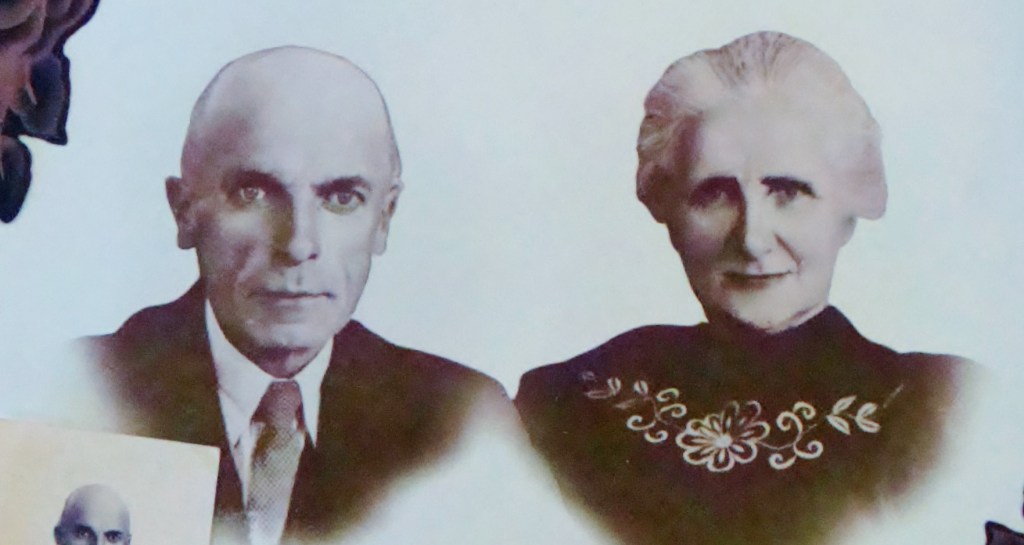
Until I found this magazine article, the only photos I had seen of Arie and Elizabeth were taken late in their life. The article had a photo of Elizabeth that I was very familiar with; however, the photo of Arie showed him when he was a younger man of about 32.
Or so I thought.
The article appeared in the historical society’s 2004 edition. The 2005 edition included mention of correspondence from my great aunt, Riet Komen, correcting a few errors in the previous year’s publication. One was to note that the photo they had published of Arie was not her father at all, but her uncle, Arie’s older brother Louw. Unfortunately, at the time Tante Riet wrote the magazine, she was unable to provide a photograph of her father. It was another year before the magazine was able to correct the error, two years after the fact.
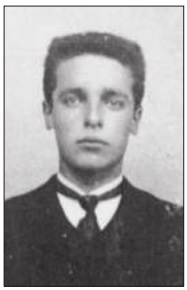
When I made my original discovery, I emailed my mother the photo of Arie (which was actually Louw) so that she could show my dad. Apparently his response was to say, “what a good looking guy!” When I found the later edition of the magazine with the correction, I sent the actual photo of Arie to my mother for my dad to see. My mom’s response was to say how much they looked alike. I responded by saying that’s probably how the error occurred in the first place.
In December 1928, the family moved to “Pikstraat” in Noord-Scharwoude. I have never been able to find Pikstraat on the map, until today. By happenstance, I found a history of a family unrelated to mine (as far as I know!) in which one of the person’s ancestors lived on Pikstraat. The author of the history noted that the street is now called Werfstraat.
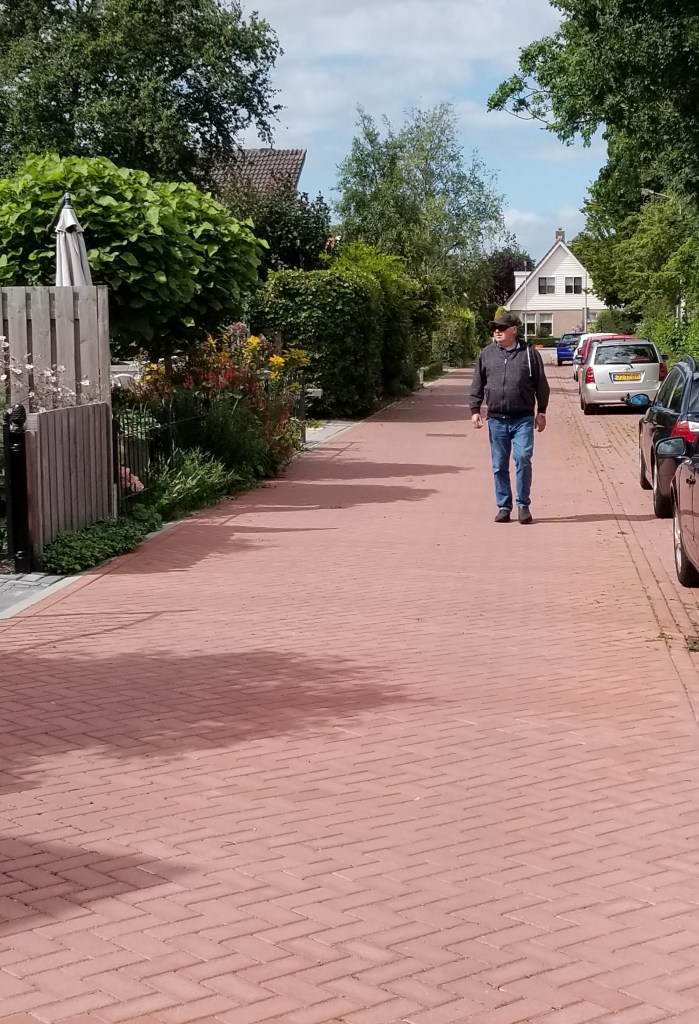
I looked it up on Google maps – and discovered I had been there! Werfstraat is just off Dorpstraat at the north end of the municipality, near where I was staying with my family member. My parents were also visiting Noord-Scharwoude at the time, which had partially prompted my trip at the time. One day my father and I were walking around the neighbourhood and he showed me things he remembered from his childhood. One place we went was to where his grandmother, Oma Komen, had lived. I never realized that after Arie passed away in 1948, Oma Komen remained in the same house until she passed away in 1976.
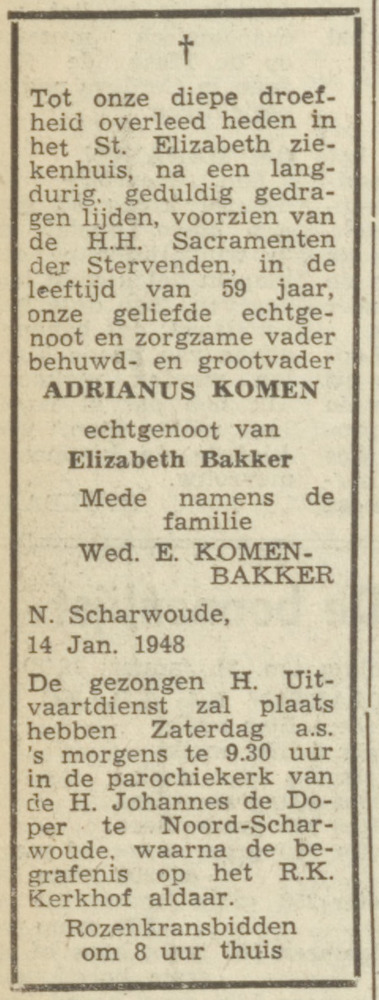
Arie was only 59 years old when he passed away in January 1948. He was buried in the parish churchyard of St. Jan de Doper Katholieke Kerk (St. John the Baptist Catholic Church) in Noord-Scharwoude. I’ve been to that cemetery, but his grave is no longer there. Graves in the Netherlands are usually leased, not purchased, and are routinely cleared after a few decades.
While I’d say I know more about my great grandfather Arie than simply his name, despite all I’ve written about him I still do not feel like I know him. My grandmother never spoke of her father and, to be fair, I never asked her about him. I was very close to one of my grandmother’s sisters, Anny Komen, ever since I was twelve. However, despite the close relationship we had, language was a significant barrier as she never spoke English and my Dutch was very rudimentary for most of the time I knew her (we had our ways of communicating), so asking about her father was not realistic. My grandmother’s youngest sister passed away only last year, but we were not as close. I last visited her in 2017, and it was not really the time for questioning her about her family history. As well, her health in the last many years made correspondence difficult for her. Thus, what I have to rely upon are what records are available. Nevertheless, I am pleased to discover that I know him better than I realized.
 A Deck of Ancestors