Unless I go back to the 1600s on my maternal grandfather’s paternal line, I do not have much English ancestry. My most recent ancestors who emigrated from England are my Great x4 Grandparents, Rachel Franklin and Thomas Hadlond. They had seven children at the time they came over sometime around 1852, give or take a year, including my Great x3 Grandmother, Maria Hadlond.
Rachel was the fourth of ten (possibly eleven) children born to James Franklin, a shoemaker, and Mary Luker Eaton. I have found several iterations of Mary’s surname. She was baptized “Mary, Daugr of Eliz Luker”. The register entry does not name a father or husband, implying that Mary was illegitimate. A few pages later there is an entry for the 1792 marriage of Thomas and Elizabeth shows: “May 20, Thos Eaton to Eliz Looker by license.” Earlier on the same page of the register for the marriage is an entry for the baptism of “Charlotte, daur of Thos and Eliz Eaton.” It would be reasonable to believe that it is the same Elizabeth Luker/Looker in both entries, but not without some doubt.
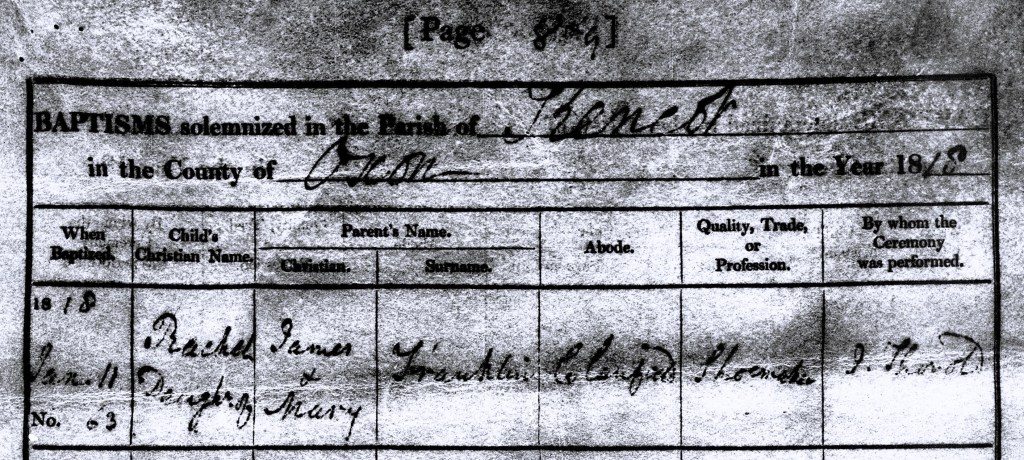
Rachel was born on December 14, 1817, in Clanfield, Oxfordshire, which is located in the Cotswolds. All of Rachel’s siblings were born in Clanfield or the nearby village of Hailey.
Rachel’s baptism registration.
Rachel married Thomas Hadlond three days shy of her 20th birthday, on December 11, 1837, in Charlbury, another village in the Cotswolds, just north of Hailey. Shortly after marrying, Rachel and Thomas were living in Finstock, a stone’s throw from Blenheim castle, the home of the Spencer-Churchill family. There they had their first child, Charlotte. The family was not in Finstock long, as my Gx3 Grandmother Maria was born in Cheltenham, Gloucester, in August 1838. Rachel bore five more children in Cheltenham. Rachel’s last child born there was Alice, in September 1850.
On November 23, 1846, Rachel was baptized into the Mormon church. I know little about the circumstances of her joining the church, but I’ve not yet found any evidence her husband Thomas did. This is evidenced by the fact that Thomas was not baptized into the church until a year after his death.
According to the 1851 English census, Rachel and her family were still resident in Cheltenham. However, sometime before 1853, the family moved to North America. It appears they entered by way of Canada, because Rachel gave birth to a son there in June 1853. By 1856, Rachel and her family were living in St. Louis, Missouri. In August 1858, Rachel gave birth to twins, Ella and Alphius, in East St. Louis, which is a suburb on the Illinois side of the Mississippi River.
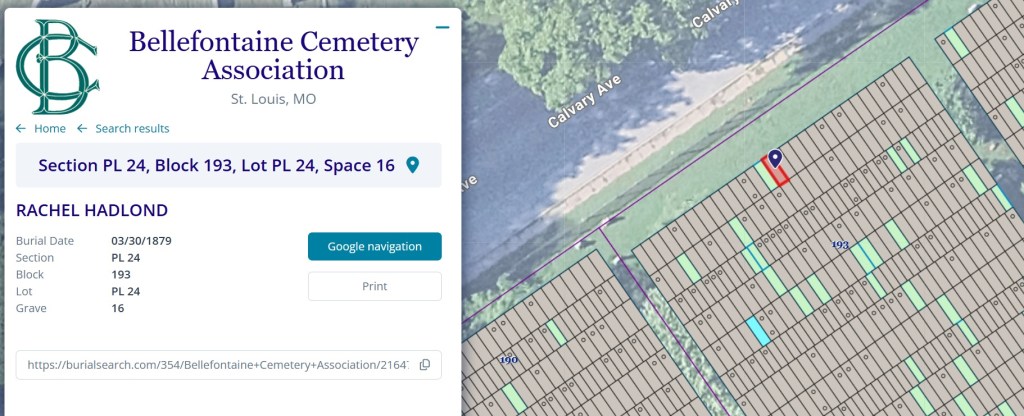
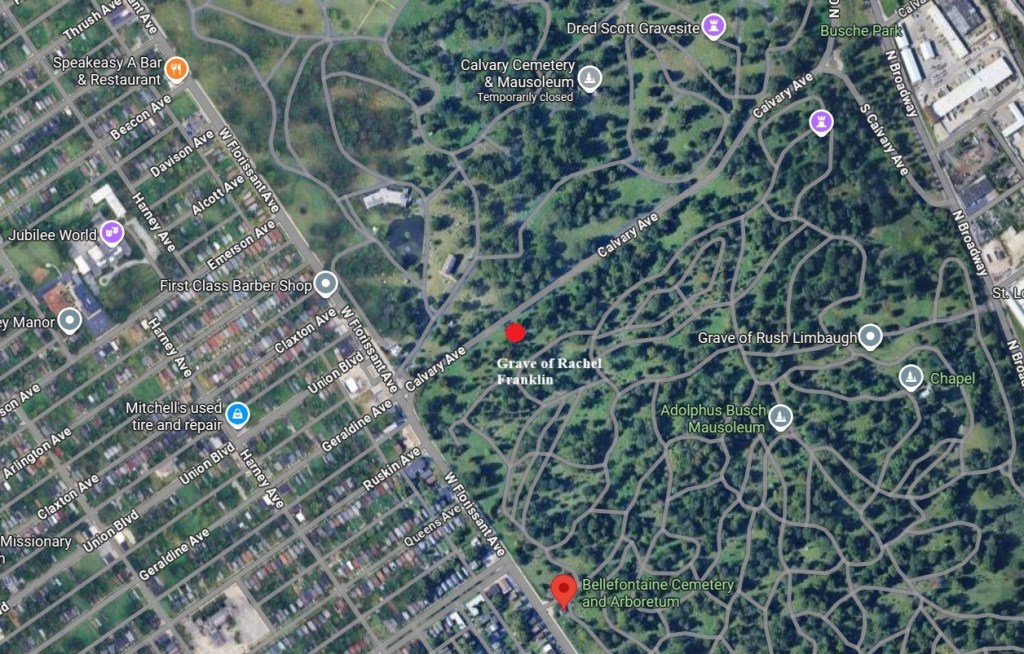
Rachel died in St. Louis on March 29, 1879. She is interred at the Bellefontaine Cemetery in St. Louis. She is buried only a few hundred meters from Dred Scott. She’s also not far from Adolphus Busch, although I think it’s lame that my ancestor is buried near the guy who made crappy Budweiser, while my wife’s ancestors are interred near Alexander Keith, who made excellent beer. Lame for me, anyway. Sadly, Rachel is also not far from Rush Limbaugh. Well, there went the neighbourhood.
Rachel’s burial location.
Rachel and her neighbours. Dred Scott is north east, while Adolphus Busch is to the east.
While I might not have a lot about my Germans from Russia ancestry and I haven’t gotten as far back in those lines as the other branches of my family tree, Katherina Loran, is one of the few of my Great x3 Grandparents of this lineage for whom I have the names of all four of her grandparents. In fact, I know the names of three of her for Great Grandfathers, but it should come as no surprise to any genealogist that I don’t know any of her Great Grandmothers.
Katherina was born in the Karlsruhe colony in the Beresan in 1846, to Michael Loran and Klara Stumpf. Both of Katherina’s parents were born in the Beresan – Michael in Karlsruhe and Klara in Speier.
On her paternal line, Katherina’s ancestors came from Queichheim, Rhinepalatinate. Queichheim is now part of Landau, Rhineland-Palatinate, Germany, about 40 kilometers northwest of Karlsruhe, where many of my other German-Russian ancestors originated.
On her mother’s paternal side, Katherine’s maternal grandfather, Jakob Stumpf, was born in Riedseltz, Weissenburg, Elsaß (Alsace). Alsace spent much of its history moving between French and German control. At the time Jakob was born, it was primarily under French control, but small exclaves were under German control. Riedseltz is now within France, about five kilometers from the German border and just over 30 kilometers due west of Karlsruhe.
Katherina’s maternal grandmother, Elisabetha Berk (or Burck) was born in Pforzheim, Baden, on the other side of Karlsruhe and about 50 kilometers from Riedseltz. Just over 15 years ago, when one of my cousins married, they and their spouse created a new surname that was a mash-up of their surnames at birth. The result was “Burke”. I had to let my cousin know that she was reviving the surname of our Great x5 Grandmother!
Returning to Katherina, she married Jacob Anton in Karlsruhe on October 28, 1863. Over a 25 year period, Katherina had 11 children with Jacob. At least half her children emigrated to the United States and Canada, mostly to Montana and Saskatchewan. I think it’s amazing to think that my lifetime overlapped with two of her children. The youngest of Katherina’s children, Mathilda, lived until December 1971, passing away at age 83. If I had ever met Mathilda, I’d have been meeting with someone only one generation away from someone born more than 100 years before me.
In 1874, Katherina and her family moved from Karlsruhe to Christina, one of the German daughter colonies in the Beresan. It was very likely that Katherina was pregnant at the time of the move, because she gave birth to a daughter, Veronica, in June 1874. Katherina and Jakob may have been amongst the earliest settlers in Christina, as it may have been founded in 1874; however, there are birth records showing that German colonists were there as early as 1860. Today what remains of Christina
Katherina died young, at age 47, when her youngest child was only five years old.
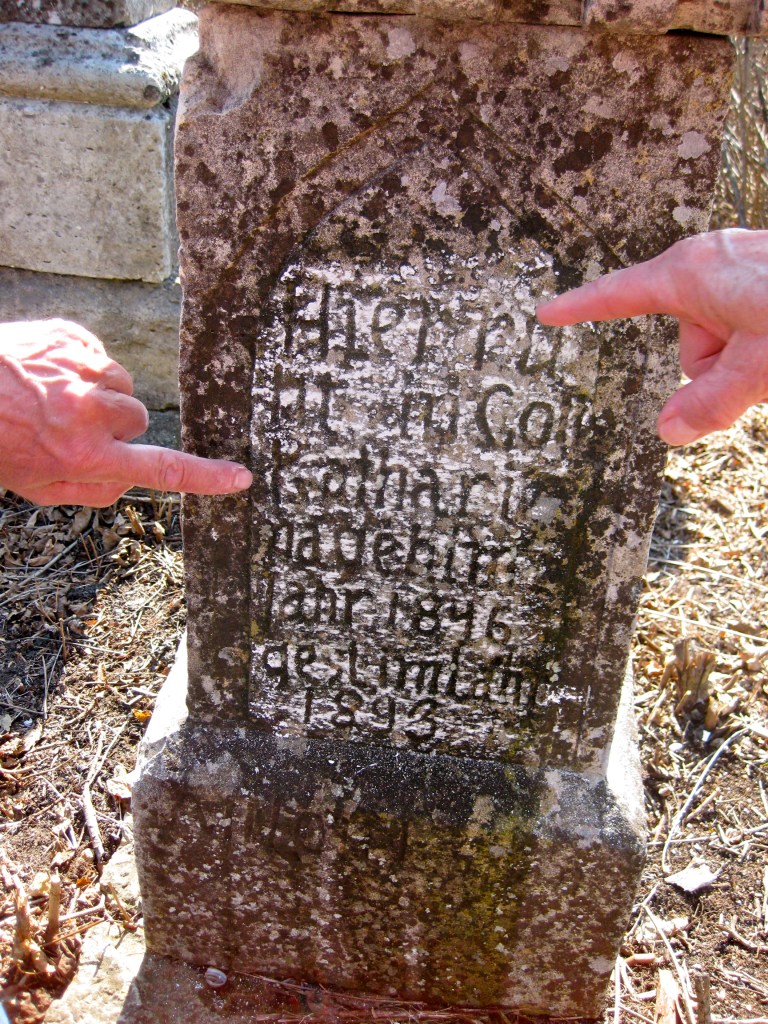
Paul Antone, my maternal grandmother’s second cousin*, made a trip to Ukraine in 2010 to visit some of the places where the German colonists had lived. He shared many of his photos with me, including several from the Christina cemetery. Amongst those was a photo of Katherina’s headstone.
Translated to English, the inscription on Katherina’s headstone reads “Here rests in God Katherina, born in the year 1846, died 1893.”
*Yes, I know that makes him my second cousin twice removed. 😏
My Great Great Grandmother, Barbara Schmidt, was born to Valentine Schmidt and Margaretha Boechler on October 25, 1865 in Karlsruhe, Beresan, Ukraine, Russian Empire. Karlsruhe was one of the colonies established by German settlers who responded to the manifestos issued by Catherine the Great and, later, her grandson Czar Alexander I. Since Karlsruhe was founded in 1809, it is most likely that its founders were responding to a manifesto issued by Alexander I in 1804.
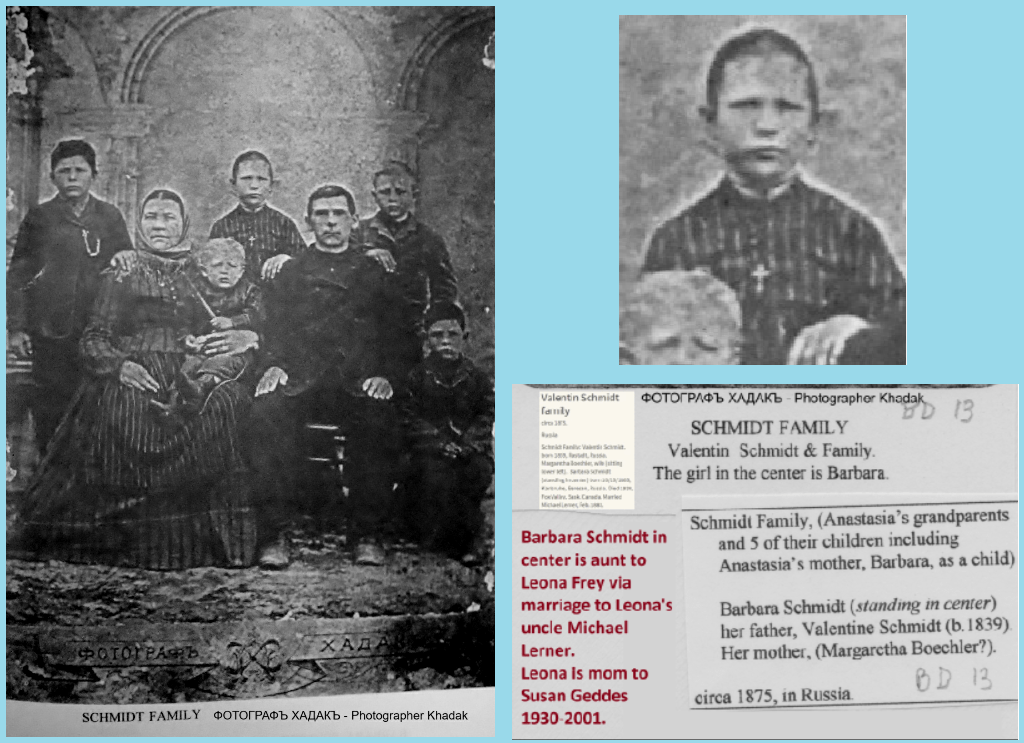
I know almost nothing about Barbara before she married Michael Lerner, said to have been in February 1883. There’s only one clue about her childhood, which is from a photo I first saw in a book in 1997. I’ve since seen it other places. I can’t even recall when or how I came across it. I think I was probably still using Windows 95 and Netscape. One of the later iterations I have of it came with additional information, which is in the bottom left of this graphic:
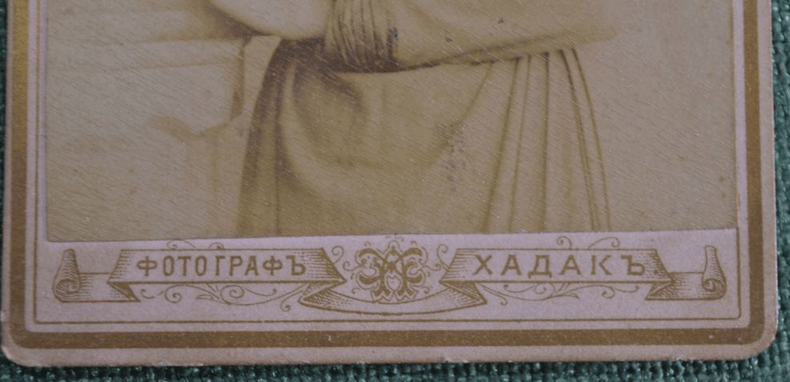
The one alteration I made to each image was to add “ФОТОГРАФЪ ХАДАКЪ Photographer Khadak” (or “Hadak”). It is what you can see in the bottom of the photo. I googled the phrase using the Cyrillic, without the translation/transliteration. The results included a photograph that was listed for sale on a Russian website that sells collectibles, which had the same caption at the bottom.
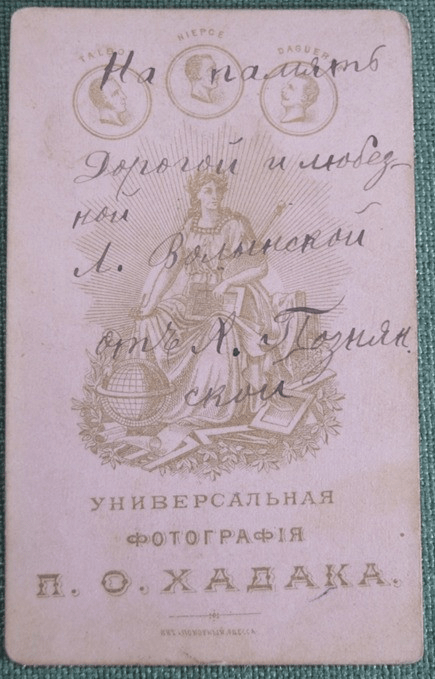
The photos of the item included this:
My Google results also included a Russian-language Wikipedia article, Хадак, Павел Иосифович (Khadak, Pavel Iosifovich). If the person in the article is the person who took the photograph, I have a real timeline problem.
The article says that Pavel Khadak was born in 1863 – two years before Barbara. So if the photo was taken when Barbara was 10, in 1875, Pavel would have been 12 years old. The Wiki article also says that Pavel took up photography sometime after 1881, and only later attended photography school. This means that Pavel likely couldn’t have taken the photo until the early to mid-1880s.
I also considered whether Barbara could have been born much later than 1865. If so, if she was 10 in a photo taken around 1885, she’d have been born in 1875. The problem is she’d have been eight years old when she married and had her first child.
Update: So often I find what I’m looking for after I click “publish”. Sigh. Better late than never! I’ve since come across transcriptions/translations of church records, which include baptismal registrations for Karlsruhe. Amongst these is an entry showing that Barbara was born on October 17, 1864, not October 25 as I found in many other secondary sources. Barbara was baptized on October 18, 1864. Interestingly, her godparents were Franz Böhm and…Barbara Schmidt! My guess is that Godmother Barbara might be an aunt.Of course, this supports the original estimate that the family photo was taken in 1875 – which weighs against it having been taken by Pavel Khadak of the Wikipedia article.
I have no idea how Barbara and Michael came to be together, as Michael was from Rastadt, Beresan, which was about 50 kilometers from Karlsruhe. After the marriage, the couple lived in Rastadt, where Michael was a farmer. The couple had six children in Rastadt.
In 1893, Michael and Barbara moved the family family from the Beresan and relocated to the United States. Their youngest child was only five months old at the time, with three three others being aged 5 and under. Poor Barbara – I’m pretty sure the childcare would have all fallen upon her.
The Lerners landed at Ellis Island on May 12, 1893 and quickly settled in Clay County, Texas, where Michael started a farm outside of Henrietta, the county seat. Meanwhile, Barbara gave birth to eight more children. The first of their child born in the United States was my Great Grandfather, Heronimus (“Jerome” or “Jerry”) Lerner. According to the 1910 US Census, Barbara only spoke German. However, according to Canadian census records, Barbara was able to speak English by 1921.
The family remained in Texas for 25 years, until 1918. By that time, several of Barbara’s older children, including Jerry, had relocated to Saskatchewan, near Fox Valley. Michael moved Barbara and most of their other children to Rastadt, Saskatchewan, not far from Fox Valley. Only one of their daughters remained in Texas. Once in Rastadt, Michael again took up farming. Barbara became a nationalized Canadian (although technically a British subject – Canadian citizenship separate from British nationality did not occur until 1947).
In 2000 or 2001, I was doing a series of job interviews. I included genealogy as one of my interests in my resume. One of my interviews was at a firm where I didn’t have much of an expectation of succeeding (there were good reasons), but I went to it anyway. Can’t score if you don’t take the shot!
One of the interviewers took great interest in my hobby, and I ended up talking about a trip to a small town in Saskatchewan that I had done a few years ago, meaning my trip to Fox Valley and Rastadt in 1997. The panelist asked me to name the towns anyway, and he said that he had heard of them. It instantly clicked as to why – his last name was Schmidt! After comparing notes, we figured out that we were third or fourth cousins of some degree.
As expected, I didn’t get the job – although I was successful elsewhere. But I found a cousin!
Barbara died on October 21, 1936, four days shy of her 71st birthday. Her death occurred in Liebenthal, Saskatchewan, a village about 25 kilometers north of Fox Valley and Rastadt. Other than the proximity, I haven’t found Barbara’s connection to Liebenthal. Her husband, who survived her, was still farming in Rastadt. Barbara might have had family in Liebenthal, but her children had largely moved to larger places like Regina, Saskatchewan and Medicine Hat, Alberta.
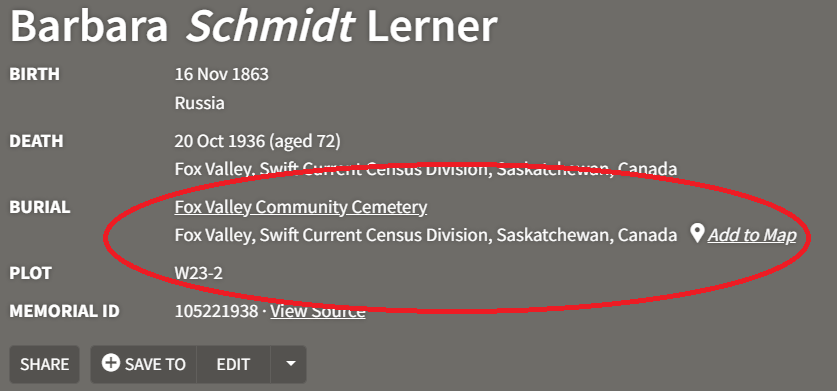
The larger mystery for some time was where Barbara was buried. When I first started investigating this in the late 1990s, the sources available to me had her interred at either the Fox Valley Cemetery or the Rastadt Cemetery. After further investigation, and a trip to Fox Valley and Rastadt in 1997, I determined that she must be buried at the Fox Valley Cemetery.
While there is no marker for her at Fox Valley, the cemetery records show that she is buried in plot as W23-2, which is right beside where her husband, Michael, is buried (plot W23-3). As well, other close Lerner family members are buried in Fox Valley Cemetery, including their son Jerome Lerner (plot W13-1).
On the contrary, there are no other Lerners buried in the Rastadt cemetery. As well, there appears to be inconsistency in the plot in which she is supposedly interred in Rastadt. An older listing from 1997 indicated plot 61; in 2004, it was said to be plot 70. This inconsistency casts doubt on the possibility Barbara is interred at Rastadt. In any event, the Fox Valley Cemetery records far outweigh the secondary sources for Rastadt Cemetery.
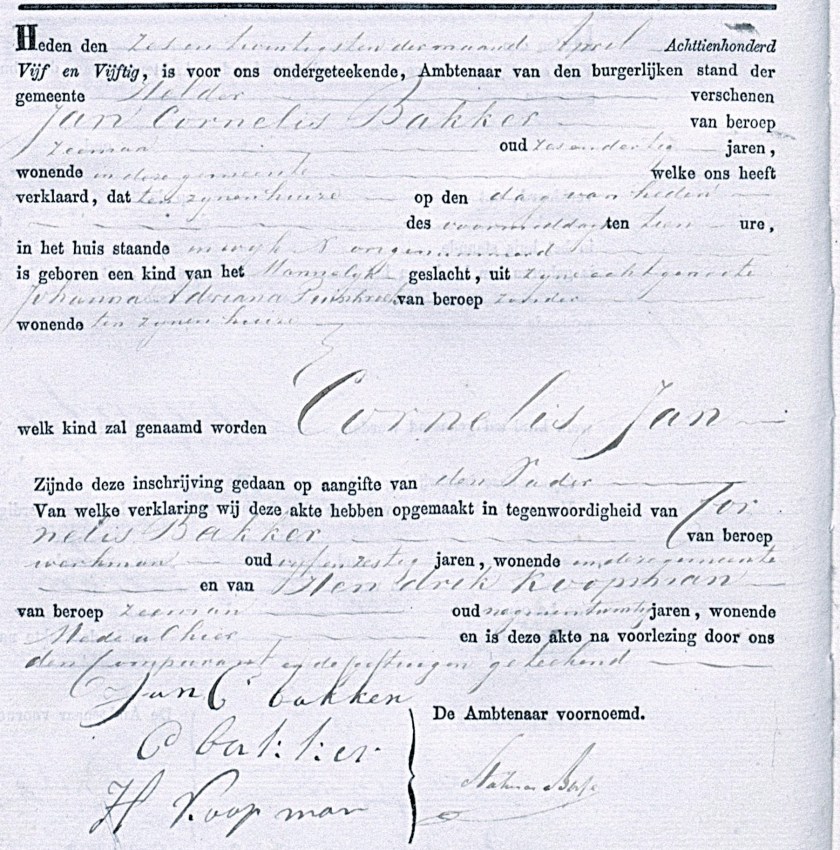
Cornelis Jan Bakker was born on April 26, 1855 in Den Helder, Noord Holland, the only son of Jan Cornelis Bakker and Johanna Adriana Puinbroek. Cornelis was only four when his father died. While Johanna remarried to a man named Pieter Dekker when Cornelis was six, the death of his father must have undoubtedly must have left a mark on his life. He remained an only child, as Johanna and Pieter never had any children that I could find.
Cornelis’s birth registration (Civil Register for Den Helder)
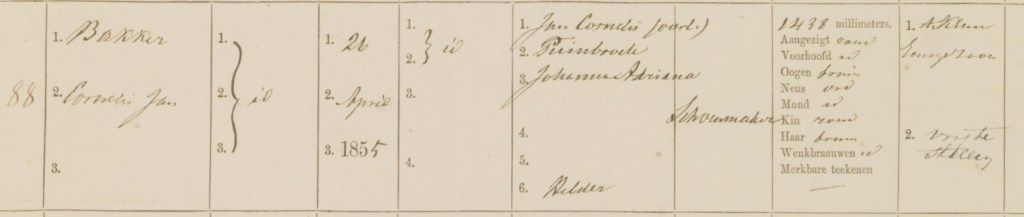
Cornelis spent his life in Den Helder, a port city in the north-west corner of the Netherlands and home of the Netherlands’ primary naval base for centuries. In 1875, Cornelis registered for mandatory military service in Den Helder but never served. The register shows that he was exempted from service because he was an only child.
Military Register showing Cornelis’s enrollment for mandatory military service and his exemption from service due to being an only child.
It should come as no surprise that Cornelis had a number of ancestors who were civilian sailors in Den Helder. Cornelis’ father and a maternal uncle were sailors, as were several other direct ancestors, along with his step-father and his father-in-law. In fact, Cornelis’s wife also had many sailors in her lineage.
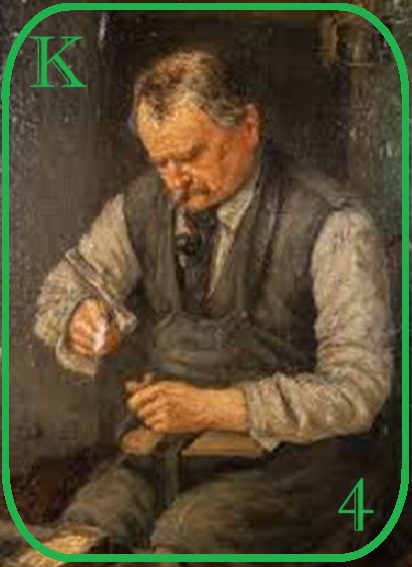
Cornelis broke with that tradition. Around 1875, Cornelis began his work as a cobbler or a shoemaker, a trade he maintained for nearly four decades, up until his death in 1914. Three of Cornelis’s five sons became shoemakers, although one later gave up the trade to work in a bank.
On September 29, 1881, when he was 26 years old, Cornelis married Christina Ran in Den Helder. Christina was born in Den Helder on February 13, 1858 and, like Cornelis, spent her entire life in that city. Together, Cornelis and Christina had eleven children. While Cornelis and Christina remained rooted in Den Helder their entire lives, several of their children later moved further afield, including my great grandmother Elizabeth Bakker who ended up in Langedijk, about 30 kilometers to the south. Other children ended up in the provinces of Utrecht and Zuid Holland.
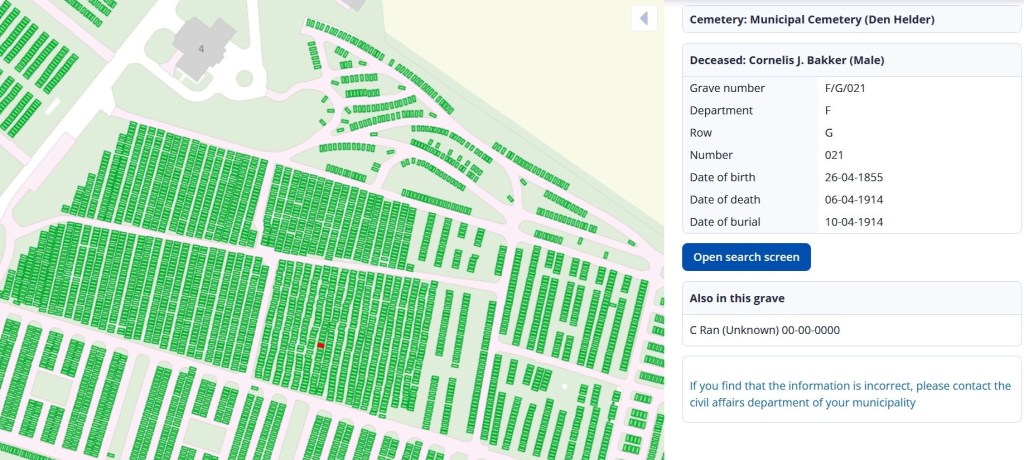
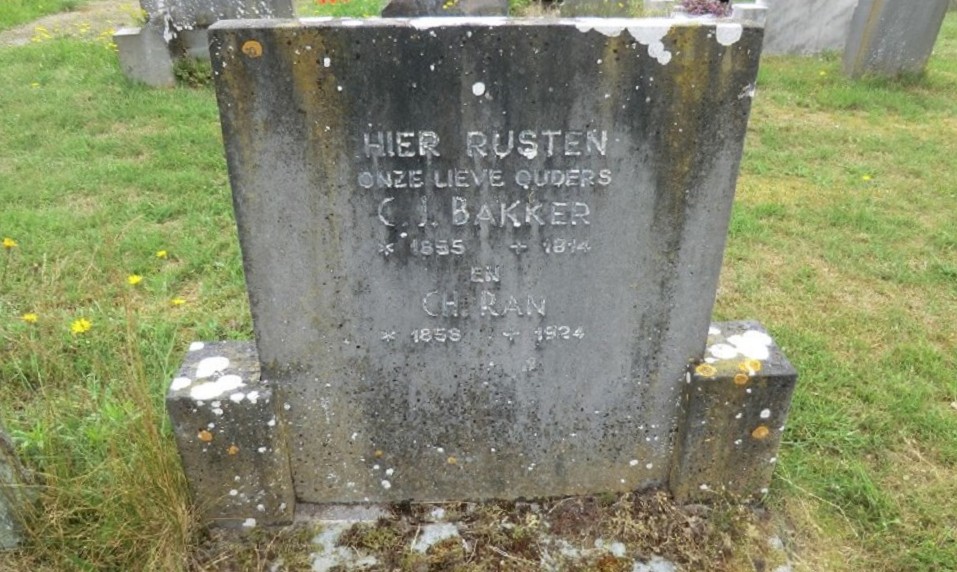
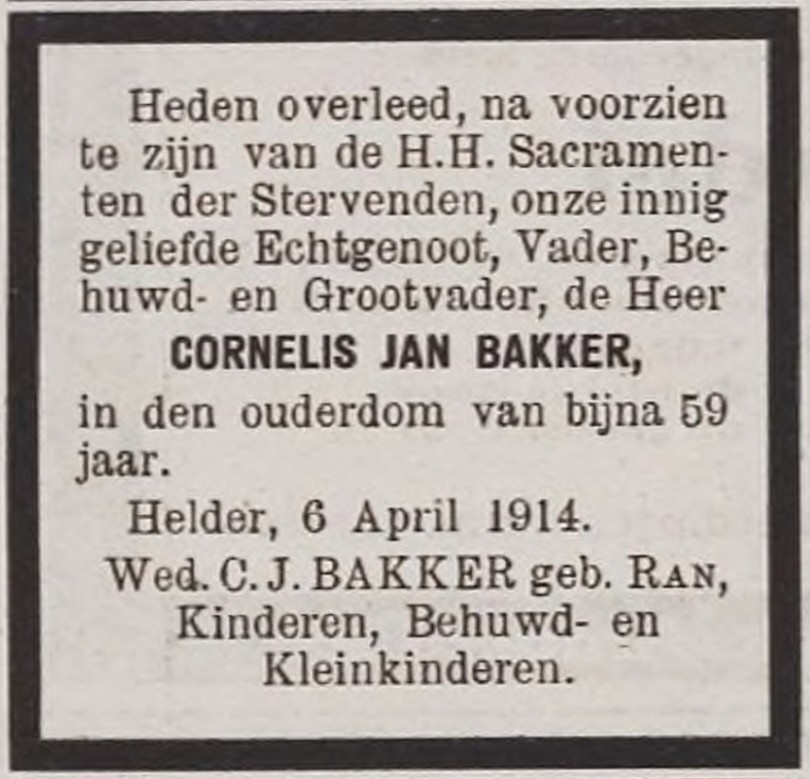
Cornelis died on April 6, 1914 at the age of 58 in Den Helder. He was buried in Den Helder, at the Begraafplaats Huisduinen (“Huisduinenen Cemetery”). The cemetery is now also known as Algemene Begraafplaats Den Helder (“General Cemetery of Den Helder”). Huisduinen is a village on the outskirts of Den Helder and was the original settlement centuries ago. When the harbour was built in Den Helder, its growth outpaced the original neighbouring village.
Map showing the location of Cornelis and Christina’s grave at Begraafplaats Huisduinen in Den Helder.
Graves in the Netherlands are usually leased, not purchased, and are routinely cleared after a few decades, so imagine my surprise when I discovered that Cornelis, along with his wife, is still interred in his original resting place! According to the Dutch version of Wikipedia, there are gravestones at Begraafplaats Huisduinen dating back to 1671 and that there are many centuries-old headstones. In fact, in 2023, many of the old graves and headstones were restored and renovated.
“Here rest our dear parents C. J. BAKKER (1855-1914) and CH. RAN (1858-1924)”
If I had known about this when I visited Den Helder many years ago, I would have loved to have visited the site!


 A Deck of Ancestors