I’ve covered a lot of ground1 on the topic of “Homestead” in past posts. As a result, it’s been hard to think of something new for this week’s prompt for the 52 Ancestors Challenge – so much so that I’m now a week late.
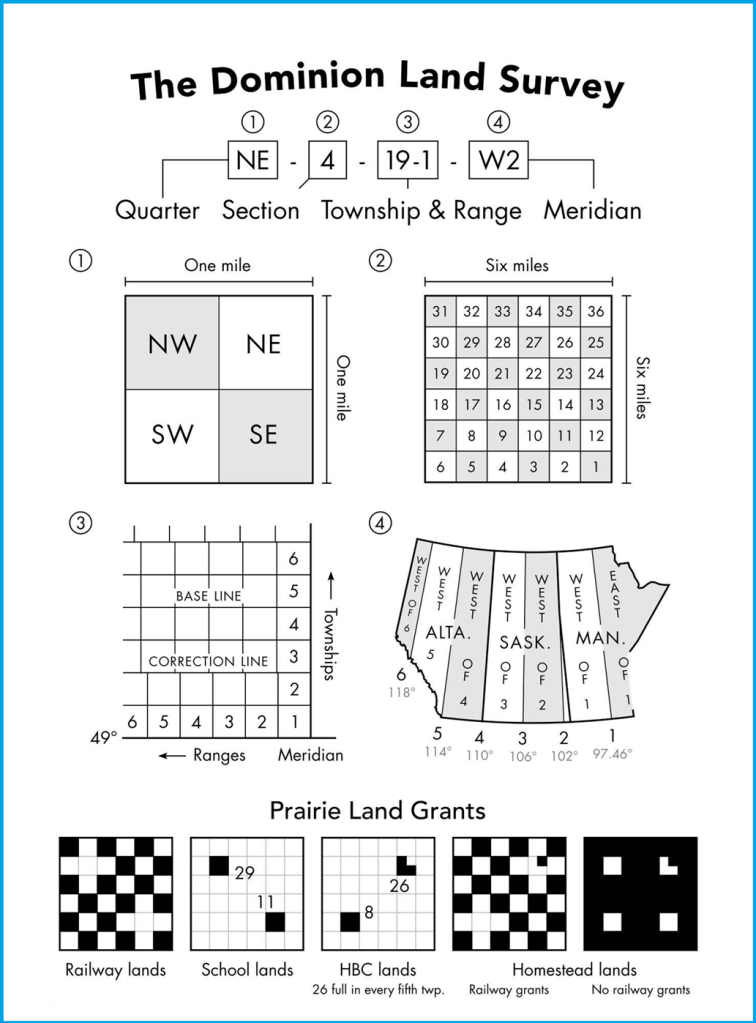
What I can offer is this handy graphic that might be of use to family historians trying to find their ancestors’ homesteads in the Canadian Prairies.
I had originally drafted this as a post separate from the 52 Ancestors Challenge, but then I noted “Free Space” as an upcoming post. So nice to be ahead of the prompt for a change!
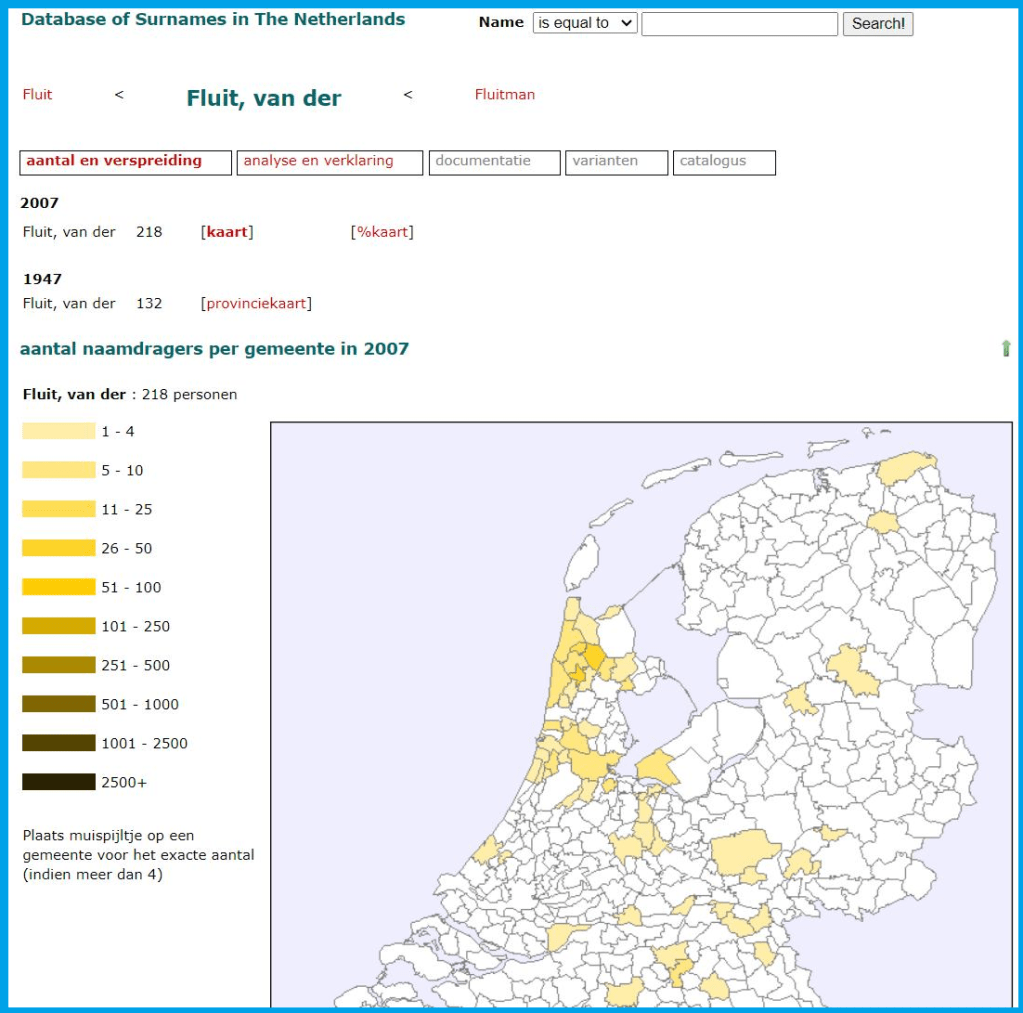
The Database of Surnames in The Netherlands contains about 300,000 surnames found in the Netherlands in 2007, with similar data for 1947. It is maintained by the CBG Centrum voor familiegeschiedenis (“CBG Centre for Family History”) in the Netherlands, formerly called the Centraal Bureau voor Genealogie (“Central Bureau for Genealogy”).
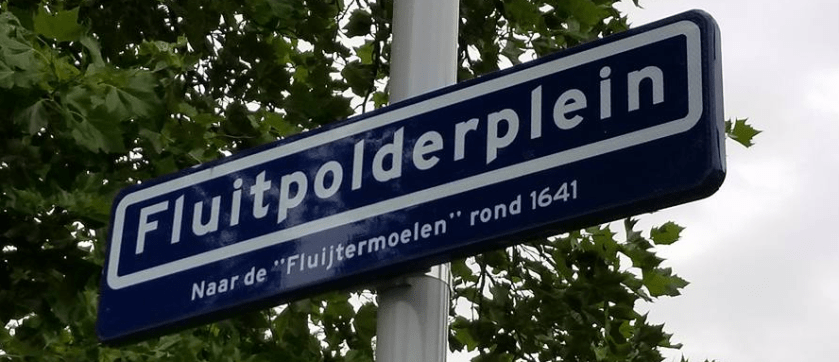
A swimming pool with my surname on it, located on Fluitpolderplein in Leidschendam, Zuid Holland. Our surname either comes from the polder on which this pool is located, or the polder is named after my ancestor. There’s also an adjacent library, where I tried to do a bit of family history research.
You’d be hard pressed to find many Vanderfluits/van der Fluits in North America. Yes, there are a few of us, mostly in New Brunswick and Alberta, and some in British Columbia (like me!). There are also a few in the United States.
There aren’t many van der Fluits in the Netherlands, either, but 218 (in 2007) seems like a huge number when I think of how few are on this side of the Atlantic.
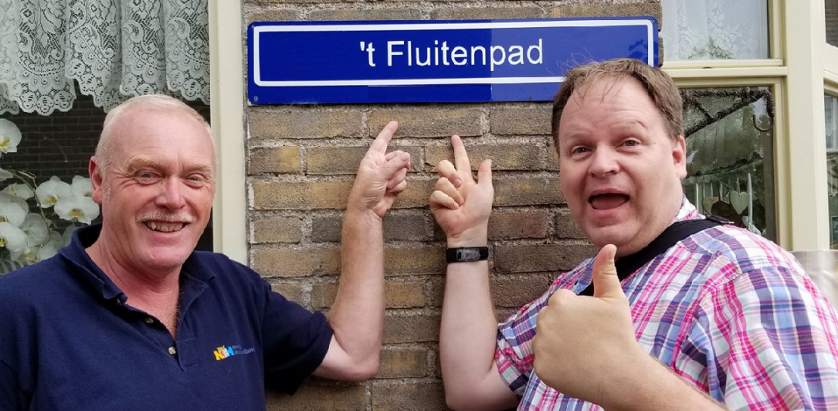
Visiting my cousin in the Netherlands, whose house is on “‘t Fluitnpad” – which is actually the name he gave his driveway. In English, it says “The Fluit Path”.
It’s no surprise to me to find the concentration in Noord Holland (the bit below Texel, the largest of the islands on the map). It’s where my father was born and pretty much where all the van der Fluits who I know in the Netherlands live. What’s surprising are the pockets of van der Fluits in Gelderland and Noord Brabant (the south-east). I have no idea who they are or how they got there. Even more surprising is the dearth of van der Fluits in Zuid Holland (around The Hague and Leiden), especially since that is the primary source of the surname. There are *zero* in many of the municipalities where my ancestors came from.
“Favourite Photo” is a perennial topic for the 52 Ancestors Challenge. The prompt started out hard enough the first year I participated in the challenge, because I had so many favourites to choose from. If I had realized back then that it was an annual topic, I wouldn’t have posted so many photos back then!
The other problem is that “favourite photo” suggests one photo that you love more than all your others. How to choose??? Simple! Simply read the prompt as “A Favourite Photo”!
Despite that, it’s still hard to choose. What I’ve decided to do is to try to post something I haven’t shared before. While maybe not my favourite, I’ve selected some photos of a memorable family road trip to Alaska in the mid-80s, when I was in grade twelve. I love road trips, and this is one that I’ve only done once (so far!).
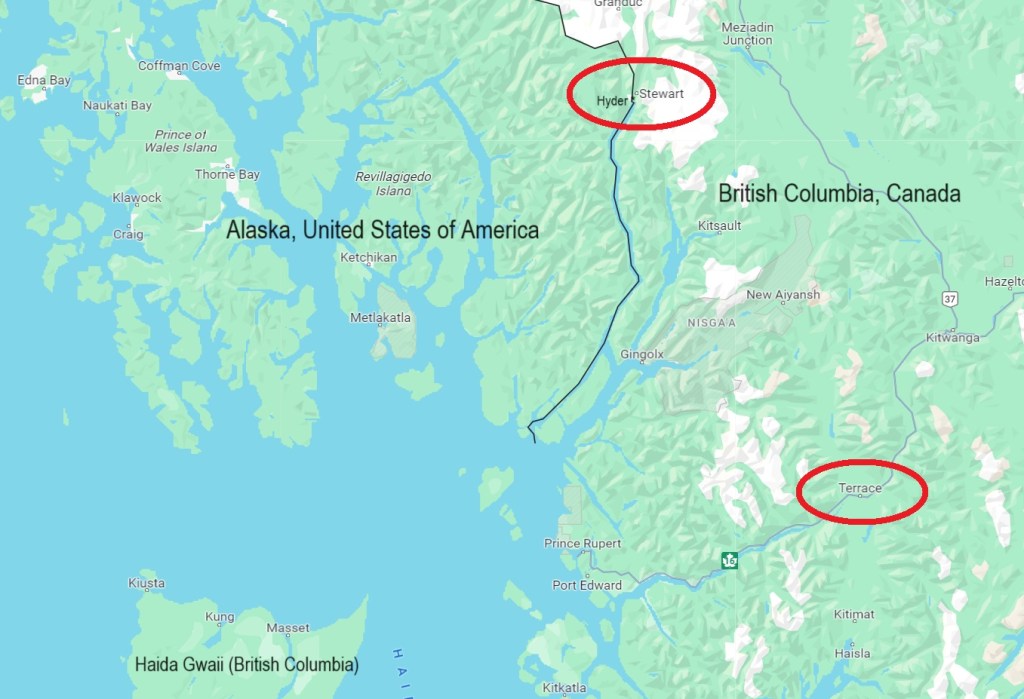
Terrace is near the northwest coast of the province, near the Alaska Panhandle. Just over 300 kilometers away (about a four and a half hour drive) are the border communities of Hyder, Alaska and Stewart, British Columbia.
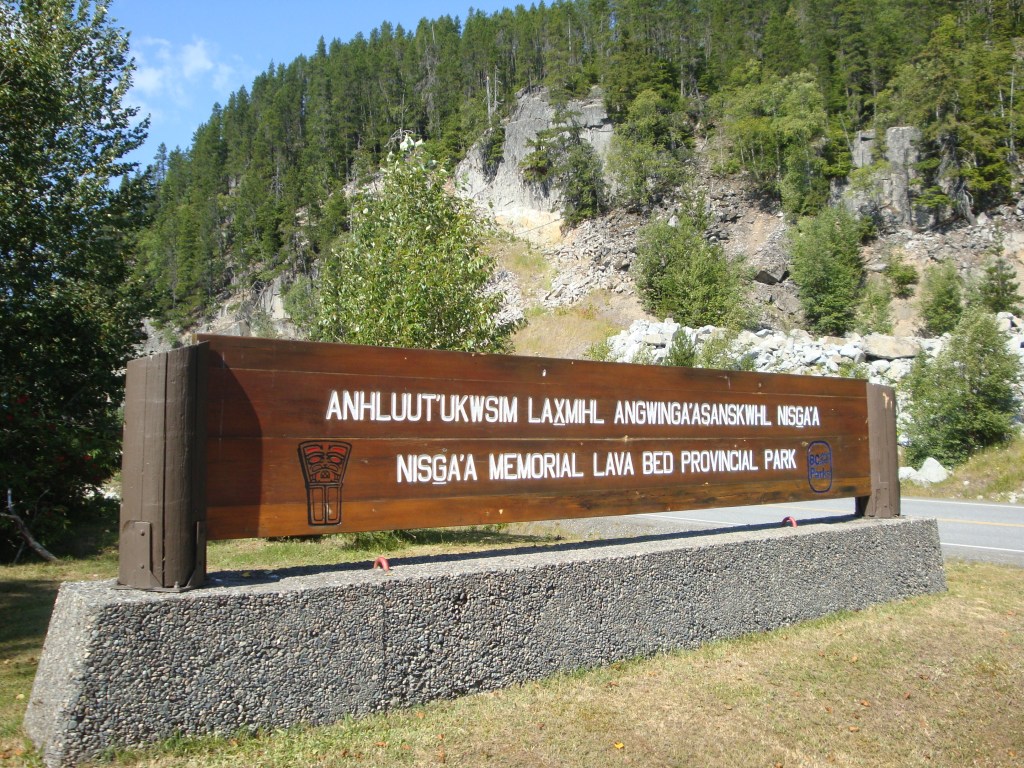
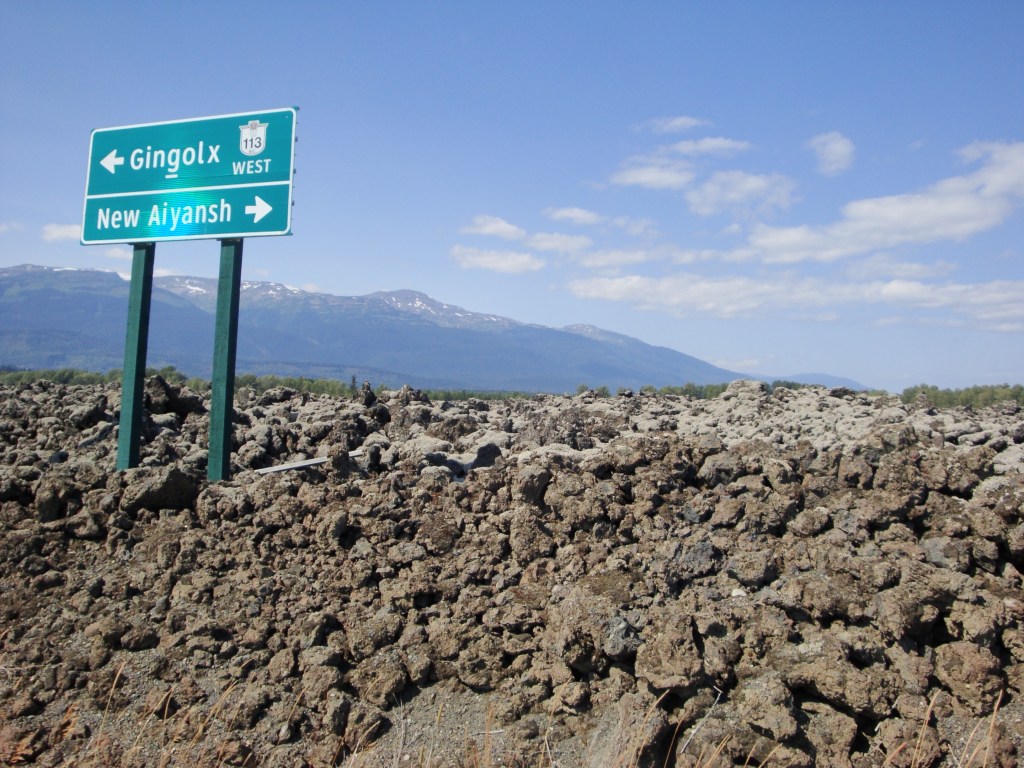
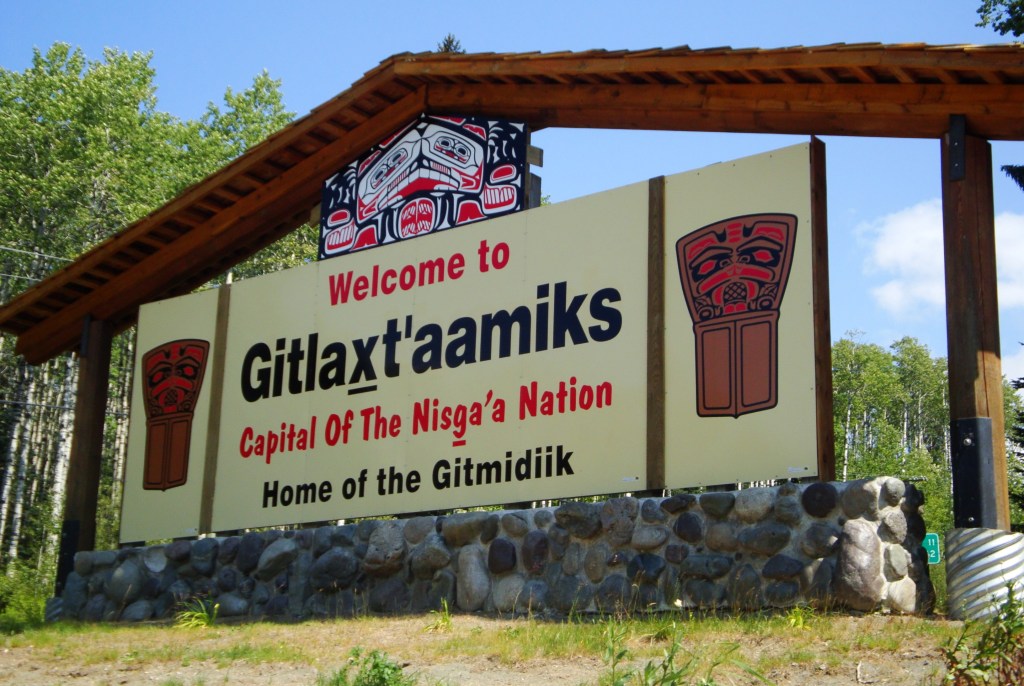
While the destination was novel, it was the journey that was the best. The easiest way to get from Terrace to Stewart/Hyder is along Highway 37. However, we took a less direct and even smaller route, Highway 113, which is now known as the Nisga’a Highway. It travels through lava beds (designated as Nisga’a Memorial Lava Bed Provincial Park in 1992) and the lands of the Nisga’a Nation.
(I’m cheating here. My photos of the lava beds and the Nisga’a territory from the road trip I’m writing about suck. In 2010, I, with my wife and some friends, took a day trip to the Nisga’a, but did not proceed any further north. My photos from that road trip are much better!)
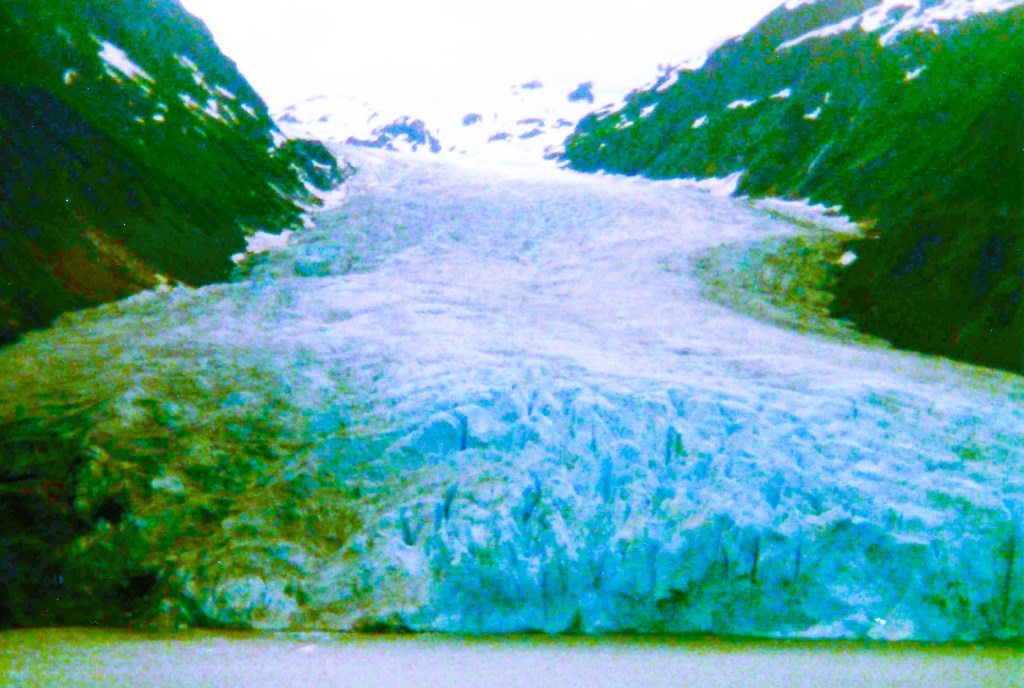
The Nisga’a Highway ultimately connects to Highway 37, which travels north to the Yukon. My folks have actually driven the length of that highway, but we didn’t on this road trip. Rather, we turned west onto Highway 37A at Meziadin Junction. Between Meziadin Junction and Stewart is the Bear Glacier.
The glacier has shrunk an incredible amount in the decades since our road trip. It no longer touches the lake as seen in my photo and is but a sliver of its former self at this location.
At our destination, we stayed in Steward, which was (and still is) the much larger of the two villages. At the time, there was no customs or border station on either side of the border, although there was the remains of one that had clearly been used for target practice. The post office in Hyder was memorable, as it was in an old Airstream (or similar) trailer. I also remember a place selling “Northern Fried Chicken”.
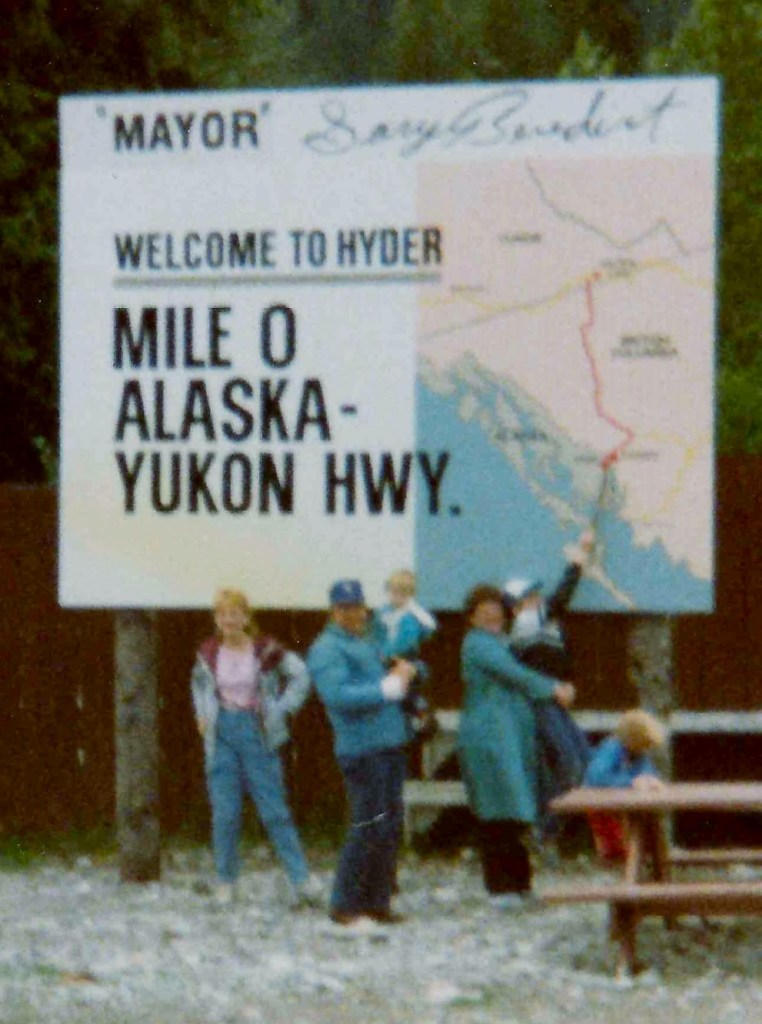
This is a photo of my family at what is purported to be the start of the “Alaska-Yukon Highway.” Of course, I’m not in the photo because I’m the one taking the picture – with a 110 film camera! Otherwise, the whole family is visible here, although my youngest sister (sitting at the table) looks quite odd. It wasn’t the best of cameras, that’s for certain. While you can travel from Hyder/Stewart to Alaska, as shown in the sign, the highway does not officially bear that designation.
One thing we didn’t do in Hyder was get “Hyderized”, which involves taking a shot of Everclear at one of the village pubs. It once appeared in the Guinness Book of World Records as the most alcoholic drink in the world. (Guinness no longer publishes alcohol-related records.) No, Everclear was not something I tried until I was in university.
A great travelogue about Highway 37 (also known as the Stewart – Cassiar Highway, is Nearly 40 on the 37 by my friend Trevor Hughes.
Two “Troublemakers” come to mind for this week’s 52 Ancestors challenge. They are both ancestors of our children.
David Van Norman (Our Kids’ Gx4 Grandfather)
Up until the 1830s, the colonies of Upper Canada and Lower Canada (roughly modern-day Ontario and Quebec) were ruled by oligarchic elites. In Upper Canada, they were disparagingly called the Family Compact; in Quebec, they were called the Château Clique (even though they were largely anglophones, one of whom was John Molson, founder of the brewery company). Their rule was largely self-serving and the government was run through patronage. Discontent was further fueled by economic depression.
A Reform movement developed in both colonies. The Reformers initially tried to change the system politically, from within, including electing Reformers to the colonial legislatures. When this failed, rebellions broke out in both colonies in 1837: in Lower Canada in November and Upper Canada in December.
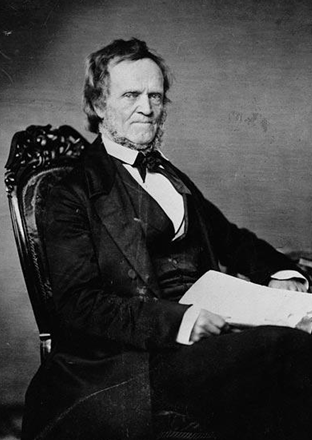
Reformer and Rebel William Lyon Mackenzie
William Lyon Mackenzie was the leader of the rebels in Upper Canada. He was a journalist, member of the colonial legislature, and the first Mayor of Toronto. He was also the grandfather of the longest serving Canadian Prime Minister, William Lyon Mackenzie King. After losing re-election to the legislature in 1836, he concluded that political change could only occur through conflict. His small militia was quickly defeated. Mackenzie and some followers fled to the United States. In mid-December, the rebels established the Republic of Canada on Navy Island in the Niagara River. The British attacked and the rebels retreated to the US, where Mackenzie was arrested and jailed for violating the its Neutrality Act, which prohibited attacks against any country at peace with the United States. President Van Buren pardoned Mackenzie, who returned to Canada after reforms had been instituted and the colonies of Upper and Lower Canada had been merged to form the Province of Canada.
David Van Norman was born to Loyalist parents in Kingston, Upper Canada, in 1815. The Loyalists were those who supported the British crown during the American Revolution. After the war, many migrated to Canada. David began his working life as a school teacher. Later in life he turned to farming. David was sympathetic to the Reformers. David was imprisoned during the 1837 rebellion; however, I have been unable to determine whether he actually participated in the fighting. Whatever the circumstances, the government clearly considered him to be a troublemaker.
Apparently David knew Mackenzie and the two remained good friends until the latter died in 1861. David passed away in Keswick, Ontario.
Richard Newman (Our Kids’ Gx10 Grandfather)
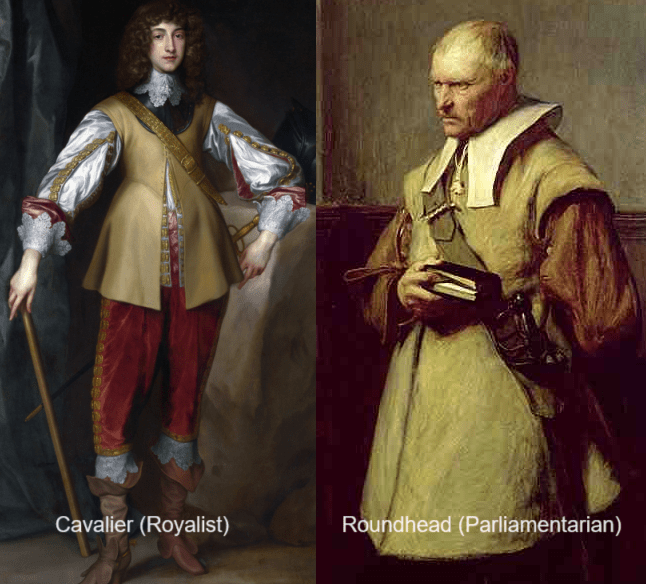
Richard Newman (c. 1620 – 1695) was a barrister who supported King Charles I during the English Civil War between the Royalists and the Parliamentarians led by Oliver Cromwell (also referred to as the Cavaliers and Roundheads). Richard’s aid to the King included financial support by way of loans. Richard was appointed High Steward of Westminster during the Civil War.
Richard also fought alongside the King’s heir, Prince Charles (later Charles II) at the Battle of Worcester in 1651. Richard served with the rank of colonel. After the Royalist loss there, Richard assisted the Prince by helping him to escape to France and by sending him money during his exile. Richard was imprisoned by Cromwell for his troublemaking. Richard was later released, presumably when Charles II returned to the throne in 1660.


 A Deck of Ancestors