52W Mark III – Week 37: Tombstone

After last week’s inadvertent repeat, I took great care to check before starting this week’s post for the 52 Ancestors Challenge. Why, look at this! The prompt for Week 46 in 2022 was “Tombstones”!

Just because it’s written in stone doesn’t mean it’s correct.

A prime example in my tree is the headstone for my mother’s maternal grandfather, Heronimus Michael Lerner (1895 – 1954), who went by Jerome. However, the headstone on his grave is in memory of “Ronimus Lerner”. It’s clear that there had not been a preceding “Je” that wore away or that had been otherwise removed.
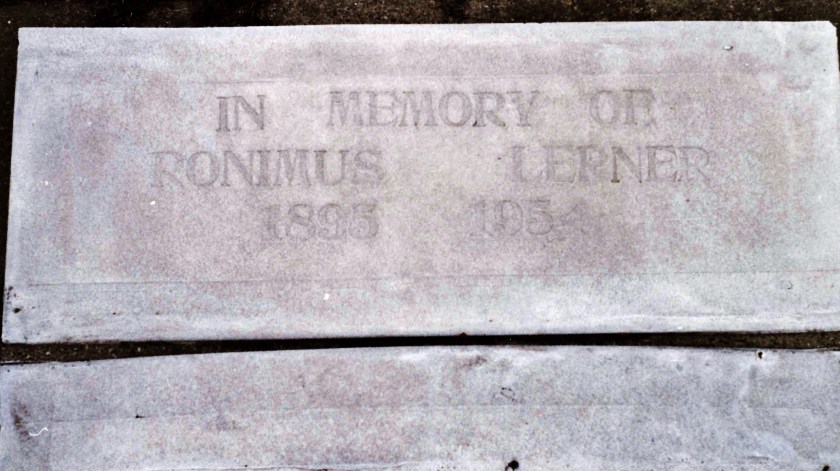
Headstone for Heronimus “Jerome” Lerner, Fox Valley Cemetery, Fox Valley, Saskatchewan

Another example is in the nearby Holy Trinity Roman Catholic Cemetery in Rastadt, Saskatchewan, where a number of my mother’s ancestors and relatives are interred. The marker for my mother’s great aunt, Marianne Roeder, says she died “6/21/29” (June 21, 1929). However, church records show that she died on June 2, 1921 and was buried July on 1, 1921.
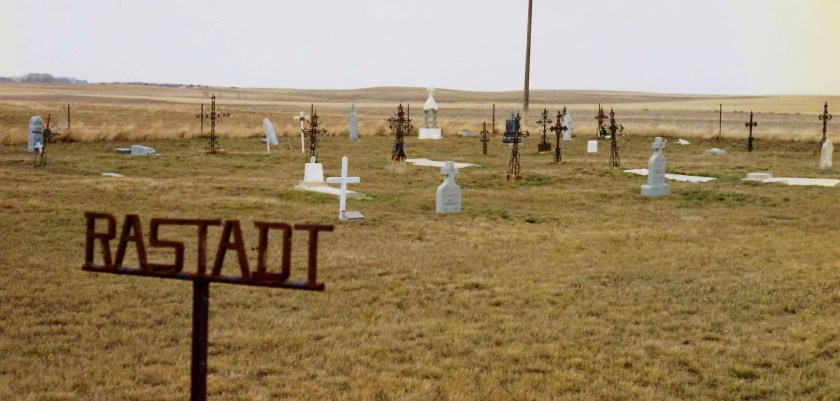
Holy Trinity Roman Catholic Cemetery at Rastadt, Saskatchewan, April 1, 1997. 

While there are several other examples in my tree, my wife’s maternal line has a significant number of tombstone typos.

The headstone for my wife’s Gx2 grandmother, Ellen Sophie Butcher Dwyer (1867 – 1952), puts her year of birth as 1866 or 1867, but the record of her marriage puts her year of birth as 1865. The 1921 census puts her birth in 1867. The headstone for Ellen’s grandmother, Agnes Pellow (1794 – 1869) erroneously states that she died in 1879.

Other apparent errors might not actually be so. For example, my wife’s Gx11 grandfather, Thomas Newman. Thomas most likely lived from about 1560 to 1649, dying at age 89. His headstone says that he was was “over eighty years old” at the time of his death. If he died at 80, Thomas would have been 15 years old when his third child, Richard, was born. However, it was more likely that Thomas was age 20 when his first child was born. While it might seem that Thomas’s headstone may have been incorrect, if Thomas died at age 89 then it was correct to say he was over 80 years old at the time of his death.

These examples underscore the importance of at least two of the elements of the Genealogical Proof Standard: the need for reasonably exhaustive research and to resolve any contradictory evidence.
52W Mark II – Week 48: Troublemaker

Two “Troublemakers” come to mind for this week’s 52 Ancestors challenge. They are both ancestors of our children.

David Van Norman (Our Kids’ Gx4 Grandfather)

Up until the 1830s, the colonies of Upper Canada and Lower Canada (roughly modern-day Ontario and Quebec) were ruled by oligarchic elites. In Upper Canada, they were disparagingly called the Family Compact; in Quebec, they were called the Château Clique (even though they were largely anglophones, one of whom was John Molson, founder of the brewery company). Their rule was largely self-serving and the government was run through patronage. Discontent was further fueled by economic depression.

A Reform movement developed in both colonies. The Reformers initially tried to change the system politically, from within, including electing Reformers to the colonial legislatures. When this failed, rebellions broke out in both colonies in 1837: in Lower Canada in November and Upper Canada in December.

Reformer and Rebel William Lyon Mackenzie

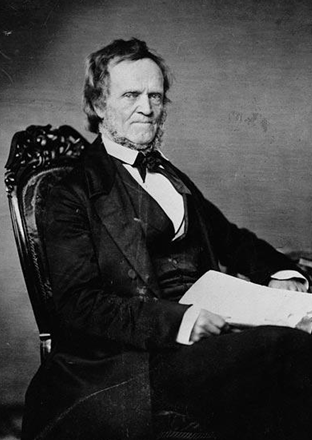
William Lyon Mackenzie was the leader of the rebels in Upper Canada. He was a journalist, member of the colonial legislature, and the first Mayor of Toronto. He was also the grandfather of the longest serving Canadian Prime Minister, William Lyon Mackenzie King. After losing re-election to the legislature in 1836, he concluded that political change could only occur through conflict. His small militia was quickly defeated. Mackenzie and some followers fled to the United States. In mid-December, the rebels established the Republic of Canada on Navy Island in the Niagara River. The British attacked and the rebels retreated to the US, where Mackenzie was arrested and jailed for violating the its Neutrality Act, which prohibited attacks against any country at peace with the United States. President Van Buren pardoned Mackenzie, who returned to Canada after reforms had been instituted and the colonies of Upper and Lower Canada had been merged to form the Province of Canada.

David Van Norman was born to Loyalist parents in Kingston, Upper Canada, in 1815. The Loyalists were those who supported the British crown during the American Revolution. After the war, many migrated to Canada. David began his working life as a school teacher. Later in life he turned to farming. David was sympathetic to the Reformers. David was imprisoned during the 1837 rebellion; however, I have been unable to determine whether he actually participated in the fighting. Whatever the circumstances, the government clearly considered him to be a troublemaker.

Apparently David knew Mackenzie and the two remained good friends until the latter died in 1861. David passed away in Keswick, Ontario.

Richard Newman (Our Kids’ Gx10 Grandfather)

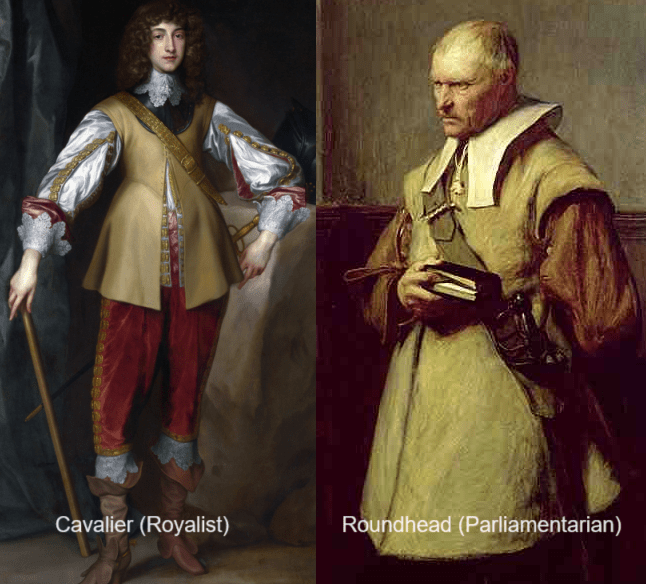
Richard Newman (c. 1620 – 1695) was a barrister who supported King Charles I during the English Civil War between the Royalists and the Parliamentarians led by Oliver Cromwell (also referred to as the Cavaliers and Roundheads). Richard’s aid to the King included financial support by way of loans. Richard was appointed High Steward of Westminster during the Civil War.

Richard also fought alongside the King’s heir, Prince Charles (later Charles II) at the Battle of Worcester in 1651. Richard served with the rank of colonel. After the Royalist loss there, Richard assisted the Prince by helping him to escape to France and by sending him money during his exile. Richard was imprisoned by Cromwell for his troublemaking. Richard was later released, presumably when Charles II returned to the throne in 1660.