Another opportunity to catch up on the 52 Ancestors Challenge with another brick wall ancestor, my Great x4 Grandfather John Joseph. Of course, I’d love to know more about John than have an opportunity to play catch-up. So here’s what I know, based on thin information. As with last week, this information is hardly definitive or reliable.
John was born in 1793 in Muff, Donegal, Ireland. He married Martha Carr sometime around 1810, although as I explained last post I suspect it was later in time. John and Martha had at least one child, my Great x3 Grandmother Elizabeth Joseph. Elizabeth was born in 1818, so I suspect John and Martha married sometime shortly before then.
John died on September 25, 1867 in Muff. Not that I can find anything solid to base that upon.
Most of the documentation I have about John Joseph.
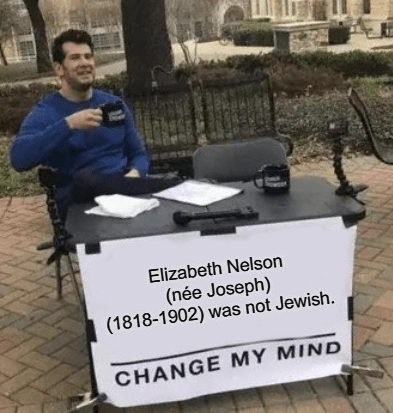
I know I’ve said it before, but I’ll say it again: my Gx3 Grandmother, Elizabeth Joseph, was not Jewish. I cannot find a shred of evidence to support the suggestion, which definitely falls short of the Genealogical Proof Standard. Elizabeth also wasn’t Scottish, which I’ve also addressed before.
Elizabeth was born on September 16, 1818 in Muff, Donegal, Ireland. It is very likely that she was baptized on November 1, 1818. While the document is not available online, my great aunt Fon Hogg (née Burgess) apparently had or saw a copy of a church record showing Elizabeth’s baptism, which is definitely contrary to her being Jewish.
While there has been a nominal Jewish presence in Ireland for centuries, it was miniscule and largely confined to Dublin or the south coast. However, exclusionary laws resulted in the decline of the tiny Jewish population up until the early 19th century. By the time of the Great Famine, there were only about 25 Jewish families in Dublin. The Jewish population in all of Ireland in 1871 was only 258. Muff is about 8 km north of Londonderry, where the Jewish community was not established until 1893. In 1894, there were only 43 Jews in Londonderry. As of 2016, there were only 25 Jews in Donegal. I also have not seen any DNA test results of Elizabeth’s descendants suggesting that have even a trace of Jewish ancestry. So it is extremely unlikely that Elizabeth was Jewish.
I know nothing of Elizabeth’s life between her birth and marriage to Robert Nelson on December 12, 1842 in Muff. One thing I find interesting about Elizabeth and Robert is that they had remarkably similar lifespans. Robert was two weeks older than Elizabeth and died three months before she did.
The other interesting thing is that Elizabeth and Robert left Ireland for Scotland by 1844 – a year before the Great Famine. However, their departure was not unusual. Ireland was poor, many Irish worked in Scotland as seasonal migrants, and emigration was already on the rise before the Famine.
Elizabeth and Robert had three children in Scotland. While there, the couple joined the fledgling Mormon church and were baptized in 1848. In 1850, Elizabeth and Robert joined the exodus of converts travelling from the UK to Utah. The family travelled from Liverpool to New Orleans in September 1850.
However, upon arriving in the United States, Elizabeth and family did not immediately make their way to Utah. Rather, they spent a year or two in Missouri. In May 1852 in St. Louis, Elizabeth had another child, her first daughter, Mary. Within months of Mary’s birth, the family were in Utah, settling in Farmington. Elizabeth had four more children in Farmington.
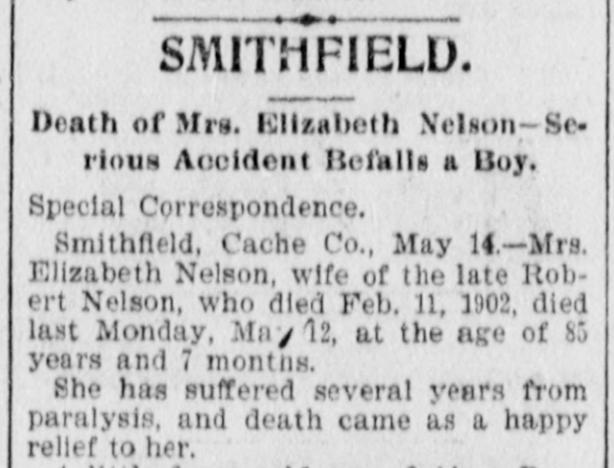
In 1860, Elizabeth and Robert moved for the last time, to Smithfield, Utah. There, Elizabeth gave birth to her last child, a daughter named Jane, in September 1862. Elizabeth spent the next forty years in Smithfield, where she died on September 12, 1902.
Deseret Evening News, May 16, 1902 (Last Edition), Page 7
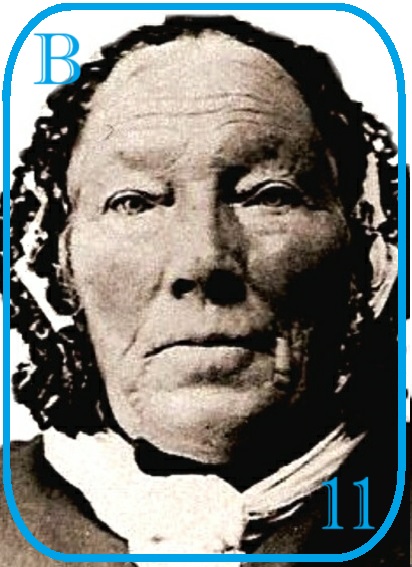
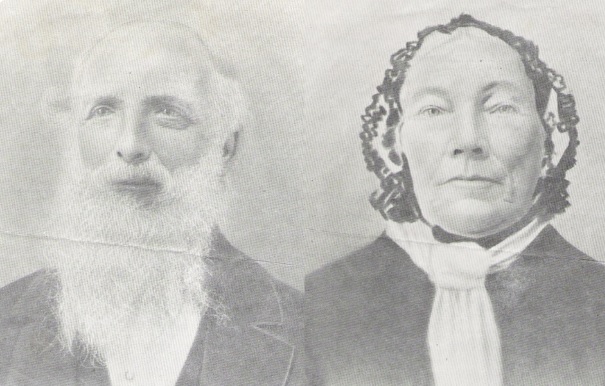
For decades I’ve been reading the same stories about my great x3 grandparents, Robert Nelson and Elizabeth Joseph. I have written about them before (such as here and here). They were both born in Muff, Donegal, Ireland in 1818, two weeks apart. Robert and Elizabeth married in 1842 and within two years they were living in Scotland, near Glasgow. In 1850 they emigrated to the United States. They both died in Smithfield, Utah in 1902: Robert in February and Elizabeth in May.
The oft-repeated story is that Elizabeth was Jewish. The related story is that Robert and Elizabeth were picnicking on an island, where they were trapped by a storm and had to spend the night. The next morning they returned home in disgrace and because they had spent the night together were forced to marry. Moreover, because Robert was Christian, Elizabeth’s parents disowned her.
Needless to say, I don’t believe a word of it.
Not once in over thirty years have I ever seen a shred of evidence supporting this story or the proposition that Elizabeth was Jewish. The conclusion that she was could not be further from the Genealogical Proof Standard if one tried.
When Elizabeth was born, the Jewish population of the entirety of Ireland was extremely small, and mainly centred in Dublin and Belfast. It had not really been established by the time Elizabeth and Robert left Ireland for Scotland. By the mid-1800s, there were only a couple hundred Jews in the entire country. According to the 1881 census, there were fewer than 400 Jews in all of Ireland. Muff, Donegal is on the northern outskirts of Londonderry, where there was no Jewish community prior to 1893. In 1894, there were only 43 Jews in Londonderry.
It is not entirely impossible that Elizabeth was Jewish, but it is extremely unlikely. Absent any evidence to support the claim, I don’t accept it.
UPDATE: Since going live with this, a reader suggested that a DNA test might help put this story to rest. Great idea, I don’t know why I didn’t think of it. This might be an unpopular thing for a genealogist to admit, but I’ve never taken one for a lot of reasons I really don’t feel like explaining right now. However, one of my brothers took a DNA test and he sent me the results. They were everything I expected and, frankly, boring! I took a look at it again, and there is no indication of even a trace amount of Jewish ancestry. To me, this reinforces my disbelief that Elizabeth was Jewish.
This week’s 52 Ancestors challenge is about one of genealogy’s biggest challenges: brick walls. These are the ancestors we can’t get past – we’ve been blocked in our ability to learn more about them or those who came before them. More often than not, brick walls involve ancestors we may have spent years or even decades researching, to no avail.
Who is Annie Pitre?
This week will be a rare foray into my wife’s side of the family. Before doing so, I want to share the brick wall in my ancestry that I’ve been banging up against for decades: my great x3 grandparents, Robert Nelson and Elizabeth Joseph. I’ve been trying to crack these two since the mid-90s. I know a lot about them after they left Ireland, but precious little about before they emigrated. It doesn’t help that this a prime example of a lot of people copying incorrect trees and sharing the information as if it’s correct. It also doesn’t help that my own family – some of them family historians – perpetuate the myths and legends about them that simply aren’t true or are contrary to what little evidence there is.
Robert Nelson (1818 – 1902) and Elizabeth Joseph (1818 – 1902)
Turning to my wife’s side of the family, the brick wall I’ve been trying to break down for almost 15 years is that of Ann (“Annie”) Pitre, my children’s great x3 grandmother. I don’t even know if that is her real name, it could be Peters. It’s also likely that her ancestors were Pitre and the name was anglicized somewhere along the way.
One of my prime sources of information about Annie came from my wife’s grandmother, L. Annie was her maternal grandmother. While L would have been 24 when her grandmother passed away, she acknowledged that her recollection of her maternal grandparents may have been inaccurate. L told me that Annie’s surname at birth was Pitre and that she was possibly born in Rustico, Prince Edward Island. Baptism indexes for several of Annie’s children list her surname at birth as “Pitre”, but others provide the surname “Peters”.
Based upon cemetery records, it would seem that Annie was born on March 25, 1857. However, census records are inconsistent regarding Annie’s date of birth. None of them support 1857 as her year of birth:
1881
1891
1901
1911
Age 29 (b. 1852)
Age 38 (b. 1853)
Age 45 (born 25 March 1856)
Age 56 (born June 1854)
I haven’t been able to find Annie in the 1921 census. The 1931 census will be released in two weeks – hopefully I will find her there.
All four censuses say that Annie was born in PEI. The 1901 and 1911 censuses state Annie was “French”. This is consistent with the fact Rustico had a large Acadian population. This would fit with the possibility Lillian’s grandmother was born in Rustico, where there was a significant French Canadian population. The 1901 census states that Annie’s mother tongue was English and that she was unable to speak French. However, the 1881 census records Annie as “Irish”. The 1891 census had a stroke through the box for “French Canadian”, as does everyone else on the page. The 1891 census notes that Annie’s father was born in PEI but her mother was born in Ireland.
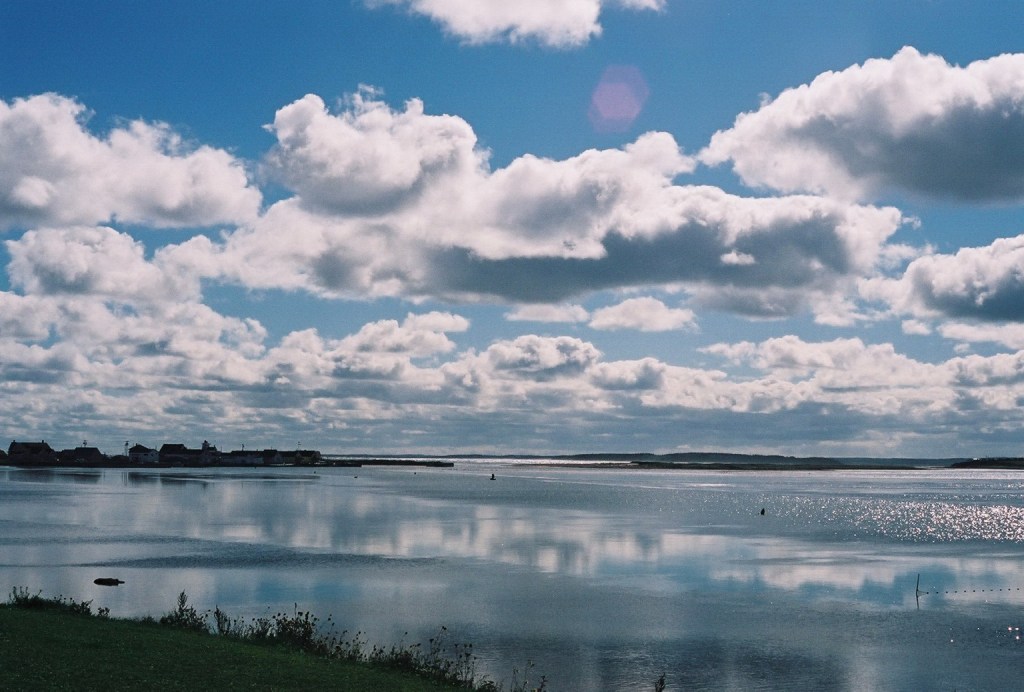
North Rustico Bay, Prince Edward Island
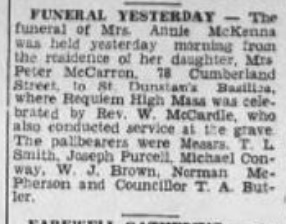
Annie married Patrick McKenna (1839 – 1914) sometime before 1873. I have yet to find any record of the marriage. The most certain facts I have relate to her death and burial.
Charlottetown Guardian, January 17, 1941, page 6.
I’ve chased down many trails, gone down many paths, reviewed many records, checked many newspapers, and ordered many inter-library loans, among other things. I’ve even employed my rusty French scouring Acadian-related sources. Luckily, my wife is fluently bilingual and has helped me with those, as has our eldest child, whose French is very good and who is a budding genealogist himself. Many promising leads came to nothing, but hope springs eternal.


 A Deck of Ancestors