
I have three direct ancestors with the forename “Teetje”: Teetje Pater (my Great Grandmother); Teetje de Groot (my Gx3 Grandmother); and Teetje Bakker (my Gx5 Grandmother). It might not surprise you that Teetje de Groot is Teetje Pater’s maternal grandmother and that Teetje Bakker is Teetje de Groot’s maternal grandmother, especially if you are aware of Dutch naming customs.
Traditionally, the first son is named after the paternal grandfather, the second son is name after the maternal grandfather, the first daughter is named after the maternal grandmother, and the second daughter after paternal grandmother. I knew of this custom for years before it dawned on me to apply it to my father and his siblings, and sure enough, they followed this pattern, assuming that “Thecla” is a variant of Teetje. I also had it that “Teetje” was a form of Theresia, at least according to some records I have of my great grandmother.
However, I recently learned of the Corpus of First Names in the Netherlands. It does not indicate any relationship between “Teetje” and “Thecla”. It also does not indicate that “Teetje” has any relationship with “Theresia”, nor does Dutch Wikipedia. I had similar results at Voornamenboek (“first name book”). However, there would be nothing stopping someone named Theresia from using the roepnaam (nickname) Teetje, or my grandmother substituting “Thecla” for “Teetje” when she named my aunt.
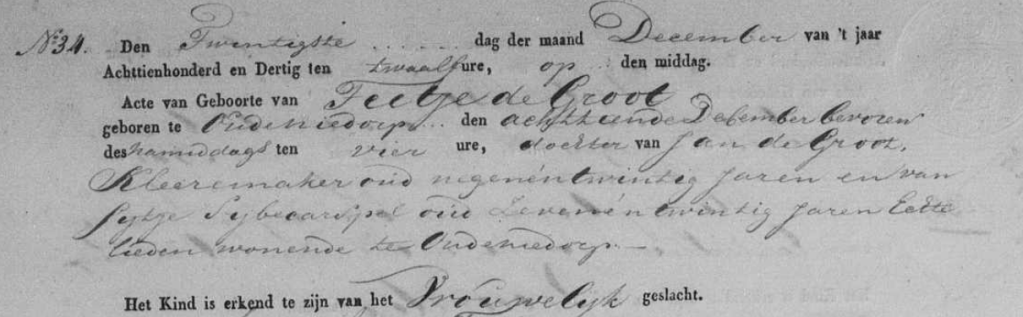
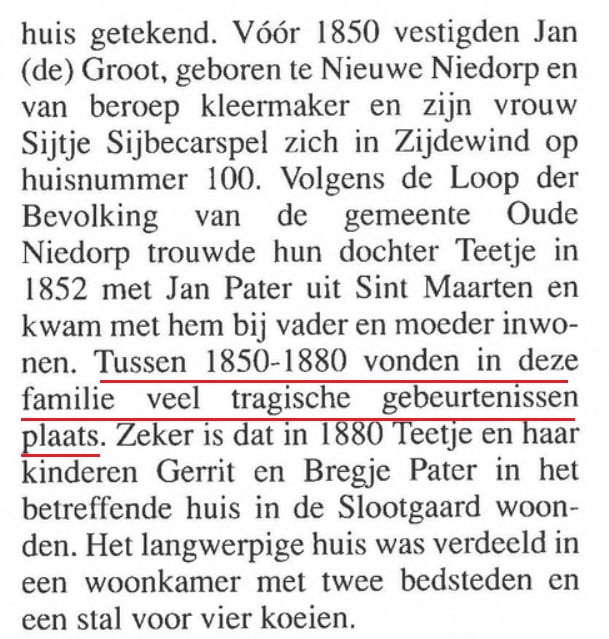
Turning to the middle of my chain of Teetje grandmothers, Teetje de Groot was born December 18, 1830 in Oude Niedorp, Noord Holland. She was the third of thirteen children, and the first daughter, born to Jan de Groot and Sijtje Sijbecarspel, my Gx4 grandparents. Teetje was also the first to live past childhood. In fact, only four of Jan and Sijtje’s children lived to adulthood. Of those who died in childhood, one lived to age eight, one lived to be three, and none of the others survived infancy. Of the four who attained adulthood, Teetje lived the longest and was the last of the de Groot children to pass away.
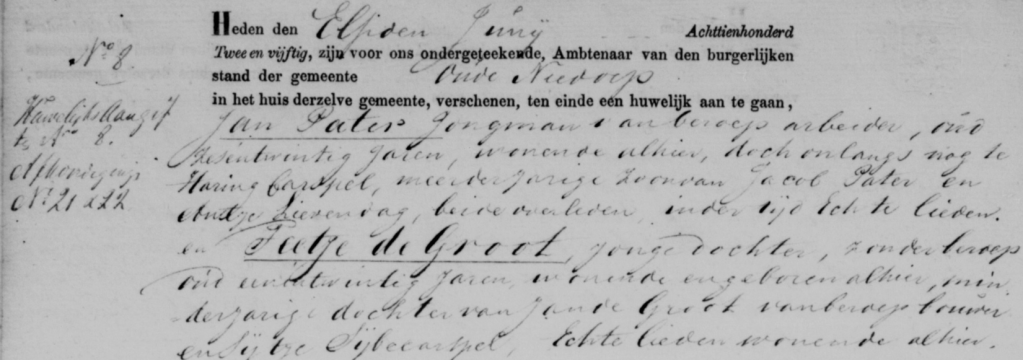
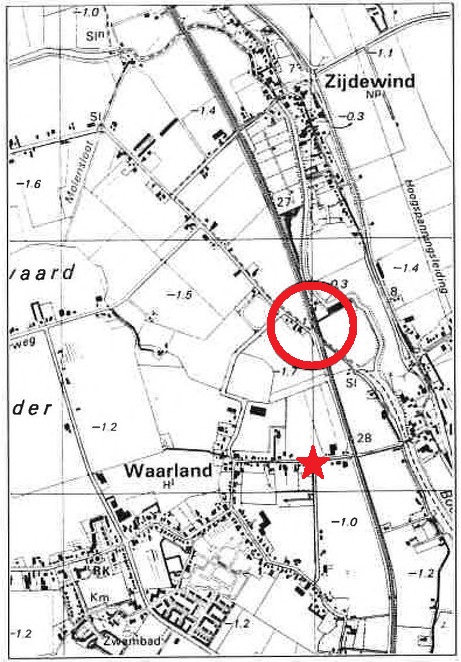
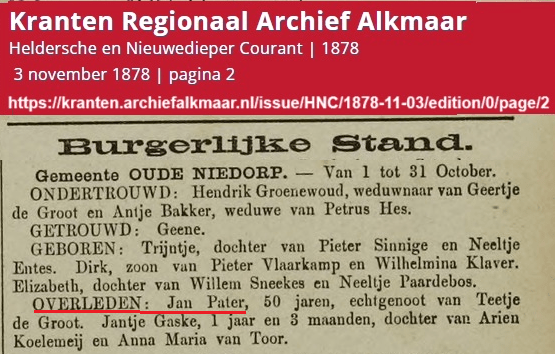
Teetje likely spent all of her adult life living at the same home. After they married, Teetje and Jan moved into Teetje’s parent’s house in Zijdewind, which at the time was part of gemeente (municipality) Oude Niedorp. Teetje was still living there after her parents and husband passed away. At least two of her children, Gerrit and Bregje, were still living with her at the house in Zijdewind in 1880. It seems that Gerrit remained at the house after Teetje passed away; he sold it in 1917.
The house was an elongated structure that was divided into a living room with two box beds and a stable for four cows. In the living area there was a small kitchen with a rainwater tank. Rainwater was collected via the gutters and a pipe indoors. The house burned down in 1926.
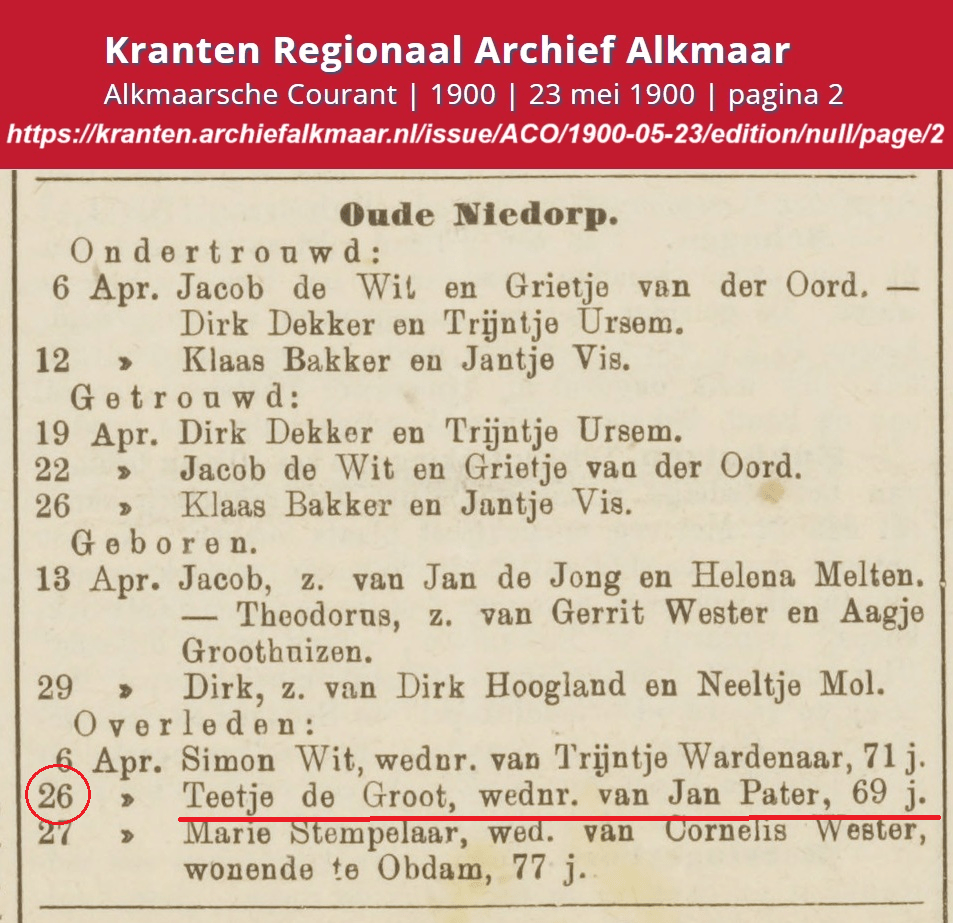
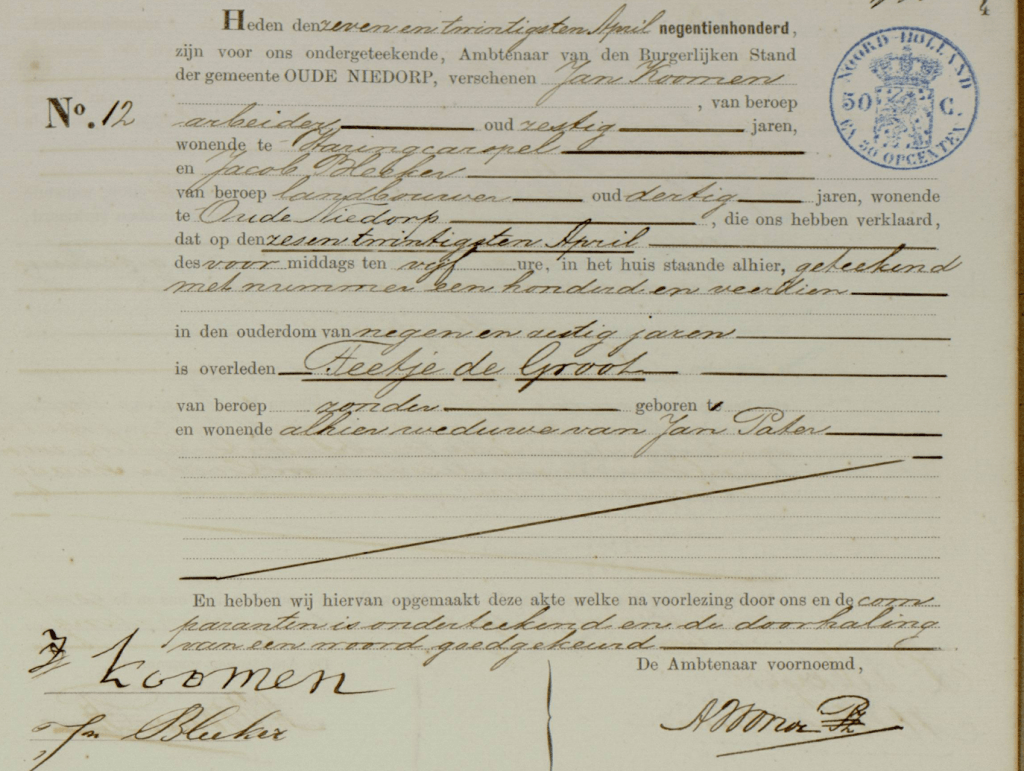
Teetje died on April 26, 1900 in Oude Niedorp, at the farm in Zijdewind.
 A Deck of Ancestors