52W Mark V – Week 1: Klara Stumpf and Michael Loran

Klara Stumpf (1822-1854) – Michael Loran (1819-?)

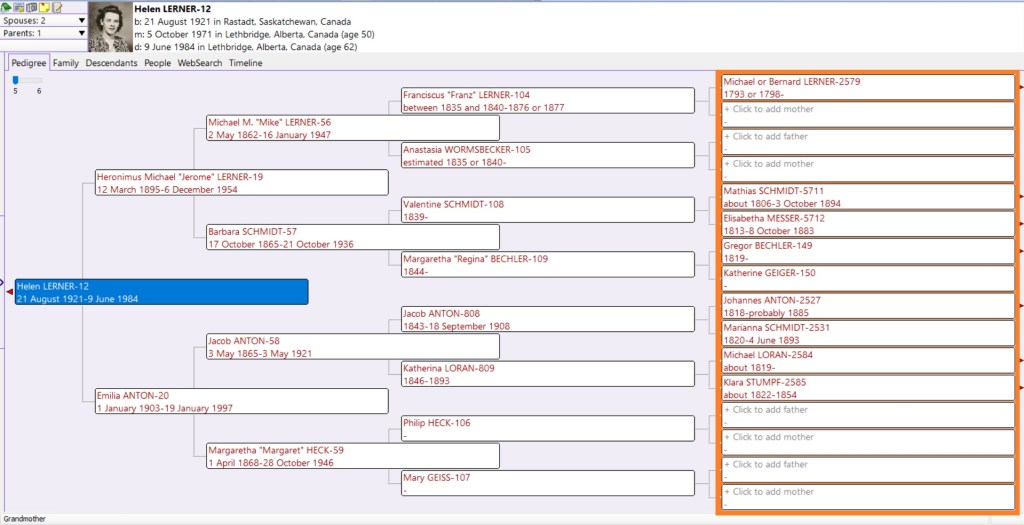
With my Great x4 Grandparents, Klara Stumpf and Michael Loran, I continue on where I left off at the end of the 2025 iteration of the  52 Ancestors Challenge, with my Germans from Russia ancestry.

Both Klara and Michael were born in German colonies located in the Beresan district of Ukraine, which was then part of the Russian Empire. Klara was born in Speier colony, likely about 1822, while Michael was born in Karlsruhe colony, sometime about 1819.
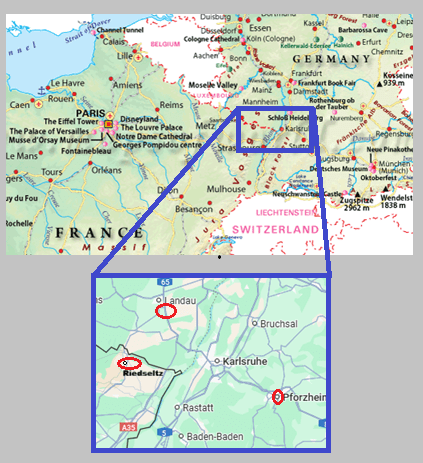
Both Klara and Michael’s parents were born in what is now south-west Germany. In fact, pretty much all my Germans from Russia ancestry originates in this part of Germany. A few, as indicated on this map, hail from Alsace, which is now part of France, but for much of its history it moved back and forth between German and French control.

Klara was the fifth of seven children born to Jakob Stumpf (1788-after 1840) and Elisabetha Berk (or Burck) (1786-1830). Jakob was born in Riedseltz, in what is now France, very close to the border with Germany. Elisabetha was born in Pforzheim, which is in the modern German state of Baden-Württemberg. It is most likely that the two met in the Beresan, given that Jakob and Elisabetha were born about 50 kilometers apart. They both settled in the Beresan in 1809 and their eldest child was born in Speier in 1810.

As for Michael, he was the second of seven children born to Heinrich Loran (1786-1840) and Eva Maria Horter (1788-1861). Heinrich and Eva were born in Queichheim and Morlheim, respectively. The are both villages that are now part or suburbs of Landau in the German state of Rhineland-Palatinate. I don’t know when they married, but they both emigrated to the Karlsruhe colony in Beresan in 1809. All seven of Heinrich and Eva’s children were born there.

Klara and Michael married sometime around 1839. Given that the two were born in different colonies, I don’t know how or where the two met. I also don’t know where they married, although it might be more likely that they married in Karlsruhe, because that is where all five of their children were born.

Klara passed away in 1854 in Karlsruhe, at the age of 32, about a year after her last child was born. Michael remarried about two years later, probably in 1856, to Maria-Elisabetha Kitzel. Together they had four children, two boys and two girls. The boys were born about 1857 and 1860, in Karlsruhe. I don’t know when the girls were born; I assume they were also born in Karlsruhe. Maria-Elisabetha died in Karlsruhe in June 1884.

Sometime after Maria-Elisabetha died, Michael relocated to Felsenburg, which had been established in the Beresan in 1860 and was a daughter colony of Waterloo. Michael died there on June 1, 1898.

Unfortunately, I have found few records other than those that provide the vital statistics about Klara and Michael, so it has not been possible so far to add more detail about their lives. This is typical of many of my German-Russian ancestors.

52W Mark V: Flipping the Script

You typically see pedigrees set out with the paternal side above and the maternal side below. Since this year I’m examining my Grandparent’s Great Great Grandparents (my Gx4 Grandparents), it would mean first looking at my paternal grandfather’s line, followed by my paternal grandmother’s line, my maternal grandfather’s line, closing with my maternal grandmother’s line.

I’ve decided to flip it around.

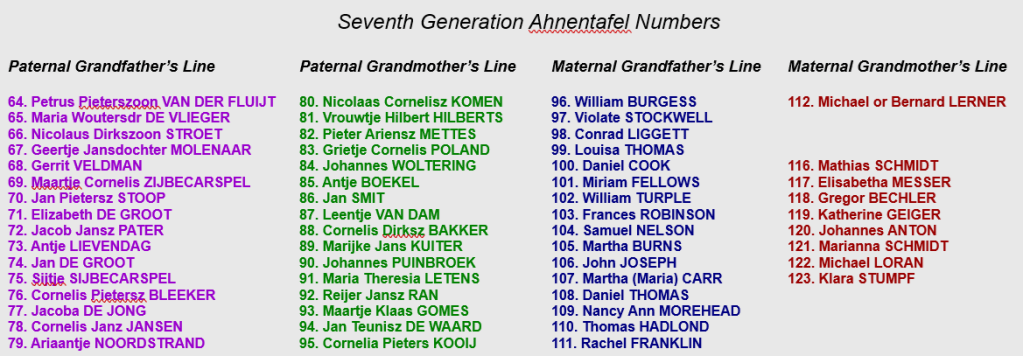
I still intend to follow the approach I described last post for this year’s 52 Ancestors Challenge. However, I’m going to start where one would usually end, at the lowest branch of maternal grandmother’s pedigree chart, Klara Stumpf. For anyone familiar with Ahnentafels (a genealogical numbering system for listing a person’s direct ancestors in a fixed sequence of ascent), Klara is the person who is last on the list of my seventh generation of ancestors.

However, as I noted last post, I’ve got 64 Gx4 Grandparents to fit into a 52 card deck. For seven, I don’t have as so much as a name, so I can leave them out of the deck. That still leaves 57 – four too many.

For my maternal grandmother, I know four pairs of her Gx2 Grandparents. If I combine those sets together, it brings me to 52. The only remaining person on that line is my maternal grandmother’s direct paternal Gx2 Grandfather, who I both know and don’t know. It’s either Michael or Bernard Lerner, sons of Franz Ignaz and and Maria Eva Geiger. Since I am uncertain as to which brother is my Gx4 Grandfather, by leaving them out it brings this year’s deck to 52.

However, in fairness, I’ll set out what I do know about Michael and Bernard:

  • Michael Lerner was born on July 11, 1793 in Malsch, Karlsruhe, Baden. He was married to Maria Eva Eberle, born June 3, 1793 in Pleisweiler, Bergzabern, Pfalz, although the evidence of this marriage is not verified.
  • Bernard Lerner born February 27, 1798 in Malsch, Karlsruhe, Baden. Bernard was married to Barbara Heil, who was born about 1799 in Niederlustadt, Germersheim, Pfalz.

With that, let’s start the 2026 52 Ancestors Challenge!

52W Mark V: Now What?

Happy New Year!

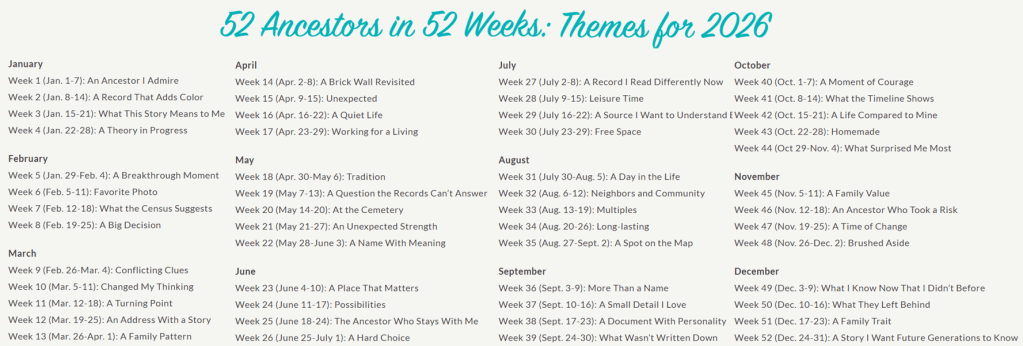
For the fifth year in a row, I’m going to participate in Amy Johnson Crow’s 52 Ancestors Challenge. For the first three years, I followed Amy’s prompts. However, for the 2024 iteration of the Challenge, I struck my own path and set my own prompts, as I explained this time last year. In Week 52 of last year’s Challenge, I indicated that I would likely return to following Amy’s prompts.

However, after seeing the list of this year’s prompts, I decided they were not for me. While I appreciate that there are many new ideas this year, most of them do not speak to me. As well, for many of the prompts, I feel hard pressed to come up with something I haven’t covered before. So I’ve decided to once again strike out on my own and create my own set of prompts.

For me, what I came up with last year really worked for me. Not only did it help my achieve my primary goal of writing up my research, it unexpectedly helped me identify the many unexpected gaps in my research. As a result, I inadvertently participated in Yvette Hoitink‘s Level-Up Challenge! It also helped that I was able to divide my fourth through sixth generations of grandparents into four suits and 52 cards, keeping with my blog’s theme of 52 Ancestors.

I decided that I would write about the next generation of my ancestors. It would once again tie the whole year together and provide me with some focus. However, the seventh generation consists of 64 individuals, which precludes writing about one per week. This problem is partly resolved by the unfortunate fact I have yet to identify seven of my Gx4 Grandparents, but that still leaves me with 57 people to fit into 52 weeks.

Despite that problem, I’m going to forge ahead with the plan to write about my seventh generation of ancestors this year – my Great Great Great Great Grandparents. I’ll figure out how to fit 57 people into 52 weeks as I go.

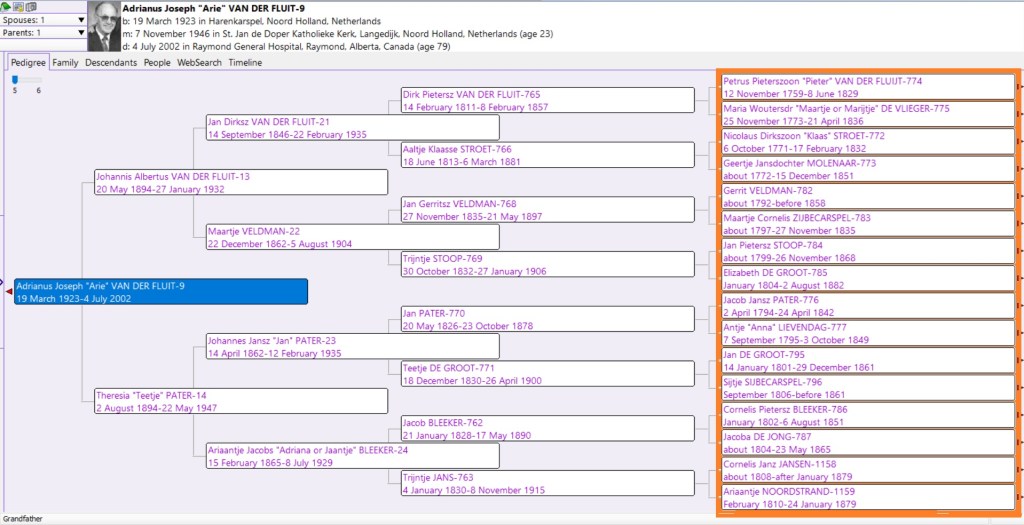
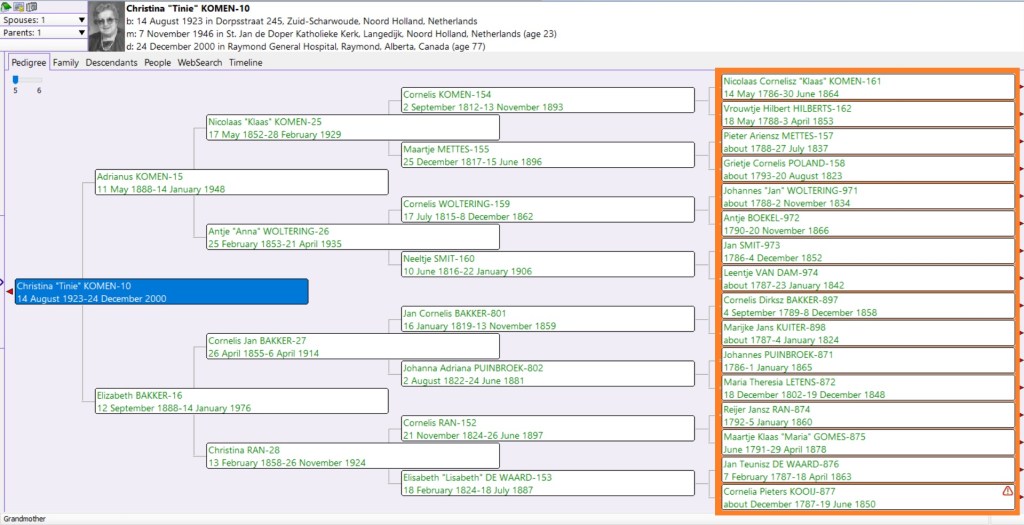
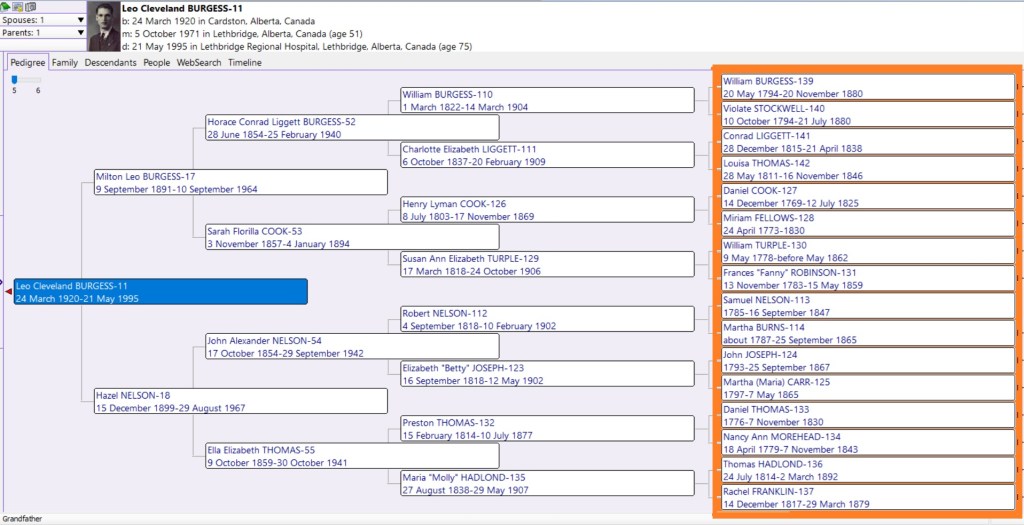
Continuing with last year’s theme, this results in four “suits” based upon each of my four grandparents. The individuals I will write about are in the orange boxes.

Good luck to everyone participating in the 52 Ancestors Challenge this year!

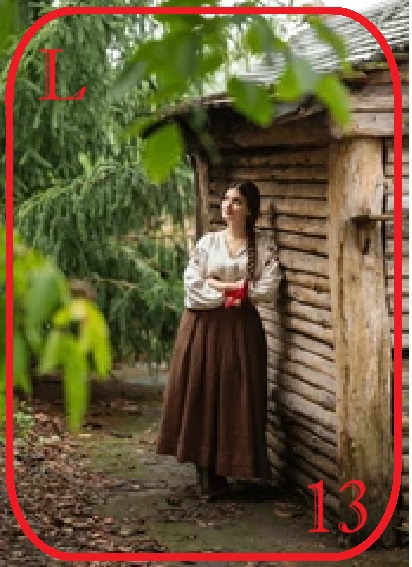
52W Mark IV – Week 52: Card L13 Mary Geiss

Mary Geiss (?-?)

With my Great x3 Grandmother, Mary Geiss, we come to the final card in the deck for this year’s 52 Ancestors Challenge. As the saying goes, last but not least. So while this might be one of the shortest posts, it does not mean that Mary is the least of the ancestors I’ve written about this year. She, along with her husband, is simply someone I know the least about.

Mary was of German origin who lived in one of the German colonies in the Beresan district of Ukraine, Russian Empire, possibly Karlsruhe colony. Mary married Philip Heck sometime before 1868. They had at least one child, my Great x3 Grandmother, Margaret Heck.

With that, another year of the 52 Ancestors Challenge is complete. Hard to believe that after signing up in 2020 and 2021 and failing to produce anything, I’ve successfully completed the challenge four years in a row. I thought that the way I approached the challenge this year would have resulted in a greater focus on writing – a primary reason why I began participating – but instead it resulted in far more research than I anticipated. In hindsight, it was worth it, but I was not expecting the amount of work I put into it.

I’ve signed up for the 2026 edition of the Challenge. I suspect I’ll revert back to following Amy’s prompts. I think I’ve gotten what I needed by deviating from the prompts for a year. Plus, by striking out on my own, I’ve become a bit disconnected from the other participants in the Challenge, particularly on Amy’s Facebook group where the weekly prompts are discussed.

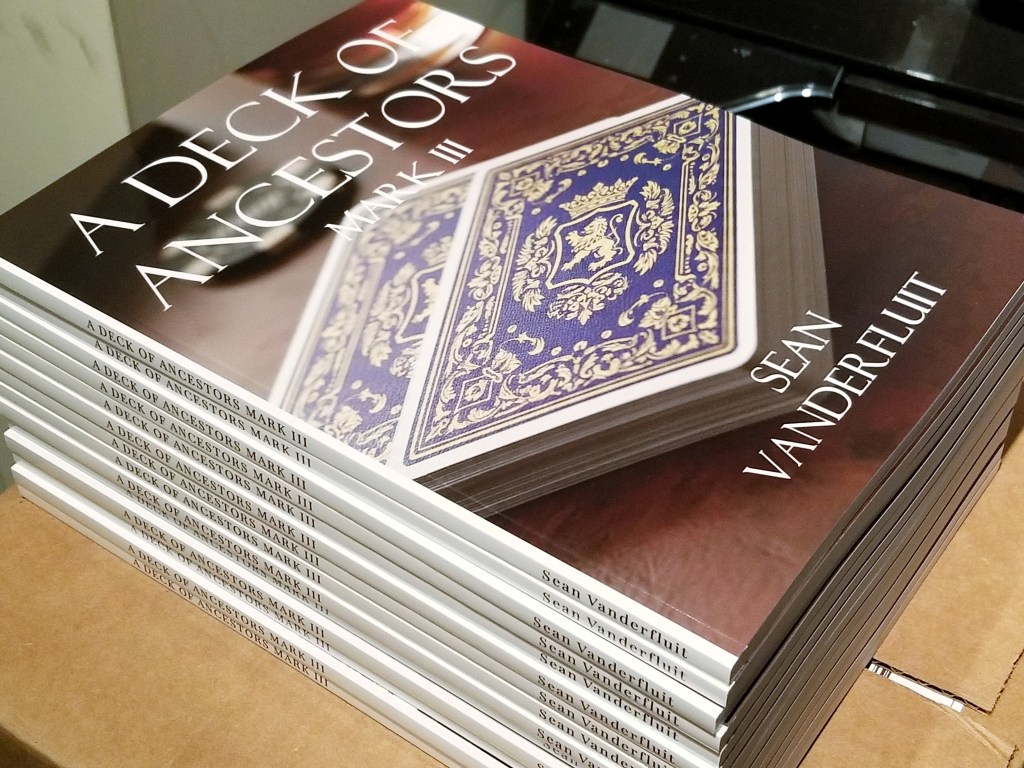
In the meantime, I once again put my hard work on the Challenge to use, having compiled a third edition of my collection of 52 Ancestors entries, consisting of my posts for 2024. It was a popular Hannukah and Christmas present this year. I’m really excited about next year’s edition (which will include this post!), because I’m really proud of the work I did this year. I’m particularly happy with the cohesive theme I set, which tied the whole set of 52 posts together unlike any other year.

All distributed now but for two copies!