

Courting
Yeah! That’s why you’re the “judge” and I’m the “law-talking guy”.
Noted lawyer Lionel Hutz

This week’s 52 Ancestors Challenge is “Courting”. If I was going to write about dating and romance, it would have been last week during what retailers are now calling “Valentine’s Week”. Besides, how my parents met is a story for another time. Instead, I am taking “courting” to be a loose descriptor of what lawyers and judges do. I acknowledge that turning a noun into a verb can be egregious, but here we are.

It turns out that there are many lawyers and judges in my family history, as well as my wife’s. My brother-in-law is a lawyer. As well, many of my friends are lawyers and judges. Unlike most people who have lawyer friends, it’s because they’re lawyers themselves. However, most of my lawyer friends are people I’ve known since high school who all happened to go to law school later in life, including myself.
It wasn’t always this way. When I was a kid, the only lawyer in the family I knew of was my Uncle Leo Burgess. He graduated from the University of Alberta with a law degree (LL.B) in June 1972. I was surprised to learn that one of the partners of my old firm, for whom I did a lot of work, was in the same graduating class. We ensured that they were seated together for the wedding reception when I got married.
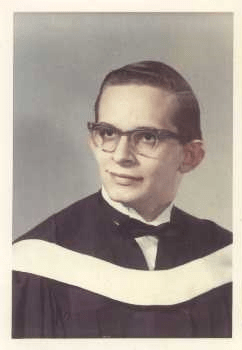
Leo articled with an Edmonton firm called Field & Field, now known as Field Law. For readers in places where articling is not part of the process of becoming a lawyer, its essentially a form of apprenticeship that takes about a year. Law school teaches the law, articling is an introduction to the actual practice of law. The articling process usually includes completion of the bar exam.
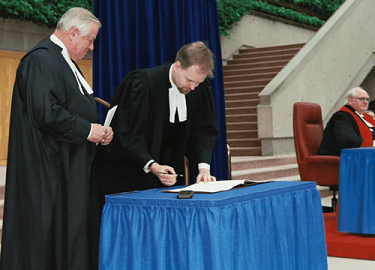
I attended Leo’s call ceremony in Edmonton. While I was only in kindergarten or grade one at the time, I remember it vividly. It was the first time I had ever been in a courtroom. I don’t even know if I had seen one on TV at the time. Everything about it was striking. It was very much a very traditional courtroom, with lots of wooden everything. The court attire, consisting of gowns and tabs, was also unforgettable.
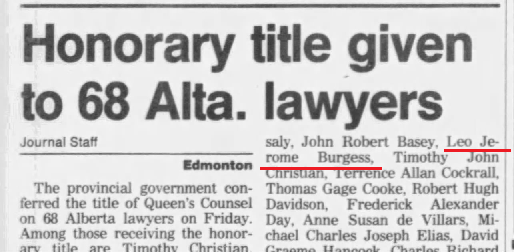
Leo remained at Field & Field for only a short time. From 1976 to 2003, Leo practiced at the Edmonton law firm of Brownlee Fryett, now known as Brownlee LLP. His expertise was municipal law. Leo became a partner in 1977. In addition to his legal practice, Leo lectured at the University of Alberta law school. In 1994, Leo earned an appointment of “Queen’s Counsel”, which entitled him to use the initials “Q.C.” after his name. In 1990, Leo was admitted to the bar of the Northwest Territories.
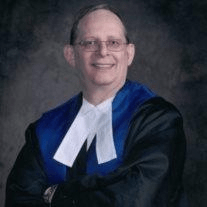
Nineteen years ago this month, shortly after Valentine’s Day, Leo was appointed to the Provincial Court of Alberta. His appointment came as a surprise to my mother, since she always thought Leo hated going to court. He did, but having spent some time as a litigator myself by that time, I told her it came as no surprise to me. Leo served on the bench until his death in 2014.
As far as I know, all the lawyers I am related to are on my mother’s side of my family tree. One was my mother’s uncle, Seth Henry Nelson, Q.C. Seth graduated from the University of Alberta in 1912. This was likely an undergraduate degree, as the University of Alberta did not establish a law school until that year. As well, becoming a lawyer at the time often did not require a law degree.
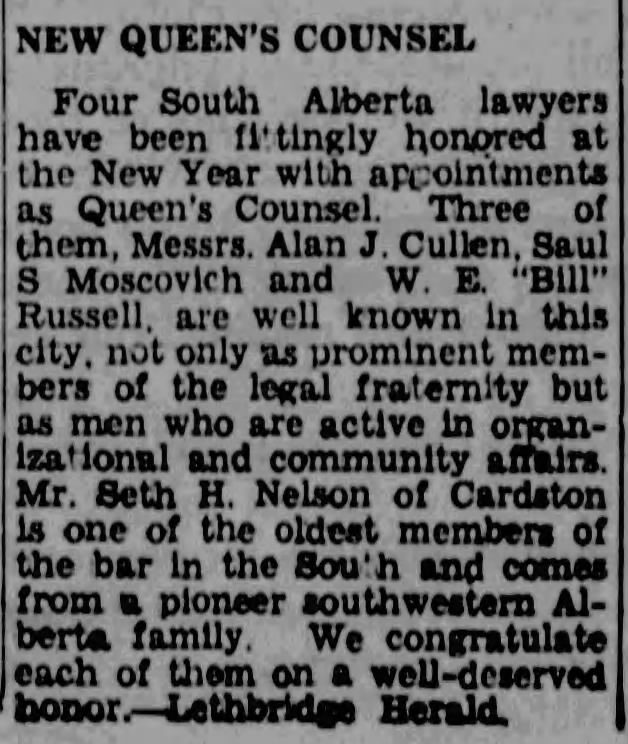
Seth practiced law in Cardston, Alberta for almost 60 years. After completing his time as a law clerk at a Cardston firm, Seth was called to the bar in April 1918. Seth was appointed a Queen’s Council (hence the “Q.C.”) in 1958. In addition to his legal practice, Seth was active in civic affairs. He was a school board trustee for 15 years, and was Secretary Treasurer of the local hospital board.
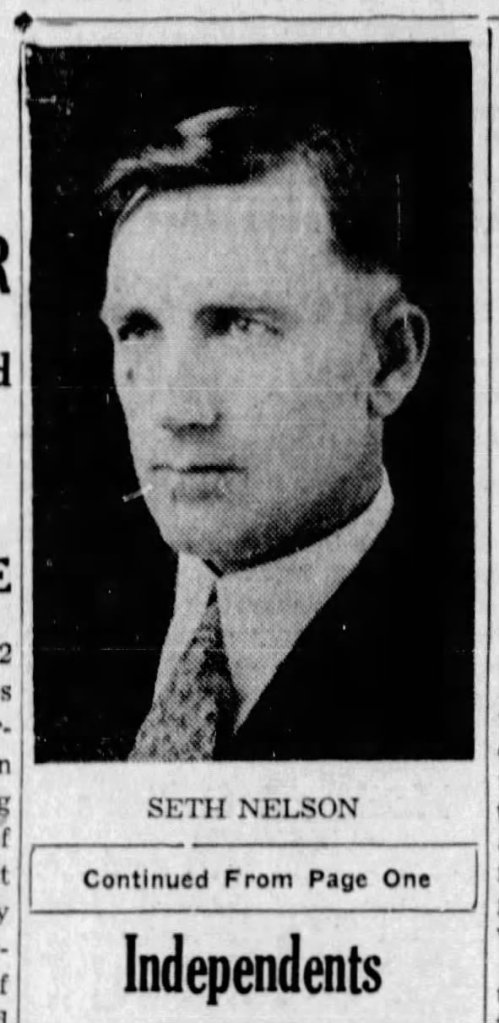
As well, Seth stood for election as an independent in the 1940 provincial general election in the riding of Cardston. He ran against the incumbent, Social Credit member Nathan Tanner, a former Speaker of the legislature who was appointed to Cabinet in 1937. Tanner defeated Seth in a two-way race, 2,160 votes to 1,808 (54.4% of the vote).
Seth remained active in his church, community, and legal work until he died in 1975, at age 83.
My 3rd Great Grandfather, Preston Thomas, also had a legal career amongst the many hats he wore. He was born in Rockingham, North Carolina, in 1814. He spent time in Tennessee in the late 1830s and early 1840s. In 1844, he joined the Latter Day Saints (Mormons) and moved west. Over a period of many years, Preston was part of a number of missions for the church.
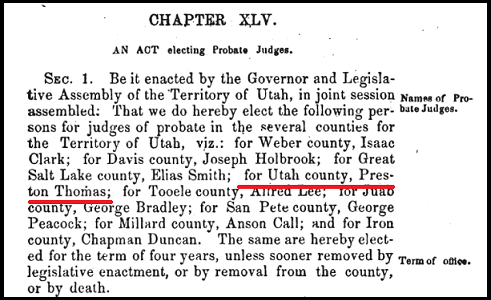
Preston was named a Probate Judge in Utah Territory in 1852, being appointed to the court upon its creation. Preston’s appointment was approved by an Act of the territorial legislature on February 7, 1852 (Laws of the Territory of Utah, Chapter XLV). He was assigned to the court in Utah County.
At the time, the Probate Court in Utah had a much broader jurisdiction than simply the estates of the deceased and those under guardianship (e.g. children, the mentally disabled), which was granted by federal US law. In addition to the usual jurisdiction of a probate court, the Utah territorial legislature granted the Probate Court jurisdiction over civil, criminal, chancery, and divorce matters. As well, the Probate Court heard appeals from the county Justice of the Peace courts. The Probate Court acted as a registry for incorporations and disincorporations and, in 1869, it was granted authority to determine land title claims.
In 1874, the federal government revoked the Probate Court’s jurisdiction over all matters except for divorce and probate matters. In 1877, the federal government revoked the Probate Court’s authority in divorce matters. Probate Judges were appointed by the legislature until 1874, when the judges were elected to a two-year term. In 1888, federal law changed the process, making the office subject to the appointment of the President of the United States. When Utah became a state in 1896, the Probate Court was abolished.
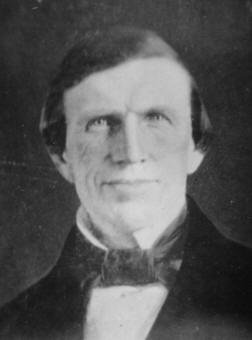
(1814-1877)
As far as I have been able to determine, Preston had no formal legal training. He did serve on a number of church and community committees, as well as a term as a member of the House of Representatives of the Territorial Legislature from 1857 to 1859, so he had some knowledge of rules and procedure.
Tullidge’s Quarterly Magazine, Vol. III No. IV, states that Isaac Higbee succeeded Preston as Probate Judge on December 27, 1852. However, Preston appointed to the Probate Court again, no later than 1864. He was still a judge of the Probate Court in 1866, as he was listed as such in The Law Register for the United States for the Year 1866 by John Livingston of the New York Bar.
Fun fact: at the convocation ceremony when I received my B.A. from U.B.C., Raymond Burr received an honourary degree. Of course, he was famous for the role of TV lawyer Perry Mason – and was quite the opposite of Lionel Hutz.
This brings the February theme of “Branching Out” to an end. The theme for March is “Women”, which is appropriate given that it’s Women’s History Month in the United States, the United Kingdom, and Australia. In Canada, it’s not until October, so that it coincides with Persons Day. However, Canada does mark International Women’s Day on March 8. Seeing the weekly themes for March, I’m quite looking forward to them!
 A Deck of Ancestors
Well done. Perry Mason was my favorite show.
LikeLiked by 1 person
This is a fine tribute to your law-talking ancestors. Thanks for sharing.
LikeLiked by 1 person