52W Mark III – Week 42: Full House

Growing up in a household with two parents and five children, it may have felt like we had a pretty full house. However, given the gaps in our ages, it wasn’t until I was 15 that there were seven of us sharing one home. Moreover, for the most part, despite all the moving around, by the time there were three of us children, the houses we lived in usually had three bedrooms. Until I was 15, that meant that there were never more than two in a room. I think my youngest brother was still in a crib by the time I moved away from home.

I compare that to my mother, who lived in the same house from age one to the time she married my father. She grew up in a tiny house in Lethbridge, which was built as part of the housing stock developed for veterans after World War II. My grandparents, Leo Burgess (1920-1995) and Helen Lerner (1921-1984), moved into the house in 1949, along with my mother and her older brother, Leo Jr. (1945-2014). Two more siblings followed, my Aunt Diana (1951-1999) and Uncle Curtis (1957-2024). In addition to her three siblings and her parents, my mother’s youngest uncle, Herb Lerner (1937-2004), also lived with them for a period of time.
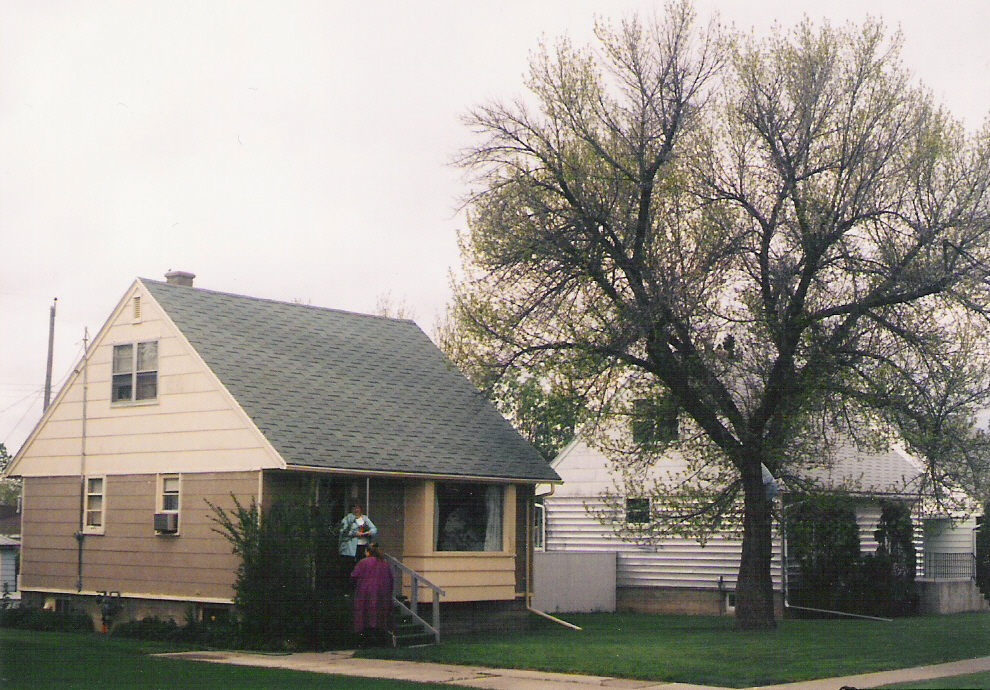
May 1995, shortly after my grandfather Leo Burgess passed away. My mother and Aunt Diana are on the stairs at the front entrance. We were there to go through some things as part of cleaning out the house and settling the estate. The window on the top floor is for the bedroom that my mother and aunt shared as kids.

While it was a three bedroom house, in reality there was a tiny master bedroom on the main floor and two little shoeboxes in the attic that served as bedrooms. Because they were in the attic, the ceiling in both bedrooms was slanted to the floor. Not much fun for my mom’s brothers, who were both well over 6’5″.What was fun were the hardwood stairs that went up the middle of the house from the main floor to the attic. We treated it as a slide. Bumpy, yes, but loads of fun when we were little.

My uncles and their uncle Herb shared one room; my mother and her sister shared the other. By the time I was born, my Diana and Curtis had their rooms to themselves. By the time I was six, my Uncle Curtis had the whole floor to himself.
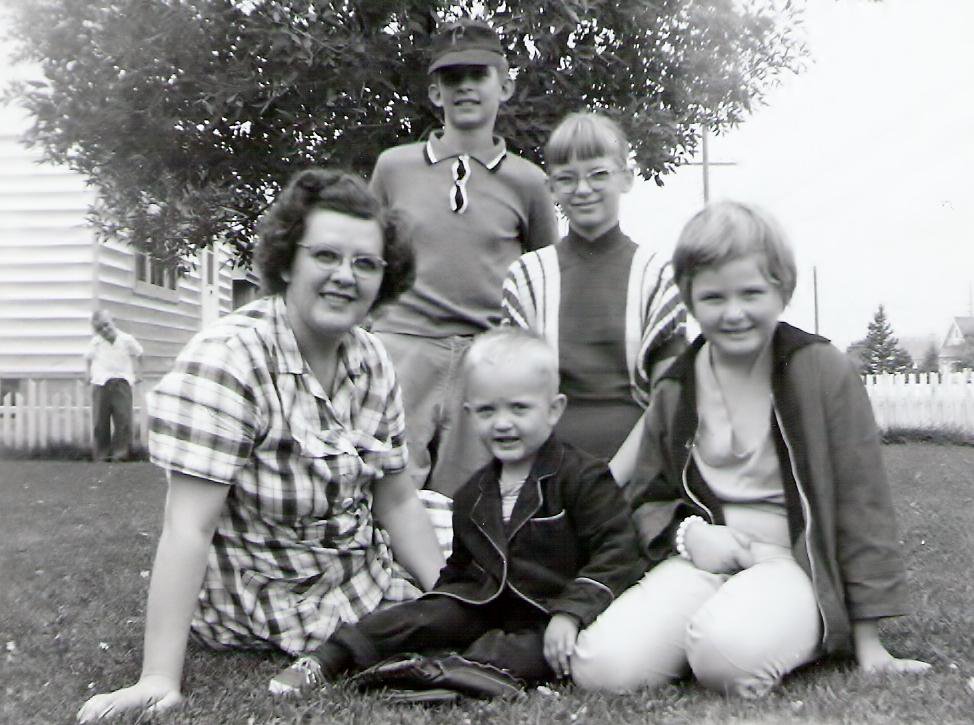
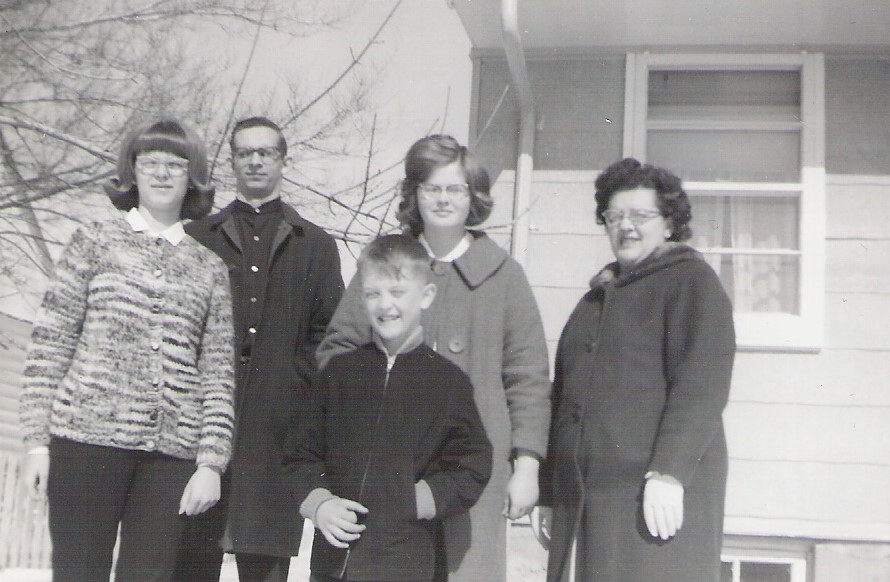
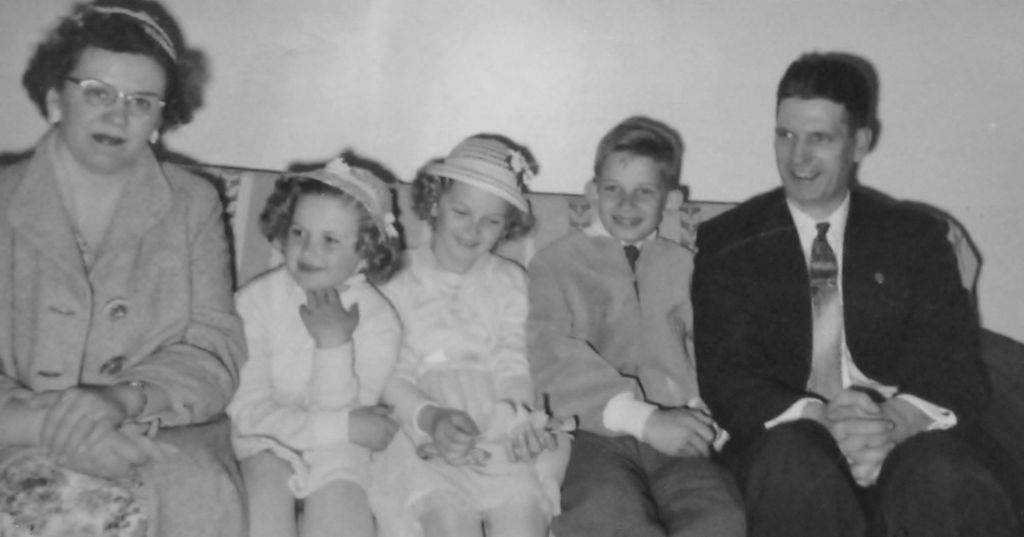
My grandmother, Aunt Diana, my mother, Uncle Leo, and grandfather, probably around 1955.

My grandfather renovated the interior a few times. The one I remember most was when he knocked out some of the walls between the dining room and living room. It made the place look palatial. Later they added a bay window to the living room at the front of the house. The least-best thing he did was when he installed shag carpet in the living room, covering up the gorgeous hardwood floor. It was the trendy thing to do at the time, something that definitely fell out of fashion a couple decades later. My grandfather also occasionally renovated the exterior, particularly the front and back entry ways.
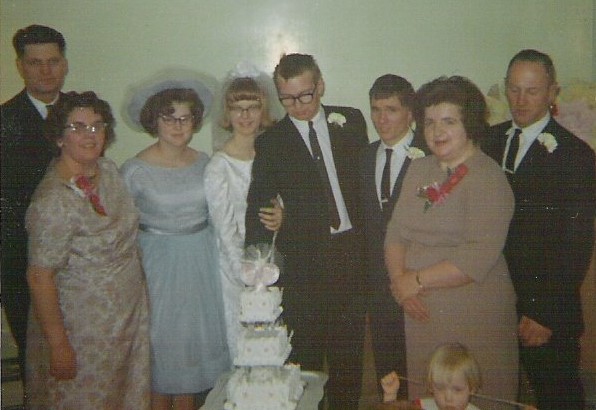
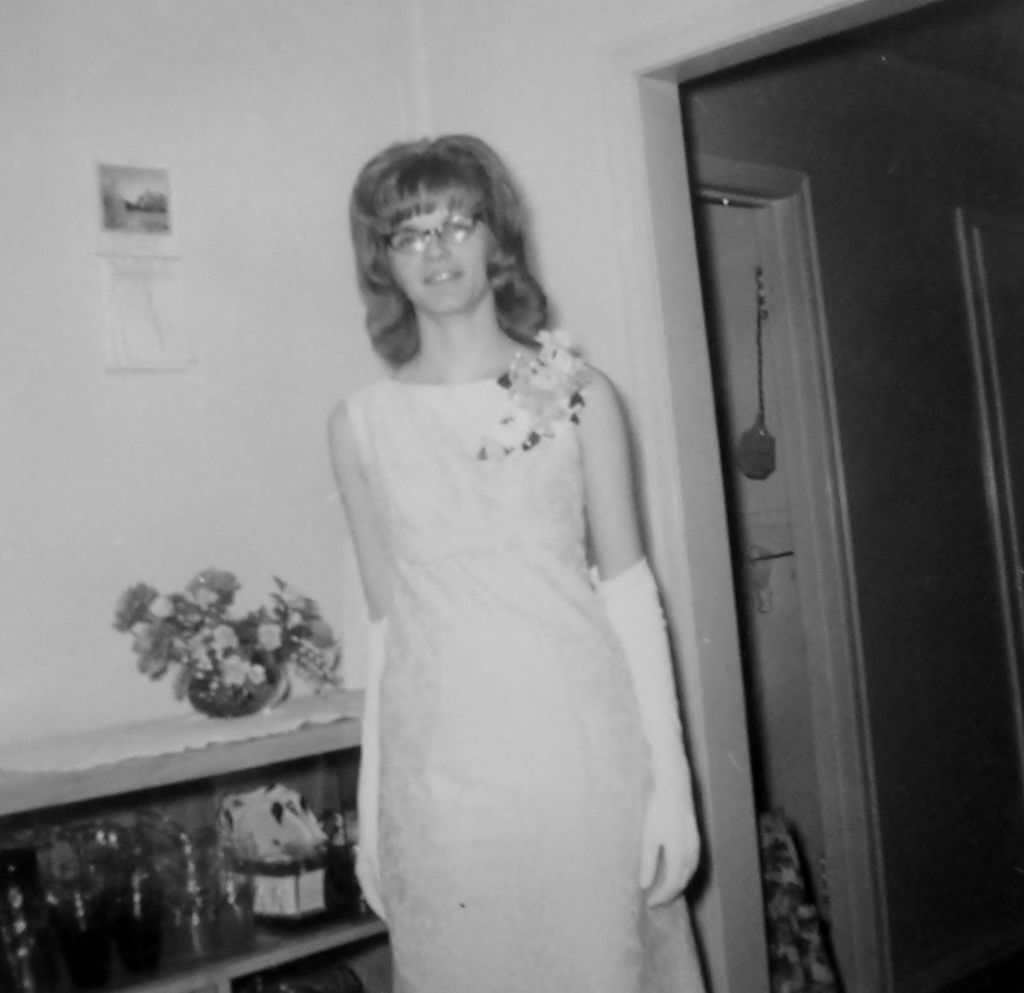
My grandparents hosted a small reception at their home for my parents after their wedding ceremony. Here, everyone is gathered in the living room. My maternal grandparents are at the left of the photo; my paternal grandparents are on the right. My parents are flanked by the Maid of Honour and the Best Man.

We moved away from Lethbridge about a year after I was born. Nearly every summer vacation afterwards involved a road trip to Lethbridge, no matter where we were living at the time. Sometimes we visited for Easter or Christmas, as well as special occasions like weddings. Almost every time we visited, we spent half our time at this house. The other half we spent at my paternal grandparents’ house, although it seems like more often than not we spent more time at my maternal grandparents’. By then my aunts and uncles had all moved away, so my folks and siblings and I would use the upstairs rooms during those visits.
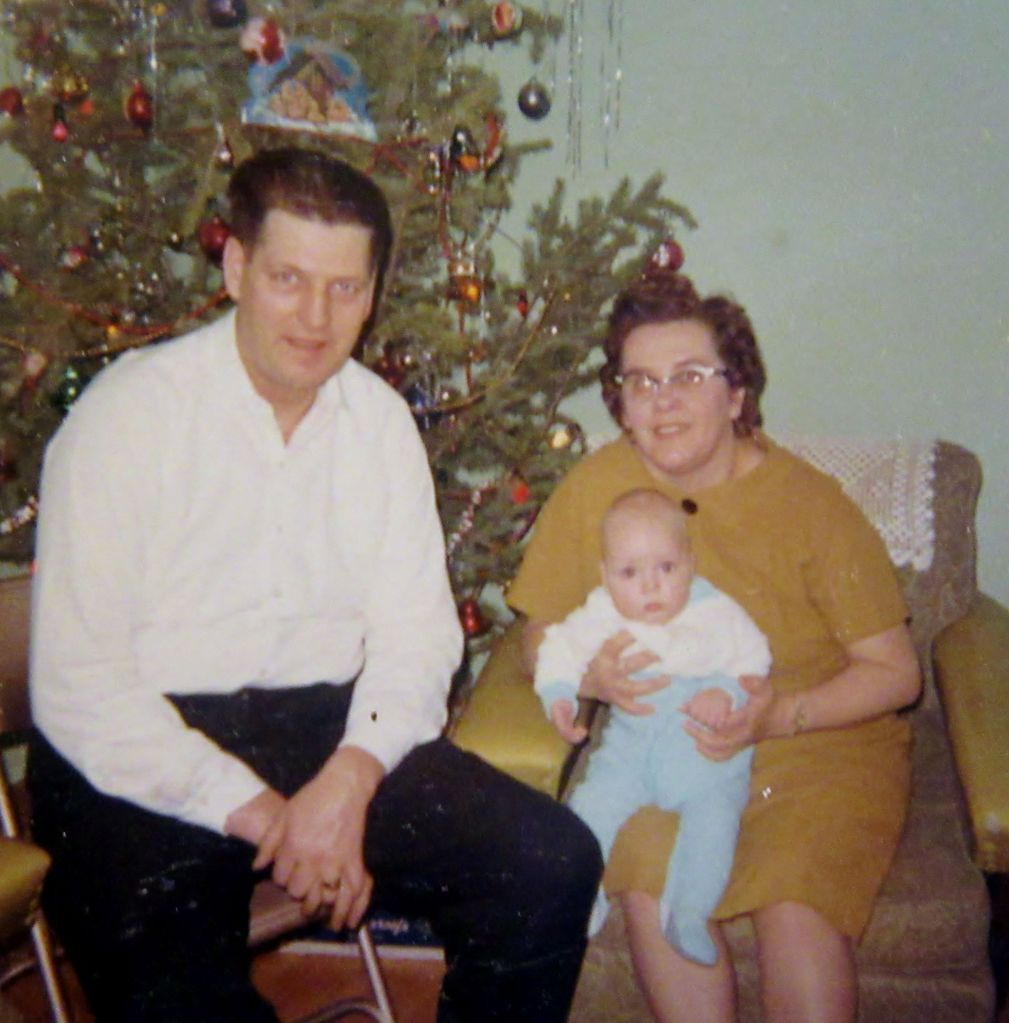
My first Christmas, with my grandparents in their living room.

My grandmother passed away in 1984; my grandfather passed away in 1995. My mother and siblings sold the house shortly after they settled my grandfather’s estate. The new owners were quick to renovate. The house has passed through several owners since then, each one renovated to some degree. I wish I had taken screen shots of the listing the last time it was listed for sale, which showed all the work they had done. The sellers had completely renovated the interior, plus they had finished the basement, something my grandfather never really worked on beyond installing some rough framing. Plus someone had gotten rid of that awful shag carpet.

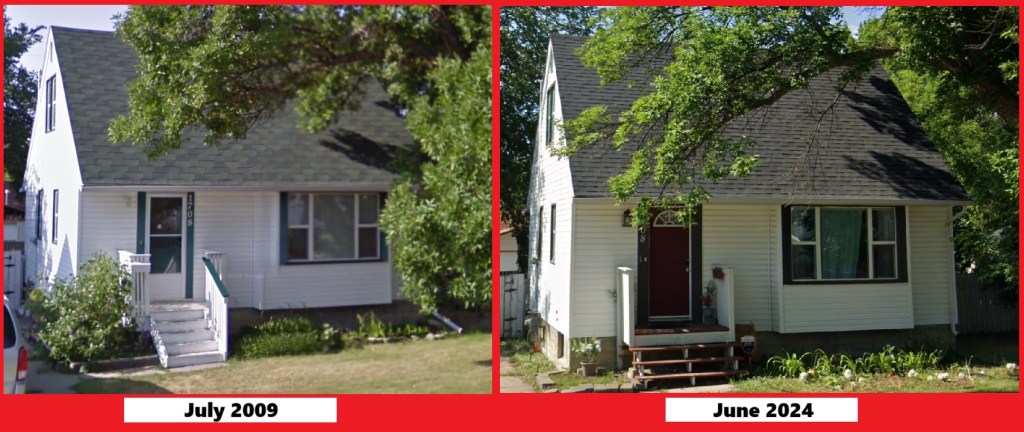
One of the great features of Google Street View is that it allows you to view the various images of a location taken over time, particularly if it is a place that Google frequently revisits. Using that function, I can see the evolution of my grandparents’ home from 2009 to 2024.
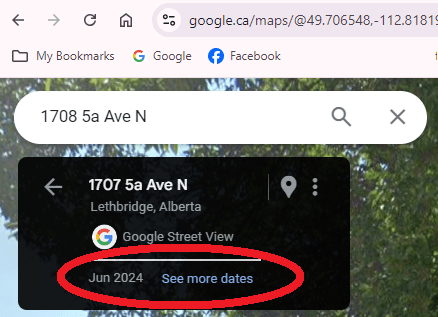

Click “See More Dates”…
…and you’ll get a set of options for past views.

52W Mark III – Week 41: Most

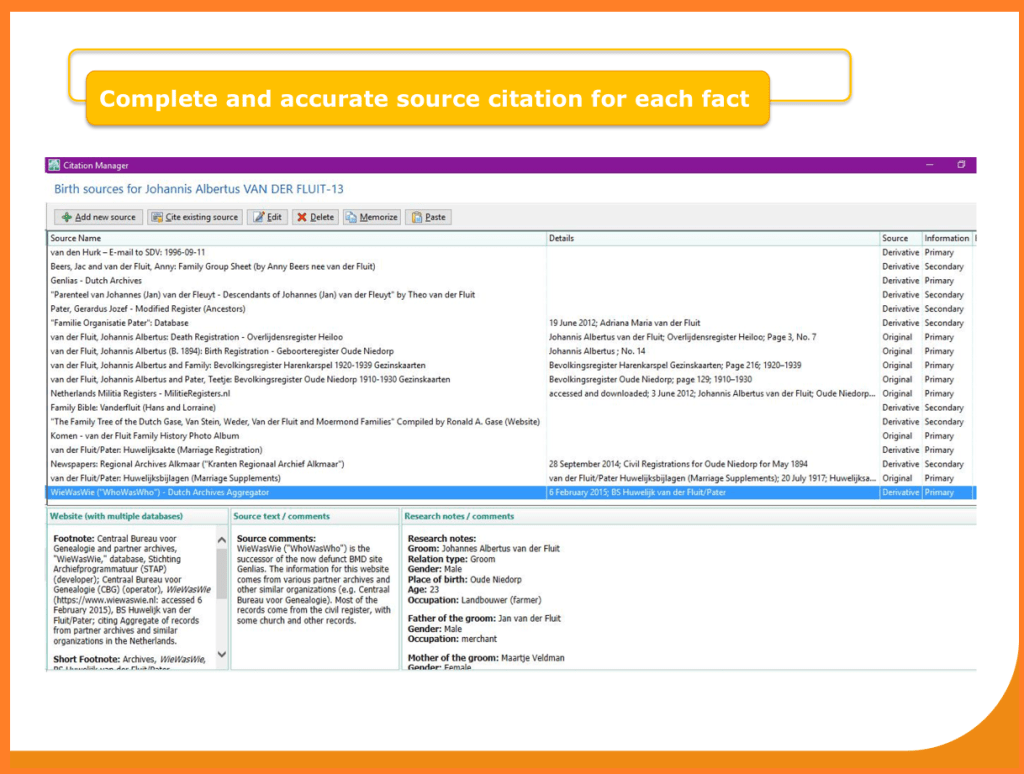
Five or six years ago I presented on the topic of “Law and Genealogy” at a continuing professional development conference. In my PowerPoint presentation, I used several examples from my own research to illustrate several of my points. For example, to illustrate one of five parts of the Genealogical Proof Standard, I used an image of the citations I used in support of the date of the birth of my great grandfather, Johannis Albertus van der Fluit (1894-1932).

What struck me at the time was how many sources I had for that one fact – 17 at the time. If memory serves, I think that was one of the reasons I chose this fact to demonstrate the point. Heck, I could have used this image to illustrate the principle of conducting reasonably exhaustive research!

That slide has stuck with me, so with “Most” being the prompt for this week’s 52 Ancestors Challenge, I got to wondering which ancestor in my family tree has the most sources. Not necessarily the best, or most reliable, or bear the most evidentiary weight – just most. Unfortunately, my software won’t provide the kind of statistics I’m looking for, so I manually went through the entries for all my direct ancestors up to and including my great grandparents.

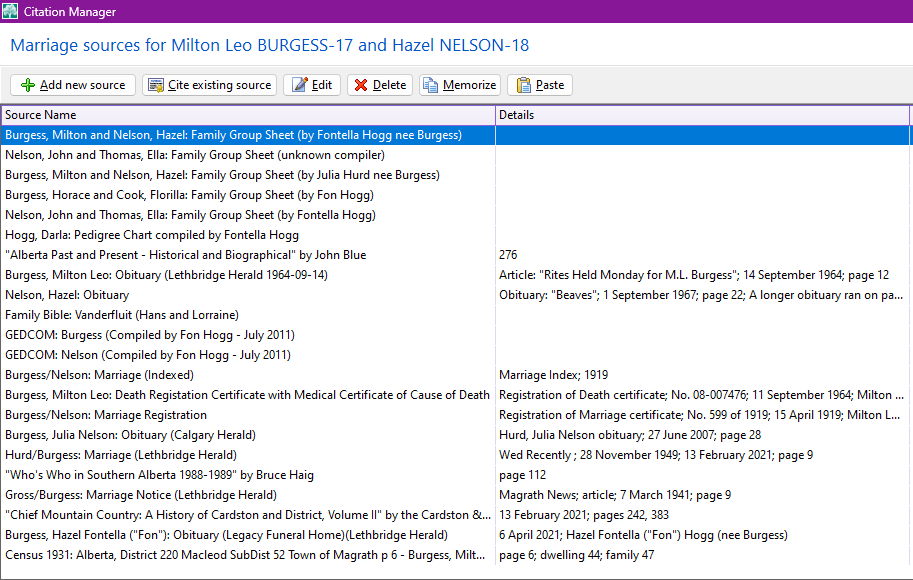
The most heavily sourced of any fact for this set of ancestors is the April 13, 1919 marriage of my mother’s maternal grandparents, Milton Leo Burgess and Hazel Nelson, with 22 unique sources cited.

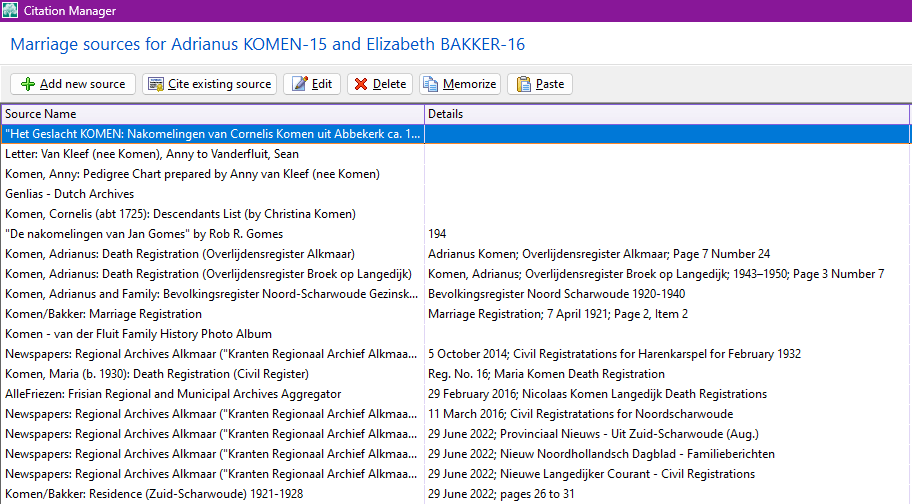
Not far behind is the list of sources demonstrating the marriage of my father’s maternal grandparents, Adrianus Komen and Elizabeth Bakker. I have cited 19 separate sources for their marriage that occurred on April 7, 1921.

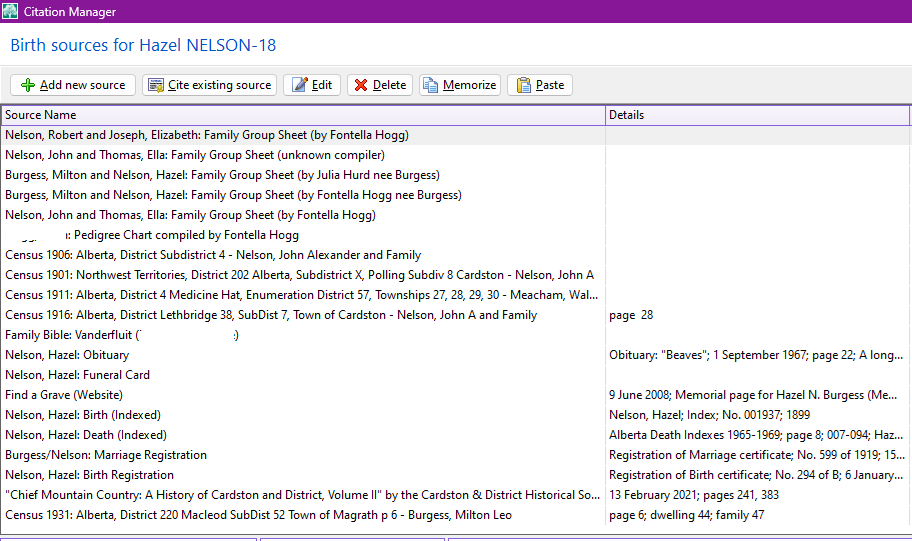
Returning to Hazel Nelson, I also have 20 separate individual sources for her birth, which occurred on December 15, 1899.

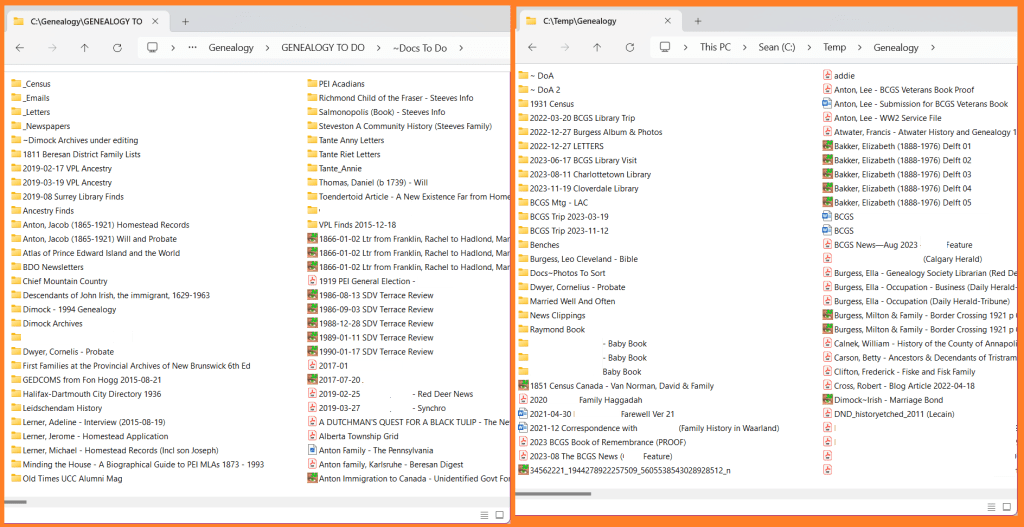
However, where I can find the most sources is in the two folders of electronic documents I’ve gathered that are all vying for my attention. There is also a banker’s box of documents that also need to be written up. Unfortunately, I hate preparing source citations as much as I love genealogy!

These sources aren’t going to write themselves up…Where are the genealogy elves when you need them?

52W Mark III – Week 40: Least

I’m at least a week behind in the 52 Ancestors Challenge, but as Amy just reminded me less than ten minutes ago, there is no behind, only progress!

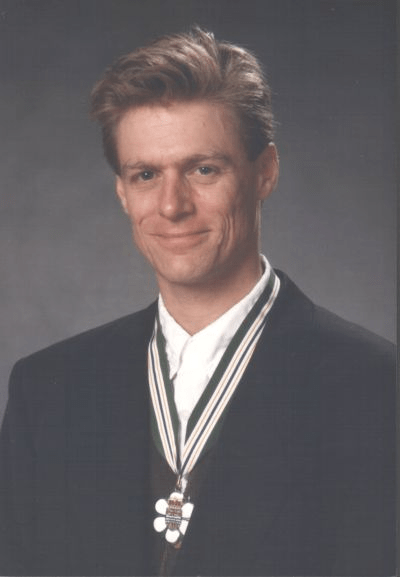
Many countries have an honours system to recognize the contributions of its citizens. According to a 2004 memo to the Select Committee on Public Administration of the UK House of Commons, with the exception of Switzerland and Ireland, every western state has instituted some system by which worthy individuals can be recognized. The United States has the Presidential Medal of Freedom. The British have their knighthoods. In Canada, we have the Order of Canada, which even at the highest rank does not denote a knighthood, unlike the on again off again highest rank of the Order of Australia, although it’s been “off again” since 1986. Even our provinces have these honour systems – in British Columbia we have the Order of British Columbia.

Inaugural Order of BC recipient Bryan Adams.

[Interlude while I look for the autograph I have of Bryan Adams. I cherish it not because of the signature, but because of the person who gave it to me. Adams was one of the recipients of the Order of British Columbia the first year it was awarded. I was working in the B.C. Parliament Buildings at the time. The office I shared with three other interns was right next door to the committee room where they bestowed the medals. We had a window looking into that room, but they made us close the blinds. One of the dearest members of the legislature’s dining room staff, who was attending to the coffee and treats for the ceremony, asked Adams for an autograph for each of the four of us, without our knowledge. Later she presented them to us, saying ” you nice boys might be fans so I thought you might like these.“]

However, since this week’s prompt is “Least”, I’m going to look at the lowest ranks of these honours. While I have extended family who hold the lowest rank of the Order of Canada, I’m going to look at a very distant cousin of mine who has received a similar honour in the Netherlands.

While the Netherlands is a constitutional monarchy (like Canada), there isn’t really much of a nobility and things like knighthoods are fairly understated. Titles, prefixes, or post-nominals are not used in the Netherlands in relation to civilian honours, so those who have been bestowed with a Dutch civil honour do not have any indication of their appointment in their names, regardless of the level or degree. Even Members of the Order of Canada (the lowest of three levels) are entitled to use “CM” after their names!

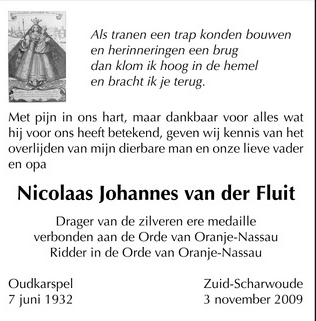
Nicolaas Johannes van der Fluit (1932 – 2009), a very distant cousin of mine (third cousin once removed, to be precise) was named a member of the Orde van Oranje-Nassau (Order of Orange-Nassau) in 2009. According to the familiebericht (family notice) of Nicolaas’s death, he was a “Drager van de zilveren medaille verbonden aan de Orde van Oranje-Nassau Ridder in de Orde van Oranje-Nassau” (Bearer of the silver medal of the Order of Orange-Nassau and (Knight in the Order of Orange-Nassau).

The Order of Orange Nassau is the lowest order of chivalry in the Netherlands, granted to individuals who have made a special contribution to society. Apparently about 4500 people are appointed to the various levels every year. Nicolaas’s appointment was in recognition of his contributions to the field of sports, community welfare, and housing and culture.

When I began to research this honour I was confused by the designation in Nicolaas’s familiebericht. The silver medal (along with gold and bronze) was only an honourary designation. Holders of the medal were affiliated with, but not actual members of, the Order of Orange-Nassau. “Ridder” was separate from the honorary levels and was the lowest rank of the order, just above gold, silver, and bronze.

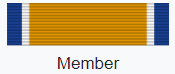
However, in 1996, the order was reformed and the various levels were replaced with six grades. Gold, silver, and bronze were replaced with by the “Member” class (“Lid”, in Dutch), which is currently the sixth and lowest level of the Order. The Member designation is no longer an affiliate level, so those holding the designation are actually members of the order. Ridder remains the fifth level of the order.

Based upon the familiebericht, it appeared to me that Nicolaas might have been originally named to the silver level, but was elevated to ridder at some later time.

My father’s uncle, Jan Meester (1925 – 2012) was also part of the Order of Orange Nassau. What little information I have about his appointment is that he had received a “Medal of Honor, attached to the Order of Orange Nassau in Silver”. This suggests his appointment was prior to 1996; however, as with Nicolaas’s familiebericht, that could be misleading. I also do not know the activities Jan had performed that garnered him the honour.

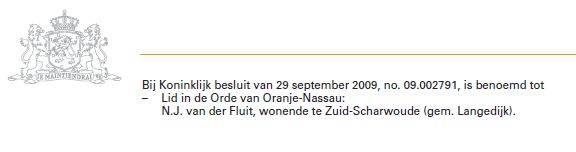
For Nicolaas, I resolved the matter when I found the notice of his appointment in the Staatscourant, the official publication of the Kingdom of the Netherlands since 1814. It is the equivalent of the Canada Gazette. (I have not yet found a copy of the Staatscourant with Jan’s appointment.)

The October 9, 2009 edition (#15208) states:

Bij Koninklijk besluit van 29 september 2009, no. 09.002791, is benoemd tot Lid in de Orde van Oranje-Nassau: N.J. van der Fluit, wonende te Zuid-Scharwoude (gem. Langedijk).

In English: By Royal decree of September 29, 2009, No. 09.002791 is named as a Member of the Order of Orange-Nassau: N.J. van der Fluit, residing in Zuid-Scharwoude (in the municipality of Langedijk).

Thus Nicolaas was appointed to the order after it was reformed in 1996 and at the lowest level of the order, Lid (Member). Nevertheless, I would imagine it was an incredible honour to receive. I wonder if a nice lady obtained his autograph for anyone.

52W Mark III – Week 39: Homestead

I’ve covered a lot of ground1 on the topic of “Homestead” in past posts. As a result, it’s been hard to think of something new for this week’s prompt for the 52 Ancestors Challenge – so much so that I’m now a week late.

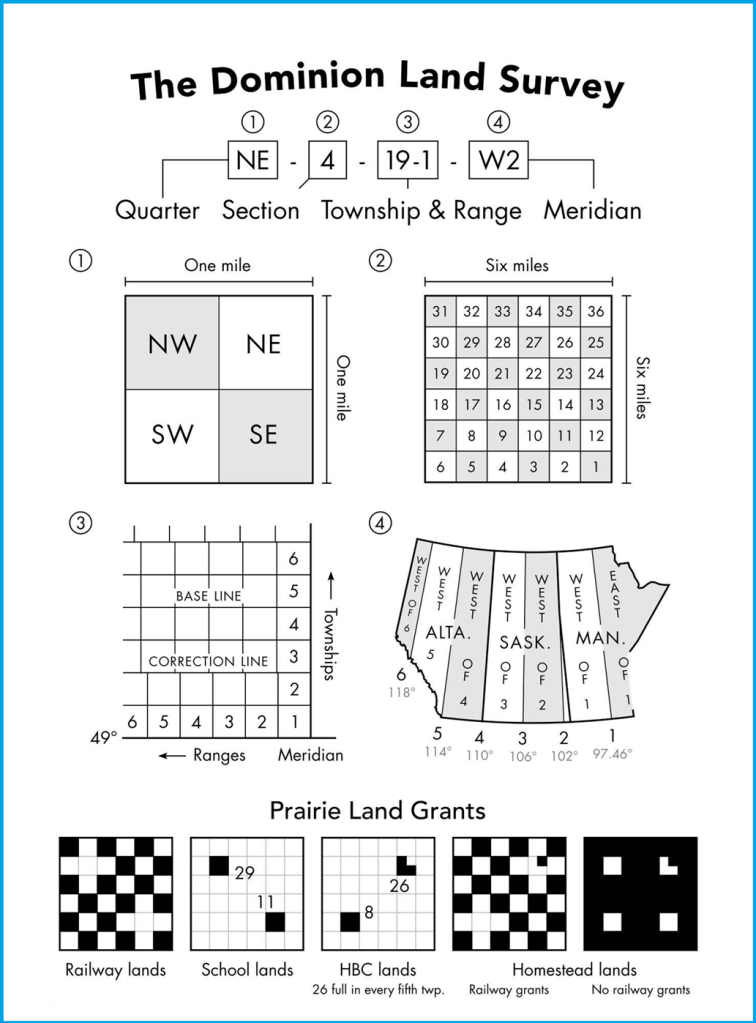
What I can offer is this handy graphic that might be of use to family historians trying to find their ancestors’ homesteads in the Canadian Prairies.

Note: “HBC” stands for “Hudson’s Bay Company”

1 All puns are intended.