52 Weeks – Week Five

Branching Out

With a new month and new week comes a new theme for the 52 Ancestors Challenge. The theme for February and the first week of the month is “Branching Out”.
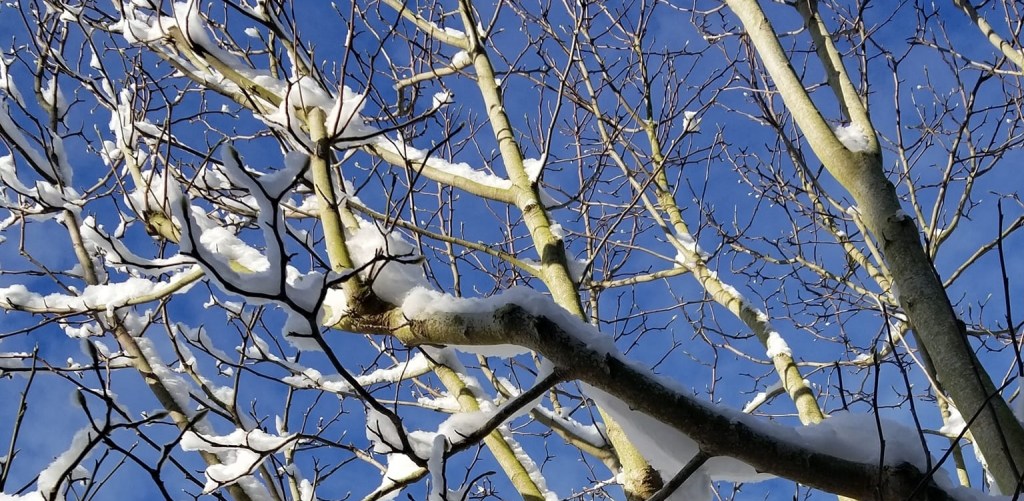
A bit literal, don’t you think?

Frankly, at first this one had me stumped. (By the way, my theory is that all puns are intended.) While Amy offers gentle suggestions as to what a theme might mean, she leaves it to participants to decide what we think it means. Many people are taking this as an opportunity to talk about their collateral branches. Others are sharing that while many genealogists look up their trees, they are in pursuit of the downward branches of a specific ancestor. There have also been many discussions of research strategies involving genealogy FAN clubs – “Friends, Associates, and Neighbours”, a term coined by Elizabeth Shown Mills describing a method of cluster research.

These forms of branching out didn’t speak to me for the challenge. For the most part, I’m primarily climbing up my tree, looking for direct ancestors. I keep track of their FANs in pursuit of that goal. I also have a couple of ancestors for whom I am tracing all their descendants. Yet I found no real inspiration there for this post.
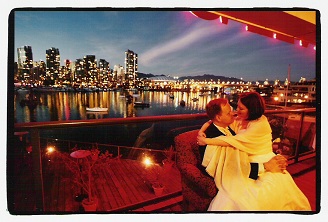
For me, a significant moment of branching out for me was when I got married. By then I had already spent many years on my own tree, and by that point in time it was becoming a lot of work to make little progress. However, with my wife, there was a whole new set of branches to explore with all sorts of low-hanging fruit ripe for easy picking. Besides, I considered her family to be my family, so it was like researching my own tree. Moreover, as we planned to have children some day, I simply saw it as getting a head start on their family tree.

To my great pleasure, our eldest child shares my interest in genealogy. I even bought him a membership to the BC Genealogical Society as a birthday present. Much of my branching out has been in pursuit of questions he has put to me.

There are all sorts of fascinating things about our children’s maternal line. For example, they are direct descendants of Heinrich Stief (“Steeves”) and Regina Stahlecker. Originally from Baden-Württemberg, they emigrated to Pennsylvania, where they had seven sons. The family relocated to New Brunswick in 1766. If you’re a “Steeves” in Canada or the United States, odds are you’re one of their direct descendants. In 2016, there was an attempt to set a Guinness World Record for largest gathering of individuals with the same last name. Unfortunately, the attempt fell short.

Notable Steeves descendants include the Hon. William H. Steeves (one of the “Fathers of Confederation” of Canada), Jack Layton (late Leader of the Opposition in Canada’s parliament), Laurence J. Peter (author of The Peter Principle), and Janette Oke (author). A few years ago I gave a presentation on “Law and Genealogy”, using my sons’ Steeves connection as a research example. Through sheer serendipity, the presenter who spoke before me was also a Steeves descendant, John Steeves, a judge of the B.C. Supreme Court.

The interesting connection is to Manoah Steeves, who later in life dropped an “e” from his surname and became “Steves”. In 1877, he and his wife moved west and bought land on Lulu Island in British Columbia, where they established a dairy farm. From this grew Steveston, a fishing village that is now part of Richmond, B.C., where we now live. Manoah’s descendants still operate a farm here. The streets in our neighbourhood share the names of Steeves relatives and places in New Brunswick, 4300 kilometres away. Taking our kids to school is like a daily trip through their family tree.
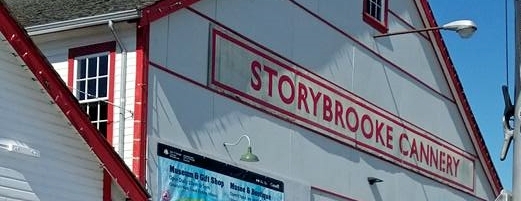
Steveston, B.C., or as you might recognize it from television, Storybrooke, Maine.
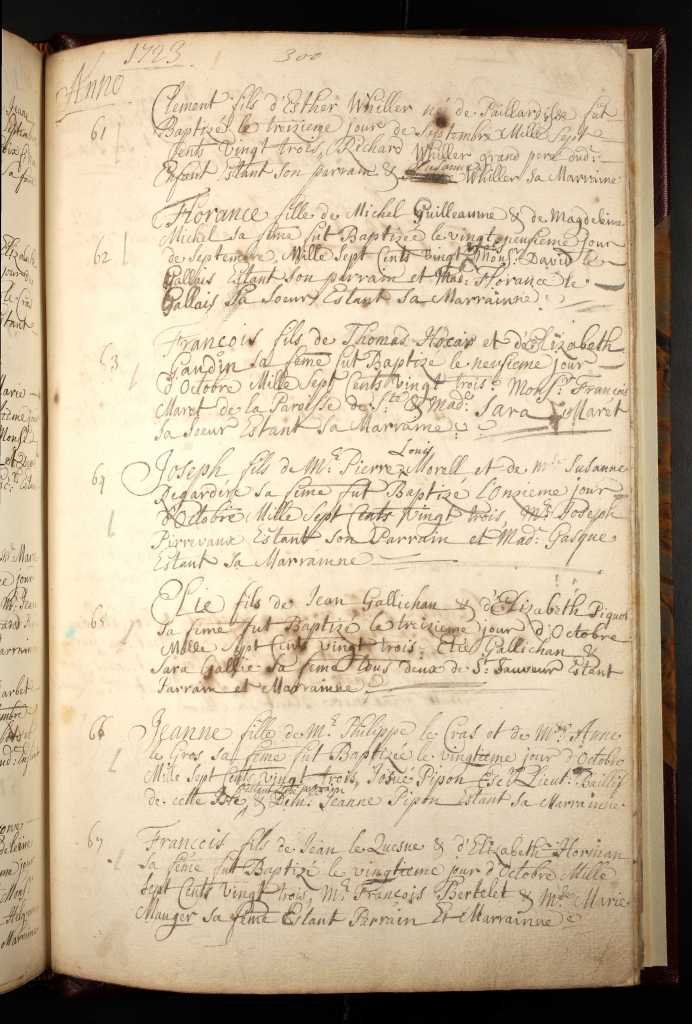
Page from the Jersey Parish Register showing the baptism of Francois Le Quesne (Francis LeCain)

Another branch on which I have spent more hours of research than I ever expected to do came from a seemingly random question my son asked about a name on his maternal line that he saw in my database, Francis Barclay LeCain. It also turned into a great way of showing him what genealogical research really entails and that not everything can be found with few clicks online. Years later he still asks to do research on Francis and the LeCains.

Francis is our childrens’ great x8 grandfather. He was born Francois Le Quesne around October 1723 in St. Helier Parish, Bailiwick of Jersey. The connection to the Channel Islands alone was an immediate point of fascination. The Le Quesnes appear to go back on Jersey for many centuries.
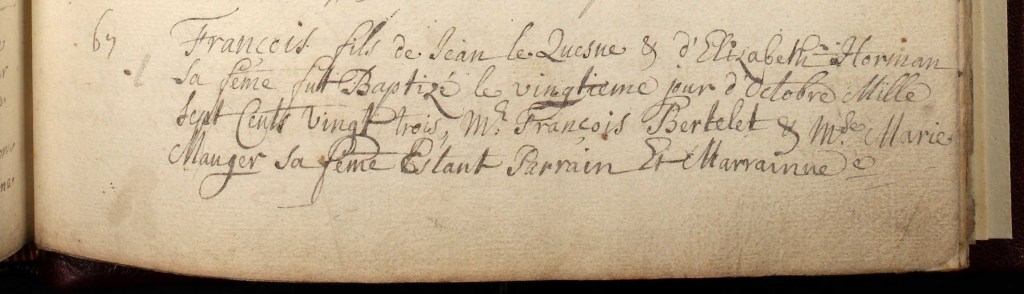
From the French: “Francois, son of Jean le Quesne & his wife Elizabeth Horman, was baptized the 20th day of October, 1723. Mr. Francois Bertelet and his wife Madame Marie Manger, being the godfather and godmother

Francis came to Annapolis Royal with the British army as a “Master Artificer” or “Armourer” in the employ of the Board of Ordnance, which among other things was responsible for the manufacture and supply of weapons for the military. Francis’s obituary noted that he had lived in Annapolis for 64 years, which puts the year he came to Nova Scotia as being about 1742. In 1745 he married Alicia Maria Hyde, a daughter of a military man who also hailed from Jersey. Our children are descended from Francis and Alicia’s youngest daughter, Mary. Alicia died in 1758. Francis married again in 1761, to Elizabeth Foster. The blacksmith shop he established remained on the same site for over 100 years. Francis died in Annapolis Royal in March 1806.
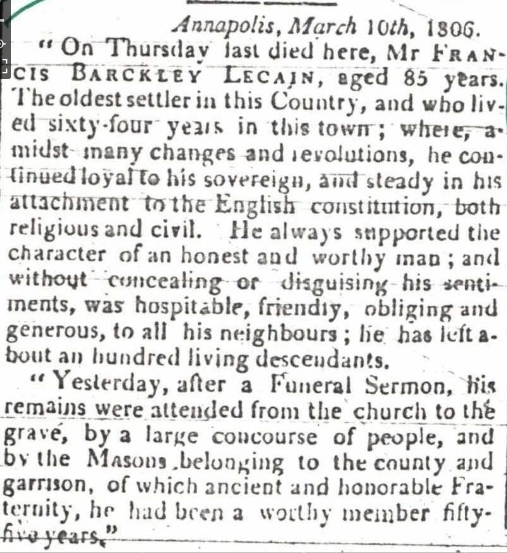
Francis LeCain’s obituary published March 15, 1806, from Minn’s Weekly Chronicle, a Halifax newspaper.

Next week’s theme is “Maps”. I’m looking forward to that. I love maps. Atlases of historical maps I found in grade eight fostered my love of history, which was my major in university.
52 Weeks – Week Four

Curious

The theme for this week’s 52 Ancestors Challenge is “curious” – a term that has been left up to our own interpretation!

There are many things that keep me curious about my family history. They say you are never finished your family tree – because you aren’t. However, if I ever ran out of questions, my family tree would be done, and not in a good way.

For decades I’ve been curious about my maternal grandmother’s first marriage. Last year I was finally able to get their marriage record because it was finally old enough for public disclosure. Despite that, I still have a lot of unanswered questions.

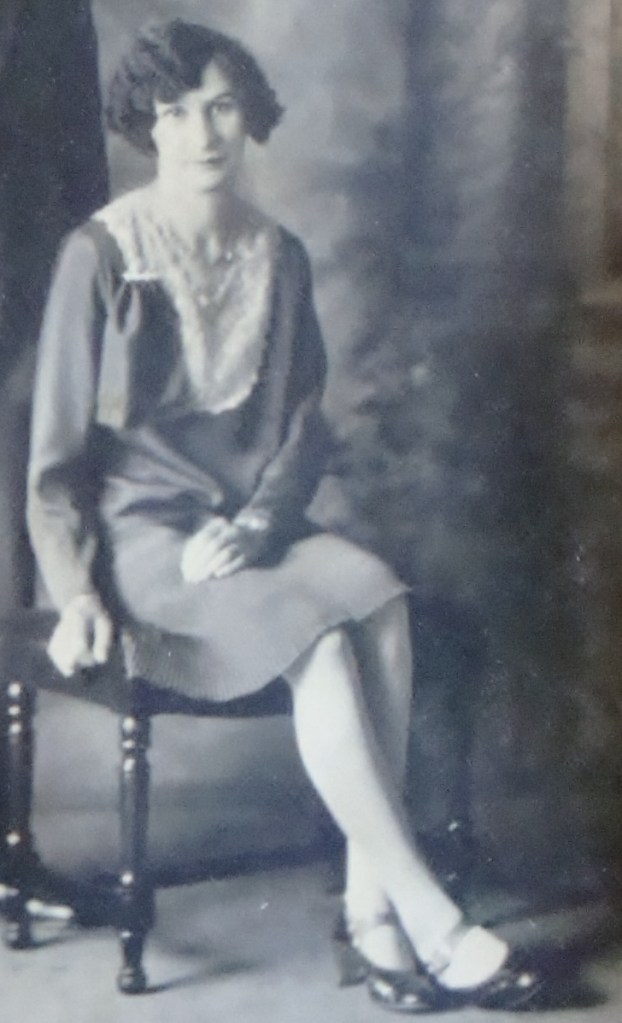
Emelia Anton, about 1931

I’ve previously mentioned my great grandmother, Emelia Anton, who was a German from Russia. She was born on New Year’s Day, but I’ve never been able to confirm whether it was by the Julian or Gregorian calendar. Another mystery: I have a copy of the passenger ship on which Emelia and her family came to Ellis Island. The family came straight to Canada from there; however, despite scouring countless records, I’ve never found where they crossed into Canada.  

Come to think of it, my Germans from Russia are the most mysterious branch of my family tree, given how little I know about it compared to other lines!

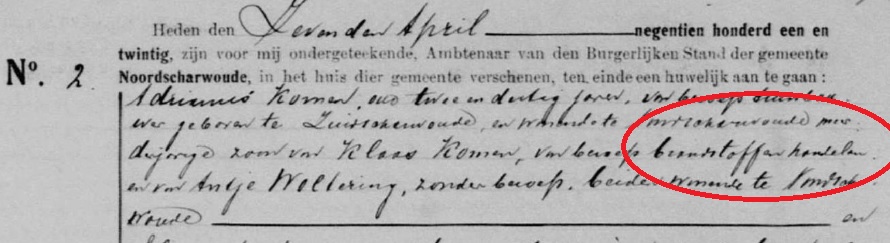
Another mystery that intrigued me for years was an occupation my great great grandfather, Nicolaas “Klaas” Komen held in the 1920s, “brandstoffelhandelaar”. It literally translates as “fuel dealer”, although it took me a long time to figure that out. Here’s a helpful tip. I’ve found that when trying to translate a difficult foreign word, type it into Google Image Search. Sometimes a photo really is worth a thousand words. However, what kind of fuel was Klaas selling? How and where was he selling it, and to whom? As far as I’ve been able to figure out, it likely involved hauling peat or coal on a wagon or truck.

Marriage registration for Adrianus Komen and Elizabeth Bakker, which identifies the occupation of Adrianus’s father, Klaas, as “brandstoffelhandelaar”

My most recent discovery was learning the sailing on which my father’s aunt came to Canada. I’ve pretty much always known the date on which my father and his family left the Netherlands and the ship he came on, the Sibajak. His aunt, Anny van der Fluit and her husband Jac Beers came on the Groote Beer a few months earlier, but I never knew when. Less than a fortnight ago, the Rotterdam Archives posted Holland America Lines passenger lists up to 1969 on its website. I finally learned that my great aunt and uncle left Rotterdam for Halifax on January 20, 1954. I then realized that I was missing information about one of my father’s uncles, Johannes “Joop” van der Fluit, who came to Canada a couple of weeks after my father. I knew the date on which he sailed, but it crossed my mind that I didn’t know the name of the ship. Ta da, there he is, in the archive, sailing to Canada with his family on the Castel Felice.

However, the greatest curiosity to me revolves around my 4x Great Grandfather, Petrus Pieterszoon “Pieter” van der Fluit, who was born in Voorhout, which is just outside of Leiden. His direct ancestors had been in what is now Zuid Holland (South Holland) for several generations, mostly around Leiden, although the surname traces to a village outside of The Hague.

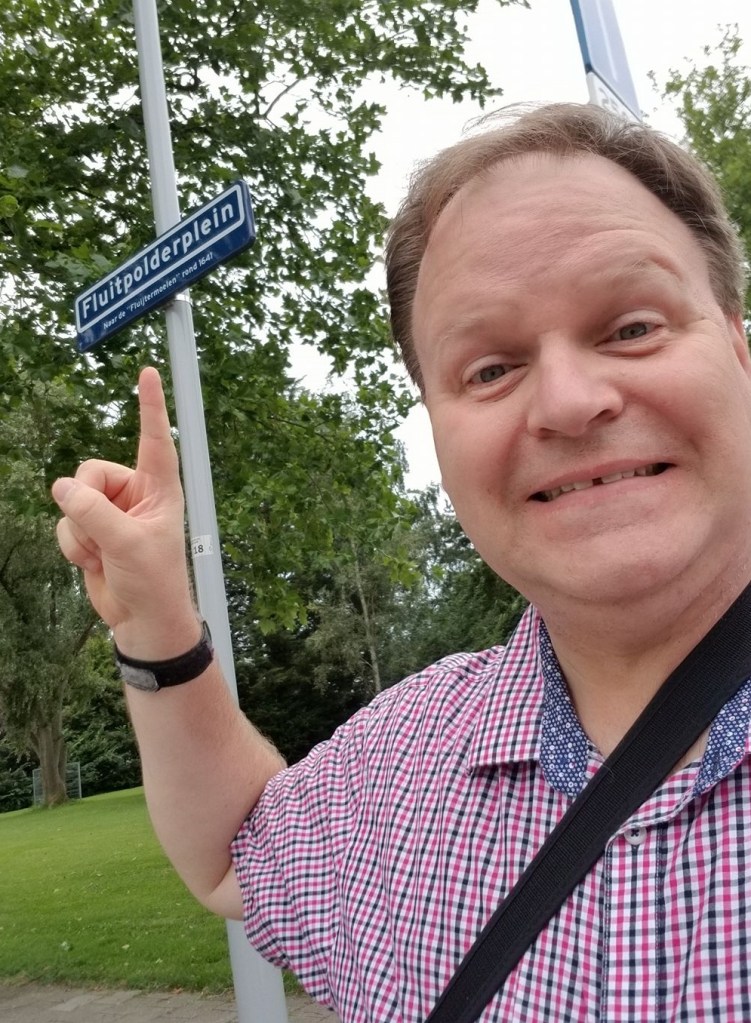
Visiting Fluitpolderplein in Leidschendam, Zuid Holland in 2017. It may well be that this is the polder after which my surname originates.

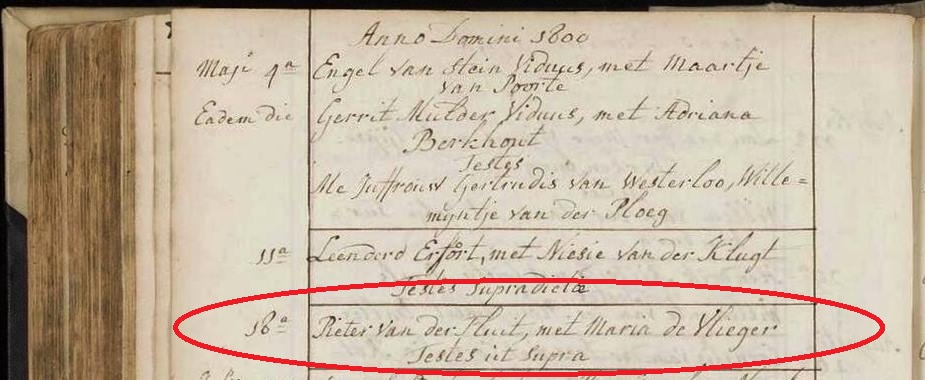
Pieter was the oldest of 11 children, four boys and seven girls. He was still in Voorhout in May 1800, when he married Maria Woutersdr (“Maartje” or “Marijtje”) de Vlieger, who was born in nearby Lisse. Pieter and Maartje have their first child, Elisabeth, in Voorhout in 1801. The next time I see Pieter and Maartje, it’s in November 1804, in Nieuwe Niedorp, in what is now Noord Holland (North Holland), where they have their second child, Pieter.

What has always had me curious is why Pieter and Maartje moved almost 70 kilometers to start a new life away from their family. Based on the time I’ve spent in the Netherlands, a trip of seven kilometers seems overwhelming for the locals. For most of my Dutch family lines, the generations never strayed far, so this strikes me as an astonishing move. After Pieter and Maartje moved to Nieuwe Niedorp, the next five or six generations were all located within a very short distance. My father was born less than four kilometers from Nieuwe Niedorp.

Marriage registration for Pieter van der Fluit and Maartje de Vlieger

Almost all of Pieter’s siblings stayed in Voorhout. One adventurous sister moved all the way to Leiden, less than seven kilometers away. Pieter’s youngest sister ended up in Antwerp after moving to what is now Belgium with her husband. There are many descendants of the original van der Fluits still in the Zuid Holland area.

It is not only the distance of the move that has me curious. Usually it was the younger siblings who move away from home, with the eldest staying behind. I have nothing more than speculation as to what drew Pieter and Maartje north.

My working theory was based upon the fact that by 1800, what is now the Netherlands was essentially a French puppet state known as the Batavian Republic. In the time leading up to its creation and during its existence, the Dutch economy was in dire straits. Between it being wartime in Europe and a poor economy, perhaps Pieter went north looking for work. Many years ago, someone suggested that during the time Pieter moved north there was a great deal of work going on with the construction of new polders and waterworks. However, my investigations indicate that most of the polders of the area were constructed well before and well after Pieter arrived on the scene.

This concludes the January 52 Ancestors theme of “Foundations”. February’s theme is “Branching Out”. In the meantime, don’t worry about the cat, it’ll be okay, stay curious!

52 Weeks – Week Three

Favourite Photo

As expected, I found this week’s 52 Weeks challenge to be particularly difficult, as I am lucky to have so many photos that I cherish. So I am going to cheat a little and post more than one, as I really do not have one photo that I favour above all others. With one exception, I’ve had a copy of all these photos for a very long time. Some of these photos were what helped kindle my love of genealogy.

On her Facebook group, Generations Cafe, Amy Johnson Crow suggested telling “the story of a favorite photo: who is in it, where and when it was taken, and why it was taken. What was the event?” I have to admit, for some of these photos I never thought of who took them or why they were taken, even though I had known of them for years.

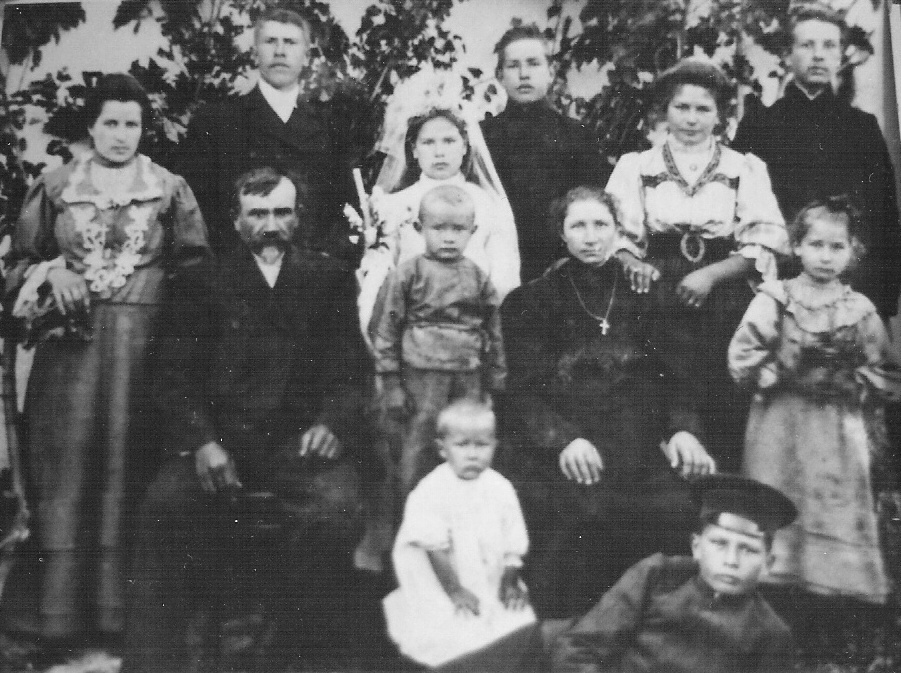
The Anton family, circa 1910. Likely taken in Selo Suchoi, Veronesch, Russia.

This is a photo of my great great grandparents, Jacob Anton and Margaretha (“Margaret”) Heck. Given the attire, this was likely the confirmation of their daughter, Elataria (“Lottie”). My great grandmother, Emilia, is the girl on the right holding flowers. She was about 7 years old here. She lived to be 94. I visited her many times. She is the one who I mentioned at the outset of this blog, who surprised me by speaking fluent German when I thought she was of English heritage.

While this photo was taken in Russia, the family was German. Their forebears were amongst the many Germans who migrated to the Russian Empire in the 18th and 19th centuries. My family settled in the Beresan region of what is now Ukraine. A few years before Emelia was born, the family migrated to Russia. They stayed there until 1912, when they emigrated to Canada.

The next few photos all relate to my father and his family.

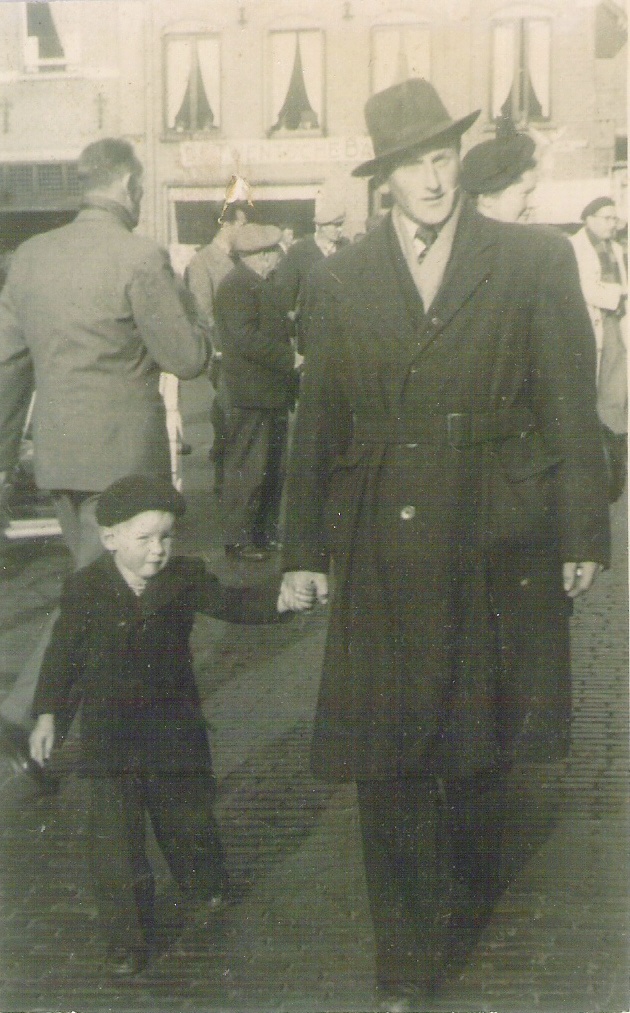
My father and his father, Adrianus (“Arie”) van der Fluit, Schagen, Netherlands, circa 1951.

This photo is definitely a contender for my absolute favourite. While I know when and where it was taken, it never crossed my mind to wonder who took it or why. I have no idea why they would have been visiting Schagen, but there they were. They certainly were dressed very fine and are looking very dapper. My grandfather was a farmer and a labourer, and they’re a bit of a way from home, so it must have been an important occasion. Looking through the family timeline, I can’t find an event that occurred in Schagen at this time.

I was in that same square with my father a few years ago. I should have recreated this photo with him, but I couldn’t quite figure out where in the square this had been taken.

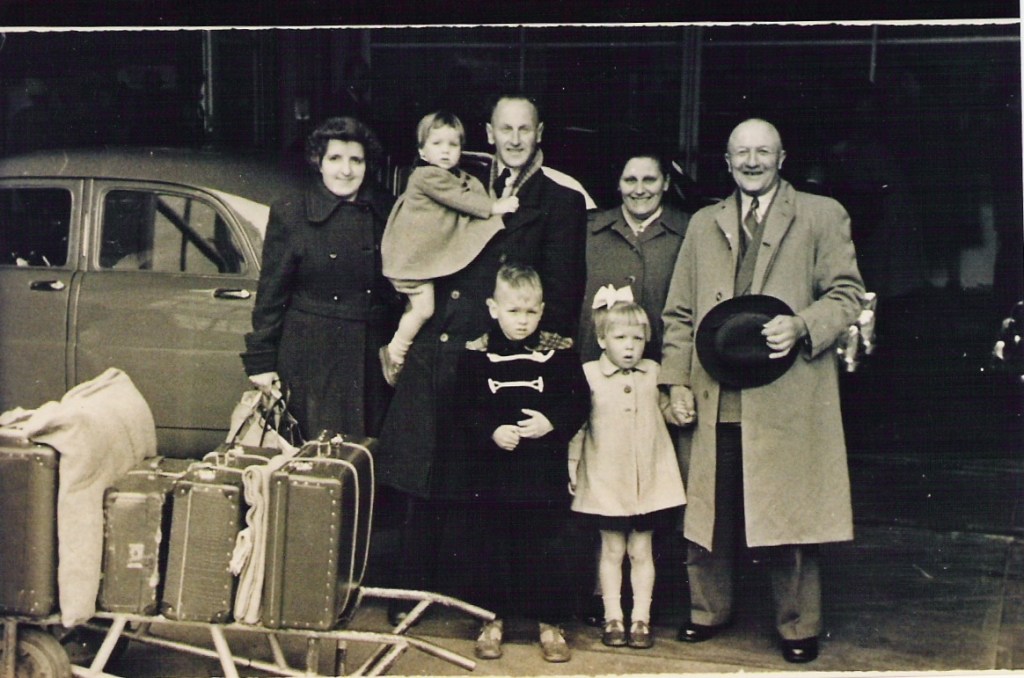
Rotterdam, 1954

This is a photo of my grandparents, my father, and his siblings being dropped off by a family friend at the port in Rotterdam. The family is about to board the ship that will take them to Canada.

Unlike the other photos, this one only came into my possession relatively recently.

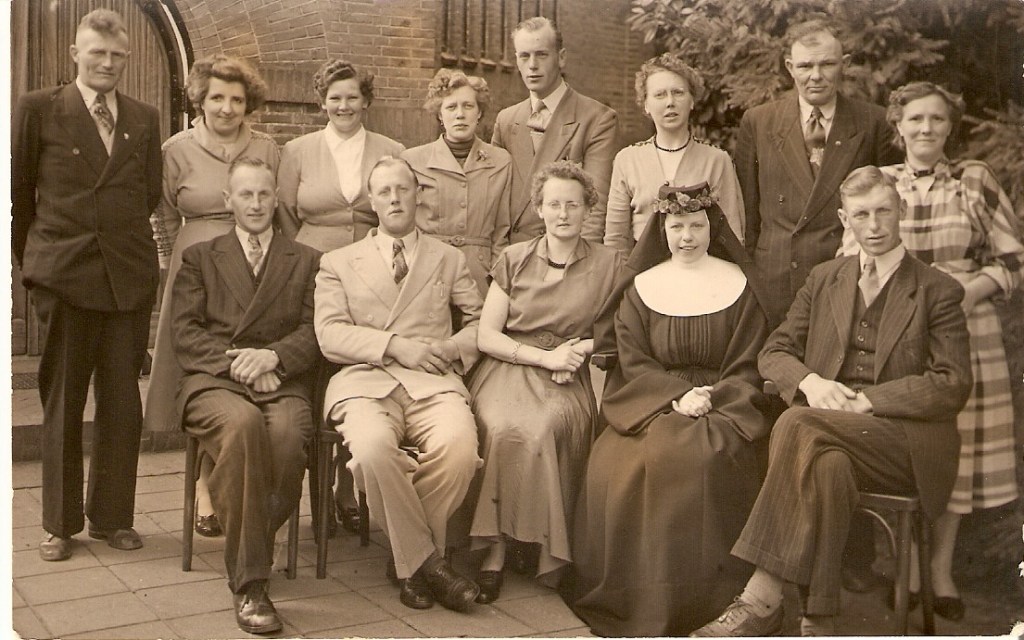
My paternal grandfather had seven siblings. He is the first person seated in the front row on the left side of the photo. My grandmother, Christina (“Tiny”) Komen is standing behind him. All of my grandfather’s siblings are here, except for his youngest sister. She might have been absent because this might have been taken after she emigrated to Canada, sometime in early 1954. My grandfather and grandmother left for Canada later in the spring of 1954. An older brother, Joop, seated immediately beside my grandfather in front of his wife Agie, left for Canada a fortnight after my grandfather.

However, this might have been taken in 1951 to mark the ordination of my great aunt, as an Urseline nun. She went by the name Sister Melania. I considered whether this might have been the occasion for which my grandfather and grandfather were dressed so fine in the above photo, but as far as I can find she was ordained in Bergen, not Schagen.

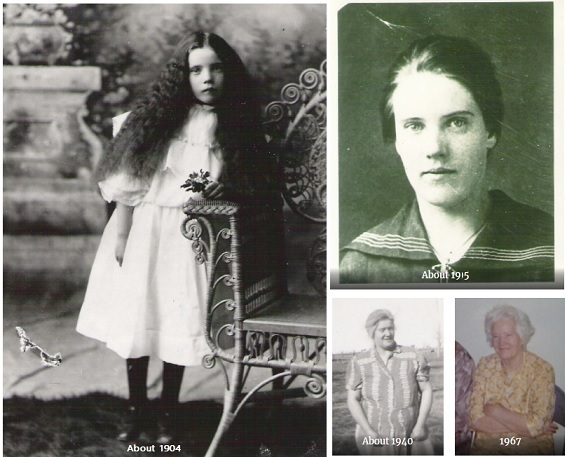
Finally. this set of photos of my mother’s maternal grandmother, Hazel Nelson. It’s the photo on the left, taken when she was about four years old, that is one of my favourites. It’s an amazing photo. I added the others because I thought it was a nice idea to see her progressing through life.

Hazel was born in December 1899. She and her sister Irene were the first twins born in the town of Cardston, Alberta, where her parents were amongst the original settlers. Irene only lived a month, but Hazel lived to be 67. I also have a copy of one of the last photos taken of her, around July 1967. Hazel died only a couple days before I was born. My mother practically went from the funeral to the hospital.

Next week: “Curious”. I wonder what that could be be? 😉

52 Weeks – Week Two

Favourite Find

When I was in my early twenties, I had it in mind to get a Dutch passport and spend a year or two living and travelling in the Netherlands and the EU. I had hoped that the fact my father was born in the Netherlands would enable me to do so. While he came to Canada with his parents when he was a child, he was still a Dutch citizen when he married my mother.

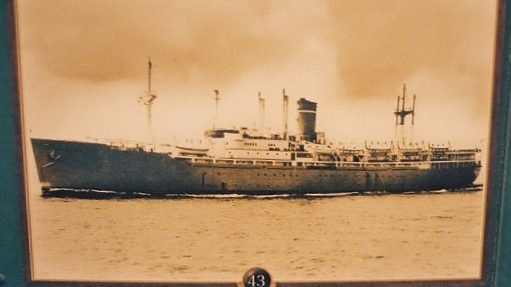
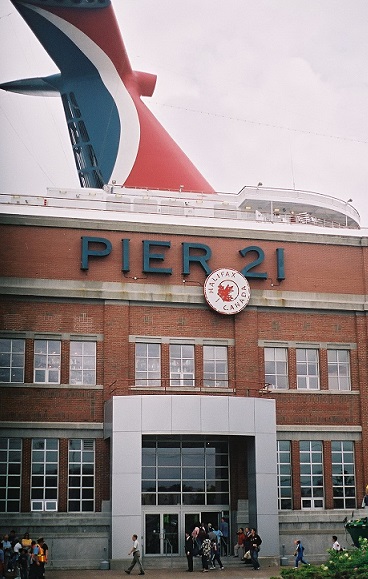
Image of the Sibajak on display at Pier 21. This is the ship that brought my father to Canada.
My dad was here!

Unfortunately – for me – six weeks before I was born my grandfather got my father to get his Canadian citizenship. He was adamantly opposed to the idea that his first-born grandson would be anything other than Canadian. He had gotten his Canadian citizenship as quickly as possible. I’m pretty sure he probably tried the second he landed at Pier 21.

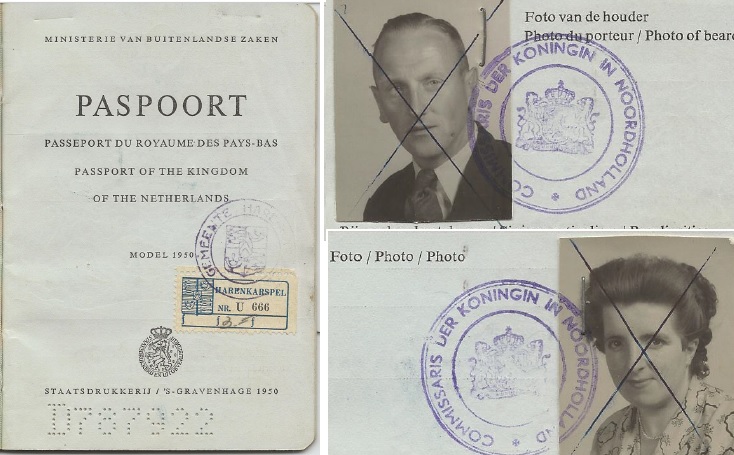
Because my father had been naturalized as a Canadian at the time of my birth, the rules at the time for me to get a Dutch passport required me to produce the passport my father held when he came tot Canada. Of course, he did not hold his own passport when he emigrated, he came under his parents’ passport. I was told that my grandparents’ passport had been long discarded or lost. So much for my plans, thanks grandpa.

Imagine my surprise many, many years later, when this came into my possession. Needless to say, by then life had gone on and my plans had changed. Moreover, the rules for getting a Dutch passport had become more restrictive.

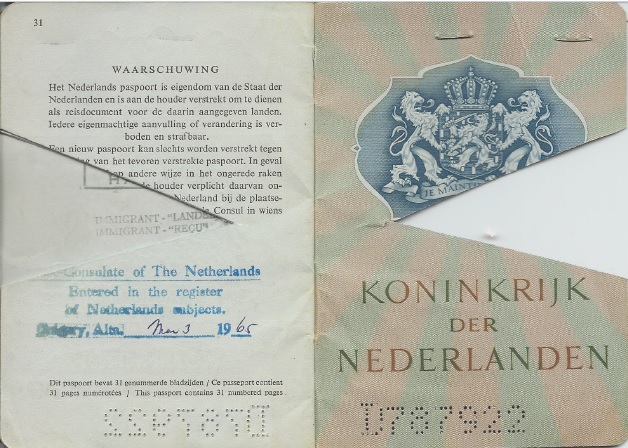
The passport of my grandparents, Adrianus (Arie) van der Fluit and Christina (Tiny) Komen. They both shared the same document, with their photos on separate pages.
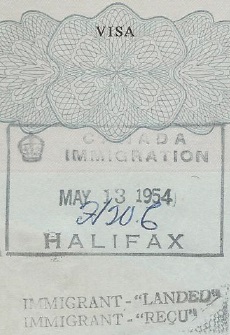
The inside back cover.
They made it!

One thing that I discovered may have made my life more difficult had this been in my possession at the time I was hoping to obtain my own Dutch passport. My father and his younger siblings are all named in the passport, but it misnamed my father. It gives his first name as “Adrianus”, which is not his name. It’s his father’s. (I have birth records showing my father’s actual name, so I know it wasn’t really Adrianus.)

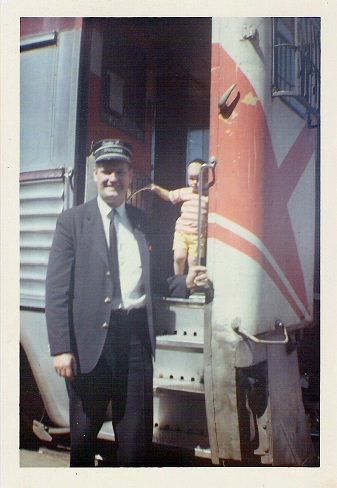
Me with my grandfather, Leo Burgess. If there is any doubt, he is the one on the left.

I will share one other thing that has come into my possession. My mother’s father worked for the Canadian Pacific Railway for many years, first as a brakeman and later as a conductor. His claim to fame was being part of the crew on the train that teenage Clark Kent raced in Superman: The Movie. My grandfather was always proud to talk about meeting Glenn Ford, one of his favourite actors, at the time.

Looking at this photo, it astounds me how much my grandfather looks the way I look now. When I was younger, I always thought I more resembled my father’s side of the family.

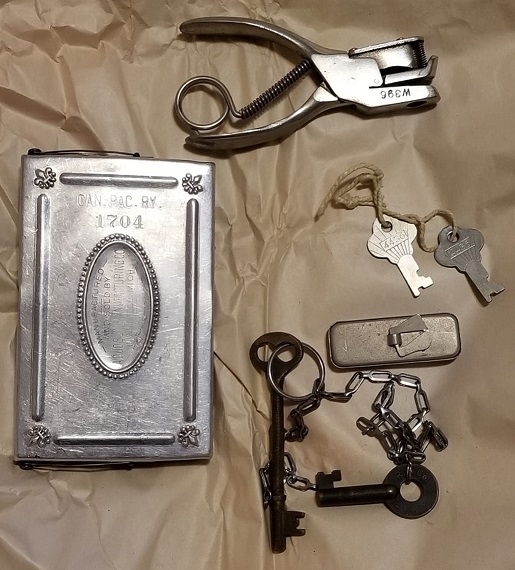
My mother gave me some of the items he used in his work as a conductor.

Some of the items my grandfather used for work. I believe – hope! – that one of my cousins has his pocket watch. One of my brothers has one of my grandfather’s hats, but I don’t recall if it’s a brakeman’s hat or a conductor’s hat.

I thought this week’s challenge would be difficult, because at first nothing came to mind for favourite find. Turned out to be easier than I expected. Next week will be a challenge: “Favourite Photo”. I have dozens of photos that all could hold that title.