I’m at least a week behind in the 52 Ancestors Challenge, but as Amy just reminded me less than ten minutes ago, there is no behind, only progress!

Many countries have an honours system to recognize the contributions of its citizens. According to a 2004 memo to the Select Committee on Public Administration of the UK House of Commons, with the exception of Switzerland and Ireland, every western state has instituted some system by which worthy individuals can be recognized. The United States has the Presidential Medal of Freedom. The British have their knighthoods. In Canada, we have the Order of Canada, which even at the highest rank does not denote a knighthood, unlike the on again off again highest rank of the Order of Australia, although it’s been “off again” since 1986. Even our provinces have these honour systems – in British Columbia we have the Order of British Columbia.
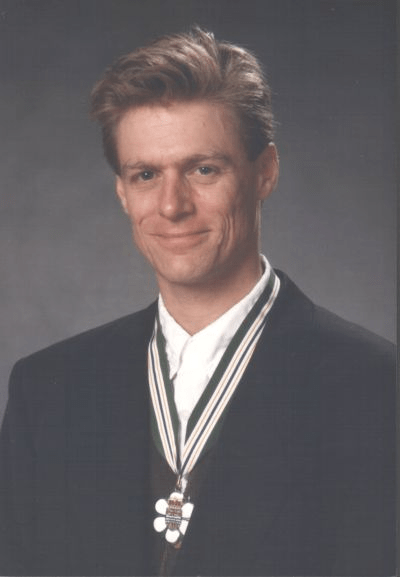
[Interlude while I look for the autograph I have of Bryan Adams. I cherish it not because of the signature, but because of the person who gave it to me. Adams was one of the recipients of the Order of British Columbia the first year it was awarded. I was working in the B.C. Parliament Buildings at the time. The office I shared with three other interns was right next door to the committee room where they bestowed the medals. We had a window looking into that room, but they made us close the blinds. One of the dearest members of the legislature’s dining room staff, who was attending to the coffee and treats for the ceremony, asked Adams for an autograph for each of the four of us, without our knowledge. Later she presented them to us, saying ” you nice boys might be fans so I thought you might like these.“]
However, since this week’s prompt is “Least”, I’m going to look at the lowest ranks of these honours. While I have extended family who hold the lowest rank of the Order of Canada, I’m going to look at a very distant cousin of mine who has received a similar honour in the Netherlands.
While the Netherlands is a constitutional monarchy (like Canada), there isn’t really much of a nobility and things like knighthoods are fairly understated. Titles, prefixes, or post-nominals are not used in the Netherlands in relation to civilian honours, so those who have been bestowed with a Dutch civil honour do not have any indication of their appointment in their names, regardless of the level or degree. Even Members of the Order of Canada (the lowest of three levels) are entitled to use “CM” after their names!
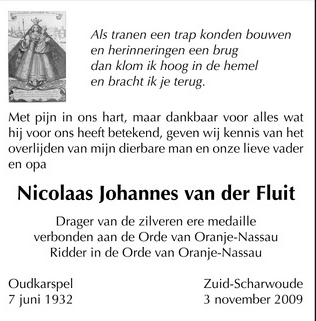
Nicolaas Johannes van der Fluit (1932 – 2009), a very distant cousin of mine (third cousin once removed, to be precise) was named a member of the Orde van Oranje-Nassau (Order of Orange-Nassau) in 2009. According to the familiebericht (family notice) of Nicolaas’s death, he was a “Drager van de zilveren medaille verbonden aan de Orde van Oranje-Nassau Ridder in de Orde van Oranje-Nassau” (Bearer of the silver medal of the Order of Orange-Nassau and (Knight in the Order of Orange-Nassau).
The Order of Orange Nassau is the lowest order of chivalry in the Netherlands, granted to individuals who have made a special contribution to society. Apparently about 4500 people are appointed to the various levels every year. Nicolaas’s appointment was in recognition of his contributions to the field of sports, community welfare, and housing and culture.
When I began to research this honour I was confused by the designation in Nicolaas’s familiebericht. The silver medal (along with gold and bronze) was only an honourary designation. Holders of the medal were affiliated with, but not actual members of, the Order of Orange-Nassau. “Ridder” was separate from the honorary levels and was the lowest rank of the order, just above gold, silver, and bronze.
However, in 1996, the order was reformed and the various levels were replaced with six grades. Gold, silver, and bronze were replaced with by the “Member” class (“Lid”, in Dutch), which is currently the sixth and lowest level of the Order. The Member designation is no longer an affiliate level, so those holding the designation are actually members of the order. Ridder remains the fifth level of the order.
Based upon the familiebericht, it appeared to me that Nicolaas might have been originally named to the silver level, but was elevated to ridder at some later time.
My father’s uncle, Jan Meester (1925 – 2012) was also part of the Order of Orange Nassau. What little information I have about his appointment is that he had received a “Medal of Honor, attached to the Order of Orange Nassau in Silver”. This suggests his appointment was prior to 1996; however, as with Nicolaas’s familiebericht, that could be misleading. I also do not know the activities Jan had performed that garnered him the honour.
For Nicolaas, I resolved the matter when I found the notice of his appointment in the Staatscourant, the official publication of the Kingdom of the Netherlands since 1814. It is the equivalent of the Canada Gazette. (I have not yet found a copy of the Staatscourant with Jan’s appointment.)

The October 9, 2009 edition (#15208) states:
Bij Koninklijk besluit van 29 september 2009, no. 09.002791, is benoemd tot Lid in de Orde van Oranje-Nassau: N.J. van der Fluit, wonende te Zuid-Scharwoude (gem. Langedijk).
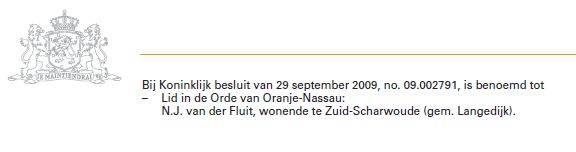
In English: By Royal decree of September 29, 2009, No. 09.002791 is named as a Member of the Order of Orange-Nassau: N.J. van der Fluit, residing in Zuid-Scharwoude (in the municipality of Langedijk).
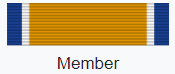
Thus Nicolaas was appointed to the order after it was reformed in 1996 and at the lowest level of the order, Lid (Member). Nevertheless, I would imagine it was an incredible honour to receive. I wonder if a nice lady obtained his autograph for anyone.

 A Deck of Ancestors