With my Great x 4 Grandmother, Martha Carr, I am hitting some real brick walls. I have little more than second and third hand information about her. Almost everything I can say about Martha should be taken with a grain of salt, as nothing is definitive. Originally, all I had was a copy of a family group sheet prepared by my Great Aunt Fon in the early 1980s. I really haven’t got much more.
Martha was born in 1797 in Muff, Donegal, Ireland. She married John Joseph there around 1810. I don’t really accept that date, as it would mean that Martha was 13 years old when she married John. It’s likely they married closer in time to when their daughter Elizabeth (my Great x3 Grandmother) was born, 1818.
In addition to Elizabeth, Martha may have had at least two other children. However, I’m not satisfied that I can place much weight on the scant evidence supporting that conclusion.
Martha died on May 7, 1865. Someone on FamilySearch relied on a search at IrishGenealogy for “Martha Joseph” for deaths from 1864 to 1865. However, the search result provides no information for that person’s surname at death or whether she was married. A broader search for “Martha Carr” for Donegal provides no results.
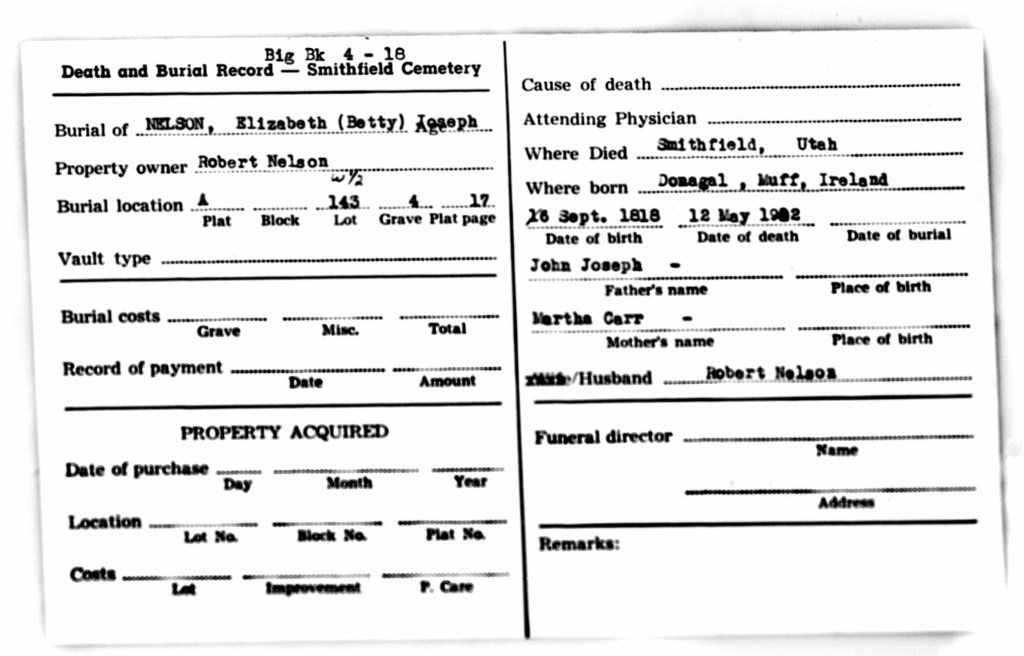
The only mention I can find in an otherwise reliable record is a cemetery burial record for Martha’s daughter, Elizabeth, as it names both of Elizabeth’s parents. However, while the record can be taken as being fairly reliable for the details of Elizabeth’s death, the same cannot be said about Elizabeth’s parents. The record was prepared almost 40 years after Martha died, in a different country, by an unidentified person. It is doubtful the record was prepared by anyone who knew Martha.
Death & Burial Record for Elizabeth Nelson (née Joseph), showing the names of Elizabeth’s parents.
No wonder I am weeks behind in the 52 Ancestors Challenge. In order to provide some background into their childhood and family before marriage, I look for what I have on each individual’s parents and siblings. It’s a good practice to examine your ancestors’ FAN club (“Friends, Associates, and Neighbours”), but I end up getting sucked into deeper research for the grandparents and great grandparents of the person I am writing about.
In this case, I’m supposed to be writing about my Great x4 Grandfather Daniel Thomas. Instead, I’ve spent the last few weeks researching his parents, Rev. Daniel Thomas (1739-1810) and Sarah Covington (1750-1828). In fact, while writing this paragraph, I ended up falling back into the research wormhole and spent two more hours on it before returning to this post.
Daniel and Sarah were both born in Maryland and had deep family roots in that state, back to the early 18th century when it was still a British colony.
Daniel Thomas Sr. was a Baptist minister and well-to-do plantation owner , which, of course, meant that he was a slave owner. Daniel Senior was the first minister of Dockery Meeting House in Rockingham, Richmond County, North Carolina, which was chartered in 1774. It was later renamed Cartledge Creek Baptist Church. While every source I have about his marriage to Sarah Covington says they married in 1770 in Rockingham, I suspect they might have married in Maryland because it seems Daniel moved to Rockingham to take up his ministerial role there.
Daniel and Sarah had eleven children in Richmond County. Daniel the younger was their third child and second son. All of Daniel’s children are named in his will, although it does not appear that he provided anything for his eldest child, Priscilla, even though she was one of the witnesses to the will. However, it may be that Priscilla was not actually Daniel’s daughter, but his niece or daughter-in-law. I could dive back into the research wormhole to find out, but I really want to make some progress here.
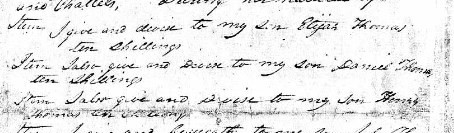
Daniel Senior did not divide his estate equally. Daniel junior only received ten shillings, as did two of his brothers. Sarah received Daniel’s plantation with a life estate, which passed to their eldest son, William, on her death. One son received $25, on received $100, and another received $400. Two daughters received a cows, with one receiving furniture as well, while a third daughter only received a bed and furniture.
Portion of the will of Daniel Thomas, Sr., showing bequests of 10 shillings to his sons Elijah, Daniel, and Henry.
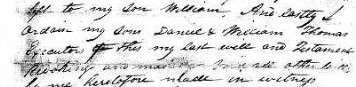
Portion of the will of Daniel Thomas, Sr., naming his sons William and Daniel as executors of his estate.
While Daniel might not have inherited his father’s plantation, he did well enough for himself. According to his grandson, also named Daniel, Daniel Jr. could be described as “wealthy”, owning a “well equipped plantation with many negro slaves.” Another writer described Daniel as “an affluent slaveholder”.
Sometime in his early adulthood Daniel bought a 3000 acre plantation with a river running through it, which included some islands. The land cost $2.24 per acre, plus the cost of surveying and the deeds. The plantation was on the east bank of the Yadkin River about 8 miles northwest of Rockingham. Daniel built an 8-room wood frame house on the land, which had an orchard and garden. Daniel kept sheep and also had a carpenter shop, blacksmith shop, a cotton gin, and a shad fishery.
Daniel also owned about 30 slaves. It’s hard enough wrapping one’s mind around the concept of one human “owning” another, even harder to think a man of God could justify it.
On December 3, 1795, Daniel married Nancy Ann Morehead. I don’t know if this was before or after he bought his plantation, but it’s likely the two events were not far apart in time. Or not. As I noted in my earlier post about Nancy, despite all the (mostly secondary) sources indicating that they married in 1795, there was a 16-year gap between their marriage and the birth of their first child in 1811.
Together Daniel and Nancy had four children, all born in Rockingham, likely on the plantation. All four were born about a year apart from each other. The fact Nancy had four children in rapid succession after a 16-year period also causes me to question the chronology set out in the information I have. Alternatively, Daniel and Nancy might have had other children I don’t know about before 1811, but that seems unlikely.
Daniel died on November 7, 1830 in Rockingham. According to Find A Grave, Daniel might be buried at the Cartledge Creek Baptist Church Cemetery, like his father. However, if he is buried there, the site of his grave is unknown.
On Daniel’s death, his family sold his property for $3,000 and relocated to Tennessee and later to Mississippi. Of course, they kept the slaves. Heaven forbid. As contemptuous as I am, one can’t choose their ancestors. You have to take the crunchy with the smooth when you do genealogy.
If the many online unsourced trees are to believed, my Great x4 Grandmother, Nancy Ann Morehead, is descended from a long line of Scottish lairds, going back to Sir William Muirhead of Lachope, who was knighted by King Richard III.
Which I won’t, without the evidence to back it up.* I barely accept what I have about Nancy’s grandparents, although I know the information’s out there. However, I’m satisfied that I can accept that her parents were Joseph Morehead and Elizabeth Turner.
As I noted a couple of years ago, Nancy and her lineage did not attract my attention as much as other lines of my tree, so I had done very little research on her and her forebears. Nancy’s great grandmother, Martha Taliaferro, piqued my interest until I found out the Taliaferros were of British origin, not Italian as the surname suggested. Well, less Italian as I had imagined, as the family apparently immigrated to England from Venice many centuries ago. Furthermore, as I noted in my earlier post, it’s more likely that I’m not descended from Martha at all.
However, in the two years since I last posted any mention of Nancy, I’ve done some research on her. I haven’t had much success beyond second-hand accounts set out in unsourced or poorly sourced materials. At most, I’ve only managed to discount some of the information I originally had about her.
I do know that the Moreheads were a prominent and wealthy family in American history. Nancy’s nephew was John Motley Morehead (1796 – 1866), 29th Governor of North Carolina. Her first cousin once removed was James Turner Morehead (1797–1854), 12th Governor of Kentucky. Those weren’t the only members of the Moreheads to become politicians. Members of the Morehead family were founders of Union Carbide.
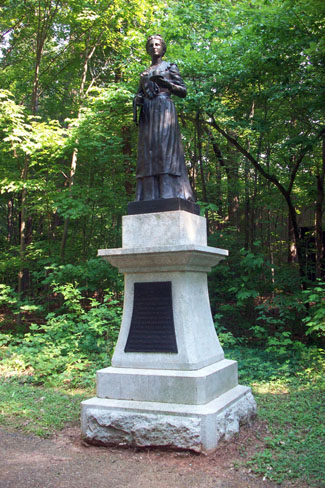
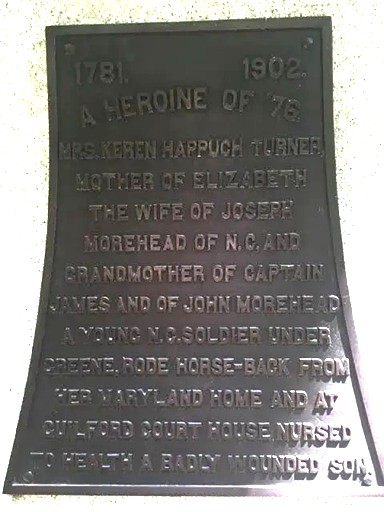
I am also vaguely aware that Nancy’s maternal side of the family were prominent or successful in various fields. Her grandmother, Karenhappuch Norman, was a heroine of the American Revolution, but I have never managed to maintain attention when reading about how she earned that status. What I understand is that she rushed to the aid of her son and others wounded at the Battle of Guilford Courthouse in Greensboro, North Carolina, in 1781.
At most, what’s helpful about Karenhappuch’s role in history is that there’s a statue of her in Greensboro at the site of the battle. The plaque on the statue’s pedestal names her daughter, Elizabeth, and son-in-law, Joseph Morehead. Since I know they were Nancy’s parents, this helps identify one generation further back.
Karenhappuch Norman Turner (1719-1807)
None of those individuals interest me at all. Finding famous folk was never a draw for me or why I took up genealogy. The majority of time finding some sort of notable ancestor or famous distant cousin generally bores me. Sometimes it even feels disappointing. Probably the most interesting thing about Karenhappuch is that she’s also a direct ancestor of Muhammed Ali on his mother’s side. There’s one famous person that I will admit it would be cool to be related to. Even then, it was only writing this blog post that caused me to calculate my relationship to Ali – we’re 6th cousins, once removed.
Turning to Nancy herself, she was born on April 17, 1779 in Halifax, Virginia, a few years after the start of the American Revolution and two years before her grandmother’s exploits in Greensboro. Nancy’s father, Joseph, was a well-to-do landowner in Halifax County, Virginia. While I haven’t researched the matter beyond a preliminary sketch, I would absolutely not be surprised to learn that he was a slaveowner.
Nancy was the second-youngest of 13 children born to Joseph and Elizabeth. An interesting thing about Nancy’s parents is that Joseph’s brother, Charles, married Elizabeth’s sister, Mary. So their siblings were also their siblings-in-law.
On December 3, 1795, Nancy married Daniel Thomas, a plantation owner, in Richmond County, North Carolina. That is in the southern part of the state, due south from Halifax County and as far from Virginia as you can get without leaving North Carolina. I have no idea how they met. As well, if I accept the birthdate I have for Nancy, she was 16 when she married Daniel, who was 19 at the time.
Another indicator that the information I have might not be accurate is that Nancy and Daniel were married almost 16 years when they first had children. In the span of four years, from 1811 to 1815, Nancy gave birth to four children. All four were born in Rockingham, North Carolina.
Daniel died in 1830. Sometime shortly afterwards, Nancy and her three eldest children – Joseph, Elizabeth, and Preston – moved to Tipton, Tennessee. It’s not clear whether they moved as a group or at separate times. All three children were in their early 20s and Joseph was married at the time, so it’s unlikely that they followed their mother.
From what little I have, it may be that Joseph moved first and the others followed suit. Joseph bought land that he farmed, although I doubt he was anything less than a wealthy landowner who largely had others – including his slaves – doing the hard labour. In Tipton, Preston married the first of three wives (the latter two were polygamous marriages), Sarah Ann Jane Morehead. When I wrote about Preston last year, I noted that he and Sarah (who went by Jane) were cousins of some kind. I’ve since found that they were first cousins. That meant Nancy was Jane’s aunt and mother-in-law.
Sometime in mid-1835, Joseph and his family moved to Somerville, Mississippi. One or two years later, Joseph returned to Tennessee and persuaded his mother and siblings Betsy and Daniel to join him in Mississippi. Preston remained in Tipton. Nancy lived the rest of her life in Somerville, where she died on November 7, 1843.
Or so it seems. I haven’t found much beyond poorly sourced secondary accounts documenting Nancy’s death and burial. I cannot find any primary sources documenting Nancy’s death. Many online trees say that Nancy died in “Somerville, Kemper, Mississippi”, which is unverified second-hand rubbish. Somerville isn’t anywhere near Kemper county. It is half a state away in Leflore county.
I have been unable to find anything in the census or other civil records showing that Nancy lived or died in Mississippi. I found Joseph Morehead Thomas in the 1840 US census for Kemper county, but the entry did not include anyone in his household who might have been Nancy. I am unable to find anything for Nancy in Leflore County, Mississippi, where Somerville is located.
* I am well aware of the book, The Morehead Family, by John Motley Morehead III, grandson of the North Carolina governor, self-published in 1921. It’s typical of those old family histories you can find on the Internet Archive and elsewhere – very detailed, but very little indication of the sources the author relied upon. For generations further back than his grandparents and grandparents, there’s a lot of speculation and conjecture, as well as placing a great deal of weight on thin evidence. I don’t find it as reliable or authoritative as others suggest it might be.
My Great x4 Grandfather, Thomas Hadlond, was most likely born in July 1814, in Churchill, Oxfordshire, England, on the fringe of the Cotswolds. Thomas was born only a couple of months after Napoleon abdicated and was exiled to Elba.
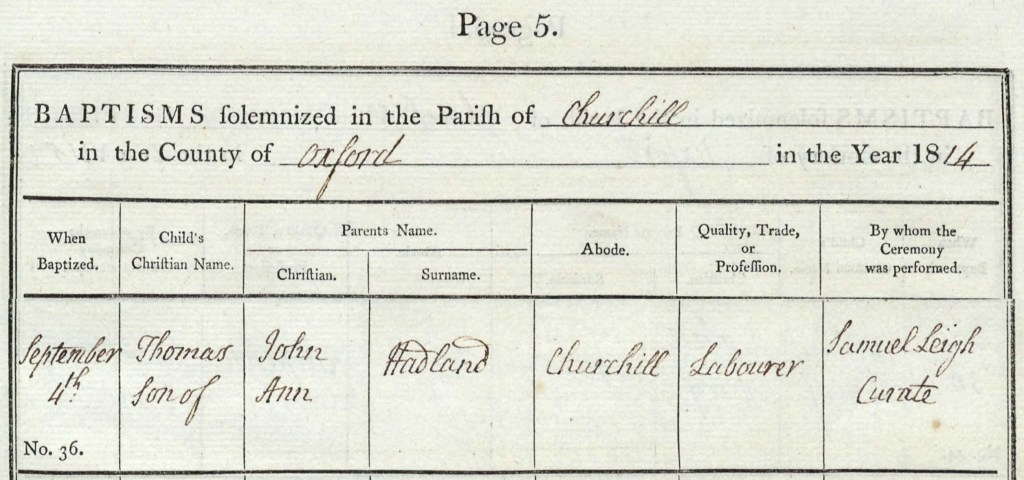
If July is the month in which Thomas was born, there was an seemingly long time before he was baptized, which occurred on September 4, 1814. The English records, including Thomas’s baptism registration, show that the family name was primarily spelled “Hadland”.
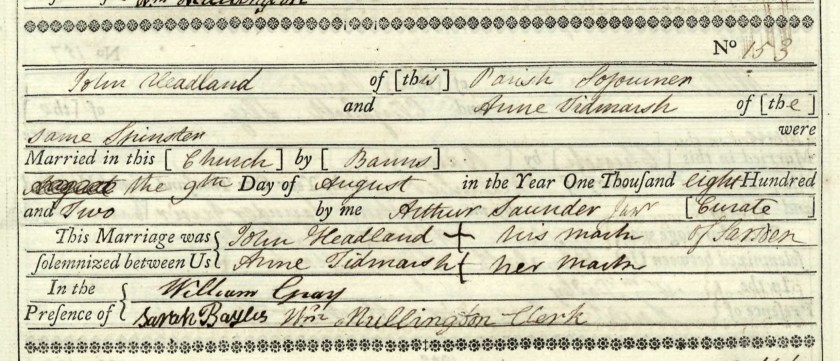
It was not until Thomas came to the new world that the spelling was recorded as “Hadlond”. Other variations in England included “Haddlond” and “Headland”. An example of the differences can even be seen in records of the same event, such as the registration of the marriage of Thomas’s parents, John Hadland and Ann Tidmarsh. In one record, it’s “Hadland”; in another it’s “Headland”.
John “Hadland” and Ann Tidmarsh, married August 9, 1802
John “Headland” and Ann Tidmarsh, married August 9, 1802
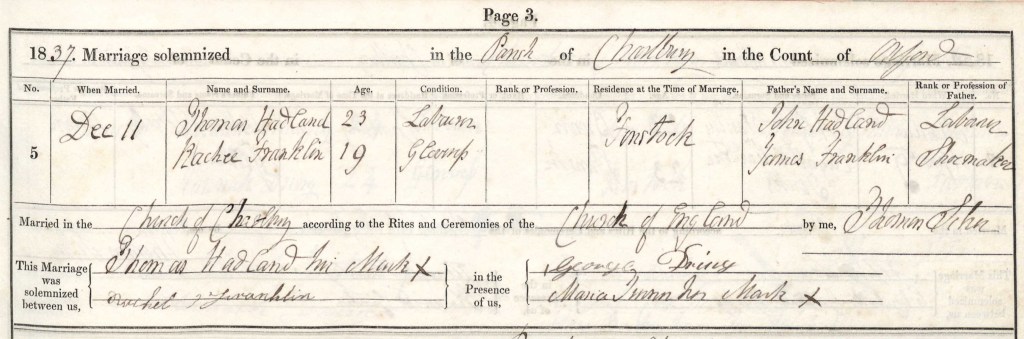
Thomas was the youngest of four children. It appears that during his adulthood, up until he married, Thomas lived in Finstock, Oxfordshire, where he worked as a labourer. On December 11, 1837, Thomas married Rachel Franklin in nearby Charlbury. After the marriage the couple likely settled in Finstock, as their first child, Charlotte, was born there.
Thomas and Rachel’s marriage registration. What I find interesting about this is that it appears that Thomas could not write, as he signed with his mark (“X”), while Rachel signed her full name. Speaking of Rachel, I’d love to decipher what was entered for her “Condition”, which to me looks like “gloump”.
By August 1838, the family had moved west to Cheltenham, Gloucester, on the other side of the Cotswolds. There Thomas worked as a domestic servant. Thomas and Rachel had six children in Cheltenham, starting with my Great x3 Grandmother, Maria Hadlond.
In 1846, Rachel joined the Mormon church, but it appears that Thomas never did. This is evidenced by the fact Thomas was not baptized into the Mormon church until June 13, 1893, a year after he passed away.
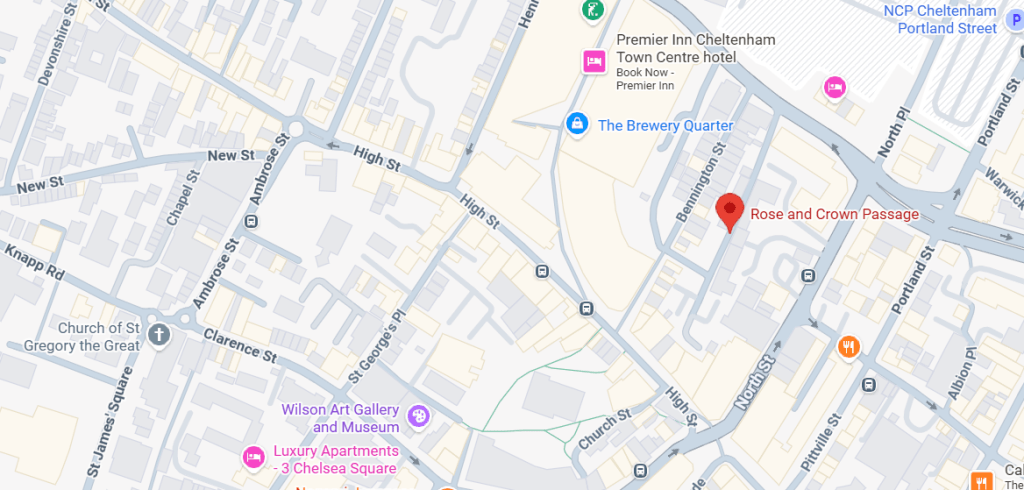
Sometime after 1851, Thomas and family left England for North America. They were still in Cheltenham when their daughter, Alice, was born on September 1, 1850. As well, the 1851 census shows that the family was still living in Cheltenham, at No. 38 Rose & Crown Passage.
Rose and Crown Passage in Cheltenham as shown on Google Maps as of March 2026.
The family left England sometime before June 1853, because Rachel gave birth to a son, Franklin, somewhere in Canada. While the family ultimately settled in the United States, this indicates that they most likely landed somewhere in British North America (the former British colonies that came together to form Canada).
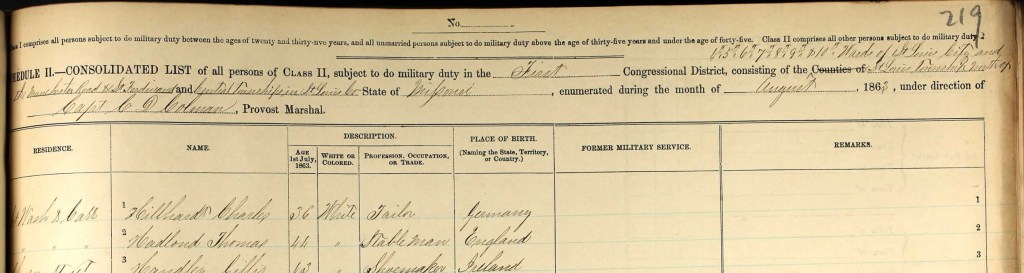
By 1856, Thomas and his family were living in St. Louis, Missouri. At the time of the 1860 census, Thomas was working in St. Louis as a hostler (a person who took care of horses, usually at an inn). During this time, the US Civil War erupted and the United States initiated a military draft in 1863. All men ages 20 to 45 were required to register. Thomas was 44 at the time. Thomas registered as Class II, which applied to married men ages 36 to 44.
Thomas’s registration for the draft during the US Civil War.
As of 1870, the family had moved across the Mississippi River to East St. Louis, Illinois, where Thomas was employed as a labourer. In East St. Louis, Thomas and Rachel had two more children, twins named Ella and Alphius, born on August 21, 1858.
Rachel passed away in March 1879. Shortly afterward, Thomas moved in with his daughter, Eunice, and her husband, Richard Cottam, at 2317 Exchange St. in St. Louis. They moved several times within the city. In 1885, they were at 3962 Cook Ave.; in 1889 they were at 4364 Vista Ave. in St. Louis.
Sometime shortly afterwards, Thomas moved to Nebraska City, Nebraska, to live with his daughter, Mary Louisa and her husband John Wischmeyer. He was not there for long, as Thomas passed away there on November 2, 1892. Thomas is interred at Wyuka Cemetery in Nebraska City.





 A Deck of Ancestors