It’s the penultimate week of Amy Johnson Crow’s 52 Ancestors Challenge, which is all about “Perserverance”. When I reflect upon this week’s theme, I keep coming back to the satisfaction I feel upon successfully rising to the challenge (albeit with one week to go!). This was the third time I signed up for the challenge, and as the saying goes, third time is the charm!
While I have been working on my family history since I was in elementary school, my greatest lapse has been writing it up. I’ve managed to collect a lot of information over the years and have recorded it all in RootsMagic, writing about my family history has been sporadic and scattered throughout various media and platforms. With this blog, I had hoped to consolidate a lot of that material in one place. So far, I have managed to do exactly that. An added and unexpected bonus is that with each entry, I learned about gaps in my research and knowledge, which lead to me improving upon those aspects of my genealogy.
Another benefit (which I had hoped for) is that this blog has served as a basis of compiling a family history book. Undertaking that project revealed how much writing I have done for this blog over the last year. With this post, the document is approaching 185 pages!
Given the primary purpose of this blog, I have largely written it for myself. However, I regularly share my weekly entries on the Twitter account I created as a companion to the blog and in the “Generations Café” Facebook group created by Amy Johnson Crow. As a result, a few people have taken the time to read it and provided some favourable feedback. For that, I remain grateful.
Finally writing about my family history in an organized way has certainly been a huge improvement in my genealogical habits. I am glad that I persevered with it over the last 51 weeks.
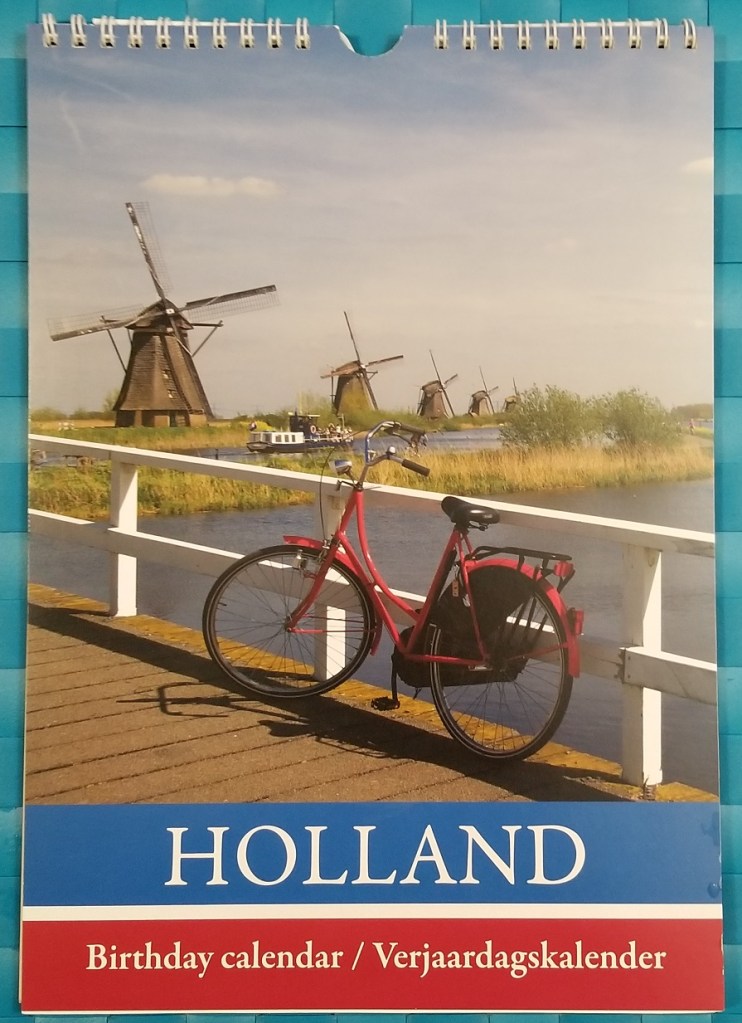
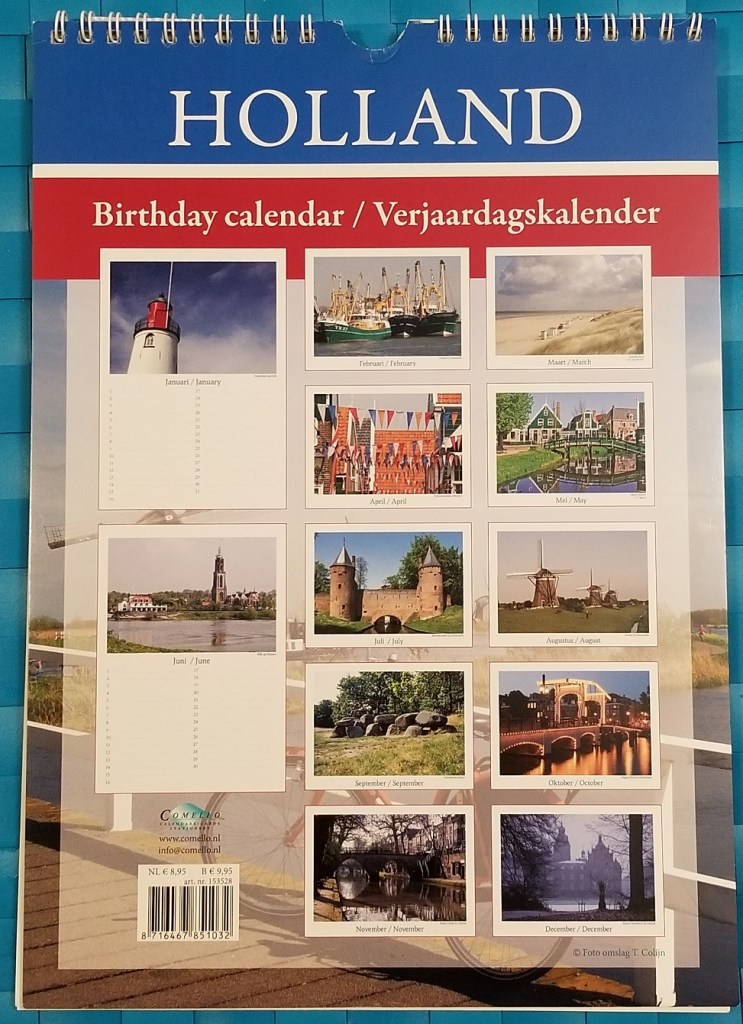
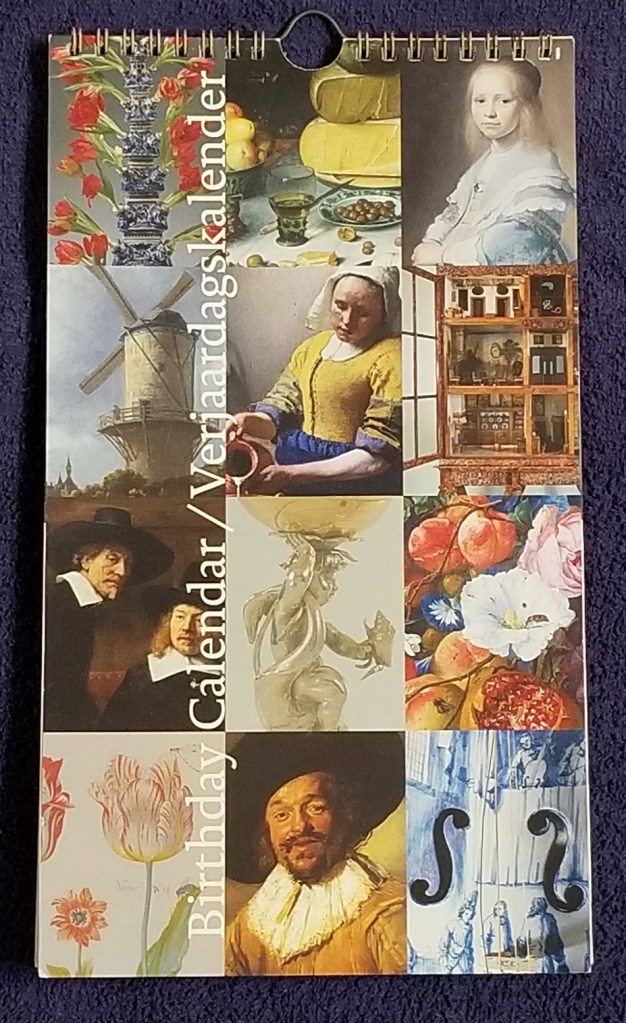
I know what my mother is getting me for Christmas – a verjaardagskalender! I know this because I was there when she bought it. She even let me pick it out. Now I’ll have one for each of our bathrooms.
Week 50 of the 52 Ancestors Challenge is “Traditions”. While it might be described more as a custom than a tradition, with a new year bearing down on us I’d like to think of a verjaardagskalender (“birthdays calendar”) as a tradition.
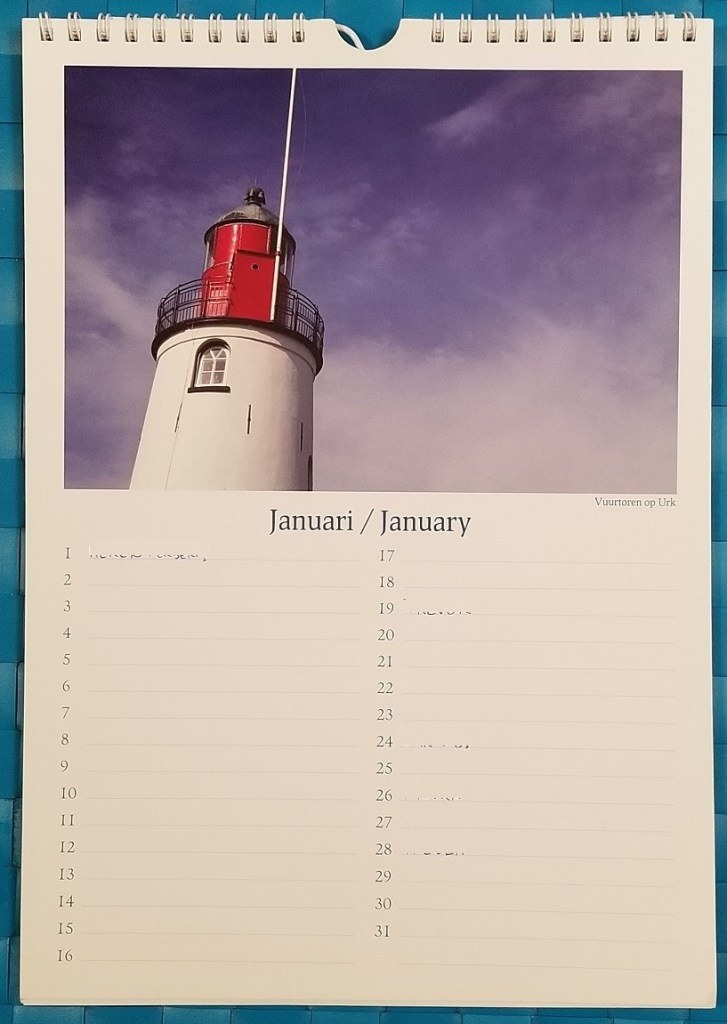
One of two verjaardagskalenders that I own (with names redacted).
A typical Dutch bathroom isn’t complete without a verjaardagskalender, a perpetual calendar that is used for keeping track of birthdays and anniversaries. Why is it hung in the bathroom? Because it’s a place where you’ll always see it, so you’ll never forget or miss an important family milestone.
When I visit my Dutch relatives in the Netherlands and Canada, I always take note to look at their verjaardagskalendars. I’ve even photographed all the pages of a few (with permission!). It’s a great way of finding those elusive birthdays, and finding out who is part of the extended family.
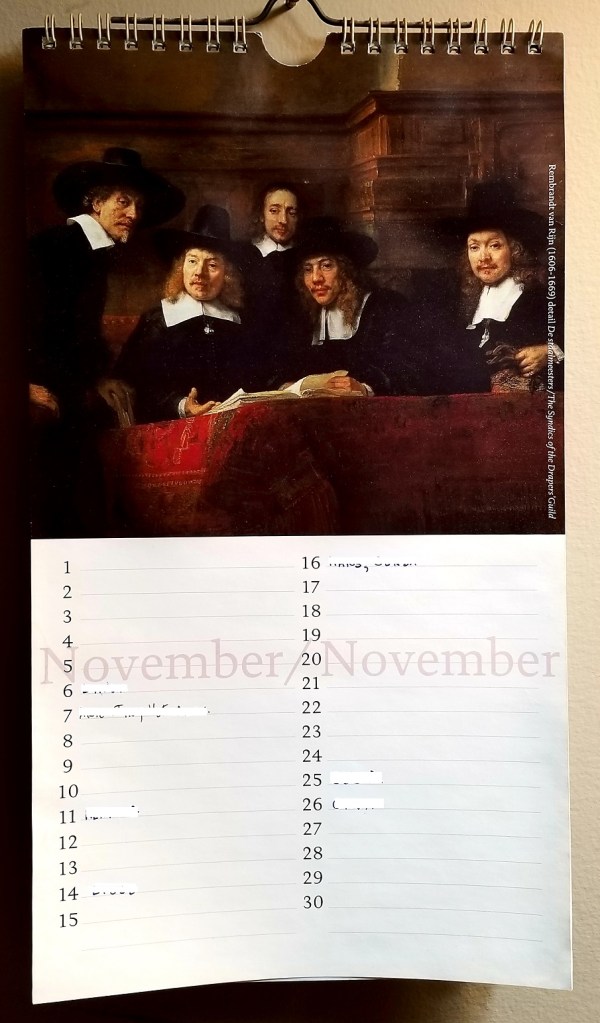
The verjaardagskalender that hangs in our kids’ bathroom.
Just be forewarned – if you ever see a verjaardagskalender when visiting a Dutch friend, do not add your own name! It would be the height of rudeness and impropriety to do so. And if you see your name on it, consider it an honour – you’re considered one of the family!
It’s Week 49 of the 52 Ancestors Challenge. As we approach the horizon of a new year, this week’s theme is “New Horizons”.
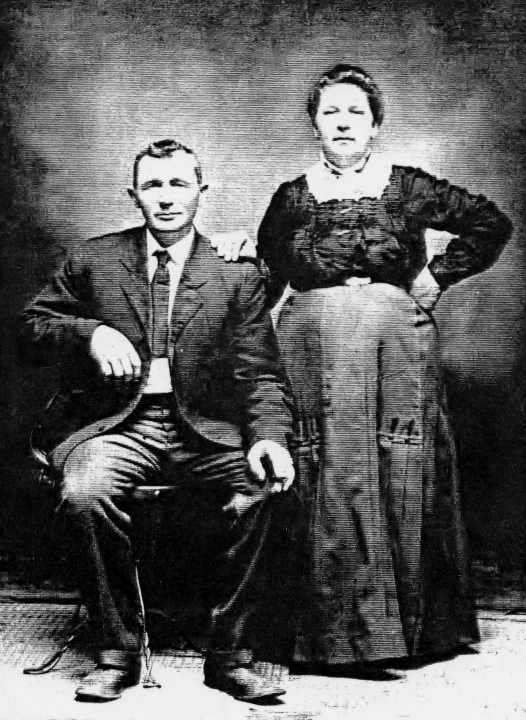
I’ve written before about my mother’s maternal lineage, who are all Germans from Russia. This is the story of my mother’s immigrant great grandparents, Michael Lerner and Barbara Schmidt, who sought new horizons in not one, but two countries.
Michael Lerner (1862 – 1947) Barbara Schmidt (1865 – 1936)
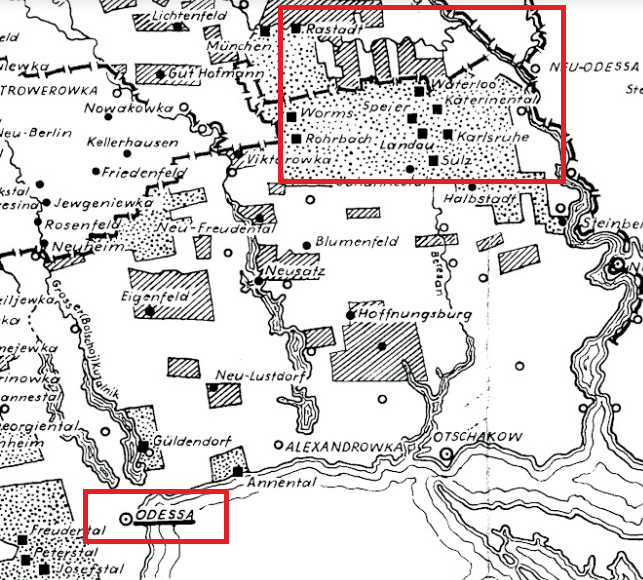
Michael and Barbara were both born in the Beresan district of Kherson province in what is now Ukraine, but which at the time was part of the Russian Empire. Michael was born in Rastatt and Barbara was born in nearby Karlsruhe. As should be apparent, the colonies were generally named after the cities and towns in what is now Germany from where the colonists came.
The German colonies in the Beresan district in 1890, as seen in relation to Odessa.
Michael and Barbara married in Rastatt in February 1865. They lived there for the next ten years, where Michael was engaged in farming. Michael and Barbara had six children together during this time.
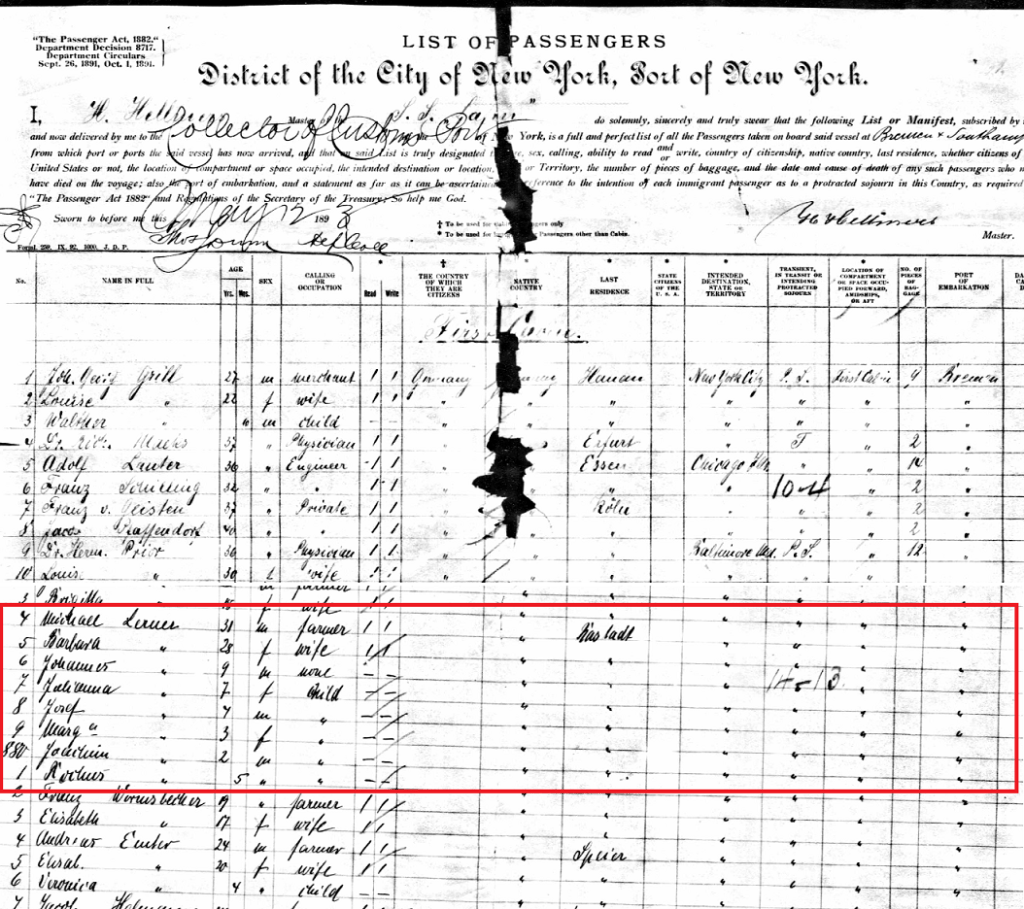
The family emigrated from the Beresan to the United States in 1893. They travelled across the Atlantic on the S.S. Lahn, landing at Ellis Island on May 12, 1893, where immigration officials did not change their surname.
The passenger list for the S.S. Lahn showing the Lerner family.
A brief editorial comment.
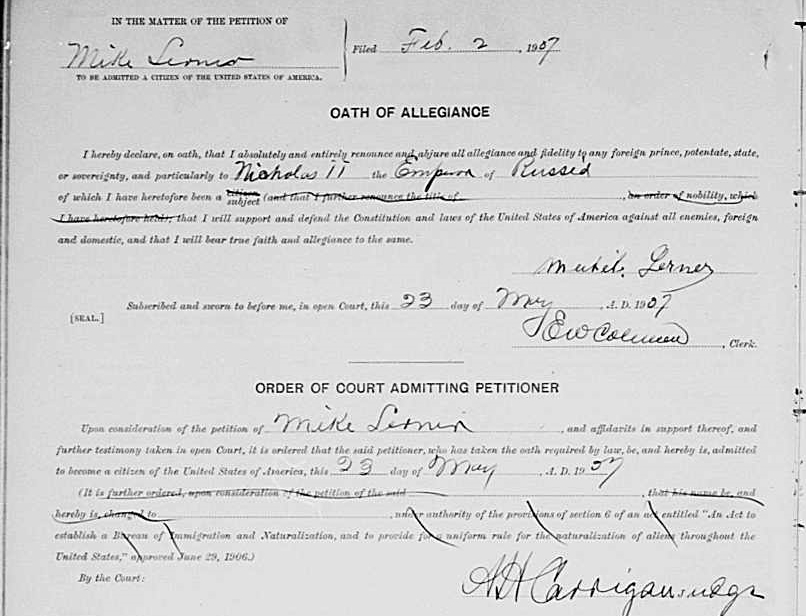
The family settled in Henrietta, Clay County, Texas, where Michael continued farming. Census records show that he farmed on Jacksonboro Road. The name must have changed over the years, as I cannot find it on any map. Michael did not waste any time in applying for American citizenship, as he filed a Declaration of Intention in 1894. However, he took no further steps towards that goal for another thirteen years, in 1907, when he filed a new Declaration of Intention. Michael and Barbara became naturalized American citizens on May 23, 1907.
Heronimus (“Jerome”) Lerner (1895-1954)
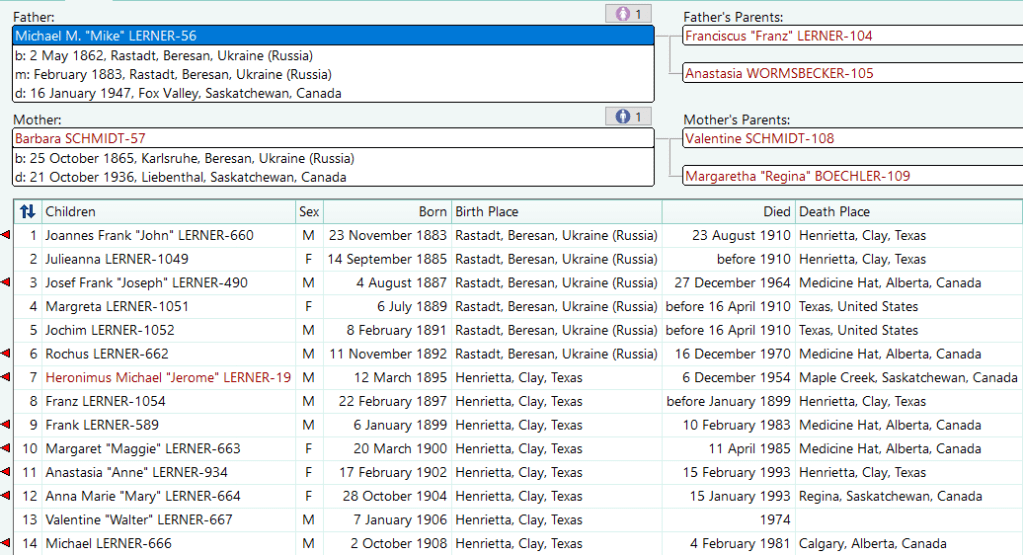
From 1895 to 1908, Michael and Barbara had eight more children while living in Henrietta. My great grandfather, Heronimus (Jerome) Lerner, born March 12, 1895, was the first of their children born in the United States.
However, most of the family did not stay there for long after the youngest child was born. In 1913, Michael and Barbara’s son Rochus (1892-1970) moved to south-west Saskatchewan, where there were many other settlements of Germans from Russia. Rochus took up farming near Fox Valley, Saskatchewan. According to my mother, Rochus sent word back to Texas saying that there was a lot of good farmland available in Saskatchewan.
My great grandfather, Jerome, followed the call and moved to Fox Valley in 1917. Michael and Barbara followed in 1918, where they settled on land just outside of Fox Valley, near Rastadt. (See how the names followed the settlers around?) Most of the family ended up in Saskatchewan, but a few of Michael and Barbara’s children remained in Texas. As well, some of the family who moved to Saskatchewan later returned to Texas.
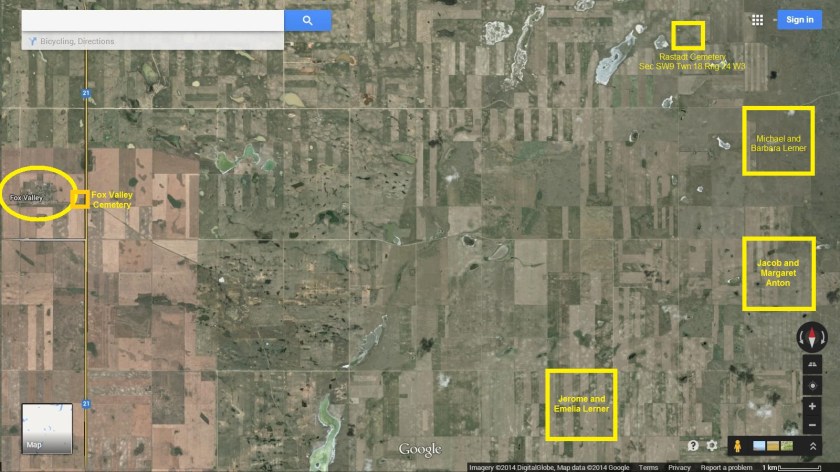
Fox Valley, Saskatchewan is in the oval on the left. The land Michael and Barbara farmed is to the east, marked in the box on the upper right. The smaller nearby box shows where Rastadt once stood.
Michael and Barbara became naturalized British subjects domiciled in Canada in 1896 (there was no “Canadian” citizenship until 1947).
Naturalization of Michael and Barbara Lerner in the Canada Gazette 1929-1930, page 692
Barbara died on October 21, 1936. Michael died just over ten years later, on January 16, 1947. Michael is buried at the Fox Valley Cemetery. There is some insistencies in the records as to where Barbara was interred.
Records show that “Barbara (Schmidt) Lerner” is buried in both Rastadt Cemetery and the Fox Valley Cemetery. It may be more likely than not that Fox Valley is the correct location. The record for that cemetery gives her plot as W23-2, which is right beside where her husband, Michael, is buried (plot W23-3). As well, other close Lerner family members are buried in Fox Valley Cemetery, including their son Jerome Lerner (plot W13-1). On the contrary, there are no other Lerners buried in the Rastadt cemetery. As well, there appears to be inconsistency in the plot in which she is supposedly interred in Rastadt. An older listing (ca. 1997) indicated plot 61; in 2004, it was said to be plot 70. This inconsistency is consistent with the conclusion that her being buried in Rastadt is less likely to be reliable.
This week, the 52 Ancestors Challenge asks us to consider “Overlooked”. What might I have overlooked? If I knew the answer to that, it wouldn’t be overlooked!
Thinking it over, it’s not so much what I’ve overlooked as what I’ve ignored.
All children of my ancestors other than the child from whom I’m descended
This is actually a thing of the past, but it’s a case of doing the work now that I should have done a very long time ago.
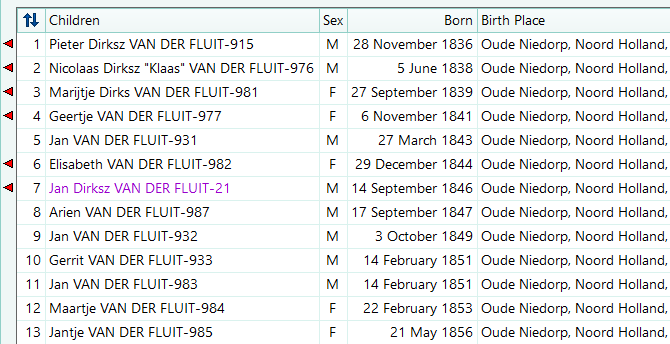
Back in the day – decades ago, now – I would sometimes ignore the multitude of children some of my ancestors brought into this world. Sometimes it was when a couple had ten or more children. More often than not, it was something I did when an ancestor remarried, or had an earlier marriage, which produced children. One of my great great grandfathers had 19 children – nine with his first wife and ten with his second.
There were simply so many kids in some families – even in ones with parents who only ever had one marriage – that I didn’t feel like I had to the time to enter all of them into my database or that it was all that important. In the case of previous or subsequent marriages, I’d usually annotate the entry with a note saying how many children the couple had together. Sometimes I’d include the first names of those children, but without their vital stats. What a time saver!
Not the longest list of children in my database!
Of course, anyone who has done genealogy for a while will have immediately spotted the error of my ways. I was foolishly ignoring my FAN club! Also known as “cluster genealogy”, “FAN” stands for “Friends, Associates, and Neighbours”, although over the years many have included “Family” amongst the friends. It is a term coined by Elizabeth Shown Mills, which involves researching the cluster of people around the person who is the target of the study. It often involves research of a person who might seem otherwise elusive. Evidence about their FANs might shed light on the otherwise mysterious relative.
I now make a point of including all the children of my direct ancestors. As well, I have a couple of direct ancestors for whom I am researching all their descendants. Of course, this has meant going back and properly adding all those children to my tree.
Citations
You have to take the crunchy with the smooth. As much as I love genealogy, like all things, it has its down sides. For me, it’s writing up source citations.
It is such a tedious time-consuming chore that I’ll sometimes put down my genealogy for weeks or even months at a time. All the while, mounds of data, digital and paper, keep piling up because sometimes I can’t not research. On top of that, I often have a gazillion browser tabs open at a time, waiting for the day that I bite the bullet and start doing the work.
It’s the doing dishes of genealogy, yet absolutely vital to the process.

 A Deck of Ancestors