

(Don’t Forget Family Search!)
While it might just be me, lately it seems that many archives are going out of their way to encourage donations. It even appears that they are targeting genealogists in these pitches. Even if an archive isn’t actively seeking donations, many archives’ websites provide information as to how to donate materials and published works.
What a great idea, particularly given how much I see on social media by genealogists pondering where their work will go, either because their children don’t care or because they have no descendants or nibblings to pass their work on to. However, even if you aren’t an endling or have someone would happily receive your genealogical materials, you should still consider what you might donate to an archive. If you’ve published a family history book, you should definitely consider it.
Don’t limit your thinking. Archives of all kinds accept donations: municipal, provincial, state, national, private, and institutional archives. Because I am based in greater Vancouver, Canada, most of the examples I am listing are Canadian. Here are but a few:
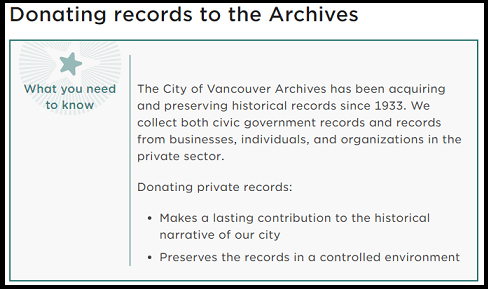
- The City of Vancouver Archives, which recently marked its 90th anniversary. “Donating records to the Archives“.
- The University of British Columbia, my alma mater. I spent countless hours in its archives and special collections division for academic and personal research – little of which was genealogy related! “Donate“.
- The British Columbia Archives: “Donating Records“.
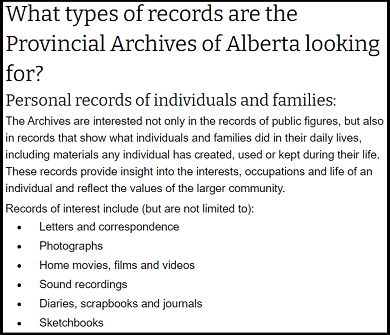
- Most other Canadian provincial archives have a donation page on their website. I’ll note two in particular. First, the Provincial Archives of Alberta. I note on their donation page, they expressly state that the kinds of records they are seeking include personal records of individuals and families: “Donate Your Records“.
- Second, the Nova Scotia Archives because they have excellent genealogy resources and I use it a lot for my wife’s side of the family: “Donating to the Archives“.
- Finally, Library and Archives Canada/Bibliothèque et Archives Canada has links for donating both records and published materials: “Donations“.
Given that there are fifty states and countless other institutions in the US, I will leave it to readers to Google the American archives that might be suitable for their records donations. However, the Society of American Archivists provides a great overview on “Donating Your Personal or Family Records to a Repository“.
Another place to consider – which might seem obvious once you think about it – is FamilySearch: “How Can I Donate?” They accept: family histories; published genealogical books; published historical books such as local and county histories; periodicals; directories; indexes and transcriptions of records in book format; yearbooks; journals (over 70 years old); family bibles containing genealogical information; and autobiographies and biographies.
Donate materials to an archive for all researchers to enjoy and benefit from!

 A Deck of Ancestors