This week, the 52 Ancestors Challenge theme is “Birthday”. What I have chosen to write about isn’t so much about a birthday, but about an age.
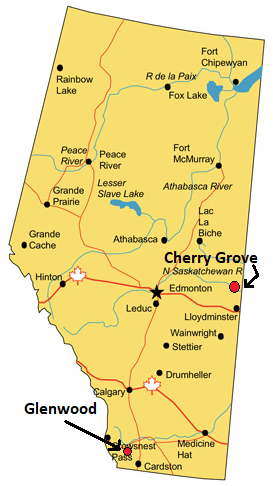
My great great grandfather, Horace Conrad Liggett Burgess, was born in 1854 in Lehi, Utah. In his 40s he was living and working in Wyoming. At age 50 he moved to Alberta, Canada, where he was a homesteader. He moved all around the province, so much so I’ve had trouble tracking his movements. It appears that from 1916 to 1930 he divided his time between Glenwood, in southern Alberta, and Cherry Grove, which is midway up the province close to the Saskatchewan border. Horace remained in Cherry Grove when he retired in 1930 at age 76. However, in 1928 he was in Glenwood.
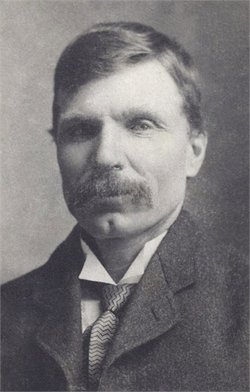
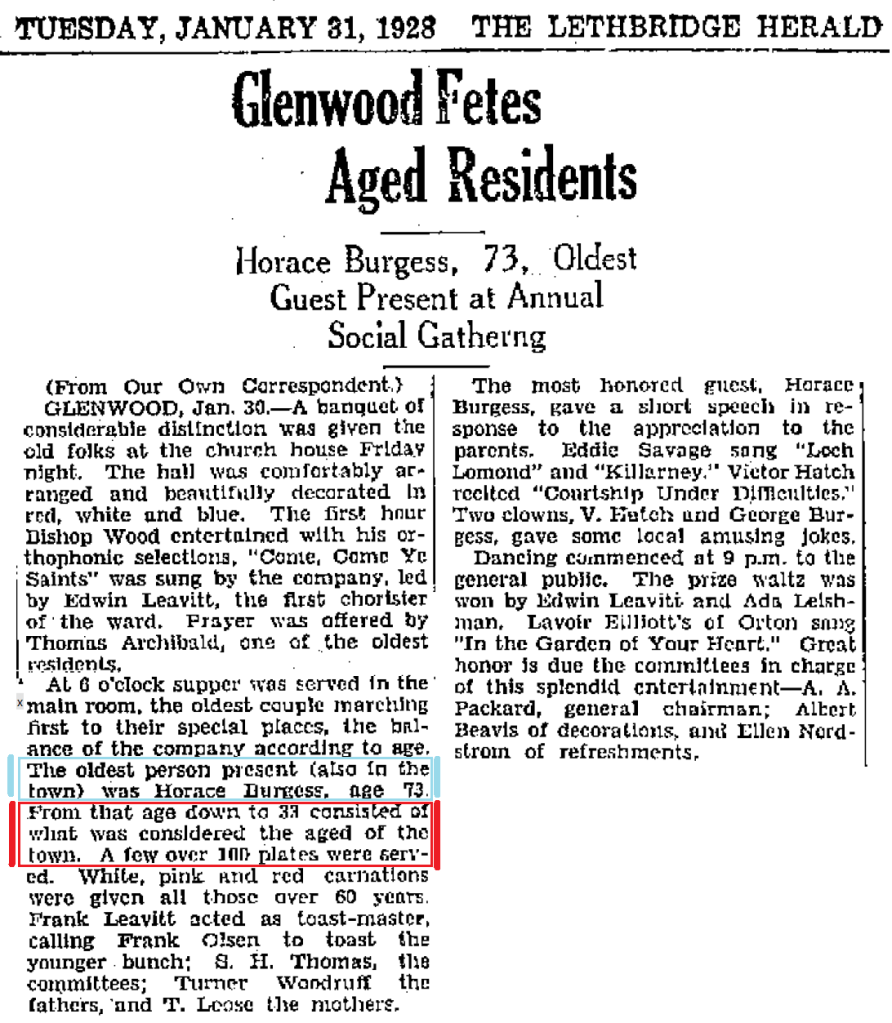
On January 30, 1928, the good burghers of Glenwood fêted the senior citizens of the village. At age 73, Horace (right) was the oldest of those honoured. According to the newspaper account of the event, “From that age down to 33 consisted of what was considered the aged of the town.”
33.
Aged.
Excuse me while I take a moment. My head just exploded.
The reference to Horace being the oldest resident of the town is in blue. The outrageous statement that age 33 is “aged” is in red.
The theme for this week’s 52 Ancestors Challenge is “Random”. So I decided to truly be random.
I currently have 5,294 people in my RootsMagic database. This consists mainly of my children’s direct ancestors, along with the spouses and children of those people. There are also several lines where I’m tracking all the descendants of certain ancestors; in particular, those of Dirck Jansz, my direct paternal great x10 grandfather.
Using a random number generator, I chose a number from 1 to 5,294. The plan was to write about the person whose record number corresponded with the result. The first result corresponded with a living person, so try again. The second time it came up with 3,061. That corresponds with Petrus van der Fluit, my second cousin twice removed.
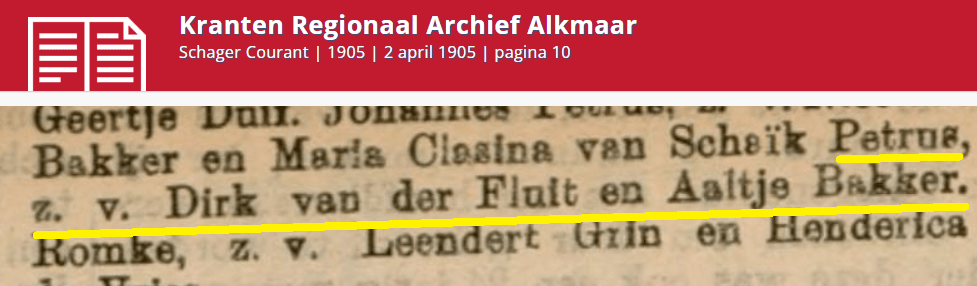
Birth notice for Petrus van der Fluit, Schager Courant, April 2, 1905, page 10.
Petrus did not have a long life. He was born on March 25, 1905 in Zijpe, Noord Holland, Netherlands. He died less than three months later, on June 18, 1905.
One might think that this is an unfortunate result, in that there is not much to say about someone who lived such a short life. However, I was quite happy with the result. To me, it’s important to remember those who never really got to live their lives. Not only were their lives dismally short, they’re often forgotten as a result. They might not have been long in this world, but their time on Earth should be noted.
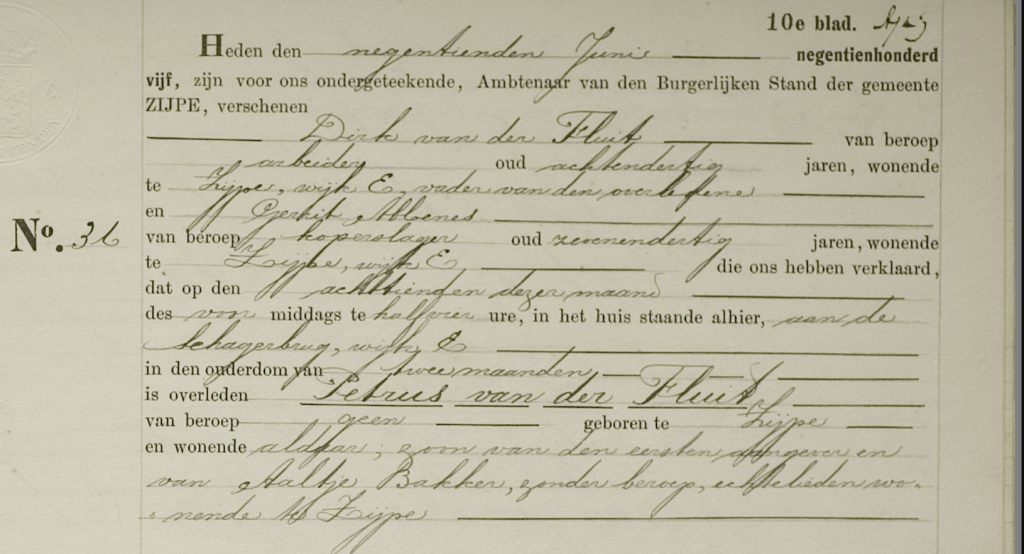
Death registration for Petrus van der Fluit, civil register for Zijpe – deaths.
Petrus was the son of Dirk van der Fluit and Aaltje Bakker. They married in Zijpe on May 4, 1895. Dirk is my first cousin three times removed. While Aaltje appears to be related to me through marriage, I have many Bakker ancestors and cousins from Zijpe and environs, so I would not be surprised to discover that she and I share a common ancestor.
Petrus was the fifth of six children born to Dirk and Aaltje. Sadly, Petrus was not the only one who died in infancy. Dirk and Aaltje’s second child passed away within a day of birth, and their youngest, Anna, lived less than ten months.
Death register for stillborn child (“levenloos”, or “lifeless”).
It has been said (attributed to everybody from the ancient Egyptians to Banksy): “Everyone dies twice. Once when you take your final breath, and then again the last time someone says your name.” I say the name “Petrus van der Fluit”, and he lives on.
Whenever I pointed out to my father how my younger siblings always got things that I was never allowed to have, he’d say, “at least I took you fishing!”
That answer sufficed for the seconds it took me to remember… “Dad, they hated fishing!”
Some of my earliest memories are going fishing with my father. We also did a fair amount of camping, but far less frequently. Fishing was our favourite outdoor activity. Growing up, we lived all over western Canada, so we’ve fished in all sorts of lakes and rivers, as well as the ocean. During trips to Alberta to see our grandparents, we’d often go fishing with my maternal grandfather as well.
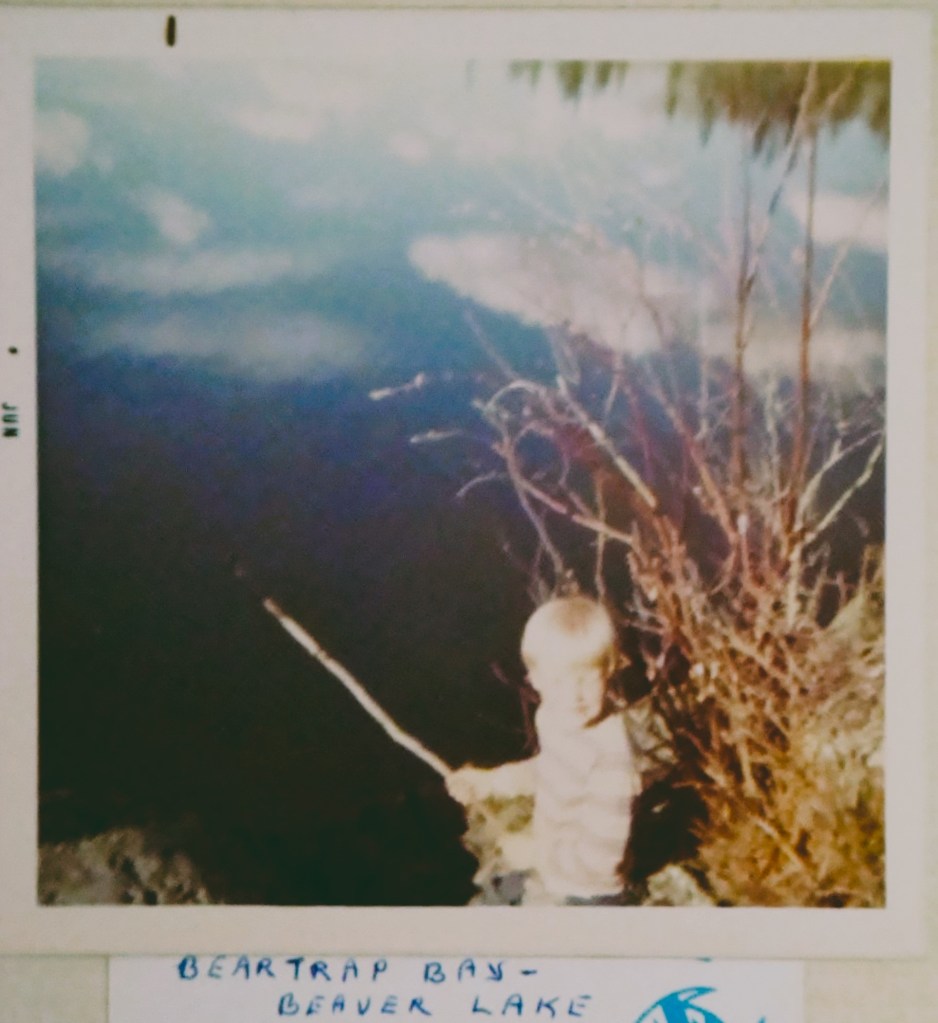
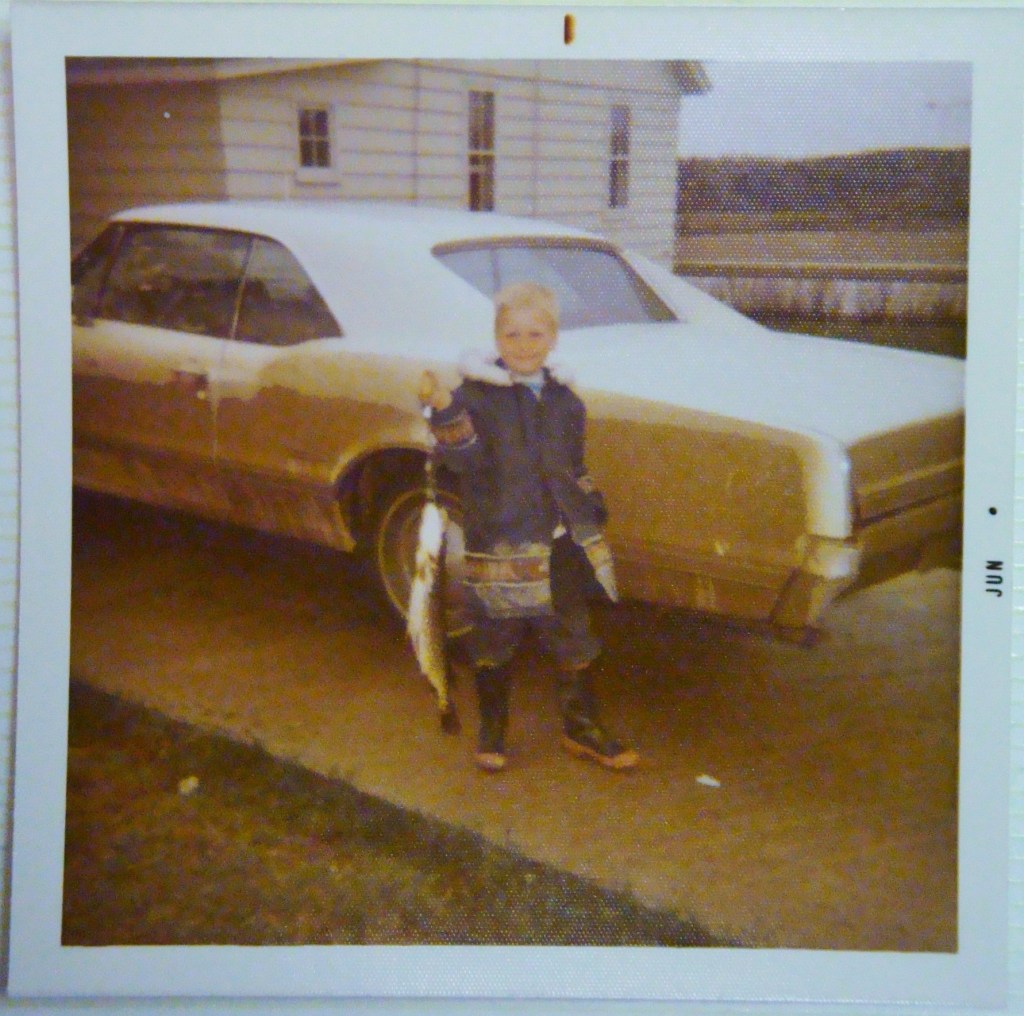
I was four and a half. We were living in Creighton, Saskatchewan at the time. We must have been on a road trip to my parents’ friends, who lived in southern Manitoba.
While we have angled for all types of fish, my favourite catch was always pickerel, which is what walleyes are called in western Canada. We also caught a lot of jackfish, which is another name for northern pike.
A month later, closer to my fifth birthday. In our driveway in Creighton.
One of the greatest controversies in my family involved pickerel. When we lived in North Battleford, Saskatchewan, one of our favourite fishing destinations was where the Battle River meets the North Saskatchewan River. In late summer, water levels were so low that a large sandbar developed, forming a sort of island. Water levels often were low enough that you could wade to the “island”, which took you to a particularly good spot where the pickerel seemed to gather.
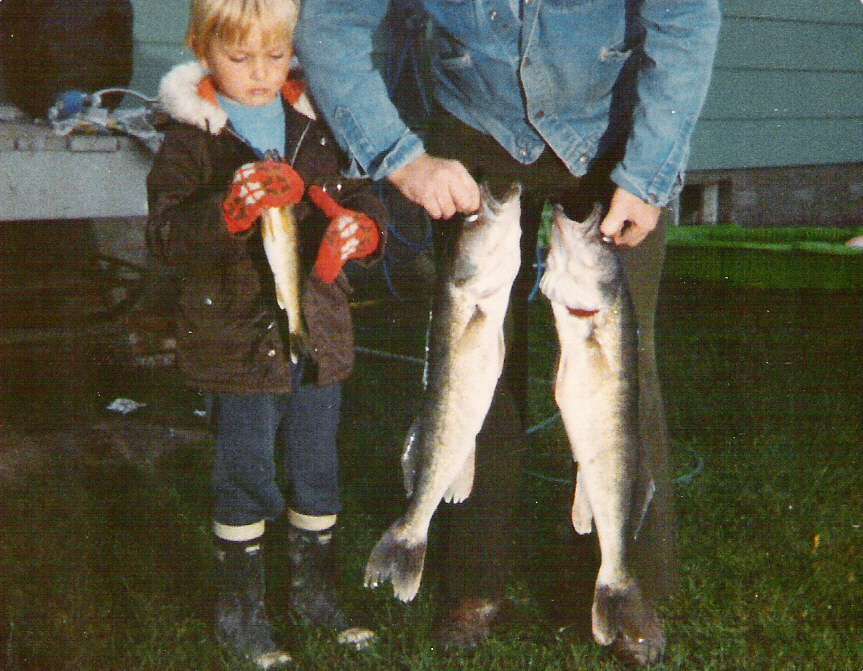
During one of those late-summer fishing expeditions, my brother caught two particularly large pickerel. However, he was about four years old at the time, and not strong enough to reel them in – one of the great things about pickerel is the fight they put up despite their size – so my father had to help them.
My brother and father with the controversial pickerel – along with one my brother was able to reel in himself.
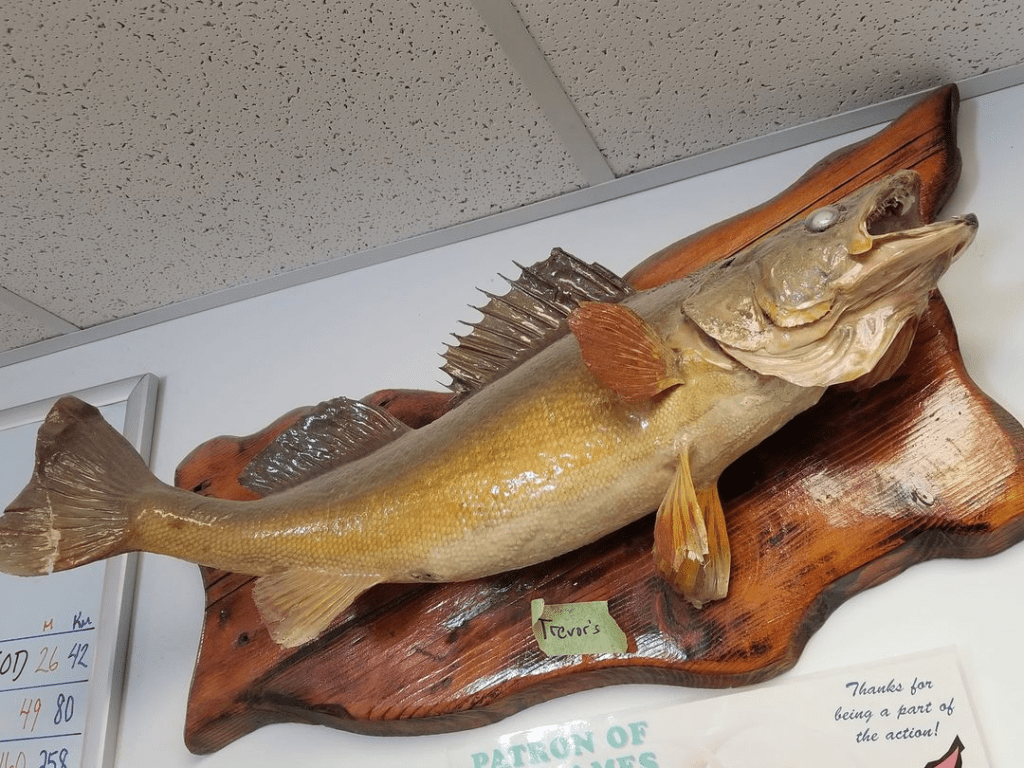
Pickerel are not a large fish by nature, so the eight-pounders my brother caught were pretty impressive. So much so that my father decided to have them mounted. However, in the decades that followed, they both claim that they caught the fish and have tried to take sole credit. In recent years, they’ve reached a compromise, and both recognize each other’s role in the achievement.
One of the two infamous controversial pickerel.
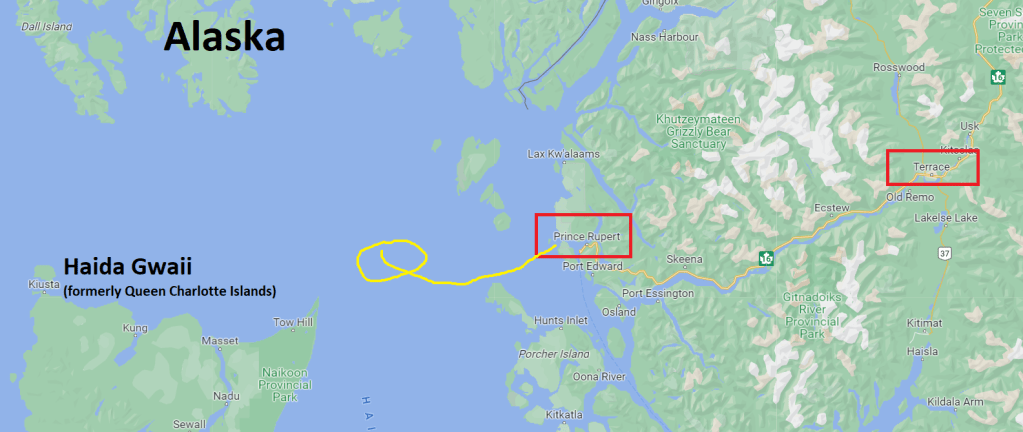
I also much prefer freshwater fishing to saltwater. However, one of my most memorable fishing trips was when I was in high school. At the time, we were living in Terrace, British Columbia. My father had a friend in Prince Rupert who had a fishing boat, who invited my father, me, and one of my brothers (he of pickerel fame) out one weekend. (My youngest brother was an infant at the time, so he wasn’t invited.) I’m sure my sisters were welcome to join us, but they had no interest.
Quickly after we started, not far offshore, we dropped some crap traps, and then set out for open water. Our goal was halibut, and we were quite successful. One of the best parts of the trip was that, at various times, we were able to see the coast of Haida Gwaii and Alaska. The most amazing part was seeing porpoises swimming along side us during part of the voyage. I’m sure my brother’s most significant memory of the trip was being nauseous.
A rough approximation of our fishing trip. The red box on the coast is Prince Rupert, the one inland is Terrace, where we were living at the time.
Talk about “slow”, this week’s theme for the 52 Ancestors Challenge. It has taken me forever to think of anything that suits, no matter how broadly I interpreted the word. After alternatively wracking my brains and sleeping on it, I was reminded of something my great grandmother, Emelia Anton, once said.
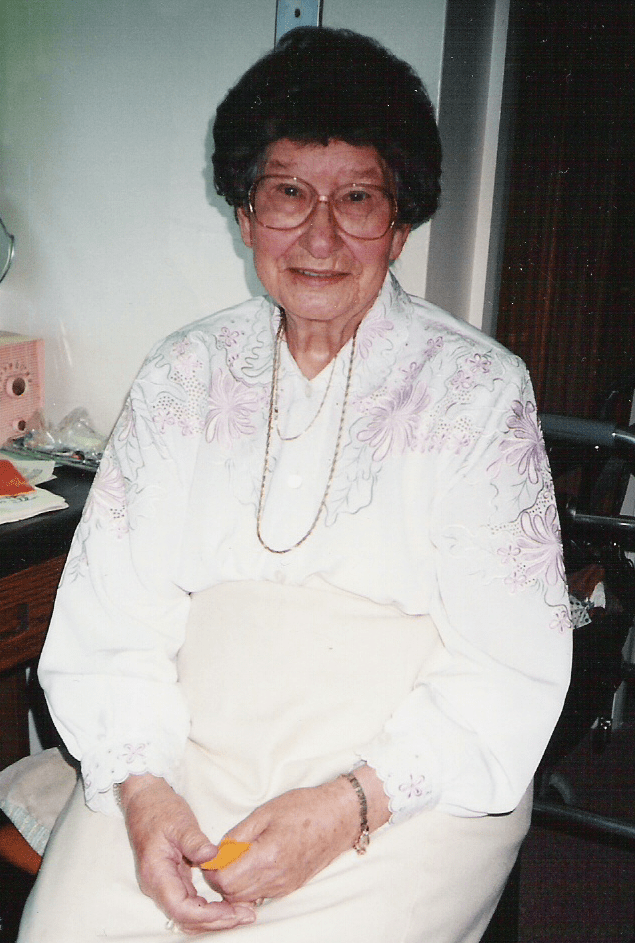
My great grandmother lived to be 94. While she experienced some dementia in her last year or so, she remained active. She regularly participated in bingo outings with my grandfather (her son-in-law), playing multiple cards at once, keeping pace better than I could (or still can).
Great grandma’s favourite game was bridge, a game I’ve struggled to grasp despite being an avid and seasoned card player. She took great pride in the fact she still had the mental acuity for the game, even into her 90s. However, but complained that her peers were getting too slow for her.
My great grandmother, Amelia Anton, late in her life, and still an avid bridge player.

 A Deck of Ancestors