52W Mark IV – Week 47: Card L8 Valentine Schmidt

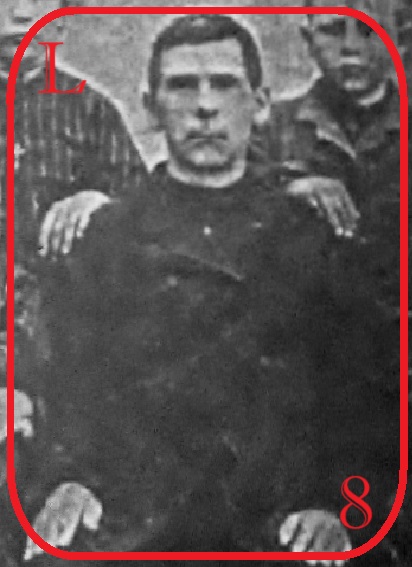
Valentine Schmidt (1839-?)

The unexpected benefit of the way I’ve chosen to do the 52 Ancestors Challenge this year is that I come out knowing more about each of my ancestors than when I started to write the posts. When I came up with the idea, I thought it would simply be a matter of writing up my research.

Instead, the gaps in my research and lack of knowledge for most individuals became readily apparent when I started to write about them. I’ve ended up doing much more research than anticipated, and that’s been a great thing. It has helped me hone and practice my genealogy skills while fulfilling the primary reason I do the challenge, which is to write more. As I said back in March, it’s turned into participating in a second challenge – Yvette Hoitink‘s Level-Up Challenge!
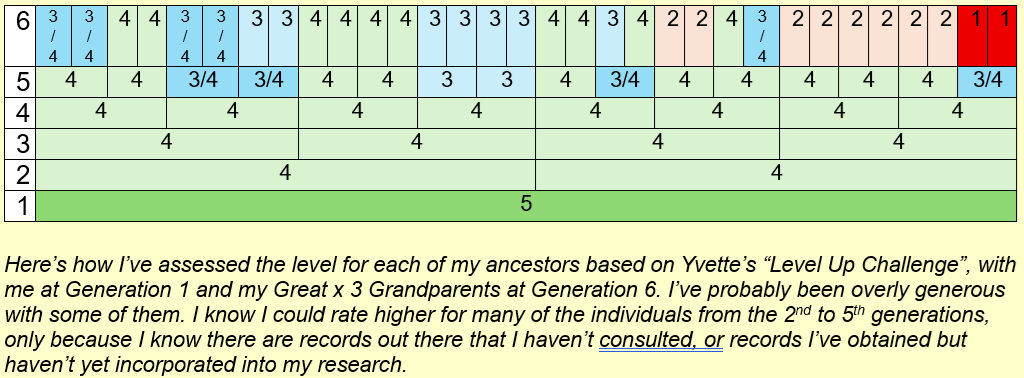
The primary downside is that I spent several months many weeks behind in the Challenge this year. I finally caught up a few weeks ago, but largely only because I know so little about the final suit of my deck and there are so few readily available resources. Many of those individuals were barely above a “one” before writing them up over the last few weeks.

Case in point is my Great x3 Grandfather Valentine Schmidt. A few weeks ago, I had little more than a birthdate, a vague idea that he was born in the Beresan colonies of the Germans from Russia and the name of his spouse. However, I did have some additional information that I hadn’t incorporated into my database – some of which I’ve had for decades.

Valentine was born in 1839 in the Karlsruhe Colony of the Beresan district in Ukraine, which at the time was part of the Russian Empire. He was the seventh of 13 children born to Mathias Schmidt and Elisabetha Messer.
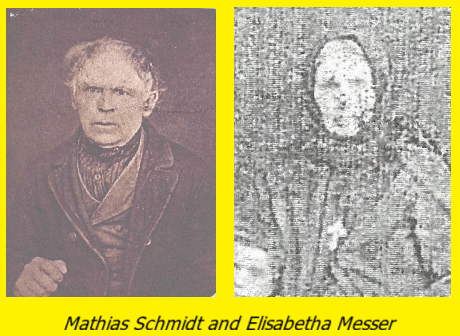
Matthias and Elisabetha were born in Alsace, which has a long history of moving between French and German control. Matthias was born in Röschwoog, which practically sits on the current French-German border, in 1806. At the time Matthias and Elisabetha were born, Alsace was firmly in the control of Napoleon. Matthias and Elisabetha most likely settled in the Beresan as teens, moving with their families. By 1819, they were both in Karlsruhe and by 1831 they were married, when they had their first child.

As far as I know, Valentine lived his whole life in Karlsruhe. He married Margaretha “Regina” Boechler on October 21, 1863. They had at least two children that I have researched and who have some sort of documented sources – my Great x 2 Grandmother Barbara and a younger sister named Elisabeth. While FamilySearch tells me that there were four more children after Elisabeth, not a single source has been cited for any of them.

Valentine was still alive in 1894, when his father passed away. He was also most likely still in Karlsruhe, which means he was still there when his daughter Barbara and son-in-law Michael Lerner emigrated to America.

Since Valentine was still alive well into his 50s and at the time his daughter emigrated, I considered whether he had also emigrated to America, particularly given the lack of evidence he died in Karlsruhe. However, I have never found anything indicating that occurred.
52W Mark IV – Week 46: Card L7 Anastasia Wormsbecker

Anastasia Wormsbecker (est. 1840-?)

My Gx3 Grandmother, Anastasia Wormsbecker, was born sometime around 1840, most likely in a German colony in the Beresan District of Ukraine, which was then part of the Russian Empire. It is likely she was from the colony of Rastadt. The original founding colonists included some Wormsbeckers; as well, Anastasia married a man, Franz Lerner, who was also likely born in Rastadt. I know nothing about Anastasia’s parents or what part of Germany her ancestors were from before settling in the Beresan.

Anastasia and Franz likely married sometime before 1860, which is the year that their first child, Elisabeth, was probably born. Anastasia and Franz had five more children, the last of whom was born in 1873. Four of their six children emigrated from the Beresan; three ultimately ended up in Saskatchewan, Canada, while a son ended up in Texax.

Sometime between 1873 and 1877, Franz died. By 1878, Anastasia married Thomas Schmidt, with whom she had three children. At least one of their children, Katharina, emigrated for Alberta, Canada.

Given that Anastasia had three children with Thomas, she likely lived at least until 1880. Beyond that, I know nothing more about her life.

52W Mark IV – Week 45: Card L6 Franciscus Lerner

Franciscus “Franz” Lerner (betw. 1835~1840 – 1876~1877)

I’m now entering the set of cards in this suit of my Gx3 Grandparents on my mother’s maternal line, of whom I know the least. We are in some pretty hazy territory, so I expect the next eight posts to be much shorter than the rest. My Gx3 Grandfather, Franciscus “Franz” Lerner is a prime example of this. I don’t even have a solid idea of when he was born and died.

As far as I know, with not a lot of evidence, is that Franz was born sometime between 1835 and 1840 in the German colony of Rastadt in the Beresan District of Ukraine, which was part of the Russian Empire at the time. What I know with a bit more certainty is that Franz’s paternal line hailed from the Karlsruhe area of Baden in what is now Germany. At least four generations of his direct male line likely may have lived in Baden.

The hiccup in this lineage is the identity of Franz’s father. While I know nothing of Franz’s mother, not even her name, I have two possible candidates who might be his father. Franz may be the son of one of two brothers, Michael Lerner or Bernard Lerner. They are the sons of Franz Ignaz Lerner (1759-aft. 1816) and Maria Eva Geiger (1756-aft. 1816), both from Malsch, Karlsruhe, Baden. They left Baden for the Beresan in 1809 and settled in Rastadt.

  • Michael Lerner was born on July 11, 1793 in Malsch, Karlsruhe, Baden. He was married to Maria Eva Eberle, born June 3, 1793 in Pleisweiler, Bergzabern, Pfalz, although the evidence of this marriage is not verified.
  • Bernard Lerner born February 27, 1798 in Malsch, Karlsruhe, Baden. Bernard was married to Barbara Heil, who was born about 1799 in Niederlustadt, Germersheim, Pfalz.

Franz married Anastasia Wormsbecker (there are many spelling variations) in Rastadt, Beresan sometime around 1860. They had five children. The youngest four all emigrated to North America. Two went directly to Saskatchewan, Canada. Two sons went to Texas, one of whom was my Great Great Grandfather, Michael (“Mike”) Lerner. Mike ultimately moved to Saskatchewan with his family; his brother, Jerome, remained in Texas. Only their eldest child, Elisabeth, remained in the Beresan.

As I was looking at the list of Franz’s children, my mind began to speculate. A custom in the Netherlands for naming children was that the first son was named after the child’s paternal grandfather. The second son was named after the maternal grandfather. The first-born daughter was named after her maternal grandmother; the second daughter was named after her paternal grandmother.

If there was anything similar in German culture, particularly those parts of Germany closer to the Netherlands, that carried into the Beresan, it might provide a clue as to whether Michael or Bernard is Franz’s father. Mike was Franz and Anastasia’s first-born son. The name would be in keeping with a paternal grandfather with the same name. Mike and Anastasia did not name any of their other two sons Bernard. Of course, I can’t place much, if any, weight on this, but it does make some walking around sense.

For me, Franz’s life ended as mysteriously as it began. At most, all I know is that the possibility is that Franz died in 1876 or 1877 in the Beresan.

You can find more specific information about the dates and places of Franz’s birth, marriage, and death on various online trees, but they are largely unsourced or provide unverifiable and vague citations. Without something more, they deserve to be given no weight.

52W Mark IV – Week 44: Card L5 Margaretha Heck

Margaretha (“Margaret”) Heck (1868-1946)

Both sides of my Grandmother Helen Lerner’s family are  Germans from Russia. Her branch of my tree is the one I know least about and is the most difficult to research. As a result, it does not go back very far for most branches, and is the most rife with brick walls and conflicting information. Perhaps the line I know least about is that of my Great Great Grandmother Margaretha (“Margaret”) Heck.

Margaret Heck was born on April 1, 1865 (although the year might be in question), in one of the German colonies in the Beresan District of what is now Ukraine, but at the time was part of the Russian Empire. Not only do I not know which specific colony she was born in, I have no idea of where her ancestors came from. At most, I suspect that they had their origins in the same German states, principalities, and duchies that my other Beresan ancestors had come from, such as Baden or the Palatinate. I really know nothing more than the names of Margaret’s parents, and even that information has little foundation.

My mother shares the same birthday as Margaret. As a result, she shares Margaret’s name as her middle name. In fact, Margaret was supposed to have been my mother’s first name, but her father, Leo Burgess, objected, saying that everyone would call her “Maggie”. When my Grandmother arrived home from the hospital with my mother, Leo’s father Milton was there. Upon seeing my mother he exclaimed, “There’s Maggie!” It stuck. Since that time, Lorraine’s father and grandfather called her Maggie.

Margaret married Jacob Anton sometime before 1890, possibly in the Karlsruhe colony. There Margaret had five children, from 1890 to 1898. Sometime after February 1898 and before April 1900, the family left the Beresan for Russia proper, settling in Selo Suchoi, somewhere near Veronesch. A “selo”, as I understand it, is a village with a church. The family lived in Selo Suchoi for just over ten years. During that time, Margaret gave birth to five more children, from 1900 to 1910.

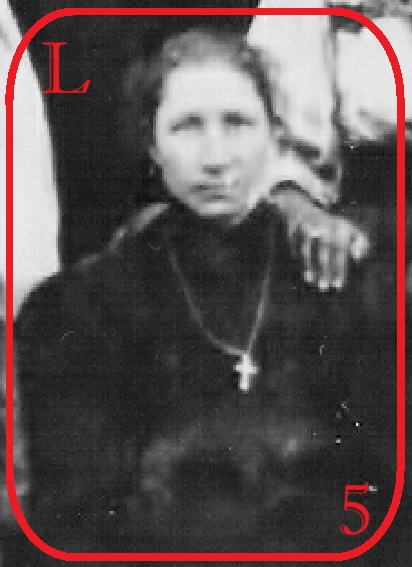
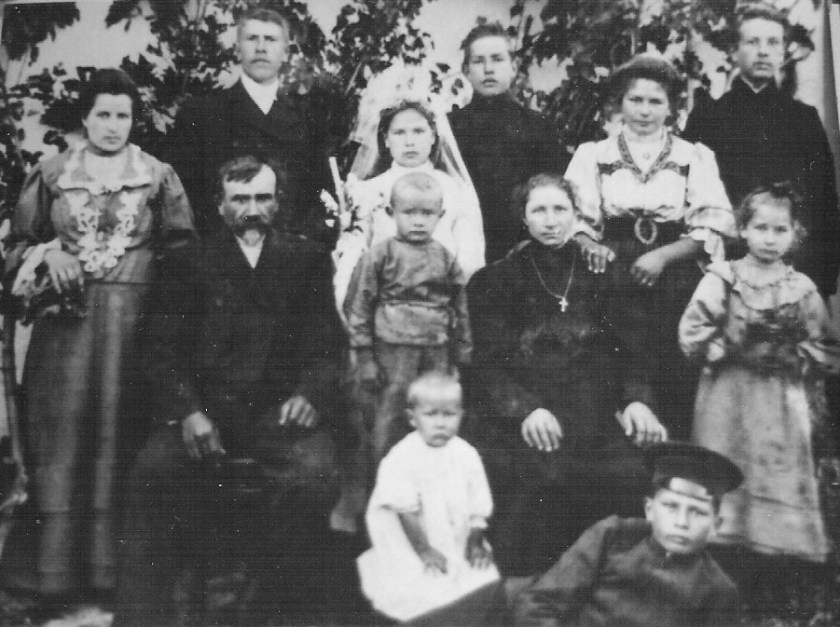
The Anton family. My Great Grandmother, Emelia Anton, is on the girl on the right side of the photo who appears to be holding a bouquet. This is said to have been taken around 1910, and was most likely taken in Selo Suchoi. I believe it was taken before Margaret’s youngest daughter, Rose, was born. Emelia had two younger brothers and one younger sister, but only two children here appear to be younger. As well, Emelia only had two older sisters, but there are three girls who appear older than her. I suspect the girl in the centre is Philomena, likely dressed for a First Communion or Confirmation, who was three years older than Emelia. My guess is that one of the older girls might be the wife of one of Emelia’s older brothers.

On June 18, 1912, Margaret and the family departed Hamburg aboard the S.S. Pennsylvania, bound for Canada via New York. The ship’s passenger manifest described Margaret as 5’6″, blonde, and blue-eyed. The Pennsylvania arrived at Ellis Island on July 1, 1912. By the end of July, the family had arrived at Rastadt, Saskatchewan, where Jacob secured a piece of land for homesteading. Jacob farmed the land for less than 10 years, as he passed away in May 1921. The land he owned was divided between three of his sons.

A few years later, sometime after January 1924 and before April 1925, Margaret remarried, to a man named George Meuchel (1863-1948). George was also a German from Russia. He moved from the Beresan to North Dakota in 1892. At the time he was married and had three children; he and his wife, Paulina, had 13 more children in North Dakota. Paulina died in January 1924. The 1925 North Dakota state census shows Margaret and George as married.

I have no idea how Margaret and George met. Some rudimentary digging seems to indicate he might have had a son who was homesteading not far from where Jacob and Margaret were farming. I also cannot find any record of their marriage, either in Saskatchewan or North Dakota. While census records suggest they were married, it may well be that they hadn’t actually gone through the civil or religious process.

The couple also were not in North Dakota for long after they married – the 1926 Canadian census of the Prairies shows them in Saskatchewan near Rastadt. Five years later, George and Margaret were living in Medicine Hat, Alberta. How long they were there, I cannot say, and 1931 is the last census year currently available. However, at some point in time they moved back to Saskatchewan.

My Aunt Adeline (Emelia’s daughter) told me that she would often go to her grandmother’s house after school. Sometimes she would spend several weeks at her grandmother’s. Addie said that her grandmother as far more straight-laced than Emelia. Addie described Margaret as religious, but in a quiet and not in a showy way; she was not the kind of person who spoke about God much. However, Addie told me that while Margaret did not say it a lot, if you shocked her she would say, “Holy mother of God”. She quickly added that her grandmother likely said it in German, but Addie could only remember it in English. Addie also remembered George, as her grandfather Jacob had passed away when Addie was nine.

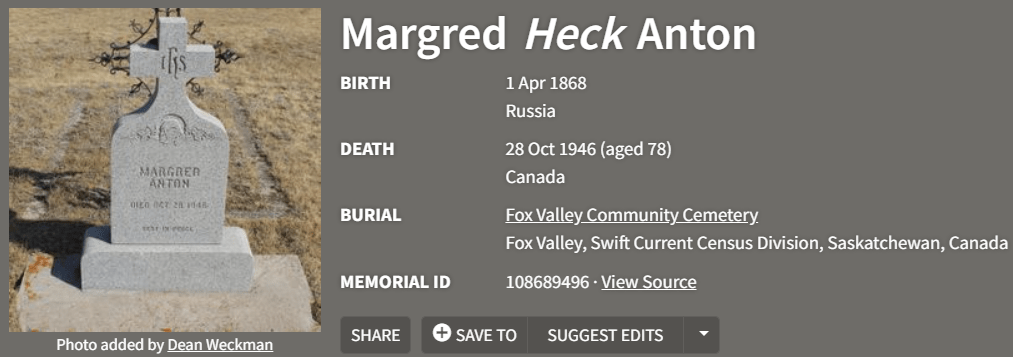
Margaret died in Fox Valley, Saskatchewan, on October 28, 1946. She is interred at the Fox Valley Cemetery. As for George, he ultimately moved back to North Dakota, where he died on March 29, 1948. George is buried alongside Pauline in Grant County, North Dakota.

I don’t recall seeing this headstone when I visited in 1997. I also don’t know where “Margred” came from.