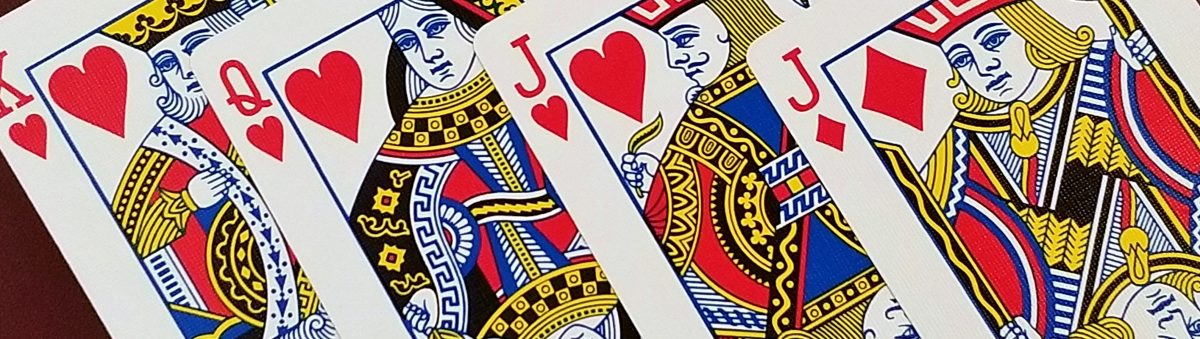
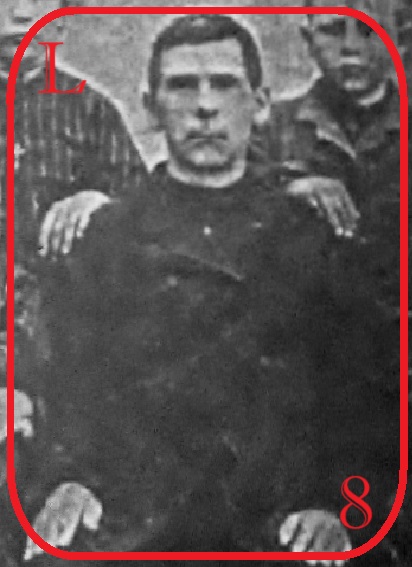
52W Mark IV – Week 47: Card L8 Valentine Schmidt

Valentine Schmidt (1839-?)

The unexpected benefit of the way I’ve chosen to do the 52 Ancestors Challenge this year is that I come out knowing more about each of my ancestors than when I started to write the posts. When I came up with the idea, I thought it would simply be a matter of writing up my research.

Instead, the gaps in my research and lack of knowledge for most individuals became readily apparent when I started to write about them. I’ve ended up doing much more research than anticipated, and that’s been a great thing. It has helped me hone and practice my genealogy skills while fulfilling the primary reason I do the challenge, which is to write more. As I said back in March, it’s turned into participating in a second challenge – Yvette Hoitink‘s Level-Up Challenge!
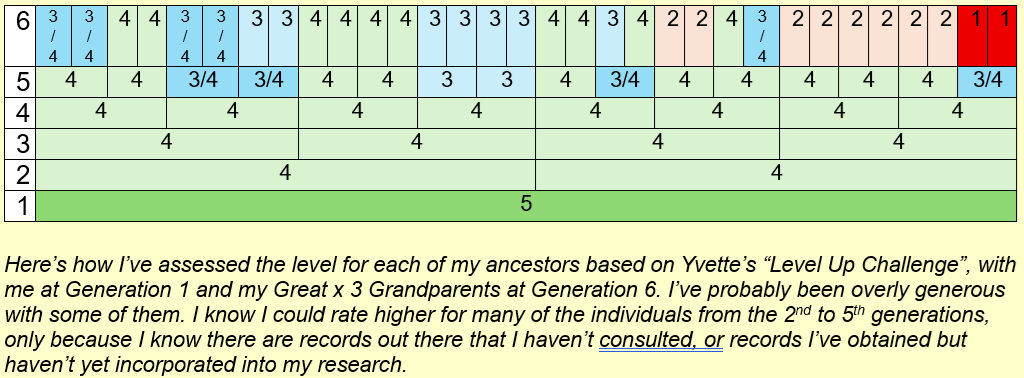
The primary downside is that I spent several months many weeks behind in the Challenge this year. I finally caught up a few weeks ago, but largely only because I know so little about the final suit of my deck and there are so few readily available resources. Many of those individuals were barely above a “one” before writing them up over the last few weeks.

Case in point is my Great x3 Grandfather Valentine Schmidt. A few weeks ago, I had little more than a birthdate, a vague idea that he was born in the Beresan colonies of the Germans from Russia and the name of his spouse. However, I did have some additional information that I hadn’t incorporated into my database – some of which I’ve had for decades.

Valentine was born in 1839 in the Karlsruhe Colony of the Beresan district in Ukraine, which at the time was part of the Russian Empire. He was the seventh of 13 children born to Mathias Schmidt and Elisabetha Messer.
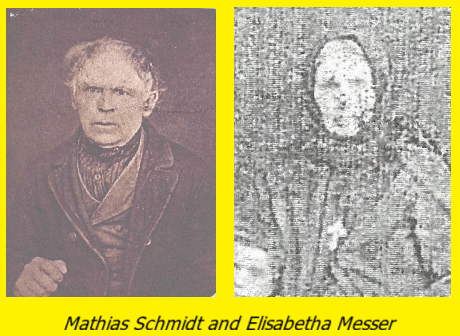
Matthias and Elisabetha were born in Alsace, which has a long history of moving between French and German control. Matthias was born in Röschwoog, which practically sits on the current French-German border, in 1806. At the time Matthias and Elisabetha were born, Alsace was firmly in the control of Napoleon. Matthias and Elisabetha most likely settled in the Beresan as teens, moving with their families. By 1819, they were both in Karlsruhe and by 1831 they were married, when they had their first child.

As far as I know, Valentine lived his whole life in Karlsruhe. He married Margaretha “Regina” Boechler on October 21, 1863. They had at least two children that I have researched and who have some sort of documented sources – my Great x 2 Grandmother Barbara and a younger sister named Elisabeth. While FamilySearch tells me that there were four more children after Elisabeth, not a single source has been cited for any of them.

Valentine was still alive in 1894, when his father passed away. He was also most likely still in Karlsruhe, which means he was still there when his daughter Barbara and son-in-law Michael Lerner emigrated to America.

Since Valentine was still alive well into his 50s and at the time his daughter emigrated, I considered whether he had also emigrated to America, particularly given the lack of evidence he died in Karlsruhe. However, I have never found anything indicating that occurred.
52W Mark IV – Week 7: Card V7 Aaltje Klaasse Stroet

Aaltje Klaasse Stroet (1813-1881)

While it’s still early days, I’m discovering that the different approach I am taking to this year’s 52 Ancestors Challenge is that it has prompted me to do a long-standing but long-languishing research goal: to bolster and verify the research I’ve done for the first few generations of my direct ancestors. While not quite the same, it’s similar to Yvette Hoitink’s “Level-up Challenge.” By focusing on individuals rather than topics, I’ve been discovering a lot of gaps in my knowledge and research for the 52 direct ancestors I’ve chosen to write about this year.

Take this week’s subject, Aaltje Klaase Stroet. A few weeks ago, I had little more than her birth, marriage, and death. Now I know a fair bit more – including a lot of information about the farm where she lived and worked with her husband Dirk.

Aaltje was the youngest and tenth child of Nicolaus Dirkszoon “Klaas” Stroet and Geertje Jansdochter Molenaar. Aaltje was born on June 18, 1813, in Nieuwe Niedorp, Noord Holland, just like all her older siblings.

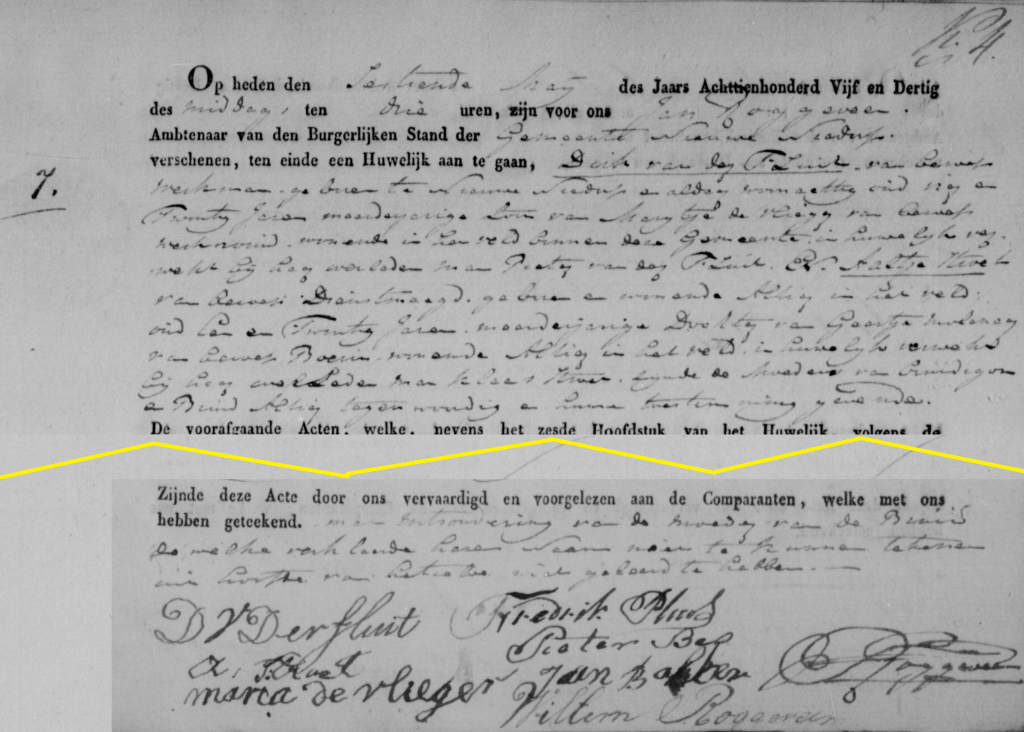
At the time Aaltje married in 1835, she worked as a housemaid in Nieuwe Niedorp; however, I have yet to find an entry for Aaltje in a Dienstboderegister (a register of domestic servants kept as part of a municipality’s Civil Registration Register). The most significant piece of evidence regarding Aaltje’s occupation as a housemaid is the registration of her marriage to Dirk Pietersz van der Fluit, which occurred on May 16, 1835 in Nieuwe Niedorp.

The top and bottom of Aaltje and Dirk’s marriage registration, which includes mention that Aaltje’s occupation was “dienstmaagd” (maid).

At the time Aaltje and Dirk married, Dirk was employed as a labourer. Dirk later took up farming. While he might have undertaken farming at an earlier time, in 1847 a stolpboerderij (“bell jar” or “covered” farm) in ‘t Veld, Noord Holland was registered in the names of Dirk and Aaltje. Until ‘t Veld was part of gemeente (municipality) Oude Niedorp; it is now within gemeente Hollands Kroon.

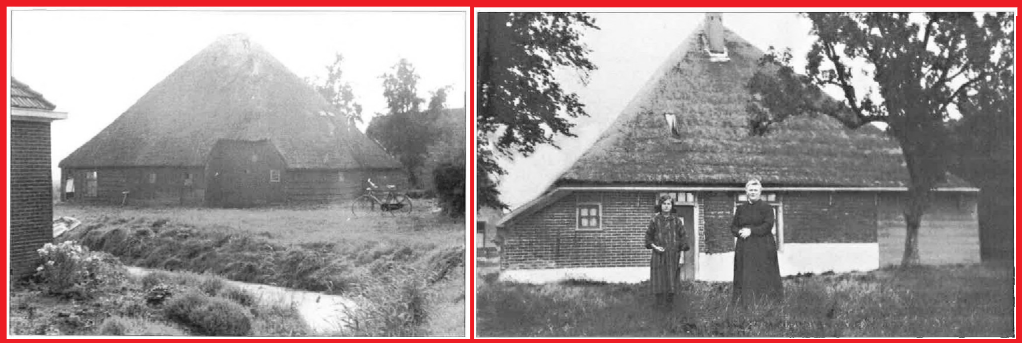
Two views of Aaltje and Dirk’s stolpboerderij from ‘t Is Mooi Weest magazine, December 2004. Both photos were taken after Aaltje’s death. The photo on the right shows Maria Veerman, the owner of the property after 1917, along with her daughter Geertje.

A stolpboerderij was a style of farmhouse that was common in the West Friesland area of Noord Holland. They were pyramid-like thatched roof buildings that served as a combination farm house and separate space for animals, hay, wagons, or tools.

The stolpboerderij that Dirk and Aaltje acquired already existed at the time the land registry in which it was registered was created, in 1832, so it is difficult to determine the time of its construction. In 1832, when the registry was created, the farm was owned by the Roman Catholic church of ‘t Veld. Aaltje remained on the farm after Dirk died in 1857, along with all their children, and it remained registered in her name.

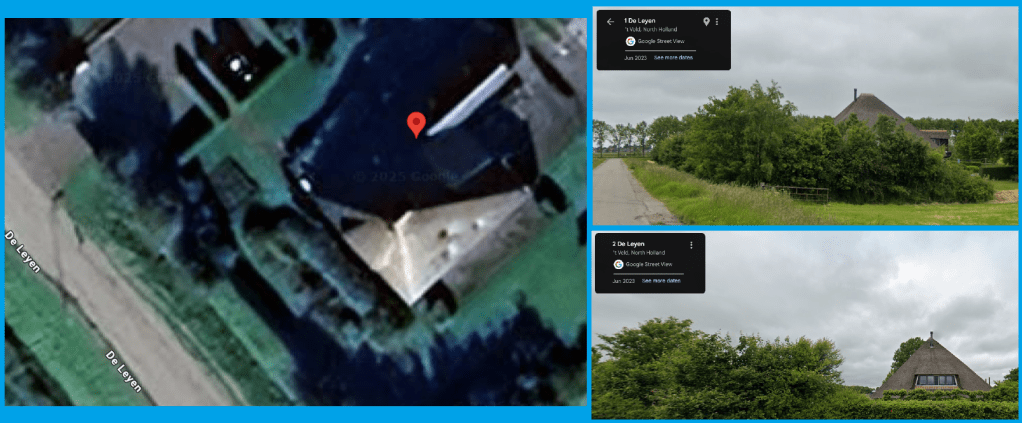
Based upon these views from Google Maps, the stolpboerderij where Aaltje and Dirk is still standing.

According to the Bevolkingsregister (population register) for Oude Niedorp for 1860-1885, some of Aaltje’s children remained at the farm after they reached adulthood. In fact, three of Aaltje’s grandchildren through her second son Nicolaas (1838-1876) were living at the farm, at least as late as 1880.

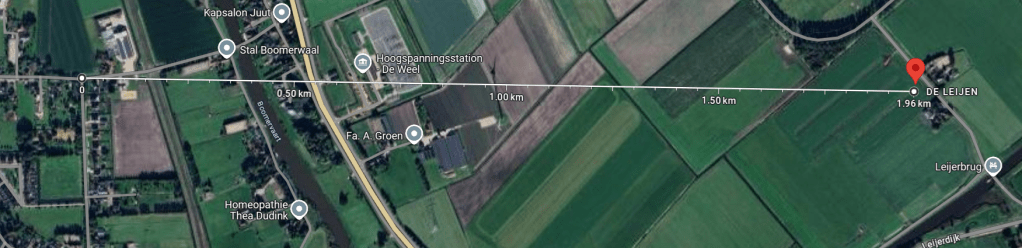
Aaltje died on March 6, 1881 in Oude Niedorp, most likely at the farm in ‘t Veld. An index for the Roman Catholic Parish of St. Martinus in ‘t Veld indicates that Aaltje’s heirs sold the farm by auction. The index suggests that the church council purchased the land, “called the Hofstede, in the Leijerpolder”. That indicates that the farm was less than two kilometers from where my father was born, in Waarland.

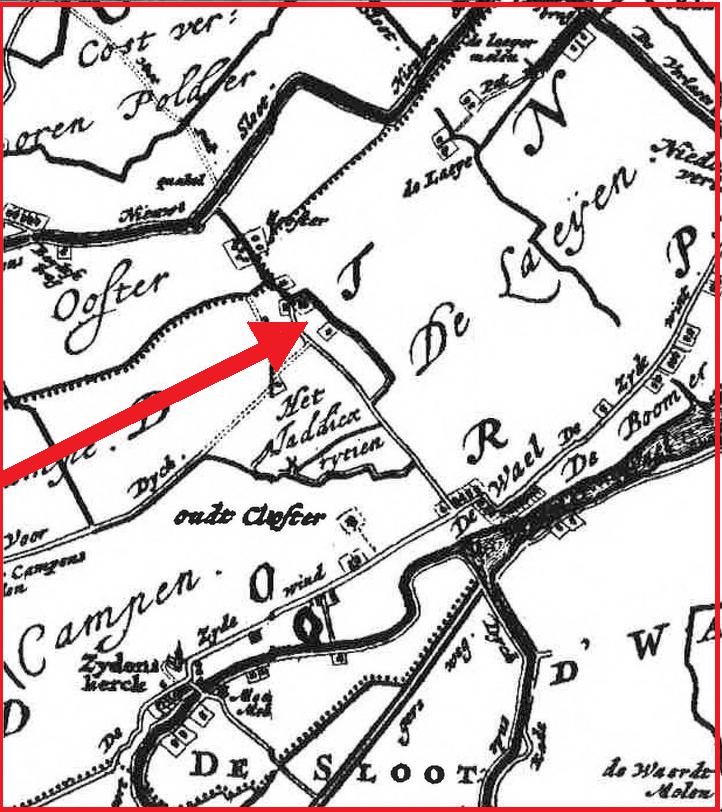
The location of Dirk and Aaltje’s stolpboerderij, shown in ‘t Is Mooi Weest magazine, page 9, December 2004.
Dirk and Aaltje’s stolpboerderij was less than two kilometers due east of where my father was born. I see that I came within about 700 meters of this property, if not closer, during my last trip to the Netherlands. If only I had known!

However, another source shows that in 1882, a year after Aaltje died, the farm was sold by auction to Simon Groen and Marijtje Kuilboer.

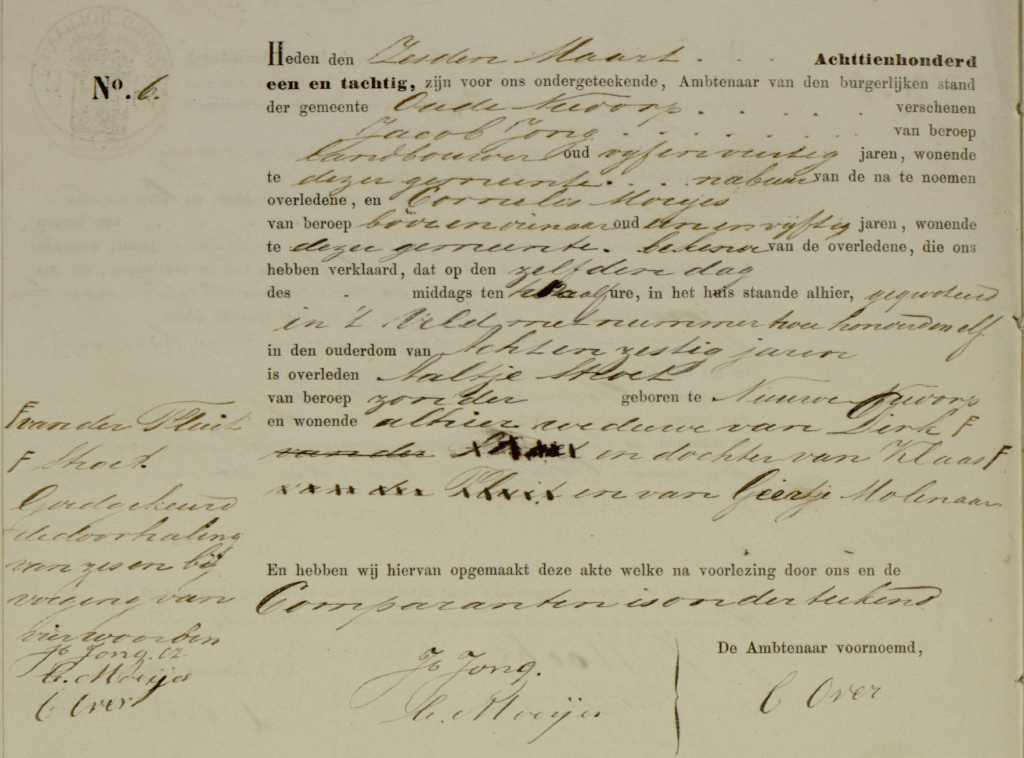
Death registration for Aaltje Stroet. There was a clerical error in that her husband Dirk was recorded as her father; it is the crossed out item. The margin corrected the error, naming Dirk as her husband.

52W Mark II – Week 6: Social Media

Needless to say, most of our ancestors were never on what we now consider to be social media. There were forms of communication and systems of social connection that we can consider to be the “social media” of their time. Minstrels, troubadours, and jongleurs were the social media influencers of medieval times. Ham radios and party lines are more recent pre-internet examples of what could be analogous to modern social media.

This is not an ad. Welcome to the olden days of the internet.

Of course, nowadays when people think of more modern forms of social media, things like Facebook and Twitter readily come to mind. I’ve made great use of both of those for genealogical purposes.

However, if you think about it, social media as we know it is getting somewhat long in the tooth, and the internet has been around so long that we no longer capitalize the word. The World Wide Web – another term that’s not used so much any more – made its debut to the general public in 1991. Thousands of genealogy websites were in existence more than 25 years ago. When Cyndi’s list made its debut in 1996, it had thousands of links by the end of that year.

The late 90s was also the heyday of Geocities, which I used for genealogy, among other things.

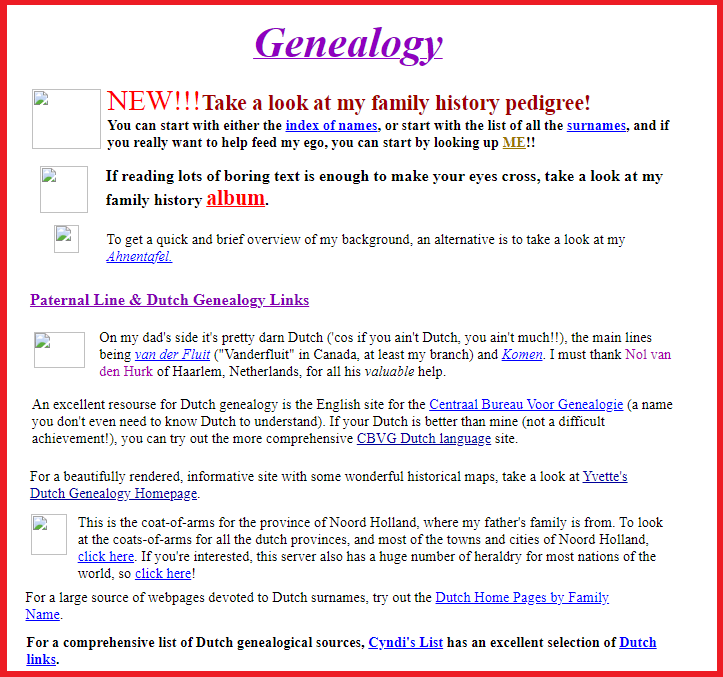
Here’s a part of the genealogy section of my Geocities site as it was in February 1999. Unfortunately, the background design and images have been lost.

I am amazed to see how many of the links on my old Geocities page still work. Of course, I made several mentions of Cyndi’s List. In fact, my genealogy page ended with this:

I also would be remiss if I didn’t give a shout out to Yvette’s Dutch Genealogy Homepage, which you’ll see is one of the hyperlinks on my old Geocities page. It is now Dutch Genealogy and I still make use of it all the time. Given that 15 years ago Yvette marked its 15th anniversary, this site has now been around in one form or another for thirty years!

Yes, I acknowledge that websites aren’t necessarily social media. However, while the term “social media” was many years in the future, I would argue that message boards, bulletin boards, IRC (internet relay chat), and Usenet were all early forms of social media. Looking through my digitized documents, I am surprised by how many items I saved through those sources as far back as 1995, along with scores of emails I exchanged with other genealogists using good old Pine. Other websites from back in the day that were forms of social media included Classmates.com and SixDegrees.com.

Even blogging easily pre-dates the turn of the century. THIS century, not 1900 as might come to mind to many older people when they hear the term. Blogging networking platforms such as Open Diary and LiveJournal originated in the late 90s.

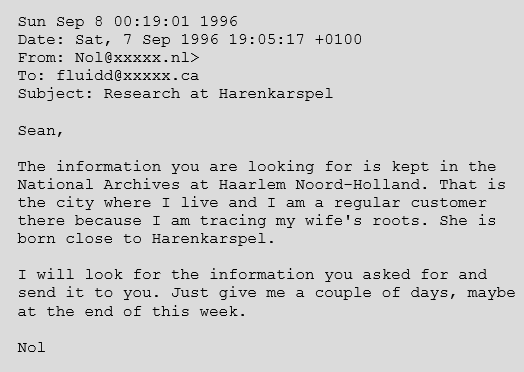
I still have connections with some of the people I met through those venues, especially Nol, a fellow genealogist from Haarlem. I can’t even remember which bulletin board or Usenet group I met him on, but I have every email we exchanged since 1995. His help over the years has been invaluable. My only regret is that after all this time, I have yet to meet him in real life. The last time I was in Haarlem, Nol was in the United States! I promise we’re not deliberately trying to avoid each other.

My first email from Nol after we moved off the message boards. Not long after we started our correspondence, I learned that the family line of Nol’s wife intersected with mine.

The internet and social media isn’t as new as it’s sometimes made out to be, and it has always been a great tool for genealogists!