52W Mark IV – Week 7: Card V7 Aaltje Klaasse Stroet

Aaltje Klaasse Stroet (1813-1881)

While it’s still early days, I’m discovering that the different approach I am taking to this year’s 52 Ancestors Challenge is that it has prompted me to do a long-standing but long-languishing research goal: to bolster and verify the research I’ve done for the first few generations of my direct ancestors. While not quite the same, it’s similar to Yvette Hoitink’s “Level-up Challenge.” By focusing on individuals rather than topics, I’ve been discovering a lot of gaps in my knowledge and research for the 52 direct ancestors I’ve chosen to write about this year.

Take this week’s subject, Aaltje Klaase Stroet. A few weeks ago, I had little more than her birth, marriage, and death. Now I know a fair bit more – including a lot of information about the farm where she lived and worked with her husband Dirk.

Aaltje was the youngest and tenth child of Nicolaus Dirkszoon “Klaas” Stroet and Geertje Jansdochter Molenaar. Aaltje was born on June 18, 1813, in Nieuwe Niedorp, Noord Holland, just like all her older siblings.

At the time Aaltje married in 1835, she worked as a housemaid in Nieuwe Niedorp; however, I have yet to find an entry for Aaltje in a Dienstboderegister (a register of domestic servants kept as part of a municipality’s Civil Registration Register). The most significant piece of evidence regarding Aaltje’s occupation as a housemaid is the registration of her marriage to Dirk Pietersz van der Fluit, which occurred on May 16, 1835 in Nieuwe Niedorp.
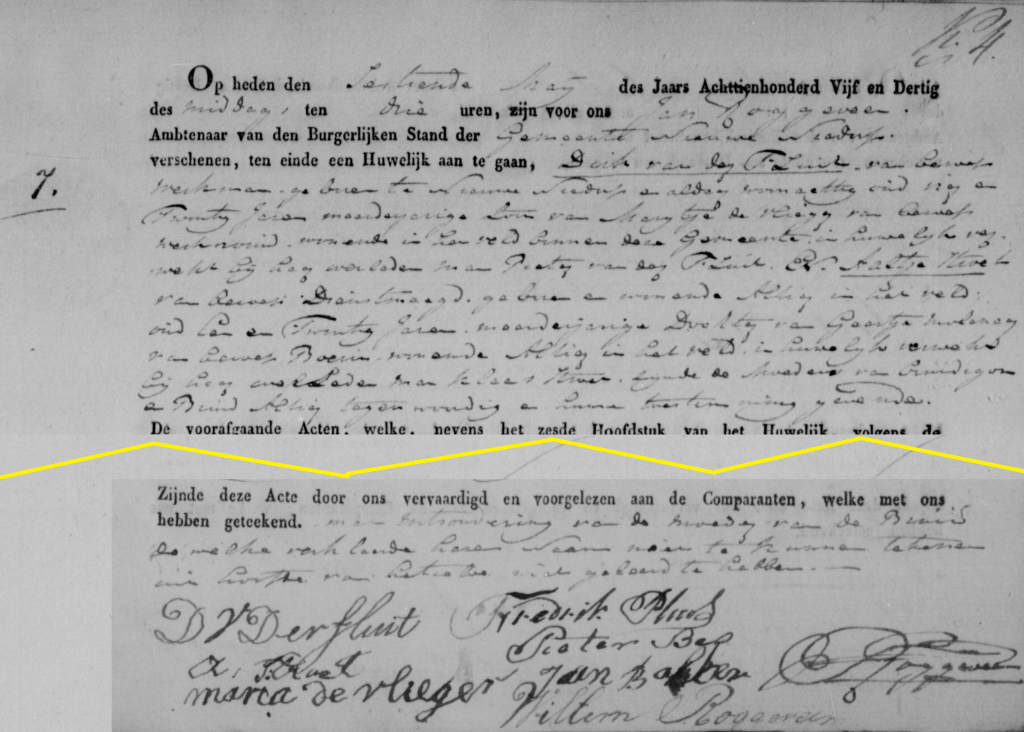
The top and bottom of Aaltje and Dirk’s marriage registration, which includes mention that Aaltje’s occupation was “dienstmaagd” (maid).

At the time Aaltje and Dirk married, Dirk was employed as a labourer. Dirk later took up farming. While he might have undertaken farming at an earlier time, in 1847 a stolpboerderij (“bell jar” or “covered” farm) in ‘t Veld, Noord Holland was registered in the names of Dirk and Aaltje. Until ‘t Veld was part of gemeente (municipality) Oude Niedorp; it is now within gemeente Hollands Kroon.
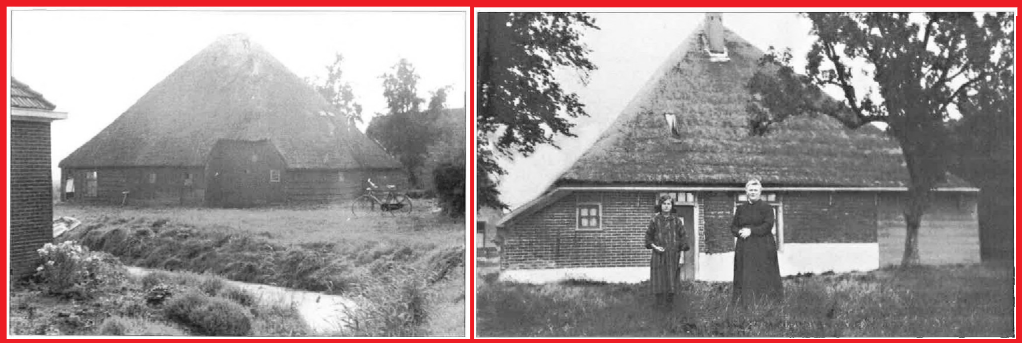
Two views of Aaltje and Dirk’s stolpboerderij from ‘t Is Mooi Weest magazine, December 2004. Both photos were taken after Aaltje’s death. The photo on the right shows Maria Veerman, the owner of the property after 1917, along with her daughter Geertje.

A stolpboerderij was a style of farmhouse that was common in the West Friesland area of Noord Holland. They were pyramid-like thatched roof buildings that served as a combination farm house and separate space for animals, hay, wagons, or tools.

The stolpboerderij that Dirk and Aaltje acquired already existed at the time the land registry in which it was registered was created, in 1832, so it is difficult to determine the time of its construction. In 1832, when the registry was created, the farm was owned by the Roman Catholic church of ‘t Veld. Aaltje remained on the farm after Dirk died in 1857, along with all their children, and it remained registered in her name.
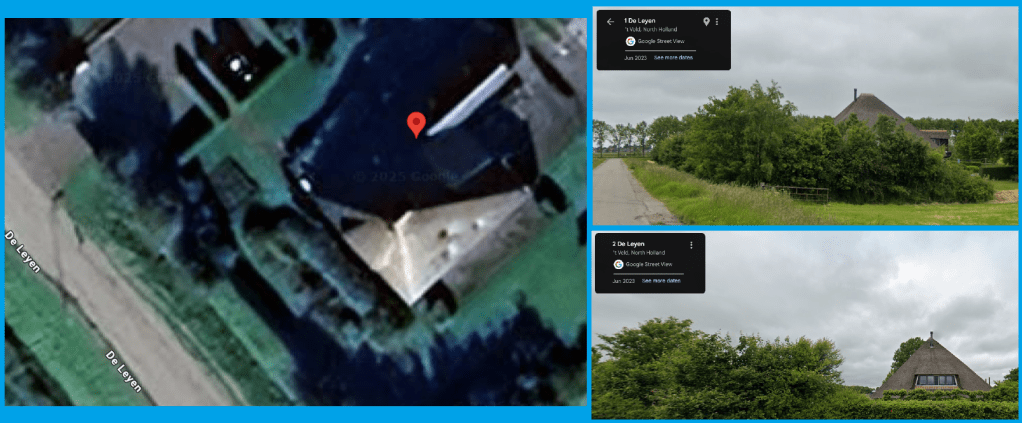
Based upon these views from Google Maps, the stolpboerderij where Aaltje and Dirk is still standing.

According to the Bevolkingsregister (population register) for Oude Niedorp for 1860-1885, some of Aaltje’s children remained at the farm after they reached adulthood. In fact, three of Aaltje’s grandchildren through her second son Nicolaas (1838-1876) were living at the farm, at least as late as 1880.

Aaltje died on March 6, 1881 in Oude Niedorp, most likely at the farm in ‘t Veld. An index for the Roman Catholic Parish of St. Martinus in ‘t Veld indicates that Aaltje’s heirs sold the farm by auction. The index suggests that the church council purchased the land, “called the Hofstede, in the Leijerpolder”. That indicates that the farm was less than two kilometers from where my father was born, in Waarland.
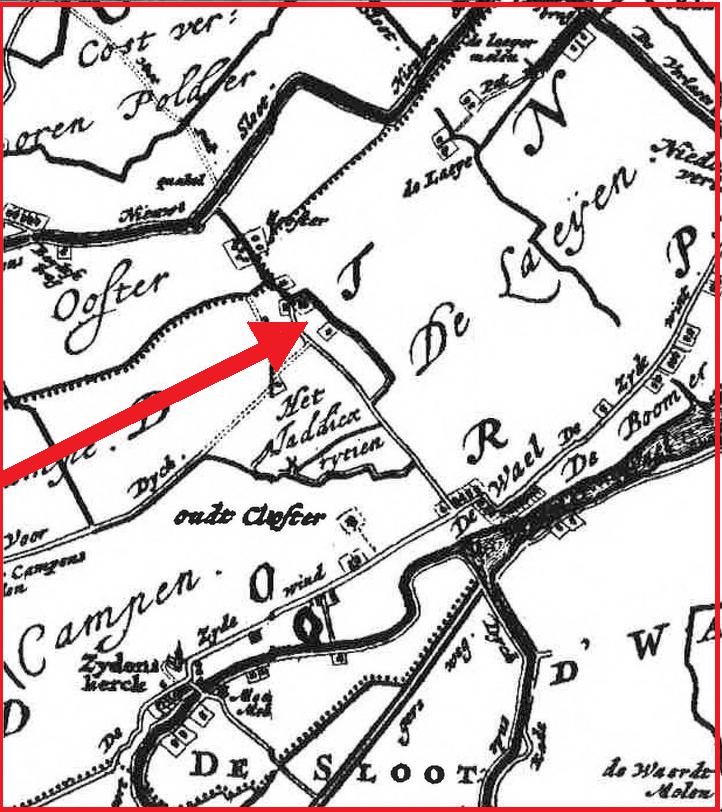
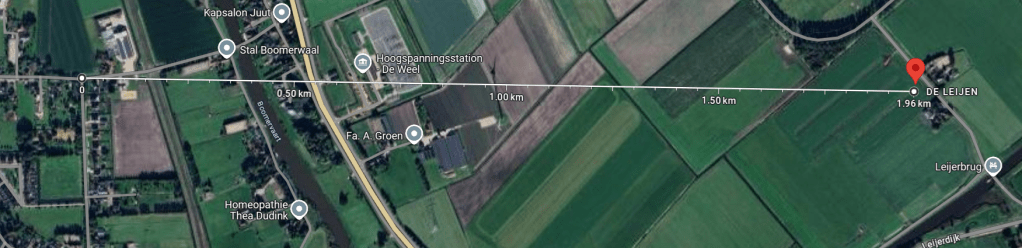
The location of Dirk and Aaltje’s stolpboerderij, shown in ‘t Is Mooi Weest magazine, page 9, December 2004.
Dirk and Aaltje’s stolpboerderij was less than two kilometers due east of where my father was born. I see that I came within about 700 meters of this property, if not closer, during my last trip to the Netherlands. If only I had known!

However, another source shows that in 1882, a year after Aaltje died, the farm was sold by auction to Simon Groen and Marijtje Kuilboer.
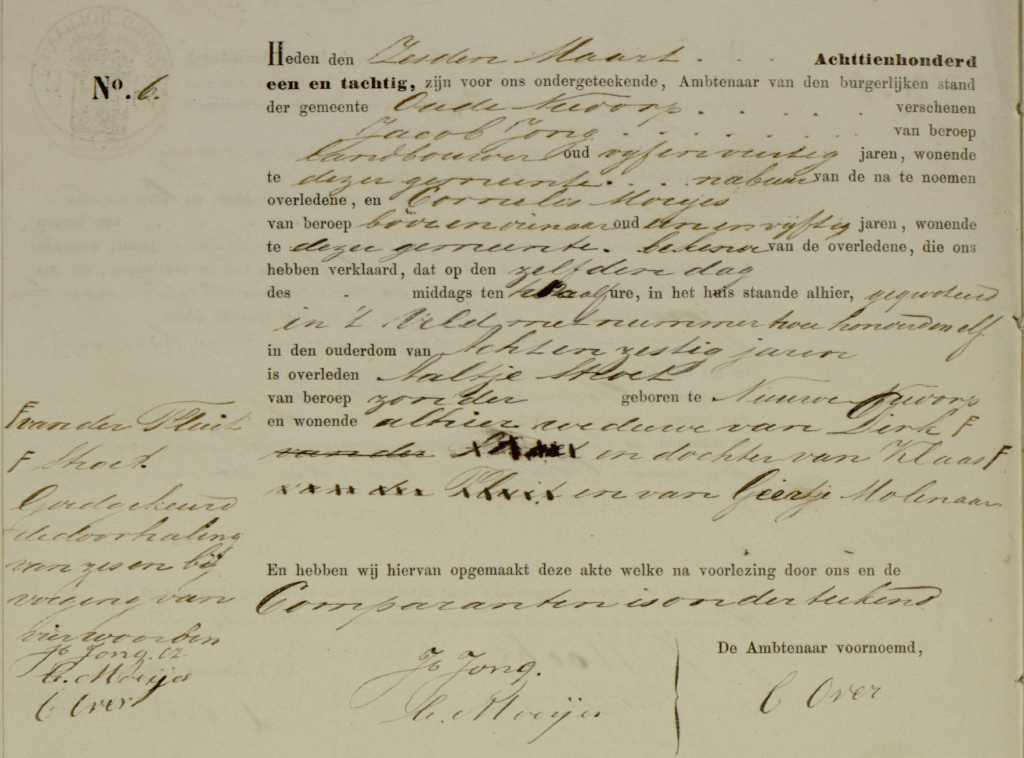
Death registration for Aaltje Stroet. There was a clerical error in that her husband Dirk was recorded as her father; it is the crossed out item. The margin corrected the error, naming Dirk as her husband.

52W Mark IV – Week 2: Card V2 Jan Dirksz van der Fluit

Jan Dirksz van der Fluit (1848-1935)

Jan Dirksz van der Fluit was born in Oude Niedorp, Noord Holland, Netherlands on September 14, 1846 to Dirk Pietersz van der Fluit and Aaltje Klaasse Stroet.

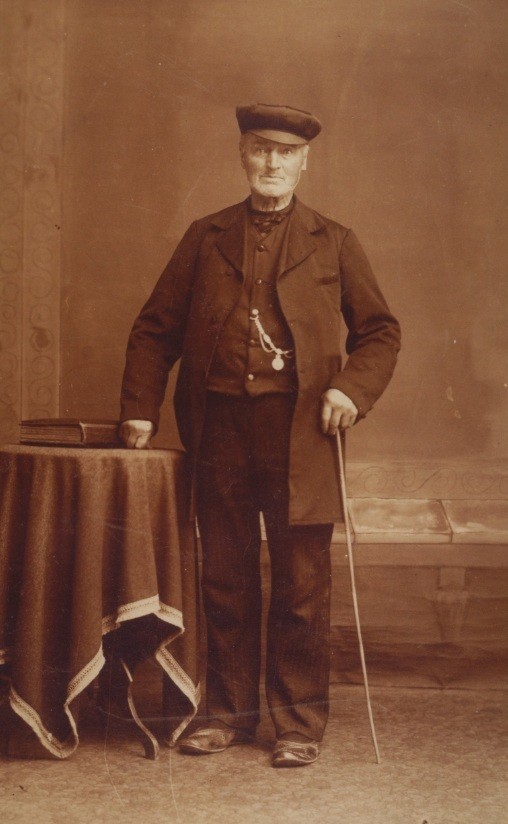
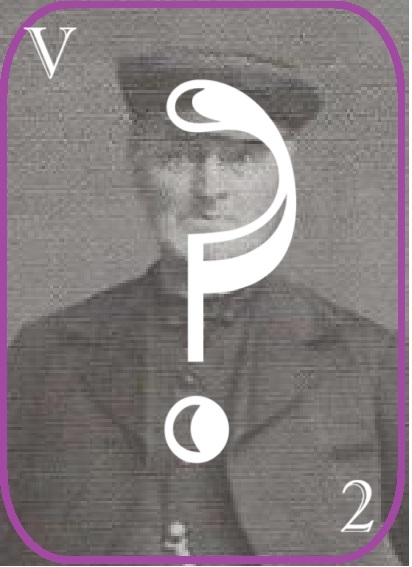
While I have a significant amount of information and source material for Jan, the one great mystery is whether the man seen in the image above is, in fact, Jan Dirksz van der Fluit. In an email, the person who provided it to me questioned whether he had correctly identified Jan as the person in the photo. He indicated that it is possible that the man is actually Jan’s brother-in-law, Klaas Dekker (1832 – 1912). Klaas was married to Jan’s sister Geertje (1841-1928). My correspondent did not indicate where he acquired the image. So this card is either Jan van der Fluit or Klaas Dekker.

The other mystery about Jan is how he spent his life between the day he was born and his first marriage to his first wife, Bregtje (also “Brechtje” or “Brigetta”) Tak, who he married on April 9, 1880. That’s a 33 year gap in time for which I have no information. At most, at the time of his marriage to Bregtje, Jan had been a farmer and a labourer, most likely in Oude Niedorp or Niuewe Niedorp.

[Update February 20, 2025: Today I found a Bevolkingsregister for Oude Niedorp for 1860-1885, with an entry for Jan’s mother, Aaltje Stroet and all her children. This was after Jan’s father had died. It indicates that up to age 15, Jan was most likely living with his mother in ‘t Veld. From age 15 to 18, Jan lived in Heerhugowaard. I will have to look for a Bevolkingsregister for Heerhugowaard to see if I can learn more. In February 1865, Jan moved back home with his mother and siblings in ‘t Veld.]

Bregtje was born in Oude Niedorp in May 20, 1855. She was 24 when she married Jan, who was 33 at the time. Jan and Bregtje had three children: Dirk, Geertruida, and Petrus. It was not a long marriage, as Bregtje died on December 8, 1884, nine days after Petrus was born. Given the close connection in time, it may be that it had been a difficult childbirth that ultimately resulted in Bregtje’s demise.

Jan married for a second time nine months later, to Maartje Veldman (1862-1904), in Barsingerhorn, Noord Holland on August 19, 1885. Maartje was 22 when she married Jan, who was then 38. I am descended from Maartje, who is Card V3 – so more on her next week. Jan’s marriage to Maartje lasted almost 20 years, ending when Maartje passed away.

Heldersche en Nieuwedieper Courant, September 9, 1885, page 4.
“Engaged and Married: Jan van der Fluit, widower of Brechtje Tak, 38 years old, and Maartje Veldman, never married, 22 years old.

Jan and Maartje had seven children together, although the first two did not survive infancy. Their fourth child was my great grandfather, Johannis Albertus van der Fluit. Jan outlived Johannis by three years. Maartje passed away on August 5, 1904, exactly one month after the birth of her youngest child, Brigettha.

Jan married for a third time, to Aagje Rood in Oude Niedorp on January 24, 1907. Aagje was born on December 20, 1863, in Heerhugowaard, Noord Holland, making her 43 when she married Jan. Aagje was a widow at the time she married Jan, having been previously married to Arie Pater. I have not done much research into Arie, but would not be surprised if he is somehow related to me given that my father’s maternal line is Pater. However, to date I have yet to find any connection between Arie and my Paters. Unlike Jan’s previous wives, Aagje outlived Jan – by two and a half months. She died on May 4, 1935.

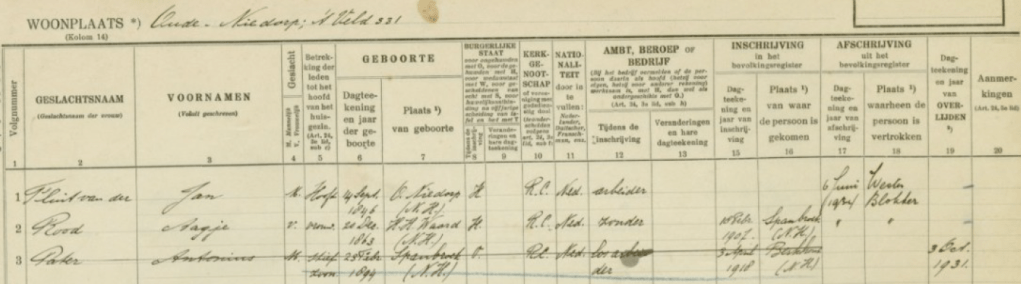
Bevolkingsregister for Oude Niedorp for 1931 to 1938

At the time of his second marriage, Jan was a merchant and shopkeeper. I know he was involved in that line of work until at least 1894, but I do not know the extent or details of that occupation. By 1904, he had returned to work as a labourer, which he apparently did until a year before he died. Since he died in 1935, that would mean he was still working when he was 87. The Bevolkingsregister (population register) for Oude Niedorp for 1910 to 1930 shows that he was a labourer during that entire time. The Oude Niedorp Bevolkingsregister for 1931 to 1938 indicated that he was still a labourer, at least until June 1934 when he moved to Westerblokker, which is about 16 kilometers from Oude Niedorp.

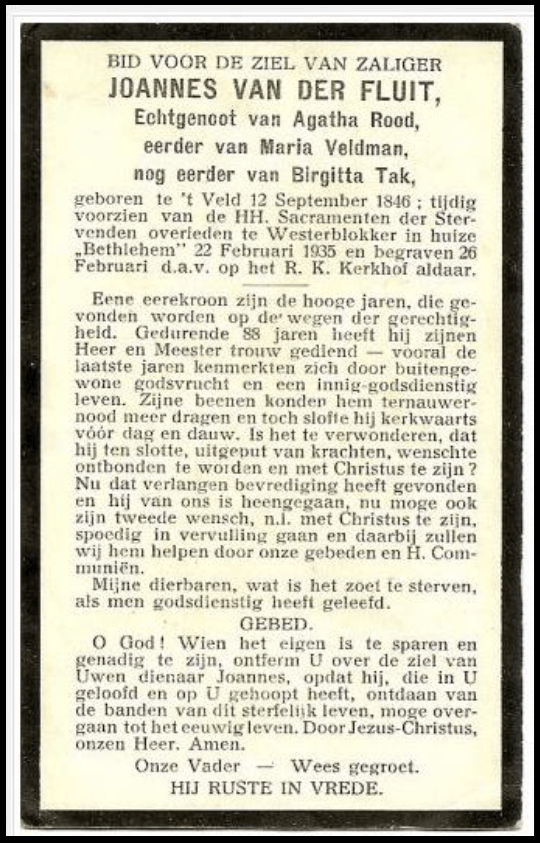
Jan’s bidprentje

However, I doubt that was so. It seems unlikely that he would still be working as a labourer in his mid-80s. The bidprentje (prayer card or in memoriam card) given out when he died. It indicated that in his last years “his legs could barely carry him”, yet he was still able to “shuffle” or “trudge” to church every day before dawn. His death registration also clearly indicated he was no longer working at the time he died.

Jan’s work was not limited to being a labourer during this period. In 1907, he was also working as a milkman; in July 1917 he was once again doing some form of work as a merchant.

On June 6, 1934, Jan and Aagje moved to Westerblokker. I still have to find the Bevolkingsregister for Westerblokker from that time. It’s on my to-do list; however, it is not yet available to the public because it includes a time period that is restricted under privacy laws. Jan died seven months later, on February 22, 1935. His bidprentje says that he passed away in “Bethlehem” house. Bethlehem was a monastery, which must have had some sort of palliative or care home. Jan was buried in Westerblokker.

UPDATE!

February 15, 2025: Late last week I was able to verify that yes, indeed, this is a photo of Jan Dirksz van der Fluit! Not only that, but it resulted in finding a photo of his wife Maartje Veldman!

Jan Dirksz van der Fluit!!