52 Weeks – Week Six (Part One)

Maps – Part One

Week six of the 52 Ancestors Challenge has us navigating maps. Like the Favourite Photo challenge, I had a hard time choosing. So this week I’ll be doing two entries.

Where I stand once stood the farmhouse where my maternal grandmother was born.
Beautiful downtown Rastadt, Saskatchewan. If the middle of nowhere has a middle of nowhere, this is it.
(Actually, this is suburban Rastadt, but no one really is counting.) Where I am standing once stood the farmhouse where my maternal grandmother, Helen Lerner, was born.
(Section 7, Township 17, Range 24, West 3)

My maternal grandmother, Helen Lerner, was born at the family farmhouse near Rastadt, Saskatchewan, which is about 16 kilometers (10 miles) east of Fox Valley. It’s where her her parents and grandparents – Germans from Russia – settled upon moving to Canada. There’s nothing left of Rastadt now other than the old schoolhouse and the cemetery.

Rastadt, Saskatchewan Cemetery, April 1, 1997. Located at 50°30’00.9″N 109°15’32.3″W
You can find the cemetery listing here.

In early 1997, I had a few months off after having left a job for a new endeavor. I visited my folks, who live in southern Alberta, during that time off. I had not been to Fox Valley since I was a kid, so while visiting my folks I thought it might be a fun family history road trip to do with my mother.

Fox Valley is about midway between Medicine Hat, Alberta and Swift Current, Saskatchewan.

One of the first things I did upon arriving at Fox Valley was visit the village hall. It was a wise decision. Not only were the staff extremely helpful, they had maps of all the farms in the district, labelled with the current owners and occupants of each section of land. It was an amazing thing to see, because many of the surnames on the map were in my family tree database.

Map of the farms and residents surrounding Fox Valley, Saskatchewan as of 1997. Fox Valley is just below and to the right of the large number “5”. While not easy to see, the Fox Valley Cemetery is marked with a small red box labelled “D”. The larger boxes to the east are where my great grand parents and great great grandparents farmed, along with the Rastadt Cemetery.
The same area, as seen on Google Maps. Fox Valley is in the oval on the left. My ancestors’ farms are on the right, along with the Rastadt Cemetery.

A history of Fox Valley was published in 2004, Fox Valley and Liebenthal, Saskatchewan: Remember When… In addition to the family history of the village’s residents, this extremely useful book includes a section in which it records all the residents of these parcels of land throughout most of the 20th Century. In conjunction with this map, the book, and census records, I’ve been able to plot out where my ancestors lived and farmed.

Detail from the map above.

The locations I’ve marked are based upon the 1921 census, except for Jacob Anton, who died a month before that census was taken. For him I used the 1916 census. My grandmother’s parents were Jerome and Emelia Lerner, whose farm is the southernmost one marked on the map.

A: Michael Lerner and Barbara Schmidt (my grandmother’s paternal grandparents)

B: Heronimus “Michael” Lerner and Emelia Anton (m grandmother’s parents, and where my grandmother was born.

C: The Rastadt Cemetery. (D, not seen in the detail, is the Fox Valley Cemetery.)

E: Jacob Anton and Margaretha (“Margaret”) Heck, my grandmother’s maternal grandparents.

Serendipity

My mother and I used this map to visit the schoolhouse, cemetery, and plot of land where my grandmother’s house had once been. After taking the photo of me, we drove a bit down the road where I used a driveway of a farmhouse to turn around. The farmer who lived there saw me and came out, thinking anyone he didn’t know who was out there must be lost.

After explaining that I actually meant to be in his part of the world, we got to talking. It turned out he was a cousin of my grandmother’s. He and his wife invited us in for coffee and they showed us all sorts of interesting family photos and mementos. Talk about serendipity! He even told me the farmhouse my grandmother was born in still existed – a farmer had bought the building and moved it to his land.

Even more fortuitous, he told me that a family history was being put together of the Boechler family, the Boechler Family History. Barbara Schmidt’s mother was a Boechler. The farmer gave me the contact information for the author. My timing was another stroke of luck. I made the call not long afterward and learned that the book was being finalized and would be going to press in a matter of days. It also turned out that Emelia’s branch of the family – from which I am descended – was a huge mystery. I was able to supply most of the information about Emelia and her descendants in time for publication.

Another form of map. This was taken inside St. Mary’s Church in Fox Valley, showing the location of each person interred at the Rastadt Cemetery.

In Part Two, I’ll be looking at another piece of prairie farmland, this time in Alberta on my mother’s paternal side.

52 Weeks – Week Four

Curious

The theme for this week’s 52 Ancestors Challenge is “curious” – a term that has been left up to our own interpretation!

There are many things that keep me curious about my family history. They say you are never finished your family tree – because you aren’t. However, if I ever ran out of questions, my family tree would be done, and not in a good way.

For decades I’ve been curious about my maternal grandmother’s first marriage. Last year I was finally able to get their marriage record because it was finally old enough for public disclosure. Despite that, I still have a lot of unanswered questions.

Emelia Anton, about 1931

I’ve previously mentioned my great grandmother, Emelia Anton, who was a German from Russia. She was born on New Year’s Day, but I’ve never been able to confirm whether it was by the Julian or Gregorian calendar. Another mystery: I have a copy of the passenger ship on which Emelia and her family came to Ellis Island. The family came straight to Canada from there; however, despite scouring countless records, I’ve never found where they crossed into Canada.  

Come to think of it, my Germans from Russia are the most mysterious branch of my family tree, given how little I know about it compared to other lines!

Another mystery that intrigued me for years was an occupation my great great grandfather, Nicolaas “Klaas” Komen held in the 1920s, “brandstoffelhandelaar”. It literally translates as “fuel dealer”, although it took me a long time to figure that out. Here’s a helpful tip. I’ve found that when trying to translate a difficult foreign word, type it into Google Image Search. Sometimes a photo really is worth a thousand words. However, what kind of fuel was Klaas selling? How and where was he selling it, and to whom? As far as I’ve been able to figure out, it likely involved hauling peat or coal on a wagon or truck.

Marriage registration for Adrianus Komen and Elizabeth Bakker, which identifies the occupation of Adrianus’s father, Klaas, as “brandstoffelhandelaar”

My most recent discovery was learning the sailing on which my father’s aunt came to Canada. I’ve pretty much always known the date on which my father and his family left the Netherlands and the ship he came on, the Sibajak. His aunt, Anny van der Fluit and her husband Jac Beers came on the Groote Beer a few months earlier, but I never knew when. Less than a fortnight ago, the Rotterdam Archives posted Holland America Lines passenger lists up to 1969 on its website. I finally learned that my great aunt and uncle left Rotterdam for Halifax on January 20, 1954. I then realized that I was missing information about one of my father’s uncles, Johannes “Joop” van der Fluit, who came to Canada a couple of weeks after my father. I knew the date on which he sailed, but it crossed my mind that I didn’t know the name of the ship. Ta da, there he is, in the archive, sailing to Canada with his family on the Castel Felice.

However, the greatest curiosity to me revolves around my 4x Great Grandfather, Petrus Pieterszoon “Pieter” van der Fluit, who was born in Voorhout, which is just outside of Leiden. His direct ancestors had been in what is now Zuid Holland (South Holland) for several generations, mostly around Leiden, although the surname traces to a village outside of The Hague.

Visiting Fluitpolderplein in Leidschendam, Zuid Holland in 2017. It may well be that this is the polder after which my surname originates.

Pieter was the oldest of 11 children, four boys and seven girls. He was still in Voorhout in May 1800, when he married Maria Woutersdr (“Maartje” or “Marijtje”) de Vlieger, who was born in nearby Lisse. Pieter and Maartje have their first child, Elisabeth, in Voorhout in 1801. The next time I see Pieter and Maartje, it’s in November 1804, in Nieuwe Niedorp, in what is now Noord Holland (North Holland), where they have their second child, Pieter.

What has always had me curious is why Pieter and Maartje moved almost 70 kilometers to start a new life away from their family. Based on the time I’ve spent in the Netherlands, a trip of seven kilometers seems overwhelming for the locals. For most of my Dutch family lines, the generations never strayed far, so this strikes me as an astonishing move. After Pieter and Maartje moved to Nieuwe Niedorp, the next five or six generations were all located within a very short distance. My father was born less than four kilometers from Nieuwe Niedorp.

Marriage registration for Pieter van der Fluit and Maartje de Vlieger

Almost all of Pieter’s siblings stayed in Voorhout. One adventurous sister moved all the way to Leiden, less than seven kilometers away. Pieter’s youngest sister ended up in Antwerp after moving to what is now Belgium with her husband. There are many descendants of the original van der Fluits still in the Zuid Holland area.

It is not only the distance of the move that has me curious. Usually it was the younger siblings who move away from home, with the eldest staying behind. I have nothing more than speculation as to what drew Pieter and Maartje north.

My working theory was based upon the fact that by 1800, what is now the Netherlands was essentially a French puppet state known as the Batavian Republic. In the time leading up to its creation and during its existence, the Dutch economy was in dire straits. Between it being wartime in Europe and a poor economy, perhaps Pieter went north looking for work. Many years ago, someone suggested that during the time Pieter moved north there was a great deal of work going on with the construction of new polders and waterworks. However, my investigations indicate that most of the polders of the area were constructed well before and well after Pieter arrived on the scene.

This concludes the January 52 Ancestors theme of “Foundations”. February’s theme is “Branching Out”. In the meantime, don’t worry about the cat, it’ll be okay, stay curious!

52 Weeks – Week Three

Favourite Photo

As expected, I found this week’s 52 Weeks challenge to be particularly difficult, as I am lucky to have so many photos that I cherish. So I am going to cheat a little and post more than one, as I really do not have one photo that I favour above all others. With one exception, I’ve had a copy of all these photos for a very long time. Some of these photos were what helped kindle my love of genealogy.

On her Facebook group, Generations Cafe, Amy Johnson Crow suggested telling “the story of a favorite photo: who is in it, where and when it was taken, and why it was taken. What was the event?” I have to admit, for some of these photos I never thought of who took them or why they were taken, even though I had known of them for years.

The Anton family, circa 1910. Likely taken in Selo Suchoi, Veronesch, Russia.

This is a photo of my great great grandparents, Jacob Anton and Margaretha (“Margaret”) Heck. Given the attire, this was likely the confirmation of their daughter, Elataria (“Lottie”). My great grandmother, Emilia, is the girl on the right holding flowers. She was about 7 years old here. She lived to be 94. I visited her many times. She is the one who I mentioned at the outset of this blog, who surprised me by speaking fluent German when I thought she was of English heritage.

While this photo was taken in Russia, the family was German. Their forebears were amongst the many Germans who migrated to the Russian Empire in the 18th and 19th centuries. My family settled in the Beresan region of what is now Ukraine. A few years before Emelia was born, the family migrated to Russia. They stayed there until 1912, when they emigrated to Canada.

The next few photos all relate to my father and his family.

My father and his father, Adrianus (“Arie”) van der Fluit, Schagen, Netherlands, circa 1951.

This photo is definitely a contender for my absolute favourite. While I know when and where it was taken, it never crossed my mind to wonder who took it or why. I have no idea why they would have been visiting Schagen, but there they were. They certainly were dressed very fine and are looking very dapper. My grandfather was a farmer and a labourer, and they’re a bit of a way from home, so it must have been an important occasion. Looking through the family timeline, I can’t find an event that occurred in Schagen at this time.

I was in that same square with my father a few years ago. I should have recreated this photo with him, but I couldn’t quite figure out where in the square this had been taken.

Rotterdam, 1954

This is a photo of my grandparents, my father, and his siblings being dropped off by a family friend at the port in Rotterdam. The family is about to board the ship that will take them to Canada.

Unlike the other photos, this one only came into my possession relatively recently.

My paternal grandfather had seven siblings. He is the first person seated in the front row on the left side of the photo. My grandmother, Christina (“Tiny”) Komen is standing behind him. All of my grandfather’s siblings are here, except for his youngest sister. She might have been absent because this might have been taken after she emigrated to Canada, sometime in early 1954. My grandfather and grandmother left for Canada later in the spring of 1954. An older brother, Joop, seated immediately beside my grandfather in front of his wife Agie, left for Canada a fortnight after my grandfather.

However, this might have been taken in 1951 to mark the ordination of my great aunt, as an Urseline nun. She went by the name Sister Melania. I considered whether this might have been the occasion for which my grandfather and grandfather were dressed so fine in the above photo, but as far as I can find she was ordained in Bergen, not Schagen.

Finally. this set of photos of my mother’s maternal grandmother, Hazel Nelson. It’s the photo on the left, taken when she was about four years old, that is one of my favourites. It’s an amazing photo. I added the others because I thought it was a nice idea to see her progressing through life.

Hazel was born in December 1899. She and her sister Irene were the first twins born in the town of Cardston, Alberta, where her parents were amongst the original settlers. Irene only lived a month, but Hazel lived to be 67. I also have a copy of one of the last photos taken of her, around July 1967. Hazel died only a couple days before I was born. My mother practically went from the funeral to the hospital.

Next week: “Curious”. I wonder what that could be be? 😉

More Than a Full Deck

Here’s the deal…

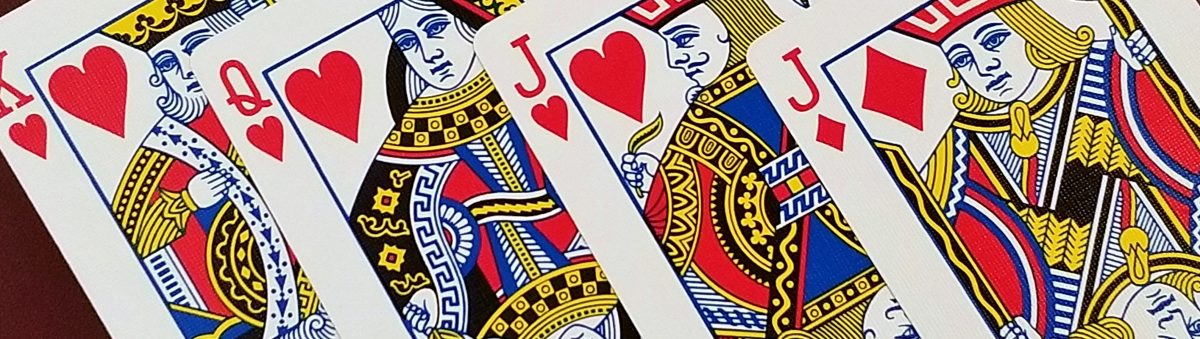
Three years in a row, I signed up for Amy Johnson Crow’s “52 Ancestors in 52 Weeks“. The first two times, that was as far as I got. Hopefully, third time’s the charm. Hence this blog, only a quarter century behind the times. As someone who enjoys games as much as genealogy, I naturally associated the number of weeks of the challenge with the number of cards in a deck.

I’d love to figure out how to centre this image – and justify this caption. [Edit: I figured it out!]

Despite the association with a deck of cards, I’ve identified more than 52 ancestors. In fact, I’ve managed to identify 55 out of my 64 great great great grandparents. So it seems I am playing with more than a full deck.

My interest in genealogy began when I was about eight years old. It was prompted along the way by questions I had as a child that, to me, had odd answers. When I was in elementary school, I asked my mom why my school principal always asked if I was Belgian. She said, “because you have a Dutch last name”. At the time, I thought Belgium was an entirely French-speaking country, so that answer made no sense. In grade eight, I switched from taking French to German. One day while visiting my great grandmother, my mother said, “Grandma, Sean is taking German in school.” I was bewildered why a woman who I thought was of English origin would care. I was even more surprised when she started speaking to me in fluent German.

Literally my first genealogy book, which I bought when I was 8 or 9.

My father’s side of the family is Dutch, going back generations, mostly from the part of the Netherlands that is now the provinces of North Holland and South Holland. However, several weeks ago I discovered connections to the Achterhoek, the easternmost part of the province of Gelderland that pokes into Germany. I have also recently been investigating a branch of the family that originates in Zeeland and what is now Oost-Vlaanderen (East Flanders). Sometime in the early 19th century, one of those Zeelanders ended up in the northernmost part of North Holland. His daughter, my third great grandmother, married into a family that has deep roots on the island of Texel.

My mother’s side is much more of a mix. Her mother’s side of the family are what is known as Germans from Russia. One branch came to Canada by way of Texas, the other branch came directly to Canada. My mother’s paternal side has roots in the United States, several branches of which go back to colonial times, including the Mayflower and Salem. My maternal grandfather’s direct paternal line goes back to a Hessian mercenary who initially fought for the British in the American Revolution, but later switched sides. That branch of the family were also some of the original members of the Latter Day Saints (the Mormons). They joined the church in its infancy, moving from New York to Ohio to Illinois. They were also part of the migration along the Mormon Trail to Salt Lake City.

I’ve also done a lot of work on my wife’s side of the family. At present, my intention with this blog is to focus on my side of the family. However, I will probably delve into my wife’s side from time to time because there are some fairly interesting stories there. Our eldest child, who shares my love of genealogy, is fascinated with a branch of his mother’s family that has deep roots on the island of Jersey. To be honest, I find it fascinating as well.