52W Mark II – Week 17: DNA

For this week’s 52 Ancestors Challenge theme, we were simply provided three letters, DNA. That could stand for anything!

Of course, the idea is probably to write about genetic genealogy. Thankfully, we are not beholden to what the weekly theme should be. Suffice to say, if we were, this would be an incredibly short post. I have precious little to say about deoxyribonucleic acid; I have far more I can say about the Dutch National Archives.
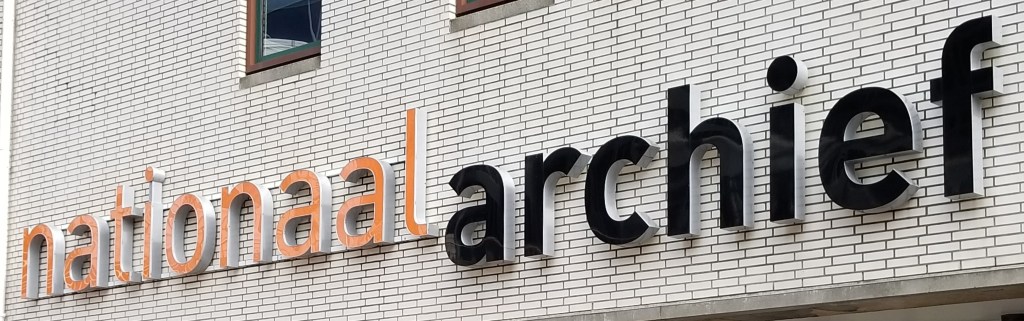
Of course, the institution is not called the Dutch National Archives. In Dutch, the institution is simply “Nationaal Archief“. You don’t need to be a polyglot to figure out that’s “National Archive”.

If you do Dutch genealogy, you’re not getting information from churches, courthouses, or libraries. The archives are where you want to be. The Netherlands adopted a system of civil registration in 1811. At that time, it had all the churches turn over their baptism, marriage, and burial records. Since then, births, marriages, and deaths have been recorded at the municipal level. After a period of time, these records are turned over to the civil or provincial archives. As well, other governmental institutions, as well as the courts, are required to turn their records over to the archives after a requisite period of time.

The Dutch archives are amazingly accessible over the internet. A lot of resources have been put into digitizing archival holdings and putting them online. Many of the provincial and municipal archives provide this material through their own websites, many of which have an English interface. However, they all contribute to a central online source, WieWasWie, which has both a Dutch and English interface. There’s also OpenArchives. It’s a portal and aggregator, that uses openly available information, although it is privately backed.
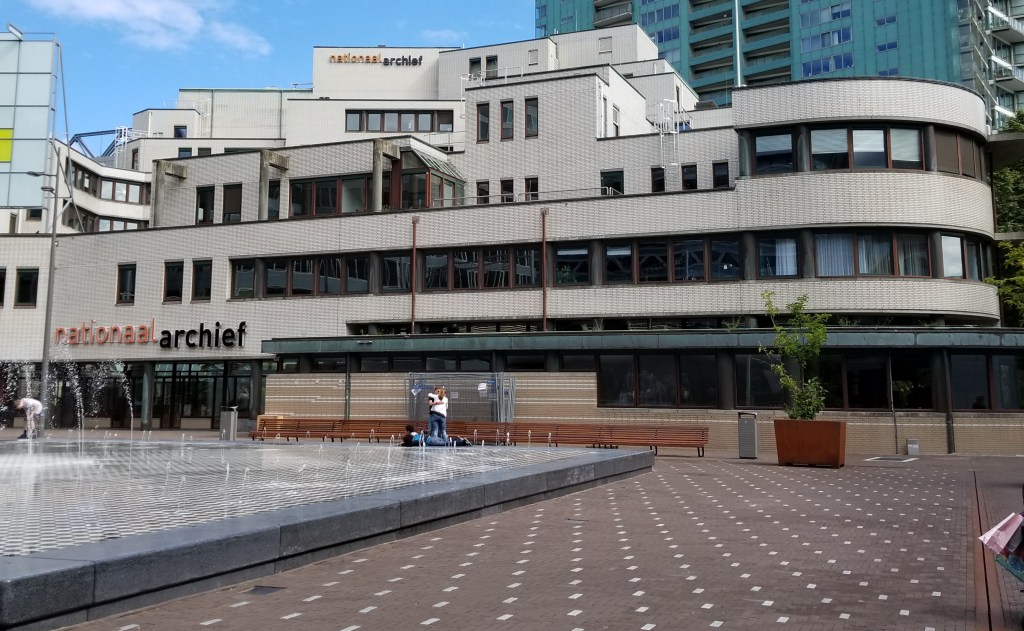
The Nationaal Archief, located in Anna van Buerenplein (Anna van Bueren Square) The Hague.

While so much is available over the internet, the old adage “not everything is online” still applies. Of course, with an entire ocean and and a whole continent separating me from the Netherlands, I don’t have the opportunity to visit in person. Thus, I’ve been to the Nationaal Archief exactly once, but as part of an unplanned visit shortly before closing just to get a lay of the land.

My last trip to the Netherlands was spurred by the fact my parents were taking a cruise out of Amsterdam. They went early to spend time with family. I’ve always wanted to visit the Netherlands with my father, so I took advantage of the opportunity.

After they left for their cruise, I had a couple days on my own. I decided that I wanted to go to The Hague, to do exactly two things. First and foremost, I had to see my favourite painting by my favourite artist: Girl With a Pear Earring by Johannes Vermeer. It’s part of the holdings of Mauritshuis, a museum adjacent to the Dutch parliament buildings in The Hague. The second was to visit a small polder in Leidschendam, on the outskirts of The Hague, which is either the source of my surname, or was named after my family.
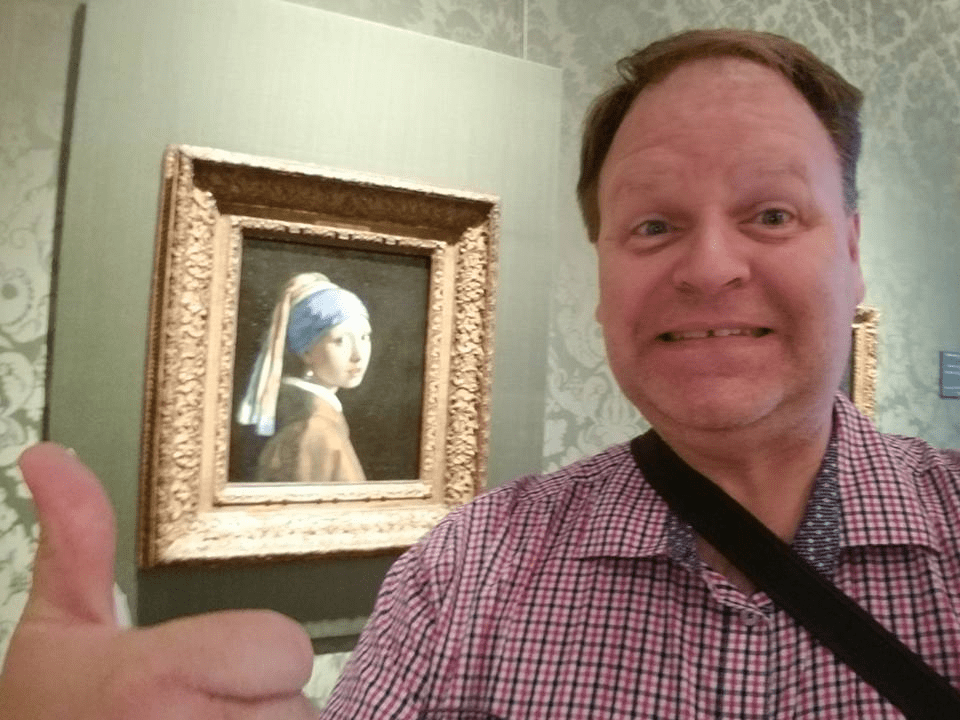
One of two reasons I went to The Hague.

Given the limited time and my singular goal, I did not make any plans to visit the Nationaal Archief. If I was going to spend any time during my trip in an archive, that would probably not be the one. The records I really need are to be found in the Noord-Hollands Archief in Haarlem (provincial) or Alkmaar Archief (regional). However, the Nationaal Archief also houses the archives for the province of Zuid-Holland, so a visit there would not be fruitless. Furthermore, the Centraal Bureau voor Genealogie (since renamed CBG Centrum voor Familiegeschiedenis – Centre for Family History) is located within the same building as the Nationaal Archief.
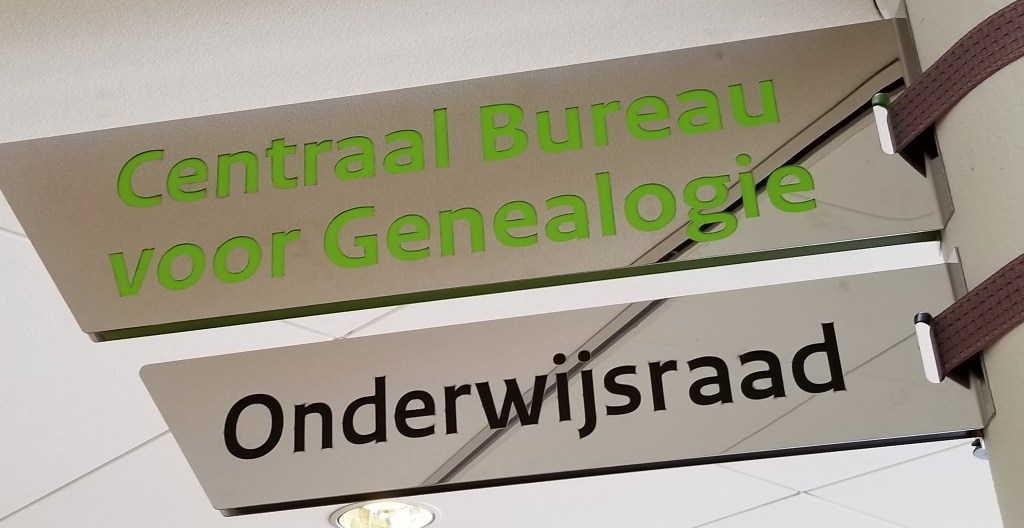
However, if I had done even a minimal amount of research, I would have discovered that the Nationaal Archief is located immediately beside The Hague’s main central train station. My hotel was a five minute walk away.

On my last day in The Hague, I found myself walking by the Nationaal Archief, and noticed it was still open. I couldn’t resist popping in, if only to take a peek. The place was spacious and pleasant. There was an archivist on duty who was very welcoming. When I explained that I wasn’t there to do any actual research and that I only wanted to take a look, she gave me a bit of a tour.
Among the items the archivist showed me was an original of the Treaty of Friendship and Commerce between the States General of the United Netherlands and the United States of America. The Netherlands was the second country in the world, after France, to formally recognize the independent United States. This treaty formed the foundation of their formal diplomatic relations.
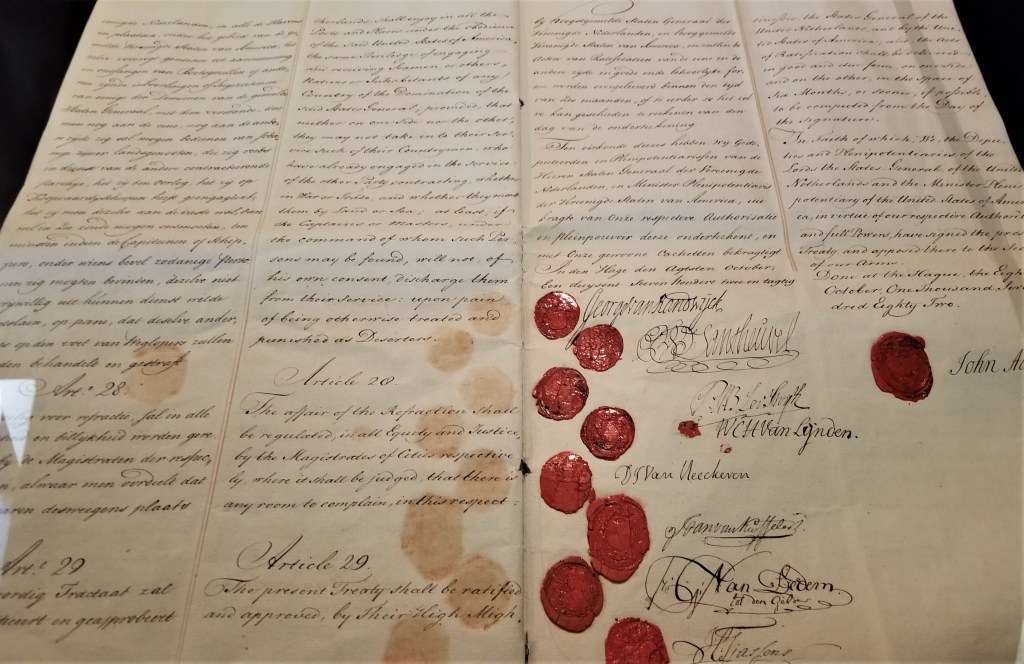
At the time this treaty was signed, the Netherlands was not a unitary state; rather, it was more of a confederation of largely autonomous states. Thus, there are eight Dutch signatories. The single American signatory was John Adams, who later became the second President of the United States.

I also saw this map of central Noord Holland, which shows many of the towns and villages where many of my ancestors lived. It is also where many of my closest Dutch relatives live. At the top, near the middle, is Waarland, where my father was born.
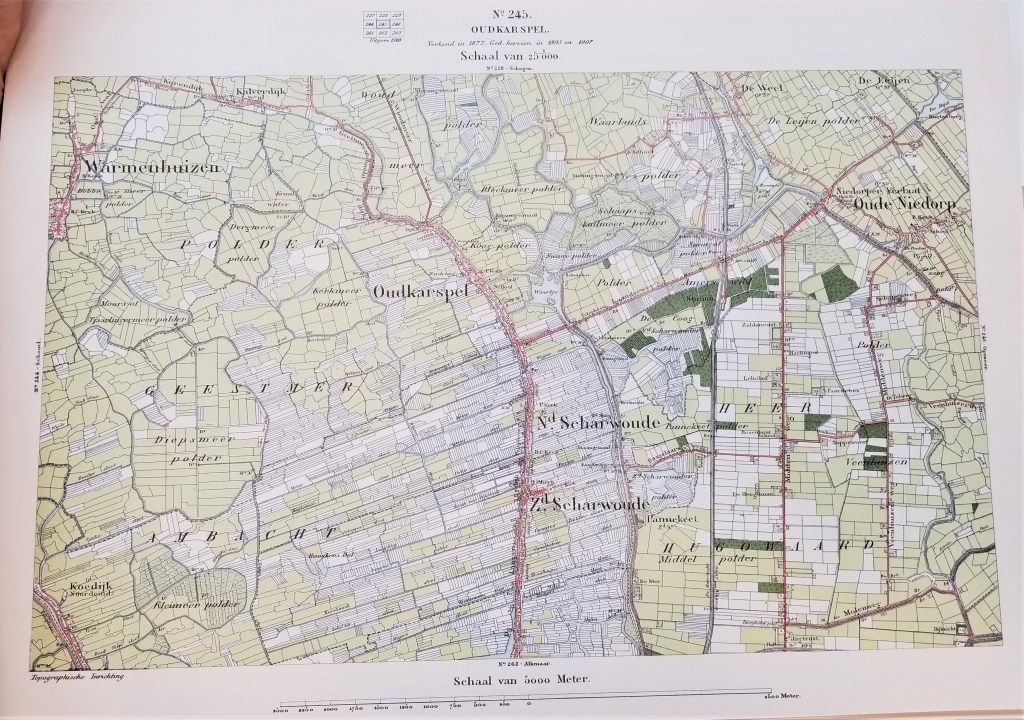
If I should ever return to The Hague with lots of time for myself, I definitely need to plan a return trip to the Nationaal Archief.
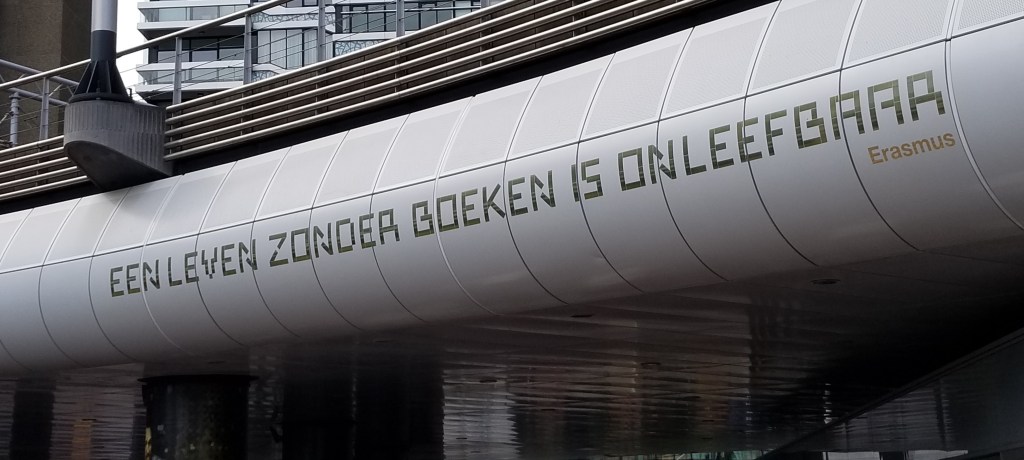
The Nationaal Archief is directly across from the University of Leiden’s campus in The Hague. “Een leven zonder boeken is onleefbaar” – “A life without books is unlivable”

52W Mark II – Week 14: Begins With A Vowel

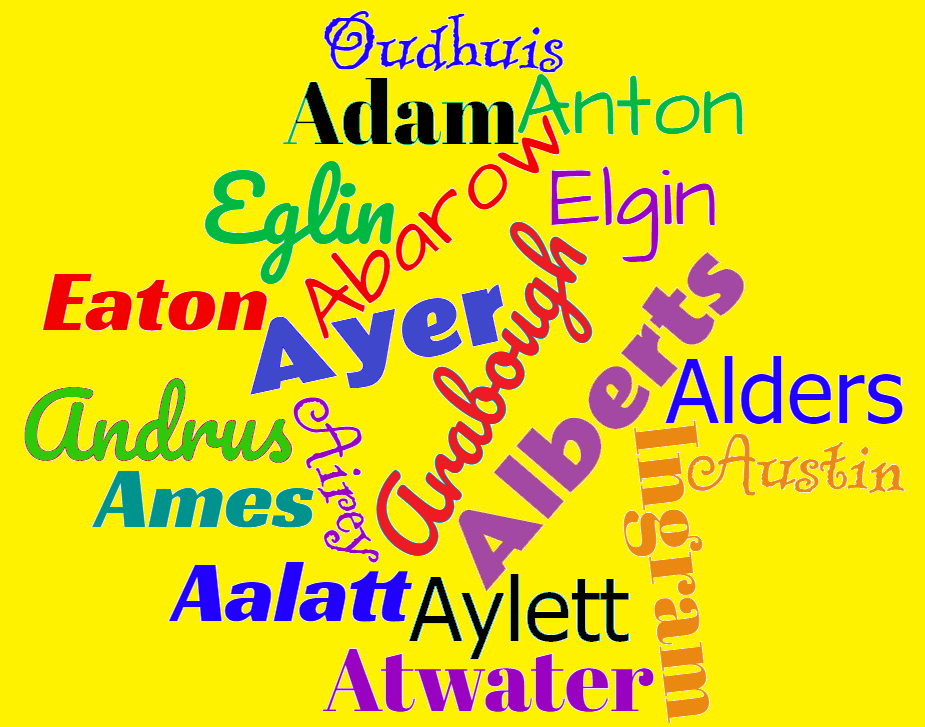
For this week’s 52 Ancestors Challenge, “Begins With A Vowel”, I decided to be more graphical. So I created a word cloud for all the surnames of my direct ancestors whose surnames begin with a vowel.

I have many more surnames in my tree that start with a vowel, but these are just my direct ancestors. There are even a few people in my tree whose first, middle, and last names all begin with vowels!

I have 14 direct ancestors whose surname begins with “A”, three whose begin with “E” (my Eglin and Elgin ancestors are not related, other than through me!), one each for “I” and “O”, and none for “U”, “Y”, and “IJ”.

“What? ‘IJ’??” you say?

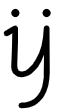
In the Dutch language, IJ is treated as a letter unto itself. In fact, in my reading it appears that there is some debate on the matter in the Netherlands, although in Flanders (a Dutch-speaking province in Belgium), it’s considered two letters. Technically speaking, “ij” is a digraph of the letters “i” and “j”, forming a single phoneme (distinct sound). It doesn’t have an exact sound counterpart in English, although it can sound somewhat like a long “i”. When a word that begins with the diagraph is capitalized, both the “i” and “j” are capitalized. The “ij” in Dutch words are often changed to a “y” when adapted into English. In modern Dutch, words with the letter “y” are most often ones that were borrowed from other languages.

For example, a Dutch surname that begins with “IJ” is “IJzerman”, which means “iron man” or “man of iron” in English. You will sometimes see this name changed to “Yzerman” in English. Ice hockey fans will be familiar with Steve Yzerman, whose grandfather immigrated to Canada from the Netherlands at the beginning of the 20th century. Given his success in the sport, “man of iron” is a fitting moniker.

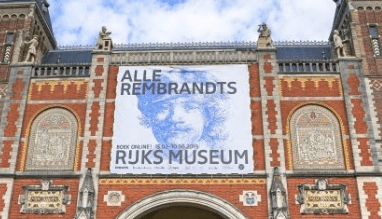
The Rijksmuseum in Amsterdam. Depending on whether you consider “IJ” to be one letter or two, it can be spelled “R-IJ-K-S” or “R-I-J-K-S”

52W Mark II – Week 13: Light a Candle

Hard to believe that we’re now a quarter of the way through this year’s 52 Ancestors Challenge! I feel like I’m still at the starting gate.

This week’s theme is “Light a Candle”. Amy says, “Candles are often lit in remembrance, in prayer, or when the power goes out for 5 days because of an ice storm. Be creative with this prompt!” So I’ll be creative!

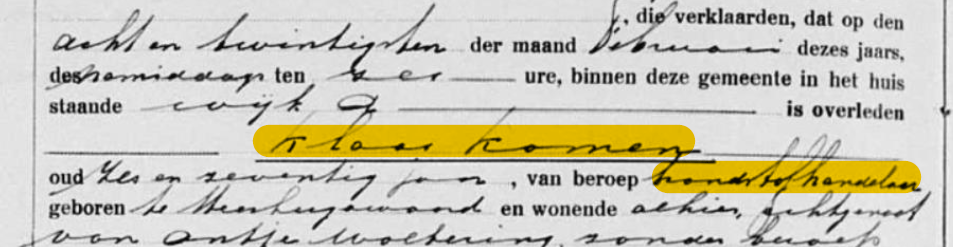
All candles need fuel for the fire, which in their case is the wax. Thinking of fuel reminded made me think of an occupation of one of my ancestors, which has intrigued me many, many years: “brandstoffenhandelaar”. It’s Dutch for “fuel merchant” or “fuel dealer”. My great great grandfather, Nicolaas “Klaas” Komen was a brandstoffenhandelaar in Zuid-Scharwoude, Noord Holland, starting sometime around 1920 up to when he died in 1929.

From the civil register of deaths for Zuid-Scharwoude for Klaas Komen (1852 – 1929), noting his occupation as a brandstoffenhandelaar.

Back in the days before Babelfish or Google Translate, and when my Dutch was still at its most rudimentary as I struggled to teach it to myself, I would often puzzle over what it meant or what the job actually involved. I couldn’t find it in any of the Dutch-English dictionaries I had. However, I knew it was a compound noun. By breaking it down to its component parts I was able to determine that it had something to do with fire and trading or mercantile.

Many years later, I learned that it meant “fuel merchant”, but what exactly did it mean? It’s a term you can find in common use today, especially in the petroleum industry. However, its current use could not possibly mean what Klaas had likely been doing in the 1920s.

Years ago, I trick I figured out for translating unusual or difficult to understand words is to use Google Image Search. Like they say, a picture says a thousand words. I did this for the term “brandstoffenhandelaar“. Not only did that search show the modern usage of the word, but it also showed century-old photos of people with carts or wagons transporting various kinds of fuels, such as coal, oil, and peat. It struck me that those images likely depicted Klaas’s occupation, particularly given that he was a labourer for most of his life. Operating a cart or wagon would be quite consistent with the other work he performed and his station in life.

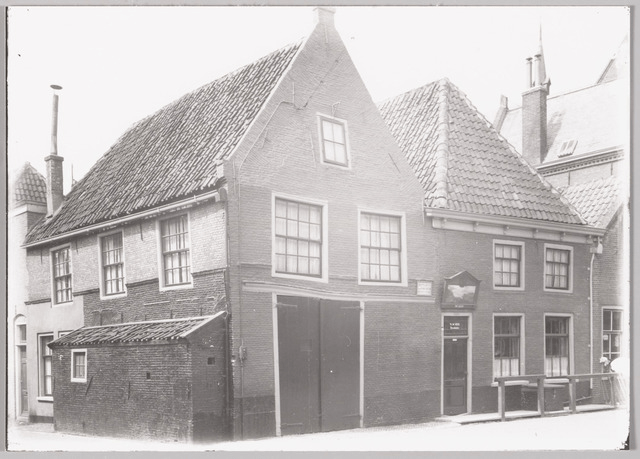
One of my Google Image Search results for brandstoffenhandelaar resulted in this photo in the collection of Regionaal Archief Alkmaar (Alkmaar Regional Archive). This was the warehouse of Dirk Veer, a brandstoffenhandelaar in Alkmaar, which is only a couple kilometers from Zuid-Scharwoude. The image was taken in 1925, so it’s possible Klaas might have known of this place.

In recent years, I discovered the Dutch Genealogy group on Facebook. I posted a query asking whether my understanding of brandstoffenhandelaar was correct, or whether it was more nuanced. The responses led me to believe that I was more or less correct. Several of the responses confirmed that back in Klaas’s day, a brandstoffenhandelaar might be someone transporting fuel by cart, wagon, or small truck, most likely coal, peat, or heating oil.

On occasion, I’ll try to find out what it was that Klaas actually did as a brandstoffenhandelaar. In preparing this post, I thought I’d give Delpher a try. Delpher is a fantastic resource, where you can find historical newspapers, magazines, books, and other publications. The only down-side to Delpher is that the site is only in Dutch, with no English interface. Even if it had one, the search results would be documents that are only in Dutch, so some knowledge of the language is necessary. I get a great language lesson every time I use it!

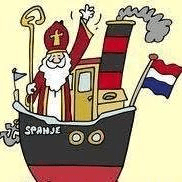
My goal with Delpher was to see if Klaas had placed any ads or notices for his services in the local paper. Delpher has great advanced search features, but I was still stymied in my search. In addition to being a surname, “komen” is also the verb “to come” in Dutch. On top of that, searching for an exact phrase using variations of Klaas’s first name (Nicolaas, Klaas, Nic) with his surname produces a lot of items about Sinterklaas coming to town. Even expressly excluding “sint” or “sinter” from the search didn’t filter them all out.

Hier komt Sint!

Despite the quirks of my search terms, I never found anything for Klaas or his work in the papers I searched. Nevertheless, my curiosity remains fueled.

52W Mark II – Week 12: Membership

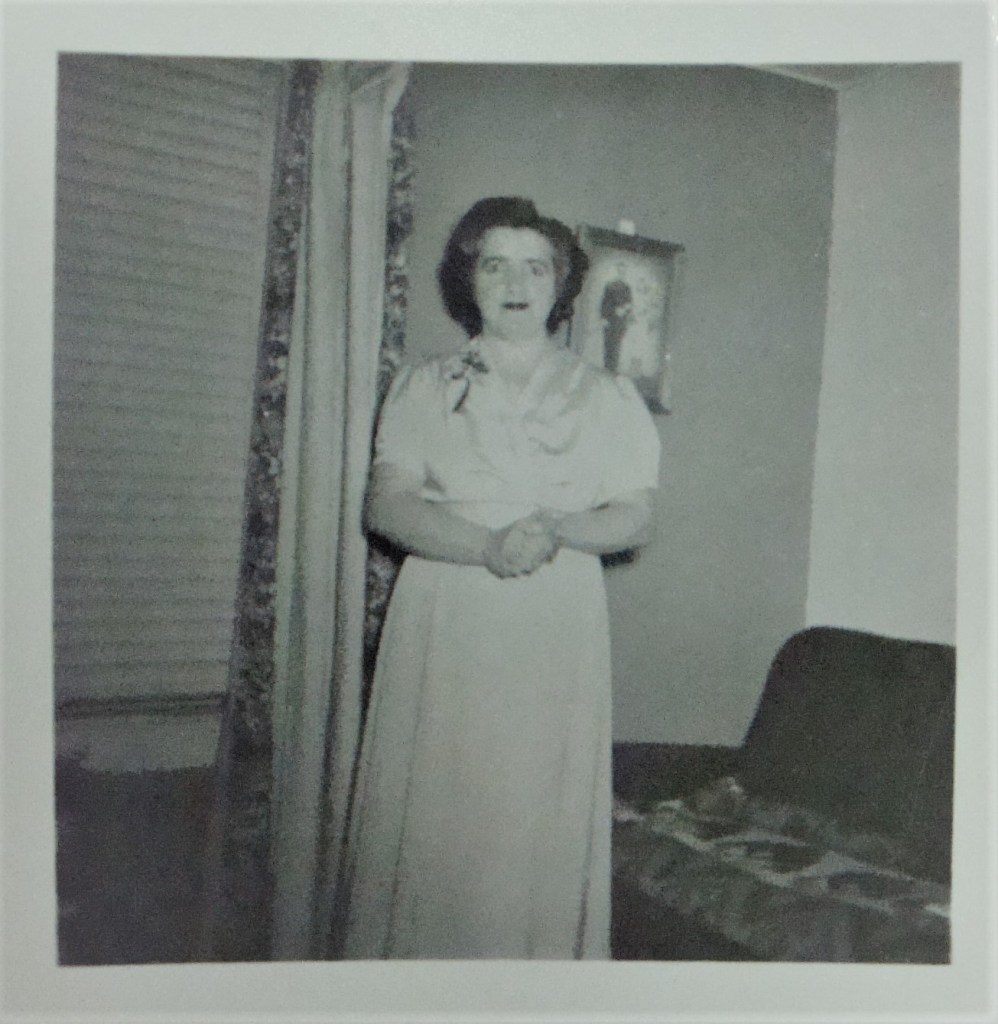
In this blog I’ve written about many different memberships that my ancestors have been part of: members of the military, the church, and the bar, for example. Something I haven’t really written about is membership in volunteer work, service organizations, and social organizations. So for this week’s 52 Ancestors Challenge, I’d like to share something about my paternal grandmother, Christina (“Tiny”, pronounced “tee-nee”) Komen.

My grandmother, Christina Komen, dressed for one of her choral performances. The date written on the back of the photo is March 5, 1957. Unfortunately, the rest of the notation is about the photo on the wall behind my grandmother. It says that it’s a Canadian soldier and his war bride from Scotland and that they were my grandparents’ neighbour. I believe this means the photo was taken at the neighbours’ house.

My grandmother was a wonderful singer with a beautiful voice. Before emigrating to Canada, she was a member of local and church choirs in her home town. After settling in Canada, my grandparents and the family (including my father) lived in a number of small towns south of Lethbridge, Alberta. However, for most of the late 1950s and early 1960s they lived in Warner, where my grandmother was a member of the Warner Choral Society.

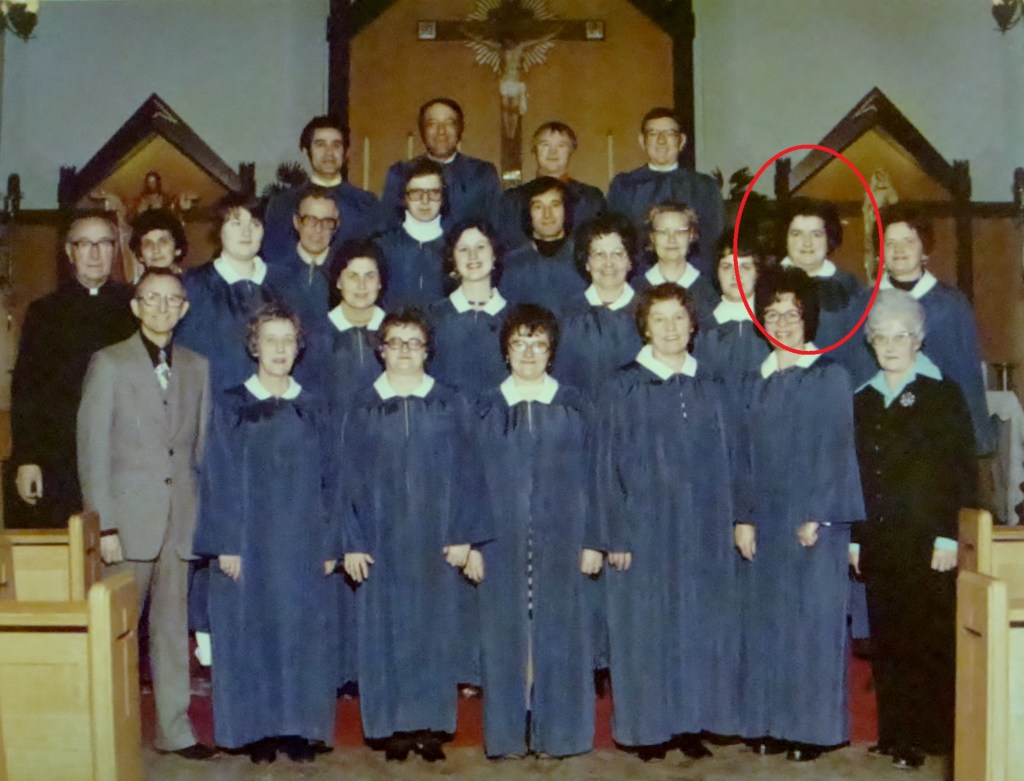
The St. Basil’s Catholic Church Choir, year unknown. My grandmother is in the second row, second from the right.

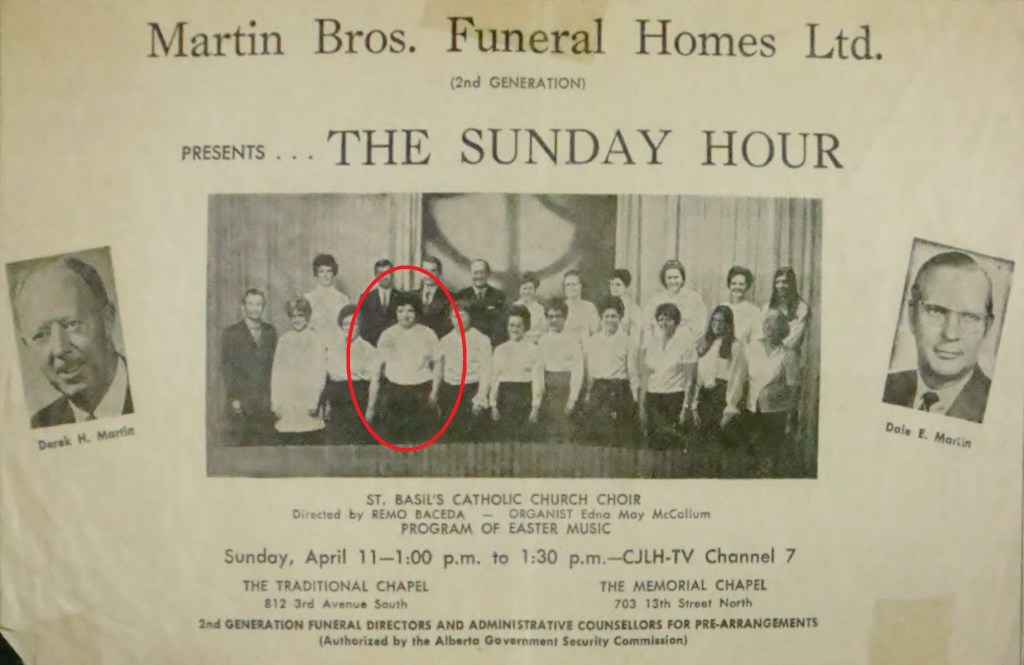
My grandparents later moved into Lethbridge, where my grandmother was a member of the St. Basil’s Catholic Church Choir. The choir would appear on a local television on “The Sunday Hour”, a program that aired on CJLH-TV. At that time, it was a CBC affiliate. It’s now CISA, a Global Television station.

The St. Basil’s Catholic Church Choir were featured on The Sunday Hour on CJLH-TV in Lethbridge on April 11, 1965. While the advertisement is for a program of Easter music, this air date occurred a week before Easter, on Palm Sunday. My grandmother is in the front row, fourth from the left.