Okay, I added the exclamation point to the theme of this week’s 52 Ancestors Challenge. However, the first thing that came to mind is what you’d yell for the guests of honour when they arrive for a party they weren’t expecting. So of course you need the exclamation point!
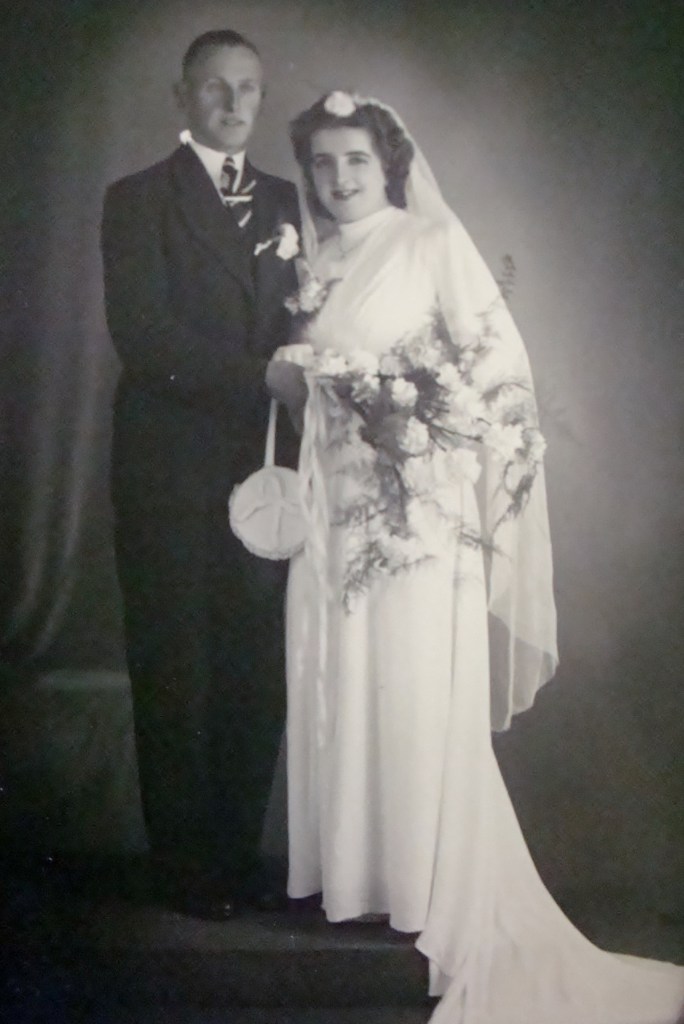
Adrianus Joseph “Arie” van der Fluit (1923 – 2002) and Christina Komen (1923 – 2000)
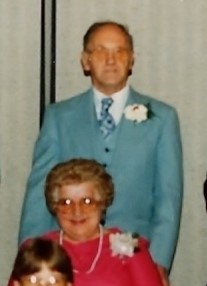
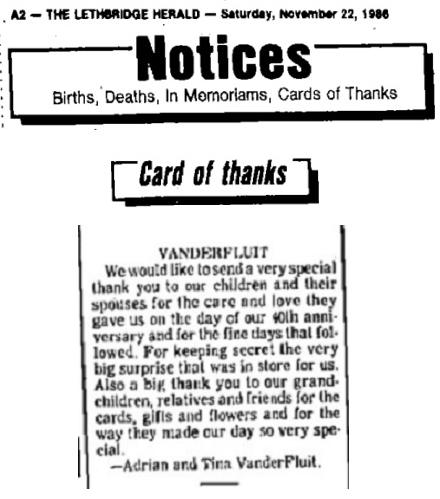
My paternal grandparents married on November 7, 1946, almost 77 years ago. For their fortieth anniversary, my aunts and uncles arranged a surprise party. All their children were in attendance, as were most of their grandchildren. I was attending second year university in Vancouver at the time, so I flew out for the event. As well, some of my father’s cousins (my grandparent’s nieces) came to Canada for the celebration.
This is cropped from the group photo taken during the celebration. I had neither the time not the interest in asking everyone’s permission to post the photo online.
While I grew up in the Canadian prairies and northern British Columbia, by my second year I had gotten used to the mild Vancouver weather and forgot to bring proper winter gear with me. Brrr!! Why on Earth did my grandparents marry in November? Why did they not marry in May? (For what it’s worth, their eldest child – my father – was born over a year after my grandparents married!)
One of the great things about conducting Dutch genealogy is the amazing array of resources that are available. While the adage “not everything is online” still applies, there are an incredible number of sources that are digitized and online – largely for free! For this week’s 52 Ancestors Challenge theme, I want to focus on two sources I have relied upon the most for newspaper articles.
One great thing about old Dutch newspapers is that they usually published summaries of all the birth, marriage, and death registrations for the local village or town civil registers (“burgerlijke stand”).
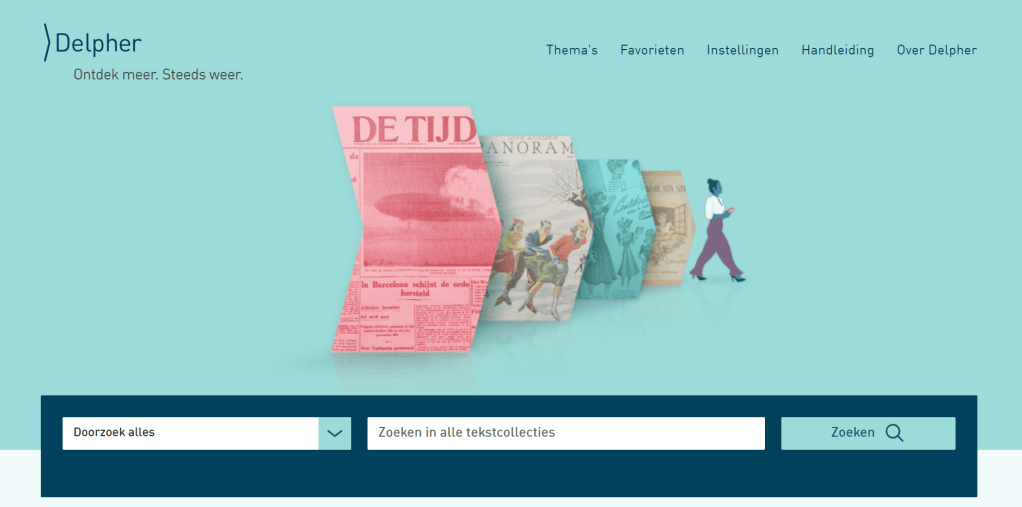
The first is Delphler.nl, a partnership between numerous Dutch libraries and archives – over 200 institutions, according to the website. It is a central access point for Dutch historical texts from the digital collections of numerous scientific institutions, libraries, and heritage institutions.
Delpher is somewhat like the Internet Archive. It is a repository for scanned images of newspapers, magazines, and books published in the Netherlands. It even includes some publications from its former colonies, such as Suriname. It boasts over two million newspapers, 400,000 magazines, and 200,000 historical books.
Delpher has a rather good search engine; I’ve rarely had difficulty finding what I am looking for. The results provide you a link to the full page of the document with your search term. The search result also allows you to go through every page of the paper or magazine containing the page you were looking for.
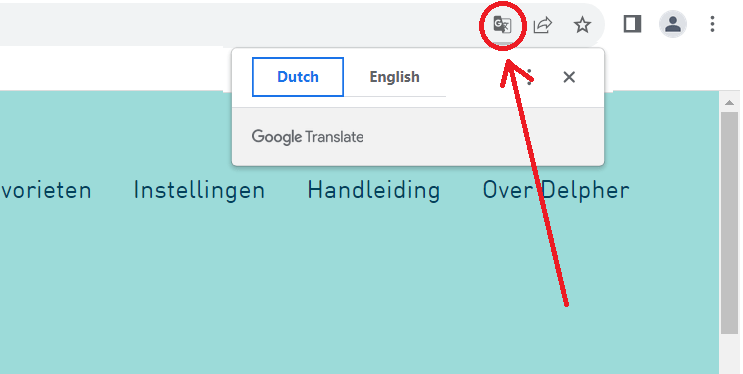
What might be a downside for most North American users is that the site is only available in Dutch. The translate function of your browser can help, although the records you’ll find will be in Dutch. Luckily, my Dutch is good enough that I can navigate and search without much difficulty. For what it’s worth, “kranten” is “newspapers” and “tijdschriften” is “magazines”. It’s probably not much of a guess to figure out “boeken” is “books”.
I use Chrome, which has a translation function.
Another excellent source of newspaper images are the many local and regional archives throughout the Netherlands. I make use of several, particularly those situated in Leiden, Haarlem, and Alkmaar. Unlike Delpher, many Dutch archives have an English interface. However, some of them only provide English versions of part – but not all – of their website. Fortunately, the English interface is usually available for things like genealogy.
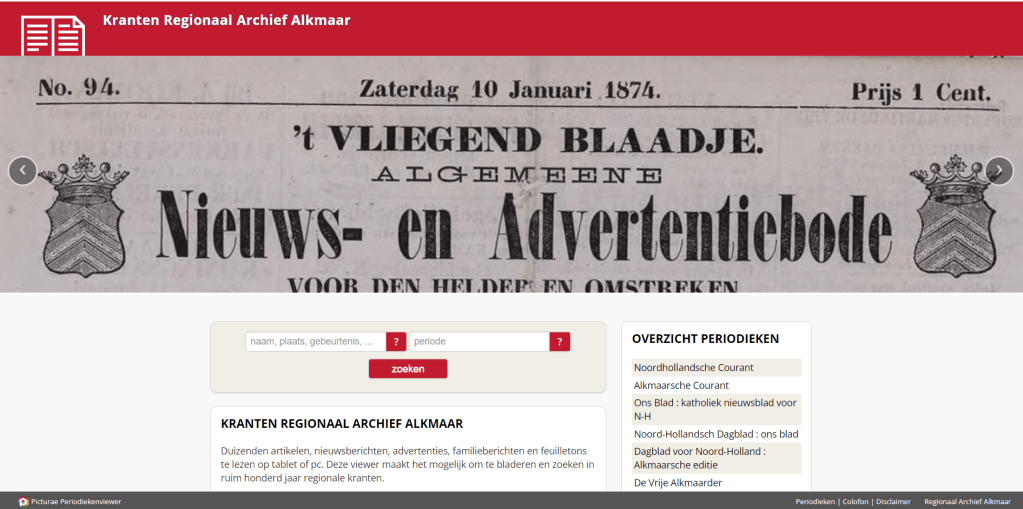
Alkmaar is very close to many of the towns and villages where my family has lived, so I have gathered a lot of newspaper images from the Alkmaar Archief. It has an online database exclusively devoted to newspaper images,Kranten Regionaal Archief Alkmaar (Alkmaar Regional Archives Newspapers).
Like Delpher, I find the Alkmaar Archief search engine works well. Like Delpher, the search result provides you with the full page of where your search term appears, with the ability to look at the entire newspaper that contains the page. However, unlike the main Alkmaar Archief, this database does not have an English interface.
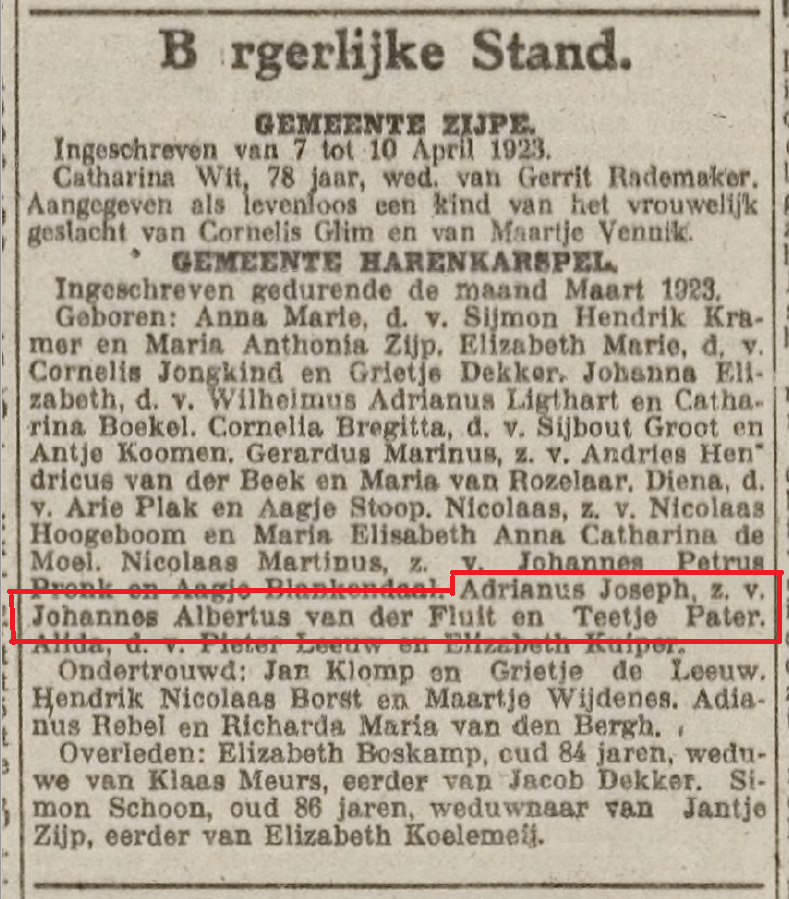
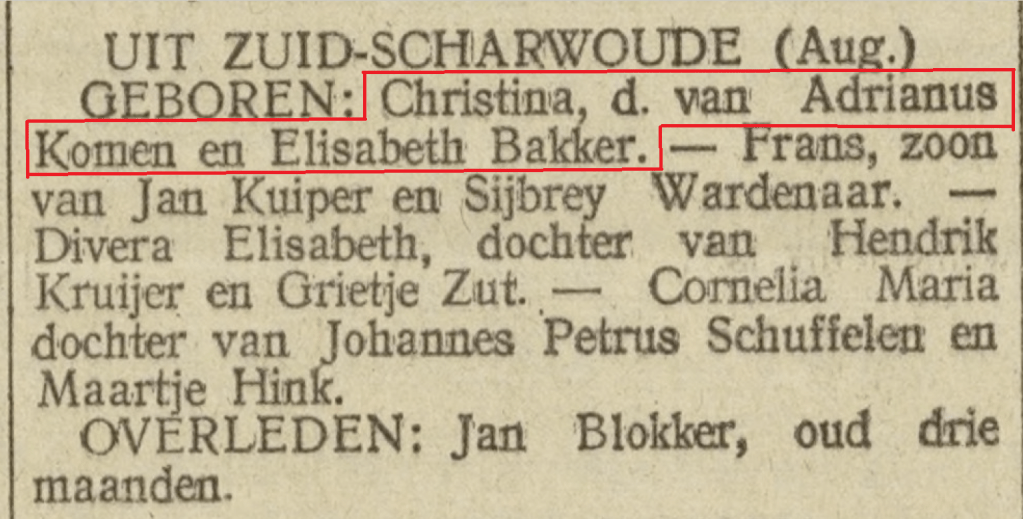
I have had a great deal of success with the Kranten Regionaal Archief Alkmaar. Here are the clippings from the papers with the summaries of the birth registrations of my paternal grandparents:
“Adrianus Joseph, son of Johannes Albertus van der Fluit and Teetje Pater” Schager Courant, 11 April 1923, page 8. (“Gemeente” is akin to a municipal district)
“Christina, daughter of Adrianus Komen and Elisabeth Bakker” Alkmaarsche Courant, September 10, 1923, page 6.
The theme for this week’s 52 Ancestors Challenge is “Random”. So I decided to truly be random.
I currently have 5,294 people in my RootsMagic database. This consists mainly of my children’s direct ancestors, along with the spouses and children of those people. There are also several lines where I’m tracking all the descendants of certain ancestors; in particular, those of Dirck Jansz, my direct paternal great x10 grandfather.
Using a random number generator, I chose a number from 1 to 5,294. The plan was to write about the person whose record number corresponded with the result. The first result corresponded with a living person, so try again. The second time it came up with 3,061. That corresponds with Petrus van der Fluit, my second cousin twice removed.
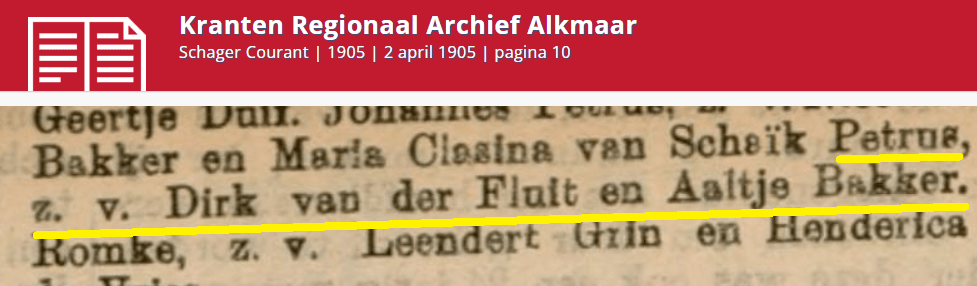
Birth notice for Petrus van der Fluit, Schager Courant, April 2, 1905, page 10.
Petrus did not have a long life. He was born on March 25, 1905 in Zijpe, Noord Holland, Netherlands. He died less than three months later, on June 18, 1905.
One might think that this is an unfortunate result, in that there is not much to say about someone who lived such a short life. However, I was quite happy with the result. To me, it’s important to remember those who never really got to live their lives. Not only were their lives dismally short, they’re often forgotten as a result. They might not have been long in this world, but their time on Earth should be noted.
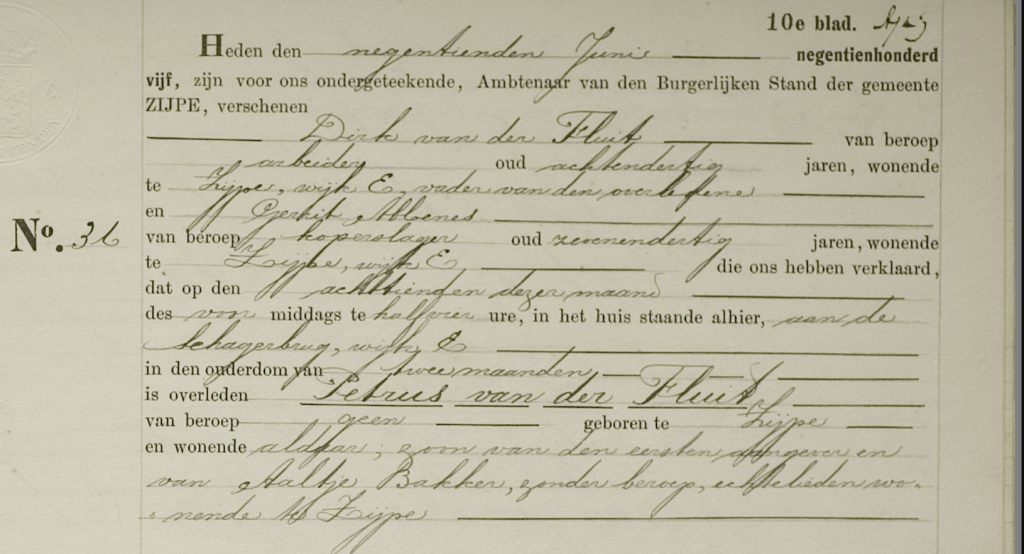
Death registration for Petrus van der Fluit, civil register for Zijpe – deaths.
Petrus was the son of Dirk van der Fluit and Aaltje Bakker. They married in Zijpe on May 4, 1895. Dirk is my first cousin three times removed. While Aaltje appears to be related to me through marriage, I have many Bakker ancestors and cousins from Zijpe and environs, so I would not be surprised to discover that she and I share a common ancestor.
Petrus was the fifth of six children born to Dirk and Aaltje. Sadly, Petrus was not the only one who died in infancy. Dirk and Aaltje’s second child passed away within a day of birth, and their youngest, Anna, lived less than ten months.
Death register for stillborn child (“levenloos”, or “lifeless”).
It has been said (attributed to everybody from the ancient Egyptians to Banksy): “Everyone dies twice. Once when you take your final breath, and then again the last time someone says your name.” I say the name “Petrus van der Fluit”, and he lives on.
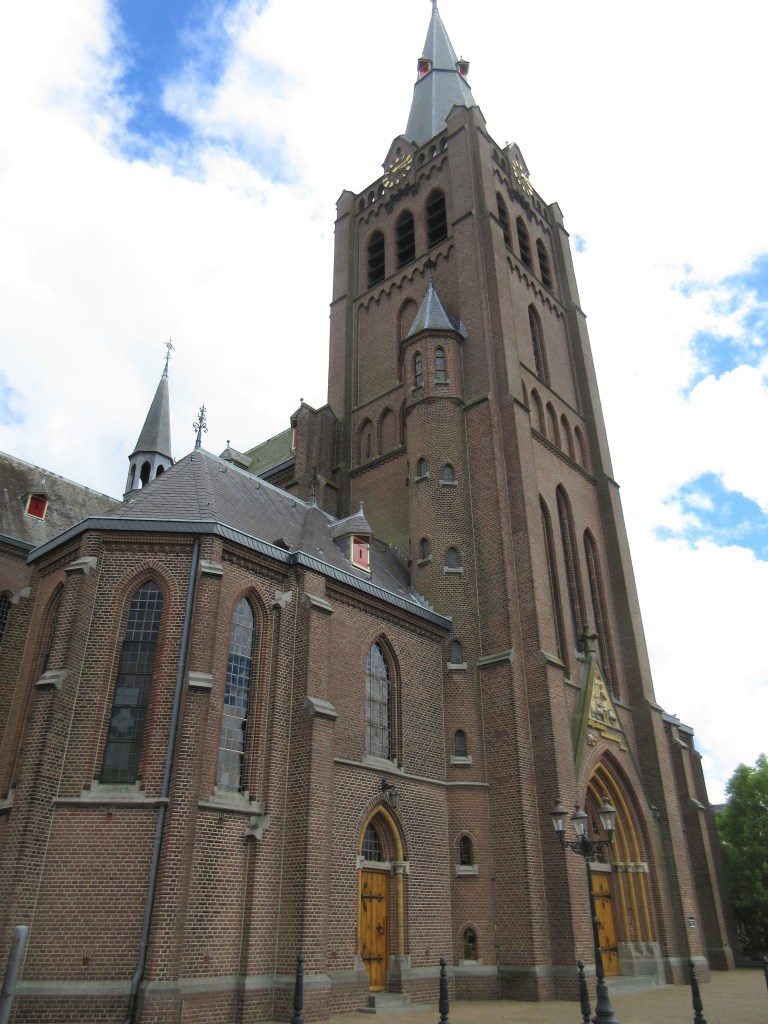
Kerk van Sint-Joannes de Doper, Noord-Scharwoude, Noord Holland, Netherlands
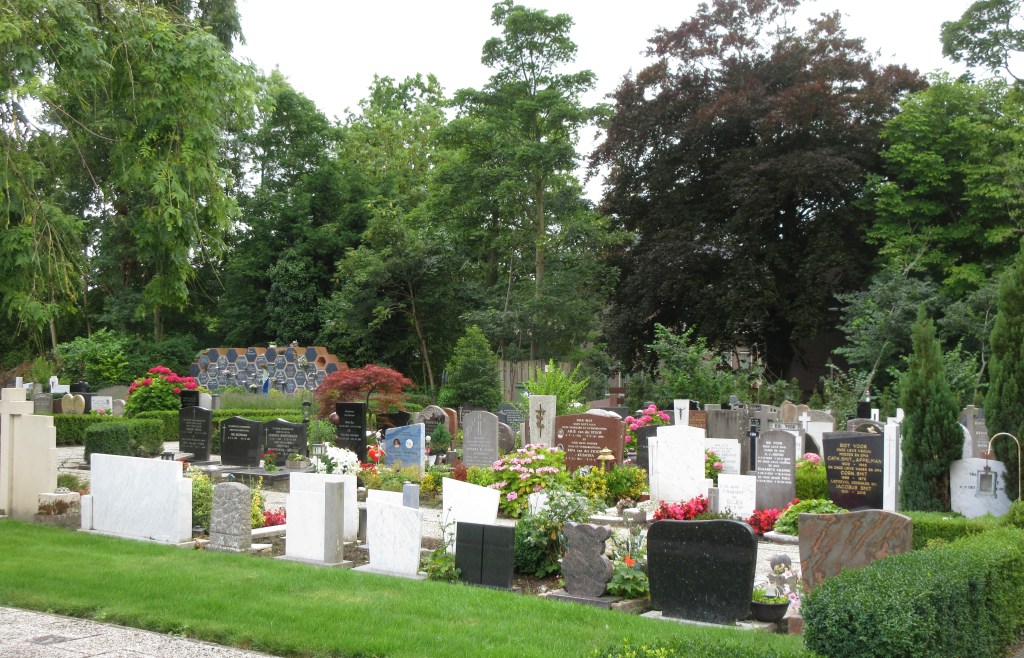
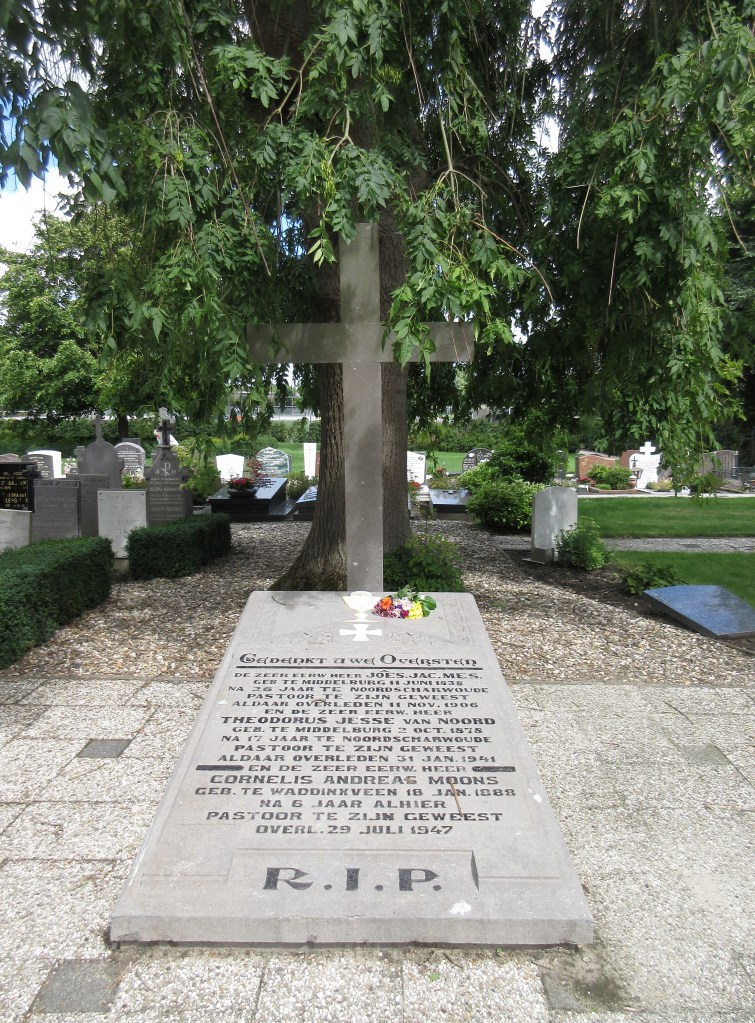
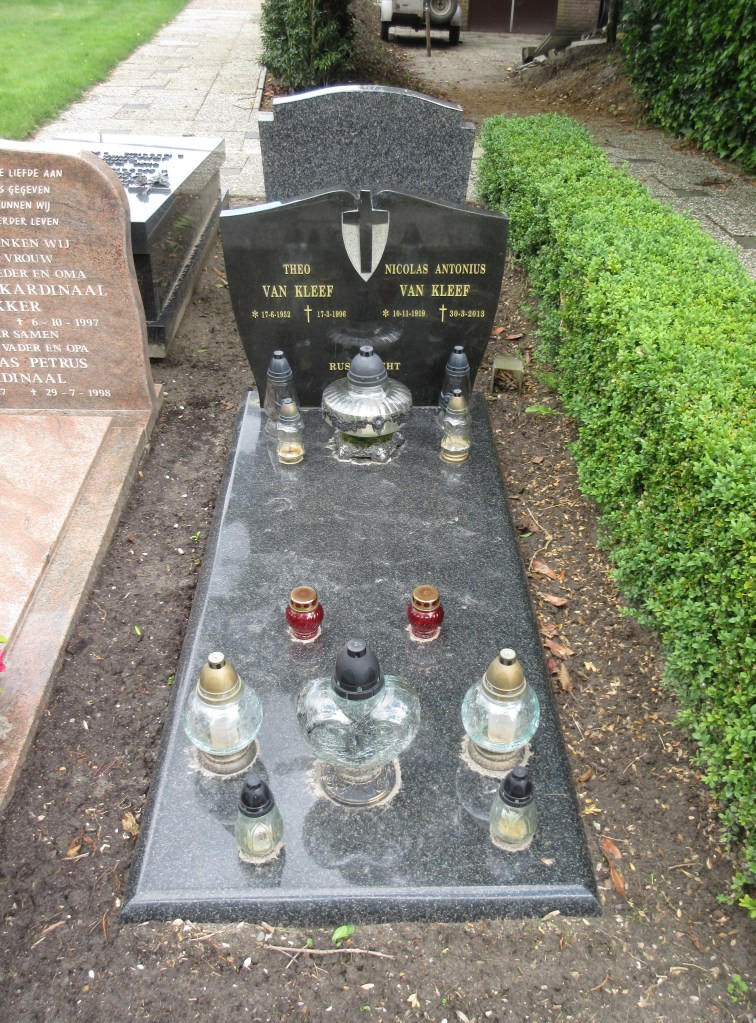
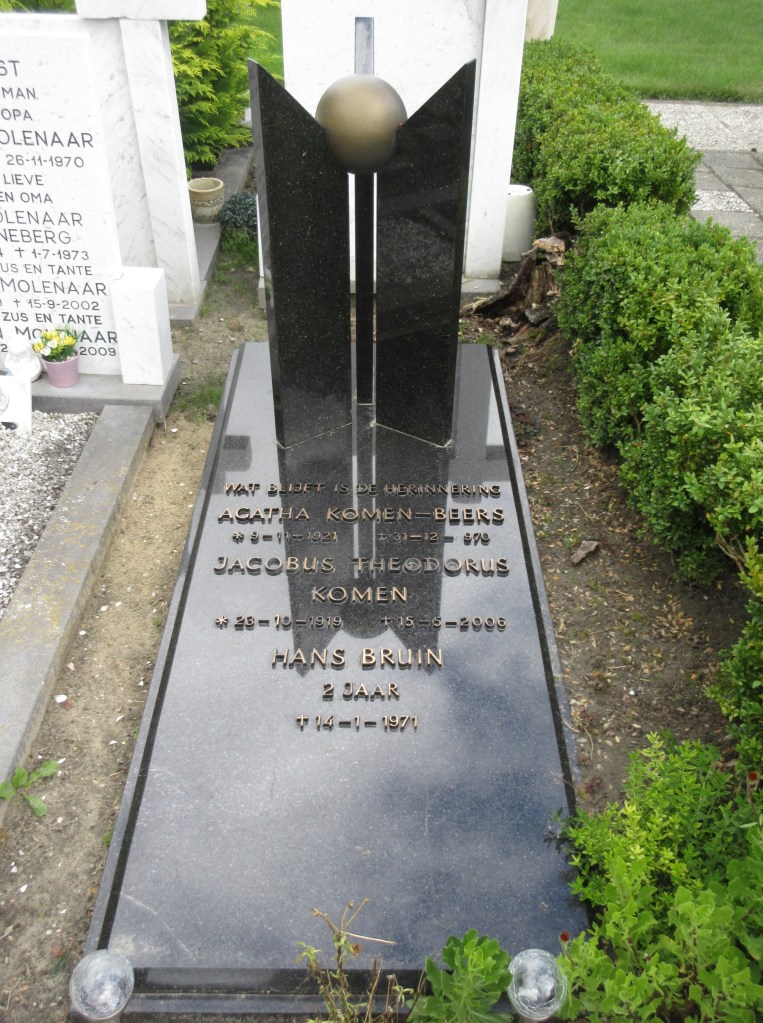
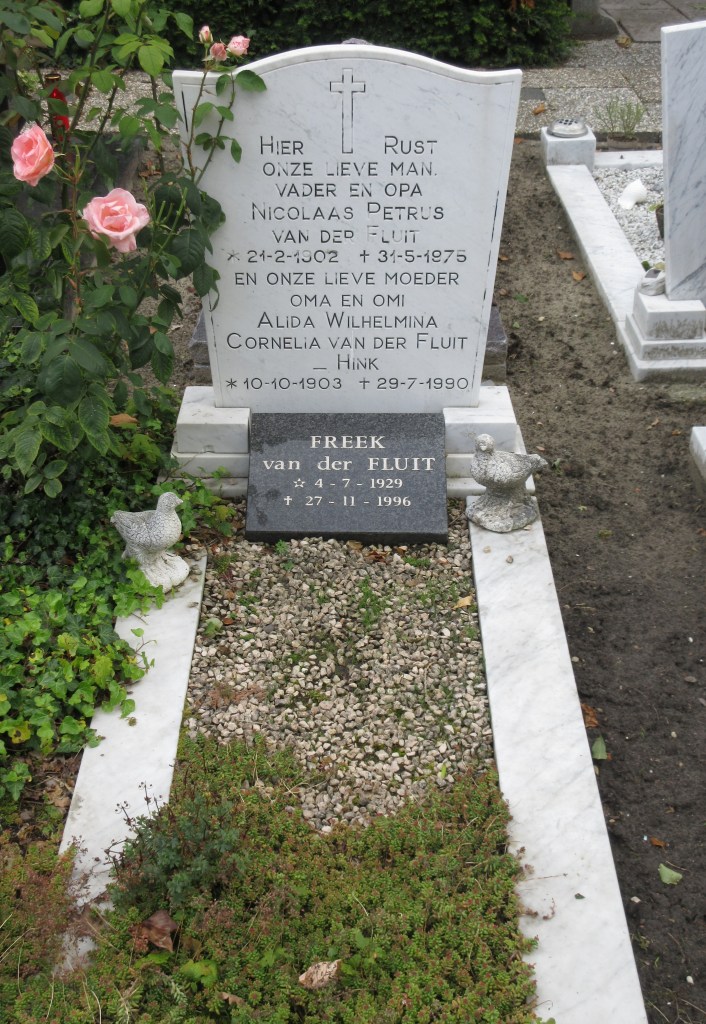
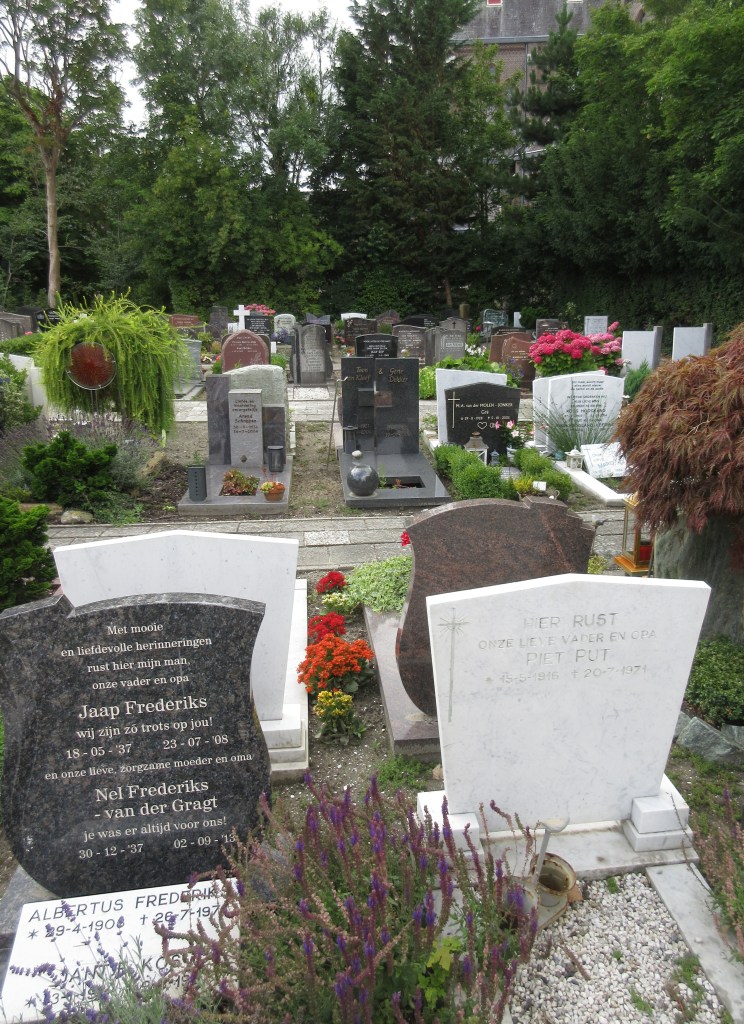
I was staying with a cousin whose home is only a few hundred metres from the Kerk van Sint-Joannes de Doper (Church of Saint John the Baptist – link is in Dutch). I walked past it every day. One afternoon my father and I, along with a few of our cousins, explored the church and the adjacent graveyard, Het Parochiële Kerkhof Sint Jan de Doper (The Parish Cemetery of Saint John the Baptist – link is to Find a Grave).
Het Parochiële Kerkhof Sint Jan de Doper (The Parish Cemetery Saint John the Baptist), Noord Scharwoude.
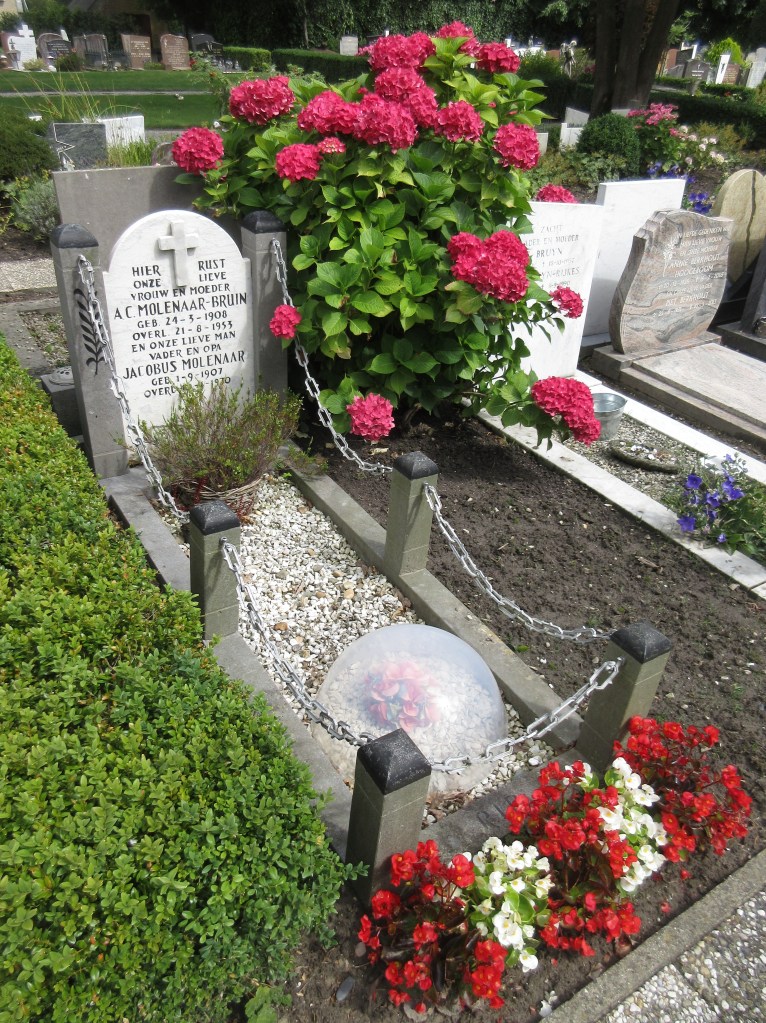
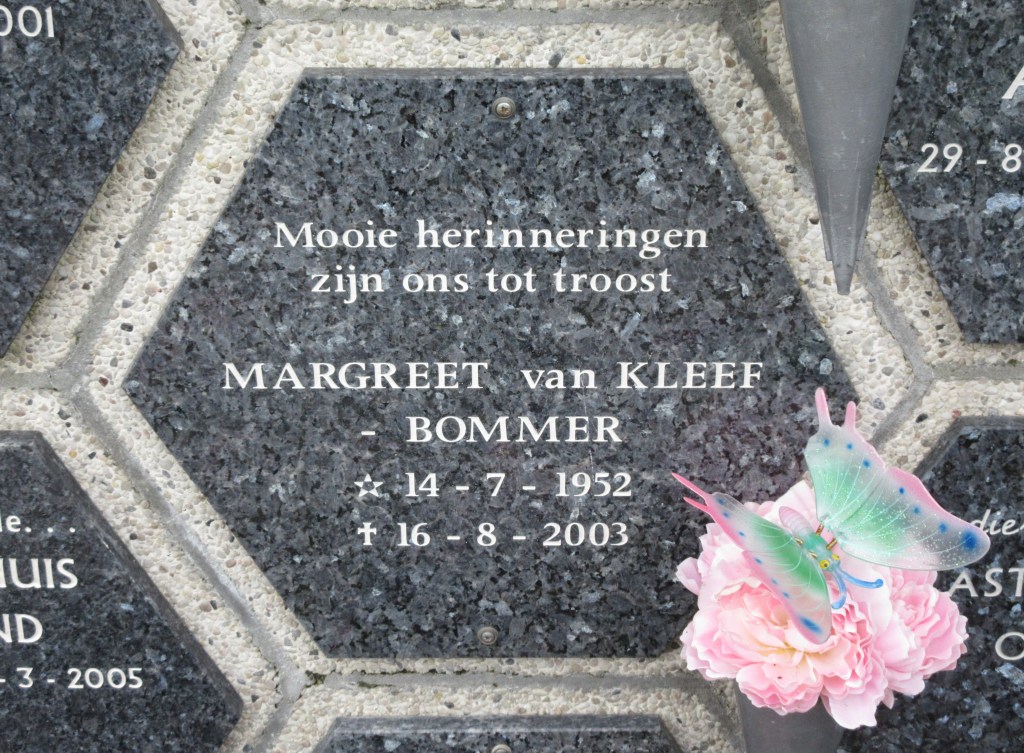
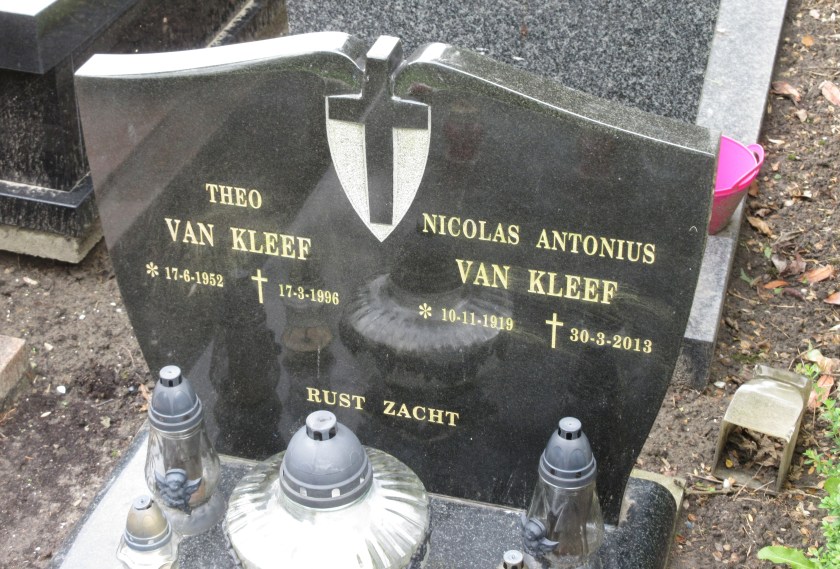
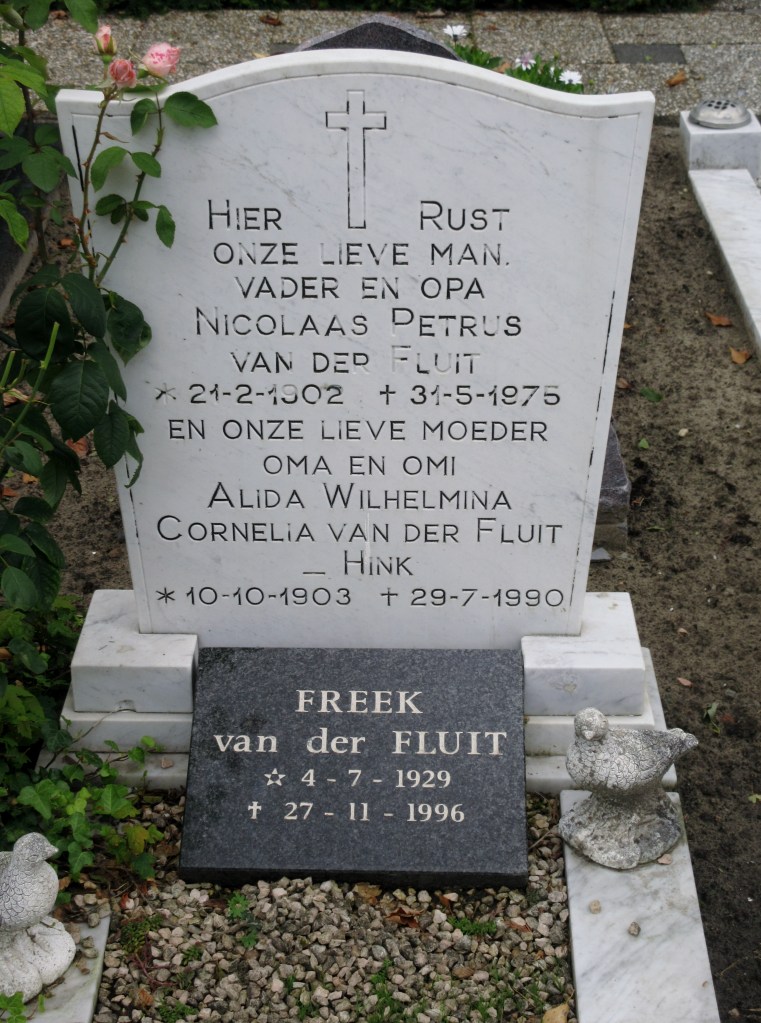
Here are a few of the graves of some of some of my extended family, several of whom I had the pleasure of knowing, including my great uncle, Nic van Kleef.
(As cemeteries are a big part of genealogy, it should come as no surprise that it forms a common theme for the 52 Ancestors Challenge. For Week 46 of the challenge in 2022, the theme was “Tombstones“.)

 A Deck of Ancestors