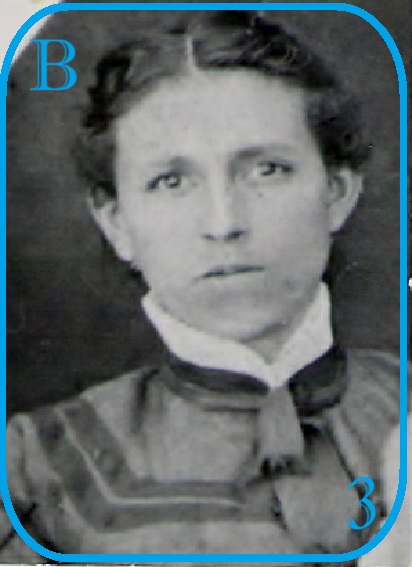
52W Mark IV – Week 29: Card B3 Sarah Florilla Cook

Sarah Florilla Cook (1857-1894)

As is typical of many of our female ancestors, there are not many primary records for my Gx3 Grandmother, Sarah Florilla (“Rilla”) Cook. Most of my sources are second or third-hand – or worse. Rilla was born, married, and died before vital records were kept in Utah, which was not yet a state during her lifetime. The few times Rilla is mentioned in the records are some of the US censuses or in the death registrations of some of her children.

Rilla was born on November 3, 1857 in Cedar City, Utah, to Henry Lyman Cook and Susan Ann Elizabeth Turple. Both of her parents seem to have had colourful lives. Henry was married four times; the last three were polygamous, with Susan being the last of those three. Susan had been married once before, in Nova Scotia, to a musician from Massachusetts. Henry and Susan each moved to Utah after joining the Mormon church. Rilla was the second of four children born to Henry and Susan. While Henry passed away when Rilla was 12, Susan outlived her daughter by 12 years.

When she was 18 years old, Rilla married Horace Conrad Liggett Burgess in Goshen, Utah on March 3, 1876. They had their first child, William Henry, on August 4, 1877. Over the next 16 years, Rilla had eight more children. The youngest, also named Sarah Florilla and who also went by “Rilla”, was born on December 19, 1893.

Sadly, Rilla died two weeks later, on January 4, 1894. While it is largely a matter of speculation given the timing of her death, I would not be surprised if Rilla died due to some complication following childbirth. Rilla was only 36 when she died.

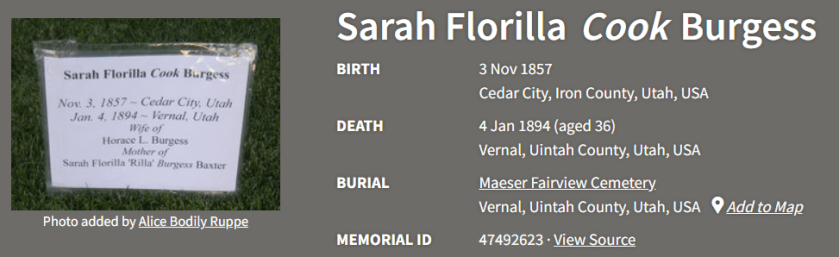
It doesn’t even appear that she has a permanent marker on her grave. The only result I could find after consulting a wide variety of online sources was on Find A Grave. There is a photo of a “temporary” marker, which was taken in 2011. It does not appear that anything more permanent has been installed in the following 14 years.

The photo in this screen shot of Rilla’s entry on Find A Grave was taken in 2011.

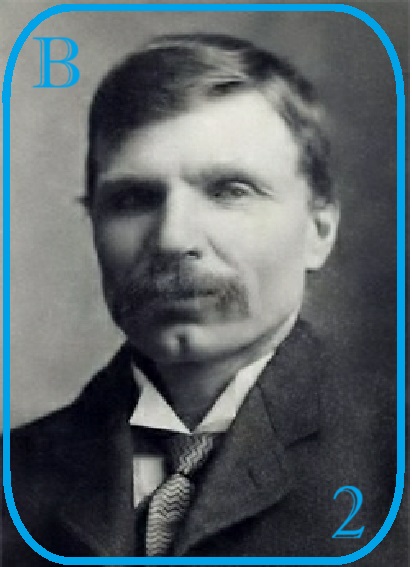
52W Mark IV – Week 28: Card B2 Horace Conrad Liggett Burgess

Horace Conrad Liggett Burgess (1854-1940)

What can I say about my Gx2 Grandfather Horace Burgess that I haven’t said before? It seems like I’ve written about or mentioned him many times in the four years that I’ve been participating in the 52 Ancestors Challenge.

Horace was born in 1854 in Lehi, Utah. As far as I can find, he was named Horace Liggett Burgess. His middle name reflects the Mormon custom of giving their children their mother’s maiden names as middle names. Census and marriage records show he was still using Liggett as his middle name in his late 40s. It was not until after he moved to Canada in 1903 that he began to use Conrad. The family lore I’ve found suggests he adopted the middle name Conrad later in life in order to add support to his claim in a dispute over his ownership of some land. Horace dropped Liggett from his full name when he applied for homesteads in Alberta in the first decade of the 20th Century. The name Liggett does not appear on his death certificate or headstone.

Horace was the only child of William Burgess and Charlotte Elizabeth Liggett, who married in 1852. The union was polygamous, as William was still married to his first wife, Maria Pulsipher. William and Maria had been married for 12 years at the time and had six children; they remained married until Maria died in 1892. Moreover, William was more than twice Charlotte’s age when they married – he was 30, she was 14. Based on my research, this was typical of polygamous Mormon marriages of the time.

Charlotte left William sometime around when Horace was three. Apparently she did not get along with Maria. Horace went with his mother when his parents separated. Charlotte remarried in 1857, entering into another polygamous marriage. By the time Horace was 17, he had five half-siblings through his mother and step-father. William married his third wife in 1858 – another polygamous marriage for him, too. William had three more children with Maria and four with his third wife. In all, Horace had 19 half-siblings.

Horace had no memories of his biological father during his childhood and teens. Based upon the 1860 and 1870 censuses, Horace went by his step-father’s surname. According to his half-brother George, Horace was 18 when he learned the identity of his biological father from his mother. Horace then sought out his father and began using the surname Burgess.

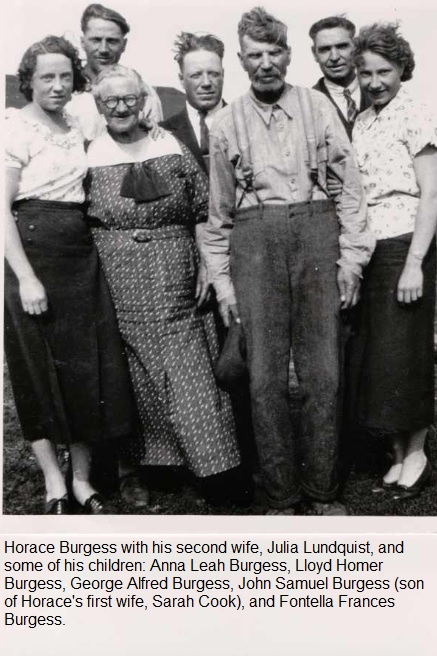
Horace married his first wife, Sarah Florilla (“Rilla”) Cook, in Goshen, Utah on March 3, 1876. He was 21 and she was 18. Together they had nine children – seven boys and two girls. Six children survived childhood and into adulthood. By 1887 the family had moved to Lawrence, Utah. As of 1891 they had relocated to Vernal, Utah.

I don’t know how Horace earned a living at the time he married or when his first two children were born. However, by 1880, he was working in Goshen as a teamster. It appears that he worked at this occupation in one form or another for the next twenty years.

1880 United States census, Utah Territory, Utah County, Goshen Precinct, Enumeration District 35, page 3.

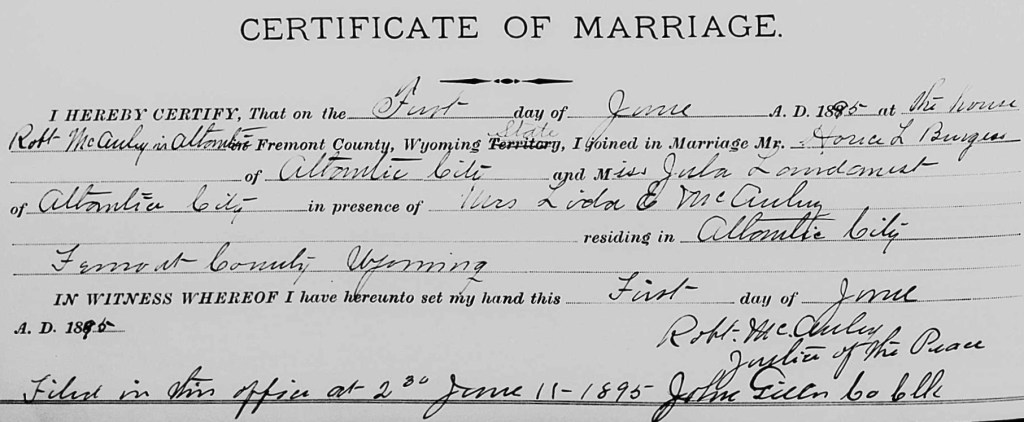
Rilla passed away in January 1894, a few weeks after giving birth for the ninth time. Just over a year later, on June 1, 1895, Horace married Julia Josephine Lundquist in Atlantic City, Wyoming. It is neither a city nor located by the Atlantic. In fact, the village is well more than twice as far from the Atlantic as it is from the Pacific. Apparently it takes its name from the fact it’s on the eastern (Atlantic) side of the Continental Divide.

Horace was 13 years Julia’s senior. It was her third marriage. Julia was born in Sweden and immigrated to the United States when she was 16. Horace and Julia had nine or ten children. I say nine or ten because I cannot find much evidence regarding their first child, said to have been born sometime in 1895. Even his name is unconfirmed. I have it as Lewiston Leon Burgess, other places it’s James Harvey Lewiston Leon Burgess. If he in fact existed, Horace and Julia had five children in the United States and five in Canada.

Based on the records I have, how Horace came to be in Wyoming is little more than an exercise in speculation. I suspect it was related to Horace’s occupation of transporting freight.

Horace is included twice in the 1900 census, in Freemont and Sweetwater counties, both in Wyoming. For both, his occupation was entered as “freighter”. Since records for other times show Horace as a teamster, it’s likely that his work as a freighter meant he transported cargo. The fact he was listed in the 1900 census at two different locations, it may be that his transport work involved travel between the two counties.

The Freemont County census shows three of Horace’s sons as being with him in that county, with their occupations listed as sheepherder. One of those sons, John, is also listed in both census records. Together, this suggests that Horace’s transport work might have been related to agricultural products.

Horace and family moved to Canada in 1903, when Horace made the first of two attempts at homesteading. In August of that year he settled on a piece of land near Grassy Lake, Alberta, which is midway between Lethbridge and Medicine Hat. The venture did not last long, because he had returned to the United States the following year. In a subsequent application for a homestead at another location, Horace reported that he had forfeited his claim to this land.

The family came back to Canada soon afterwards and made a second attempt as a homesteader on a piece of land near Brant, Alberta, about 60 kilometers southeast of Calgary.

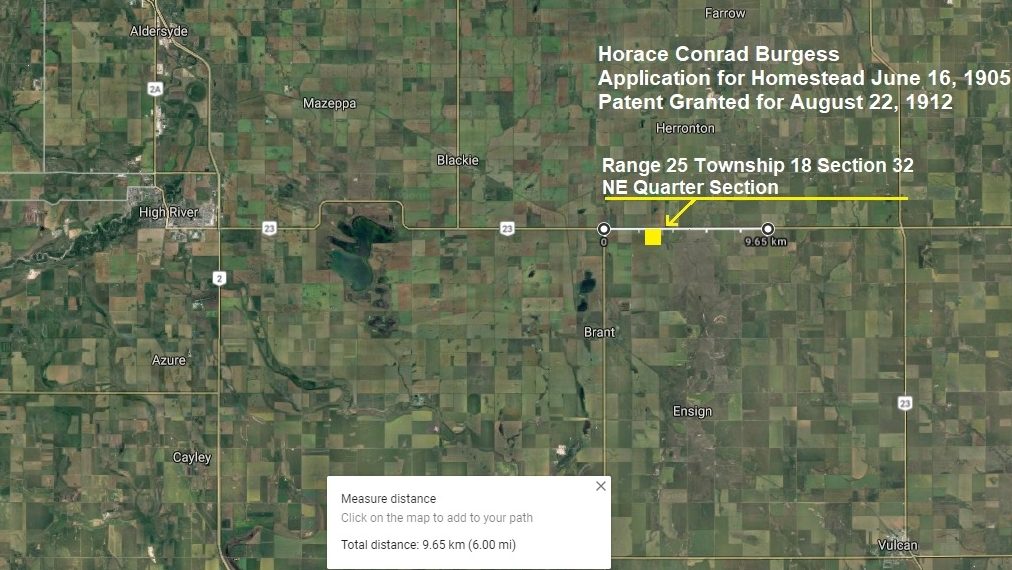
Horace obtained entry for the land on June 19, 1905. He built a home on the land and began continuous occupation in April 1908. That was the same year Horace was naturalized as a Canadian national (at that time, a British subject domiciled in Canada). According to the homestead application Horace filed in June 1908, on two occasions after entering the land he spent several months working in British Columbia. On this homestead, Horace had seven horses and ten head of cattle. The land was granted to him on August 22, 1912. Horace remained here until 1916. I do not know his ownership status there after that time.

The yellow square marks the land granted to Horace Burgess, upon which he was a homesteader – not far from Vulcan!

Sometime in 1916, Horace and family relocated to a farm at Glenwood (at the time, “Glenwoodville”), north of Cardston. Sometime after 1916, Horace and family moved several times, to places in Utah and Idaho, but they did not sell their home in Glenwood. Horace, Julia, and their two youngest children moved back to Glenwood in September 1924. It appears that from up to 1930, Horace divided his time between Glenwood and Cherry Grove, which is midway up the province close to the Saskatchewan border.

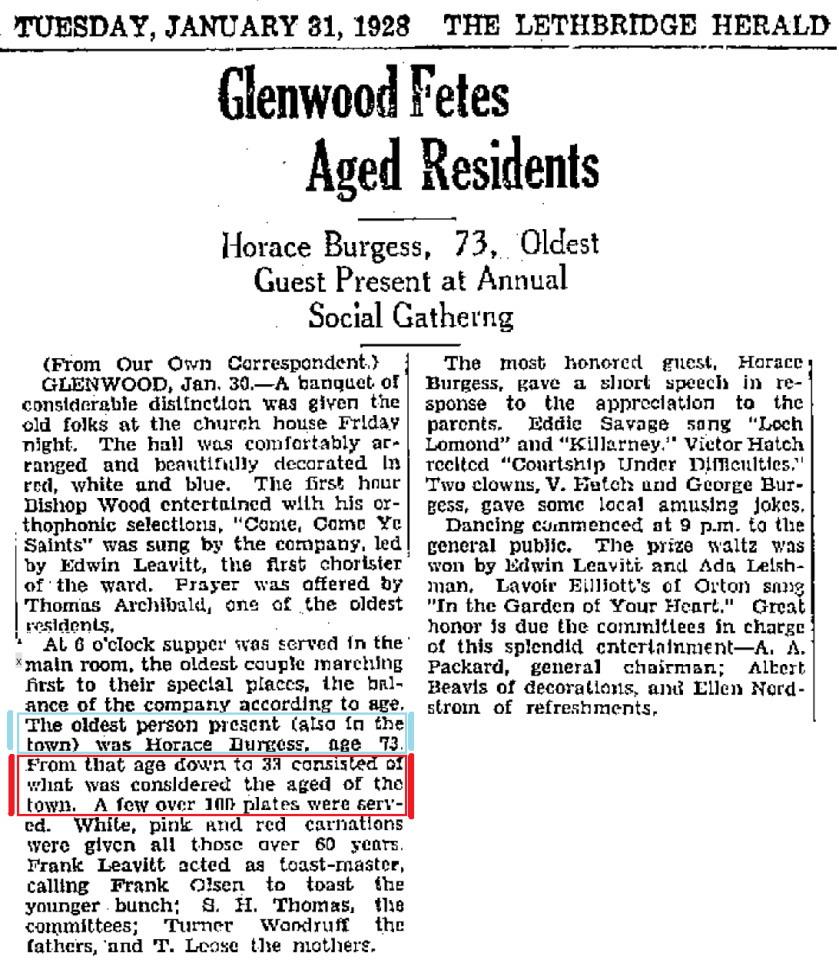
Two years before Horace left Glenwood the last time, the village honoured its oldest residents at a banquet in January 1928.  At age 73, Horace was the oldest of those honoured. However, the bar for what was considered “aged” was pretty low. According to the newspaper account of the event, from age 72 “down to 33 consisted of what was considered the aged of the town.” I suppose midlife crises in Glenwood occurred when people were in their teens.

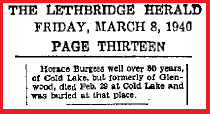
Horace ultimately retired in 1930 and remained in Cherry Grove from that time on. His hobbies included vegetable gardening. Horace passed away at age 85, on February 25, 1940. While the cause of death was due to kidney problems, the registration of his death said it was secondary to “senility”, amongst other health problems. Horace is buried at the Cherry Grove Cemetery.

Horace’s Gx3 and Gx4 grandsons, visiting the land he farmed just over 100 years ago.

52W Mark IV – Week 27: Card B1 Milton Leo Burgess and Hazel Nelson

Milton Leo Burgess (1891-1964)
Hazel Nelson (1899-1967)

We’re halfway through the 2025 edition of my take on Amy Johnson Crow’s 52 Ancestors in 52 Weeks Challenge. With it I start the maternal side of my family and a new suit involving my mother’s paternal line. It’s also my Mormon lineage. In fact, my  Gx4 Grandfather, William Burgess (1794-1880), joined the church in 1832, two years after it had been founded. Moreover, all eight of my maternal grandfather’s great grandparents joined the church in the 1830s and 1840s.

However, after five generations, that came to an end with my grandfather, Leo Burgess, as none of his four children were members of the church or raised Mormon. In fact, my grandfather was pretty much a lapsed Mormon, if there is such a term, by his late teens. He only returned to the church after my grandmother, Helen Lerner, passed away.

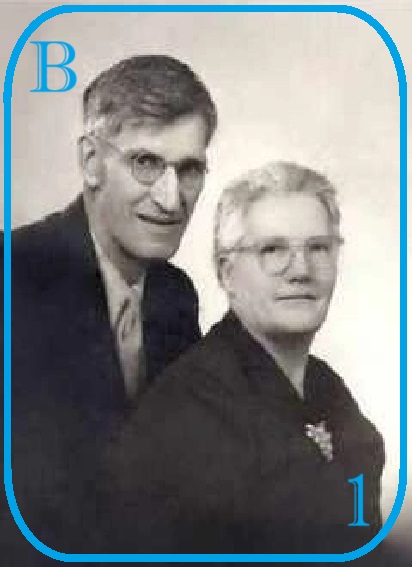
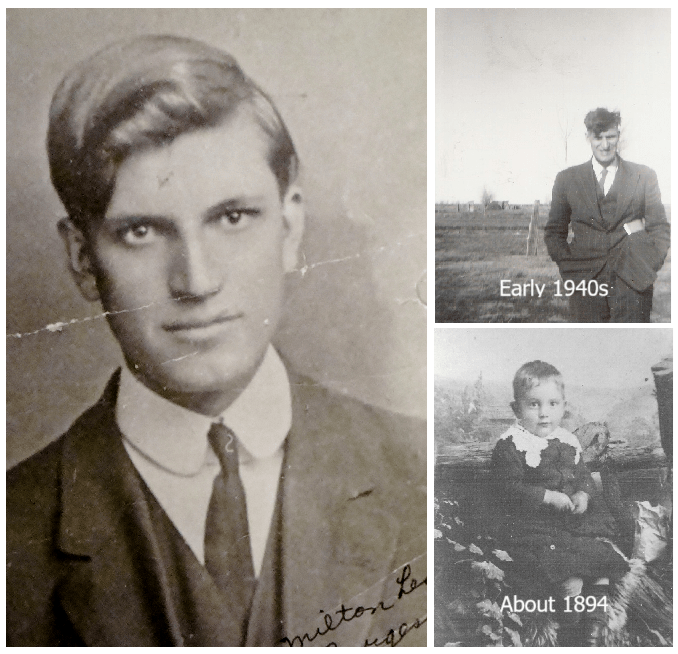
Leo’s parents, and the subject of the first card of this suit, were Milton Leo Burgess and Hazel Nelson.

Milton was born in Vernal, Utah, on September 9, 1891, the eighth of nine children born to Horace Conrad Liggett Burgess and Sarah Florilla Cook. Florilla passed away in January 1894, a few weeks after her last child, also named Sarah Florilla (“Rilla”), was born. Milton was only two years old at the time. Horace remarried shortly afterwards, to Julia Josephine Lundquist, with whom he had at least another eight or nine children. The family moved Canada when Milton was 14. They settled in Vulcan County, Alberta.

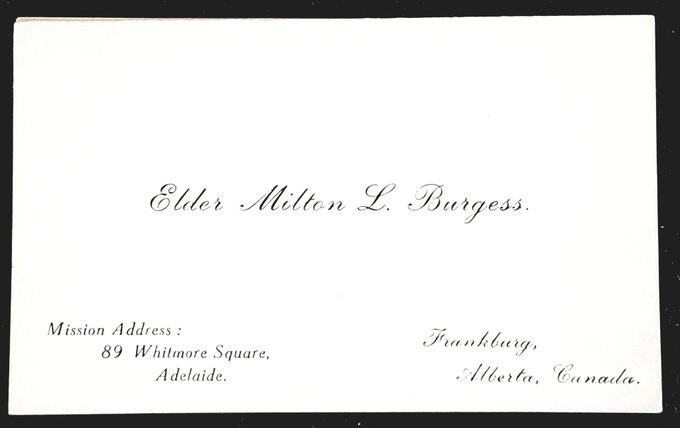
After completing a two-year mission to Australia in 1915, Milton settled in Glenwood, Alberta, which is about 22 kilometers from Cardston as the crow flies. There he worked as a farm labourer. Sometime afterwards, he met Hazel Nelson, who he married in Cardston on April 13, 1919.

Calling card of Milton Leo Burgess from his time as a Mormon missionary in Adelaide, Australia

Milton’s calling card from his time as a Mormon missionary in Adelaide, Australia

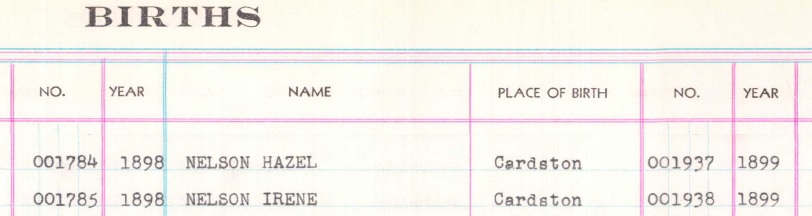
Hazel’s family was amongst the earliest settlers of  Cardston, Alberta, which Mormon immigrants from the United States founded in 1887. Her parents, John Alexander Nelson and Ella Elizabeth Thomas settled there in 1890. Six of their 12 children were born in Utah; the other six were born in Canada. Hazel and her sister Irene were born on December 15, 1899. They were the first twins born in Cardston. Sadly, Irene passed away five weeks later, but Hazel lived to be 67.

Because Hazel is listed first, I take it to mean that she was born first.

The year after they married, Milton and Hazel had the first of their nine children, my grandfather Leo. Shortly afterwards, the family moved to Nampa, Idaho, where Milton worked at an orchard with his in-laws. In Nampa they had three more children before permanently returning to Canada in 1924.

By 1927, the family had settled in Magrath, where Milton and Hazel spent the rest of their lives. While he continued to do farm work over the decades, Milton had a wide variety of jobs. In the early 1940s he worked as a plumber. Milton later worked in a woolen mill, where he lost a finger of his left hand in a work injury. Milton also worked for a short time as a grave digger around 1950. By 1958, when he was 67, Milton retired.

My mother has told me many stories about him over the years. One story that she has recounted many times is that her grandfather would often talk about how, according to the bible, no man was meant to live more than 72 years. Milton died on September 10, 1964, the day after he turned 73.

I also have a small cache of letters Milton wrote to my grandfather in the 1940s. Most of them were gentle admonishments, such as disapproving of my grandfather working in establishments that served alcohol, coffee, and tea, or telling him that it was time to stop seeing the Catholic girl he had been dating and to find a nice Mormon girl to settle down with. Fortunately for me, my grandfather did not follow that advice, as that Catholic girl became his wife and my grandmother!

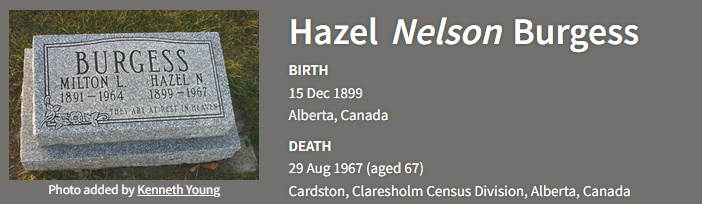
Screenshot of the entry for Hazel at Find a Grave, showing the headstone she shares with Milton.

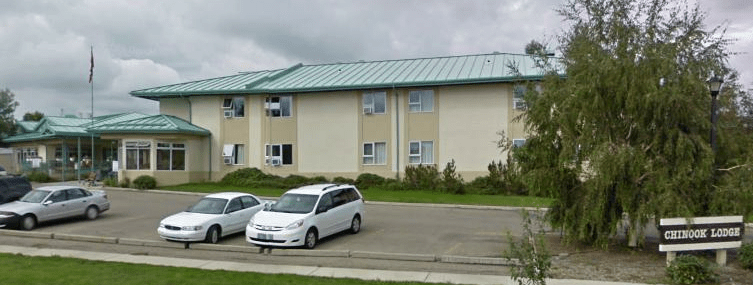
Hazel was 64 when Milton passed away. Around that time she moved to a seniors’ home in Cardston, which she derisively called “the old fools’ home”. There she met a widower, Albert Beaves, who she married in July 1967. Eight weeks later, Hazel passed away. My mother literally went from the funeral to the hospital, where I was born.

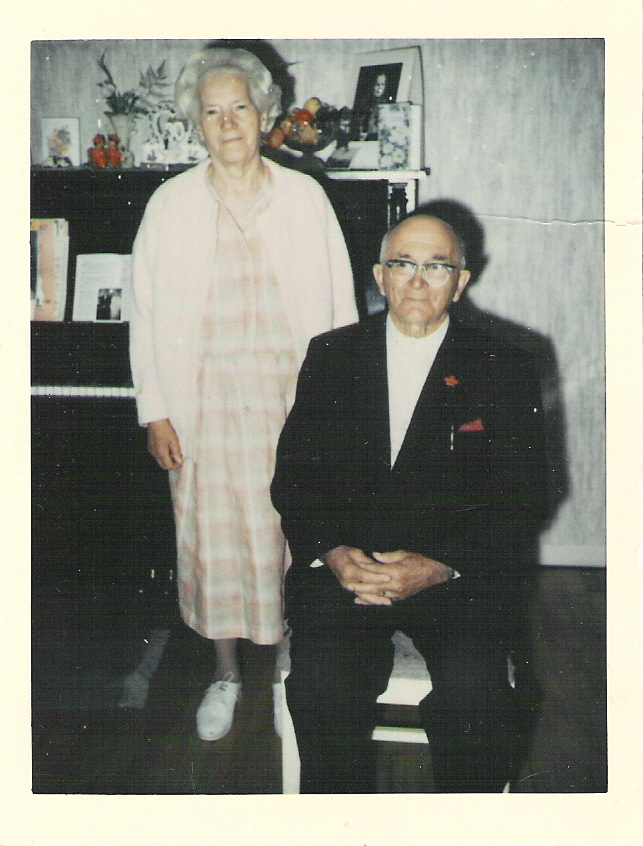
The newlyweds, Hazel Nelson and Albert Beaves, about July 5, 1967.

“The Old Fool’s Home” – Chinook Lodge in Cardston, Alberta

52W Mark IV – Week 26: Card K13 Elisabeth de Waard

Elisabeth “Lisabeth” de Waard (1824-1887)

Halfway through the 2025 52 Ancestors Challenge brings us to the last card on my paternal line. Last but not least, meet Lisabeth de Waard, my Gx3 grandmother.

Elisabeth de Waard was born on February 18, 1824 in Oudeschild, a village on the island of Texel, the largest of the Wadden Sea Islands off the north shore of the Netherlands. It is the only settlement on the island located on the coast. While there is now a ferry dock on the southernmost point of the island, Oudeschild was the only port on Texel in Elisabeth’s time.

Thus, it should come as no surprise that her paternal grandfather, husband, and at least three of her brothers were sailors. Despite the seafaring lives of many of her relatives, Elisabeth’s father, Jan Teunisz de Waard, was a labourer at the time she was born. Jan became a shopkeeper shortly afterwards and remained in that profession until he died in 1863 at age 76.

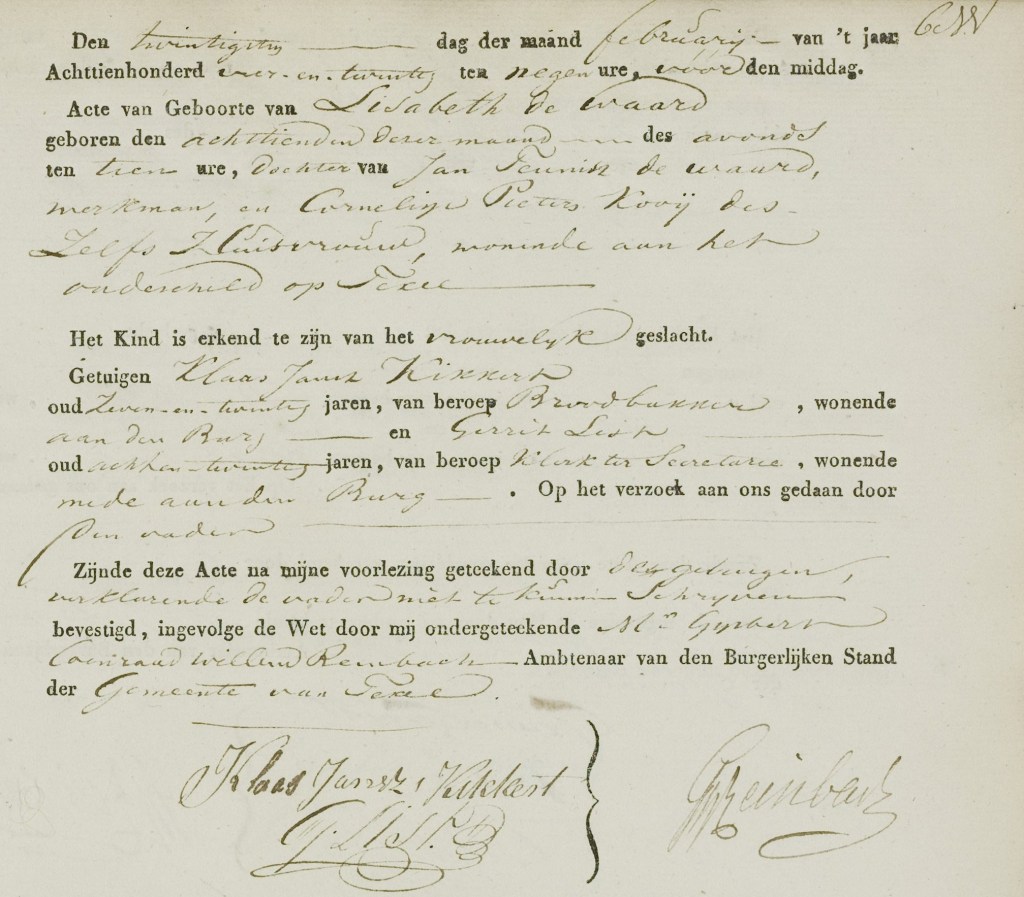
Registration of Lisabeth’s birth.

Elisabeth’s mother was Cornelia Pieters Kooij. Jan and Cornelia’s marriage intrigues me, because Jan was Protestant and Cornelia was Roman Catholic. Jan was the first direct ancestor I found on my paternal line who was not Catholic. They married at the Catholic church on Texel.

Up until the mid to late 20th Century, Protestants and Catholics in the Netherlands kept well apart. Each had their own schools, newspapers, sports clubs, political parties, and social organizations. Intermarriage between the two groups was not common or as widely accepted as it is now. The 1830 census shows that their eldest child, Teunis, was a Protestant like his father, but the rest of their eight children, were Catholic like their mother.

One might think that my great grandmother’s name was Elisabeth and Lisabeth was her nickname. However, as can be seen above, her father named her as “Lisabeth” when he registered her birth. The only place I have found her name recorded as Elisabeth was in the Bevolkingsregisters (population registers). Moreover, the 1840 census listed her as Betje, another common Dutch nickname for Elisabeth.

One of the many population registers showing my great grandmother as “Elisabeth”. Cornelis and Elisabeth’s names are crossed out because they moved to a different house. In fact, they moved around Den Helder a lot!

The census records also show that Lisabeth lived in Oudeschild at least into her late teens. In fact, the registration of her marriage to Cornelis Ran shows that she was still resident on Texel when they married on February 6, 1851 in Den Helder, where Cornelis was an apprentice harbour pilot. While it appears that Cornelis had lived on the mainland for many years by the time they married, he had deep roots in Oudeschild. It is likely that Jan and Lisabeth came together through familial connections.

Lisabeth and Cornelis settled into life in Den Helder, where they had seven children – five girls and two boys. The boys, who were the youngest, were also drawn to naval life, although as members of the navy.

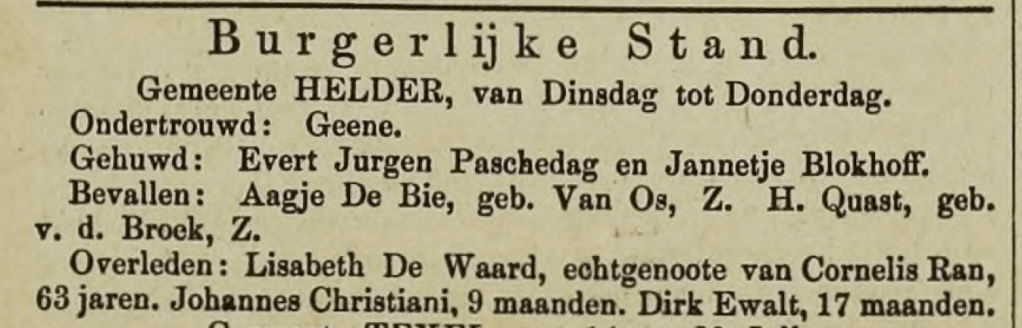
The couple spent the rest of their lives in the port city. Lisabeth passed away in Den Helder on July 18, 1887, at the age of 63. She was buried in Huisduinen, a village outside of Den Helder, four days later. Cornelis lived another ten years.

Weekblad van Den Helder en het Nieuwediep, 10 February 1851, page 3
Civil Register. Deceased: Lisabeth de Waard, wife of Cornelis Ran, age 63.

Two suits down, two to go!