Egad, I almost ghosted this week’s 52 Ancestors Challenge, themed “Spirits”. I thought I had done this a week ago, but it turns out I only did so in my mind.
Initially I had hoped to take the theme in a more libatious direction and share an anecdote involving jenever, a Dutch liquor that is the forefather of gin. Unfortunately, once I began to write it, it became apparent that it was a rather boo-ring story.
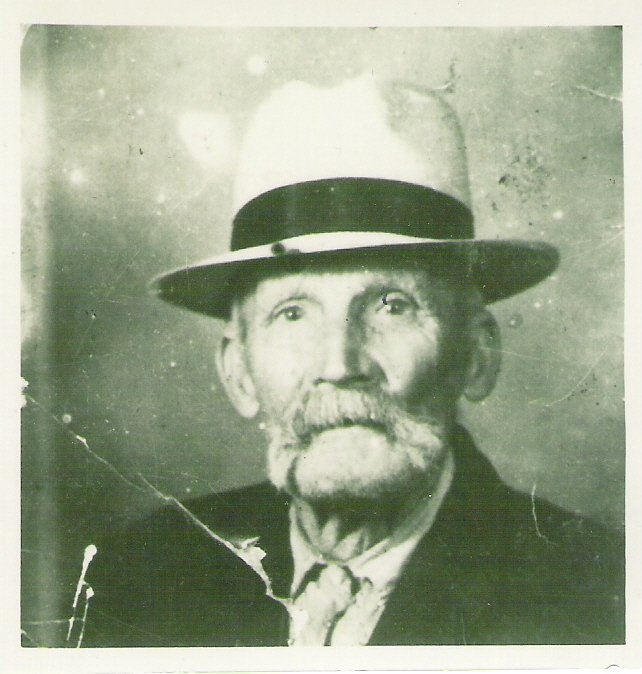
John A. Nelson
Thus I have turned to this well-worn oft-repeated anecdote about my great great grandfather, John A. Nelson (1854-1942), that I’ve seen innumerable times over the last thirty years. It’s attributed to his son Seth Henry Nelson (my mother’s great uncle, who I wrote about on Week 8 in 2022). While I’ve seen countless copies of it, I’ve never seen anything its provenance or that could be described as the original.
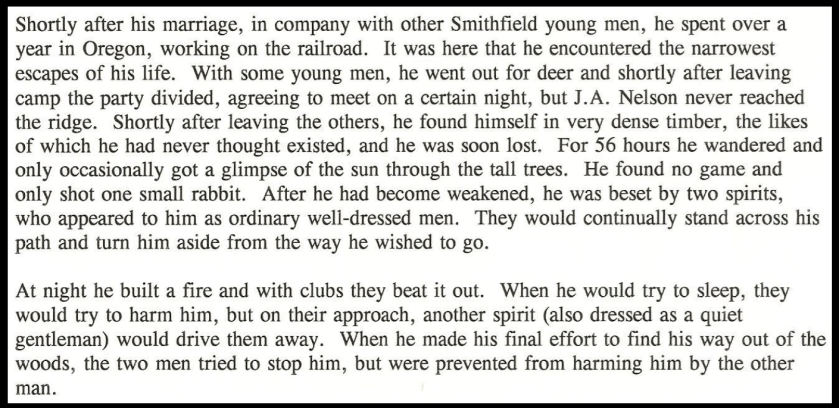
The tale relates to John’s encounter with two malevolent spirts and a third that may have been his protector. I’ll share it as written:
Needless to say, I don’t believe a word of it. Its greatest value may be that it tells me something I otherwise wouldn’t have known about John: he spent a year in Oregon working on the railroad. The only question is when.
The anecdote indicates that John was in Oregon for over a year shortly after his marriage to my great great grandmother, Ella Elizabeth Thomas, which occurred on January 9, 1879. Their first child, Maria (“Mimie”), was born in March 1880, so John did not leave for Oregon any earlier than June or July 1879. John and Ella’s second child, Ella, was born more than two years after Mimie, in June 1882. If John was away from home for more than a year shortly after marrying Ella, it could have occurred anywhere between late summer 1979 and the summer of 1881. However, without further evidence, I don’t have a ghost of a chance of figuring it out.
Most of my ancestors have been labourers. Many of them did a lot of digging as part of their work, especially since a lot of them were agricultural workers. Some may have only deep enough to plant crops, while others may have dug a little deeper.
I’ve already speculated about my 4x Great Grandfather, Petrus Pieterszoon “Pieter” van der Fluit and the possibility that the reason he relocated from Zuid Holland to Noord Holland was to work digging canals and other work related to polder construction and waterworks. Unfortunately, the timing does not seem quite right. Furthermore, and of greater importance, I’ve yet to discover any real evidence to support the theory.
Turning to my mother’s side of the family, my great grandfather Milton Leo Burgess was a man of many occupations over his working life: farmer; plumber; and woolen mill worker (where he lost a finger of his left hand due to a work injury). Unique amongst the labouring jobs held by my ancestors, apparently Milton spent a short period of time sometime around 1950 working as a gravedigger. The only source I have for this is my mother. While she knew her grandfather well, if he was a gravedigger in the early 1950s she would have been too young to have had any memories of the time he held that job. It is something he likely told her when she was older.
I’ve really struggled with this week’s 52 Ancestors Challenge theme of “Friends”. I have not had a scintilla of inspiration. I tried to tackle the topic from a new perspective. No Dutch ancestors with the surname “Vriend”. No Quaker ancestors. No one that I could think of who were members of a fraternal organization. Finally, I settled on a bit of a thought experiment: people who might have been friends, or at least who might have known each other.
My wife and I have very little in common genealogically. My lineage is largely Dutch, Germans from Russia, and adherents of the Mormon church from its earliest days. My wife has incredibly deep roots in the Maritimes, mostly of Irish descent. She also has a branch of her family that originated in Ontario, likely of English background. There is very little overlap.
One thing we each have in common is a Mayflower ancestor. Mine is Francis Eaton, hers is Richard Warren. Outside our Mayflower ancestors, we both have other branches that reach well back into 17th century colonial New England, including not only Massachusetts but also Connecticut. I have come across names in both our trees of people who lived in the same place at the same time many times. Needless to say, I would not be surprised if some of my ancestors knew my wife’s ancestors. Who knows (absent further research!) if any of them might have been friends?
However, not only I have never found a common ancestor between the two of us, I have yet to find any connection between our trees, such as distant cousins. Of course, somewhere out there a connection exists. As our eight-year-old repeatedly says, “after all, everyone’s related!”
So seeking inspiration and a different perspective on the theme, I looked at our kids’ maternal side and their Gx3 grandfather, Charles Crittenden Van Norman. He was a merchant and businessperson and was involved in a number of enterprises. Charles’s many business interests involved a great deal of travel. To that end, Charles was an early member of the Commercial Travellers’ Association of Canada and he remained so for thirty years.
Charles was born on August 10, 1849, in Keswick, York, Canada West, Province of Canada. Charles began working around the age of 16. His earliest work included the wholesale and retail book and stationery trade. The 1891 census said he was a “greens clerk”. Later, he became a wholesale manufacturer of boots and shoes, retiring from that endeavour in 1902. Later in his career, he was a director of the Ontario, Manitoba & Western Land Company and was Vice-President of the McElroy Manufacturing Co. Charles also had a significant interest in the Alberta Farm & Cattle Company, in which he was Vice-President. Charles also had an interest in banking, primarily as a shareholder. While I have not yet verified it, Charles may have been a director as well.
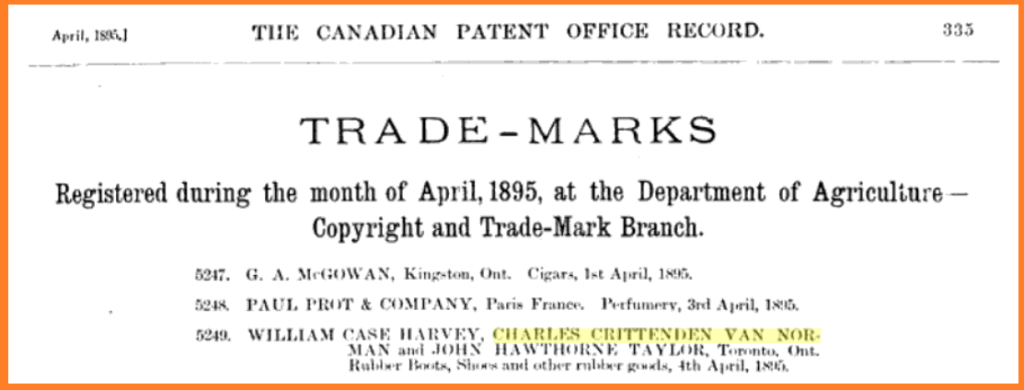
The Canadian Patent Office Record and Register of Copyrights and Trade-Marks, Volume 23, 1896. Charles and his partners held a trade-mark in rubber boots, shoes, and other rubber goods.
Amongst his many endeavors, Charles was an executive and director of a number of insurance companies. From about 1880 to 1920, Charles was a manager and vice president of the Metropolitan Fire Insurance Company in Toronto. During the same period, he was a director and vice president of the Equity Fire Insurance Company in Toronto. From 1904 to about 1920, Charles was the president and managing director of the Independent Fire Insurance Company in Toronto, of which he was one of the founders. Despite his high position in these companies, for the 1911 Canadian census Charles modestly reported his occupation as “insurance agent”.
Charles retired in 1921, at the age of 72. He died on February 2, 1939 in Toronto.
The Commercial Travellers’ Association of Canada was founded in 1874. Its purposes included providing its members with travel and insurance benefits. Charles joined in 1880 and remained a member until 1910. He was a director and a vice president of the organization for many years and served two terms as its president.
The Commercial Travellers’ Association also provided what we would now call networking opportunities and frequently had banquets and social gatherings for its members. Its members had a considerable amount of influence, such that it was common for a Prime Minister or cabinet ministers to be in attendance. In 1989, the organization changed its name to the Canadian Professional Sales Association.
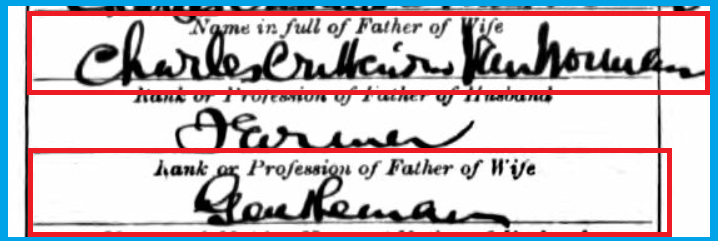
While he was a prominent and successful business person with many commercial interests, what I enjoy most is Charles’s occupation set out in the Marriage Affidavit and Certificate for his daughter Madeline (our children’s great great grandmother): “Gentleman”.
Extract from the Marriage Affidavit for the marriage of Madeline Van Normand and Robert Willan Mann, who married in Toronto on September 6, 1911.
 A Deck of Ancestors