
52 Weeks Mark III – Week 7: Immigration

My mother’s maternal line are all Germans from Russia. The Russian Empire expanded significantly during the 18ths century. When Catherine the Great came to power in 1763, she encourage immigration, partly to re-establish farming in regions that had laid fallow during periods of warfare, modernize the country, and to populate regions the Empire had absorbed.
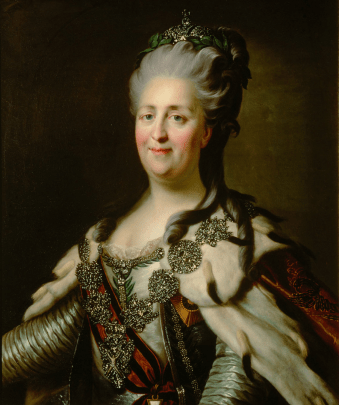
Catherine the Great

Catherine’s manifesto inviting settlers bears some resemblance the homestead schemes introduced in the United States and Canada over a century later.

Among other things, she promised land, free transportation to Russia, and economic incentives (including freedom from taxes for a period of time and interest-free loans for the purchase of equipment). As well, settlers were promised that they could freely practice their religion, retain their language, and be free from military service. The settlers were also promised a degree of self-government.

While settlers came from several places in Europe, a majority were Germans. At the time, there was no “Germany”. Rather, the region was primarily composed of a multitude of principalities, dutchies, and other small states. While Catherine’s promises provided a significant pull, economic and political conditions in the German states provided a significant push.
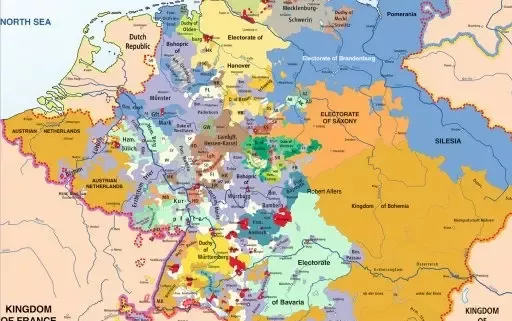
Germany in 1789

The first wave of settlers formed colonies in the Volga region (“Volga Germans”). The next wave occurred after Catherine’s grandson, Alexander I, issued a similar manifesto with many of the same promises. My ancestors were part of this wave of settlers, who formed colonies in what is now southern Ukraine, particularly in the area north of Odessa (“Black Sea Germans”).
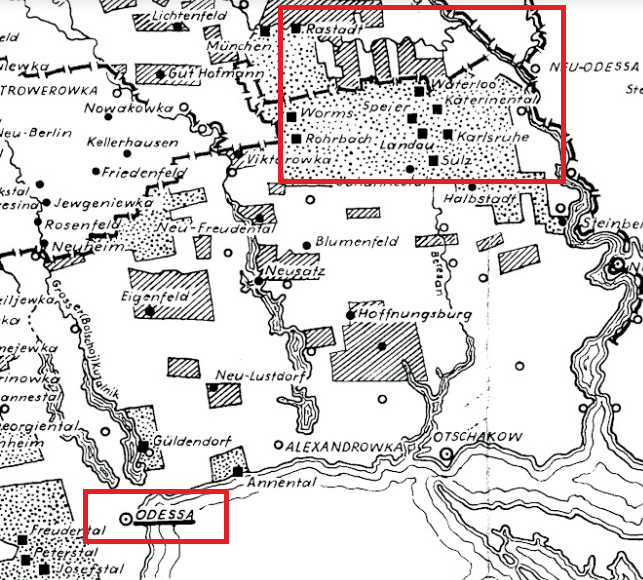
The German colonies in the Beresan district in 1890, as seen in relation to Odessa. All four of my maternal grandmother’s grandparents came from Rastadt and Karlsruhe, located in the upper right-hand corner.

The German colonies were usually composed of members of the same religion. The main colonies were Catholic, Lutheran, and Mennonite. These colonies thrived for decades. However, in 1871, Czar Alexander II repealed the manifestos of Catherine and Alexander I. The German colonists lost many of their privileges. Shortly afterwards, they lost their exemption from military service. The next Czar, Alexander III, took further steps to incorporate the German population into general Russian society, which included discouraging the German language and encroaching on the school system established by the colonists.

Needless to say, this immediately sparked waves of emigration of the German colonists, many of whose families had been in Imperial Russia for decades. Many of these Germans left for the United States and Canada, relocating to the plains stretching from Texas to Saskatchewan. Other colonists left for Argentina and Brazil.
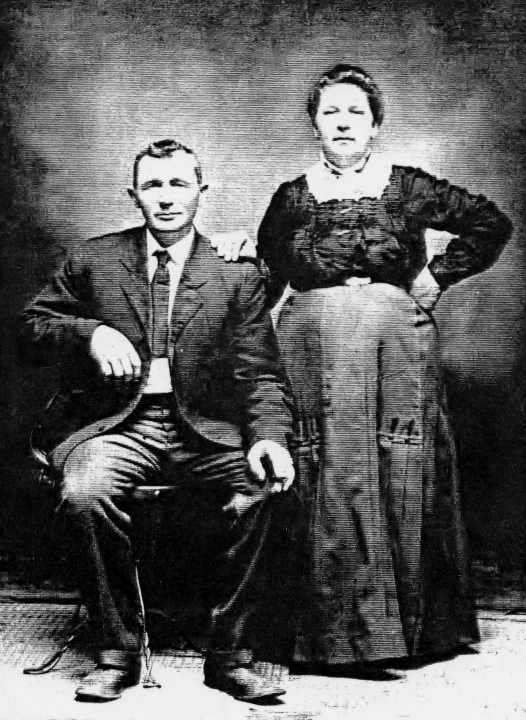
My grandmother’s paternal line originally settled in Texas, starting with my great great grandparents, Michael Lerner and Barbara Schmidt and their six children. They came over in 1893 on the S.S. Lahn, which landed at Ellis Island – less than 18 months after it had opened. Michael and Barbara had six more children after settling in Texas, the first of whom was my great grandfather, Heronimus “Jerome” Lerner. Over time, many of their children relocated to Saskatchewan, including Jerome. Michael and Barbara ultimately made the same move themselves, leaving behind several of their adult children.

My grandmother’s maternal grandparents,  Jacob Anton and Margaretha “Margaret” Heck, came directly to Canada in 1912 with all their children and settled in Saskatchewan. This included my great grandmother, Emelia Anton, who was nine years old at the time. She lived to be 94 and I knew her well.
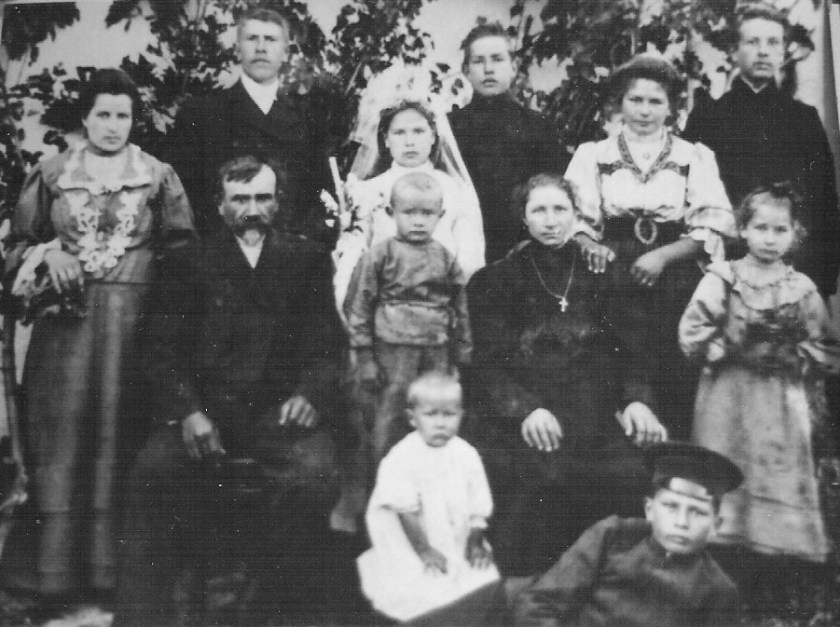
The Anton family, circa 1910. Likely taken in Selo Suchoi, Veronesch, Russia. My great grandmother, Emelia, is the little girl standing at the edge of the right side of the photo.
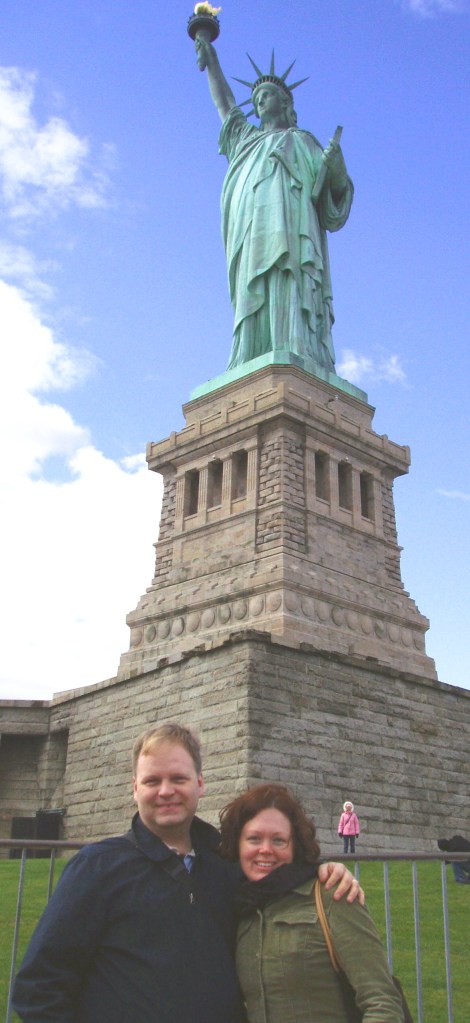
Emelia had not had much schooling before coming to North America, but was very religious. She said that she was frightened and nervous during the journey, as she did not know anything about where she was going and did not fully understand what was going on. However, on reaching New York, she said her fears subsided when she saw “the Madonna”. When she saw that, she knew she would be safe and all would be well. Of course, the “Madonna” was the Statue of Liberty. As she had never heard of it before, she thought it was a statue of the Virgin Mary.

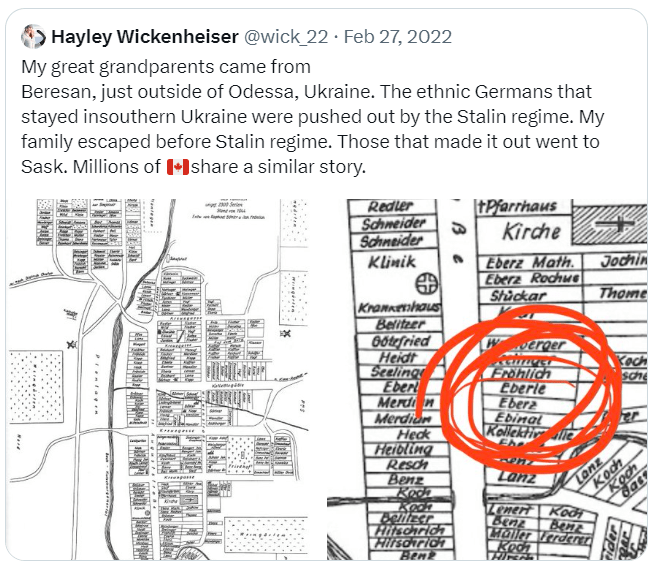
There are many well-known descendants of the Germans from Russia. They include Lawrence Welk, who married my grandmother’s fourth cousin. While I am generally disinterested in celebrity, I was excited to learn that Hayley Wickenheiser is a descendant of Germans from Russia. Her great grandparents lived in Rastadt, where Mike and Barbara had lived before emigrating. However, her family was there decades after mine left, as the did not leave until they fled Stalin’s regime.
52 Weeks Mark III – Week 6: Earning a Living

While most of my Dutch ancestors were farmers and labourers, it should come as no surprise that a few worked in windmills. On my father’s maternal side of the family, three of my Gx4 grandfathers were watermolenaaren (singular, watermolenaar – “water mill worker”). These were the windmills used for pumping water.

On my father’s paternal line, the surname “van der Fluit” may have originated with a windmill (“Fluijtermolen” – “Whistler Mill”) or the polder (“Fluitpolder”) on which it stood in Veur, Zuid-Holland (now part of Leidschendam). Alternatively, the windmill and polder might have been named after my ancestor, Johannes Dircks (“Jan”) (van der Fluit or Goeman) who owned or constructed them.

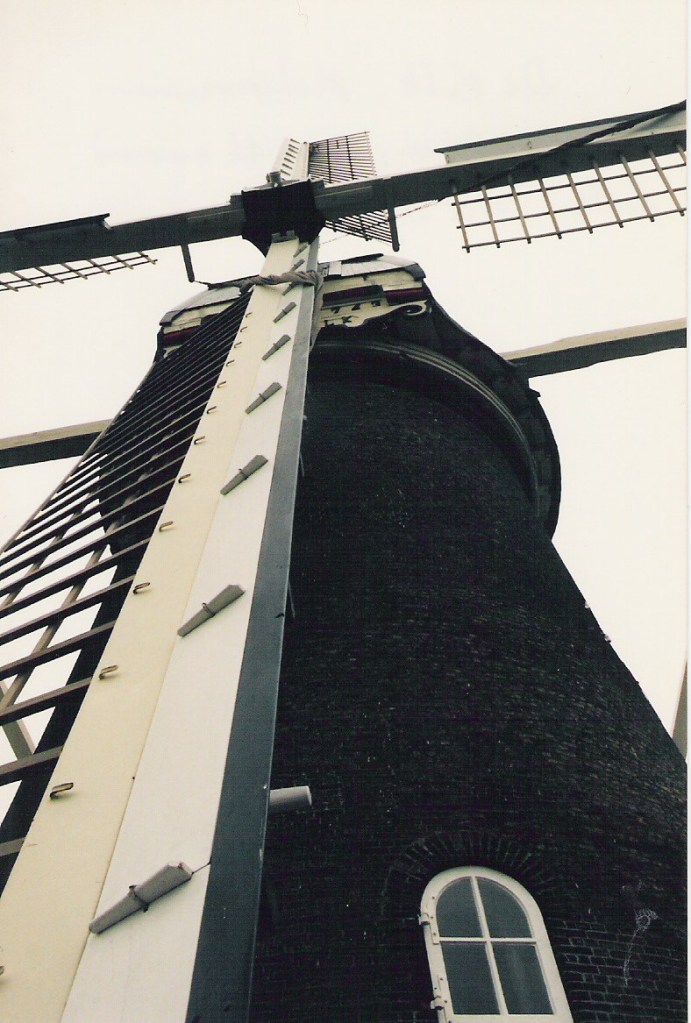
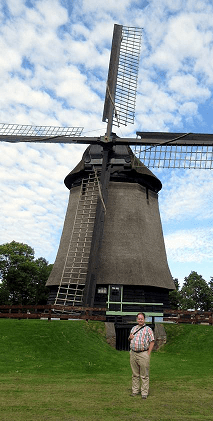
Me standing in front of the windmill in Waarland, Noord Holland, at more than a metre below sea level, about a kilometer from where my father was born and 200 metres from where he was baptized.

My paternal grandmother’s father was Adrianus Komen (1888-1948). Three of his four great grandfathers were all water mill workers. There is a strong possibility all three worked in the same windmill at the same time. I know that two of them, Nicolaas Cornelisz “Klaas” Komen (1786-1864) and Jan Smit (1786-1852) worked at the windmill located in Heerhugowaard, Noord Holland. However, the records I have consulted do not indicate when they worked in the windmill. At most, it is quite likely that Jan was working at the windmill until at least 1852.

I have no idea where and when the third, Johannes “Jan” Woltering (abt 1788-1834) worked in a windmill. I know that it was sometime before 1814, by which time he was working as a carpenter, as documented in the registration of his marriage. Unfortunately, the source from which I obtained the fact he had been a watermolenaar was simply an index and no longer exists. I have not found this item in other sources and records I’ve consulted. The population registers I have seen do not include his occupation. A notarial record I’ve found is dated 1817, which shows Jan working as a carpenter.

Despite this, I have reason to believe that Jan may have worked in the windmill in Heerhugowaard. Jan was born in 1788 in what is now Vreden, North Rhine-Westphalia, Germany. Vreden is about three kilometers from the Dutch border. What he did between his birth and marriage I don’t know, but by 1814 he was living in Akersloot, Noord Holland, which is about 14 kilometers south of Heerhugowaard. After he married he lived and worked in Langedijk, Noord Holland, which is immediately adjacent to Heerhugowaard.

“De Valk” (The Falcon), a windmill in Leiden, Zuid Holland, about 10 kilometers from where Fluijtermolen once stood.

There is one fact in particular that makes me suspect Jan may have worked in the windmill in Heerhugowaard is that Jan Woltering’s son Cornelis married Jan Smit’s daughter Neeltje. Thus, it is possible that the families knew each other because Jan and Jan worked together in the same windmill. Then again, Heerhugowaard was not a large place in 1814 and it is quite possible they knew each other the way everyone in a small town tends to know each other.

Turning to Jan Dircks, the website for the municipality of Leidschendam-Voorburg used to have this information, which I have translated from Dutch:

The square and adjacent street between Prinsensingel, Noordsingel, de Amstelweg, and de Graaf Willem de Rijkelaan is called Fluitpolderplein. This was decided in 1970. But where does the “fluit” in “Fluit Polder” come from anyway? According to a historian of Veur, Hendrik Brouwer Schut, it may have something to do with the whistle of the grinding mills, or possibly the “fluitenkruid” (“cow parsley” or “Queen Anne’s lace” in English). [The Dutch name of the plant refers to the fact a flute or whistle can be made from the stem.] However, there may be a better explanation. In 1648 a large part of the territory of the polder already belonged to a certain Jan Dirckxz, who also went by the name “Fluijt”.

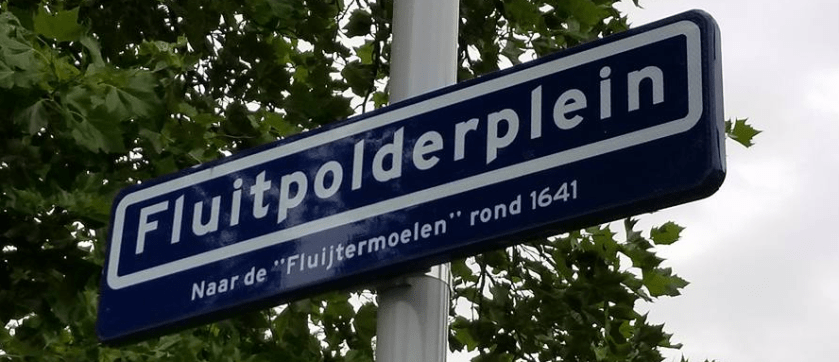
According to the street sign for Fluitpolderplein, the polder was located alongside the “Fluijtermolen” (Fluit Windmill), which was built around 1641. 

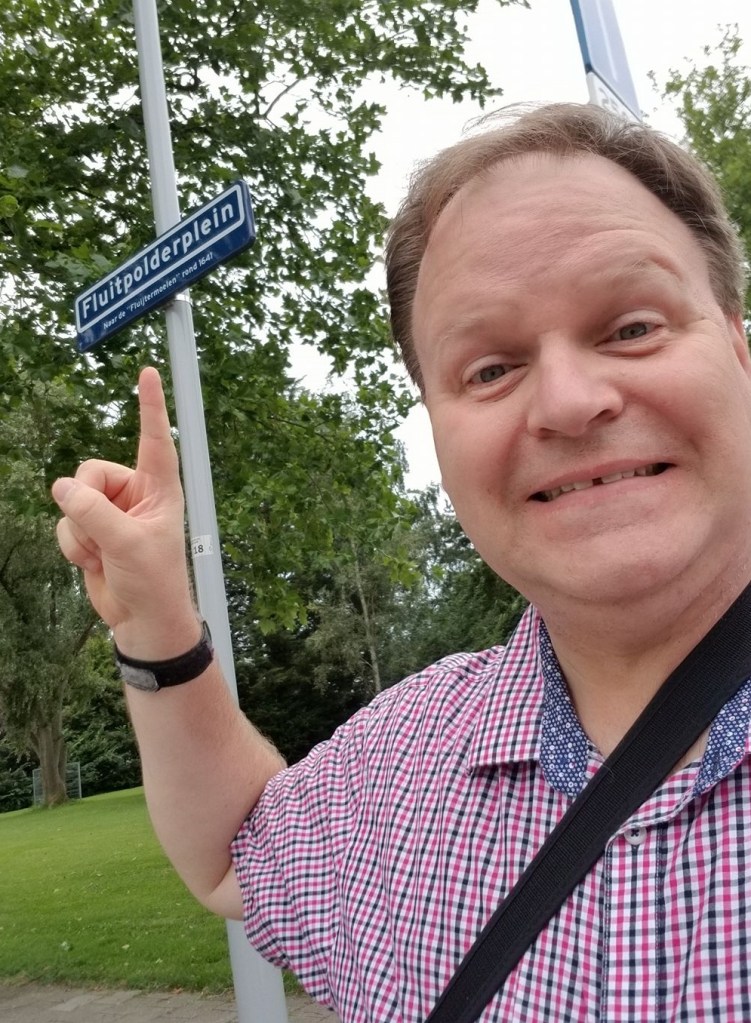
Am I named after the polder or is the polder named after me?

52 Weeks Mark III – Week 5: Influencer

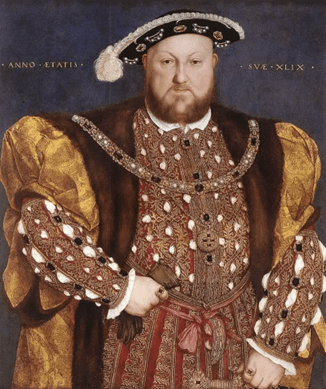
That feeling when you discover that your Great x12 Uncle was Henry VIII’s royal bum wiper. Genealogy is not for wimps.

While I haven’t researched the connection to the degree required by the Genealogical Proof Standard, Michael Heneage (1540–1600) was my Gx12 Grandfather. Among other things, Michael was a Member of Parliament during the latter part of the reign of Elizabeth I, from 1571 to 1593. Michael represented several different constituencies over the years: Arundel, East Grinstead, Tavistock, and Wigan.

One of Michael’s other roles was Keeper of the Records in the Tower of London. (Sounds like a job for a genealogist!). He was appointed to the position in 1576, jointly with his older brother, Sir Thomas Heneage (1532-1595). Like Michael, Sir Thomas also served as Member of Parliament, from 1553 to 1593. He too held different parliamentary seats over the years: Arundel, Boston, Lincolnshire, and Essex.

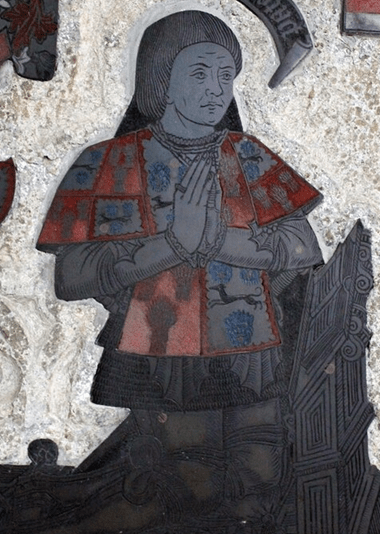
Part of the memorial for Sir Thomas Heneage at St Mary’s Church

Sir Thomas had considerable power and influence over his lifetime. He was educated at Cambridge and had many important connections. Sir Thomas served in the courts of both Henry VIII and Elizabeth I. Among other things, he served as Elizabeth’s Gentleman of the Privy Chamber around 1565 and later as the Treasurer of the Queen’s Privy Chamber. Sir Thomas ultimately became a member of the Privy Council in 1587.

Speaking of privy, Sir Thomas held a number of significant posts during Henry VIII’s reign. This included the office of Groom of the Stool for the King, from 1536 to 1546. Yes, he was the royal bum wiper. That duty of the office, which lasted until the death of Queen Victoria, fell away over the centuries.

The job came with other significant responsibilities and privileges (I’d hope so!), plus the office holder learned a lot of important information. Records of testimonials show that Henry complained to Sir Thomas about his wives, particularly Anne of Cleves. It was extremely important for the Groom of the Stool to be trustworthy and able to exercise utmost discretion. While it would have been detrimental for any of the Grooms to breach that trust, the fact they even had that information gave them tremendous influence.

My wife’s response when I told her about this ancestor? “No wonder you were so good at changing diapers!”

52 Weeks Mark III – Week 4: Witness to History

Two weeks ago, I wrote about my roots in the Dutch island of Texel. While the focus was primarily on my paternal grandmother’s ancestors, my paternal grandfather’s side of the family also has a strong connection to Texel. This includes several van der Fluit cousins of varying degrees, many of whom are descendants of my 4x Great Grandfather, Petrus Pieterszoon “Pieter” van der Fluit. I’ve written about at least one of those cousins, Pieter Jansz van der Fluit.

Both sides of my father’s family had a presence on Texel during the French occupation of the Netherlands during the Napoleonic Wars. Many of my ancestors were living on the island during one of the most unusual military confrontations in history, involving a confrontation between cavalry and naval forces.

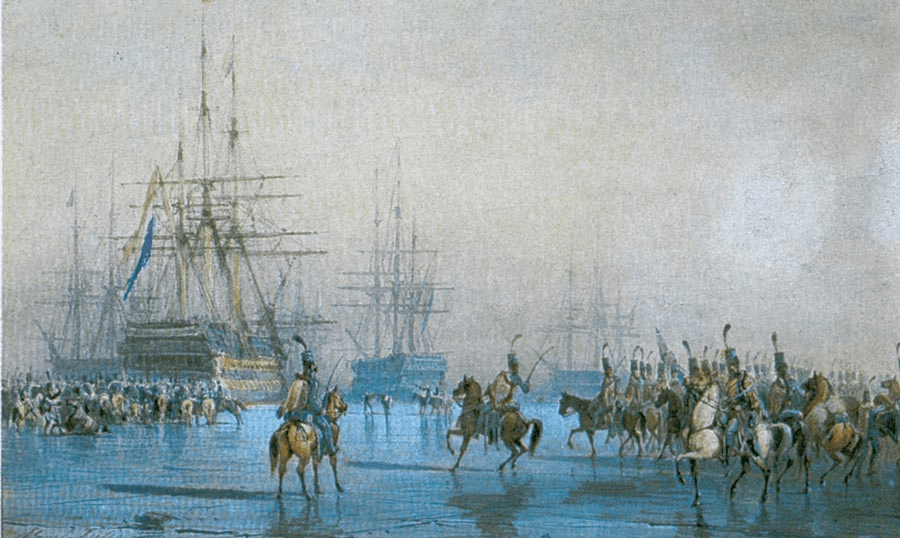
A depiction of the capture of the Dutch fleet at Texel by French naval painter Antoine Léon Morel-Fatio (1810–1871)

The French invaded the Dutch Republic over the period from 1793 to 1795. There was a great deal of support for the French in the Dutch provinces. The Patriotten (“Patriots”) shared the ideals of the French Revolution. During the French incursion, a French-supported uprising led by the Patriots overthrew the previous regime.

By January 19 , 1795, the Patriots had succeeded and established the Batavian Republic (later the Batavian Commonwealth). While nominally independent, the Batavian Republic was essentially a French vassal state. However, Napoleon was dissatisfied by the rate of change in the new state and was not impressed by its degree of opposition to the English. In 1806 he replaced the Batavian Republic with the Kingdom of Holland, with his brother Louis (Lodewijk in Dutch) installed as its King. When Lodewijk proved to be too sympathetic to his subjects, Napoleon removed him from office and incorporated the Netherlands into France itself.

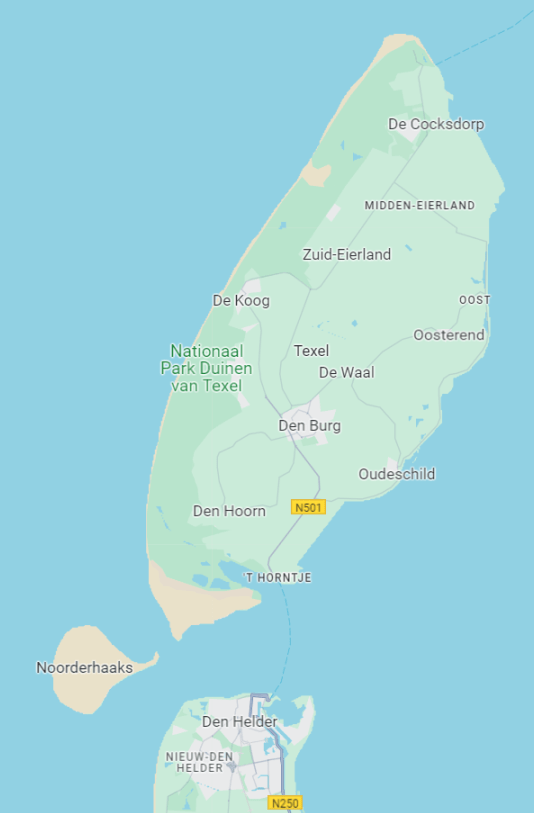
After the success of the Batavian revolution, the provisional government ordered loyalist Dutch forces to stand down. Despite the support for the French in the Netherlands, the Navy remained loyal to the previous regime. It had formidable forces centred at Den Helder, a major naval port.

The winter of 1794-95 was particularly cold. A storm threatened the Dutch fleet at Den Helder, so it sought shelter on the leeward side of Texel. Nevertheless, the fleet found itself frozen in the ice offshore. Wishing to take advantage of the loyalists’ plight, the French ordered the appropriately-named Admiral Jan Willem de Winter to Den Helder to secure the fleet for the Franco-Dutch forces. De Winter led forces comprised of cavalry and artillery. They arrived on January 22, 1795.

The senior officer of the fleet prepared to scuttle his ships, while de Winter prepared for an attack. However, once news confirmed that the revolutionaries had succeeded and taken over the government, the two sides negotiated a surrender.

There were other reasons why a battle might not have occurred, even if the rebels had not succeeded in overthrowing the government. If the battle had occurred, it would have been a very rare occasion of a land force attacking and (possibly) overtaking a naval force.

Texel was of significant military value during the French occupation. It was a lynchpin of defence against an English naval attack on the Dutch coast. So much so, Napoleon himself visited the island in 1811. One of the key locations he visited were two fortresses at De Schans, a kilometer or so outside of Oudeschild, where many of my ancestors lived. I would love to know what my ancestors might have seen and experienced at that time!

A cousin of mine has a story about one of our van der Fluit ancestors that took place on Texel during the French occupation. He didn’t say who it was specifically, other than a van der Fluit. Whether or not the story is true, or has a kernel of truth, I really cannot say. Nevertheless, whether fact or fantasy, it’s a fascinating legend.

In the course of the wars, Napoleon instituted conscription in many of the French territories, including the Netherlands. Orders were sent to round up all able-bodied men of fighting age and press them into service. One of our Texelaar van der Fluit ancestors sought to evade conscription by hiding in a hay rick while soldiers were rounding up men. The soldiers suspected that people might try to hide in the hay ricks, so they went from rick to rick and pierced them with their bayonets. Legend has it that this particular van der Fluit was praying the rosary while hiding. While doing so, a bayonet passed between his chest and upper arm. He went unscathed and undetected, so he evaded conscription.