“Favourite Photo” is a perennial topic for the 52 Ancestors Challenge. The prompt started out hard enough the first year I participated in the challenge, because I had so many favourites to choose from. If I had realized back then that it was an annual topic, I wouldn’t have posted so many photos back then!
The other problem is that “favourite photo” suggests one photo that you love more than all your others. How to choose??? Simple! Simply read the prompt as “A Favourite Photo”!
Despite that, it’s still hard to choose. What I’ve decided to do is to try to post something I haven’t shared before. While maybe not my favourite, I’ve selected some photos of a memorable family road trip to Alaska in the mid-80s, when I was in grade twelve. I love road trips, and this is one that I’ve only done once (so far!).
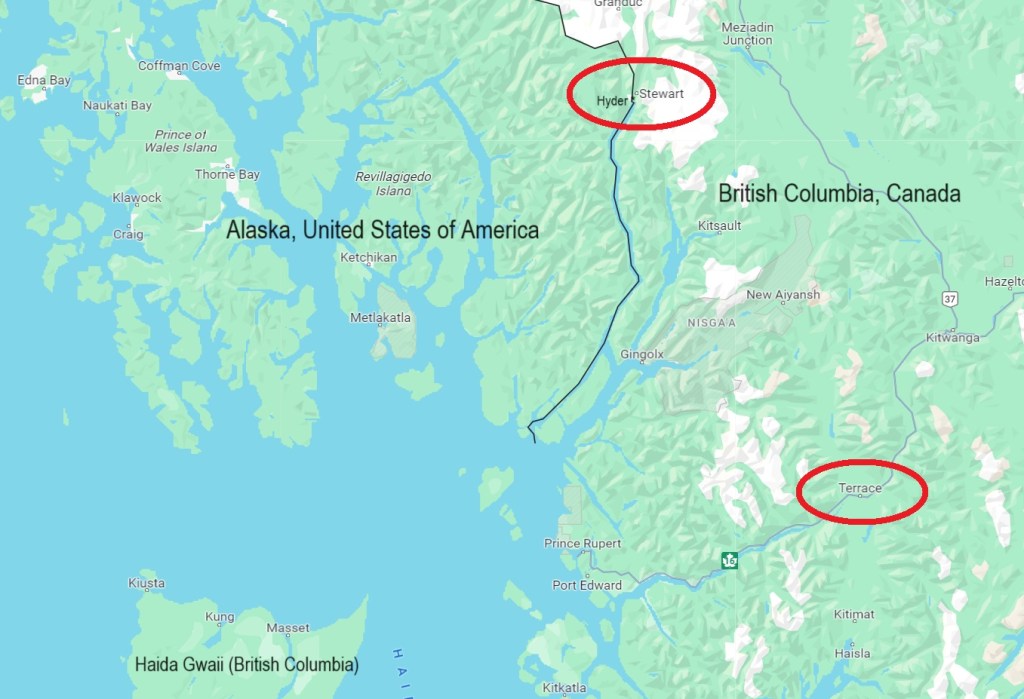
Terrace is near the northwest coast of the province, near the Alaska Panhandle. Just over 300 kilometers away (about a four and a half hour drive) are the border communities of Hyder, Alaska and Stewart, British Columbia.
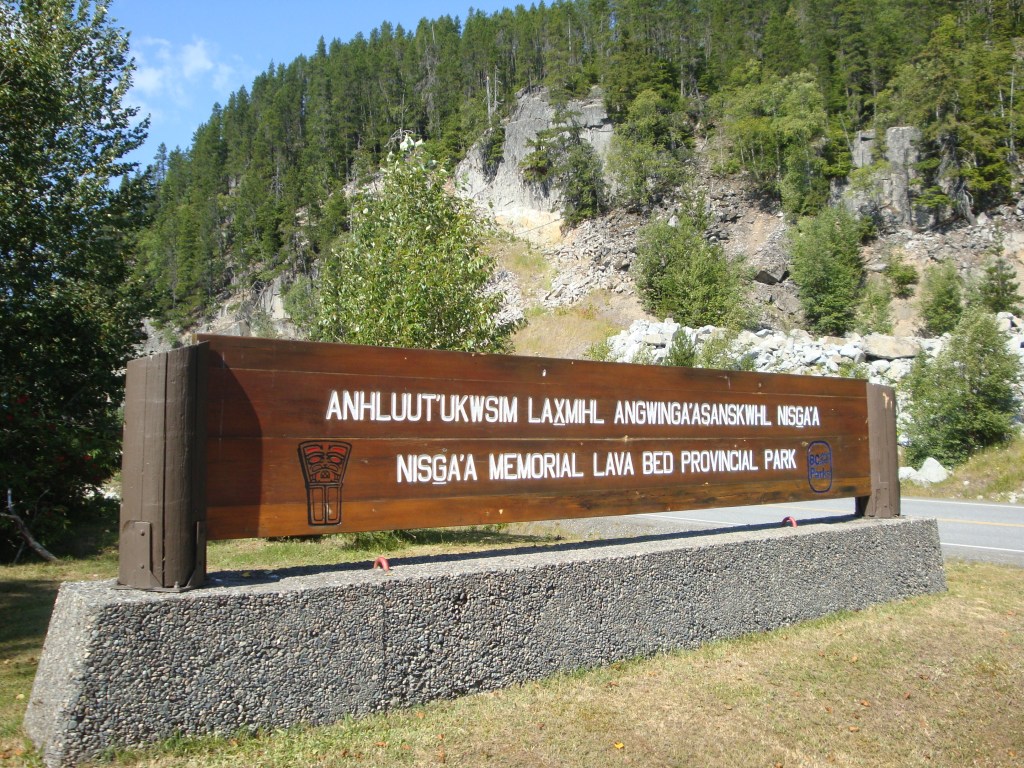
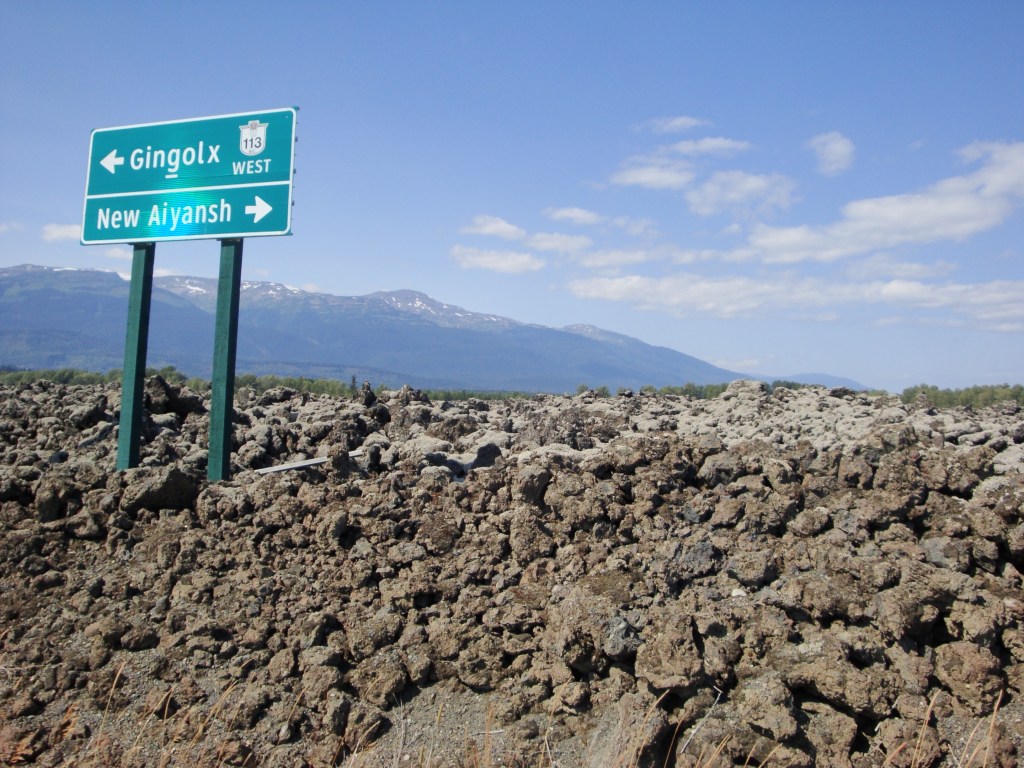
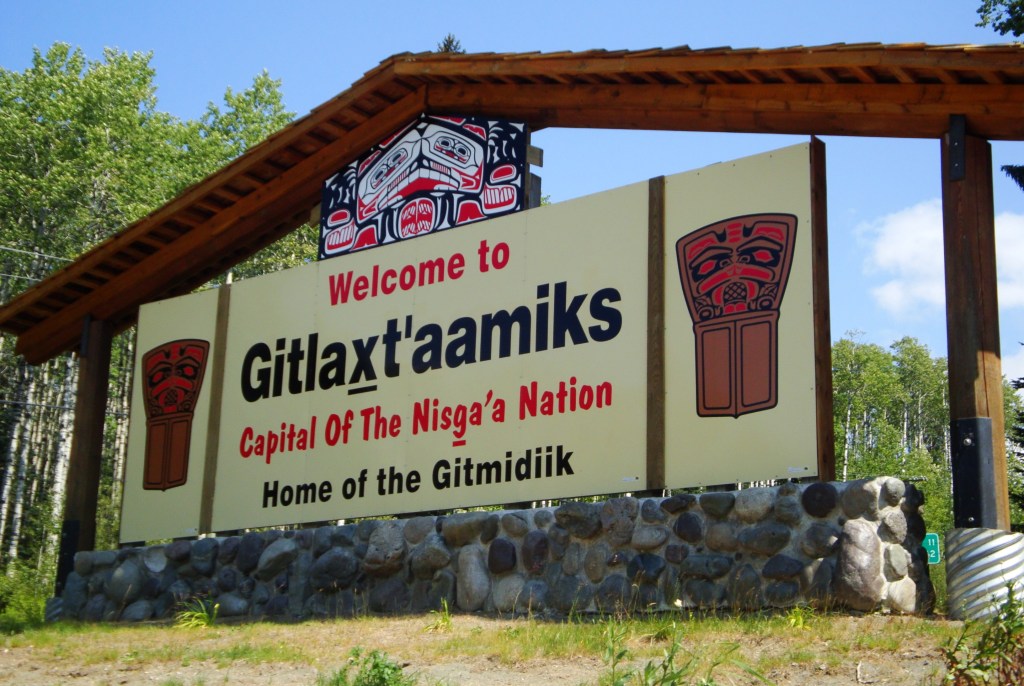
While the destination was novel, it was the journey that was the best. The easiest way to get from Terrace to Stewart/Hyder is along Highway 37. However, we took a less direct and even smaller route, Highway 113, which is now known as the Nisga’a Highway. It travels through lava beds (designated as Nisga’a Memorial Lava Bed Provincial Park in 1992) and the lands of the Nisga’a Nation.
(I’m cheating here. My photos of the lava beds and the Nisga’a territory from the road trip I’m writing about suck. In 2010, I, with my wife and some friends, took a day trip to the Nisga’a, but did not proceed any further north. My photos from that road trip are much better!)
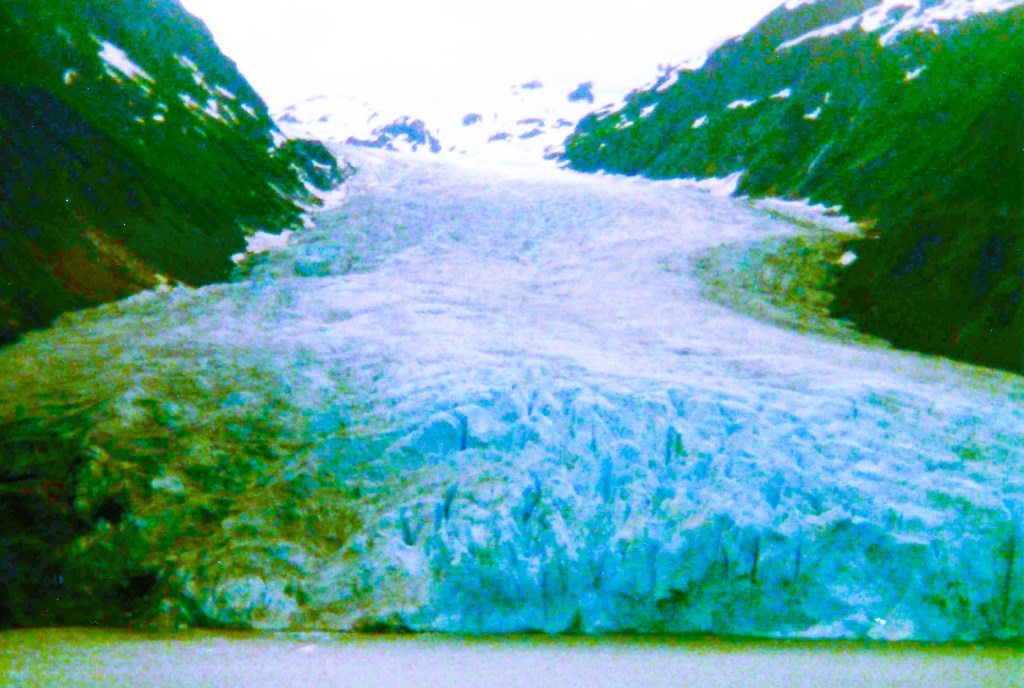
The Nisga’a Highway ultimately connects to Highway 37, which travels north to the Yukon. My folks have actually driven the length of that highway, but we didn’t on this road trip. Rather, we turned west onto Highway 37A at Meziadin Junction. Between Meziadin Junction and Stewart is the Bear Glacier.
The glacier has shrunk an incredible amount in the decades since our road trip. It no longer touches the lake as seen in my photo and is but a sliver of its former self at this location.
At our destination, we stayed in Steward, which was (and still is) the much larger of the two villages. At the time, there was no customs or border station on either side of the border, although there was the remains of one that had clearly been used for target practice. The post office in Hyder was memorable, as it was in an old Airstream (or similar) trailer. I also remember a place selling “Northern Fried Chicken”.
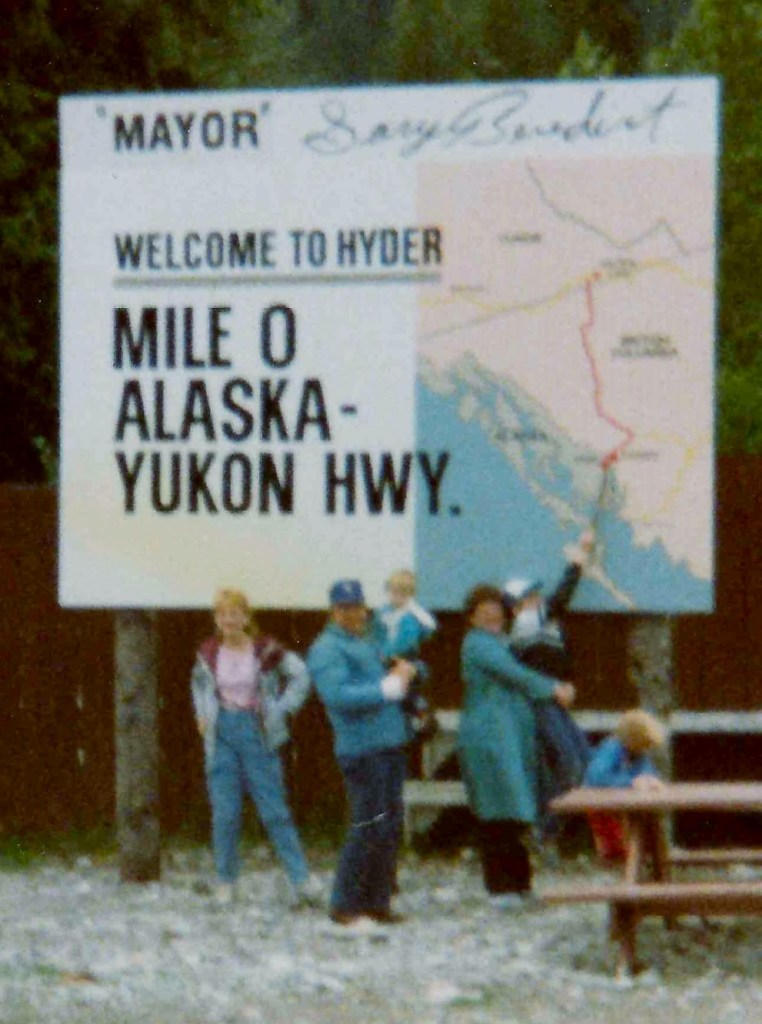
This is a photo of my family at what is purported to be the start of the “Alaska-Yukon Highway.” Of course, I’m not in the photo because I’m the one taking the picture – with a 110 film camera! Otherwise, the whole family is visible here, although my youngest sister (sitting at the table) looks quite odd. It wasn’t the best of cameras, that’s for certain. While you can travel from Hyder/Stewart to Alaska, as shown in the sign, the highway does not officially bear that designation.
One thing we didn’t do in Hyder was get “Hyderized”, which involves taking a shot of Everclear at one of the village pubs. It once appeared in the Guinness Book of World Records as the most alcoholic drink in the world. (Guinness no longer publishes alcohol-related records.) No, Everclear was not something I tried until I was in university.
A great travelogue about Highway 37 (also known as the Stewart – Cassiar Highway, is Nearly 40 on the 37 by my friend Trevor Hughes.
Week Two for the 2024 edition of the 52 Ancestors Challenge, and I’m already struggling. While my experience with the challenge has been rewarding and continues to be so, as I start my third year participating I am finding it harder to find things I haven’t previously written about one way or another. For this week’s prompt, “Origins”, it would have been quite easy to simply recycle any one of a number of past posts. However, I am trying to do something relatively new each week, because I think that’s most in keeping with the purpose and goal of the challenge.
Finally, today, now that Week Three’s prompt has been issued (on another recurring topic!), I thought I had finally come up with something I hadn’t written about before. Turns out that it’s something I’ve touched upon before. Nevertheless, I’m running with it because it’s never been the primary focus of a post.
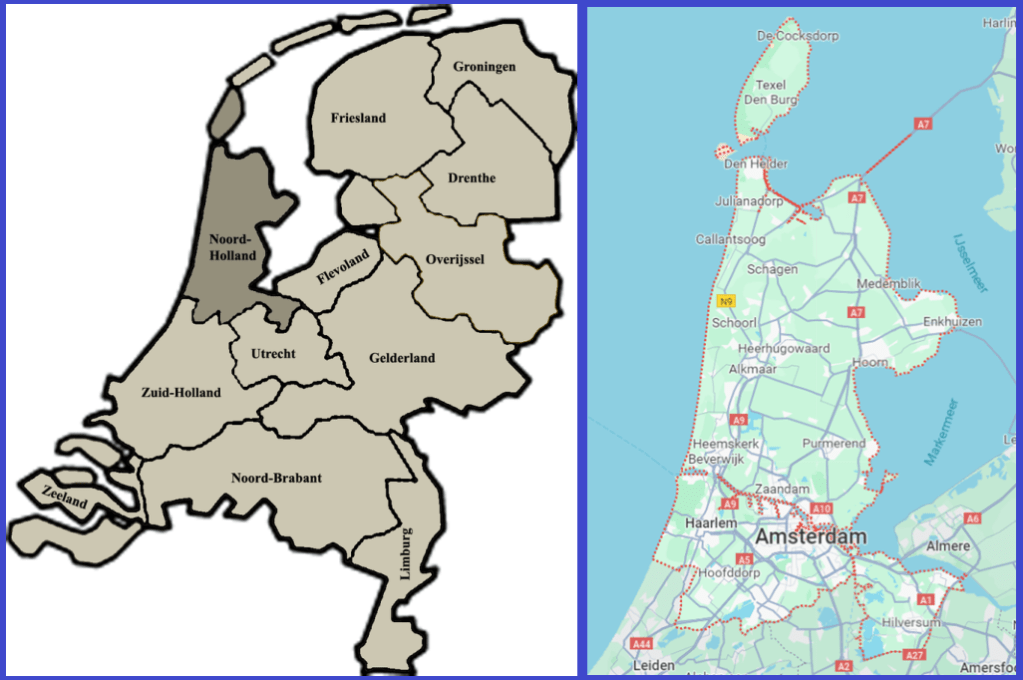
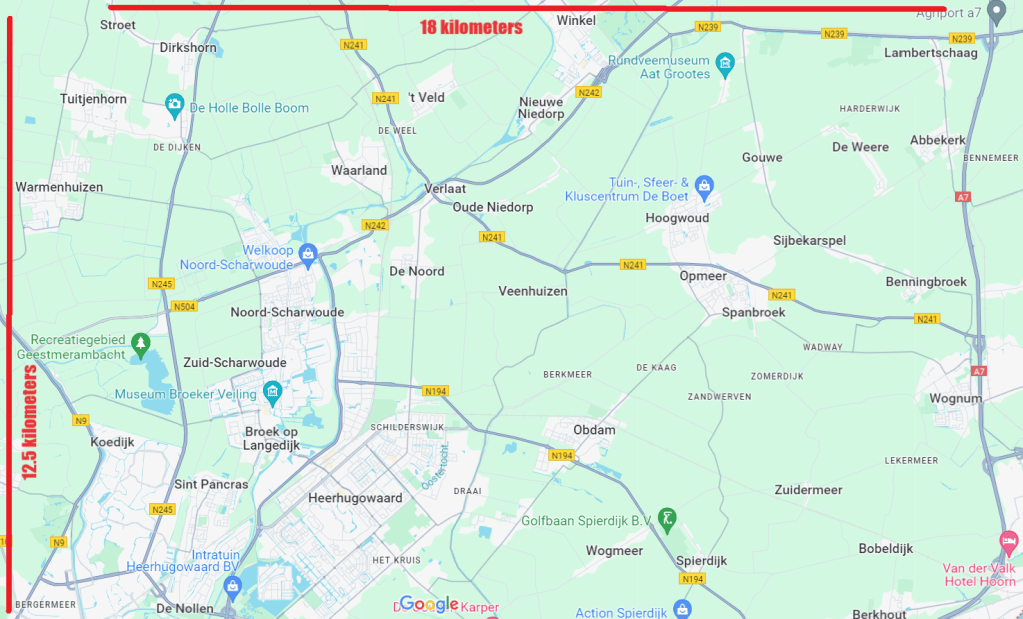
My father was born in the Netherlands, so I have deep Dutch roots. My direct ancestors are primarily from the central part of what is now the province of Noord Holland, going back centuries. My paternal line has been there for 200 years but originated in Zuid Holland, in towns and villages between Den Haag (The Hague) and Leiden. Most of my Noord Holland ancestors were born, lived, and died roughly within a 280 square kilometre area.
The area of Noord Holland where many of my paternal ancestors lived. This is immediately north-east of Alkmaar, one of the larger cities in the area.
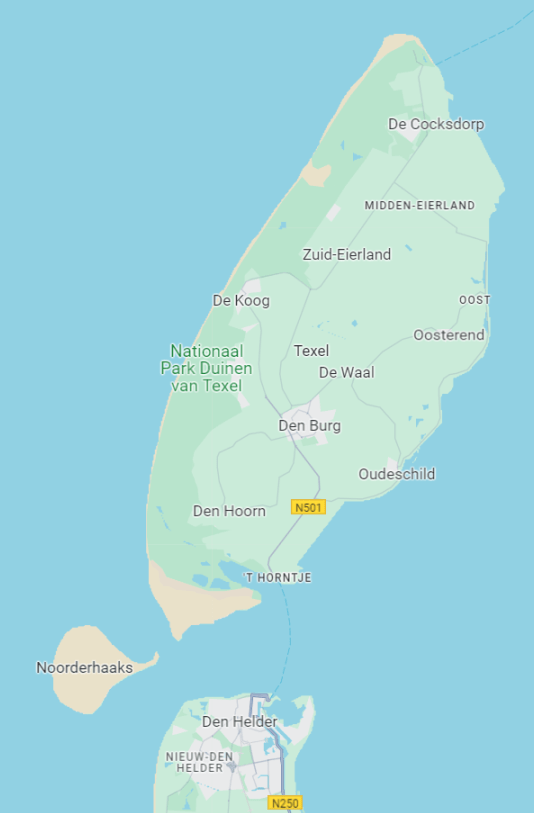
However, several of my Noord Holland ancestors were from Den Helder, a city on the northern tip of the mainland of Noord Holland. It is an important port city. In the 16th and 17th centuries, it was a significant mustering and departure point for Dutch overseas trade and exploration. It is now the home of the Netherland’s main naval base.
Three kilometers north of Den Helder, across the Marsdiep strait, is the island of Texel. Through my father’s maternal grandmother, Elisabeth Bakker (1888-1976), I have significant roots in Texel. I do not know how far back those roots truly go, but I know that one branch of Elisabeth’s maternal line was on Texel by end of the 15th century.
In English, the “x” is pronounced the same as it is in “Texas”. In Dutch, it’s pronounced “Tessel”. Texel is the first and largest of the Wadden Sea islands, which stretch along the entire north coast of the Netherlands. Nine hundred years ago, Texel was part of the mainland. A catastrophic flood in 1170 dramatically changed the geography of north-west Netherlands, including the creation of the island of Texel. There has been settlement on Texel since at least the 12th century. Texel even has its own dialect, Tessels. It was common until the 1950s, after which time it went into significant decline.
The island received city rights in 1415. It has been the site of significant naval engagements over the last 400 years. It was also the site of one of the last battles of World War II in Europe. The island had been relatively unscathed during the war itself. It was only after the war was over that it was devastated. A German battalion made up of Georgian soldiers occupied Texel during the war. Supported by the Dutch Resistance, they rebelled in April 1945. Fighting between the Georgians and Germans lasted well beyond VE Day, ending only with the arrival of Canadian troops on May 20, 1945.
Historically, Texel’s primary economic activity involved agriculture and the sea. It is famous for a breed of sheep, Texels, that originated there. In present times, the island is primarily dependent on tourism. While most of my Dutch ancestors were primarily farmers and labourers, many of my Texel ancestors were sailors.
Both of Elisabeth Bakker’s grandfathers, Jan Cornelis Bakker (1819-1859) and Cornelis Ran (1824-1897), were harbour pilots. I suspect it was that line of work that led them to relocate and settle in Den Helder. Two of Elisabeth’s four great grandfathers, Cornelis Dirksz Bakker (1789-1858) and Reijer Ran (1792-1860), were also sailors. It was Elisabeth’s father, Cornelis Jan Bakker (1855-1914) who broke with that tradition. He was a cobbler and shoemaker.
One of Elisabeth’s great grandfathers who was not a sailor was Jan de Waard (1787-1863). He began his working life as a labourer but for the last twenty years of his life he was a shopkeeper. Jan is interesting because nearly all my paternal line were Roman Catholic, but Jan was baptised in the Reformed Church. However, his wife Cornelia Pieters Kooij was Catholic and their children were baptised as Catholics. It is possible that Jan might have converted.
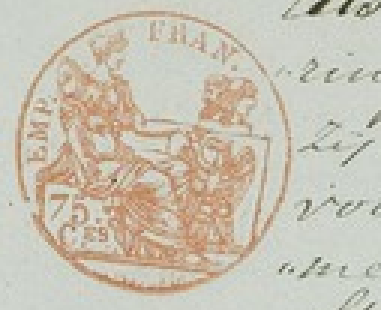
The other interesting thing about Jan and Cornelia is that they were amongst the last to be married during the period of French rule during the Napoleonic wars. They married at Texel on October 10, 1813. The record of their marriage is written in Dutch, but bears the seal of Imperial France. Less than a month after their marriage, a popular uprising resulted in the ouster of the French. On November 30, 1813, the son of the former stadholder of the country returned from exile and was named William I, Sovereign Prince of the United Netherlands and subsequently King.
The other of Elizabeth’s great grandfathers who was not a sailor, Johannes Puinbroek (1786-1865), was not even from Texel. In fact, he is quite the oddity in my family tree. He was born so far south from Texel that the town where he was born, Vrasene, is in Belgium (which at the time was the Austrian Netherlands). Sometime around 1822 and 1824 Johannes relocated to Den Helder, where he met and married his third wife. I have no idea beyond speculation as to what prompted him to move. I thought I had written about him before, given his unusual story, but searching through my posts I found nothing. Well! There is something I haven’t written about before! Stay tuned…
For decades I’ve been reading the same stories about my great x3 grandparents, Robert Nelson and Elizabeth Joseph. I have written about them before (such as here and here). They were both born in Muff, Donegal, Ireland in 1818, two weeks apart. Robert and Elizabeth married in 1842 and within two years they were living in Scotland, near Glasgow. In 1850 they emigrated to the United States. They both died in Smithfield, Utah in 1902: Robert in February and Elizabeth in May.
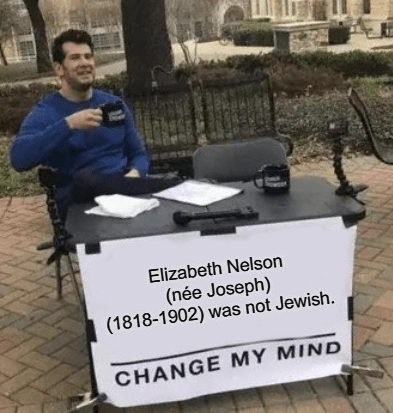
The oft-repeated story is that Elizabeth was Jewish. The related story is that Robert and Elizabeth were picnicking on an island, where they were trapped by a storm and had to spend the night. The next morning they returned home in disgrace and because they had spent the night together were forced to marry. Moreover, because Robert was Christian, Elizabeth’s parents disowned her.
Needless to say, I don’t believe a word of it.
Not once in over thirty years have I ever seen a shred of evidence supporting this story or the proposition that Elizabeth was Jewish. The conclusion that she was could not be further from the Genealogical Proof Standard if one tried.
When Elizabeth was born, the Jewish population of the entirety of Ireland was extremely small, and mainly centred in Dublin and Belfast. It had not really been established by the time Elizabeth and Robert left Ireland for Scotland. By the mid-1800s, there were only a couple hundred Jews in the entire country. According to the 1881 census, there were fewer than 400 Jews in all of Ireland. Muff, Donegal is on the northern outskirts of Londonderry, where there was no Jewish community prior to 1893. In 1894, there were only 43 Jews in Londonderry.
It is not entirely impossible that Elizabeth was Jewish, but it is extremely unlikely. Absent any evidence to support the claim, I don’t accept it.
UPDATE: Since going live with this, a reader suggested that a DNA test might help put this story to rest. Great idea, I don’t know why I didn’t think of it. This might be an unpopular thing for a genealogist to admit, but I’ve never taken one for a lot of reasons I really don’t feel like explaining right now. However, one of my brothers took a DNA test and he sent me the results. They were everything I expected and, frankly, boring! I took a look at it again, and there is no indication of even a trace amount of Jewish ancestry. To me, this reinforces my disbelief that Elizabeth was Jewish.
I originally wrote this for Week 1: Family Lore. Shortly after posting, I went through some draft posts I had written weeks ago and realized that the story about my great x3 grandparents, Robert Nelson and Elizabeth Joseph, was a much better fit for that prompt. So I deleted the original Week 1 post, replaced it with Robert and Elizabeth’s story, and repurposed this story for Week 9: Changing Names.
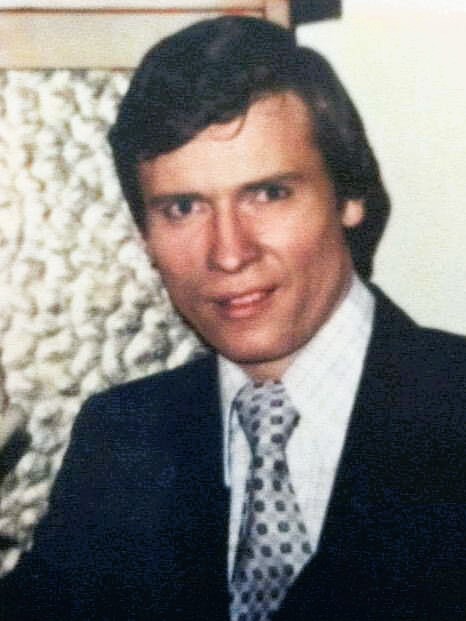
Schulor Barry McGene (formerly John Warkentin)
When I was a kid, sometimes I’d hear talk about one of my mother’s first cousins, John Warkentin (1942-2003). The family referred to him as “Hollywood Jack”. The family lore was that he had always dreamed of moving to Hollywood and becoming a star. My mother said that when Jack was still a teenager, he left home for California and changed his name.
When I was a kid, the stories left me with the impression that Hollywood Jack was never heard from again. When I was older, I learned that John had remained in contact with his family, they knew his whereabouts, and knew his new name.
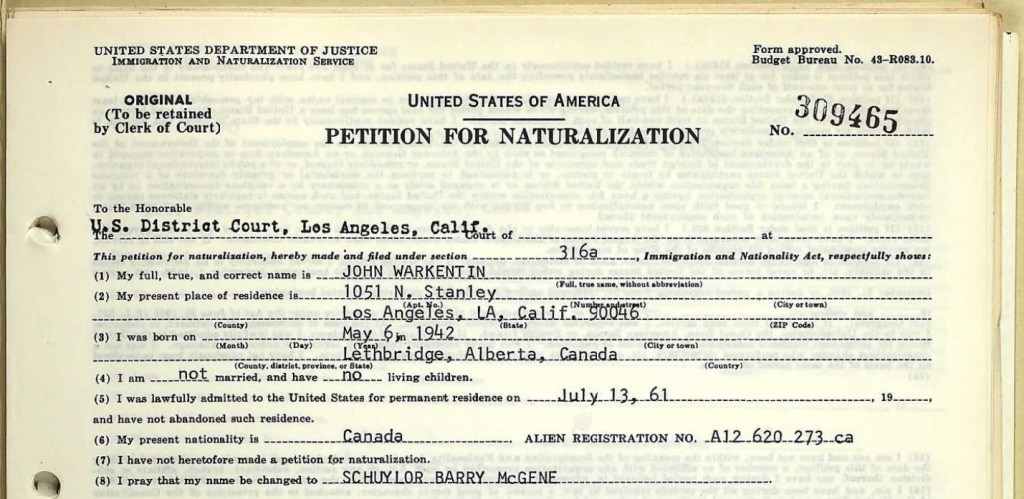
John’s Petition for Naturalization filed with the U.S. District Court in Central California shows that he landed in the United States on July 13, 1961, shortly after he turned 19. The Petition showed that John was living in Los Angeles, half a block from Santa Monica Boulevard. That area is now part of West Hollywood, which separated from Los Angeles and incorporated as a city in 1984. John was granted U.S. citizenship on November 21, 1969. He married for the first time one month later.
What I was surprised to discover was that in the United States – at least at the time John moved there – you can apply for a legal change of name in your Petition for Naturalization. (However, they did not change your ancestor’s name at Ellis Island!!) In his Petition, John asked for his name to be changed to “Schuylor Barry McGene”. It seems he also went by “Skyler”, which is how he was named in his brother Frank’s obituary. I have no idea why John chose that name, but I would love to know the story behind it. (For ease of reference, I will continue to refer to him as John.)
For the life of me I still can’t figure out why WordPress won’t centre an image even when it is marked as centred.
Another fascinating aspect of John’s Petition are the affiants who were witnesses to John’s Petition. What caught my eye is that one affiant, Luthor Lindstrom, lived near John, on North Sweetzer Avenue in West Hollywood, while the other affiant was named Chase Sweetser. Chase lived about 25 kilometers away from John, in Redondo Beach. It should be no surprise that one affiant lived in John’s neighbourhood; it is a complete mystery to me how John knew Chase.
I spent a very brief amount of time trying to find out more about the affiants to see if this coincidence might be something other than happenstance. I also did do in hope of learning more about John. Always remember to research the FAN (“Friends, Associates, and Neighbours”) club! While I know John married twice and had children with both wives, I know nothing about what he did for work or how he otherwise spent his life.
I have not find anything on Luthor Lindstrom.
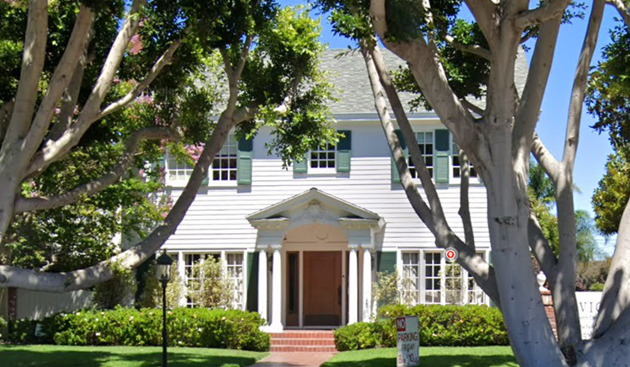
However, I found a newspaper article from 1988 about the address Chase Sweetser provided. The house at that address was built in the American Colonial Revival style by Chase Sweetser Sr. Since this person died in 1947, I assumed that he must be the father of the Chase Sweetser who swore the affidavit in support of John’s Petition. Further research confirmed that suspicion.
Chase Sr. apparently made his fortune as a “grocer”, provisioning ships in the nearby harbour. Chase Sr. also built his fortune through shares he owned in Coca-Cola as one of its early investors; he was also on its board of directors. The article said that his son Chase Jr. had been the president of the local Coca-Cola bottler.
The house went up for sale in the 1980s, after Chase Jr. died. It was newsworthy because it was listed on the National Register in 1985. The article noted that despite being on the National Register, there were no restrictions on tearing the house down and redeveloping the property. The house was listed for US$1.275 million (US$3.14 million in 2024 dollars).
Other articles I found show that the house was never torn down and still stands. Rather, the property sold a number of times (first in 1989 at well below the asking price) and currently serves as the offices of a wealth management firm. The firm’s website even provides a photo and brief history of the house.
417 Beryl St, Redondo Beach, California
My next thought was to research how Sweetzer Avenue in West Hollywood got its name. On top of that idea, my wife suggested that maybe Chase Sweetser was John’s landlord and Sweetzer Avenue was named as such because the Sweetsers owned property there. It turns out that Sweetzer Avenue is likely named after Edward Healey Sweetser. While my search was brief, I found no connection between Chase Sweetser and Edward Healey Sweetser. However, there still remains the possibility that Chase Sweetser was John’s landlord.
Another possibility is that John worked for Chase; however, I have not yet found any information as to what John might have done for a living in Los Angeles. Other than his marriages, the only other thing I know about John is that he died in July 2003 – in La Cañada Flintridge, California. Born in Canada, died in La Cañada!
I have a couple other theories about John (and his FANs) to research, but as of yet they’re speculative. While sites like Ancestry and FamilySearch do not include living persons, some of the records available there do identify living people, which provide some clues for research. As well, bits and pieces I’ve gathered through Google and other search engines have given me a few bits of additional details about John. However, given that they involve living persons, I will simply leave it at that.
Needless to say, in trying to answer a few questions about the family lore, I am left with many more than I started with!
Addendum
For the brief period of time this was live someone posted a comment asking about John’s choice of new name. In the time since I posted this and took it down, I asked my mother what she knew. Bear in mind John’s mother – my mom’s aunt – passed away when my mother was two months old and she never had much contact with her Warkentin relations.
Most of what my mother knows came from a mutual aunt of John and my mother’s. My mother said that when John first left home, he went to live with this aunt.Their aunt had a son who is also named John, so that’s when they started using “Jack”. Since Jack spoke so often of going to Hollywood, they started calling him Hollywood Jack.
My mom says that John wanted to be an actor and thought Schuylor Barry McGene would be a great name for an actor. He also wanted to make a break from his father, with whom he did not get along. My mom says John remained in contact with their aunt for about a year after he moved to California. After a period of no contact, my mother’s aunt contacted the Red Cross to help track him. About a year or two later John called the aunt. Apparently she was quite shocked when she learned about the name change. My mom tells me that sometime well afterwards John came back to Canada to visit his aunt, at least once, but he otherwise remained in California.
Additional – November 5, 2025
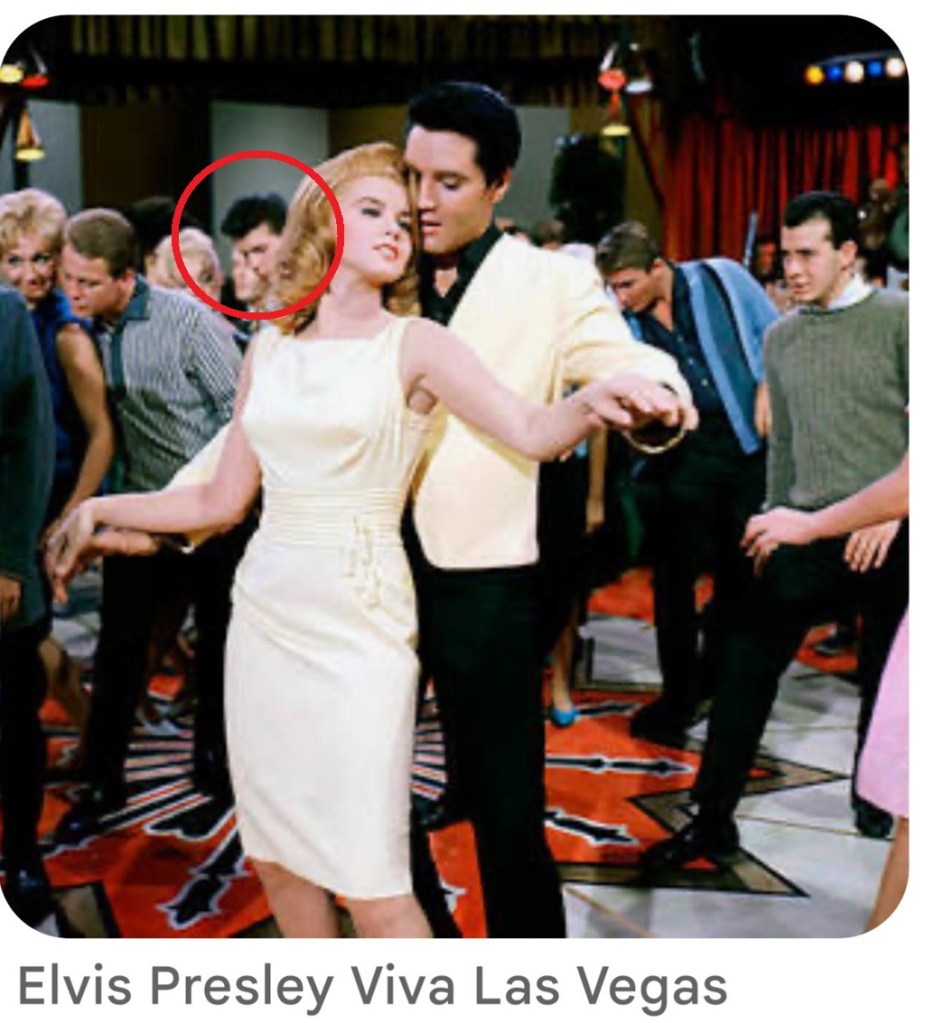
In the last six months, a distant relative came across this post and contacted me. We entered into correspondence and exchanged a fair amount of info. All I will say about it is that Hollywood Jack made it into show business. While not his biggest foray into the industry, one thing he did was to appear on screen with Elvis and Anne Margaret!



 A Deck of Ancestors