Continuing with the foray into my direct Dutch ancestors who were not farmers or labourers, meet Cornelis Ran, my Gx3 Grandfather. In his occupation, Cornelis was following in the footsteps of his father, Reijer Jansz Ran, at least as much as you can follow on the confines of a boat or ship. Cornelis’s maternal grandfather and great grandfather were also sailors, although their forebears were innkeepers, bricklayers, and bakers.
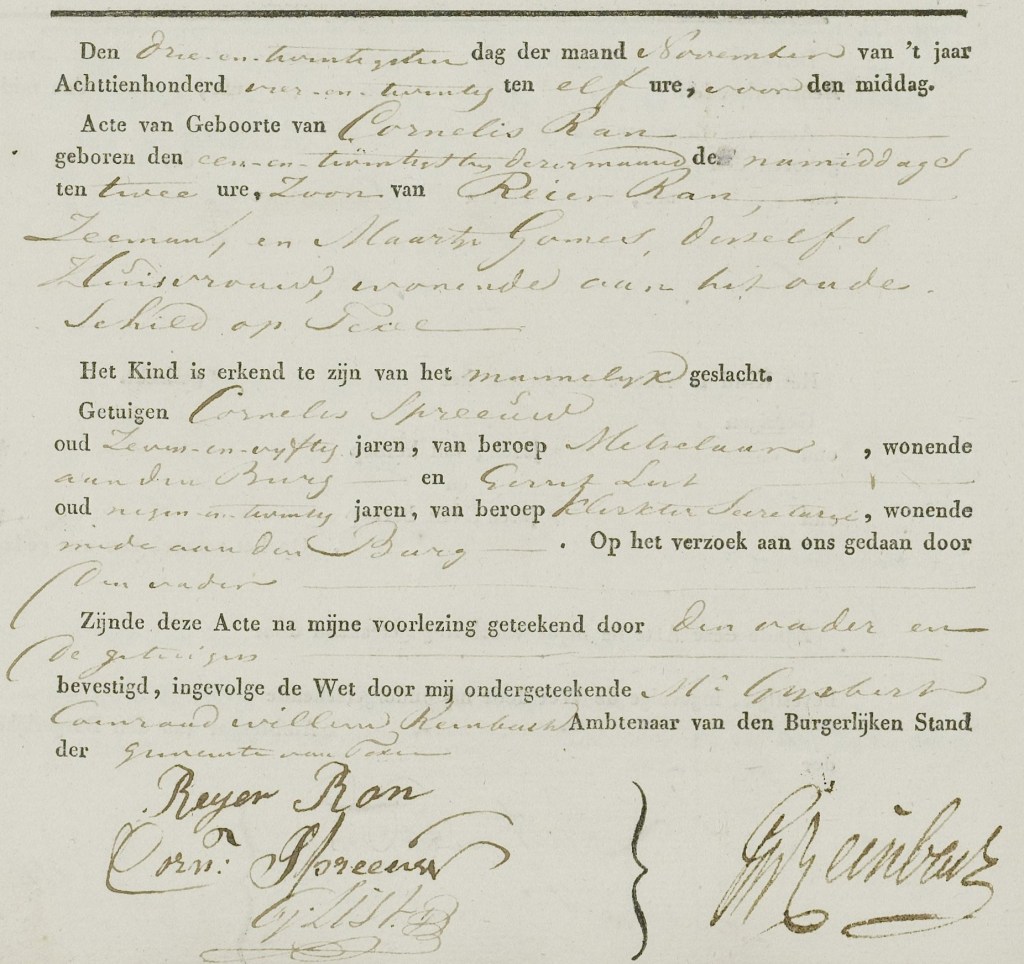
Cornelis’s birth registration
Reijer and his wife Maartje Klaas Gomes had eleven children, all born on Texel. Remarkably for the time, all but two survived to adulthood. Cornelis, born on November 21, 1824, was the sixth of these eleven children. He was born in Oudeschild, a coastal village on the east coast of the island of Texel, which lies only a couple of kilometers across the Marsdiep from the mainland city of Den Helder, a major Dutch port and naval city. Several generations of Cornelis’s ancestors spent their lives in Oudeschild.
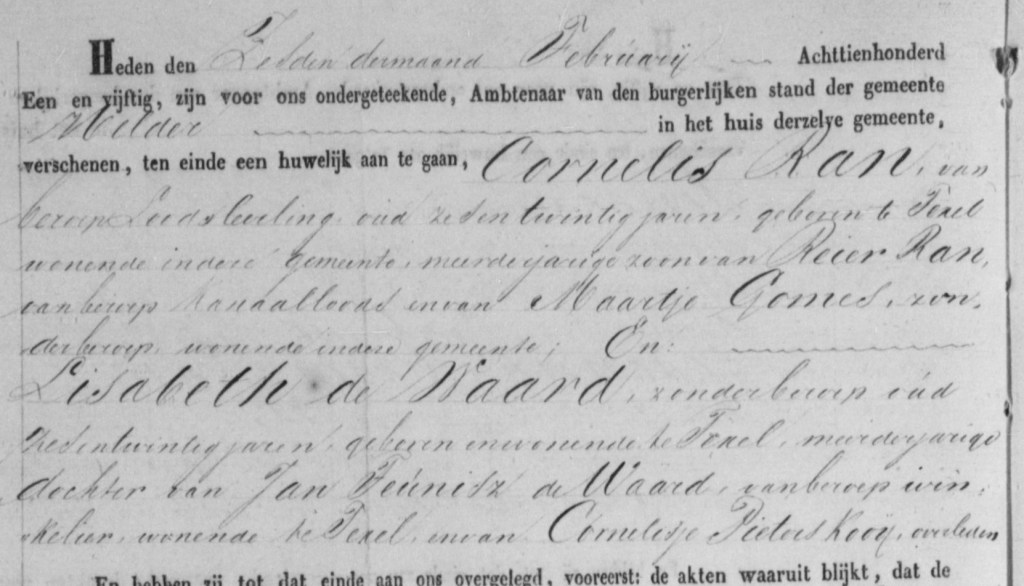
Top portion of Cornelis and Elisabeth’s marriage registration
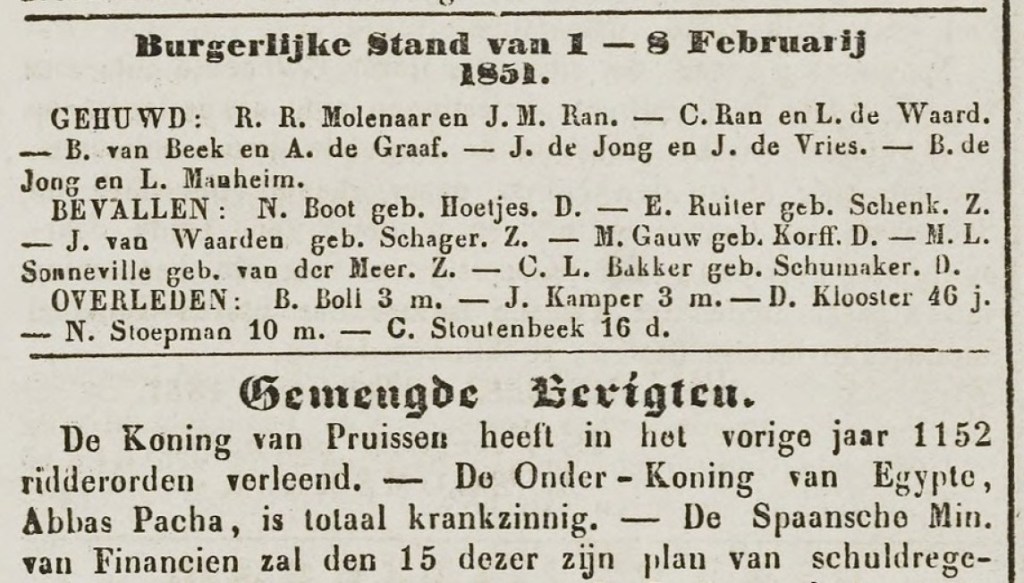
Cornelis’s life on the water was spent as a harbour pilot and sailor. He was serving his apprenticeship as a harbour pilot in Den Helder when he married Elisabeth “Lisbeth” de Waard there on February 6, 1851. Lisbeth, who also went by Betje, was born on Texel in 1824. Delightfully, Cornelis and his sister Johanna Maria were both married on the same day and at the same place, possibly in a joint family celebration in Den Helder.
From the Weekblad van Den Helder en het Nieuwediep, 10 February 1851, page 3. It shows the double-marriage of Johanna Maria Ran (to Reijer Molenaar) and Cornelis Ran (to Lisbeth de Waard). The item below the civil registration notice are odd little bits of news: “The King of Prussia appointed 1,152 knights in the previous year.” “The Governor of Egypt, Abbas Pacha, is totally insane.”
Elisabeth and Cornelis remained in Den Helder for the rest of their lives, where they raised seven children. Again, remarkably for their time, all seven of their children lived well into adulthood. All seven also went on to marry.
Over those years, Cornelis continued in his profession, working as a harbour pilot and as a sailor until about 1886, when he was 62. Records show that Cornelis had no occupation from 1886 to 1890. This suggests he might have retired. However, he was working again as a sailor in 1890, so it is not clear if he had briefly retired, had been unable to work, or had been unable to find work.
Elisabeth passed away in 1887 at the age of 63 and was buried in Huisduinen, a village near Den Helder. Cornelis lived another ten years, dying in Den Helder on June 26, 1897, at the age of 72. He was also buried in Huisduinen, on June 29, 1897.
I am terribly, terribly far behind with this year’s 52 Ancestors Challenge. Ironically, I thought I would be much more focused on the writing, since I had thought that I had done a thorough job on the research for the individuals I had been planning to write about. How wrong I was!
Not only did I discover that I had a lot of gaps in my research, I kept getting sucked into rabbit holes of other research. Particularly so for Johanna Adriana Puinbroek, my Great x3 Grandmother. For years her parents, Johannes Puinbroek (1786-1865) and Maria Theresia Letens (1802-1848), have been a mystery to me. So instead of writing about Johanna I spent most of the last several weeks researching her parents. After overcoming a litany of hurdles I won’t detail here, I finally cracked through some brick walls.
But first, Johanna. I find her interesting in her own right for several reasons. One is where she was born. The vast majority of my Dutch ancestors are from the province of Noord Holland, with one branch originating in Zuid Holland and migrating to Noord Holland in the early 1800s. But not Johanna.
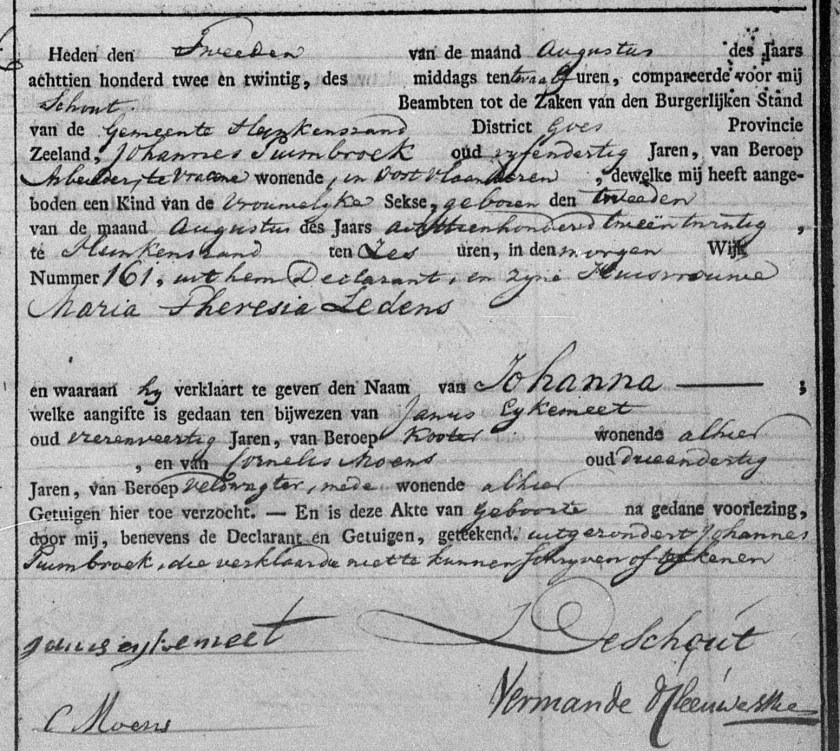
Johanna Adriana’s birth registration. “Ledens” was one of the many spelling variations for her mother’s surname; there are also many iterations of the spelling of “Puinbroek” in the records.
Johanna was born on August 2, 1822 in Heinkenszand, a village on Walcheren, a former island that is now a peninsula in the province of Zeeland. It is almost as far down the Dutch coast as you can get from Den Helder, Noord Holland, where she and her parents moved before Johanna turned two. In a country where it seems that travel to the next town is still a major undertaking for the locals, literally moving from one end of the country to another in the early 19th century seems quite amazing.
It is largely speculation based on little evidence, but I suspect the move might have been more a result of her parent’s personal circumstances than anything to do with what was happening in Zeeland at the time. Johannes and Maria were not married when Johanna was born; in fact, they never married during the almost 25 years that they were together. That might not be unusual in itself.
However, when Maria conceived Johanna Adriana, Johannes was married to another woman, Johanna Judoca van Haever (1786-1823). While Johannes and Johanna Judoca were the same age, Johannes was 16 years older than Maria. Johanna Judoca died in April 1822, shortly after giving birth to her and Johannes’s sixth child, Josephus Bernardus. Josephus died three months later, in July.
The following month Johanna Adriana was born to Johannes and Maria. In fact, the birth registration for Johanna Adriana shows that Johannes and Maria were living in different towns about 40 kilometers apart. Maria was living in Heinkenszand, where Johanna Adriana was born. Johannes was living in Vrasene, Oost-Vlaanderen, where he was born. Vrasene is just outside of Antwerp, which was still part of the Netherlands. Belgium did not become a country until 1830. Vrasene is about 10 kilometers from Sint Jansteen, where Johanna Judoca lived her entire life. So it appears Johannes was not living near either of his partners at the time.
Sometime before 1824, Johannes, Maria, and Johanna Adriana moved to Den Helder. It appears that only two of Johannes and Johanna Judoca’s children survived childhood. They would have been 12 and 9 when their mother died and their father moved north, but they did not accompany him. They both stayed in Zeeland. I don’t know who raised them after their father left for Den Helder.
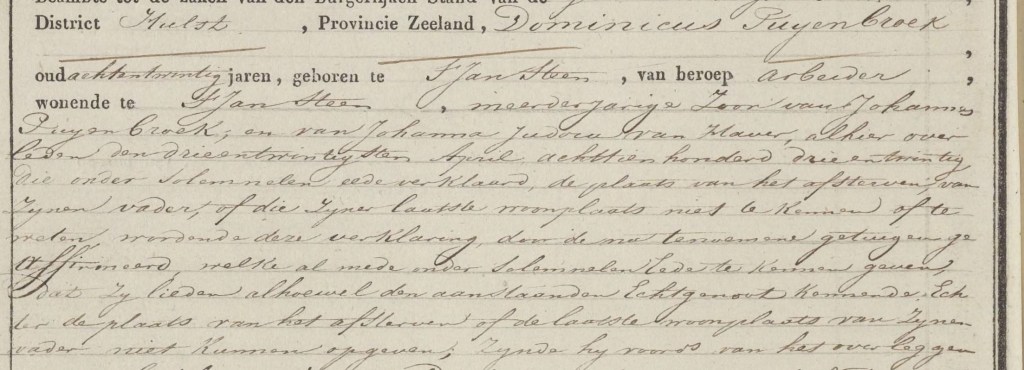
In fact, I doubt they ever saw their father again. When Johannes and Johanna Judoca’s eldest son, Dominique, married in Sint Jansteen in 1838, he attested that he did not know if his father was alive and that he did not know his father’s last residence. It would follow that Dominique likely had no idea about Johanna Adriana or his other half siblings.
The passage from Dominique Puijenbroek’s marriage registration in which he attests to the fact he had no knowledge of his father’s whereabouts. In fact, Dominique said that he believed his father was deceased.
In Den Helder, Johannes and Maria had four more children. The first, Frederika, was born on February 23, 1824, but she did not survive the day. Their last child, Willem, was born in 1834. As of 1840, the family was still living together in Den Helder, although Johannes and Maria remained unmarried. It’s a mystery to me why Johannes and Maria never married. Since Johanna Judoca had passed away, I cannot find any impediment to them marrying – to each other or anyone else.
Five years later, in 1845 when Johanna Adriana was 23 years old, Maria married a sailor named Jacob Pel. Maria was 42; Jacob was 29 – only six years older than Johanna Adriana. Like Maria, Jacob was also born in Zeeland, although by the time he was required to register for compulsory military service he was living in Noord Holland. The couple never had children and the marriage was short, as Maria died in December 1848, the day after her 46th birthday. It does not appear that Jacob ever married again.
A year after Maria married Jacob, her former partner Johannes married Cornelia Bakker, on April 2, 1846. Johannes, who was then 60, was 18 years older than Cornelia, who was 42. There were children in this marriage. Despite Cornelia’s much younger age, Johannes outlived her. She died on February 20, 1859. Johannes died on January 1, 1865.
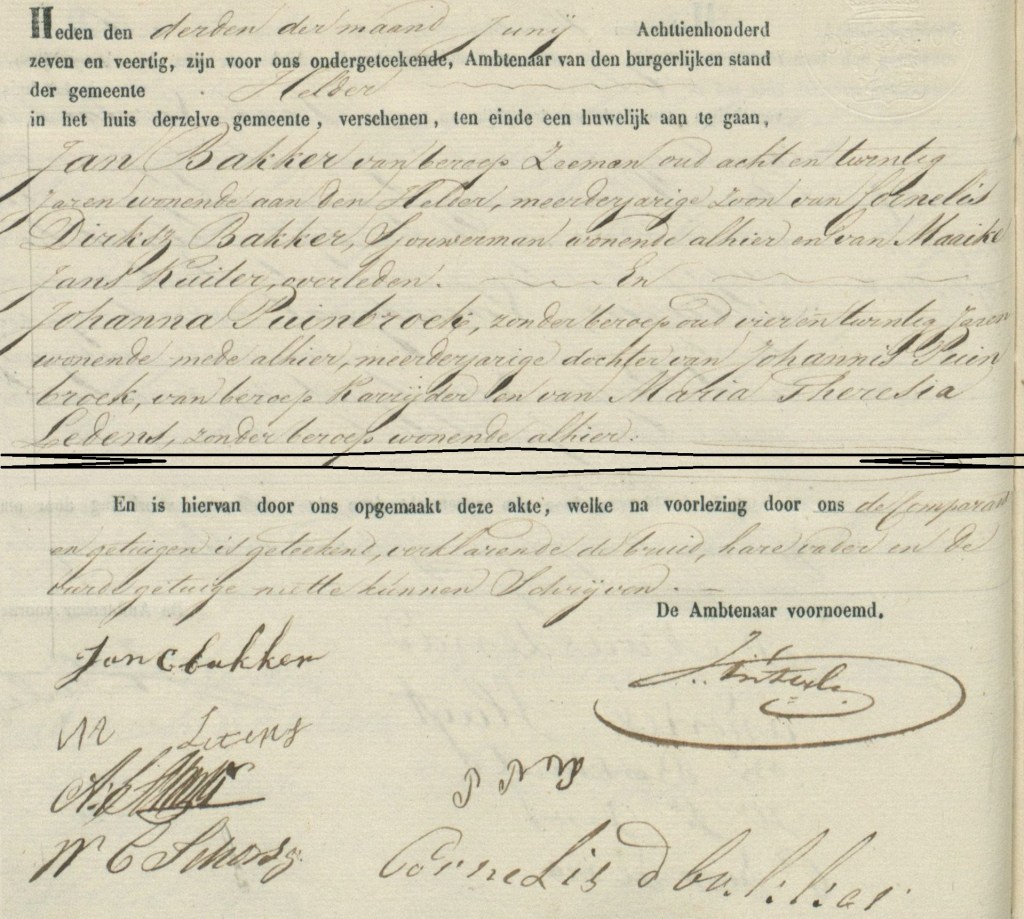
On June 3, 1847, two years after her mother married Jacob and one year after her father married Cornelia, Johanna Adriana married Jan Cornelis Bakker, a 28-year-old sailor who was living in Den Helder. Johanna was 24 at the time. They had one child together, my Gx2 Grandfather Cornelis Jan Bakker, who was born in 1855. Unfortunately, Jan died young, at age 40, when Cornelis was only four years old.
The top and bottom of Johanna Adriana and Jan’s marriage registration. The bottom half notes that Johannes Puinbroek could not read or write. It also bears the signature of Maria Letens.
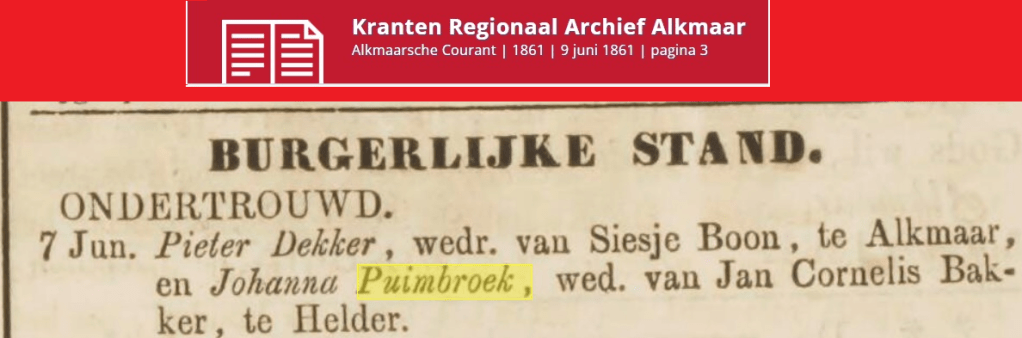
Within two years of Jan’s death, on June 16, 1861, Johanna Adriana married Pieter Dekker (1813-1885), in Den Helder. Pieter was also a sailor and spent many decades at that profession, although when Johanna died on June 24, 1881 he was a shopkeeper in Den Helder. Johanna and Pieter never had any children.
Alkmaarsche Courant, June 9, 1861. “Civil Register. Married June 7. Pieter Dekker, widower of Siesje Boon, from Alkmaar, and Johanna Puimbroek, widow of Jan Cornelis Bakker, from Den Helder.”
The account of Johanna and her parents is one of the more complicated stories in my family history. The countless hours of research I poured into finding it out reflects that complexity.
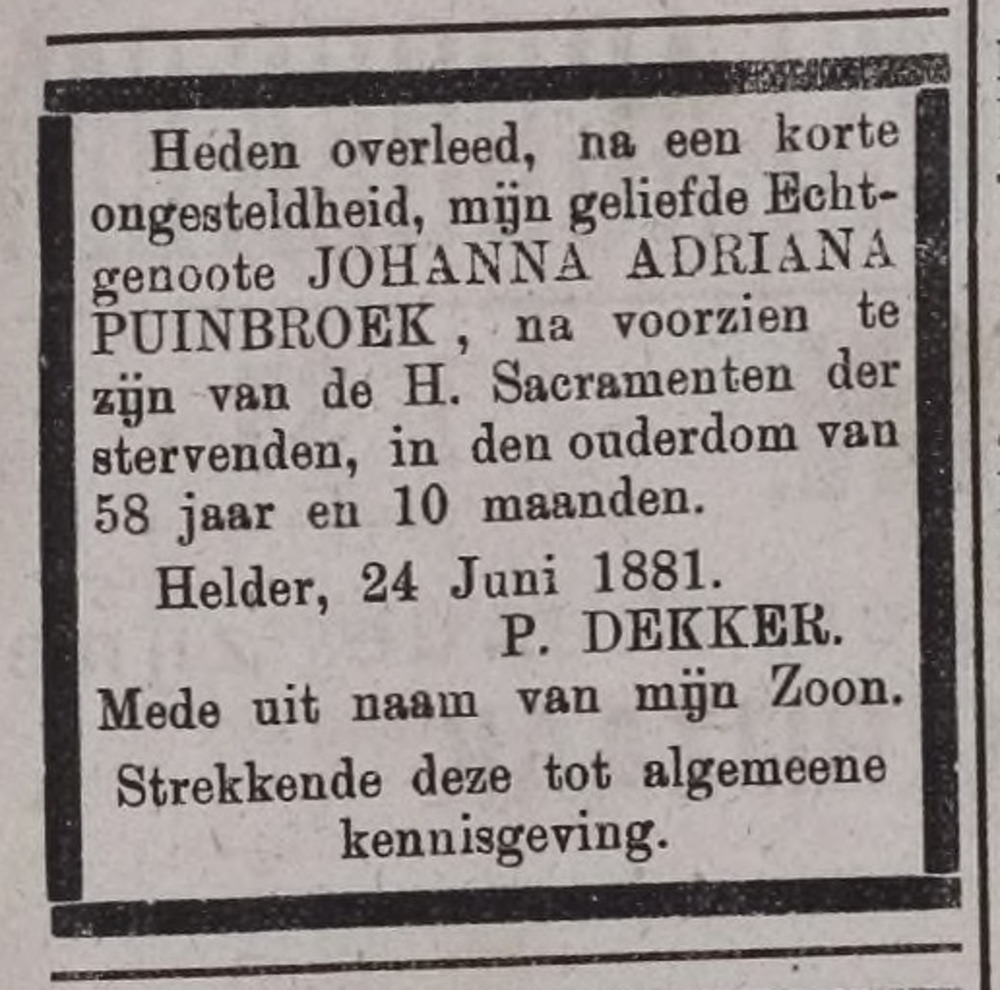
Vliegend Blaadje: Nieuws- en Advertentieblad voor Den Helder, June 28, 1881. “Today after a short illness my beloved wife Johanna Adriana Puinbroek passed away after receiving the Holy Sacrament of the Last Rites, at the age of 58 years and 10 months. Den Helder, June 24, 1881. P. Dekker. Also in the name of my son. This is for general information.” The son Pieter Dekker referred to was from his first marriage.
I recently noted that most of my direct Dutch ancestors were farmers and labourers. Jan Cornelis Bakker is another exception to that generalization. For most of his short life, he worked as a sailor in Den Helder, Noord Holland. In fact, he was the descendant of sailors on both sides of his family.
Jan was born on January 16, 1819, in the village of Oost, located on the island of Texel in the province of Noord Holland, Netherlands. He was the second child of Cornelis Dirksz Bakker and Marijke Jans Kuiter, who had married a few years earlier in Texel, on April 25, 1815. Jan’s older sister, Naantje, had been born in July 1815, just months after their parents’ wedding.
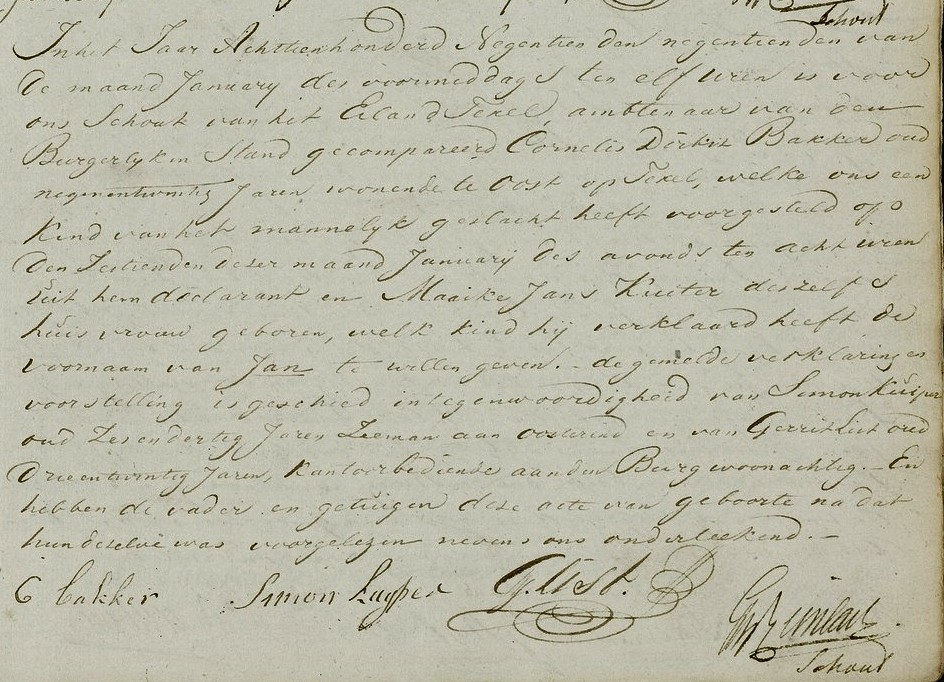
Jan’s birth registration
Both sides of Jan’s family have deep roots on Texel. I have traced both his lines back at least three generations. Jan’s mother, Marijke, was born on Texel around 1787. Her father, Jan Kuiter, was a sailor. Marijke passed away relatively young, on January 4, 1824, in Oost, when Jan was only five years old.
Jan’s father was a sailor on Texel. His father remarried in 1826 and moved the family from Texel to Den Helder sometime before 1833. Den Helder is a major Dutch port at the northwestern tip of the country and has been a major naval base since the 1700s. It seems that Cornelis gave up life at sea for life on the shore after moving to Den Helder. His recorded occupation was porter, most likely working on the docks.
When the family moved to the mainland, Jan Cornelis would have been in no more than his early teens. By 1847, Jan had followed in his father’s footsteps and was working there as a sailor. That year, he registered for compulsory military service but was not called to serve. Jan carried on in his profession as a sailor, which was how he spent the rest of his working life.
On June 3, 1847, Jan married Johanna Adriana Puinbroek in Den Helder. Johanna was born in 1822, in Heinkenszand, Zeeland, far to the south. Her parents were Johannes Puinbroek and Maria Theresia Letens. What brought Johanna’s family north to Den Helder is unclear, but her marriage to Jan firmly rooted her there. Together, Jan and Johanna had one child, my Gx2 Grandfather, Cornelis Jan Bakker, born on April 26, 1855, in Den Helder.
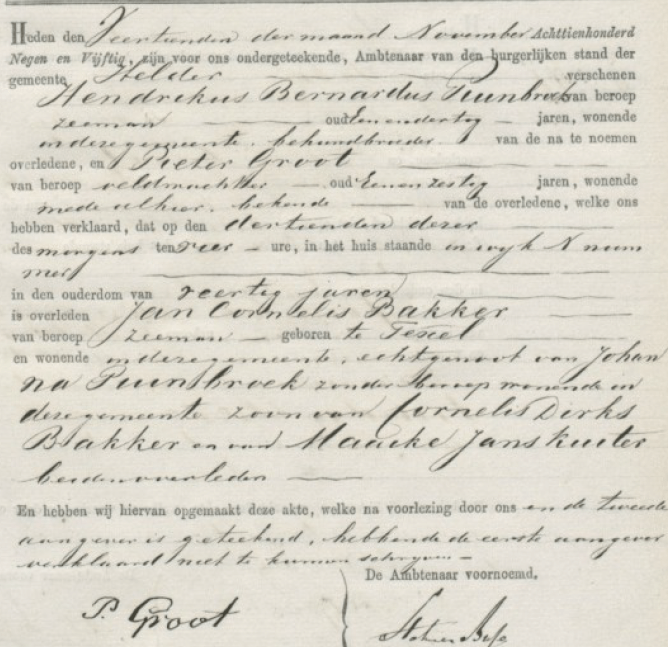
Sadly, Jan’s life was cut short. He died on November 13, 1859, at the age of 40, in Den Helder. His widow, Johanna, lived on for more than two decades after his death, passing away in 1881, at age 58. I have no idea as to how he died, but I’ve wondered whether it occurred as a result of his work as a sailor given how young he was at the time. However, I’ve found nothing in any of the sources I’ve consulted, including the online newspaper collections at Delpher and various Dutch archives.
Neeltje Smit, my Gx3 Grandmother born on June 10, 1816, is one of my longest-lived ancestors. Her life spanned nearly ninety years, from the end of the Napoleonic era into the 20th century. Her life began in Heerhugowaard, Noord Holland, where she was born. She was the third of nine children born to Jan Smit and Leentje van Dam.
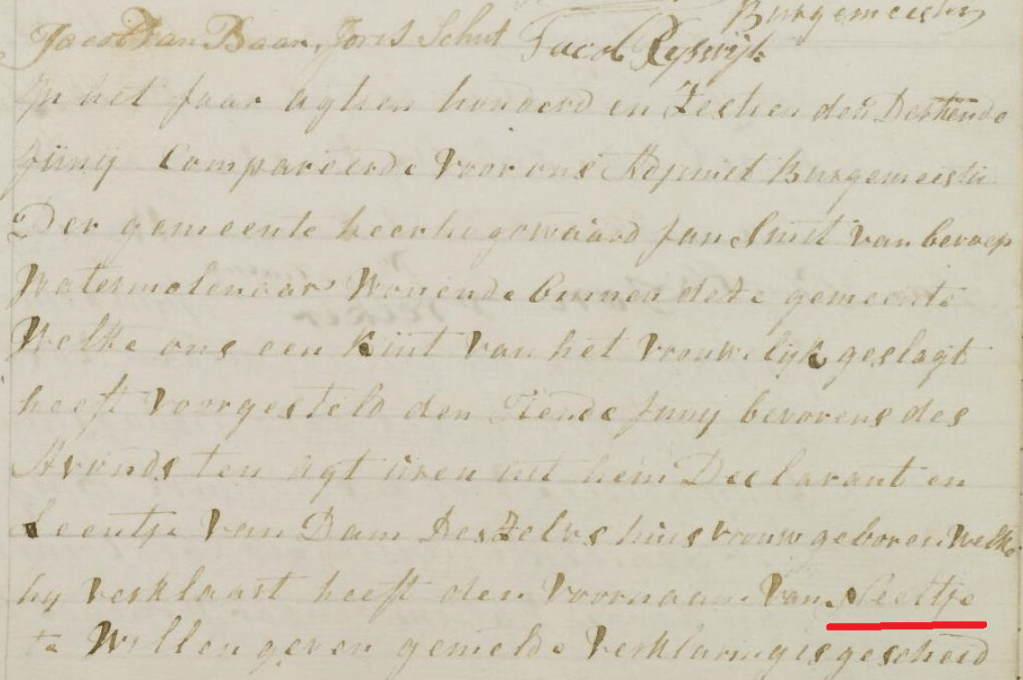
Portion of Neeltje’s birth registration.
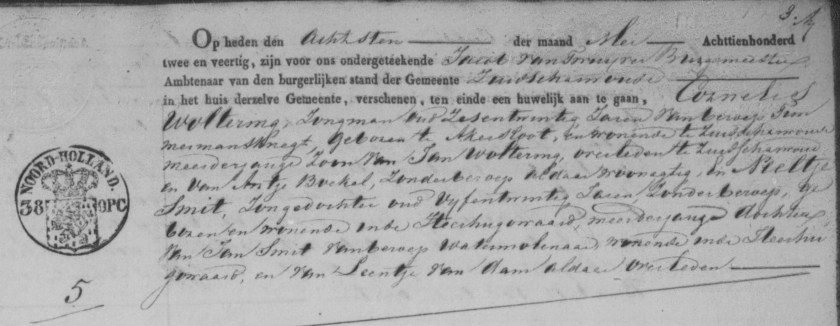
I have little information about Neeltje’s childhood or early adulthood. She was still living in Heerhugowaard at age 26, when she married her first husband, Cornelis Woltering, on May 8, 1842. Cornelis, born in Akersloot in 1815, was then a carpenter’s apprentice, just starting his trade. After they were married, Neeltje and Cornelis settled in Zuid-Scharwoude, Noord Holland. Neeltje would spend almost the rest of her life living there.
Cornelis and Neeltje’s marriage registration.
The couple had six children. Their first child, Leentje, was born in 1843 and would marry and move to Den Helder, and then later to Nijmegen. Their second child, Jan, born in 1846, died in infancy. Another son, also named Jan, was born in 1848 and lived to age 71, working as a tailor. He never married. Willem (1850–1851) and Teetje (1855–1860) also died young. Their daughter Antje – my Gx2 Grandmother – was born in 1853 and would later marry Nicolaas Komen in 1878.
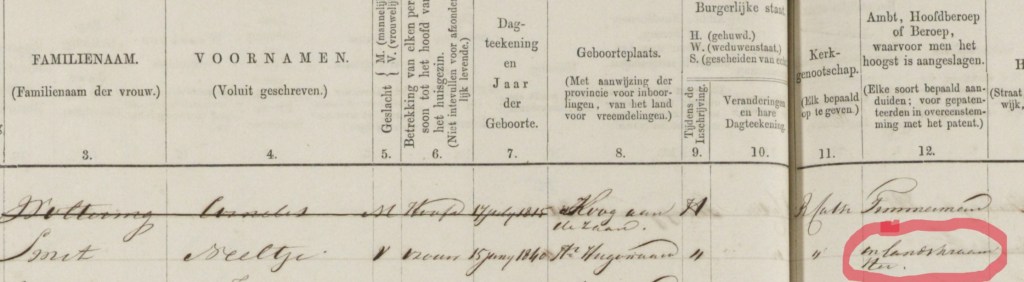
Cornelis Woltering passed away in Zuid-Scharwoude in December 1862, leaving Neeltje a widow at just 46 years old. Her youngest child, Antje, was only nine years old. In the population register for the year Neeltje was widowed, she was quaintly described as a “landsraamster”; literally, a “country widow”.
Bevolkingsregister (Population Register) for Zuid-Scharwoude 1860-1870 showing Neeltje as a “landsraamster”
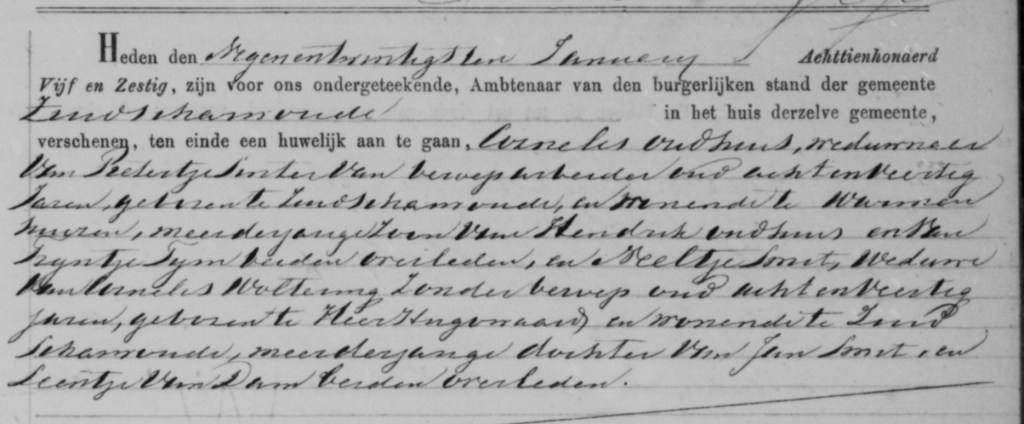
Two years after Cornelis died, on January 29, 1865, Neeltje remarried. Her second husband was Cornelis Oudhuis, a labourer born around 1817 in Zuid-Scharwoude. He himself was a widower. Cornelis had lived in Warmenhuizen prior to his marriage to Neeltje. The two spent over three decades together before Cornelis died in 1897 at age 80.
Neeltje and Cornelis Oudhuis’s marriage registration.
After her second husband’s death, Neeltje continued to live in Zuid-Scharwoude for several more years, remaining in the village where she had spent much of her life. In April 1903, in her late 80s, Neeltje moved a short distance to Noord-Scharwoude, another of the component parts of Langedijk. There she lived with her daughter Antje and son-in-law Klaas Komen.
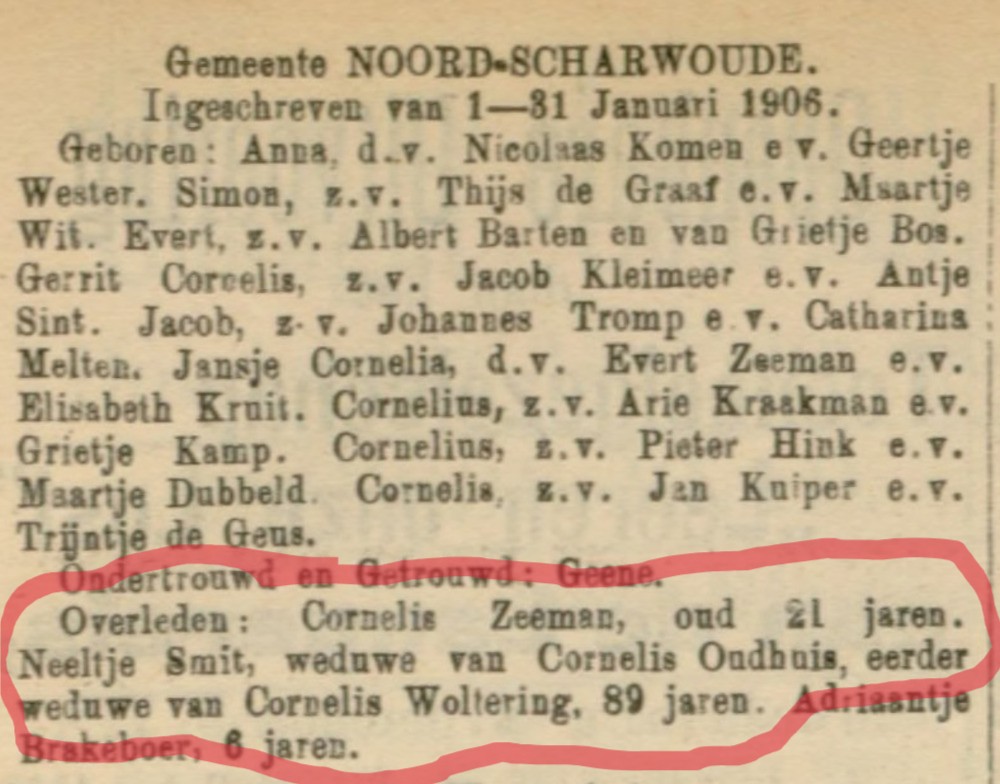
Neeltje Smit died in Noord-Scharwoude on January 22, 1906, at the age of 89. She had outlived two husbands and several of her children, living the entirety of her long life within a few kilometers of where she had been born.
Schager Courant, February 15, 1906, page 3 “Neeltje Smit, widow of Cornelis Oudhuis, previously widow of Cornelis Woltering, age 89.”

 A Deck of Ancestors