Happy birthday to my mother on her 75th birthday, or, as she marks it, the 56th anniversary of her being perpetually 19.
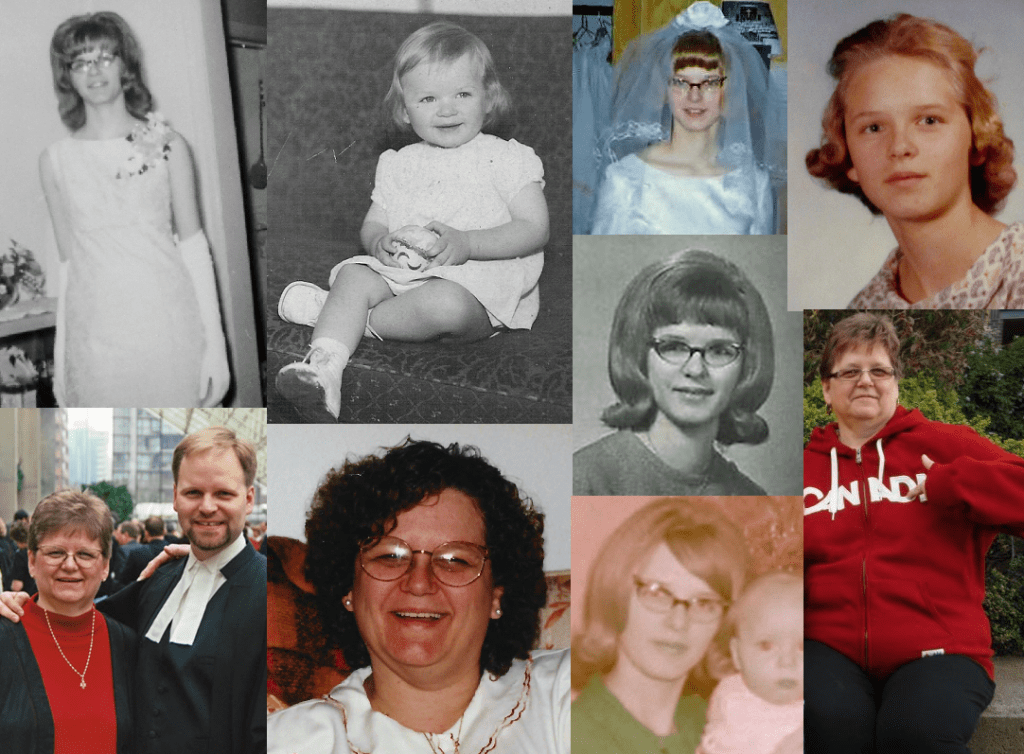
Happy birthday to my mother on her 75th birthday, or, as she marks it, the 56th anniversary of her being perpetually 19.
Hard to believe that we’re now a quarter of the way through this year’s 52 Ancestors Challenge! I feel like I’m still at the starting gate.
This week’s theme is “Light a Candle”. Amy says, “Candles are often lit in remembrance, in prayer, or when the power goes out for 5 days because of an ice storm. Be creative with this prompt!” So I’ll be creative!
All candles need fuel for the fire, which in their case is the wax. Thinking of fuel reminded made me think of an occupation of one of my ancestors, which has intrigued me many, many years: “brandstoffenhandelaar”. It’s Dutch for “fuel merchant” or “fuel dealer”. My great great grandfather, Nicolaas “Klaas” Komen was a brandstoffenhandelaar in Zuid-Scharwoude, Noord Holland, starting sometime around 1920 up to when he died in 1929.
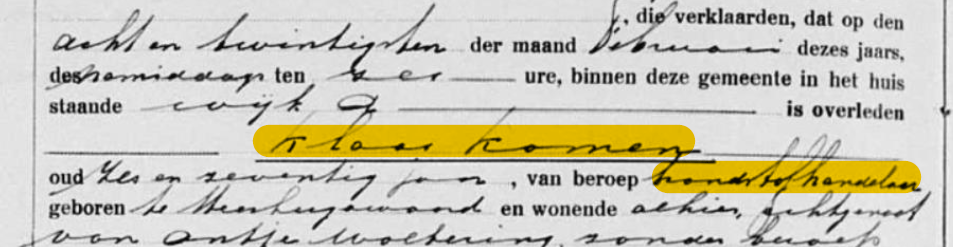
Back in the days before Babelfish or Google Translate, and when my Dutch was still at its most rudimentary as I struggled to teach it to myself, I would often puzzle over what it meant or what the job actually involved. I couldn’t find it in any of the Dutch-English dictionaries I had. However, I knew it was a compound noun. By breaking it down to its component parts I was able to determine that it had something to do with fire and trading or mercantile.
Many years later, I learned that it meant “fuel merchant”, but what exactly did it mean? It’s a term you can find in common use today, especially in the petroleum industry. However, its current use could not possibly mean what Klaas had likely been doing in the 1920s.
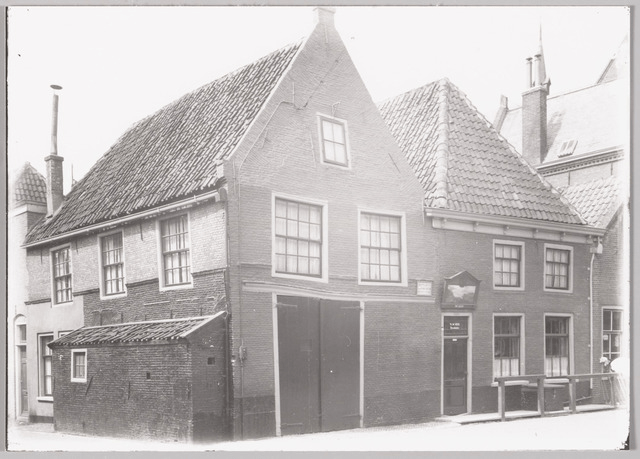
Years ago, I trick I figured out for translating unusual or difficult to understand words is to use Google Image Search. Like they say, a picture says a thousand words. I did this for the term “brandstoffenhandelaar“. Not only did that search show the modern usage of the word, but it also showed century-old photos of people with carts or wagons transporting various kinds of fuels, such as coal, oil, and peat. It struck me that those images likely depicted Klaas’s occupation, particularly given that he was a labourer for most of his life. Operating a cart or wagon would be quite consistent with the other work he performed and his station in life.
In recent years, I discovered the Dutch Genealogy group on Facebook. I posted a query asking whether my understanding of brandstoffenhandelaar was correct, or whether it was more nuanced. The responses led me to believe that I was more or less correct. Several of the responses confirmed that back in Klaas’s day, a brandstoffenhandelaar might be someone transporting fuel by cart, wagon, or small truck, most likely coal, peat, or heating oil.
On occasion, I’ll try to find out what it was that Klaas actually did as a brandstoffenhandelaar. In preparing this post, I thought I’d give Delpher a try. Delpher is a fantastic resource, where you can find historical newspapers, magazines, books, and other publications. The only down-side to Delpher is that the site is only in Dutch, with no English interface. Even if it had one, the search results would be documents that are only in Dutch, so some knowledge of the language is necessary. I get a great language lesson every time I use it!
My goal with Delpher was to see if Klaas had placed any ads or notices for his services in the local paper. Delpher has great advanced search features, but I was still stymied in my search. In addition to being a surname, “komen” is also the verb “to come” in Dutch. On top of that, searching for an exact phrase using variations of Klaas’s first name (Nicolaas, Klaas, Nic) with his surname produces a lot of items about Sinterklaas coming to town. Even expressly excluding “sint” or “sinter” from the search didn’t filter them all out.
Despite the quirks of my search terms, I never found anything for Klaas or his work in the papers I searched. Nevertheless, my curiosity remains fueled.
In this blog I’ve written about many different memberships that my ancestors have been part of: members of the military, the church, and the bar, for example. Something I haven’t really written about is membership in volunteer work, service organizations, and social organizations. So for this week’s 52 Ancestors Challenge, I’d like to share something about my paternal grandmother, Christina (“Tiny”, pronounced “tee-nee”) Komen.
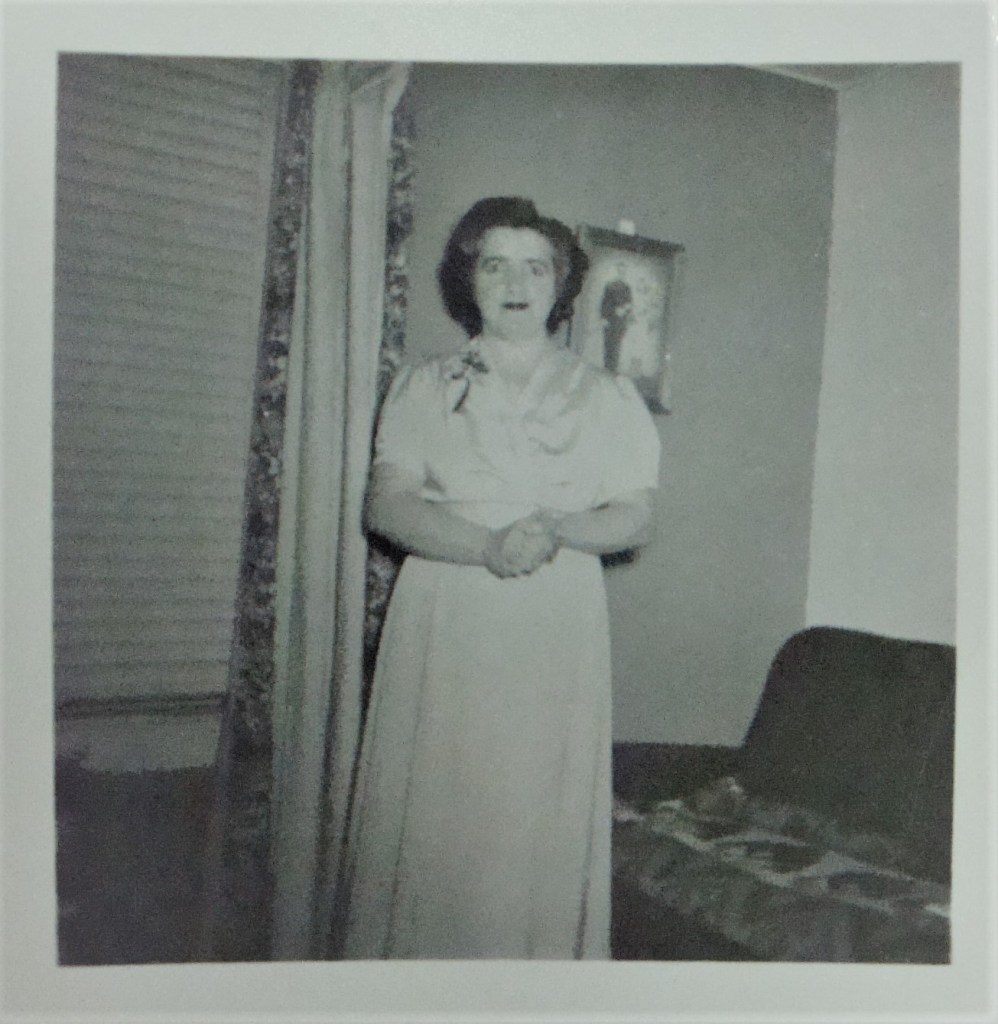
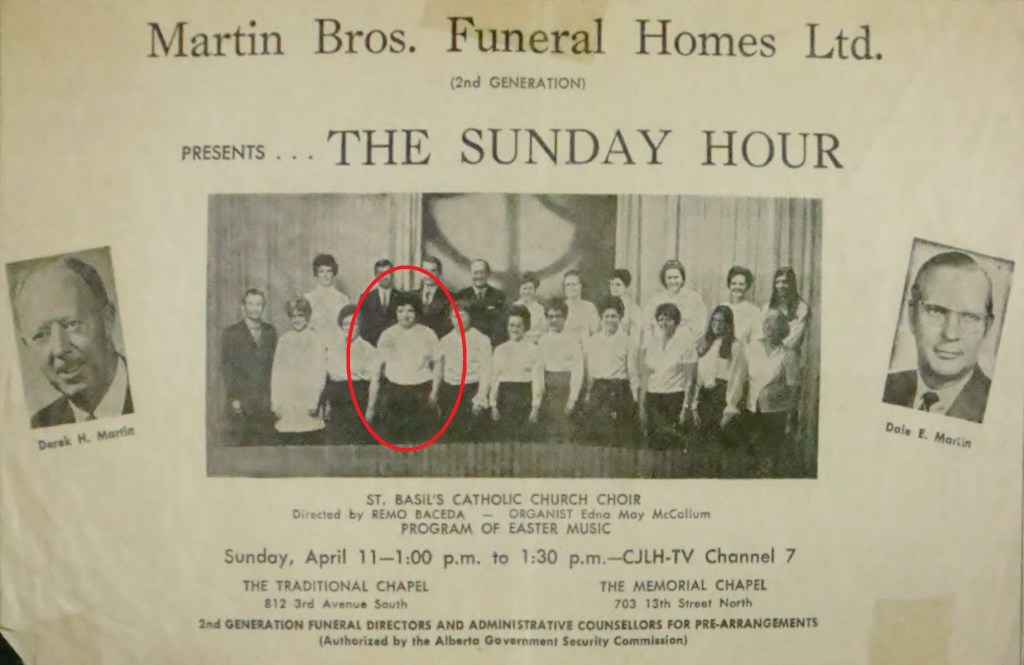
My grandmother was a wonderful singer with a beautiful voice. Before emigrating to Canada, she was a member of local and church choirs in her home town. After settling in Canada, my grandparents and the family (including my father) lived in a number of small towns south of Lethbridge, Alberta. However, for most of the late 1950s and early 1960s they lived in Warner, where my grandmother was a member of the Warner Choral Society.
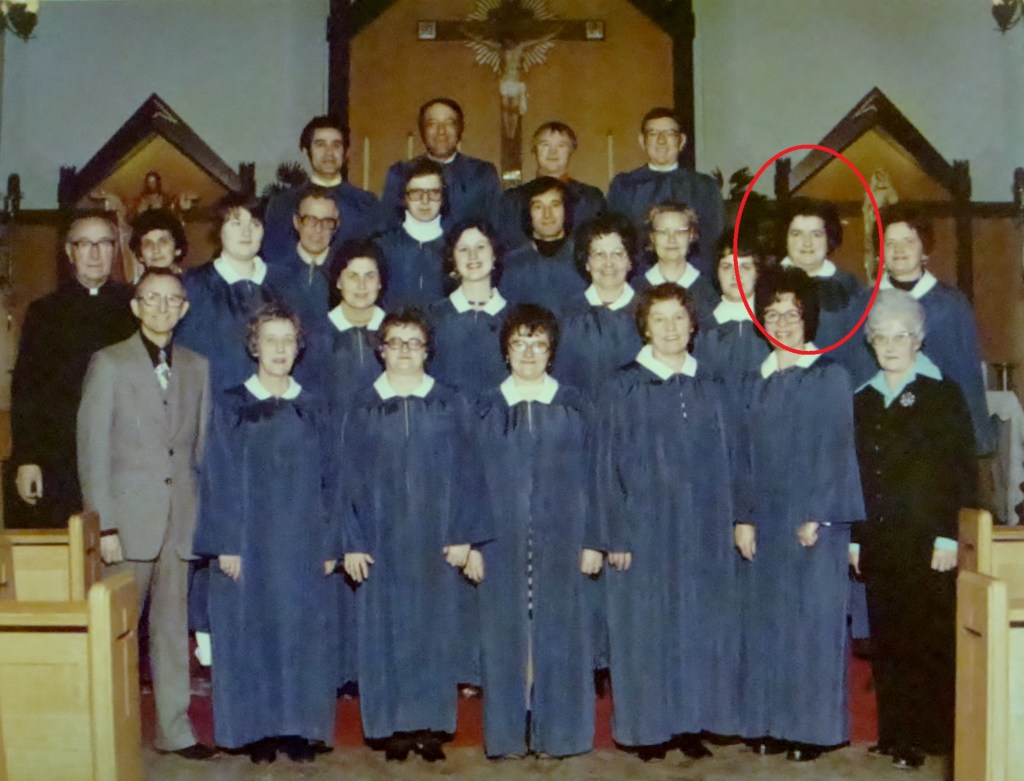
My grandparents later moved into Lethbridge, where my grandmother was a member of the St. Basil’s Catholic Church Choir. The choir would appear on a local television on “The Sunday Hour”, a program that aired on CJLH-TV. At that time, it was a CBC affiliate. It’s now CISA, a Global Television station.
I’ve already written about the two luckiest genealogical breaks I’ve had: meeting Nol van den Hurk on an online forum, resulting in the foundation of much of my Dutch family history research; and using a random farm driveway in the middle of nowhere to turn around, thus stumbling upon and meeting a cousin in time to contribute to a family history book project. So it took a bit of thinking to come up with something new for this week’s them of “Lucky” for the 52 Ancestors Challenge.
When most people hear the word “luck” or “lucky”, the assumption is usually good luck. I started off with that premise in mind, only to discover that the example I came up with involves both good and bad luck.
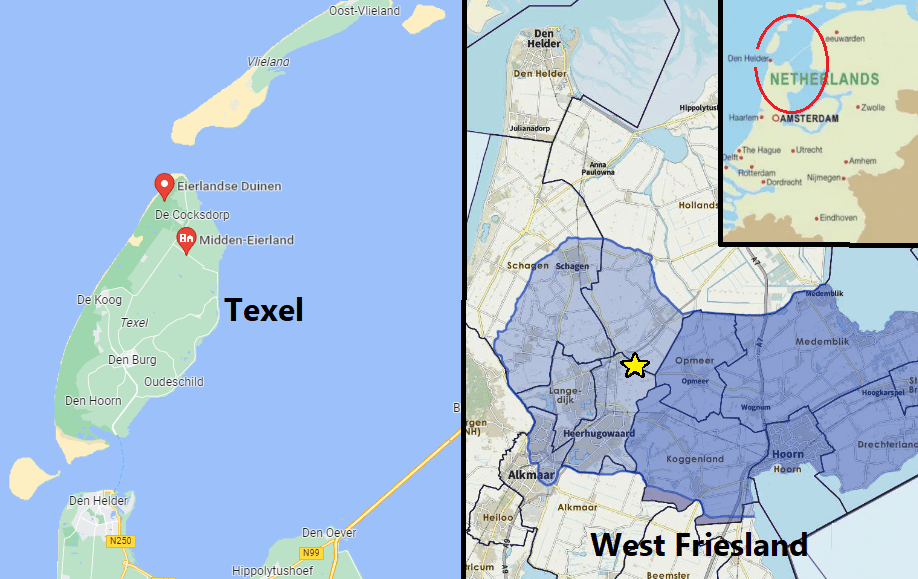
Sometime in the early 1860s, Pieter Jansz van der Fluit, my first cousin four times removed, relocated from Oude Niedorp to Eierland. Oude Niedorp is in the centre of West Friesland (which is actually in the province of Noord Holland). Eierland (“Egg Land”), is located at the northernmost tip of Texel, the largest of the Wadden Sea Islands (or Frisian Islands), which stretch from the western Netherlands to Denmark. Until the 13th century, Eierland was part of the neighbouring island of Vlieland, when natural changes separated the two. In the 1600s, a sandbar developed between Eierland and Texel, which was dammed, merging the two. In the 1840s, developers enlarged this area to create a polder, resulting in new farmland.
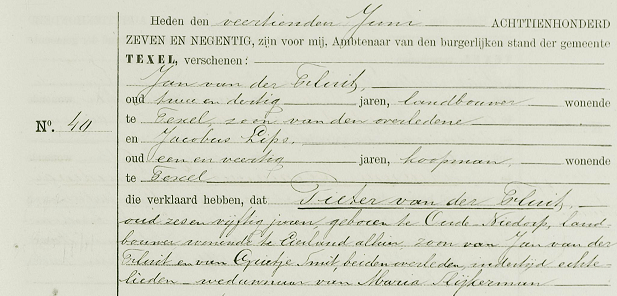
I first learned about Pieter in August 1997, in an email from Nol summarizing many birth, marriage, and death registrations. In that email, he wrote that one of the records described Pieter’s occupation as “Farm”, as opposed to “Farmer”, suggesting that he owned his farm in Eierland. In the decades that followed, these archival records have been scanned and posted online. However, the only records I’ve found for Pieter say that he was a “farmer”.
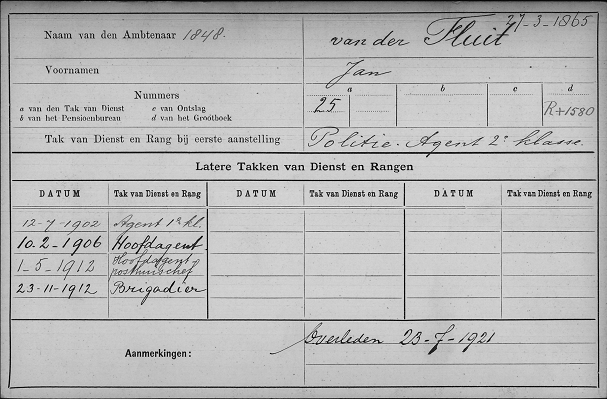
The farm was later taken over by Pieter’s son Johannes Pietersz (“Jan”) van der Fluit. In an a September 1998 email to me, Nol reported that Pieter’s occupation was “farmer on Texel”, at Eierland. Nol added that the farm was named Het Fortuin (“The Fortune”). However, it seems that good fortune was not with Jan, as Nol said that Jan went broke. Nol told me that Jan was 75 Guilders short to pay an unspecified debt. Nol said that this was about the price of three sheep. I don’t know if Jan farmed sheep, but Texel is famous for a breed of sheep developed there. After going broke, Jan relocated to Amsterdam and became a police officer.
I’ve found records showing Pieter and Jan farming at Eierland and Jan relocating to Amsterdam and becoming a police officer. Good luck! Unfortunately, I have been unable to find any of the sources Nol might have been looking at confirming that the farm was named Het Fortuin or Jan’s financial woes. Bad luck.
“Het Fortuin” was also the name of a ship that sailed from Texel in September 1723, bound for Indonesia. It was the ship’s maiden voyage. It reached the Cape of Good Hope (South Africa) in January 1724. The ship and its crew of 225 men set sail two weeks later and was never seen again. Not very good luck at all.
 A Deck of Ancestors