52W Mark III – Week 43: Lost Contact

This week’s prompt for the 52 Ancestors Challenge is “Lost Contact”. Losing contact is one way of losing a connection. Sometimes losing the connection might be necessary.

There are countless ways as to why a tree is such an excellent metaphor for genealogy. One comparison that might not be considered so often is that, like a tree, sometimes one’s family history might need some pruning.

As our research progresses over time and we add to our trees, we might discover that there are branches that no longer belong, which should never have been there in the first place. They might have been grafted to our trees early on, when we were new to genealogy, and did not realize that the connection was not supported by the evidence. There might be branches that seemed to be supported by the evidence that was available at the time, but new evidence comes to light that disproves the connection. When this happens, we have to cut that branch and end contact with the false connection.

I know that sometimes many genealogists have had a hard time making the cut. After all, until the connection was disproved, the individuals on the branch were considered family.

Over the years, I’ve made cuts now and again. Some small, some big. A few years ago I found a significant cut I had to make for my 6xG Grandfather, James Turner (1715-1773). James is on a branch of my tree for which I’ve had less interest than others over the years. He was the great grandfather of my 3xG Grandfather, Preston Thomas (1814-1877). While I’ve done quite a lot of research on Preston – and written about him here many times – I have not done much research on his lineage. Most of what I have is names and dates I gathered in the mid-90s during my earliest visits to the Family History Centre in Burnaby, and never really looked at again very seriously. It comes as no surprise to me when I have to prune some of the branches on Thomas’s line, including the parents of James Turner (which I wrote about on Week 8 of the 2023 52 Ancestors Challenge).

The other branches of my tree that I know need some more serious research and that might result in some pruning, or at least some revision, are the paternal lines of my maternal grandmother, Helen Burgess (1921-1984). I have great confidence in the information I have for Helen’s grandparents and her attachment to them. However, I have doubts about the lineage of her great grandfather Franciscus “Franz” Lerner (b. bet. 1835-1840 – d. 1876 or 1877) and her great grandfather Georg Jacob Anton (1843-1908).

My grandmother’s is a descendant of Germans from Russia, which I have written about here quite often. Those ancestors are my most difficult branches to research, for many reasons.

For Franz, I am confident in the identity of his paternal grandfather [Franz Ignaz Lerner (1759-abt 1816 or later)]. The main problem is identifying his father. Franz’s father is one of either two individuals:

  • Michael Lerner born 11 Jul 1793 in Malsch, Karlsruhe, Baden, wife Maria Eva Eberle born 1793 in Pleisweiler, Bergzabern, Pfalz (although possibly Eva Eberle), or
  • Bernard Lerner born 27 Feb 1798 in Malsch, Karlsruhe, Baden, wife Barbara Heil born abt 1799 in Niederlustadt, Germersheim, Pfalz.

As for Georg Jacob, he might not actually be Georg Jacob. It is possible he is actually simply just Jacob. As for Georg Jacob’s father, the name I have is Johannes Anton; however, he might actually have been Peter Johannes Anton. Not only are the names I have slightly off from some other indicators, the birthdates I have for both is in question. Interestingly, the identity of their spouses does not seem to be as dubious. This leads me to believe that there is no mistaken branch here; rather, it is simply a matter of properly identifying Georg Jacob and Johannes.

I will add that even when I prune a branch, I keep a record of it. If large enough, I create a separate database for it; if not, I keep notes in my research logs or in the notes for the child whose parents I ended up cutting. That way I don’t retrace my steps or fall into old traps. Moreover, should it turn out the information actually was correct, I have it handy and can graft the branch back onto my main tree.
52W Mark III – Week 17: War

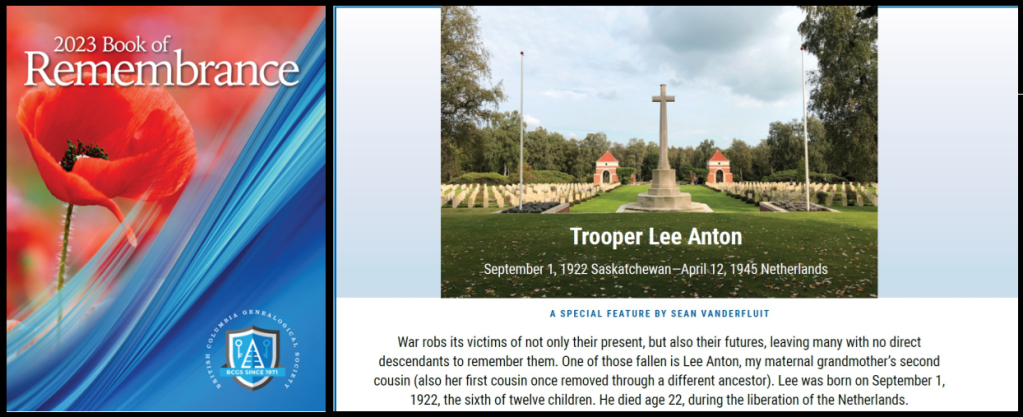
In Week 45 of the 2022 52 Ancestors Challenge, I wrote about my maternal grandmother’s cousin Lee Anton. I also wrote about Lee as one of the Featured Articles for the 2023 Book of Remembrance published by the British Columbia Genealogical Society. With this week’s writing prompt, I’d like to share what I’ve learned since writing these two pieces.

              The cover of the book.                                        Feature about Lee on page 98.

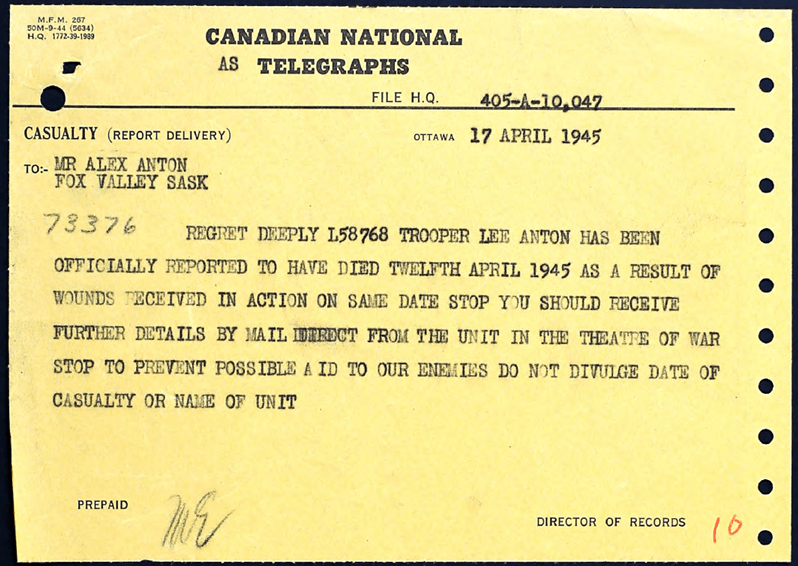
First, to recap, Lee was a Trooper of the 8th Reconnaissance Regiment (14th Canadian Hussars, also known as the 8th Recce) R.C.A.C. Lee was killed in action on April 12, 1945, age 22, less than a month before V-E Day, in the northern part of the Dutch province of Drenthe, the day before the start of the Battle of Groningen. Along with many of Canada’s other fallen soldiers, Lee is memorialized in two very special ways.

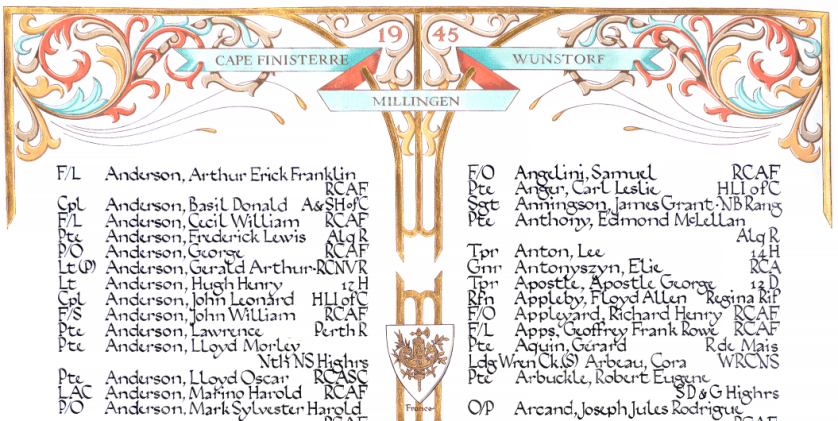
One is through the Second World War Book of Remembrance for the Second World War. Lee is commemorated on page 491.

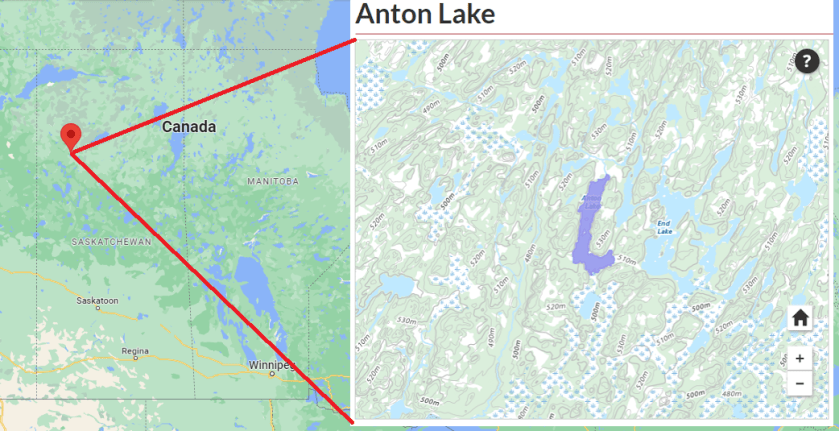
Lee was also memorialized through Saskatchewan’s “Geo-Memorial” program. You can see Anton Lake, which was named after Lee, on Google Maps. This project is documented in the book, Their Names Live on: Remembering Saskatchewan’s Fallen in World War II.

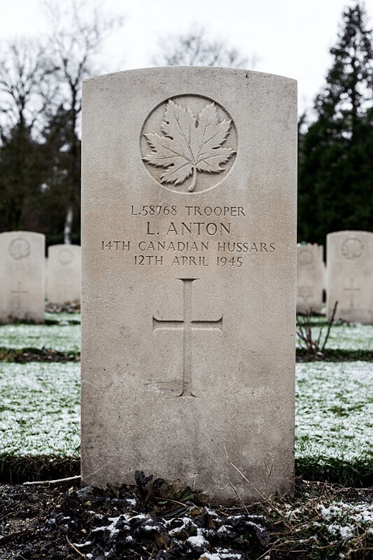
Lee is interred at the Holten Canadian War Cemetery, located just outside of Holten, Overijssel, Netherlands. It is not far from where Lee was killed.

It was only a few weeks ago that the significance of the date on which Lee had been killed dawned on me. April 12, 1945 is the day that Canadian troops liberated Camp Westerbork. It was the transit point where the Nazis gathered Dutch Jews before sending them to the death camps. It was the first place they interred Anne Frank after she and her family were betrayed.

Going through the regimental diaries for Lee’s regiment, I discovered that it was the 8th Recce that liberated the camp, which the Germans had abandoned hours beforehand.

Entry from the War Diary of the 8th Reconnaissance Regiment for April 12, 1945 documenting the liberation of Camp Westerbork.

Based upon the chronology set out in the diaries and other war records, advancing on the camp was the first thing Lee’s regiment did that day. It means that the fighting in which Lee was killed occurred after the camp was liberated. While the entire regiment was not involved, there were at least 100 members of the regiment present at the camp, so there is a good chance that Lee was present for the liberation of Westerbork.

Lee’s grave as seen on Find a Grave

52 Weeks Mark III – Week 7: Immigration

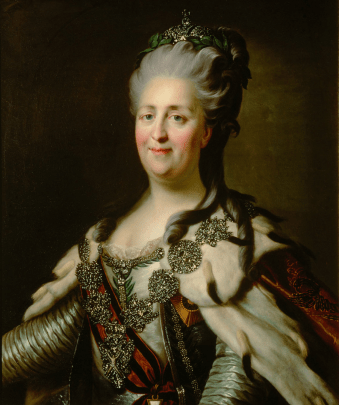
My mother’s maternal line are all Germans from Russia. The Russian Empire expanded significantly during the 18ths century. When Catherine the Great came to power in 1763, she encourage immigration, partly to re-establish farming in regions that had laid fallow during periods of warfare, modernize the country, and to populate regions the Empire had absorbed.

Catherine the Great

Catherine’s manifesto inviting settlers bears some resemblance the homestead schemes introduced in the United States and Canada over a century later.

Among other things, she promised land, free transportation to Russia, and economic incentives (including freedom from taxes for a period of time and interest-free loans for the purchase of equipment). As well, settlers were promised that they could freely practice their religion, retain their language, and be free from military service. The settlers were also promised a degree of self-government.

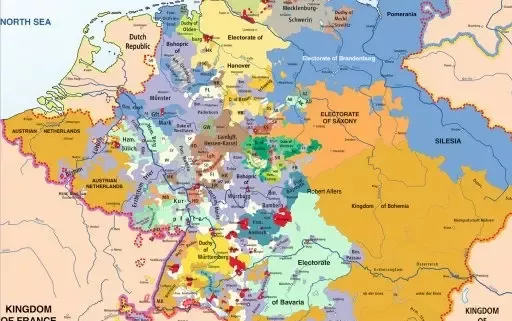
While settlers came from several places in Europe, a majority were Germans. At the time, there was no “Germany”. Rather, the region was primarily composed of a multitude of principalities, dutchies, and other small states. While Catherine’s promises provided a significant pull, economic and political conditions in the German states provided a significant push.

Germany in 1789

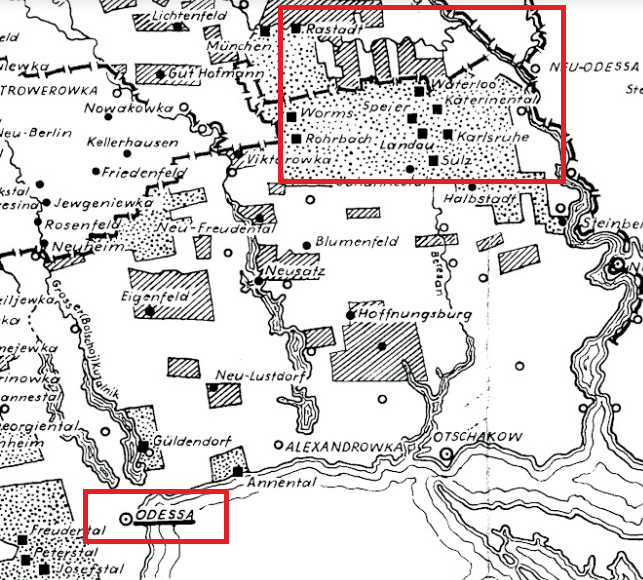
The first wave of settlers formed colonies in the Volga region (“Volga Germans”). The next wave occurred after Catherine’s grandson, Alexander I, issued a similar manifesto with many of the same promises. My ancestors were part of this wave of settlers, who formed colonies in what is now southern Ukraine, particularly in the area north of Odessa (“Black Sea Germans”).

The German colonies in the Beresan district in 1890, as seen in relation to Odessa. All four of my maternal grandmother’s grandparents came from Rastadt and Karlsruhe, located in the upper right-hand corner.

The German colonies were usually composed of members of the same religion. The main colonies were Catholic, Lutheran, and Mennonite. These colonies thrived for decades. However, in 1871, Czar Alexander II repealed the manifestos of Catherine and Alexander I. The German colonists lost many of their privileges. Shortly afterwards, they lost their exemption from military service. The next Czar, Alexander III, took further steps to incorporate the German population into general Russian society, which included discouraging the German language and encroaching on the school system established by the colonists.

Needless to say, this immediately sparked waves of emigration of the German colonists, many of whose families had been in Imperial Russia for decades. Many of these Germans left for the United States and Canada, relocating to the plains stretching from Texas to Saskatchewan. Other colonists left for Argentina and Brazil.

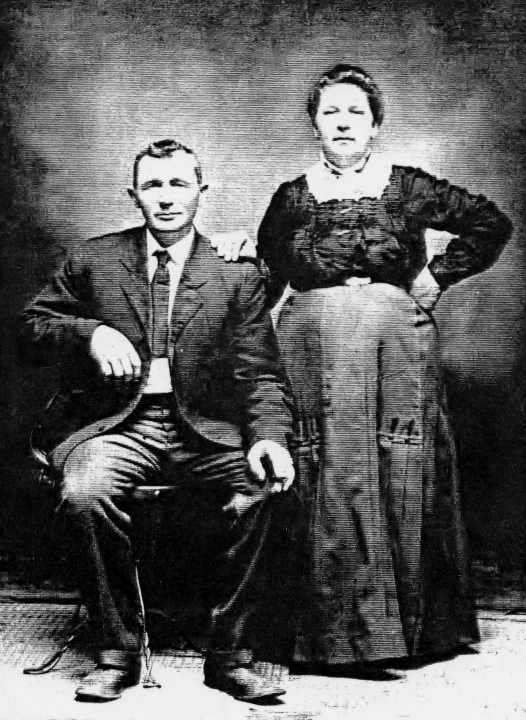
My grandmother’s paternal line originally settled in Texas, starting with my great great grandparents, Michael Lerner and Barbara Schmidt and their six children. They came over in 1893 on the S.S. Lahn, which landed at Ellis Island – less than 18 months after it had opened. Michael and Barbara had six more children after settling in Texas, the first of whom was my great grandfather, Heronimus “Jerome” Lerner. Over time, many of their children relocated to Saskatchewan, including Jerome. Michael and Barbara ultimately made the same move themselves, leaving behind several of their adult children.

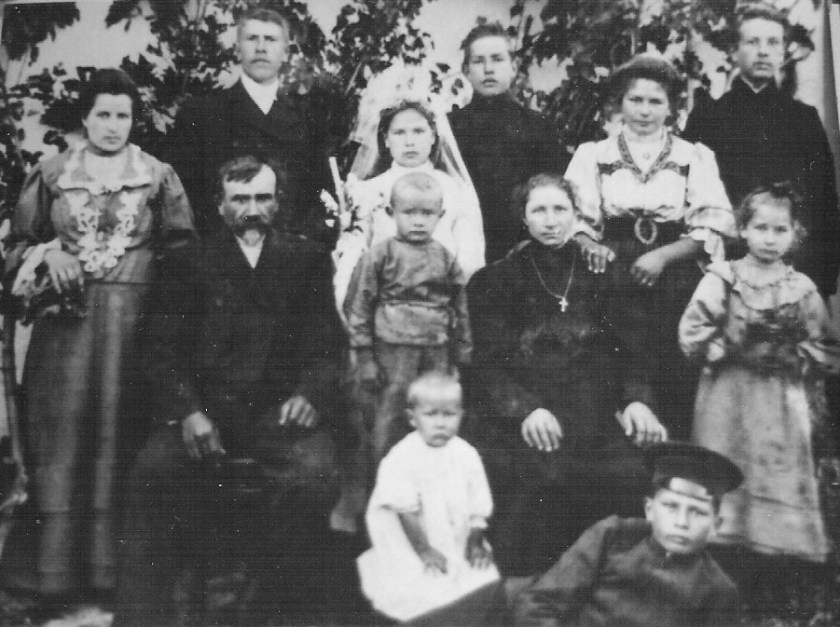
My grandmother’s maternal grandparents,  Jacob Anton and Margaretha “Margaret” Heck, came directly to Canada in 1912 with all their children and settled in Saskatchewan. This included my great grandmother, Emelia Anton, who was nine years old at the time. She lived to be 94 and I knew her well.

The Anton family, circa 1910. Likely taken in Selo Suchoi, Veronesch, Russia. My great grandmother, Emelia, is the little girl standing at the edge of the right side of the photo.

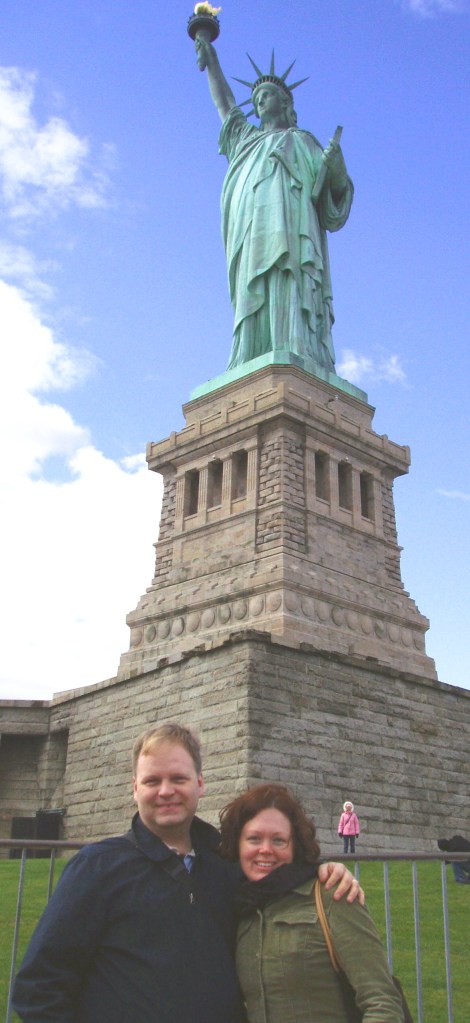
Emelia had not had much schooling before coming to North America, but was very religious. She said that she was frightened and nervous during the journey, as she did not know anything about where she was going and did not fully understand what was going on. However, on reaching New York, she said her fears subsided when she saw “the Madonna”. When she saw that, she knew she would be safe and all would be well. Of course, the “Madonna” was the Statue of Liberty. As she had never heard of it before, she thought it was a statue of the Virgin Mary.

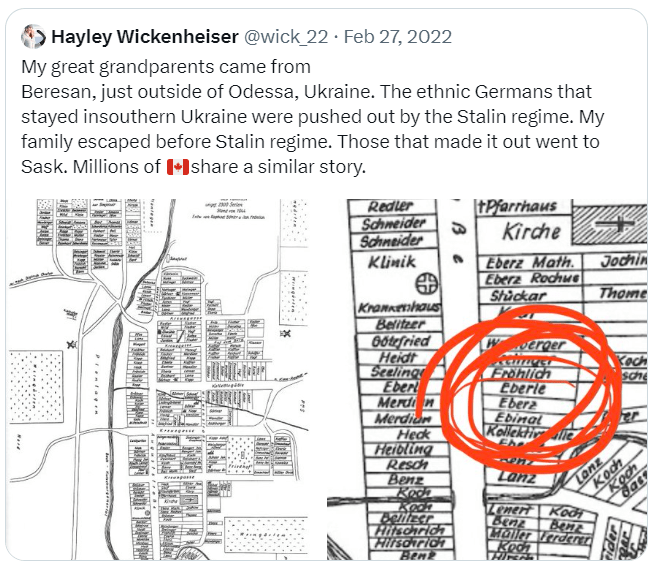
There are many well-known descendants of the Germans from Russia. They include Lawrence Welk, who married my grandmother’s fourth cousin. While I am generally disinterested in celebrity, I was excited to learn that Hayley Wickenheiser is a descendant of Germans from Russia. Her great grandparents lived in Rastadt, where Mike and Barbara had lived before emigrating. However, her family was there decades after mine left, as the did not leave until they fled Stalin’s regime.

52W Mark II – Week 45: War and Peace

With Remembrance Day (Veteran’s Day in the United States), this week’s 52 Ancestors Challenge theme is “War and Peace”. Rather than write about my own ancestors’ experiences with war and peace, I’d like to call attention to an exciting undertaking by the British Columbia Genealogical Society (“BCGS”).

Every month the BCGS publishes The BCGS News. For the last few years, it has been only published in electronic format. Every issue since January 2020 is available on the BCGS website. You don’t have to be a member of the society to access this part of the website (although there’s lots of benefits to be one – they just launched their 2024 membership drive!).

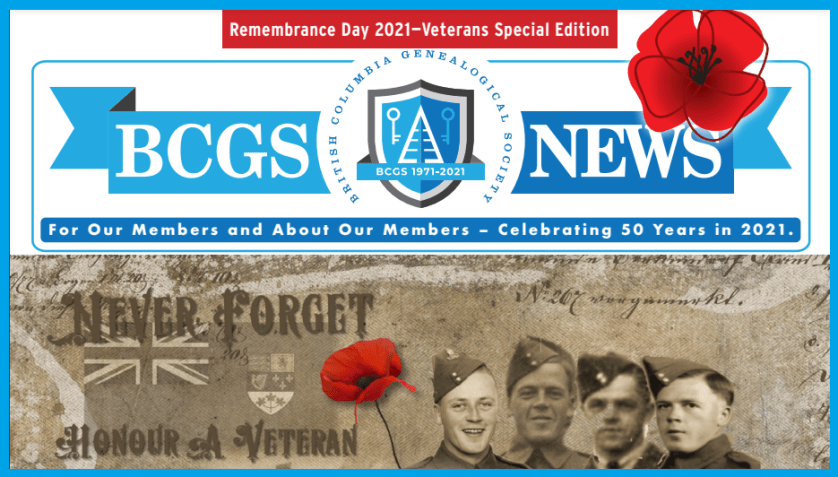
In November 2021, the BCGS published a “Veterans Special Edition” of The BCGS News. Members were invited to submit stories about their veteran ancestors, regardless of what conflict in which they had served. Submissions included veterans of the American Revolution, the War of 1812, the Lower Canada Rebellion, the North-West (Riel) Rebellion, the Fenian Raids, the South African War (often referred to as the Second Boer War), World War I, World War II, and the Korean Conflict.

This year, The BCGS News team (spearheaded by its Editor/Designer Sue Sullivan) is going even bigger and better – they’re doing a book! Throughout most of 2023, BCGS members have been encouraged to submit stories and photos of their veteran ancestors – any time in history, any conflict, any place. Moreover, it’s not limited to those who actually fought, it includes those who served in peacetime or on any peacekeeping mission.

The book will be available to BCGS members as a digital download. The editorial team is also considering publishing it in print form, but that has yet to be determined.

Remarkably, I have very few ancestors who served in wartime. They were usually too young or too old to have served in the conflicts of their time and place. However, I provided two submissions for the veterans book, both of which involve individuals I’ve written about in this blog: my maternal grandfather Leo Burgess; and Lee Anton, my maternal grandmother’s second cousin (also her first cousin once removed through a different ancestor). The editor invited me to submit a larger piece on Lee, as she hopes to have a few “featured” veterans.

Lee Anton commemorated on page 491 of the Second World War Book of Remembrance.
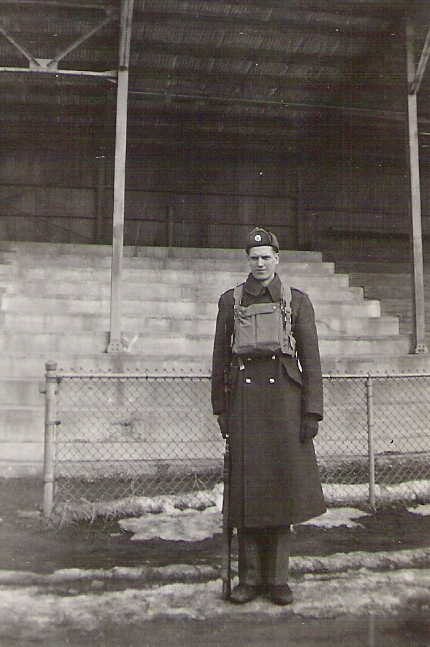
My maternal grandfather Leo Burgess during basic training in Peterborough Ontario.

Hopefully the book will be ready by Remembrance Day. I know that it has been a huge undertaking by a small band of volunteers, so it would be understandable if it comes out sometime later this month. Either way, I am really looking forward to it!