52 Weeks – Week 35: Free Space

Beginner’s luck! The first time my wife joined me and my parents at bingo, she won several hundred dollars.

With the theme of “Free Space” for this week’s 52 Ancestors Challenge, I can’t help but think of bingo. Bingo was a big part of my mother’s side of the family. Moreover, bingo is one of the many games that are a huge part of both sides of my family.

Cards were, and remain, a huge part of our extended family’s gaming traditions. As you may recall if you have been with this blog since the beginning, part of the inspiration for its name was my family’s affinity for cards.

My maternal grandmother, Helen Lerner, and her mother, Emelia Anton, were both bridge players. Into her 90s, my great grandmother took great pride in the fact she still had the mental acuity for the game, but complained that her peers were getting too slow for her. Bridge is the one card game that has eluded me. I just never developed an interest in it and, despite my familiarity with many other card games, it still strikes me as unnecessarily convoluted.

However, there were a myriad of other card games that always seemed to be at play. Canasta, Oh Hell, Smear, and Hearts were frequent games of choice on my mother’s side of the family, while huge group games of Crazy 8s were popular with my paternal grandparents and my father’s siblings. Most Christmases, my siblings and I usually converge at my parents. In addition to the extended family who drop in during the holidays, our spouses have also become part of the card-playing tradition. Almost every evening there is a card game that goes into the wee hours of the night.

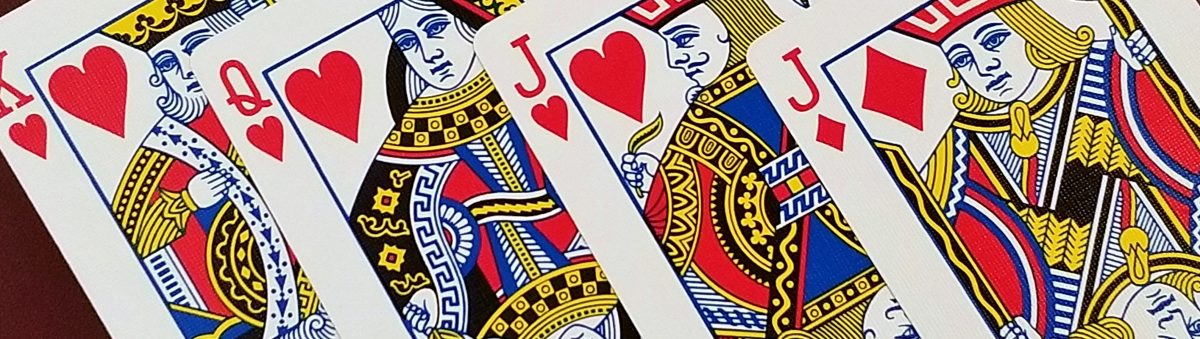
After decades of playing crib, of course it’s the day I teach the game to my eldest that I got dealt a hand like this.

The king of games with my maternal grandfather, Leo Burgess, was cribbage. When I was little, I was mesmerized by the cadence of the game and the cryptic chanting involving the counting of fifteens. My grandfather and my father taught me how to play when I was seven or eight, and I still play to this day.

My grandfather was a real stickler for the way people played cards. There were all sorts of arcane rules, traditions, and habits that had to be followed. Heaven help you if you cut the deck the wrong way. I still wince whenever one of his customs are breached, despite the fact my grandfather died over 25 years ago. Even worse was if you dared take “his” trick or – god forbid – you beat him at a game. In my case, there was little risk of that happening. I happen to be a good crib player, but my grandfather often seemed unbeatable.

The last day I spent with my grandfather, about a month before he passed away, was spent playing crib and watching The Price is Right. It was clear my grandfather’s advancing age and deteriorating health was starting to affect him, because out of the score of games we played that day, I managed to beat him twice. My grandfather was such an avid card player that – don’t tell anyone – my mother and uncle slipped a fresh deck of cards in the pocket of the suit he was buried in.

It seems that the only time I play Rummikub is when I visit family in Holland.

Board games were – and remain – popular as well. One of my uncles had a collection of now-obscure games that we nibblings enjoyed playing, even though we didn’t know the rules or have all the pieces. Nothing made us feel more like a big kid when our parents invited us to play a board game, such as Stock Ticker, with them. Board games were a common birthday and Christmas gift. With five kids in my family, we had a lot of Board games! I still have some of them, although it seems one of my brothers absconded with a lot of them.

Our sons are also very keen on board games, and do well with games that one might think are well above their age level. Hardly a weekend goes by in our house without several games being played. It is also common for us to play on some weeknights as well.

We love board and card games in our family. These are but a few of the games we have.

Before ending this examination of our family’s tradition of game play, I return to the game of bingo. It was extremely popular on my mother’s side of the family. My mother’s parents, aunts, and grandmother were all devoted bingo players. I remember the first time I got to go to bingo with my mother, two of her aunts, and my grandmother. My great grandmother might have been there that same evening. As I was in my teens, I definitely threw off the demographic curve of the crowd in the bingo hall. While the majority of the crowd in attendance that night struck me as rather old, they were amazingly spritely and quick with their cards. The speed at which my great aunts and grandmother marked the many cards they each were playing at one time. I found it difficult enough to keep up with the few cards I was playing each time.

My maternal grandfather also loved playing bingo and often went with my grandmother. My grandmother passed away in her early 60s, so after she died my grandfather would often go with my great grandmother. The two of them seemed to squabble quite often and my grandfather once complained about being in his 70s but still having mother-in-law problems. Nevertheless, he and my great grandmother shared their love of bingo. In fact, my grandfather passed away while doing something he loved, while out one night playing bingo with his younger brother.

With a long weekend coming up, I expect that we will be playing a lot of board games over the next many days!

Addendum: Clearly I’ve generated a lot of content in 35 weeks that I’ve already forgotten about. A week after posting this, I discovered I had already written about this on Week 18 (Social), albeit in less detail. C’est la vie!

Further Addendum: Every week, Amy Crow Johnson sends an email summarizing two or three items that have caught her eye, along with a description of the next week’s 52 Ancestors theme. In her email looking back at Week 35, Amy highlighted this post, saying “Sean shared how much his family has enjoyed card games and board games over the years. (I have to admit that I was secretly hoping someone would write about bingo. My mom used to be an avid player, and my family has a Christmas bingo party every year!)”

52 Weeks – Week 30: Teams

Maybe it’s the fact it’s been a long hard couple of weeks, maybe it’s the heat, or maybe it’s the lack of a spark of an idea, but I just don’t have much left in the tank for this week’s 52 Ancestors Challenge. Which might be a good thing – nothing wrong with a short snapper of a post to add some variety to the long posts I usually write.

This week’s theme is “teams”. I decided not to go for the most literal take on it. Instead, I’ll go with the fact my great great grandfather, Horace Burgess, was listed in the 1880 census as a teamster.

1880 United States census, Utah Territory, Utah County, Goshen Precinct, Enumeration District 35, page 3.

By 1890, Horace was in Wyoming, where his occupation was “freighter”, a related occupation related to cattle work.

1890 United States census, Wyoming, Precinct Pacific, Enumeration District 30, Fremont County

See you next week!

52 Weeks – Week 28: Characters

This week’s 52 Ancestors Challenge theme is “Characters”. While that actually provides a wide scope, the inclination might be to write about an ancestor who had a big personality or was quite the extrovert. I’ve decided to write about an ancestor who most likely needed quite a bit of character to have endured what life sent her way.

One of my Gx3 grandmothers was Charlotte Elizabeth Liggett. Charlotte was born on October 2 or 6, 1837, to Conrad Liggett and Louisa Thomas. According to some sources, Charlotte was born born in Dover Township, Union County, Ohio, although most other accounts say it was Ostrander, Delaware, Ohio. While in different counties, these communities are about five kilometers apart.

Charlotte Elizabeth Liggett

Conrad and Louisa married on February 28, 1837. Unfortunately, Conrad died shortly after Charlotte was born. I have been unable to find definitive sources as to when and where he actually died, although it is likely that it occurred in April 1838. Several sources suggest he died at Nauvoo, Illinois sometime before 1839. However, the Latter Day Saints (Mormons), of which he was likely a member, did not really begin to settle in Nauvoo until after they were expelled from Missouri in late 1838. It may be that Conrad himself never left Ohio. According to Find a Grave, Conrad is buried in Ohio, although there is always the possibility that his remains were transported to Ohio after his death.

Louisa remarried in 1841, to Aaron Cook. This marriage may have occurred in Nauvoo. With the Mormons being driven out of Nauvoo starting in 1846, Louisa, Aaron, and Charlotte set out in the westward migration to what is now Utah. The migration, undertaken in haste and without time for proper preparations, was arduous. On the way to Winter Quarters in Nebraska, in November 1846, Louisa died. Charlotte had just turned nine.

After time spent at Winter Quarters, Aaron continued to Utah with Charlotte. According to one family history I’ve read, upon reaching Utah Aaron, he “married Charlotte off” to a Mormon elder. That was likely a reference to Charlotte’s first husband, my Gx3 grandfather, William Burgess. The marriage occurred on June 3, 1852, when William was 30 and Charlotte was only 14. Even worse, this was a polygamous marriage, as William was still married to his first wife of 12 years, Maria Pulsipher.

The marriage did not last long. Fortunately for me, it lasted long enough to produce one child, my Gx2 grandfather, Horace Burgess. Apparently Charlotte did not get along with Maria. Charlotte left William sometime in 1857, when she was 19. Many secondary sources suggest that William and Charlotte divorced. However, being a polygamous marriage, there may have been no formal civil registration of the marriage and, therefore, no formal divorce. While at the time of their marriage William and Charlotte had been “sealed” (a Mormon ritual meant to bind familial relationships for eternity), Charlotte had the sealing annulled in 1890.

Shortly after leaving her first husband, Charlotte entered into her second marriage, with William Whitehead Taylor, on September 7, 1857. This was also a polygamous marriage, and at age 28, William was almost 10 years older than Charlotte.

While Charlotte’s early life may have been difficult, it may have been much less onerous after she joined with William. It appears that they remained together for 50 years, until William passed away in 1907. Charlotte and William were never sealed during their lifetimes, as a bishop had told Charlotte that she could not be sealed again. Apparently they were sealed after Charlotte’s death, as it was her “dying wish”.

The Salt Lake Tribune, April 25, 1908, Page 11

Charlotte and William had four children. It appears their second child, Louisa, may have died in infancy or childhood. Their eldest, Sarah, died at age 49, when Charlotte was 70. There was a small amount of notoriety in the press when Sarah died. She was married twice. The first marriage was to Prime Evans. The second marriage was with a J. M. Tanner. However, this was not a legal marriage. According to newspaper reports at the time of Sarah’s death, this was a secret polygamous marriage, solemnized within the church after polygamy was outlawed. Tanner had been named executor of Sarah’s will and guardian of children Sarah had adopted (young relatives of hers). However, he ultimately declined to act in either role, likely because of the scandalous nature of his relationship with Sarah.

Charlotte died at home in Lehi, Utah on February 20, 1909 due to apoplexy, a term formerly describing a cerebral hemorrhage or stroke. Charlotte is interred at Lehi City Cemetery, with her second husband.

Charlotte’s Death Certificate

52 Weeks – Week 22: Conflict

My grandfather during basic training when he first enlisted during WWII. One of these men was responsible for a “prank” that resulted in my grandfather’s back injury.
I definitely needed one of these this week.

This week’s theme for the 52 Ancestors Challenge, is “Conflict”. I knew right away what I wanted to write about: the fight by my maternal grandfather, Leo Burgess, for his military disability pension. Unfortunately, it has been exceptionally busy at home this week, so I only got to this today.

I have always found the records to be fascinating, because they read quite like a workers’ compensation claim, except in a military context. The records are rather detailed, and include both the legal and medical records that were part of the process. They also included far too much personal information about my grandfather’s personal life, going beyond what was necessary for the adjudicators to decide the issue. Nothing scandalous or unsavoury, just things you really don’t want to think about. As our 11-year-old says when there’s anything remotely romantic in a TV show or movie: ew.

My grandfather’s attestation paper and other military records from the short time he spent in the army during World War II.

My grandfather’s military service and his injury were often-told tales, which is largely reflected what I found in his military records. My grandfather actually enlisted twice during World War II. The family story is that my grandfather was injured during basic training, due to a prank pulled by a bunkmate. A couple of months after he was discharged, my grandfather enlisted again. The family story is that he decided to re-enlist after a “robust” night on the town with his buddy. It wasn’t until after he was well into basic training the second time that the military seemed to discover that they had already discharged my grandfather once before, and decided to discharge him again.

Now, to the record. Both times, my grandfather was enlisted as a private. He first enlisted in July 1941. Upon enlistment, he was assigned to the 6th Division Petrol Company Royal Canadian Army Service Corps and posted to #13 District Depot in Calgary. However, he was admitted hospital in August 1941 due to appendicitis.

My grandfather during basic training in Peterborough Ontario.

Leo was in hospital until mid-September 1941, but was on sick leave for most of the rest of the year. On December 6, 1941, he arrived at the No. 32 Canadian Army (Basic) Training Centre in Peterborough, Ontario. Later that month, he was indeed injured due to a prank by one of his bunkmates.

If the family anecdotes are correct, this is an accurate depiction of my grandfather’s wartime injury.

According to my grandfather and the witness statement of another soldier, my grandfather had the top bunk of the bed. The man below him thought it was funny to use his legs to push the bunk above as a way to wake my grandfather up in the morning. The man pushed too hard, causing my grandfather to be ejected from his bed, injuring his back. My grandfather’s evidence and the medical records say that subsequent to this incident, his back condition worsened in the course of basic training

By mid-January 1942, my grandfather was in the hospital due to his back condition. He spent time at military hospitals in Peterborough and Kingston until March 1942, when he entered physical rehabilitation. The military discharged my grandfather due to his disability at that time, and he returned to Calgary.

My grandfather enlisted a second time in July 1942. While the family story is that the military didn’t know at the time that my grandfather had already enrolled and been discharged, the records are not so clear. At least one document refers to “re-enlistment”, so it may be that my grandfather’s prior service was not such a surprise to the army.

During his second enlistment, my grandfather was sent to the Canadian Army (Basic) Training Centre No. 133 in Alberta. He did not complete his training as he was discharged as he was “unable to meet the required Military Physical Standards”.

My grandfather with his parents, Hazel (née Nelson) and Milton Burgess.

The pension records I have do not tell the whole story. At every level of adjudication, the military had denied my grandfather a disability pension. My grandfather was about 6’4” or 6’5”. Veterans Affairs took the position that my grandfather’s back problems had been due to his height and were not aggravated by his duties during basic training. The documents I have are the statement of claim and a 20 page summary of evidence for what was likely the last level of appeal. I do not know if he was successful, although I do know he was in receipt of some form of military pension after he retired from his career with the Canadian Pacific Railway.

Despite his short and interrupted service, my grandfather was awarded the Canadian Volunteer Service Medal (CVSM), which was established on October 22, 1943 and issued in recognition of eighteen months of voluntary service in the Canadian Forces. The medal was granted upon honourable discharge to any service member of any rank who served on Active Service from September 1939 to March 1947. Leo was also granted the War Service Badge – General Service, awarded to members of the Canadian military who served in the military forces on active service during WWII and who honourably ceased to serve on active service by reason of physical disability.

Some of the documents from my grandfather’s pension appeal.