Egad, I almost ghosted this week’s 52 Ancestors Challenge, themed “Spirits”. I thought I had done this a week ago, but it turns out I only did so in my mind.
Initially I had hoped to take the theme in a more libatious direction and share an anecdote involving jenever, a Dutch liquor that is the forefather of gin. Unfortunately, once I began to write it, it became apparent that it was a rather boo-ring story.
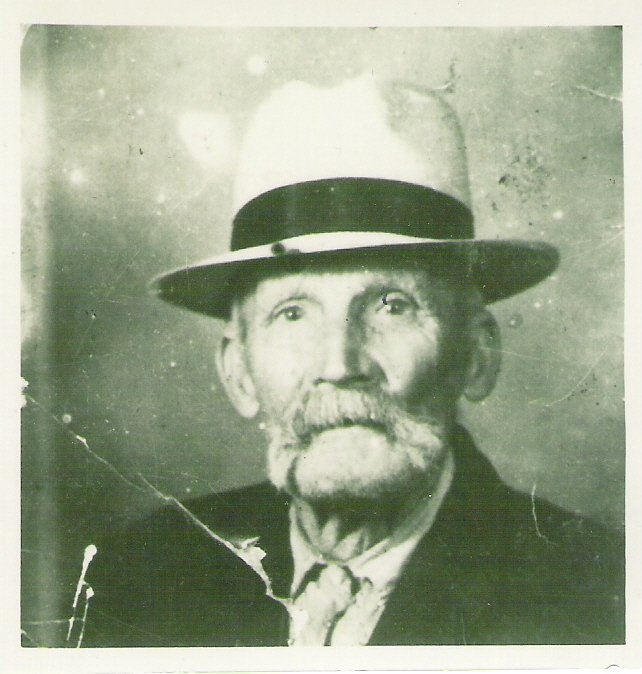
John A. Nelson
Thus I have turned to this well-worn oft-repeated anecdote about my great great grandfather, John A. Nelson (1854-1942), that I’ve seen innumerable times over the last thirty years. It’s attributed to his son Seth Henry Nelson (my mother’s great uncle, who I wrote about on Week 8 in 2022). While I’ve seen countless copies of it, I’ve never seen anything its provenance or that could be described as the original.
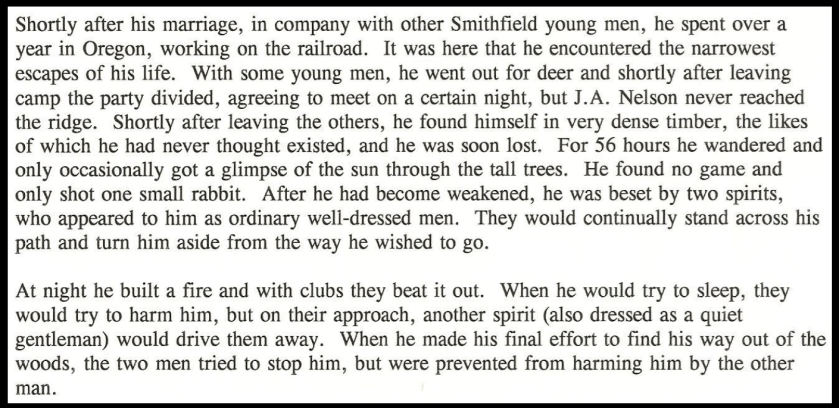
The tale relates to John’s encounter with two malevolent spirts and a third that may have been his protector. I’ll share it as written:
Needless to say, I don’t believe a word of it. Its greatest value may be that it tells me something I otherwise wouldn’t have known about John: he spent a year in Oregon working on the railroad. The only question is when.
The anecdote indicates that John was in Oregon for over a year shortly after his marriage to my great great grandmother, Ella Elizabeth Thomas, which occurred on January 9, 1879. Their first child, Maria (“Mimie”), was born in March 1880, so John did not leave for Oregon any earlier than June or July 1879. John and Ella’s second child, Ella, was born more than two years after Mimie, in June 1882. If John was away from home for more than a year shortly after marrying Ella, it could have occurred anywhere between late summer 1979 and the summer of 1881. However, without further evidence, I don’t have a ghost of a chance of figuring it out.
I’ve only been to one family reunion, when I was 13. It was a gathering of all the descendants of John Alexander Nelson and Ella Elizabeth Thomas, my great great grandparents.
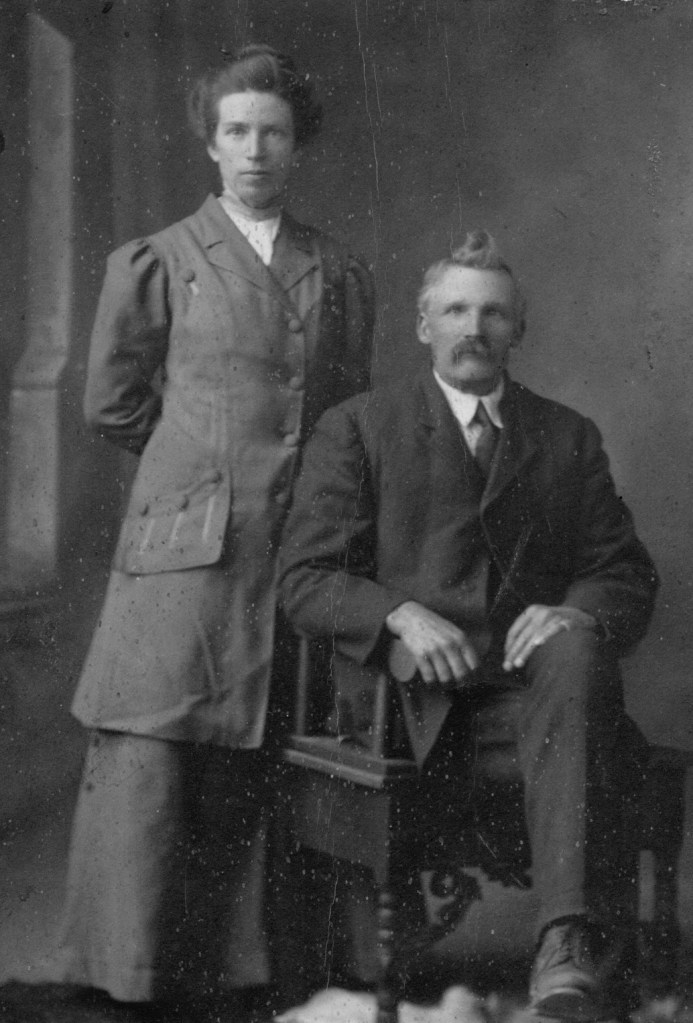
Ella Elizabeth Thomas (1859 – 1941) John Alexander Nelson (1854 – 1942)
They were amongst the earliest settlers of Cardston, which was founded in 1887 by members of the Latter Day Saints (Mormons). John and Ella were both born in Utah a few short years after it became a territory of the United States. John was born in 1854 to Irish immigrant parents. Ella was born in 1859. Her father was originally from North Carolina and her mother was from England. John had worked as a farm labourer in Utah before he married. John and Ella married in Salt Lake City in 1879. Shortly afterwards, John and Ella moved to Smithfield, Utah, where John continued to work in farming.
John and Ella came to Canada in September 1890. John and Ella had five children at the time. The family travelled to Canada by covered wagon. Their eldest daughter, Maria, said that she often drove the wagon team while her father managed the cattle. The family first settled in a sod dugout at “Lee’s Creek”, west of Cardston. They arrived with 13 horses, 7 cows, 7 “other horned cattle”, and a pig.
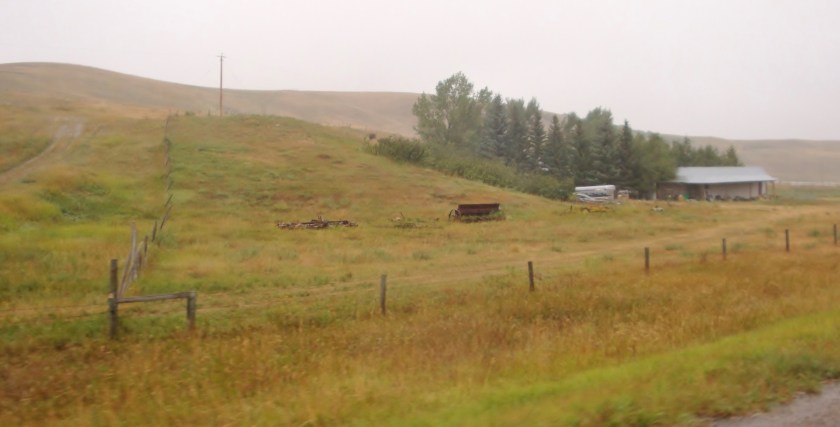
This was where John and Ella first settled in Canada, just west of Cardston, where the prairies meet the foothills of the Rockies.
The book, Alberta Past and Present, states that upon moving to Canada, John homesteaded on 160 acres of raw land. The homestead was located on Lee Creek, which ran through the property and into the centre of Cardston. The farmhouse was about four kilometers southwest of the town centre and is located on what is now Alberta highway 501.
In addition to farming, John also worked in carpentry. As well, John and a partner, John Turner, constructed and operated the first lime kiln in this part of the country. In 1906, John and Ella moved to nearby Woolford, Alberta, where John continued farming. John and Ella briefly returned to Utah in the early 1920s, where John operated an orchard or fruit farm, but they returned to Woolford in 1924. John continued farming the rest of his working life.
Ella did not simply bide her time in the background as a farm wife and mother. According to a Lethbridge Herald article published after her death, in 1892 Charles Ora Card, Cardston’s founder and stake president, called to on Ella to study nursing and obstetrics. After six months’ training, Ella returned to Cardston and started her service. The Herald article says that Ella “answered every call from 1892 to the time when the district was supplied with medical men, and after that time when there was more work than one doctor could do”. Ella continued as a midwife until 1932, when she was 73.
John and Ella had twelve children, two of whom died in infancy. This included my great grandmother, Hazel Nelson, and her twin sister, Irene, who died at one month old. Ella died in October 1941. John died almost a year later, in September 1942.
The reunion was quite an interesting experience for me. The reunion was held in Bigfork, Montana, with attendees from the United States and Canada. At the time, I knew I had American ancestors, but did not realize how large an extended family I had that lived there. A memorable highlight for me was some of my mother’s American cousins hiring me to babysit for them one night – and paying me in American dollars.
Another interesting part of the experience was that our immediate family, and my maternal grandmother, were pretty much the only attendees who were not members of the The Church of Jesus Christ of Latter-day Saints (Mormon) church. While my maternal grandfather Leo Burgess was Mormon, he was no longer an active participant in the church during my childhood, so at the time I knew little about their church, customs, and traditions. In my late teens my grandfather began participating more in the church, which is when I learned much more about them.
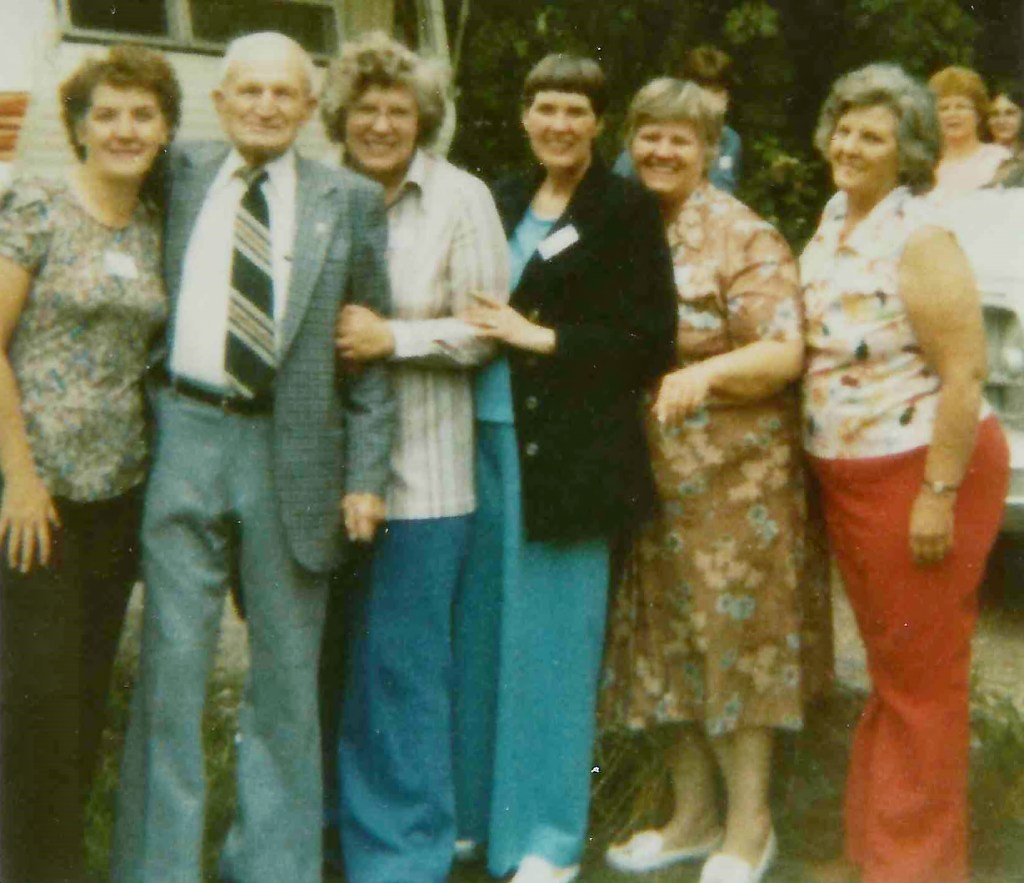
The only photo I have scanned of the Nelson family reunion. This is Cleveland Nelson (1893-1982) with four of my maternal grandfather’s aunts (Cleve’s nieces). From left to right: Fon, Cleve, Julia, Ella, Molly, and Irene. In the background on the right you can see my mother.
The star of the reunion was my great great uncle Cleveland Nelson. Cleve was John and Ella’s eighth-born and last surviving child. He was 87 years old at the time. Everyone wanted to talk to and get a photo with him!
Last week, on June 1, 2023, the Library and Archives Canada released the 1931 Canadian census. The site was overwhelmed at first, but now it seems to be operating without any problems. As of now, the LAC only has the raw images, in that they are not indexed. You can search the images by Province, District, and Sub-District. Fortunately, I knew where to look for many of my ancestors and found them without any problem.
The Library and Archives Canada page for the 1931 Canadian Census on June 1, 2023
Yesterday, Ancestry Canada went live with a searchable indexed version of the 1931 census. It enabled me to find some of my more elusive family members, particularly some of those in urban areas for whose sub-districts I could not quite identify.
Both the LAC and Ancestry.ca allow you to download census records in jpg format. The LAC also allows you to download entire sub-district files in pdf format. What I’ve done is download both versions. For the pdf version, I’ve used the “print to pdf” function to create a file for the single page I am interested in.
I save the single page with my family members with a unique file name, using the system I established for myself many years ago.
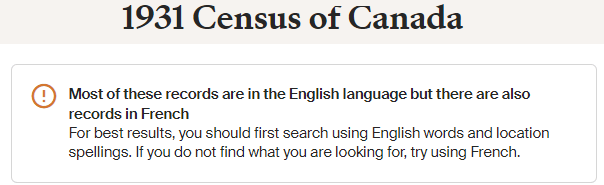
The LAC website seems to be better set up for those who are searching in French, looking for francophone ancestors. For now, Ancestry recommends searching first in English and then again in French if the initial search was unsuccessful.
So far, the biggest surprise was learning that my great aunt (who’s still alive) is a year older than I thought she was. The census was taken on June 1, 1931. Everything I had so far indicated that my aunt was born in October 1931, which was after the census was taken, so she shouldn’t have been there. However, the entry for my great grandparent’s family includes my great aunt, saying that she was 8 months old at the time. This means she would have been born in October 1930.
My mother’s maternal grandparents, and her mother Helen. My great grandparents separated later in life. I don’t have an exact date, but the fact they’re still together here is consistent with my theory that they separated around 1937. I guess I’ll have more evidence in 5 years, when the 1936 prairie census come out, and more in 10 years, when the 1941 census comes out.
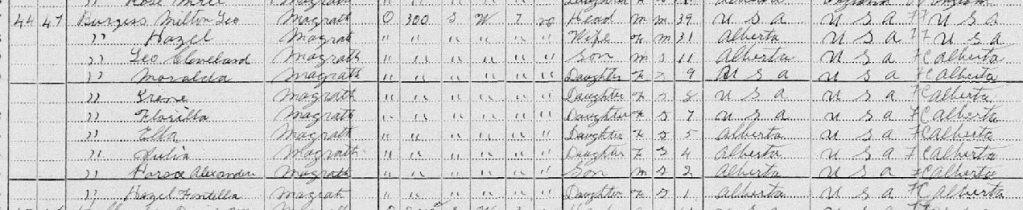
This is the second census in which my maternal grandfather, Leo Burgess, appears. I see the enumerator was much more careful than his predecessor who prepared his entry for the 1921 census, which for some bizarre reason stated my grandfather was Dutch. Wrong grandfather.
This census includes my grandfather and all his siblings, other than his youngest brother Ralph, who was born in 1935. His youngest sister, Fon, (seen here as Hazel Fontella), was an avid genealogist. She missed being able to see herself her by 18 months.
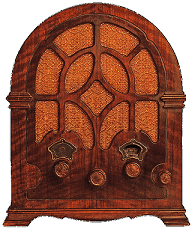
One of the most interesting things about the 1931 census was that it asked whether the household owned a radio. It was no surprise to me that neither of my grandparents’ families owned a radio. However, I was surprised to see that another member of the extended family, who was very successful and well-off, did not. My suspicion was that he was not interested in such new-fangled things like radios.
This week’s 52 Ancestors challenge is about one of genealogy’s biggest challenges: brick walls. These are the ancestors we can’t get past – we’ve been blocked in our ability to learn more about them or those who came before them. More often than not, brick walls involve ancestors we may have spent years or even decades researching, to no avail.
Who is Annie Pitre?
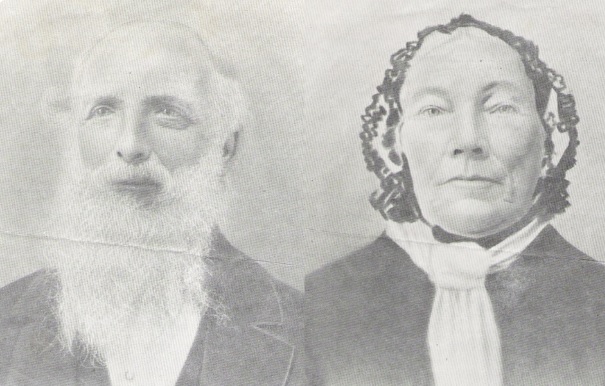
This week will be a rare foray into my wife’s side of the family. Before doing so, I want to share the brick wall in my ancestry that I’ve been banging up against for decades: my great x3 grandparents, Robert Nelson and Elizabeth Joseph. I’ve been trying to crack these two since the mid-90s. I know a lot about them after they left Ireland, but precious little about before they emigrated. It doesn’t help that this a prime example of a lot of people copying incorrect trees and sharing the information as if it’s correct. It also doesn’t help that my own family – some of them family historians – perpetuate the myths and legends about them that simply aren’t true or are contrary to what little evidence there is.
Robert Nelson (1818 – 1902) and Elizabeth Joseph (1818 – 1902)
Turning to my wife’s side of the family, the brick wall I’ve been trying to break down for almost 15 years is that of Ann (“Annie”) Pitre, my children’s great x3 grandmother. I don’t even know if that is her real name, it could be Peters. It’s also likely that her ancestors were Pitre and the name was anglicized somewhere along the way.
One of my prime sources of information about Annie came from my wife’s grandmother, L. Annie was her maternal grandmother. While L would have been 24 when her grandmother passed away, she acknowledged that her recollection of her maternal grandparents may have been inaccurate. L told me that Annie’s surname at birth was Pitre and that she was possibly born in Rustico, Prince Edward Island. Baptism indexes for several of Annie’s children list her surname at birth as “Pitre”, but others provide the surname “Peters”.
Based upon cemetery records, it would seem that Annie was born on March 25, 1857. However, census records are inconsistent regarding Annie’s date of birth. None of them support 1857 as her year of birth:
1881
1891
1901
1911
Age 29 (b. 1852)
Age 38 (b. 1853)
Age 45 (born 25 March 1856)
Age 56 (born June 1854)
I haven’t been able to find Annie in the 1921 census. The 1931 census will be released in two weeks – hopefully I will find her there.
All four censuses say that Annie was born in PEI. The 1901 and 1911 censuses state Annie was “French”. This is consistent with the fact Rustico had a large Acadian population. This would fit with the possibility Lillian’s grandmother was born in Rustico, where there was a significant French Canadian population. The 1901 census states that Annie’s mother tongue was English and that she was unable to speak French. However, the 1881 census records Annie as “Irish”. The 1891 census had a stroke through the box for “French Canadian”, as does everyone else on the page. The 1891 census notes that Annie’s father was born in PEI but her mother was born in Ireland.
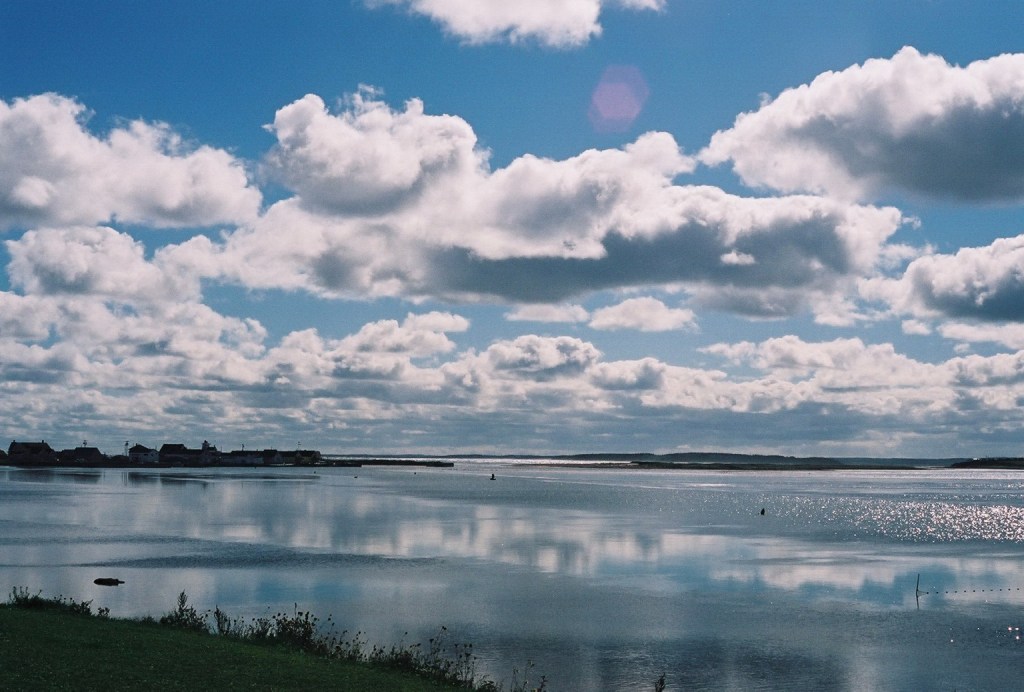
North Rustico Bay, Prince Edward Island
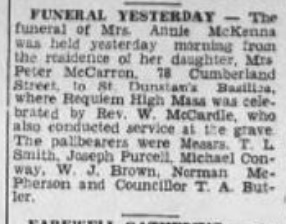
Annie married Patrick McKenna (1839 – 1914) sometime before 1873. I have yet to find any record of the marriage. The most certain facts I have relate to her death and burial.
Charlottetown Guardian, January 17, 1941, page 6.
I’ve chased down many trails, gone down many paths, reviewed many records, checked many newspapers, and ordered many inter-library loans, among other things. I’ve even employed my rusty French scouring Acadian-related sources. Luckily, my wife is fluently bilingual and has helped me with those, as has our eldest child, whose French is very good and who is a budding genealogist himself. Many promising leads came to nothing, but hope springs eternal.



 A Deck of Ancestors