Twelve weeks of genealogy, my true love gave to me: the theme “Joined Together” for the 52 Ancestors Challenge. Rather than a lot of discussion, I thought this week I’d post photos of some of the couples whose unions ultimately resulted in…me!
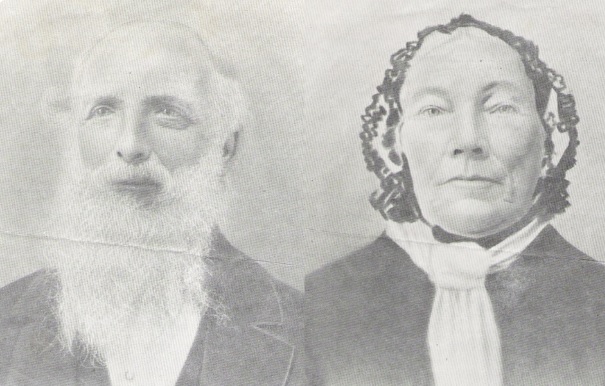
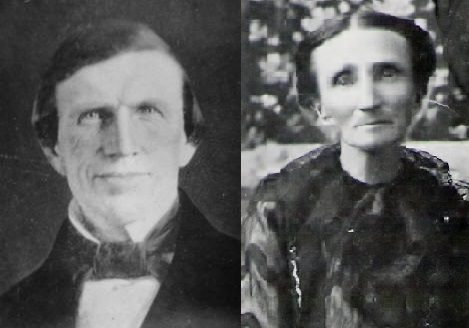
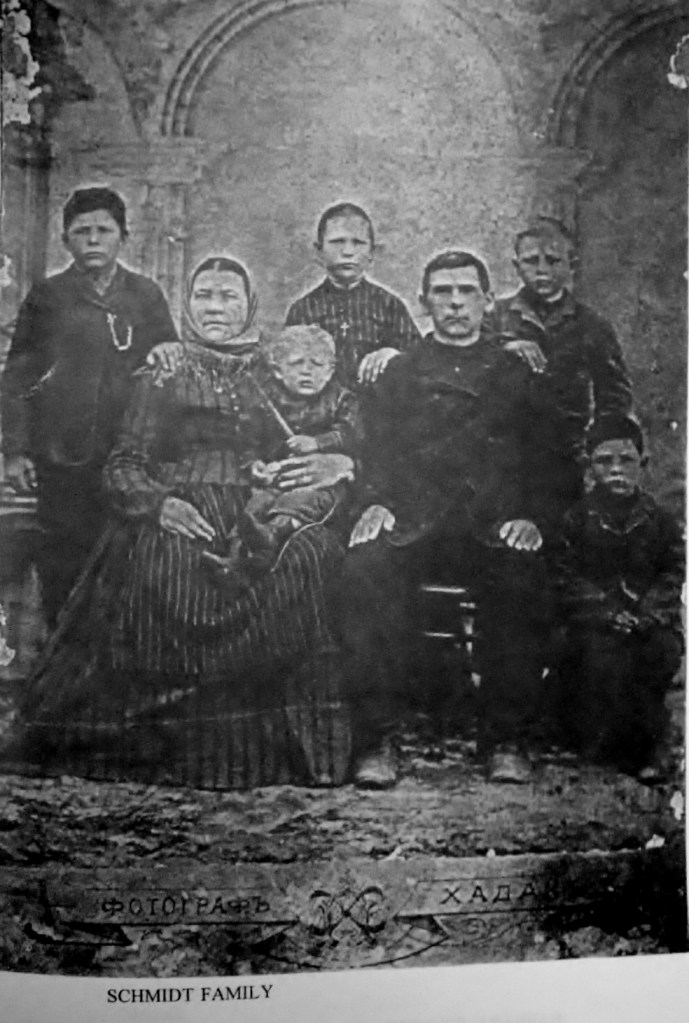
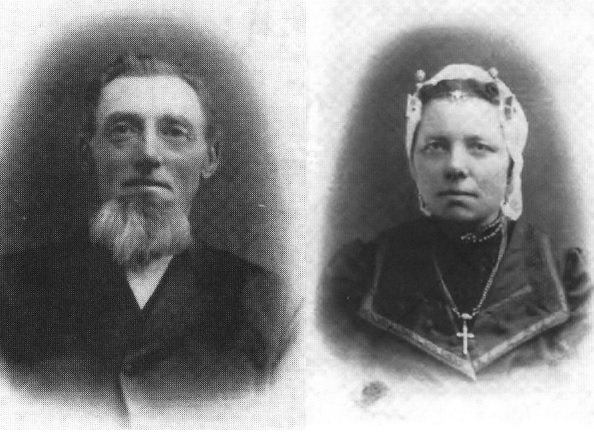
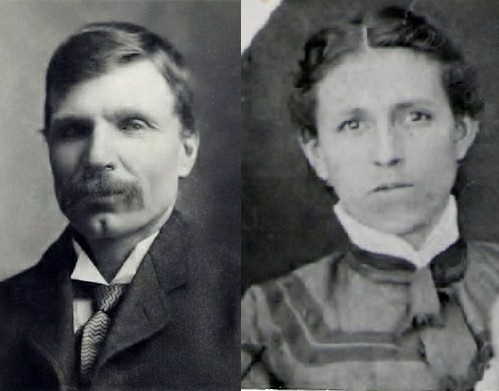
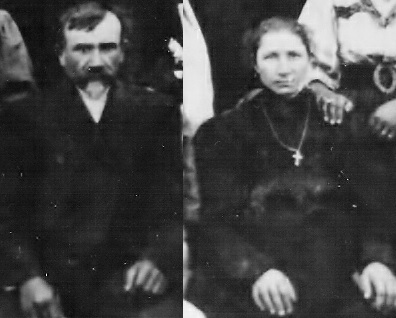
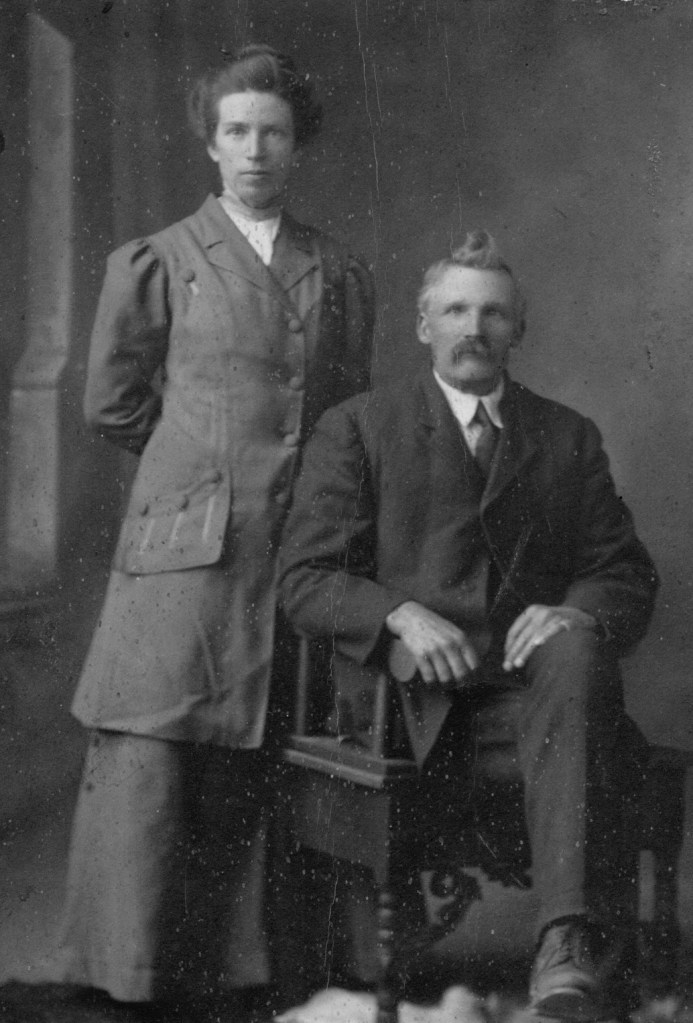
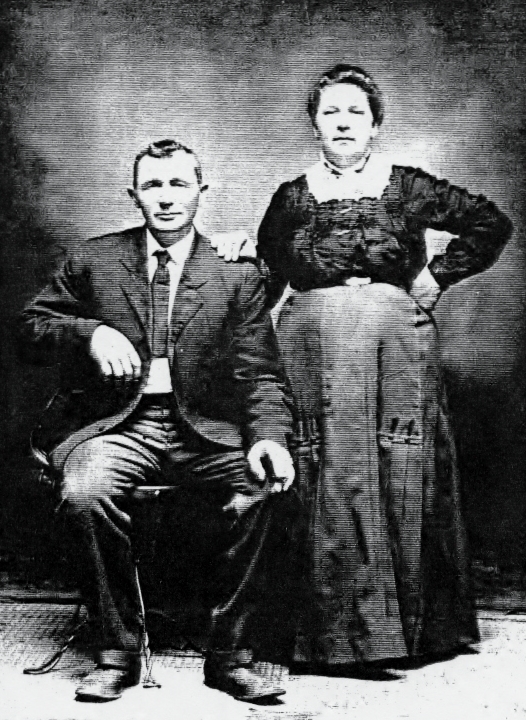
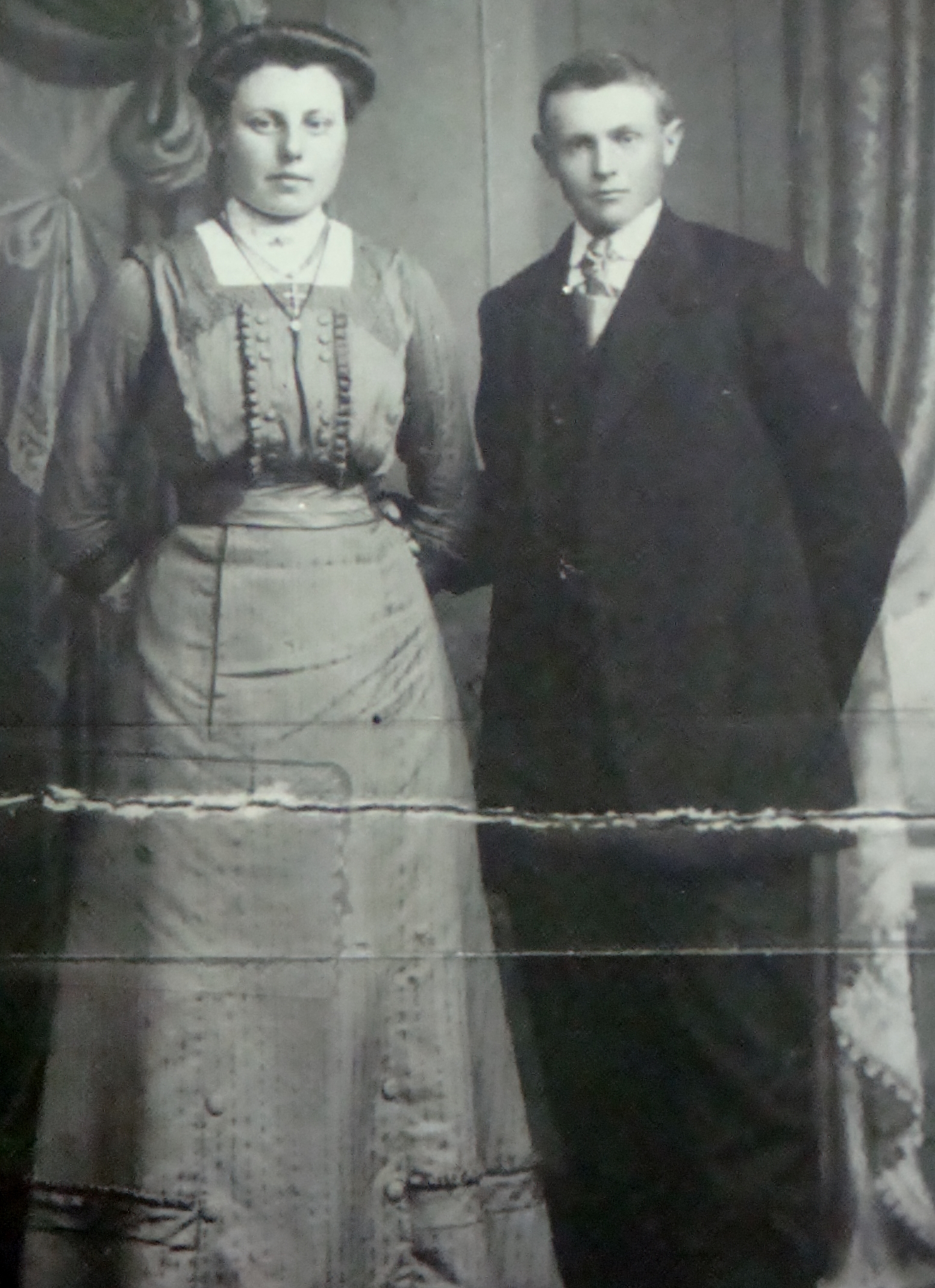
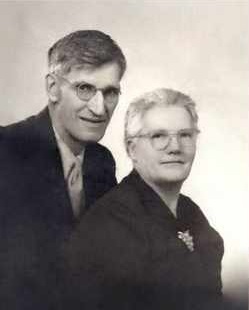
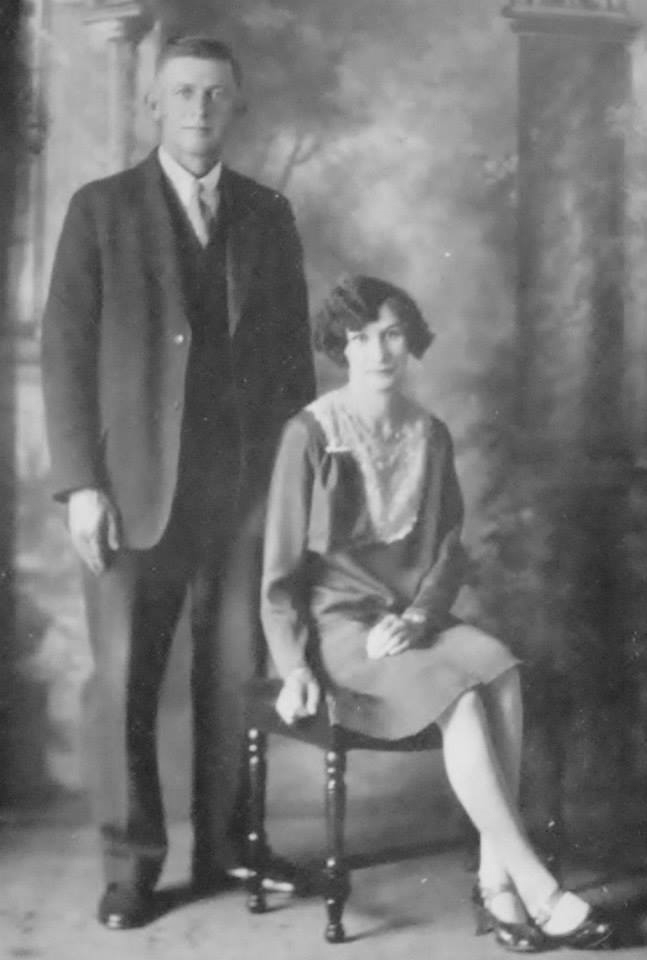
While I have photos of other (great) grandparents, I will only post for those of whom I have the pair. First, my maternal great great great grandparents.
William Burgess (1822 – 1904) Charlotte Liggett (1837 – 1909)Henry Lyman Cook (1803 – 1869) Susan Turple (1818 – 1906)Robert Nelson (1818 – 1902) Elizabeth Joseph (1818 – 1902)Preston Thomas (1814 – 1877) Maria Hadlond (1838 – 1907)
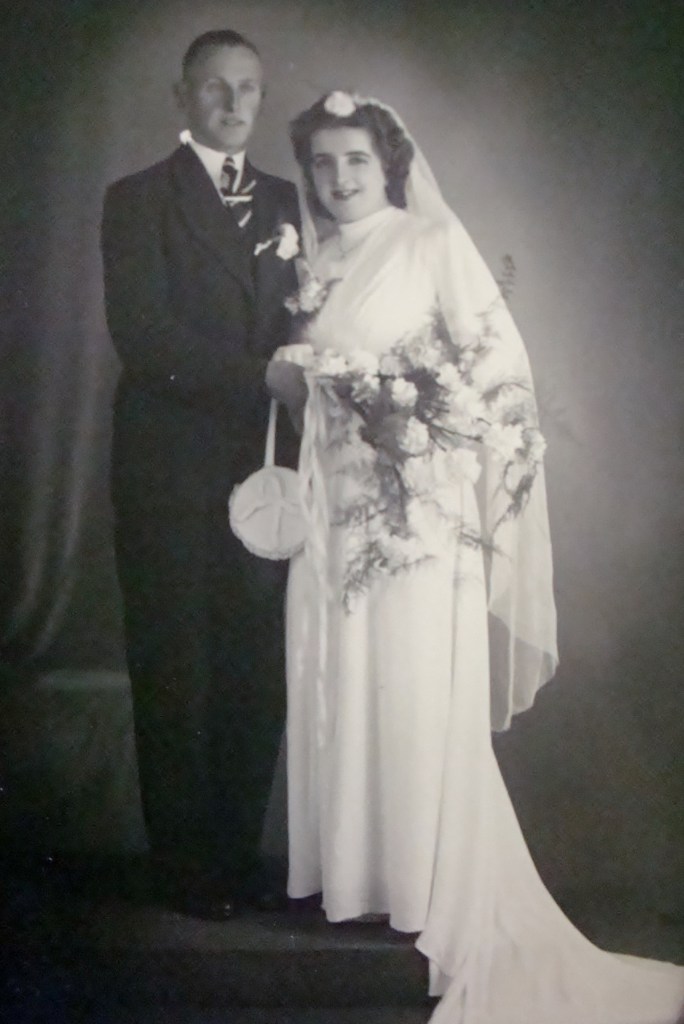
Adrianus Joseph “Arie” van der Fluit (1923 – 2002) Christina Komen (1923 – 2000)
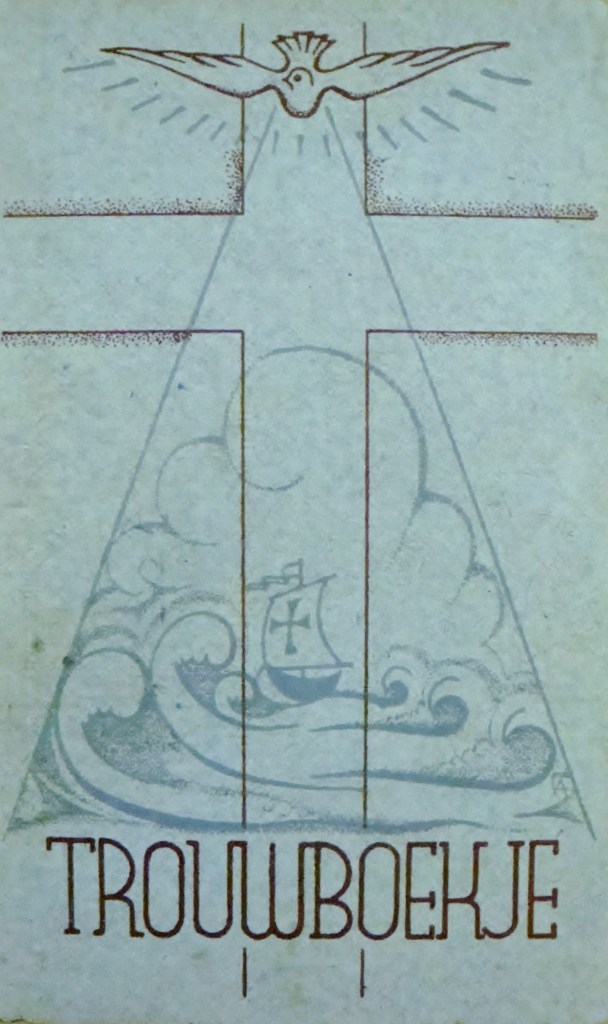
“Trouwboekje” means “marriage booklet” in Dutch. In the Netherlands, only a civil marriage is legally valid. A church ceremony can take place afterward, but is not recognized by the state. The registry office would issue one to a couple at they time they were married. They typically include an extract of the marriage registration. While they can vary from one municipality to another, a trouwboekje usually will include space for the birth information of the couple, as well as for the children of the marriage. They can also include information about religious matters, such as information about the church wedding and baptisms of the couple and their children.
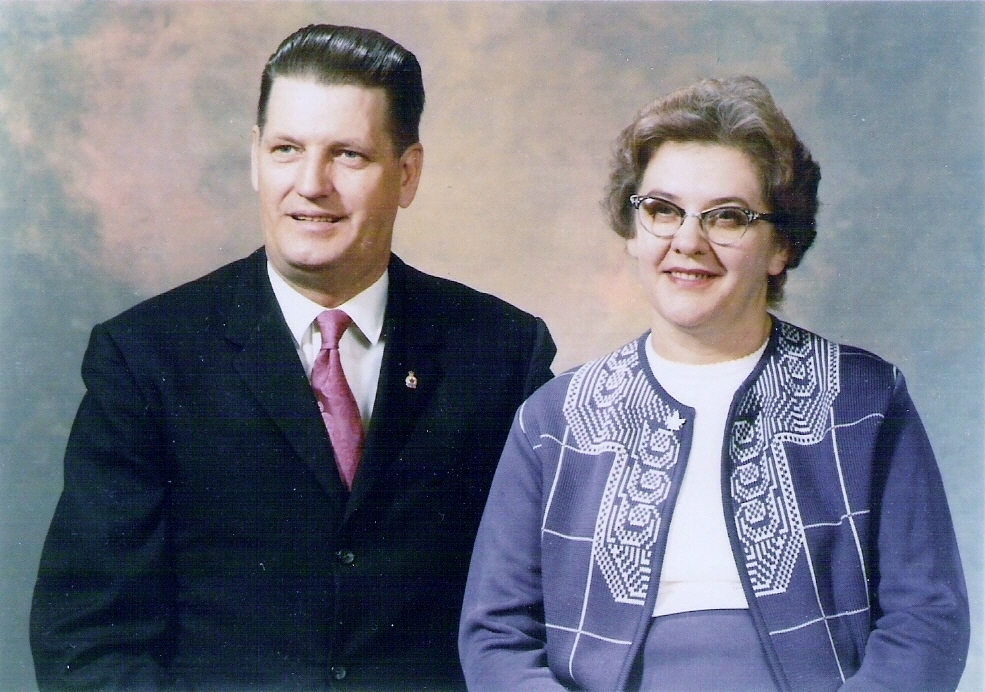
My maternal grandparents.
Leo Cleveland Burgess (1920- 1995) Helen Lerner (1921 – 1984) October 1971
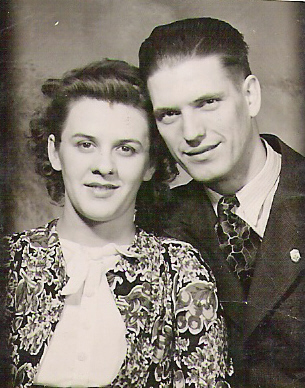
Helen and Leo around 1947.
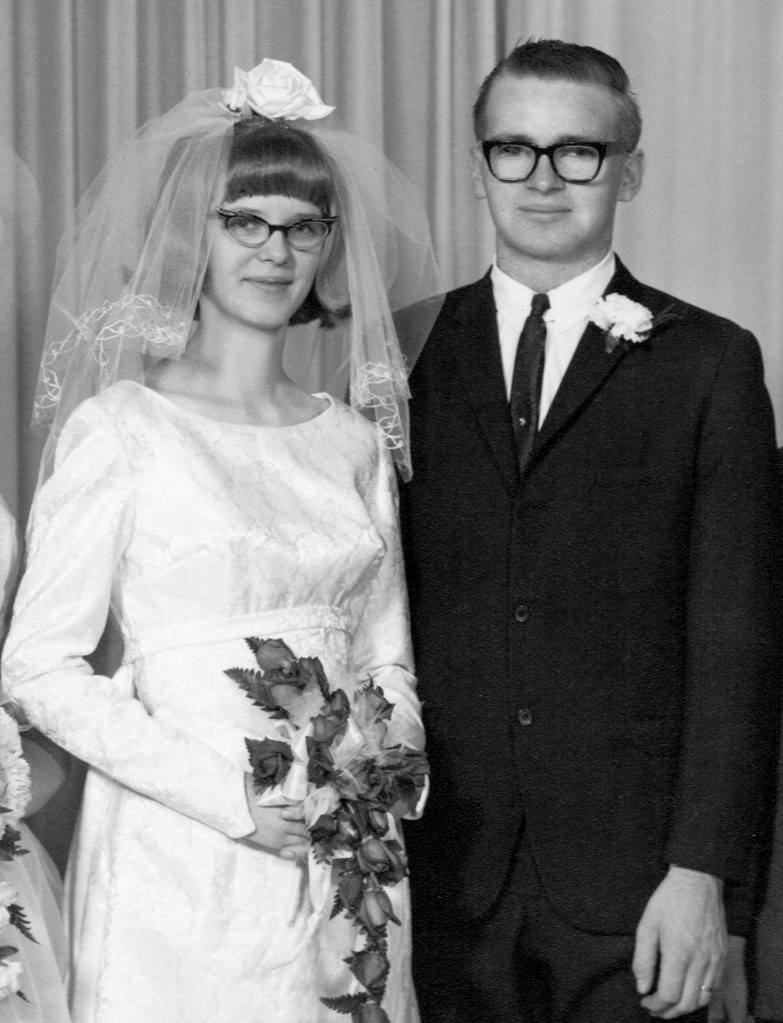
My parents. Married crazy young by current standards and still together, modelling what a great marriage should be.
Yeah! That’s why you’re the “judge” and I’m the “law-talking guy”.
Noted lawyer Lionel Hutz
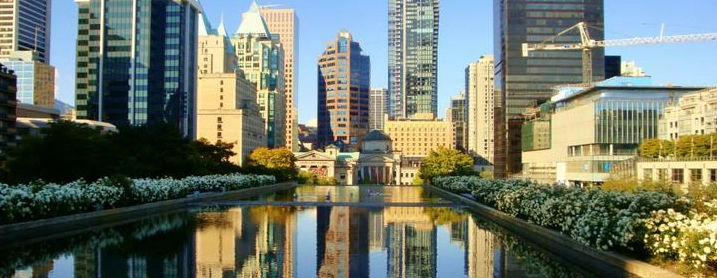
View from the current Vancouver Law Courts, looking towards the former law courts, which is currently the home of the Vancouver Art Gallery.
This week’s 52 Ancestors Challenge is “Courting”. If I was going to write about dating and romance, it would have been last week during what retailers are now calling “Valentine’s Week”. Besides, how my parents met is a story for another time. Instead, I am taking “courting” to be a loose descriptor of what lawyers and judges do. I acknowledge that turning a noun into a verb can be egregious, but here we are.
Canadian courts don’t use gavels!
It turns out that there are many lawyers and judges in my family history, as well as my wife’s. My brother-in-law is a lawyer. As well, many of my friends are lawyers and judges. Unlike most people who have lawyer friends, it’s because they’re lawyers themselves. However, most of my lawyer friends are people I’ve known since high school who all happened to go to law school later in life, including myself.
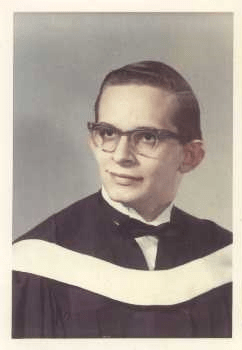
It wasn’t always this way. When I was a kid, the only lawyer in the family I knew of was my Uncle Leo Burgess. He graduated from the University of Alberta with a law degree (LL.B) in June 1972. I was surprised to learn that one of the partners of my old firm, for whom I did a lot of work, was in the same graduating class. We ensured that they were seated together for the wedding reception when I got married.
Leo Burgess – University Graduate
Leo articled with an Edmonton firm called Field & Field, now known as Field Law. For readers in places where articling is not part of the process of becoming a lawyer, its essentially a form of apprenticeship that takes about a year. Law school teaches the law, articling is an introduction to the actual practice of law. The articling process usually includes completion of the bar exam.
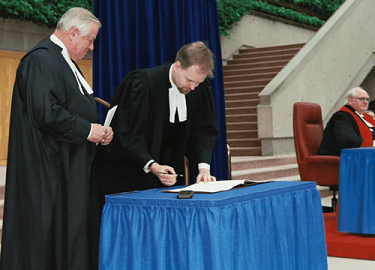
I attended Leo’s call ceremony in Edmonton. While I was only in kindergarten or grade one at the time, I remember it vividly. It was the first time I had ever been in a courtroom. I don’t even know if I had seen one on TV at the time. Everything about it was striking. It was very much a very traditional courtroom, with lots of wooden everything. The court attire, consisting of gowns and tabs, was also unforgettable.
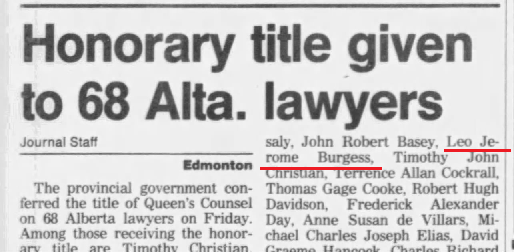
Leo remained at Field & Field for only a short time. From 1976 to 2003, Leo practiced at the Edmonton law firm of Brownlee Fryett, now known as Brownlee LLP. His expertise was municipal law. Leo became a partner in 1977. In addition to his legal practice, Leo lectured at the University of Alberta law school. In 1994, Leo earned an appointment of “Queen’s Counsel”, which entitled him to use the initials “Q.C.” after his name. In 1990, Leo was admitted to the bar of the Northwest Territories.
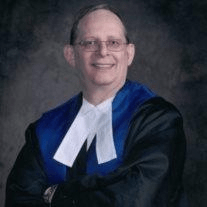
The Hon. Leo Burgess, Prov. Ct. of Alberta
Nineteen years ago this month, shortly after Valentine’s Day, Leo was appointed to the Provincial Court of Alberta. His appointment came as a surprise to my mother, since she always thought Leo hated going to court. He did, but having spent some time as a litigator myself by that time, I told her it came as no surprise to me. Leo served on the bench until his death in 2014.
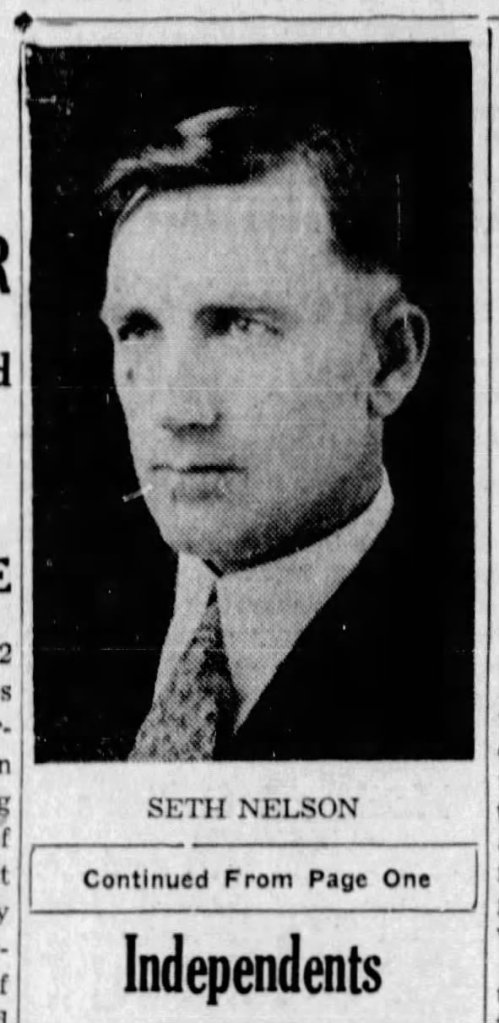
As far as I know, all the lawyers I am related to are on my mother’s side of my family tree. One was my mother’s uncle, Seth Henry Nelson, Q.C. Seth graduated from the University of Alberta in 1912. This was likely an undergraduate degree, as the University of Alberta did not establish a law school until that year. As well, becoming a lawyer at the time often did not require a law degree.
The Cardston News, Jan. 9, 1958, p. 1
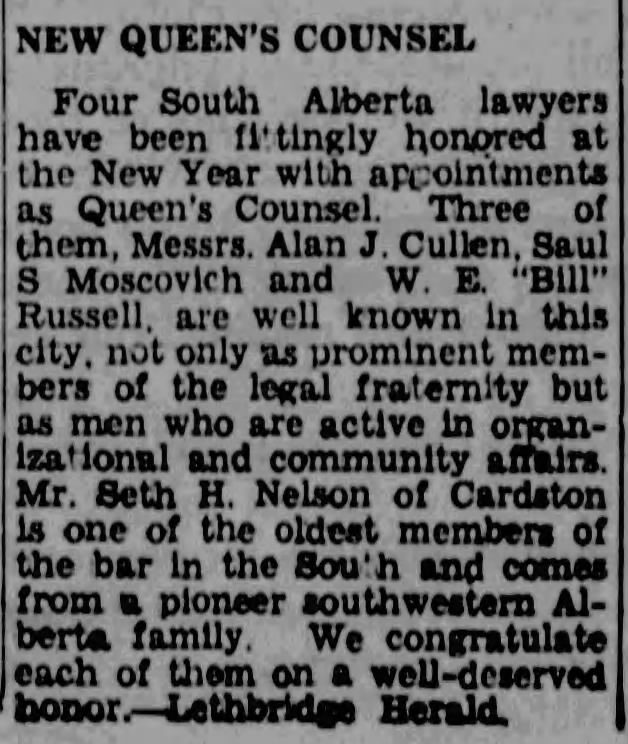
Seth practiced law in Cardston, Alberta for almost 60 years. After completing his time as a law clerk at a Cardston firm, Seth was called to the bar in April 1918. Seth was appointed a Queen’s Council (hence the “Q.C.”) in 1958. In addition to his legal practice, Seth was active in civic affairs. He was a school board trustee for 15 years, and was Secretary Treasurer of the local hospital board.
Calgary Herald, Feb. 22, 1940, p. 8
As well, Seth stood for election as an independent in the 1940 provincial general election in the riding of Cardston. He ran against the incumbent, Social Credit member Nathan Tanner, a former Speaker of the legislature who was appointed to Cabinet in 1937. Tanner defeated Seth in a two-way race, 2,160 votes to 1,808 (54.4% of the vote).
Seth remained active in his church, community, and legal work until he died in 1975, at age 83.
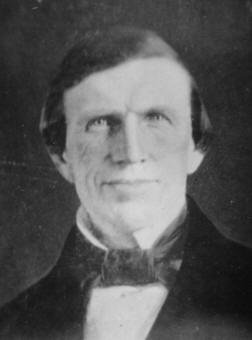
My 3rd Great Grandfather, Preston Thomas, also had a legal career amongst the many hats he wore. He was born in Rockingham, North Carolina, in 1814. He spent time in Tennessee in the late 1830s and early 1840s. In 1844, he joined the Latter Day Saints (Mormons) and moved west. Over a period of many years, Preston was part of a number of missions for the church.
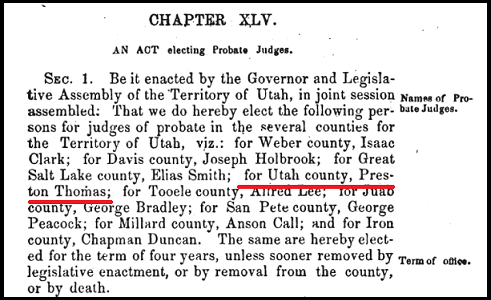
Preston was named a Probate Judge in Utah Territory in 1852, being appointed to the court upon its creation. Preston’s appointment was approved by an Act of the territorial legislature on February 7, 1852 (Laws of the Territory of Utah, Chapter XLV). He was assigned to the court in Utah County.
At the time, the Probate Court in Utah had a much broader jurisdiction than simply the estates of the deceased and those under guardianship (e.g. children, the mentally disabled), which was granted by federal US law. In addition to the usual jurisdiction of a probate court, the Utah territorial legislature granted the Probate Court jurisdiction over civil, criminal, chancery, and divorce matters. As well, the Probate Court heard appeals from the county Justice of the Peace courts. The Probate Court acted as a registry for incorporations and disincorporations and, in 1869, it was granted authority to determine land title claims.
In 1874, the federal government revoked the Probate Court’s jurisdiction over all matters except for divorce and probate matters. In 1877, the federal government revoked the Probate Court’s authority in divorce matters. Probate Judges were appointed by the legislature until 1874, when the judges were elected to a two-year term. In 1888, federal law changed the process, making the office subject to the appointment of the President of the United States. When Utah became a state in 1896, the Probate Court was abolished.
Preston Thomas (1814-1877)
As far as I have been able to determine, Preston had no formal legal training. He did serve on a number of church and community committees, as well as a term as a member of the House of Representatives of the Territorial Legislature from 1857 to 1859, so he had some knowledge of rules and procedure.
Tullidge’s Quarterly Magazine, Vol. III No. IV, states that Isaac Higbee succeeded Preston as Probate Judge on December 27, 1852. However, Preston appointed to the Probate Court again, no later than 1864. He was still a judge of the Probate Court in 1866, as he was listed as such in The Law Register for the United States for the Year 1866 by John Livingston of the New York Bar.
Fun fact: at the convocation ceremony when I received my B.A. from U.B.C., Raymond Burr received an honourary degree. Of course, he was famous for the role of TV lawyer Perry Mason – and was quite the opposite of Lionel Hutz.
Look at me, becoming an official Law Talking Guy!
This brings the February theme of “Branching Out” to an end. The theme for March is “Women”, which is appropriate given that it’s Women’s History Month in the United States, the United Kingdom, and Australia. In Canada, it’s not until October, so that it coincides with Persons Day. However, Canada does mark International Women’s Day on March 8. Seeing the weekly themes for March, I’m quite looking forward to them!
I’m starting to realize that when I choose a topic for the theme of the week for the 52 Ancestors Challenge, I should look ahead to see what other topics are coming up. That way I can avoid getting to a topic like this week’s, “Landed”, and seeing that I’ve written on the topic before. Then again, a little repetition here and there won’t hurt.
If I had approached this topic a few hours ago, I would probably be sitting here casting about in my mind as to what “landed” means to me. Fortunately, our eldest son inadvertently gave me a focus to write about. During dinner, out of the blue, he asked “besides Opa, did any of our ancestors come to Canada on steamships?”
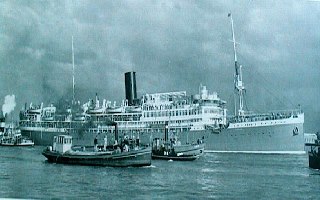
The Sibajak, which brought my father and his family to Canada.
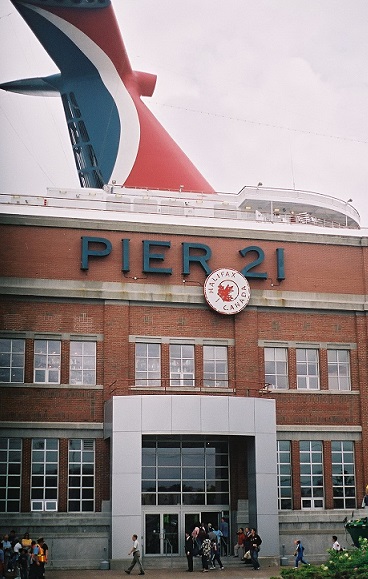
Pier 21, Halifax
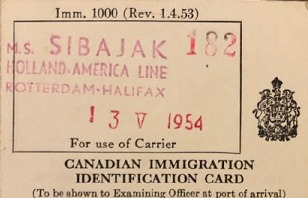
Opa is my father, the Dutch side of my family. I’ve already written about his coming to Canada on the Sibajak. He and his family came in early May 1954, travelling from Rotterdam to Halifax. They landed at Pier 21, which could be described as the Canadian equivalent of Ellis Island. My father’s aunt and uncle came over four months earlier, in January 1954 on the Groote Beer, while another aunt and uncle followed in late May 1954, on board the Castel Felice.
While it was a Holland America ship during his crossing, built and originally operated by Rotterdam Lloyd, along with other ships that they mainly used to go to the East Indies. Built in 1927, the Sibajak served as a troop ship during World War II. After the war, the Sibajak was one of a number of ships operated by Holland America that were used almost entirely for Dutch emigrants, along with the Grote Beer, Waterman, and Zuiderkruis. It was sold and scrapped in Hong Kong in 1959. When I was in Hong Kong in 1996, while travelling around the harbour and between its islands, I wondered how close I might have come to what scraps of it might remain.
This is a fascinating short documentary about a voyage the Sibajak made to Australia carrying Dutch emigrants. The video is in Dutch, but the images convey a lot of meaning.
In the late 1990s, my parents went on an Alaskan cruise on a Holland America ship. During the trip, my father, who loves to talk to people, fell into a conversation with one of the older hands on deck. My father mentioned having come to Canada on the Sibajak. After a few questions from the crew member, my dad learned that the man had been on the Sibajak during my father’s trip, in his first year or two of service.
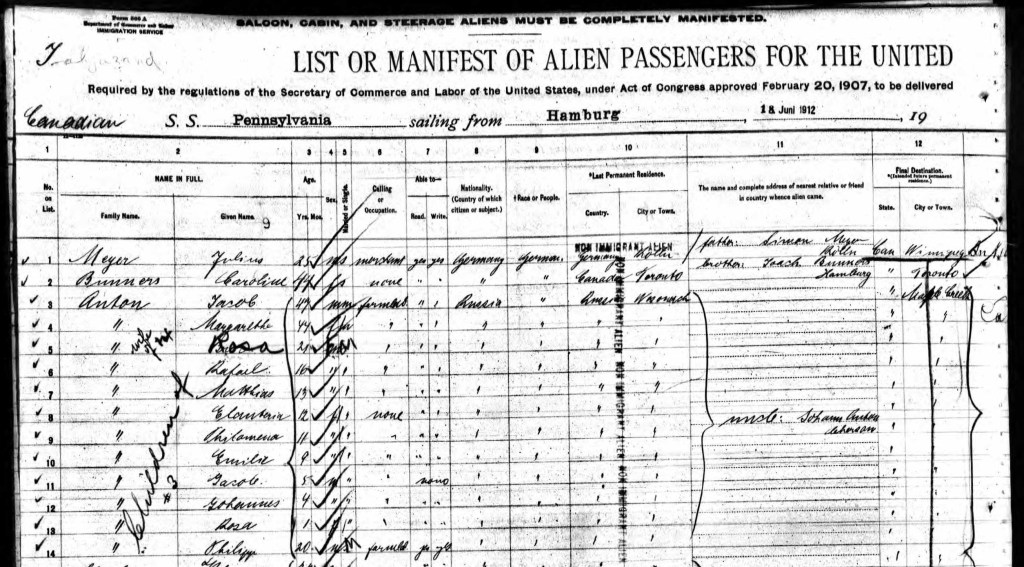
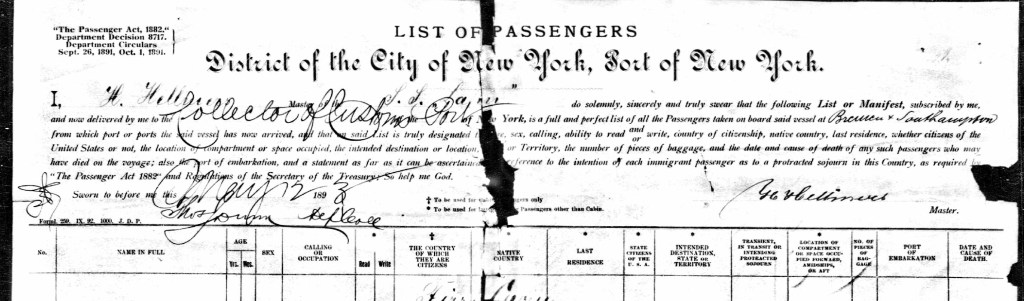
On my mother’s side, the most recent ancestor to arrive by steamship was my great grandmother, Emelia Anton. She came to Canada at the age of nine, with several of her siblings and her parents, Jacob Anton and Margaretha “Margaret” Heck. They were Germans from Russia. The family sailed out of Hamburg on June 18, 1912 aboard the S.S. Pennsylvania. They arrived at the Port of New York (Ellis Island) on July 1, 1912. Their declared destination was Maple Creek, Saskatchewan, to join Emelia’s older brother, Rochus. The passenger manifest stated that Jacob paid for the entire family’s transport, other than that of one of his daughters-in-law, whose passage had been paid by her father.
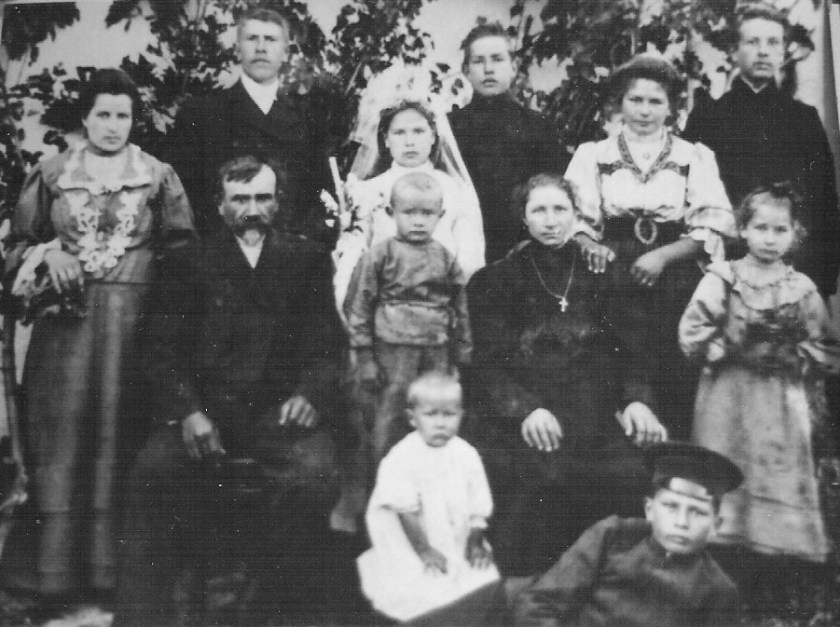
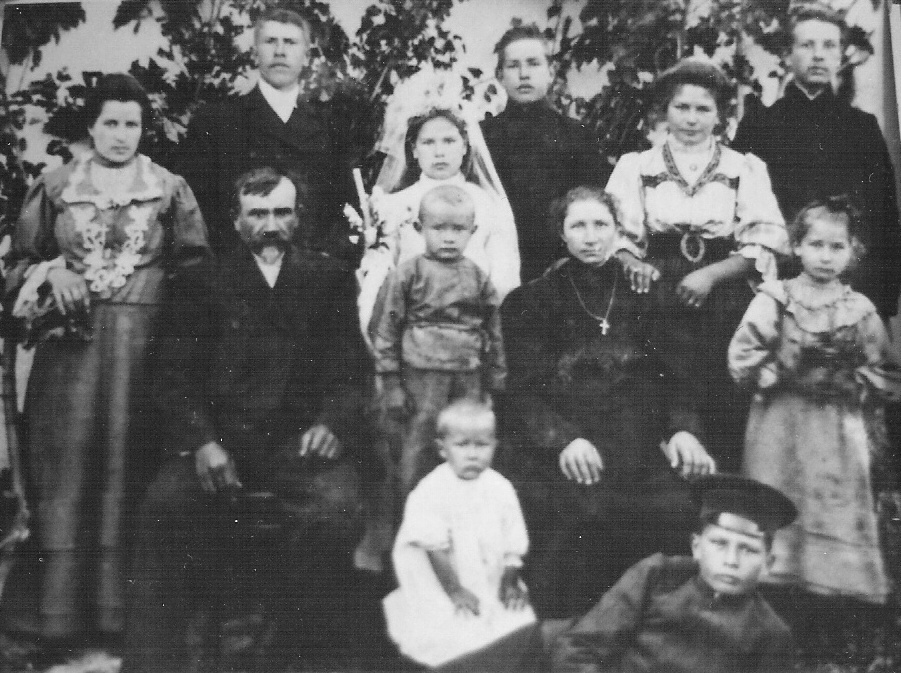
The Anton family, circa 1910. Likely taken in Selo Suchoi, Veronesch, Russia.
Emelia had not had much schooling before coming to North America, but was very religious. She said that she was frightened and nervous during the journey, as she did not know anything about where she was going and did not fully understand what was going on. However, on reaching New York, she said her fears subsided when she saw “the Madonna”. When she saw that, she knew she would be safe and all would be well. Of course, the “Madonna” was the Statue of Liberty. As she had never heard of it before, she thought it was a statue of the Virgin Mary.
Passenger list for the S.S. Pennsylvania showing the Antons.
Jerome Lerner (1895-1954)
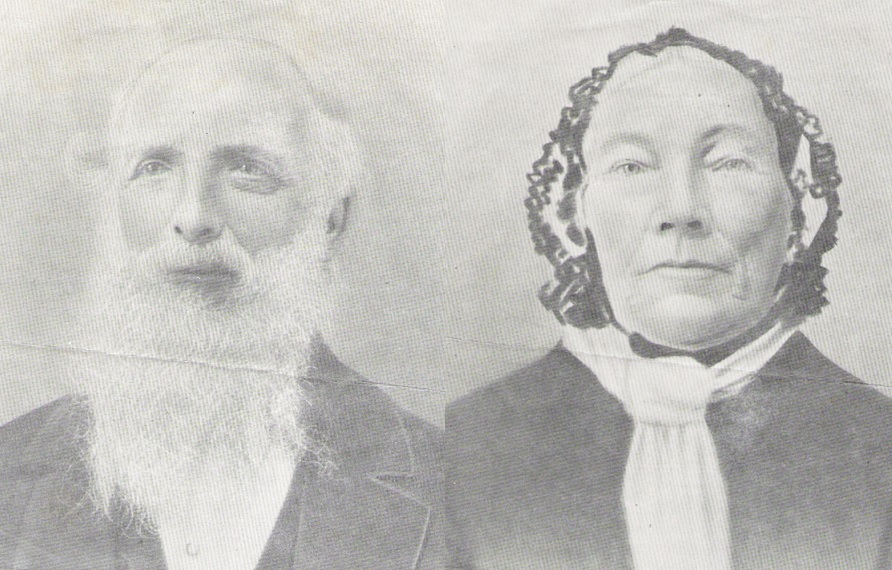
Michael Lerner (1862-1947) and Barbara Schmidt (1865-1936)
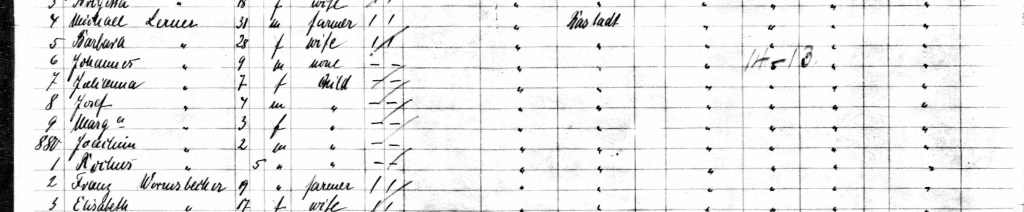
Emelia’s husband, Heronimus “Jerome” Lerner, was born to parents who were also Germans from Russia, Michael Lerner and Barbara Schmidt. Michael and Barbara came to the United States in May 1893 aboard the S.S. Lahn, with the five children they had at the time. They landed at Ellis Island and made their way to Clay County, Texas. Jerome was the first child born to Michael and Barbara in the United States. They had seven other children in Texas after Jerome was born. Jerome moved to Saskatchwan in 1917, preceded by an older brother. Jerome’s parents followed a year later. Other siblings came north at other times.
Passenger list for the Lahn showing the Lerners
The ancestors furthest back in time that I can find who came to North America on a steamship were my great x3 grandparents, Robert Nelson and Elizabeth Joseph. They were both born in Muff, Donegal, Ireland in 1818 and married there in 1842.
Joseph Nelson (1818-1902) and Elizabeth Joseph (1818-1902)
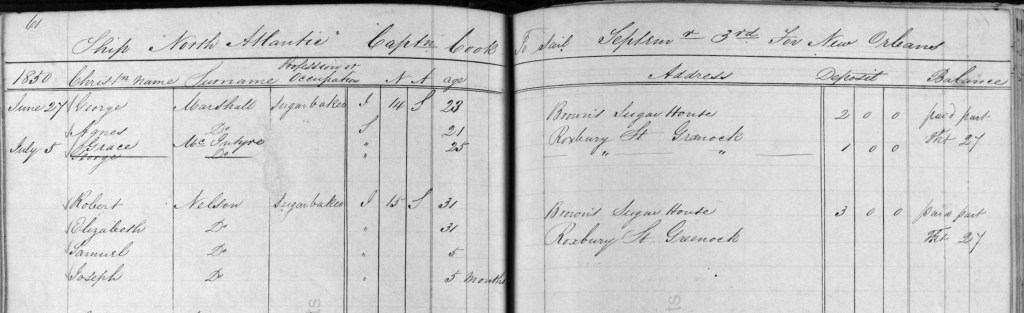
Sometime in the early 1840s they had moved to Linwood, Renfrew, Scotland. They were there at least by January 1844, when their first son, Samuel, was born. By 1850, Robert was working at Brown’s Sugar House, on Roxburgh Street in Greenock, Scotland as a sugar baker. Sugar bakers usually refined muscovado sugar, an unrefined brown sugar imported from Barbados.
On September 3, 1850 Robert and Elizabeth, along with their three children, departed Liverpool on board the ship “North Atlantic” bound for New Orleans. For a long time I had been confused by references I had seen to them coming over on “the north Atlantic”, thinking it meant the route they travelled. It wasn’t until I came across the passenger list that I realized that “North Atlantic” was the name of the ship. Having a name like that makes it difficult refine a search to distinguish the ship from where it sailed. However, while I have not found very good sources, it appears that the North Atlantic was a steam powered ship.
Passenger list for the North Atlantic showing the Nelson family
The records show that there was at least one other family headed by a sugar baker from Brown’s on the same voyage. Robert and Elizabeth were part of a company of Latter Day Saints (Mormon) converts travelling from the United Kingdom to Utah. The family spent a short period of time in Missouri, where in 1852 Elizabeth had her first child born in America. By late 1854 they were in Farmington, Utah, where my great great grandfather John Alexander Nelson was born.
Looking at my pedigree for this post, I realized I might have one other ancestor who might have travelled from the United Kingdom to the United States by means of a steam powered ship. That would be my great x3 grandmother, Maria Hadlond, who was born in Cheltenham, Gloucester, England in 1838 and who emigrated sometime in the 1850s. I have not really researched this branch of my family beyond collecting names and basic vital stats. For whatever reason, it has never caught my interest.
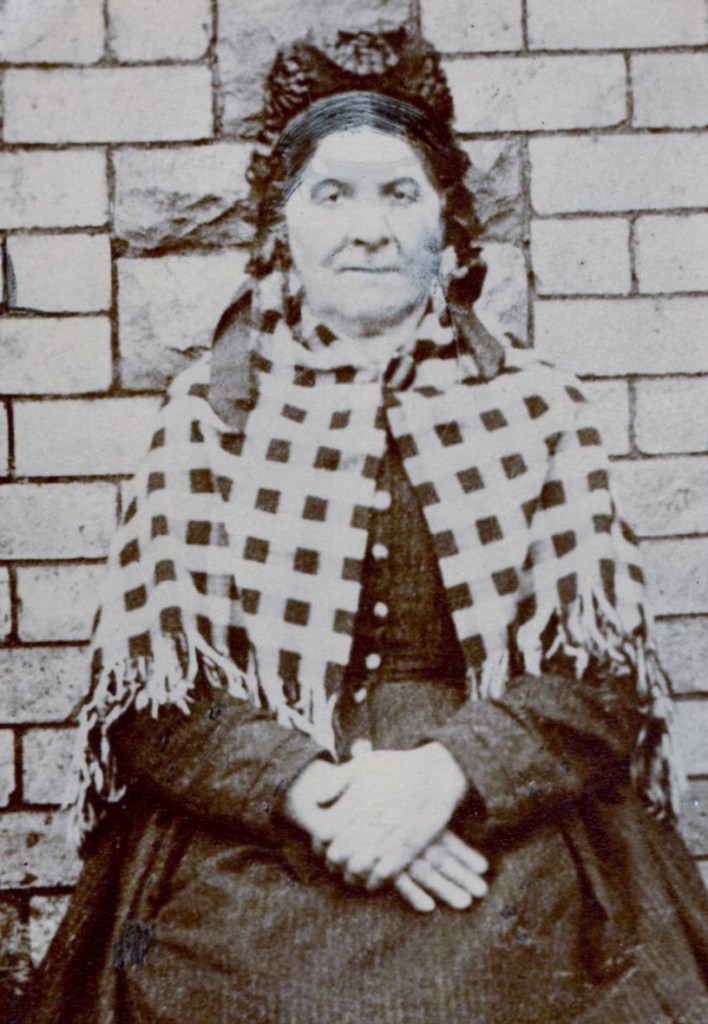
Susan Turple (1818-1906)
I also have a great x3 grandmother, Susan Turple, whose family had been in Nova Scotia since the 18th century, who would have travelled by means of a ship with sails. In 1849, Susan joined the Mormon church in 1849. In 1852, she went from Halifax to Boston to join a westward migration of Mormons. It is most likely that the initial part of Susan’s travels was by means of steam powered ship.
Before these people, any ancestors I have who crossed the Atlantic would have done aboard ships with sails.
Speaking of looking ahead, I see that next week’s theme is “Courting”. Since I am writing this on February 14, I wonder if that should have been this week’s theme!
As expected, I found this week’s 52 Weeks challenge to be particularly difficult, as I am lucky to have so many photos that I cherish. So I am going to cheat a little and post more than one, as I really do not have one photo that I favour above all others. With one exception, I’ve had a copy of all these photos for a very long time. Some of these photos were what helped kindle my love of genealogy.
On her Facebook group, Generations Cafe, Amy Johnson Crow suggested telling “the story of a favorite photo: who is in it, where and when it was taken, and why it was taken. What was the event?” I have to admit, for some of these photos I never thought of who took them or why they were taken, even though I had known of them for years.
The Anton family, circa 1910. Likely taken in Selo Suchoi, Veronesch, Russia.
This is a photo of my great great grandparents, Jacob Anton and Margaretha (“Margaret”) Heck. Given the attire, this was likely the confirmation of their daughter, Elataria (“Lottie”). My great grandmother, Emilia, is the girl on the right holding flowers. She was about 7 years old here. She lived to be 94. I visited her many times. She is the one who I mentioned at the outset of this blog, who surprised me by speaking fluent German when I thought she was of English heritage.
While this photo was taken in Russia, the family was German. Their forebears were amongst the many Germans who migrated to the Russian Empire in the 18th and 19th centuries. My family settled in the Beresan region of what is now Ukraine. A few years before Emelia was born, the family migrated to Russia. They stayed there until 1912, when they emigrated to Canada.
The next few photos all relate to my father and his family.
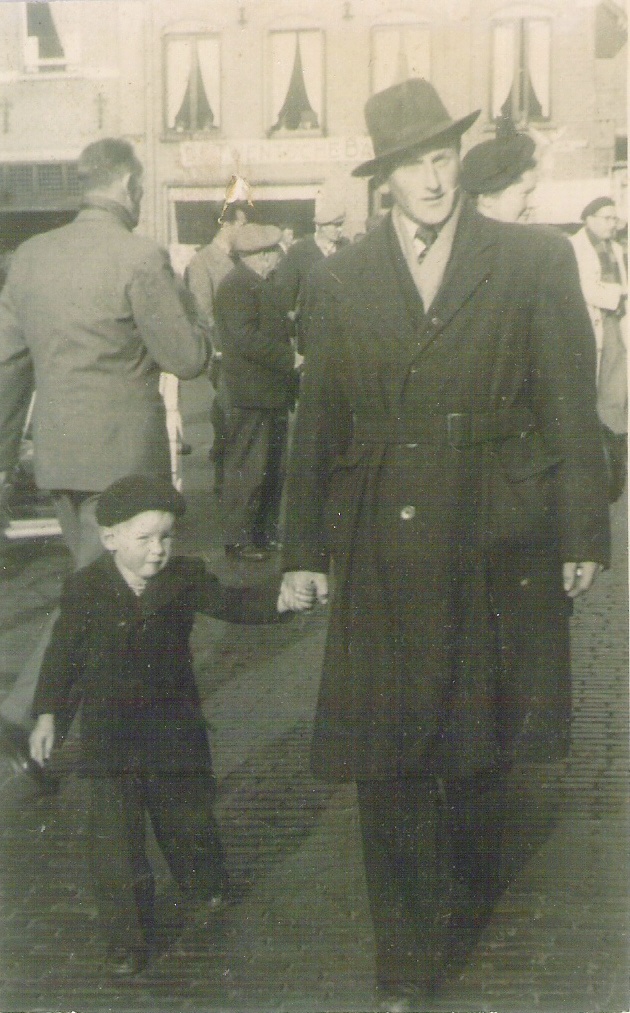
My father and his father, Adrianus (“Arie”) van der Fluit, Schagen, Netherlands, circa 1951.
This photo is definitely a contender for my absolute favourite. While I know when and where it was taken, it never crossed my mind to wonder who took it or why. I have no idea why they would have been visiting Schagen, but there they were. They certainly were dressed very fine and are looking very dapper. My grandfather was a farmer and a labourer, and they’re a bit of a way from home, so it must have been an important occasion. Looking through the family timeline, I can’t find an event that occurred in Schagen at this time.
I was in that same square with my father a few years ago. I should have recreated this photo with him, but I couldn’t quite figure out where in the square this had been taken.
Rotterdam, 1954
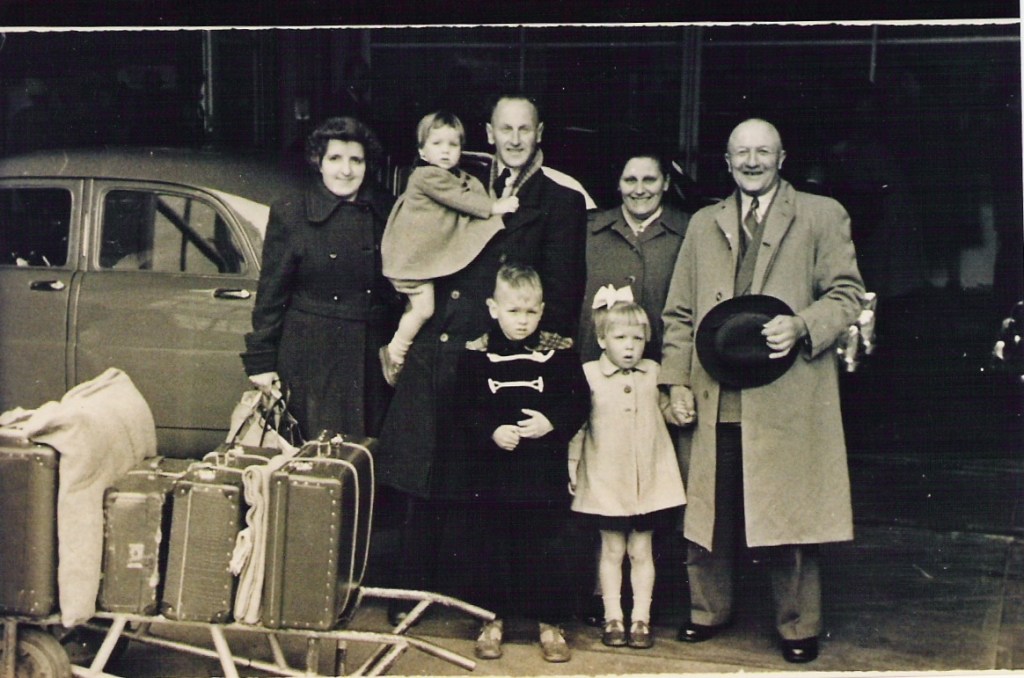
This is a photo of my grandparents, my father, and his siblings being dropped off by a family friend at the port in Rotterdam. The family is about to board the ship that will take them to Canada.
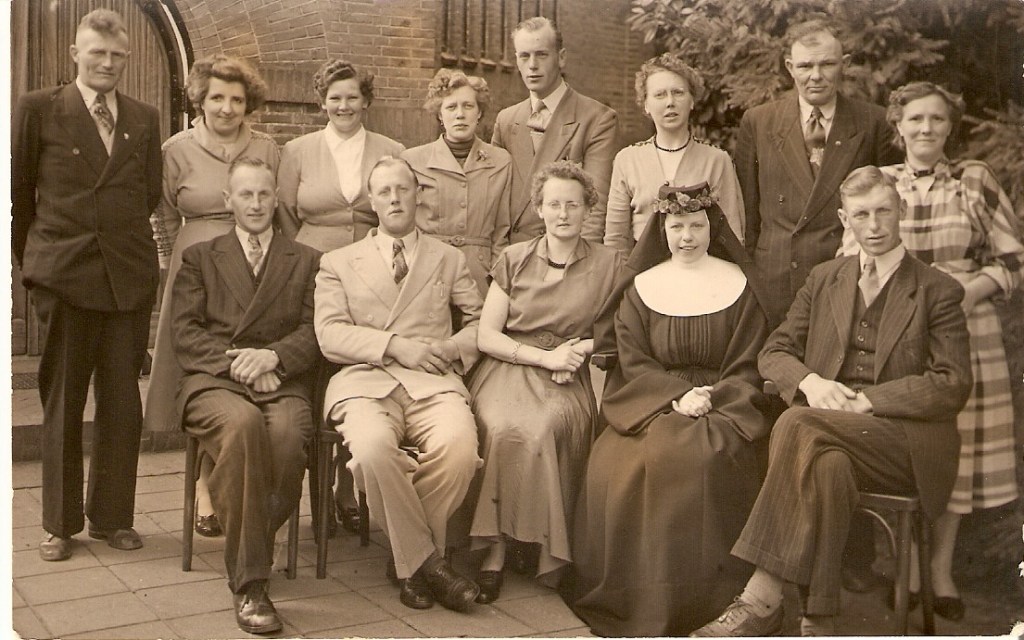
Unlike the other photos, this one only came into my possession relatively recently.
My paternal grandfather had seven siblings. He is the first person seated in the front row on the left side of the photo. My grandmother, Christina (“Tiny”) Komen is standing behind him. All of my grandfather’s siblings are here, except for his youngest sister. She might have been absent because this might have been taken after she emigrated to Canada, sometime in early 1954. My grandfather and grandmother left for Canada later in the spring of 1954. An older brother, Joop, seated immediately beside my grandfather in front of his wife Agie, left for Canada a fortnight after my grandfather.
However, this might have been taken in 1951 to mark the ordination of my great aunt, as an Urseline nun. She went by the name Sister Melania. I considered whether this might have been the occasion for which my grandfather and grandfather were dressed so fine in the above photo, but as far as I can find she was ordained in Bergen, not Schagen.
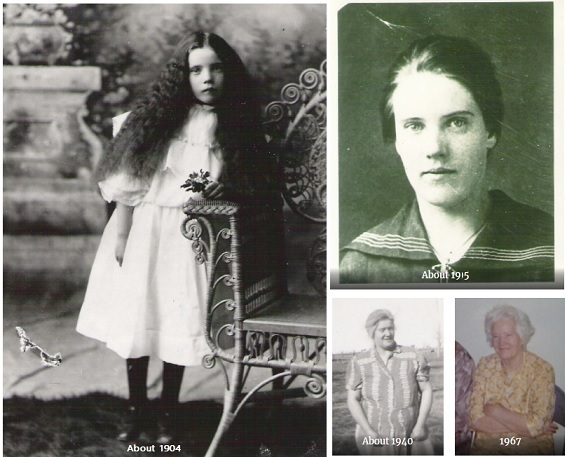
Finally. this set of photos of my mother’s maternal grandmother, Hazel Nelson. It’s the photo on the left, taken when she was about four years old, that is one of my favourites. It’s an amazing photo. I added the others because I thought it was a nice idea to see her progressing through life.
Hazel was born in December 1899. She and her sister Irene were the first twins born in the town of Cardston, Alberta, where her parents were amongst the original settlers. Irene only lived a month, but Hazel lived to be 67. I also have a copy of one of the last photos taken of her, around July 1967. Hazel died only a couple days before I was born. My mother practically went from the funeral to the hospital.
Next week: “Curious”. I wonder what that could be be? 😉
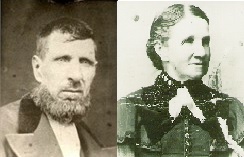
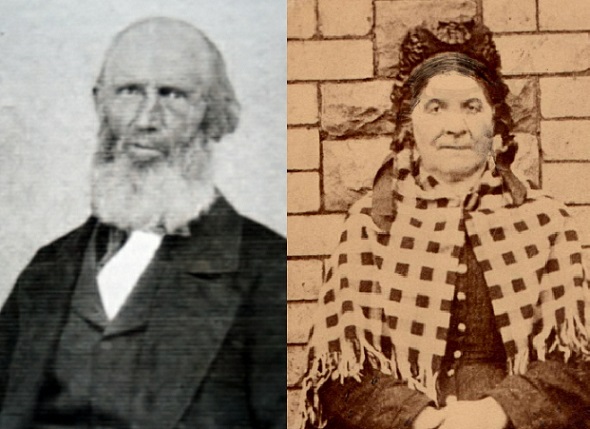

 A Deck of Ancestors