52W Mark III – Week 41: Most

Five or six years ago I presented on the topic of “Law and Genealogy” at a continuing professional development conference. In my PowerPoint presentation, I used several examples from my own research to illustrate several of my points. For example, to illustrate one of five parts of the Genealogical Proof Standard, I used an image of the citations I used in support of the date of the birth of my great grandfather, Johannis Albertus van der Fluit (1894-1932).
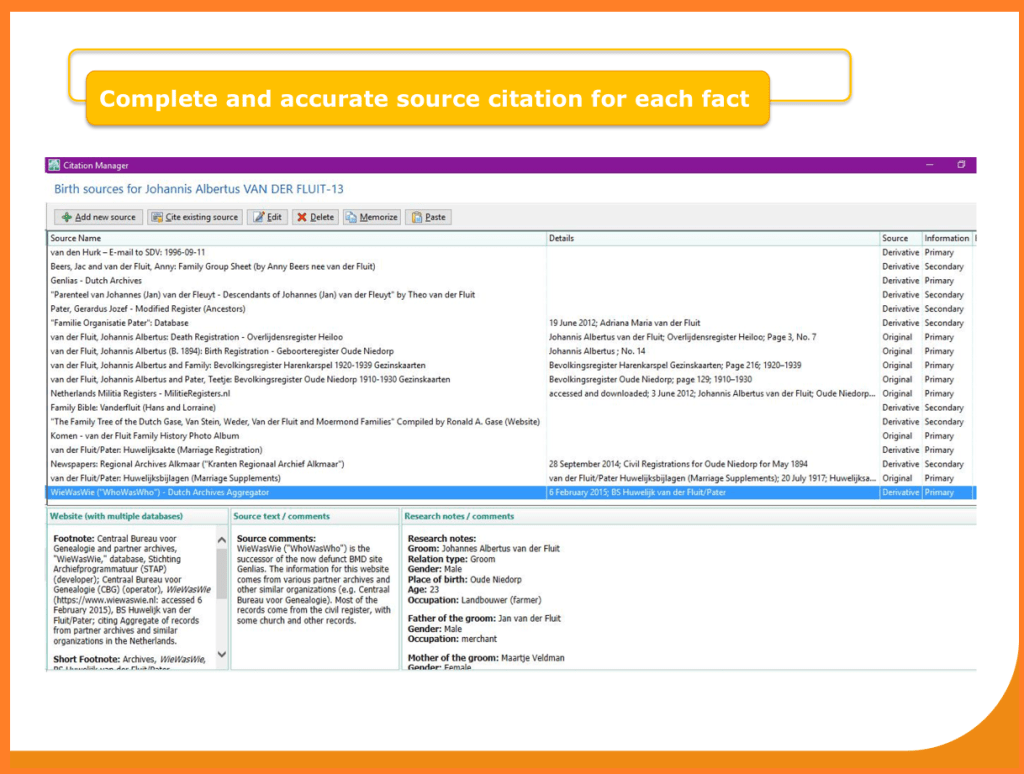
What struck me at the time was how many sources I had for that one fact – 17 at the time. If memory serves, I think that was one of the reasons I chose this fact to demonstrate the point. Heck, I could have used this image to illustrate the principle of conducting reasonably exhaustive research!

That slide has stuck with me, so with “Most” being the prompt for this week’s 52 Ancestors Challenge, I got to wondering which ancestor in my family tree has the most sources. Not necessarily the best, or most reliable, or bear the most evidentiary weight – just most. Unfortunately, my software won’t provide the kind of statistics I’m looking for, so I manually went through the entries for all my direct ancestors up to and including my great grandparents.

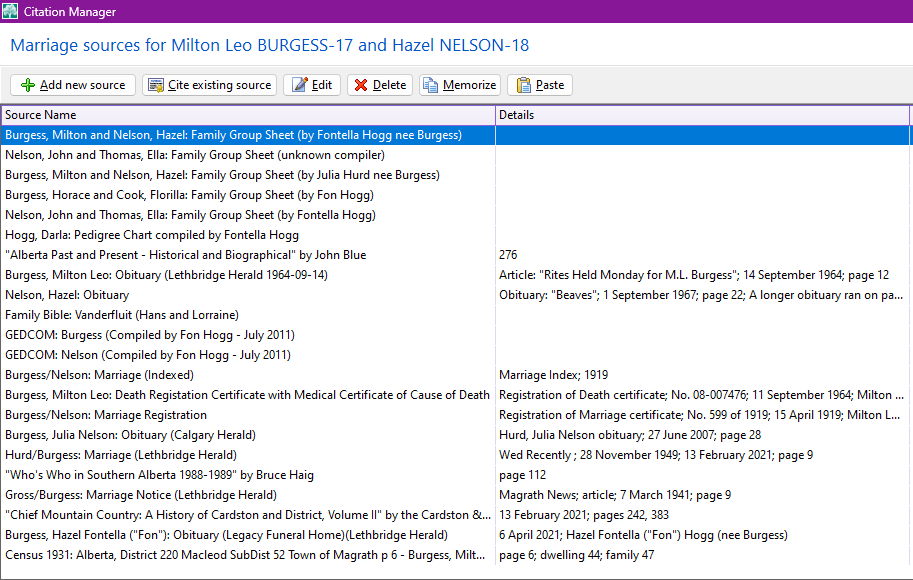
The most heavily sourced of any fact for this set of ancestors is the April 13, 1919 marriage of my mother’s maternal grandparents, Milton Leo Burgess and Hazel Nelson, with 22 unique sources cited.
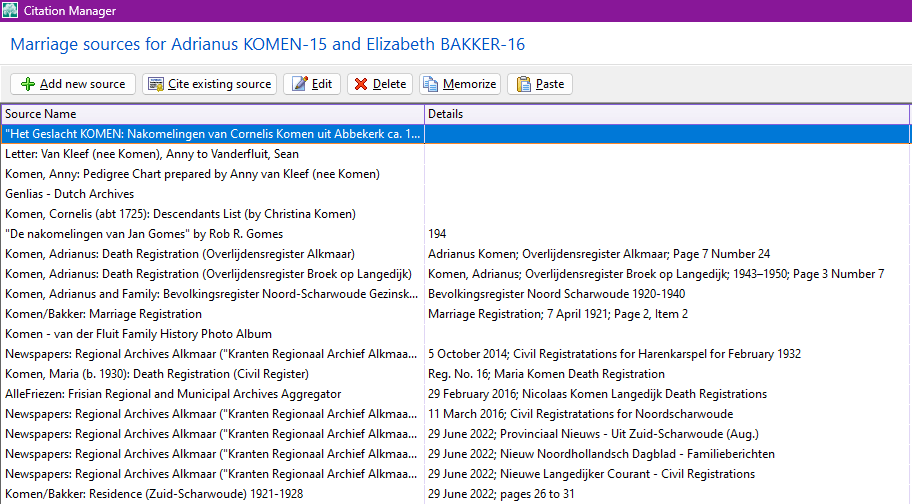
Not far behind is the list of sources demonstrating the marriage of my father’s maternal grandparents, Adrianus Komen and Elizabeth Bakker. I have cited 19 separate sources for their marriage that occurred on April 7, 1921.
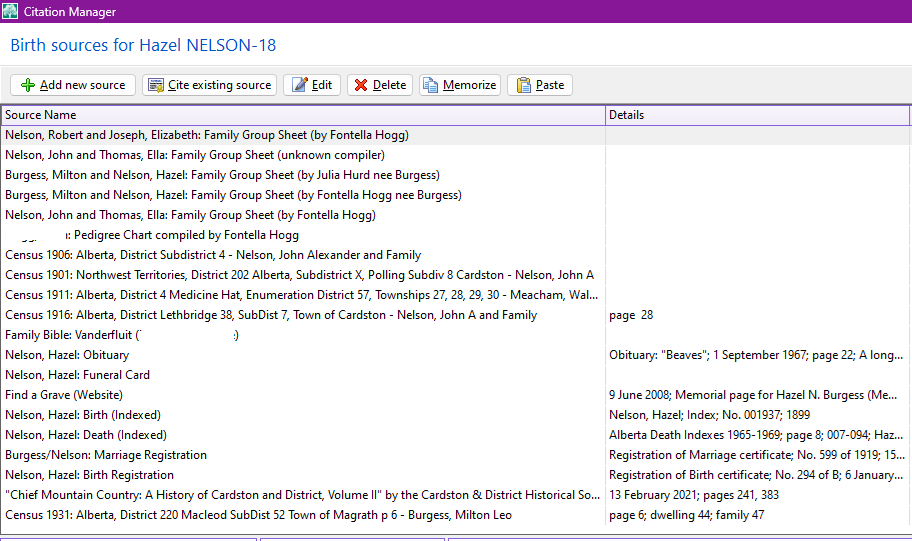
Returning to Hazel Nelson, I also have 20 separate individual sources for her birth, which occurred on December 15, 1899.
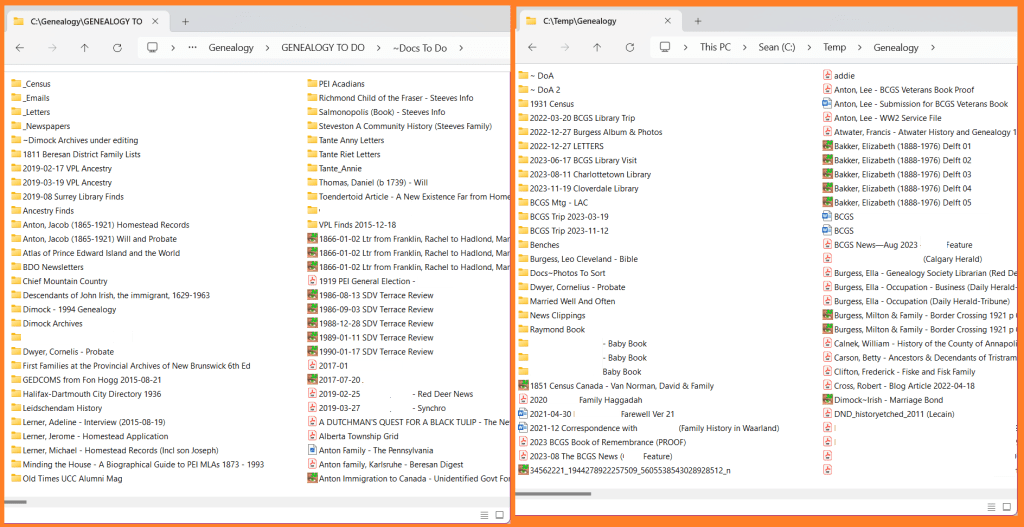
However, where I can find the most sources is in the two folders of electronic documents I’ve gathered that are all vying for my attention. There is also a banker’s box of documents that also need to be written up. Unfortunately, I hate preparing source citations as much as I love genealogy!
These sources aren’t going to write themselves up…Where are the genealogy elves when you need them?

52W Mark III – Week 27: Planes

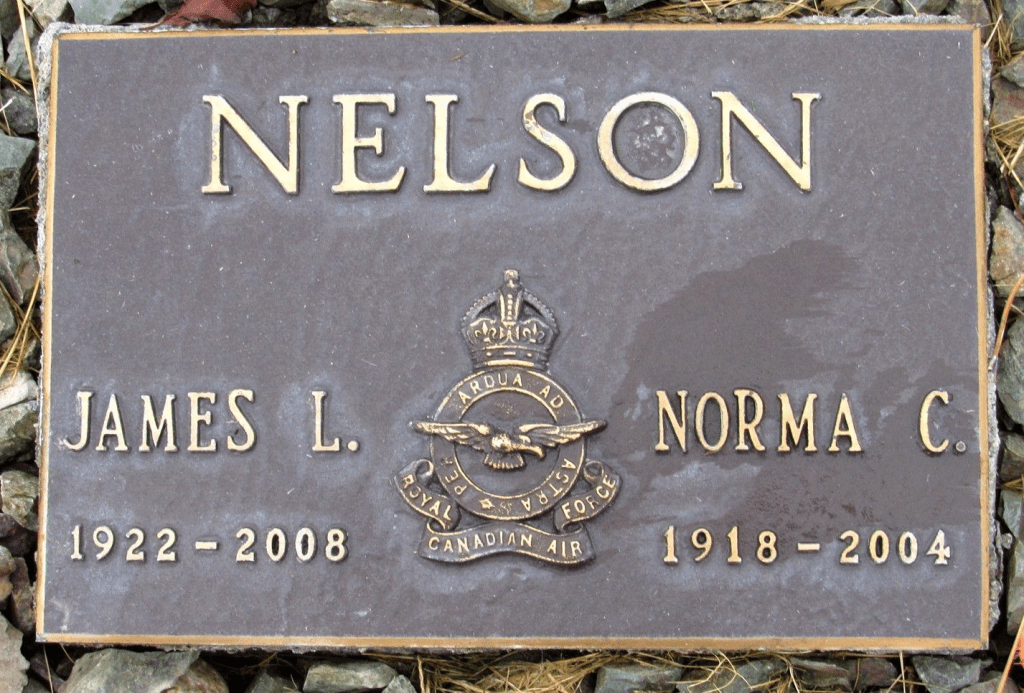
James Lorenzo Nelson (1922 – 2008) was my grandfather Leo Burgess’s cousin. James had a distinguished career as a Royal Canadian Air Force pilot, which included a four-year stint assigned to the Royal Air Force. During his career, he served on 16 different kinds of aircraft and logged 8334 flying hours.

James Lorenzo Nelson

James was the second of the nine children of Lorenzo Snow Nelson and Mary Ireta Turner. However, James’s older sister Clea died within weeks of birth, so James essentially grew up as the eldest child.

When he was 20, James joined the Royal Canadian Air Force during World War II, in October 1942. After training, James was transferred to Bomber Command in Leeming, Yorkshire, flying Halifax and Lancaster bombers. After the war, he remained in England as part of the post-war demobilization. During that time, he transported soldiers out of Italy, cleared armament dumps, disposed of unused bombs and ammunition by dropping them into the Irish and North Seas, and flew old aircraft to the “junk yard”. James was part of the last Canadian-crewed Lancaster flight.

This Lancaster is on display at the Bomber Command Museum of Canada in Nanton, Alberta. It is one of 17 remaining Lancasters in the world. It is also one of four Lancasters that can taxi under its own power. We were lucky enough to see the engines in operation during a test in 2016.

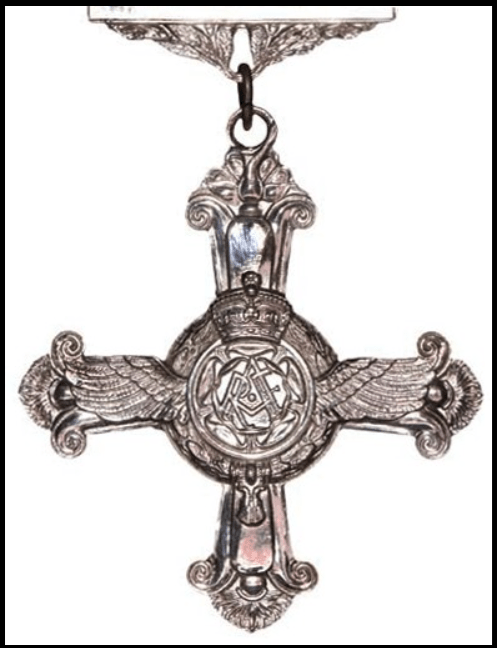
After the war, James returned home to Alberta and briefly spent some time as a grain buyer. Clearly the land was not where James’s heart laid, as he joined the Royal Air Force in 1947. James served with the #224 Squadron in Belfast, Ireland and with a detachment in Gibraltar. His duties included long-range meteorological reconnaissance. King George VI awarded James the Distinguished Flying Cross at Buckingham Palace on October 31, 1951. The commendation read:

This officer has served with No. 224/269 Squadron at Aldergrove and Gibraltar for two and a half years from March 1948 to 1951. During this time he has flown one hundred meteorological sorties, and on nine occasions he has experienced engine failure in flight. He has coped with these problems coolly and with exceptional skill, proving an excellent leader under most adverse conditions.

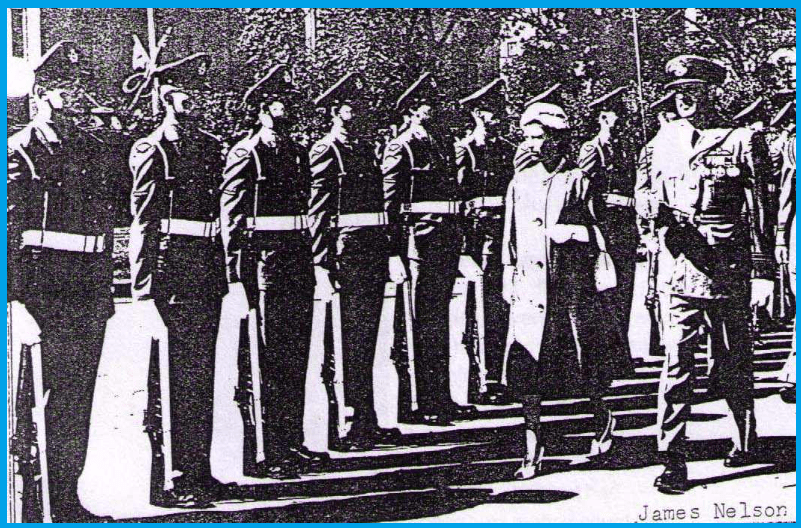
James completed his service with the Royal Air Force in 1951. He returned to Canada and immediately reenlisted in the Royal Canadian Air Force. James was initially posted in Calgary and then later in Edmonton. During his time in Edmonton, James was awarded the Air Force Cross by Governor General Vincent Massey for his service. After four years in Edmonton, James was transferred to Training Command. In 1959, James served as Guard Commander during Queen Elizabeth’s visit to Regina. In 1967, James was transferred back to Edmonton to serve as Provincial Air Cadet Liaison Officer.

James serving as The Queen’s Guard Commander during her Royal Visit in 1959.

In 1953, while stationed in Calgary, James married Norma Dunford (1918 – 2004). Together they had two children, one of whom was a dentist. I am pretty sure he worked on my teeth, but I didn’t discover the familial connection until well after the fact.

After James left the military, he and Norma relocated to Penticton, British Columbia. James owned and operated a picture-framing business there from 1971 to 1976, when he sold the business. James spent his retirement in Oliver, British Columbia, spending his time golfing, fishing, hunting, and caring for a small fruit orchard. He died in 2008, at the age of 86.

52W Mark III – Week 15: School Days

I typically consider myself as a descendant of many, many farmers. However, I am always surprised to remember that I am also descended from many individuals for whom education was important. There are also several educators in my extended family, including a high school principal. One of my sisters was a school teacher before becoming a medical doctor. As well, my maternal grandmother, Helen Lerner, originally intended to become a school teacher until a nun steered her in another direction.

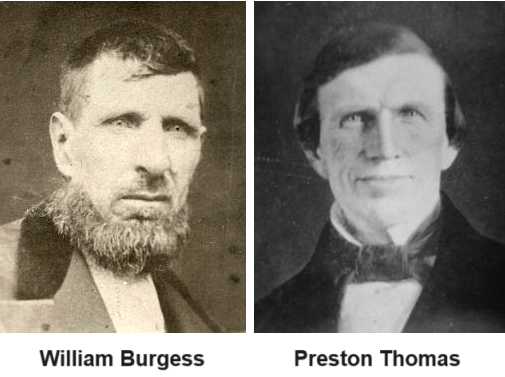
In particular, several of my direct ancestors were school board trustees. The earliest were my Gx3 grandfathers, William Burgess (1822-1904) and Preston Thomas (1814-1877). They served together on the first school board for the Lehi, Utah school district. The school district was created by the city of Lehi by resolution dated February 17, 1854. An election was held three days later, on February 20, 1854. Three school trustees were elected: William, Preston, and Daniel Collett.

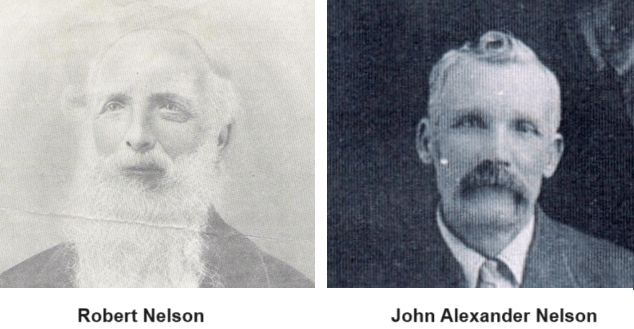
My Grandpa Burgess also had several other school trustees on his maternal line, the Nelson family. According to the 1880 US Census, his great grandfather (another of my Gx3 grandfathers), Robert Nelson (1818-1902) was a school trustee in Smithfield, Utah. Twenty-seven years later Robert’s son, John Alexander Nelson (my Gx2 grandfather) held the same office in Woolford, Alberta. John was one of the founders of the Woolford school board and was one of its first board members.

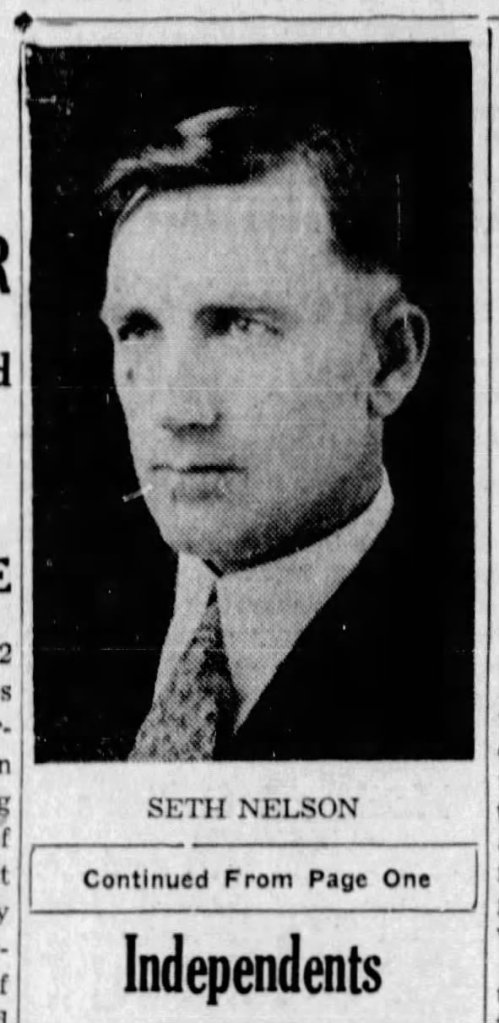
John’s son (my grandfather’s uncle), Seth Henry Nelson Q.C. (1891-1975), also served as a school board trustee in Cardston, Alberta. Seth was a school trustee for 15 years, from 1924 to 1939. Seth served as the Board’s Secretary for the last 10 years of his time in office. Following his last term as a school trustee, Seth made an unsuccessful run for a seat in the Alberta provincial legislature during the 1940 general election. Seth ran as an independent against the incumbent Social Credit candidate, Nathan Tanner. Tanner was a former Speaker of the legislature who was appointed to Cabinet in 1937. Despite running as an independent, it was a close race. Tanner defeated Seth in a two-way race, 2,160 votes to 1,808 (54.4% of the vote).

Education was also a facet of my wife’s side of the family, one of whom also served as a school trustee. Frank Eden (1839-1907), our children’s Gx3 grandfather, was a prominent Halifax, Nova Scotia merchant whose primary business was shoe manufacturing and sales. Frank served two non-consecutive terms as an alderman on the Halifax city council (1892-1893 and 1895-1896). Concurrent with both terms of office on city council, Frank served on the Halifax Board of School Commissioners.

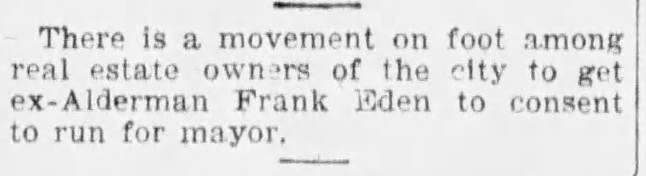
In 1902, there was an attempt to persuade Frank, who was still in the shoe industry, to run for Mayor of Halifax. As stated on page nine of the Halifax Herald, on January 1, 1902: “There is a movement on foot…to get ex-Alderman Frank Eden to consent to run for mayor.” As far as I’m concerned, all puns are intended.

52W Mark III – Week 1: Family Lore

Wow, hard to believe I’m leaping into my third year participating in  Amy Johnson Crow’s “52 Ancestors in 52 Weeks“!

For decades I’ve been reading the same stories about my great x3 grandparents, Robert Nelson and Elizabeth Joseph. I have written about them before (such as here and here). They were both born in Muff, Donegal, Ireland in 1818, two weeks apart. Robert and Elizabeth married in 1842 and within two years they were living in Scotland, near Glasgow. In 1850 they emigrated to the United States. They both died in Smithfield, Utah in 1902: Robert in February and Elizabeth in May.

The oft-repeated story is that Elizabeth was Jewish. The related story is that Robert and Elizabeth were picnicking on an island, where they were trapped by a storm and had to spend the night. The next morning they returned home in disgrace and because they had spent the night together were forced to marry. Moreover, because Robert was Christian, Elizabeth’s parents disowned her.

Needless to say, I don’t believe a word of it.

Not once in over thirty years have I ever seen a shred of evidence supporting this story or the proposition that Elizabeth was Jewish. The conclusion that she was could not be further from the Genealogical Proof Standard if one tried.

When Elizabeth was born, the Jewish population of the entirety of Ireland was extremely small, and mainly centred in Dublin and Belfast. It had not really been established by the time Elizabeth and Robert left Ireland for Scotland. By the mid-1800s, there were only a couple hundred Jews in the entire country. According to the 1881 census, there were fewer than 400 Jews in all of Ireland. Muff, Donegal is on the northern outskirts of Londonderry, where there was no Jewish community prior to 1893. In 1894, there were only 43 Jews in Londonderry.

It is not entirely impossible that Elizabeth was Jewish, but it is extremely unlikely. Absent any evidence to support the claim, I don’t accept it.

UPDATE: Since going live with this, a reader suggested that a DNA test might help put this story to rest. Great idea, I don’t know why I didn’t think of it. This might be an unpopular thing for a genealogist to admit, but I’ve never taken one for a lot of reasons I really don’t feel like explaining right now. However, one of my brothers took a DNA test and he sent me the results. They were everything I expected and, frankly, boring! I took a look at it again, and there is no indication of even a trace amount of Jewish ancestry. To me, this reinforces my disbelief that Elizabeth was Jewish.