
52W Mark III – Week 35: All Mixed Up

Imagine changing municipalities several times in your life while living in the same house the entire time. With the ever changing municipal boundaries of the Netherlands, it can become All Mixed Up – which is the prompt for this week’s 52 Ancestors Challenge!

The Netherlands has thousands of villages, towns, and cities; however, the smallest administrative unit of government is the gemeente, which roughly translates as “municipality” or “local authority”. They are the third and lowest level of government after the national and provincial governments. Some gemeentes (in Dutch the plural is “gemeenten”) consist of a single community, such as gemeente Amsterdam. Many consist of multiple villages and towns.
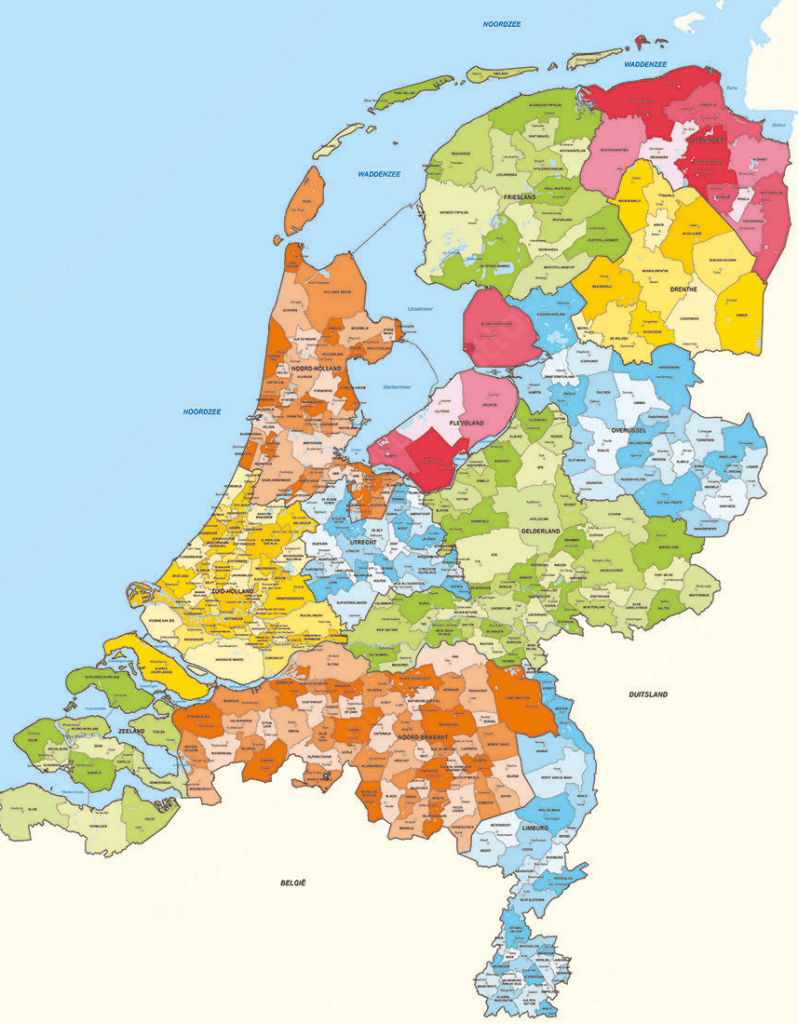
The gemeentes of the Netherlands as of 2024. The colour groups indicate the provinces of the Netherlands.

In 1812, immediately after the end of Napoleonic rule, the Netherlands had more than 1,100 gemeentes. I don’t know if that includes or excludes modern-day Belgium, which until 1830 was part of the Netherlands. Over the following two centuries, the municipal map was revised many times. Gemeentes expanded, shrank, divided, and merged, such that almost 1,700 different gemeentes have existed over time.

Since January 1, 2023, the most recent reorganization, there are 342 gemeentes in the European part of the Netherlands. There are three in the Caribbean Netherlands, except there they are a “Caribisch openbaar lichaam” (“Caribbean Public Body”).

My father was born in Waarland, a village that currently has about 2,700 inhabitants. When my father was born, it was in gemeente Harenkarspel, which had been in existence for centuries. Its boundaries changed twice after my father was born.
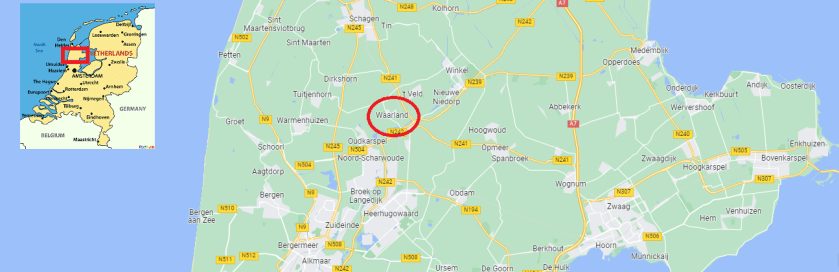
Waarland’s location in the Netherlands.
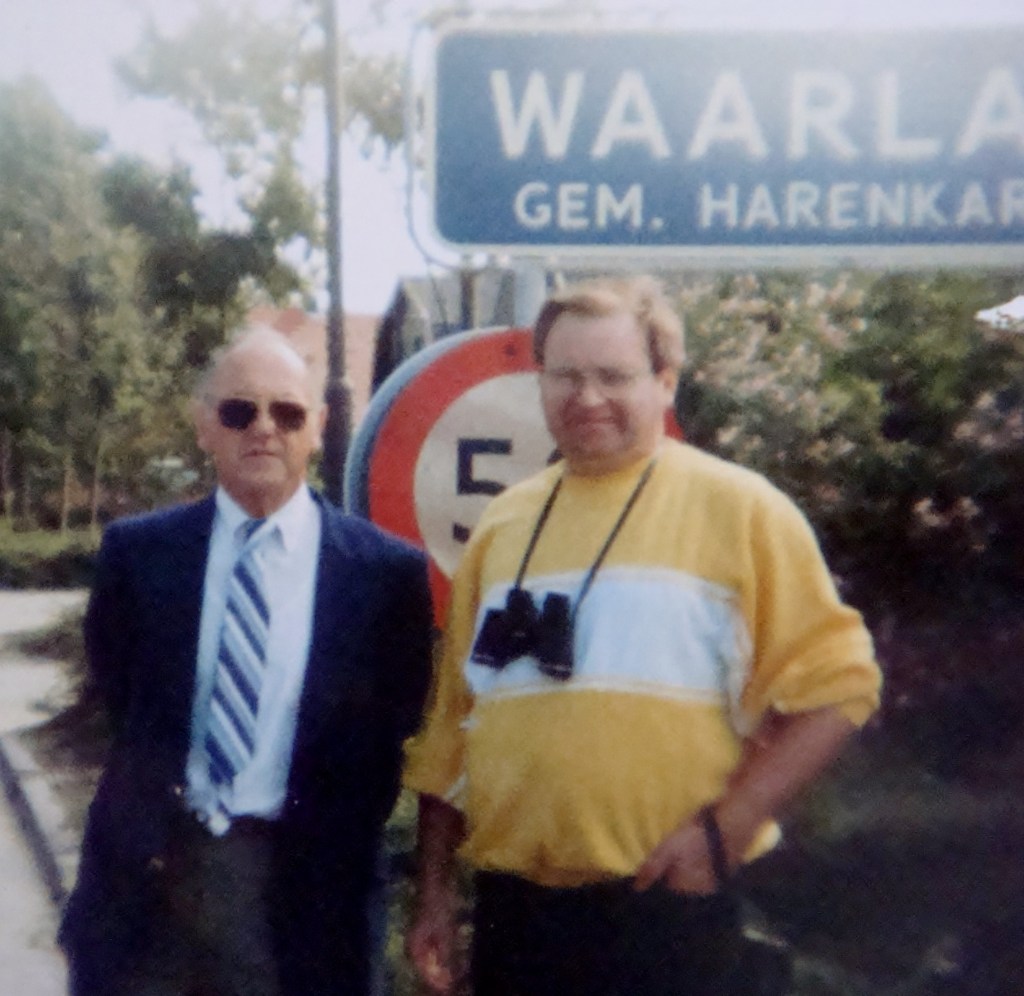
My grandfather and father visiting Waarland in the late 1980s. It was my father’s first time back since they emigrated to Canada. The sign says “Waarland Gemeente Harenkarspel”. Waarland was in Harenkarspel the first time I visited it; it was in Schagen the next time I was there.

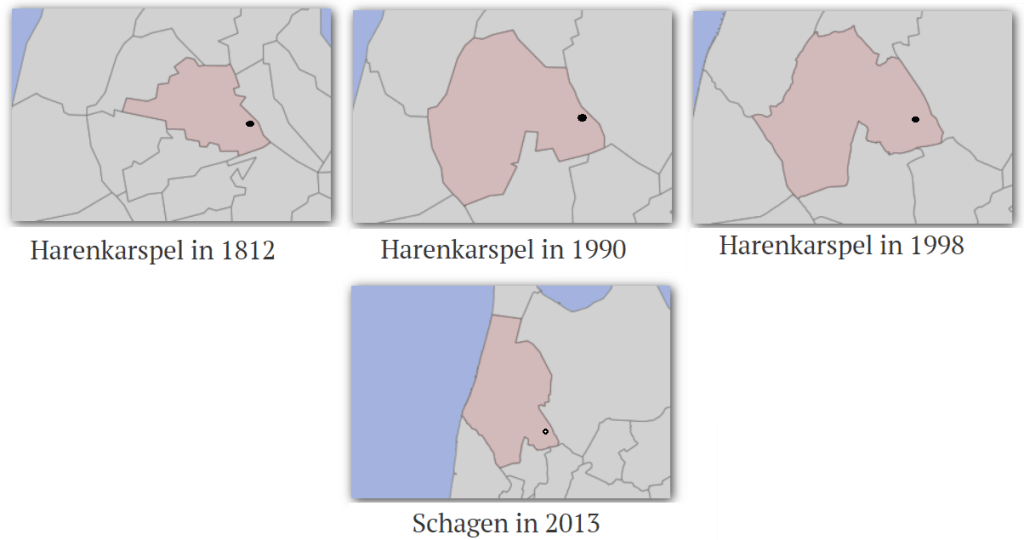
In 2013, Harenkarspel merged with Zijpe and Schagen and ceased to exist as a separate gemeente. Since the merger, the gemeente is simply Schagen. Zijpe itself had six different iterations between its creation in 1817 and its merger with Schagen in 2013.
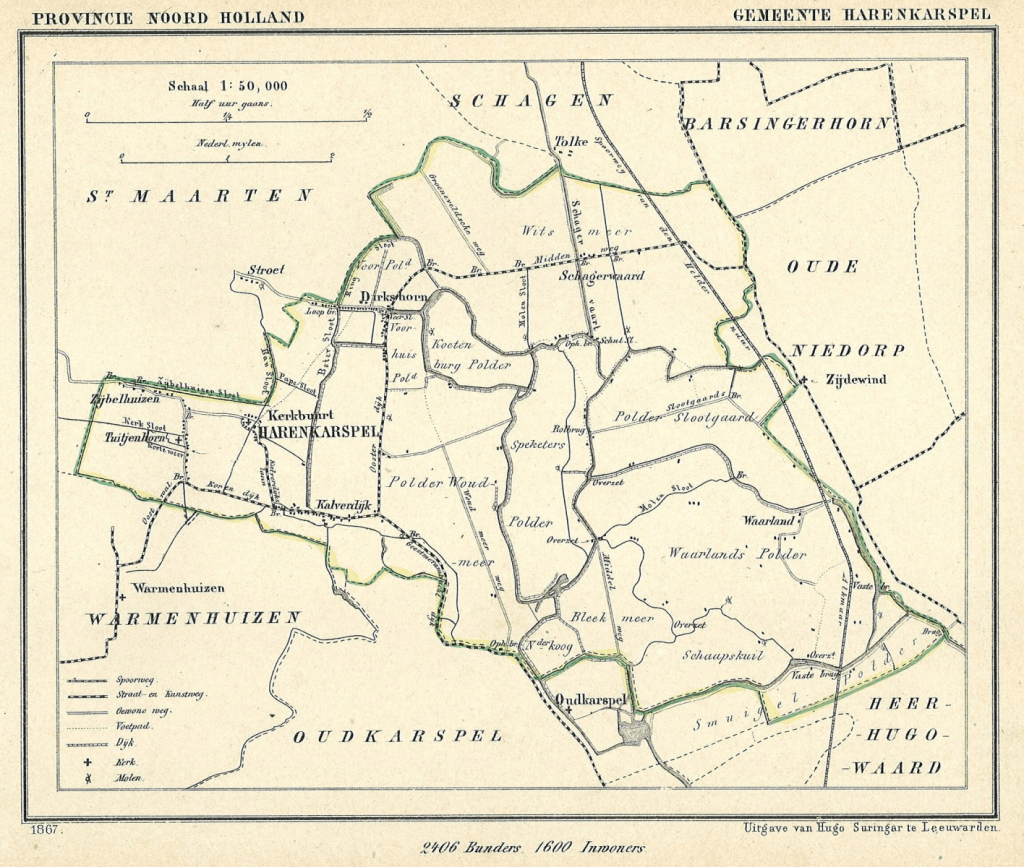
Harenkarspel in 1867. Waarland is in the south-east, near the border with Niedorp.
Waarland’s location within Harenkarspel and, now, Schagen.

When I enter a Dutch location into my database for any particular fact, I always use the smallest unit, even if it is not an independent administrative body. While gemeentes come and go, or expand and contract, the villages, towns, and cities largely stay the same. Thus Waarland is Waarland, regardless of what gemeente it is in. Fortunately, there is a website that helps track all the gemeentes that have existed “from ancient times” to present: “Gemeentegeschiedenis” (“Municipal History”). With it, you can find which gemeente a place might have been at any time in Netherlands history. No need to be all mixed up!
52W Mark III – Week 15: School Days

I typically consider myself as a descendant of many, many farmers. However, I am always surprised to remember that I am also descended from many individuals for whom education was important. There are also several educators in my extended family, including a high school principal. One of my sisters was a school teacher before becoming a medical doctor. As well, my maternal grandmother, Helen Lerner, originally intended to become a school teacher until a nun steered her in another direction.

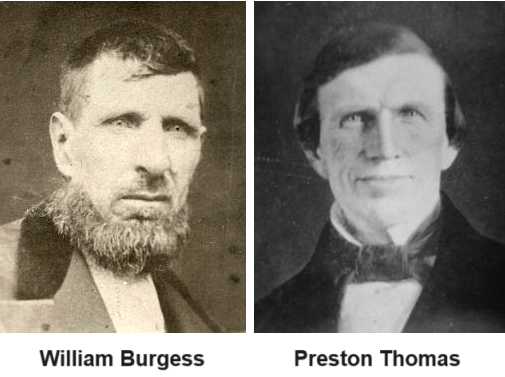
In particular, several of my direct ancestors were school board trustees. The earliest were my Gx3 grandfathers, William Burgess (1822-1904) and Preston Thomas (1814-1877). They served together on the first school board for the Lehi, Utah school district. The school district was created by the city of Lehi by resolution dated February 17, 1854. An election was held three days later, on February 20, 1854. Three school trustees were elected: William, Preston, and Daniel Collett.

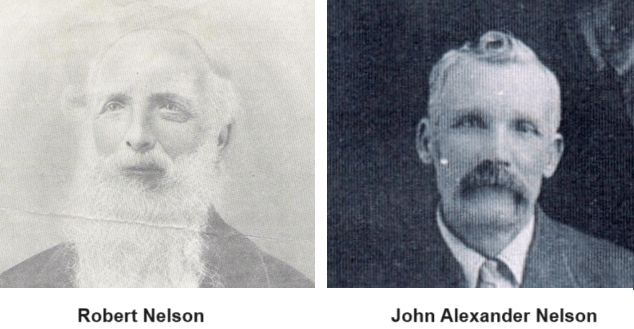
My Grandpa Burgess also had several other school trustees on his maternal line, the Nelson family. According to the 1880 US Census, his great grandfather (another of my Gx3 grandfathers), Robert Nelson (1818-1902) was a school trustee in Smithfield, Utah. Twenty-seven years later Robert’s son, John Alexander Nelson (my Gx2 grandfather) held the same office in Woolford, Alberta. John was one of the founders of the Woolford school board and was one of its first board members.

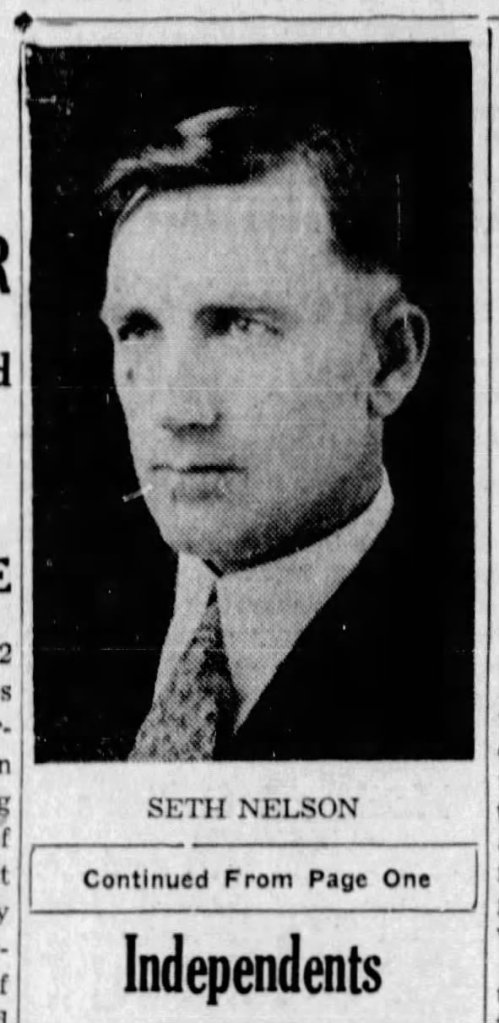
John’s son (my grandfather’s uncle), Seth Henry Nelson Q.C. (1891-1975), also served as a school board trustee in Cardston, Alberta. Seth was a school trustee for 15 years, from 1924 to 1939. Seth served as the Board’s Secretary for the last 10 years of his time in office. Following his last term as a school trustee, Seth made an unsuccessful run for a seat in the Alberta provincial legislature during the 1940 general election. Seth ran as an independent against the incumbent Social Credit candidate, Nathan Tanner. Tanner was a former Speaker of the legislature who was appointed to Cabinet in 1937. Despite running as an independent, it was a close race. Tanner defeated Seth in a two-way race, 2,160 votes to 1,808 (54.4% of the vote).

Education was also a facet of my wife’s side of the family, one of whom also served as a school trustee. Frank Eden (1839-1907), our children’s Gx3 grandfather, was a prominent Halifax, Nova Scotia merchant whose primary business was shoe manufacturing and sales. Frank served two non-consecutive terms as an alderman on the Halifax city council (1892-1893 and 1895-1896). Concurrent with both terms of office on city council, Frank served on the Halifax Board of School Commissioners.

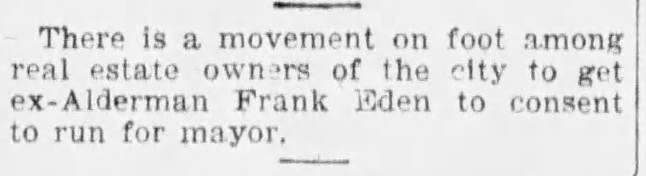
In 1902, there was an attempt to persuade Frank, who was still in the shoe industry, to run for Mayor of Halifax. As stated on page nine of the Halifax Herald, on January 1, 1902: “There is a movement on foot…to get ex-Alderman Frank Eden to consent to run for mayor.” As far as I’m concerned, all puns are intended.