
52W Mark V – Week 14: William Turple

William Turple (1778-1862)

Looking for words that rhyme with purple? Look no further than William Turple!

William, my Great x4 Grandfather, is on the only branch of direct ancestors on my tree that goes into the Maritimes, a region of Canada that now consists of the provinces of Nova Scotia, New Brunswick, and Prince Edward Island.

William was born in Halifax, Nova Scotia, on May 9, 1778. He was the eldest of six children born to John Philip Turple and Mary Little. William’s paternal grandparents, Johannas Godfed Törpel and his wife Sophia, were amongst the German immigrants who settled in Lunenburg, Nova Scotia in the mid-18th century. I know nothing about Mary’s lineage.

William’s parents married on Christmas Day 1776 at St. Paul’s Church in Halifax. I touched upon the history of St. Paul’s last week, which is the oldest building in Halifax. William was born almost 18 months after his parent’s marriage and he was baptized in St. Paul’s on May 27, 1778. While the church is now 276 years old, it was not even 30 years old when his William’s parents were married and when William was born.
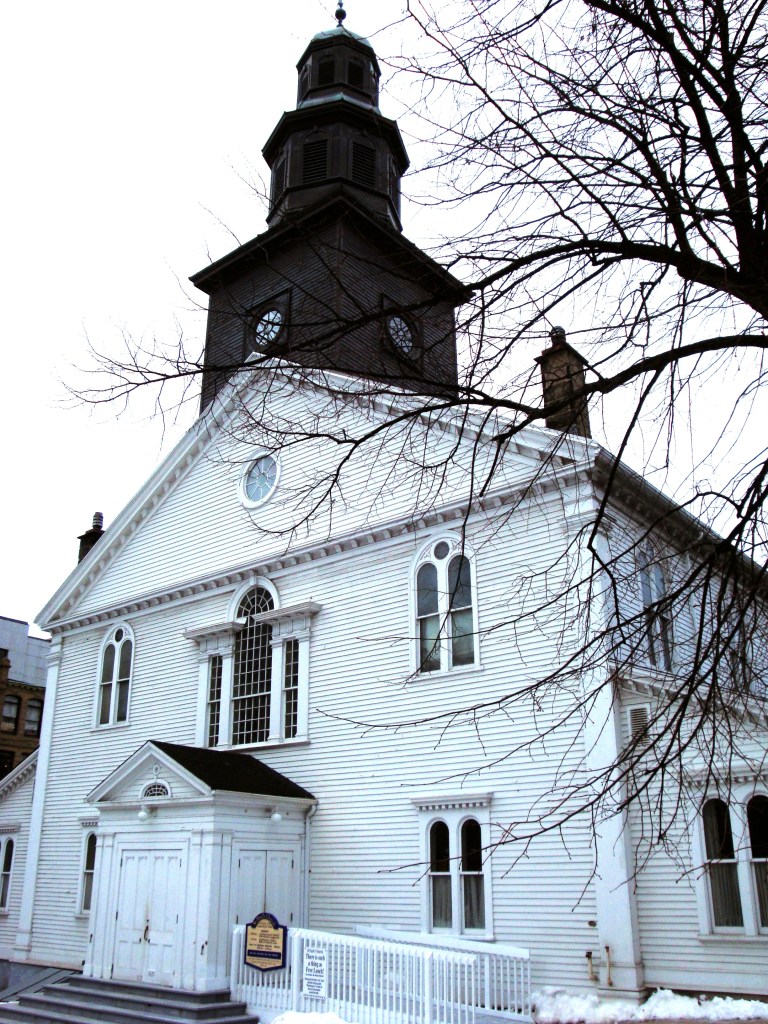
St. Paul’s Church, Halifax, in January 2009.

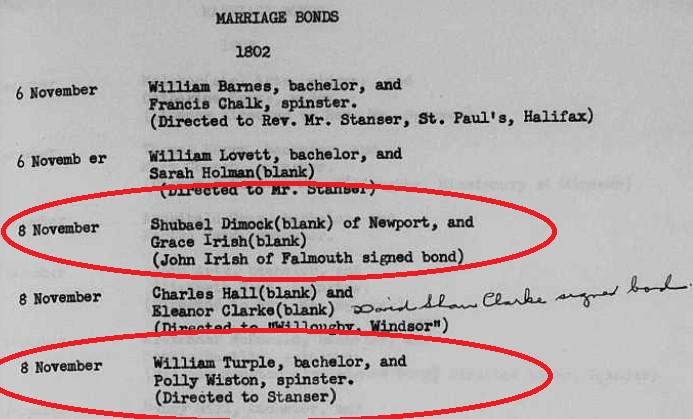
William himself also got married in St. Paul’s – twice. His first marriage was to Polly Wiston, about whom I know nothing other than that she was married to William. I’ve searched for name variants of “Polly”, to no avail. William and Polly married on or about November 8, 1802.

By sheer coincidence, my wife’s Great x5 Grandparents, Shubael Dimock (1753 – 1834) and Grace Irish (1768 – 1846) were issued a marriage bond the same day as William and Polly.
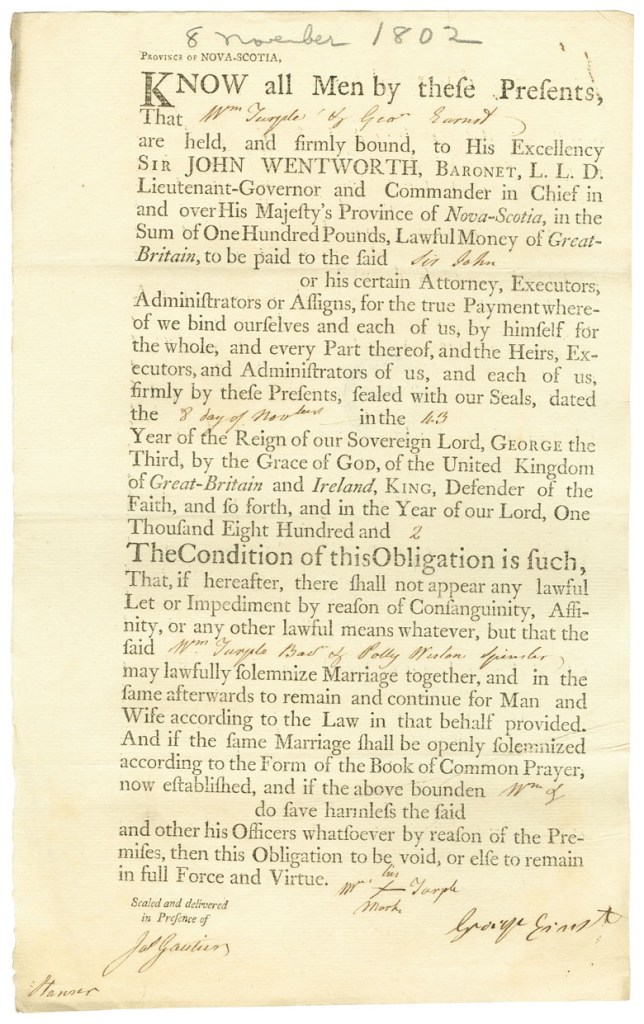
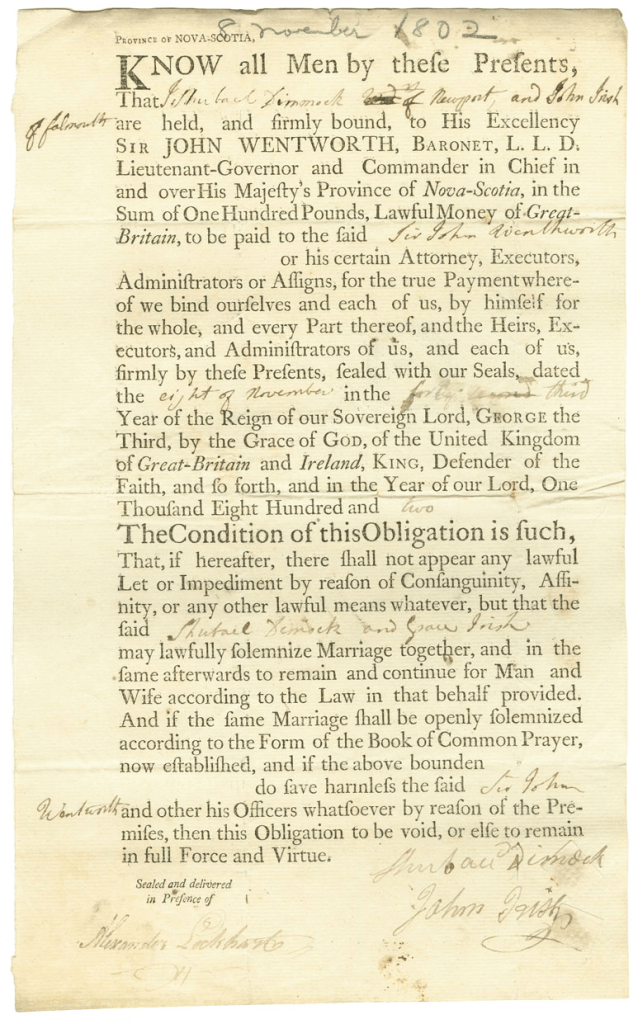
William and Polly had one child, a son named John Jacob born around 1804. Polly died sometime between the birth of her son and William’s second marriage in 1814.

William married Frances “Fanny” Robinson at St. Paul’s Church on September 13, 1814. I find it interesting that William’s first marriage was a year before the Napoleonic Wars began and his second one occurred the year before the Napoleonic Wars ended. Okay, maybe only interesting to me. I was a history major after all.

Together William and Fanny had eight children, although as I explained last week it was more likely that they only had seven. The question mark is a son named William who, if he existed, was a possibly a twin with another son named Stephen. The case against this William is that William and Fanny already had a son named William, who was still alive when the purported second William was born. It’s not unheard of for parents to give the same name to two children, especially if an elder one passed away in infancy or before the later child was born, but I doubt it was so in this case.

As well, there’s no mention of the second younger William in his father’s will. All of William’s other children – including Stephen – were named in his will. The only exception was his daughter Susan (my Great x3 Grandmother), who had moved to Utah with the Mormon migration years before William wrote his will. It’s possible the mystery William could have pre-deceased his father, but I have no indication that is so.

As far as I can determine, William was a carpenter his entire life. Some secondary accounts also suggest William spent his entire life in Halifax. However, the Nova Scotia 1838 census shows that he was living in Granville, Annapolis, Nova Scotia working as a ship carpenter at the time. Otherwise, it does appear that William spent most of his life in Halifax.

William wrote his will on April 17, 1861. He died sometime before May 20, 1862, as that is when his will was granted probate. It appears that William died while once again a widower, because there is no mention of Fanny in his will.
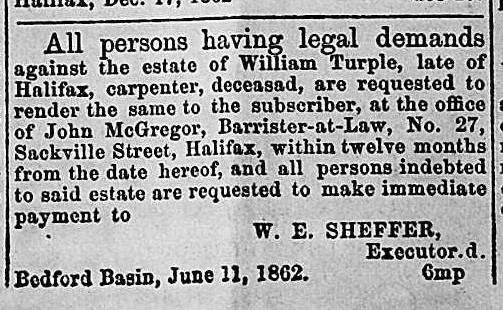
A notice to creditors of the estate of William Turple in the Royal Gazette, February 4, 1863. Vol. LXII No. 5 page 41.

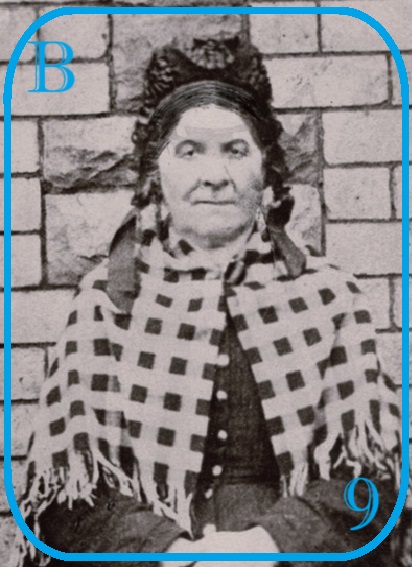
52W Mark IV – Week 35: Card B9 Susan Ann Elizabeth Turple

Susan Ann Elizabeth Turple (1818-1906)

What rhymes with “purple”. Nothing? Not so fast! Meet my Gx3 Grandmother, Susan Turple!

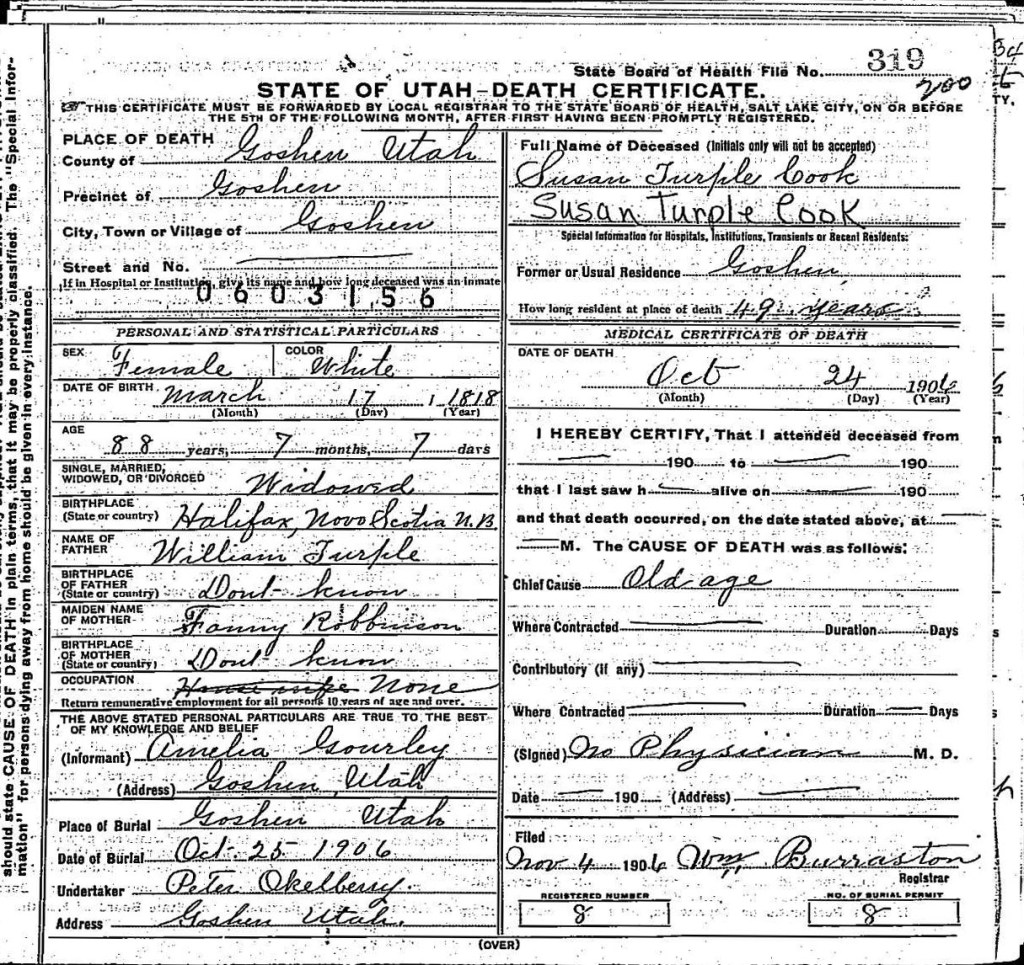
Susan was born on March 17, 1818 in Halifax, Nova Scotia to William Turple and Frances “Fanny” Robinson. While she was born on St. Patrick’s Day, it’s unlikely that Susan was even the least bit Irish. Her direct paternal line came to Nova Scotia from what’s now Germany around 1750. The rest of her lineage was most likely English and was in Nova Scotia by the mid-1700s.

Around 1841, when she was in her early 20s, Susan married Charles Brady, a musician who was born in Boston. I don’t know when Charles came to Nova Scotia and have no idea how he met Susan. It was a short marriage, lasting long enough for the couple to have a daughter, Amelia, who was born in Charlottetown, Prince Edward Island in 1842. Why Charles and Susan were living in Charlottetown at the time, again, I do not know why.

Some sources I’ve found suggest that Susan was widowed following the “untimely death” of Charles. This probably would have come as a surprise to Charles, who lived to be 67 and died in Washington in 1881, eight years before it became a state, as well as his second wife, Anne Dillon, who he married in 1855.

Rather, first-hand accounts written by Susan and Amelia show that Susan left Charles around 1843. Susan wrote that Charles was away from home a lot and that when he was home he mistreated her. Amelia stated that she did not know much about her father, because her mother left him when she was 11 months old. As far as I can find, Susan and Charles never formally divorced.

After Susan separated from Charles, she and her daughter Amelia moved back to Halifax and moved in with her parents. Apparently Susan’s parents primarily raised Amelia during that time.

Around 1838, the first Mormon missionaries began preaching in Halifax and the Latter Day Saints established a church there in 1843. Susan, her mother Fanny, and several of her siblings joined the church in the late 1840s. Susan was formally baptized into the church on May 18, 1849.

At that time, the Latter Day Saints were in the midst of a succession crisis, which had been ongoing since its founder Joseph Smith was killed in 1844. Susan, as well as her mother and some of her siblings, aligned herself with James Strang, who claimed to have a letter from Joseph Smith appointing Strang as his successor. It appears that many Halifax Mormons simply found themselves following Strang by default rather than actually taking an active interest in who their leader should be.

Strang’s faction of followers was about a fifth the size of those following Brigham Young. The schism resulted in the establishment of a separate church, also known as Church of Jesus Christ of Latter Day Saints, often distinguished as the “Strangites”. The Strangites fell into decline after Strang’s death, and further fractured into two separate groups. By 2000, neither branch of Strangites had more than a few hundred adherents.

In 1851, a delegation loyal to Brigham Young travelled to Halifax to re-establish their control over the Mormons there. Once there, this delegation excommunicated those who were loyal to Strang. This included Susan and those of her family who were members of the church.

Susan “confessed” her “error” shortly afterwards and was rebaptized back into the church on October 13, 1851. While Susan’s family members also recanted their “error”, they ultimately left the Mormon church. It seems that Susan’s family had stronger feelings about the church leadership and would not follow Young. Only Susan remained with the Mormon church.

This led to estrangement from her family, based upon Susan’s desire to leave Halifax for Salt Lake City. This estrangement is evident from her father’s will, which made provision for every one of his children – including a son from a first marriage – but left nothing to Susan.

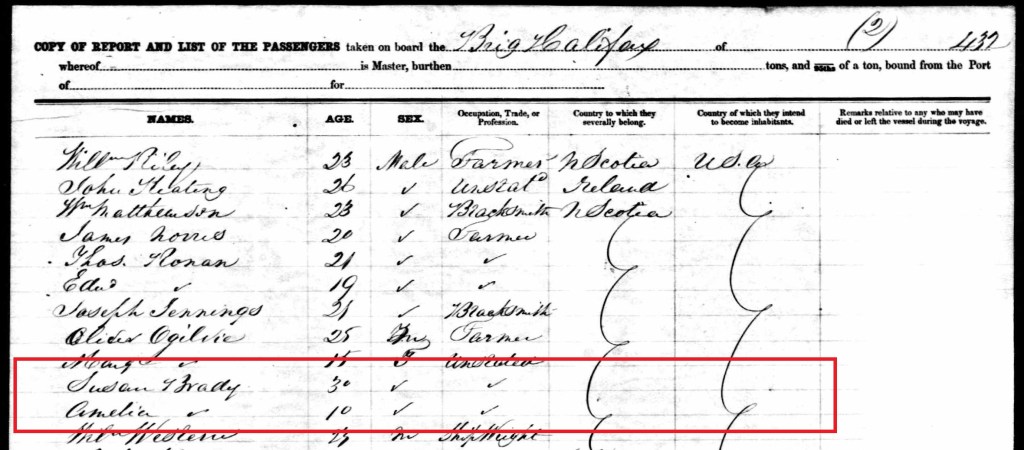
Susan set out with her daughter for Boston in April 1853, aboard the Brig Halifax, with the intention of joining the Mormon migration to the west. They arrive in Boston on April 14, 1853. Susan was still using the surname Brady. As well, while Susan was 35 years old at the time, the passenger record lists her as having been 30.

The passenger list for the Brig Halifax showing Susan and Amelia travelling to Boston.

From there, Susan and Amelia moved westward and joined a wagon train that formed part of the William Atkinson company. The company consisted of 79 individuals and 12 wagons. The company left Keokuk, Iowa in May 1853. After a brief sojourn in Kanesville, Iowa, the company resumed its journey in July 1853. The company arrived in Utah by September 11, 1853.

Two weeks of arriving in Utah, on September 28, 1853, Susan married Henry Lyman Cook. How they met or how that came to be I do not know. While some secondary sources suggest otherwise, I doubt Susan and Henry knew each other before Susan arrived in Salt Lake City.

While it might be little more than speculation, I’ve wondered whether this was a marriage arranged by the church. Henry was already married; in fact, Susan was his fourth wife. Henry’s first wife died. His second marriage lasted only a few months, but there does not seem to have been a formal divorce. Henry’s third wife, Lovina, was still alive when Henry married Susan and I have no evidence the two ever separated.

Thus it seems that Henry’s marriage with Susan was polygamous, and conducted only in accordance with Mormon custom. I have no marriage record; rather, all I know is that Henry and Susan were “sealed”, a Mormon rite that binds spouses and family members for eternity. Henry was also a father to Susan’s daughter Amelia, who took on her stepfather’s surname. However, being 11 years old, it likely was not Amelia’s decision. In fact, later in life Amelia used the surname Brady.

Regardless of the nature and circumstances of their spousal union, Susan and Henry remained together until Henry died in 1869. Within a year of marrying Susan and Henry moved to Iron City in the southwest corner of Utah. Looking at the map, if the middle of nowhere had a middle of nowhere, it would be Iron City. In Iron City Susan gave birth to the first two of her children with Henry; a son who was also named Henry Lyman and a daughter, Sarah Florilla, my Gx2 grandmother. By the start of 1860 the family was in Goshen, a small town not far from Provo, Utah.

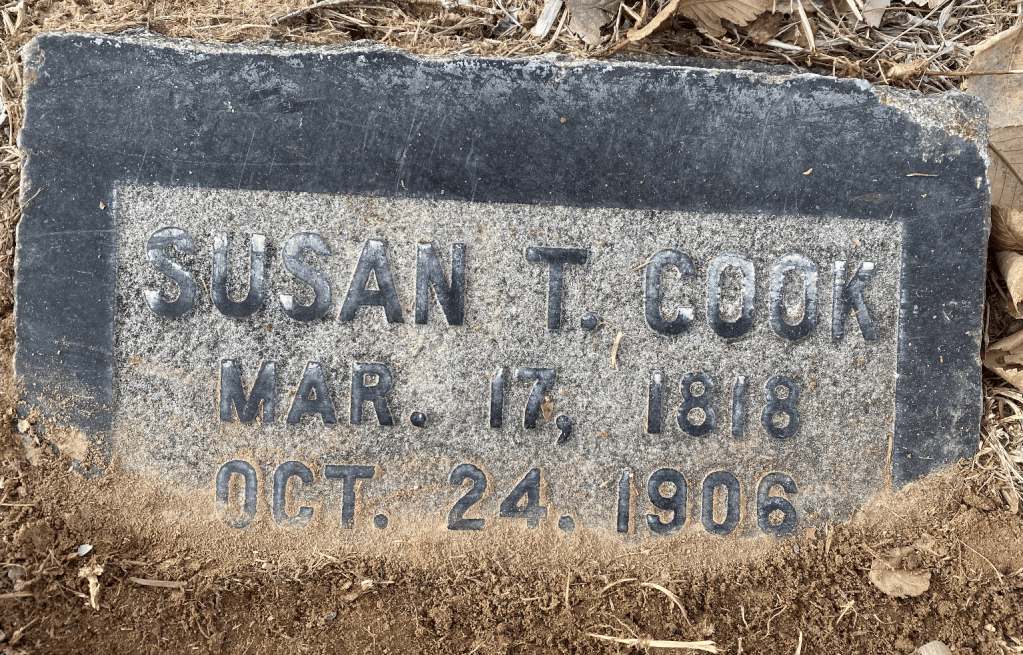
Susan lived out the rest of her long life in Goshen, on October 24, 1906, at the age 88. She was 63 when Henry died. Not only that, Susan outlived three of the four children she had with Henry. Her eldest son Henry Jr. passed away two months after his mother. Even Amelia, Susan’s oldest child, passed away within seven years of her mother. Susan is buried at the Goshen City Cemetery.

Having an ancestor whose surname rhymes with “purple”, I now need to find ones whose surnames rhyme with “orange” and “silver”.