My Great x4 Grandfather, Conrad Liggett, had a very short life of only 22 years. As far as I can tell, he essentially lived long enough to have a child, which ensured my existence.
Conrad was the seventh of ten children born to James Liggett and Susanna Carr. Unusual for many family trees, I know more about his maternal line than his paternal side.
Apparently, Conrad’s Great Grandfather, James Alexander Liggett, was from Londonderry, Ireland and emigrated to Pennsylvania sometime before 1740. He seems to have moved to Virginia by 1740, where his son James, and grandson James, were born.
Conrad’s mother, Susanna Carr, was of German and Swiss heritage. Her father’s paternal line originated in Schwaigern, Wurttemburg, which is less than 75 kilometers from where many of my Germans from Russia ancestors originated from. On her father’s maternal side, Susanna’s great grandparents were from Switzerland.
On her maternal line, Susanna’s heritage is entirely Swiss, primarily from the area around Basil, which is also not far from where my Germans from Russia ancestors originated. I find it fascinating that I have Swiss ancestors, so I am somewhat surprised by how little I have done in researching those lines.
It seems that all of Conrad’s grandparents, as well as his parents, were born in Virginia. James and Susanna’s first three children were also born in Virginia. Sometime shortly before 1810, the family moved to Ohio, where the rest of their children, including Conrad, were born.
Conrad was born on December 28, 1815, possibly in Madison County, Ohio. Early in his childhood, probably around when he was eight, Conrad’s family moved to Scioto Township, Delaware County, Ohio. There are actually five Scioto Townships in Ohio, all in different counties, all along the Scioto River.
Several older sources suggest some of Conrad’s life events occurred in Ostrander, Delaware, Ohio, which cannot be true. Ostrander was not established until a train station was built there in 1852 and the town itself was not incorporated until 1875. However, land once farmed by Conrad’s father was located where Ostrander now stands.
On February 28, 1837, Conrad married Louisa Thomas in Delaware County. While the evidence is thin, it seems that Louisa was a widow when she married Conrad. Conrad and Louisa’s only child, Charlotte, was born on October 6, 1837. As one wag described Conrad in a discussion on FamilySearch, he was a “bad boy” because Charlotte was born little more than seven months after her parents’ marriage.
Regardless of the circumstances of Charlotte’s conception and birth, Conrad did not get to see much of his daughter’s life. Six and a half months after Charlotte was born, on April 21, 1838, Conrad died.
I do not know what caused his untimely death, but it left Louisa a widow for a second time. While his death was incredibly unfortunate for the entire family, Conrad’s brief existence was long enough to ensure mine. There is something rather bittersweet about that.
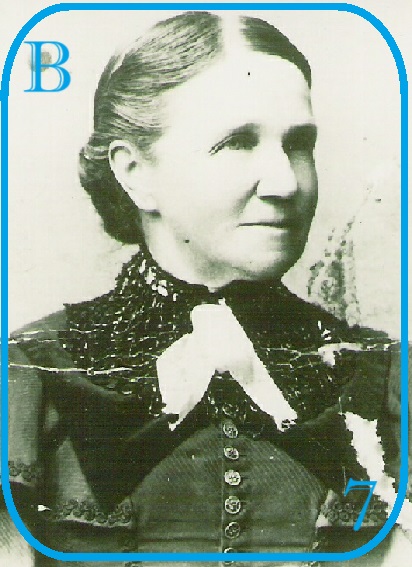
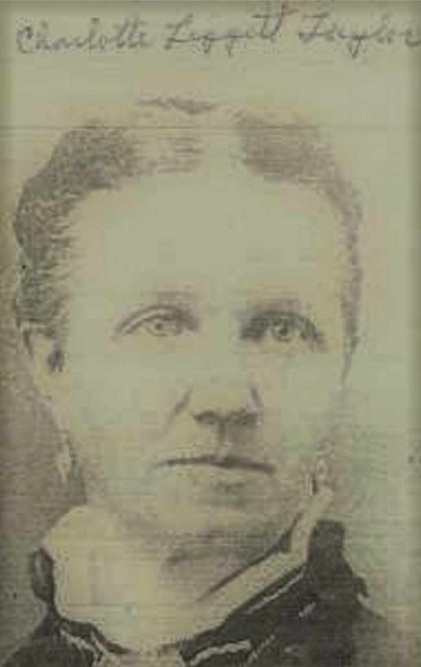
I wrote quite a lot about my Gx3 Grandmother, Charlotte Liggett, when I first participated in the 52 Ancestors Challenge in 2022, particularly in Week 28, Characters. Over the last few years, particularly in the last few months, I’ve learned a lot more about Charlotte, and have managed to clarify a lot of things since I last wrote about her.
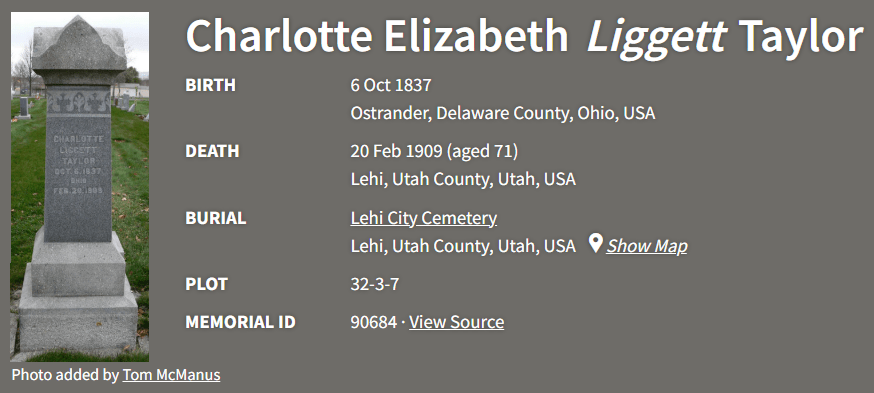
Charlotte was born on October 6, 1837 in Ostrander, Delaware County, Ohio; however, by a few accounts she was born on October 2, 1837, in Dover Township, Union County, Ohio. While in different counties, these communities are five kilometers apart. My speculation is that it may be that one set of information relates to Charlotte’s birth and the other set relates to her baptism or christening. Given the Liggett family roots and connections to Ostrander, I believe that is more likely the correct location.
While Charlotte was born in Ohio, both sets of her grandparents were from Virginia, albeit the part of the state that is now West Virginia. The Liggetts were in Virginia at least by the mid-1700s. Charlotte’s Gx2 Grandfather, James Alexander Liggett, likely came from Londonderry, Ireland and settled in Pennsylvania around 1740, before relocating to Virginia. Charlotte’s maternal line was also likely in Virginia by 1750, if not by 1800, but originated in Württemberg and Switzerland.
Charlotte was the only child of Conrad Liggett (1815-1838) and Louisa Thomas (1811-1846). Charlotte was eight months old when her father Conrad died. When I first wrote about Charlotte in 2022, I was uncertain as to where Conrad had died. After more research, I am now pretty certain that Conrad died in Ostrander and that it was highly unlikely he ever joined the Mormon church.
With the death of her husband, Louisa had to find work to support the family. As a result, Charlotte’s grandparents, James Liggett and Susana Carr took her in, possibly along with her half brother (Louisa’s son from a previous marriage).
Most of the information I have regarding Charlotte’s life after her father died is from secondary sources, and the accounts vary somewhat. Thus, it is not clear if Charlotte’s grandparents had full-time custody and care of her or whether they only looked after her during Louisa’s working hours. Based upon the descriptions of their custody, it appears that James and Susana had full-time care of Charlotte.
When Charlotte was three, her mother Louisa remarried, to Aaron W. Cook. (This was only six months after Charlotte’s husband to be, William Burgess, married his first wife!) According to her grandson in his memoire, George Burgess, this marriage occurred in secrecy. At the same time, the couple joined the Mormon church.
Shortly after the marriage, Louisa asked her in-laws if she could take Charlotte home with her for a week or a weekend. However, Louisa never returned Charlotte to her grandparents. In George’s words, they “ran off” with Charlotte and joined the Mormons in their westward migration. George said that Louisa had three daughters with Aaron when they were living in Nauvoo, plus another child about 12 miles out of Nauvoo after the Mormons were driven out of there. The child and Louisa died during childbirth. Charlotte was nine years old at the time. Aaron continued to Utah with Charlotte and raised her – if you can call “marrying her off to a Mormon elder” at age 14 raising a child.
Several of the accounts I have were from or by Charlotte’s non-Mormon relatives and their descendants. Some of these have a clearly anti-Mormon bias. I have several stories of how families shunned and broke off relations with family members who joined the church. However, whatever one might think of the Mormon religion, it seems to me that Louisa was well within her rights to keep her daughter with her and that her in-laws never had any form of legal custody of Charlotte.
The secondary sources indicate that Charlotte’s grandfather had made provisions for her should she ever be found. Apparently, years later her family in Ohio subsequently managed to find Charlotte, who then received her portion of her grandfather’s estate.
The “Mormon elder” I referred to was most likely my Gx3 Grandfather, William Burgess (1822-1904). They married on June 3, 1852. He was 30, she was 14. More accurately, William and Charlotte were “sealed”, a Mormon ritual meant to bind familial relationships for eternity. When he joined with Charlotte, William was still married to his legal wife, Maria Pulsipher.
William and Charlotte’s marriage was short lived, lasting long enough for Charlotte to have one child, my Gx2 Grandfather Horace Burgess. Charlotte left William sometime before September 1857, before she was 20. Most secondary sources suggest William and Charlotte divorced. However, being a polygamous marriage, there was no formal civil registration of the marriage and, therefore, no formal divorce. According to the secondary accounts, Charlotte left William because she could not get along with his first wife, Maria. Other accounts suggest Charlotte became disenchanted with polygamy.
According to my great aunt Fon, Charlotte had her sealing to William annulled in 1890 “after the manifesto and was not sealed to second husband until after her death, as [she had been] told by the bishop she couldn’t be sealed again. This second sealing was her death wish.” Fon’s reference to “the manifesto” is likely the proclamation made by the Latter Day Saints’ President banning polygamy as one of the tenets of the Mormon church.
If Charlotte had become disenchanted with polygamy, it did not last long. On September 7, 1857, Charlotte entered into a polygamous relationship with and was sealed to William Whitehead Taylor, a man ten years her senior. William was already married to a woman, Nannie Standring, who he wed around 1855.
Charlotte and William’s polygamous marriage occurred before the practice was outlawed in Utah by the federal government in the 1860s and banned by the Latter Day Saints in 1890. Even so, William and Charlotte played down the nature of their relationship. For example, in the 1880 census Charlotte was listed as “keeping house” separate from William and his legal wife, Nannie. There was no entry for the box indicating her status as head of house, spouse, or relative of others. Charlotte’s children with William were reported as those of Nannie. However, Charlotte’s surname was reported as “Taylor”.
Nevertheless, the relationship between William Taylor and Charlotte was a durable one, lasting until William’s death in 1907. William Taylor and Charlotte had five children together.
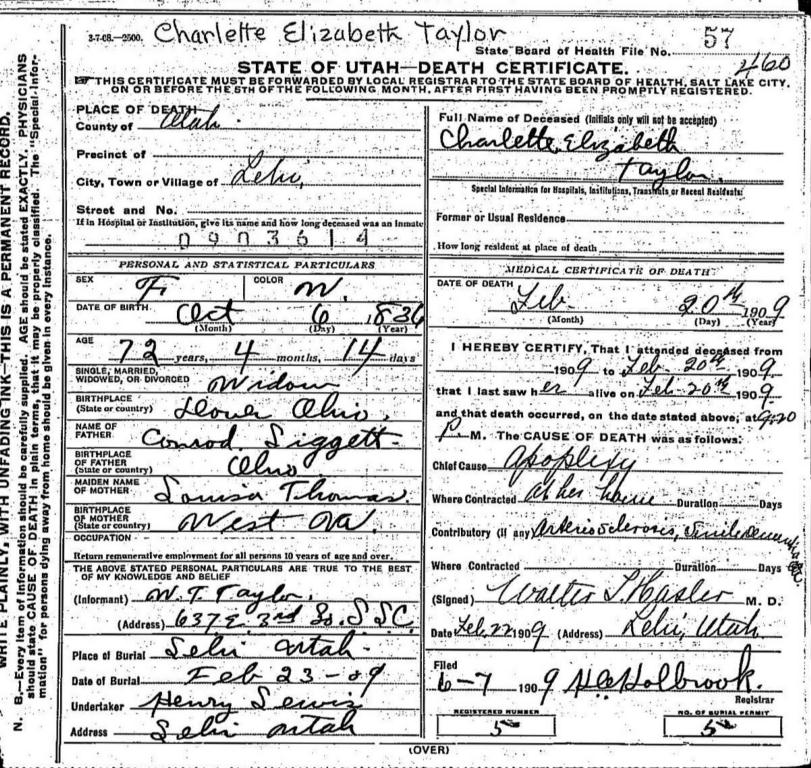
Charlotte died at home in Lehi, Utah on February 20, 1909 after having a stroke. She is buried at the Lehi City Cemetery, alongside William Taylor.


 A Deck of Ancestors